
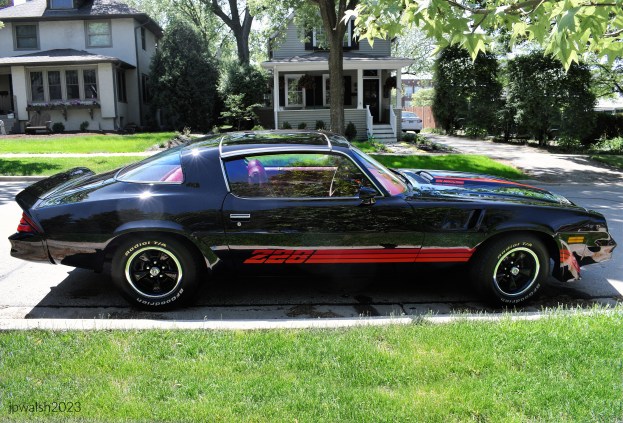
Feature Image: 1979-1981 Chevrolet Camaro Z28 (Details in post). May 2023. 7.72 mb 66%. Author’s photograph.
From the original 1967 pony car to the high-performance machines of the 21st century, the Chevrolet Camaro has remained one of America’s most recognizable symbols of speed, style, and automotive individuality while maintaining its identity as a competitor to the Ford Mustang.

1969 Chevrolet Camaro Z28. Author’s photograph. May 2023. 7.85mb 98%
The car evolved from a lightweight pony car into a powerful muscle-car icon.
The name Z/28 was introduced by General Motors in December 1966. In 1967 to 1969, Chevrolet continued to improve the car’s list of engine and performance options. The year 1970 introduced Gen II in a new Camaro design. In 1982 the car was redesigned again marking Gen III. There have been more redesigns over the decades with Chevrolet announcing that production of the Gen VI Camaro would officially end in December 2023, with the 2024 model year serving as the final run and the Z/28s with it.

1979-1981 Chevrolet Camaro. Author’s photograph. May 2023. 7.72 mb 66%.
Generation Overview
The second-generation Camaro ran from 1970 through 1981—making it the longest-running generation in the nameplate’s history—and transitioned the car from a raw late-1960s pony car into a sleeker, European-inspired sports coupe. By 1980, strict federal emissions rules had lowered factory horsepower across the industry, so Chevrolet leaned heavily on bold visual flair and handling packages to keep the Z28 exciting.
Key Styling Details
This Z28 has bodywork and graphics specific to 1980. The forward-facing “Air Induction” hood scoop (which featured a solenoid-operated flap that opened under full throttle) and the functional side fender vents replaced the simulated louvers used on 1978–1979 models. The lower body is wrapped in bold tri-tone red and orange decal stripes that integrate the Z28 callout along the doors, paired with matching striping over the hood.
Other period hallmarks visible in the profile include the integrated body-color urethane bumpers, a deep front air dam, flared wheel-arch moldings, and a tall three-piece rear decklid spoiler. The car is also equipped with removable glass T-top roof panels (a hugely popular option in the late 1970s and early 1980s), a vibrant Carmine red interior, and color-keyed 5-spoke Z28 wheels wrapped in raised white-letter BFGoodrich Radial T/A tires

Interior packages included cloth and custom cloth, and vinyl and custom vinyl. In 1980 the five interior colors included oyster, black, blue, carmine red and tan. In 1981 the five interior colors changed to silver, black, blue, camel and red. In 1980, to save gas during the gas crisis, the car’s 130-mph speedometer was reduced to an 85-mph speedometer. See – https://mikeduman.com/blog/history-z28; https://www.caranddriver.com/news/a43578551/2025-chevrolet-camaro-z28-future-cars/; https://www.hemmings.com/stories/article/1980-81-chevrolet-camaro-z-28 – retrieved May 22, 2023.
1980 Z28 Engine & Drivetrain Specifications
The 1980 Camaro Z28 was powered by a 190-horsepower 350-cubic-inch V8 (49 states) or a 165-horsepower 305 V8 (California), with total Z28 production reaching 45,137 units. The 1980 model year marked a major milestone for enthusiasts because it was the last year Chevrolet allowed the 350 V8 to be paired with a 4-speed manual transmission (beginning in 1981, the 350 was restricted exclusively to an automatic, and the 4-speed manual could only be ordered with the 305).
Classic muscle car
Camaro vs. Mustang
Among debates about classic muscle cars, none gets hotter than the Chevrolet Camaro versus the Ford Mustang.
The Z/28’s Place in the Muscle-Car Era
With the exception of the 6.6-liter Trans Am, the Z/28 represents the best Detroit had to offer in the early 1980s, and an excellent entry point. A great car with its own ups and downs as its model developments moved ahead, the Camaro Z/28 at the outset was known for its good looks and sleek, crisp styling.
Styling and Performance
It hugged the road and moved fast with superb handling. By 1980, the standard wheel cover was matched by a rear deck spoiler and hood and deck stripes and, soon, a front spoiler to reduce drag.
The Last Traditional Drivetrain
The 1980 models were the last that offered the quintessential muscle car power-train combination-a 350-cu.in. V-8 with four-speed transmission.
Cost of a Loaded Z/28
The loaded Z in 1981 would cost around $12,000 (or $40,000 in 2023 dollars).
Dimensions
The Z/28 was 197.6 inches long and rode on a 108-inch wheelbase. It stood at a height of 49.2 inches and was 74.5 inches wide. The body was all steel.
Camaro styling reflected changing American tastes, from the crisp lines of the late 1960s to the aerodynamic forms of the 1980s and retro-inspired designs of the 2010s

This is a 1997 Chevrolet Camaro Z28 SS (or a 1996 model, as the two years share identical exterior styling, though the 1997 model was far more common in SS trim). Although fourth-generation Camaros ran from 1993 to 2002, Chevrolet gave the car a mid-cycle facelift in 1998. Fourth-generation LT1 SS coupes are relatively scarce compared to standard Z28s. SLP converted only 2,410 SS coupes in 1996 and 2,958 in 1997, making either year a notable find on the street today. Author’s photograph. May 2018. 7.39 mb
Distinctive 1993–1997 Styling
The rounded, slightly recessed headlight bucket visible at the front left fender, along with the three-color (red, amber, and clear) taillights, was used strictly from 1993 through 1997. These details place the car firmly within the early phase of the fourth-generation Camaro.
Return of the SS
Chevrolet revived the legendary SS (Super Sport) badge for the fourth generation in 1996 after a 24-year absence, modifying Z28 coupes through SLP Engineering. The car in the photo displays the authentic SS-specific styling cues from that two-year run: the raised, pedestal-mounted rear spoiler, the dual-outlet exhaust exiting together on the left side (“two-on-the-left”), and the SS emblems on the front fenders and rear fascia.
LT1 Power
The 1996 and 1997 SS models were the final fourth-generation Camaros powered by Chevrolet’s iron-block 5.7-liter LT1 V8, which was replaced by the aluminum LS1 in 1998. Thanks to the functional Ram Air induction system and low-restriction exhaust, SLP increased output from the standard Z28’s 285 horsepower to 305 horsepower (and 310 horsepower with the optional performance exhaust), along with 335 lb.-ft. of torque. Performance was impressive for the era, with 0–60 mph arriving in approximately 5.3 seconds.
A Relatively Rare Camaro
The car retains its signature two-tone fourth-generation appearance, with the gloss-black roof (“sail panel”) and side mirrors contrasting against the Bright Red paint. While the five-spoke ZR1-style wheels match the factory SS wheel design, they have been painted or powder-coated black rather than the original silver or chrome finish, giving the car a more contemporary blacked-out stance while preserving the aggressive look that helped make the SS one of the most desirable Camaros of the 1990s.

2011(?) Chevrolet Camaro. Author’s photograph, June 2017. 4.19 mb

2010 Chevrolet Camaro. Author’s photograph. April 2025. 7.16mb DSC_8471

2018 Chevrolet Camaro 2LT Coupe. The sixth-generation Camaro SS (2016–2024) is equipped with a 6.2L LT1 V8 engine and offered as a 6-speed manual and 8-speed automatic. The SS is capable of 455 horsepower and 455 lb.-ft. of torque, performing a 0-60 in 4.0 seconds. Author’s photograph. June 2024. 73% 7.83 mb 8246
Birth of a Pony Car
The Chevrolet Camaro is a pony car that began production in model year 1967. It ceased production in model year 2002 in its Gen IV. Starting in 1993 the iconic American car was produced exclusively in Canada in Sainte-Thérèse, Quebec.
Crisis at General Motors
In 2008 GM faced a severe liquidity crisis, having lost over $30 billion in 2008. In 2009 Chevrolet restarted its Camaro production in Gen V that was built exclusively in Canada though shifted to Oshawa, Ontario. Then-GM Chairman and CEO Rick Wagoner said about his Canadian-made car: “Camaro is much more than a car; it symbolizes America’s spirit and its love affair with the automobile.”
That same year the Obama administration demanded he resign for GM to receive a massive taxpayer-funded federal bailout. Without this federal assistance, the company was expected to go into liquidation, which officials estimated would cost more than one million jobs. The total bailout for General Motors and Chrysler amounted to approximately $80 billion, with the government taking a majority stake in GM during the process to guide its reorganization.
The Camaro Comeback
The 2010 Camaro became the model’s best seller (81,299 units) since 1995 (122,738 units). The first half of the 2010s was a renaissance for Camaro though its heyday remained the late 1960s and 1970s.
Inspired by a Legend
The 2010 Camaro was intentionally designed and produced along the lines of the 1969 model and is almost identical to the car’s original concept. By combining modern engineering with styling cues from one of Chevrolet’s most celebrated muscle cars, the fifth-generation Camaro successfully linked the model’s past with its future.
Original Pricing
The original MSRP for a 2010 Chevrolet Camaro ranged from $22,680 ($33,187.71 in 2025 dollars) for the LS coupe to $33,945 ($49,671.82 in 2025 dollars) for the 2SS coupe.
This explanatory article may be periodically updated.

