
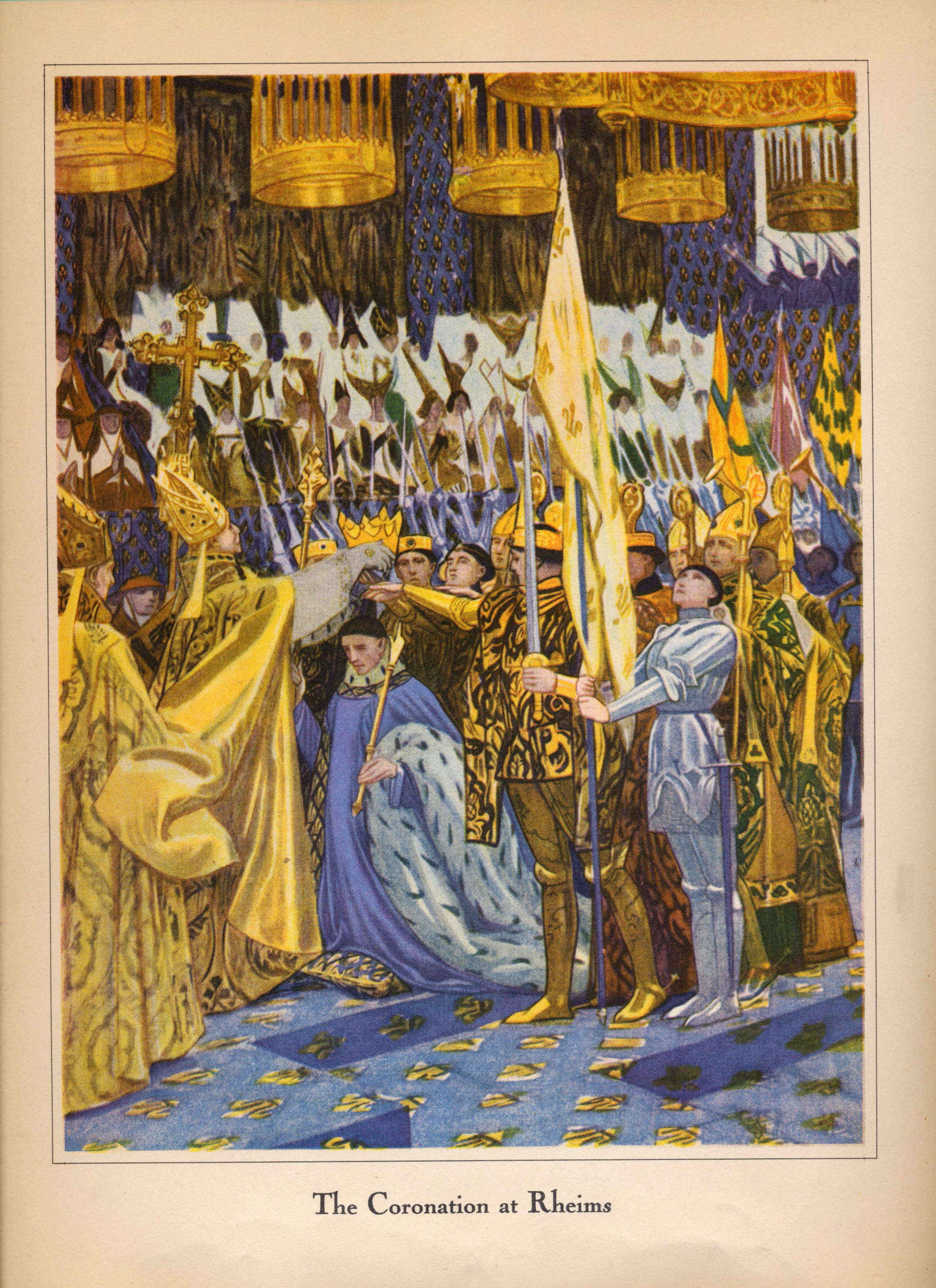

FEATURE image: King’s Coronation at Reims Cathedral. France was divided in the early 15th century when a teenage girl called Joan of Arc heard her Voices with their explicit instruction for her to go to the French royal court to aid France as a warrior-maid. For a young girl to dress and act as a military figure was shocking and unsettling to many who up to now had simply taken one side or another in the situation of France’s national divide.
Six centuries after her death, Joan of Arc remains one of history’s most compelling figures. Through the illustrations of O.D.V. Guillonnet, Joan of Arc’s story places her as more than a medieval heroine. Her unwavering faith, astonishing military leadership, martyrdom, and posthumous vindication transformed a teenage peasant girl into one of France’s most enduring national and religious symbols.
By John P. Walsh
Joan of Arc: France’s Warrior-Maid in History, Art, and Memory
A Medieval Heroine Who Endures
JOAN OF ARC (French, 1412-1431) is one of the best-documented and most beloved saints of the late Middle Ages. Known in France as Jeanne la Pucelle (“The Maid”), her remarkable story has inspired artists, writers, playwrights, and filmmakers for more than six centuries.
Across France, many places associated with Joan remain intact and can still be visited today. Standing in the same villages, churches, castles, and cities where Joan lived and acted provides a tangible connection to her world and to one of history’s most extraordinary lives.
The fascination with Joan began almost immediately after her death, fueled by the surviving transcripts of her trial. Since then, an immense body of scholarship, biography, historical fiction, and popular history has emerged around her life. Among the many notable authors drawn to her story are Mark Twain (Personal Recollections of Joan of Arc, 1896), George Bernard Shaw (Saint Joan, 1923), Vita Sackville-West (Saint Joan of Arc, 1936), Helen Castor (Joan of Arc: A History, 2016), Kathryn Harrison (Joan of Arc: A Life Transfigured, 2014), and Kimberly Cutter (The Maid: A Novel of Joan of Arc, 2011). Countless other books and articles continue to appear each year, enriching an already vast field of study.
Within this immense educational and informational landscape, there are many ways to approach France’s warrior-maid. One particularly appealing path is through the combination of art and history.
Octave Denis Victor Guillonnet’s Vision of Joan
One such artistic interpretation comes from the work of Octave Denis Victor Guillonnet (1872-1967), the popular French painter and illustrator whose images vividly bring Joan’s story to life. Through his illustrations, viewers can follow the dramatic arc of her brief but transformative life.
Domrémy: The Beginning of a Legend
Anyone interested in Joan of Arc first encounters her as a humble peasant girl in the small village of Domrémy in eastern France.
Before she was even a teenager, Joan reported hearing heavenly voices. Throughout the rest of her life, she remained guided by what she believed were messages from Saint Michael, Saint Margaret, and Saint Catherine of Alexandria. According to Joan, these voices instructed her to aid France and fulfill a divinely appointed mission as a warrior-maid.
Called to Save France
Joan’s appearance on the national stage came at a critical moment in the Hundred Years’ War, when the French crown was struggling against the competing forces of England and Burgundy for control of France.
At just 17 years old, Joan began her military mission in 1429. Her arrival transformed the political and military situation. Following a series of rapid and spectacular victories, she successfully escorted the dauphin to Reims Cathedral, where he was crowned King Charles VII of France (1401-1461) in 1429. The coronation represented a decisive symbolic victory for the French cause and became one of the defining moments of Joan’s career.
Capture, Trial, and Execution
Joan’s military role ended abruptly when she was captured on the battlefield.
Held prisoner for a ransom that her king never paid, she remained in captivity despite several unsuccessful rescue attempts. Her enemies placed her on trial for heresy, and proceedings were conducted by church officials sympathetic to England’s interests.
On May 29, 1431, Joan of Arc was condemned as a heretic by 37 judges aligned with her opponents. The following day, May 30, 1431, the 19-year-old visionary and soldier was burned at the stake in the marketplace of Rouen, France.
The verdict did not stand forever. In 1456, higher Church authorities formally overturned the condemnation, nullifying the trial and restoring Joan’s reputation, setting justice aright in her case.
From Condemned Heretic to Catholic Saint
Nearly five centuries after her death, Joan’s standing received its highest official recognition. In May 1920, she was canonized as a saint of the Roman Catholic Church. Miracles have been attributed to her intercession, and her influence has continued to grow both within France and around the world.
Joan’s Lasting Legacy
Joan of Arc was only 19 years old when she died. Yet in that brief span she achieved what many could not accomplish in a lifetime. Her brief but successful military and political career, as well as her unshakable belief under incredible duress that she was on God’s errand, helped place France on the path to sovereignty. More than six centuries after her death, Joan of Arc remains one of history’s most compelling figures: a peasant girl turned military leader, a condemned prisoner later vindicated, a Catholic saint, and today a co-patron of France.
Today, Joan remains one of history’s most compelling figures: a peasant girl turned military leader, a condemned prisoner later vindicated, and a national heroine who became a saint. Her courage, sacrifice, and belief that she was carrying out God’s mission continue to resonate more than six hundred years after her death.
Illustrations by French artist Octave Denis Victor Guillonnet (1872-1967) are in the Public Domain.

In July 1428, young Joan of Arc and her family fled their village of Domrémy with their livestock and belongings to take refuge in the fortified town of Neufchâteau during a Burgundian raid. As fires burned in the background, the villagers drove their cattle and sheep to safety behind the fortress walls, remaining there for about two weeks until the enemy troops withdrew and they returned to find their homes and church destroyed.

Around age 13 in her father’s garden in Domrémy, Joan of Arc experienced her first divine vision as St. Michael the Archangel appeared to her in a blinding light. Dropping her distaff to kneel in prayer, she listened as the armored archangel instructed her to live a devout life and prepare for her mission to save France.

This illustration depicts the decadence and indifference of the French nobility during the Hundred Years’ War, contrasted against the suffering of the common people before Joan of Arc’s arrival. While wealthy aristocrats parade in extravagant gowns and towering headdresses—ignoring the jeers of the impoverished crowd—Joan was preparing to leave her humble village to awaken the Dauphin’s court and save France.

In February 1429, Joan of Arc departed the garrison town of Vaucouleurs on horseback—dressed in men’s riding clothes and escorted by six armed soldiers—to begin her perilous journey to meet the Dauphin at Chinon. As cheering townspeople gathered in the snow to bid her farewell, she set off through enemy-held territory after finally convincing the local commander, Robert de Baudricourt, of her divine mission.

In early March 1429 at the royal castle of Chinon, Joan of Arc recognized the disguised Dauphin Charles VII among his courtiers and declared her divine mission to lift the siege of Orléans and see him crowned King of France at Reims. Pointing upward toward Heaven as the startled nobles looked on, she assured the hesitant prince that God had sent her to restore his rightful kingdom.

In March 1429 at Poitiers, Joan of Arc was relentlessly questioned by a panel of churchmen including theologians and experts appointed by the Dauphin to verify her orthodoxy and divine mission. Standing boldly before the assembled clergy and others, she declared that her authority came directly from God and pledged to prove her calling by lifting the siege of Orléans.

In June 1429 during the Loire Campaign, Joan of Arc led French forces in a fierce assault to recapture the English-held town of Jargeau. Despite being struck on the helmet by a heavy stone while climbing a scaling ladder, she immediately rallied her troops to storm the walls, defeat the garrison, and capture the English commander, the Earl of Suffolk.

During the Siege of Orléans in May 1429, Joan of Arc stood fearlessly on the front lines holding her standard under a hail of enemy arrows to rally her faltering troops. Guided by heavenly inspiration, her courage transformed the demoralized French soldiers, driving them forward to storm the English fortifications and turn the tide of the Hundred Years’ War. She did this at other notable battles also where her forces overcame long odds.

In late June and July 1429, Joan of Arc escorted the Dauphin Charles VII and his army through hostile Burgundian territory toward Reims—the traditional coronation city of French monarchs—as town after town peacefully opened its gates to them. Riding beside the future king beneath heavenly visions of his impending anointing, she fulfilled the central promise of her divine mission when he was officially crowned King Charles VII in Reims Cathedral on July 17, 1429.


Following Joan of Arc’s capture by Burgundian forces outside Compiègne in May 1430, barefoot, hooded penitents marched through French cities—most notably in Tours and Orléans—carrying torches and the Blessed Sacrament to pray for her deliverance. As grief-stricken townspeople knelt in the streets to mourn her imprisonment, these solemn religious processions petitioned God for the safe release of the young heroine who had liberated their nation.

During her confinement at the Castle of Beaurevoir from July to November 1430, Joan of Arc was treated with kindness and respect by the noblewomen of the household—specifically John of Luxembourg’s wife, Jeanne de Béthune, and his elderly aunt, Jeanne of Luxembourg. These sympathetic ladies attempted to console her, pleaded with John of Luxembourg not to sell her to the English, and unsuccessfully urged Joan to abandon her male attire for women’s clothing.

While imprisoned at the Castle of Beaurevoir in late 1430—desperate to aid the besieged people of Compiègne and avoid being sold to the English—Joan of Arc jumped from the 70-foot tower against the advice of her heavenly voices. Remarkably, she survived the fall without serious injury, though she was knocked unconscious and promptly recaptured by her guards. She claimed that as a prisoner it is her right to try to escape from her captors.

In November 1430, after John of Luxembourg sold Joan of Arc to King Henry VI of England for a king’s ransom of 10,000 gold crowns, Burgundian guards handed the captive heroine over to English soldiers at Le Crotoy. Placed under heavy armed escort, she was soon transported to the English stronghold of Rouen to face an ecclesiastical trial orchestrated by her enemies.
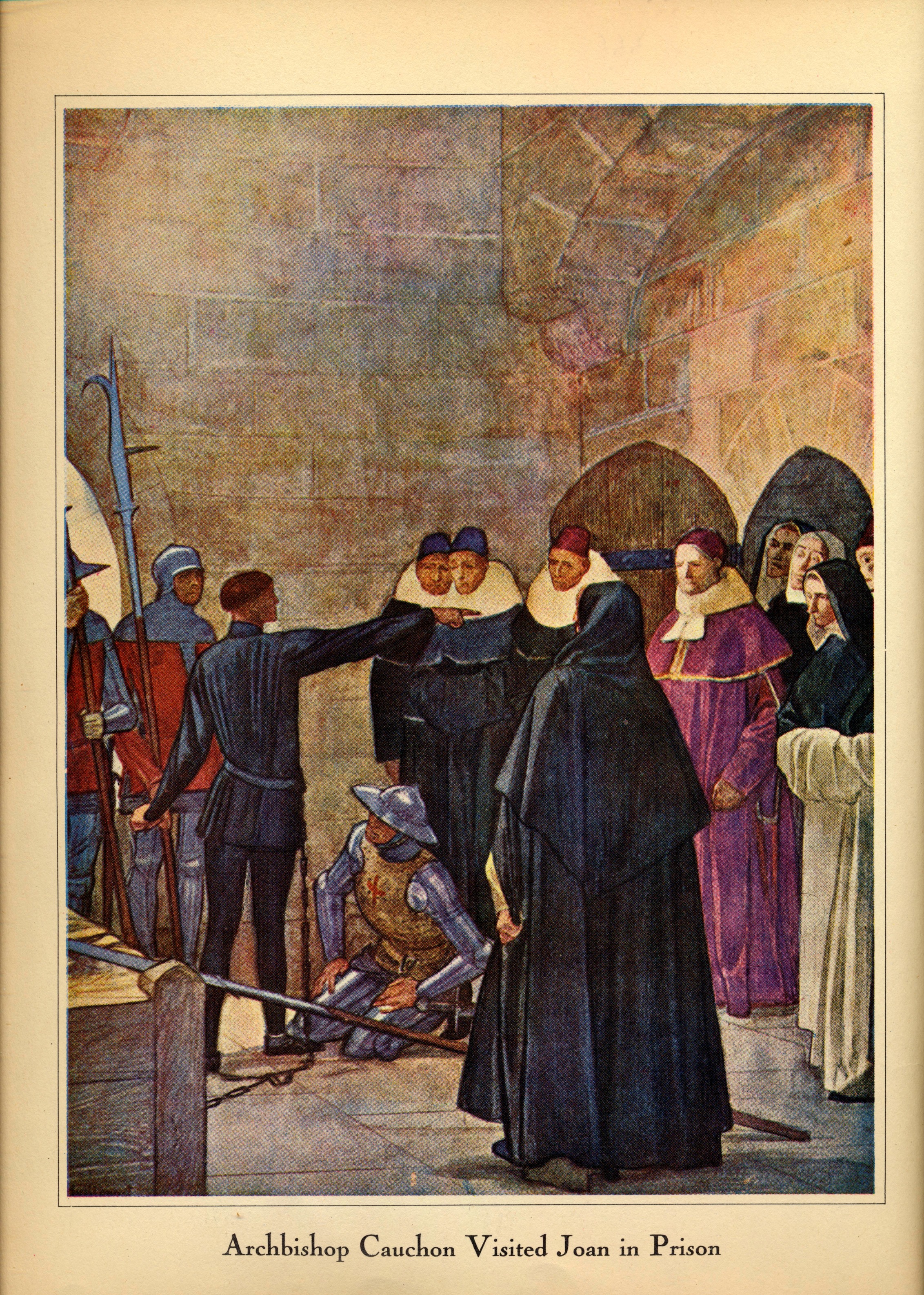
During her captivity in Rouen in early 1431, Bishop Pierre Cauchon—the pro-English judge presiding over her heresy trial—visited Joan of Arc in her heavily guarded cell along with other clerics to interrogate and pressure her. Despite being shackled, denied the Eucharist, and surrounded by hostile church officials and prying guards, Joan stood firmly in her men’s attire and refused to recant her heavenly voices or submit to their biased demands.

From February to May 1431 in Rouen, Joan of Arc stood alone before a tribunal of pro-English church judges and theologians presided over by Bishop Pierre Cauchon to answer charges of heresy, witchcraft, and dressing in men’s clothing. Despite having no legal counsel and facing months of relentless, hostile interrogation, the nineteen-year-old answered her accusers with remarkable clarity, courage, and theological acuity. When she was asked on February 24, 1431, “Do you know whether you are in the grace of God?”— Joan of Arc famously replied, “If I am not, may God put me there; and if I am, may God so keep me,” adding that she would be the saddest person in the world if she knew she were not in God’s grace. It was asked by Maître Jean Beaupère, a prominent University of Paris professor of theology. During the third public session of the trial on Saturday, February 24, 1431, Bishop Pierre Cauchon instructed Beaupère to lead the interrogation. This exchange is considered one of the most brilliant moments of her trial because the judges had set a classic theological trap. According to medieval Catholic doctrine, no mortal could claim with absolute certainty to be in a state of grace without committing the sin of spiritual pride, while admitting she was not in grace would be a direct confession of guilt and heresy. By placing the matter entirely in God’s hands, Joan effortlessly sidestepped both traps and left her trained biased “expert” interrogators stunned. The trap was so blatant that even one of the court’s own assessors, Jean Lefèvre, interrupted to protest that it was a “grave question” which Joan was not legally bound to answer—only for Cauchon to snap back at him to shut up. Joan then delivered her famous reply, leaving the entire courtroom stunned.

On May 24, 1431, in the cemetery of the Abbey of Saint-Ouen in Rouen, Joan of Arc—exhausted by months of imprisonment and threatened with immediate burning at the stake—placed her mark on a short abjuration document denying her visions and agreeing to resume women’s clothing. Surrounded by hostile English soldiers and pressing church officials on a public scaffold, she signed the brief paper (which her captors later fraudulently replaced in the official record with a much longer confession) in exchange for a commuted sentence of life in a church prison.
But after church offcials had her signature on a confession they returned her to a secular English prison cell rather than being transferred to a church prison with female attendants as promised. According to witnesses at her later rehabilitation trial, her English guards then took away her women’s clothes while she slept and left only men’s clothing in her cell. By other accounts, she put the male garments on to protect herself from attempted sexual assaults by her guards.
Whatever happened, Joan of Arc resumed wearing men’s clothes on Sunday, May 27, 1431. When Bishop Cauchon and the inquisitors visited her cell on May 28 and saw her dressed in men’s attire again, Joan officially retracted her abjuration outright. She declared that she had signed the paper only out of fear of their threats of burning her alive at the stake, and that indeed God had sent her to aid the French, and that her voices were real—giving the tribunal legal pretext to condemn her as a “relapsed heretic” and execute her.

On May 30, 1431, as Joan of Arc was driven in a cart through the streets of Rouen toward the stake, Nicolas Loyseleur—the treacherous priest who had posed as a fellow prisoner to betray her confessions—rushed forward weeping to beg her forgiveness. Furious at his display of remorse, the surrounding English soldiers violently dragged him away from the cart and would have killed him on the spot if the Earl of Warwick had not intervened to spare his life.

Joan of Arc was burned at the stake in the Place du Vieux-Marché (Old Market Square) in Rouen, France.
On May 30, 1431, she was tied to a high plaster pillar erected in the center of the bustling public marketplace so the large crowd of spectators and English soldiers could clearly see her execution. After she died, Cardinal Henry Beaufort ordered her ashes and unburned heart to be gathered and thrown into the Seine River from the nearby Mathilde Bridge to prevent anyone from collecting relics.

Today, the exact spot where the stake stood is marked by a towering 20-meter-high cross and is situated right next to the modern Church of Saint Joan of Arc (Église Sainte-Jeanne-d’Arc), which was built in 1979 in the center of the square.

In April 1430 at the church of Notre-Dame in Lagny-sur-Marne (spelled “Cagny” in the illustration’s caption), Joan of Arc joined the local maidens in praying before the statue of the Virgin Mary for a three-day-old infant who had died unbaptized. According to testimony at her trial, the lifeless baby suddenly revived, yawned three times, and was immediately baptized so its soul could be saved before it passed away again and was buried in consecrated ground.

During her military campaigns across France in 1429 and 1430, Joan of Arc frequently stood as godmother to local infants at church baptismal fonts and gathered with neighborhood children to pray and receive the sacraments. Known for her deep affection for children and the poor, she often named the boys “Charles” after the king and the girls “Jeanne” after herself, bringing comfort and spiritual hope to ordinary families amidst the devastation of war.
Conclusion
Six centuries after her death, Joan of Arc remains one of history’s most compelling figures. Guided by faith, tested by war, condemned by her enemies, and ultimately vindicated, she transcended her brief life to become a symbol of courage, conviction, and national identity. Through O.D.V. Guillonnet’s illustrations and the enduring power of her story, the Martyr-Maid continues to inspire admiration as both a heroic defender of France and a saint whose legacy reaches far beyond her own age.
GLOSSARY by John P. Walsh.
Versailles – The Palace of Versailles (French: Château de Versailles), or simply Versailles is a royal castle in Versailles, west of Paris in the Île-de-France region that includes Paris and its environs. The Château is open today as a museum and is a very popular tourist attraction. For more visit: http://en.chateauversailles.fr/
Joan of Arc – Joan of Arc (French: Jeanne d’Arc) was born January 6, 1412 and died by execution (burned at the stake) in Rouen, France, on May 30, 1431. Nicknamed “The Maid of Orléans” (French: La Pucelle d’Orléans) Joan of Arc is considered a heroine of France for her role during the The Hundred Years War and is a canonized Roman Catholic saint. She is one of several patrons of France today.
Domremy – (French: Domrémy, today Domrémy-la-Pucelle in reference to Joan of Arc.) Domremy is a small commune in the Vosges department in Grand Est in northeastern France. It is the birthplace of Joan of Arc. In 1429 Domrémy (and neighboring Greux) was exempted from taxes “forever” by King Charles VII which was the sole request made of the king by Joan of Arc when Charles asked her how he could show her his appreciation for seeing him made king. Taxes were imposed again upon Domrémy and Greux during the French Revolution and the people have had to pay taxes again ever since.
Meuse – (French: la Meuse.) The Meuse is a major European river, originating in France and flowing through Belgium and the Netherlands and draining into the North Sea. It has a total length of 925 km (575 miles).
Rivulet of Three-Fountains – (French: Le ruisseau des Trois Fontaines.) In Jeanne’s time, the village of Domremy was divided by the Creek of Three Fountains, so named because of three sources that fed it. To the south of it (right bank) is the Barrois and to the north of it (left bank) is Champagne. The stream also separates Domremy and Greux. Champagne was part of the royal domain, and when Joan left her home to aid the “Dauphin” Charles at Chinon or went to Nancy to visit the Duke of Lorraine, she had to seek safe conduct.
The Duchy of Lorraine – (French: Lorraine) was a duchy or dukedom that today is included in the larger region of Lorraine in northeastern France. Its capital was Nancy.
Province of Chaumont – Chaumont is a small commune of France which historically was the seat of the Counts of Champagne.
Jacques d’Arc – also Jacquot d’Arc. (b. 1375/80-d. 1431). Father of the Maid, he was born about 1375 at Ceffonds, in the diocese of Troyes, according to the Traité sommaire of Charles du Lys published in 1612. It was about the time of his marriage that he established himself at Domrémy, for his wife Isabelle Romée was from Vouthon, a village about seven kilometers away. He seems to have enjoyed an honorable position in this countryside, whether he was rich, as some have implied, or not. In 1419 he was the purchaser of the Chateau de I’Ile, with its appurtenances, put up at auction that year. In a document of 1423 he is described as doyen or sergeant of the village. He therefore took rank between the mayor and the provost, and was in charge of collecting taxes, and exercised functions similar to those of the garde Champêtre which is a combination of forest ranger, game warden, and policeman in certain rural communes in France. The same year finds him among the seven notables who responded for the village in the matter of tribute imposed by the damoiseau of Commercy. In 1427 in an important trial held before Robert de Baudricourt, captain of Vaucouleurs, he was again acting as a delegate of his fellow citizens. We know that he opposed with all his power the mission of his daughter, whom he wished to marry off. However, he went to Reims for the coronation of the King, and the King and the municipality defrayed his expenses and gave him a horse for his return to Domrémy. He was ennobled in December, 1429. Jacques d’Arc died 1431, it is said, from sorrowing over his daughter’s end.
Castle of the Island – In front of Domremy, and connected by a bridge, the Castle of the Island was the possession of the Bourlemont family, the lords of Domremy. It was rented by the inhabitants in the time of Joan and served, at times, as a refuge for their cattle.
Brothers Jacques, Jean, and Pierre, and sister, Catherine – Jacquemin d’Arc (b. 1402 d. 1450). There is very little known about Jacquemin, other than he was born 1402 in Vaudeville-le-Haut, and died in 1450. He was married to Catherine Corviset who was born in 1405 and died in 1430. They were married at Domremy.
Jean d’Arc (b. 1409 d. 1447) fled with his sister Joan to Neufchâteau; accompanied her to France; and was lodged at the house of Jacques Boucher at Orléans. With his father, he was ennobled in December 1429. As provost of Vaucouleurs he worked for the rehabilitation of his sister; appeared at bodies in Rouen and Paris; and formed a commission to get evidence from their native district and produce witnesses. He was Bailly of Vermandois and captain of Chartres.
Pierre d’Arc (b. 1408 d. ?) went to seek his sister in France; fought along with her at Orléans; lived in the same house with her in that city; accompanied her to Reims; and was ennobled with the rest of the family. He was captured with Jeanne at Compiègne, but was eventually released. Pierre retired to the city of Orléans where he received many gifts – from the King, the city of Orléans, and a pension from Duke Charles, among them the Île aux Boeufs in 1443. The descendants of Pierre had in their possession three of Jeanne’s letters and a sword that she had worn. The letters were saved but the sword was lost during the the French Revolution.
Catherine d’Arc (b. 1413 d. 1429). There is very little known about Catherine, other than she married Colin, the son of Greux’s mayor, and died very young in childbirth near the end of 1429.
Isabella Romée – Isabelle Romée (b. 1385 d. Dec. 8, 1458), known as Isabelle de Vouthon. Isabelle d’Arc and Ysabeau Romée, was the mother of Jeanne. She moved to Orléans in 1440 and received a pension from the city. She petitioned Pope Nicholas V to reopen the court case that had convicted Jeanne of heresy, and then, in her seventies, addressed the assembly delegation from the Holy See in Paris. On July 7, 1456 the appeals court overturned the conviction of Jeanne. Isabelle gave her daughter an upbringing in the Catholic religion and taught her the craft of spinning wool.

BIBLIOGRAPHY
- Boutet de Monvel, Louis Maurice. Joan of Arc. New York: Pierpont Morgan Library; Viking Press, 1980.
- Castor, Helen. Joan of Arc: A History. New York: HarperCollins Publishers, 2015.
- Coulson, John, ed. The Saints: A Concise Biographical Dictionary. New York: Guild Press, 1957.
- Harrison, Kathryn. Joan of Arc: A Life Transfigured. New York: Doubleday, 2014.
- Lucie-Smith, Edward. Joan of Arc. New York: W. W. Norton, 1977.
- Guillonnet, O. D. V., illus. The Beautiful Story of Joan of Arc: The Martyr Maid of France. Text by Viola Ruth Lowe. New York: Grosset and Dunlap, 1923.
- Pernoud, Régine. Joan of Arc by Herself and Her Witnesses. Translated by Edward Hyams. Lanham, MD: Scarborough House, 1994.
- Pernoud, Régine. Joan of Arc: Her Story. Translated by Jeremy duQuesnay Adams. New York: St. Martin’s Press, 1998.
- Rankin, Daniel S., and Claire Quintal, trans. and eds. The First Biography of Joan of Arc, with the Chronicle Record of a Contemporary Account. Pittsburgh: University of Pittsburgh Press, 1964.
- Twain, Mark. Joan of Arc. New York: Harper and Brothers, c. 1924.


