


FEATURE image: Kaskaskia tribe member leads Fr. Jacques Marquette, S.J. and Louis Jolliet through the Chicago Portage, 1673. Cor-10 steel, Ferdinand Rebechini (1923-2003), The Chicago Portage National Historic Site, Lyons, Illinois, 1990. Author’s photograph taken in November 2012.
Ferdinand Rebechini’s monumental Cor-Ten steel sculpture at The Chicago Portage National Historic Site honors the vital, historical role of Indigenous Kaskaskia guides in leading French explorers through the strategic geographic corridor that directly enabled the trade expansion, continental travel, and ultimate founding of Chicago.
The Chicago Portage, which made Chicago’s founding and thriving possible, is a U.S. Department of Interior National Historic Site.

A Native American of the Kaskaskia tribe leading French explorers Father Jacques Marquette, S.J. and Louis Jolliet through The Chicago Portage. A Cor-10 steel sculpture by Ferdinand Rebechini (1923-2003) of Rebechini Studios Inc. of Elk Grove Village. The artwork was dedicated at The Chicago Portage National Historic Site in Lyons, Illinois, in April 1990. November 2012. Author’s photograph.
In September 1673 members of the Kaskaskia, a Native American tribe of the Illinois Confederation, led French explorers Louis Jolliet (1645-1700) and Père Jacques Marquette, S.J. (1637-1675) through the portage that was well known to Native Americans for centuries and later called the Chicago Portage. The statue depicts that event, showing a Native American pulling the canoe where water meets land, and Jolliet in the middle and Father Marquette, a cross upon his chest, standing outside the canoe and pointing ahead. For hundreds of years, early travelers, traders, and settlers had to carry their canoes and its contents overland through the Chicago Portage between the Chicago and Des Plaines Rivers. It was on this tract of Illinois land – little changed since the mid17th century – where Marquette and Jolliet, the first French explorers to open up the Old Northwest Territory, once stood.
The statue captures a definitive moment from September 1673, portraying a Kaskaskia guide pulling a canoe alongside French explorers Louis Jolliet and Father Jacques Marquette, S.J.
Cor-10 steel.
Made of Cor-10 steel by Chicago-area artist Ferdinand Rebechini (1923-2003) and dedicated in April 1990, the sculpture at The Chicago Portage is made of the same material used to construct Chicago’s Picasso statue in Daley Plaza in downtown Chicago.
This outdoor sculpture stands at the western terminus of a nearly 8-mile-long water-and-overland travel route across the Continental Divide between the St. Lawrence and Mississippi River systems known as “the Chicago Portage.” Linking Lake Michigan (via the Chicago River) to the Mississippi River (via the Des Plaines River), the Chicago Portage became the key to expansion of travel and trade in the Old Northwest territory which later became the raison d’être for the founding of Chicago.
Portage Type and Length Could Widely Vary With the Weather and Seasons.
The length of the portage varied with the weather. If water was high, canoes could be paddled longer from Portage Creek into Mud Lake and to the Chicago River without any overland portaging. In dry times, travelers would have to portage in the waist-high swamp waters of Mud Lake, and then drag their canoes through swamp, sloughs, and mud all the way to the Chicago River. The portage became no better in times of drought. Then the overland portage could be as long as upwards of 100 miles with no paddling between the Chicago River and the Illinois River near LaSalle/Peru.
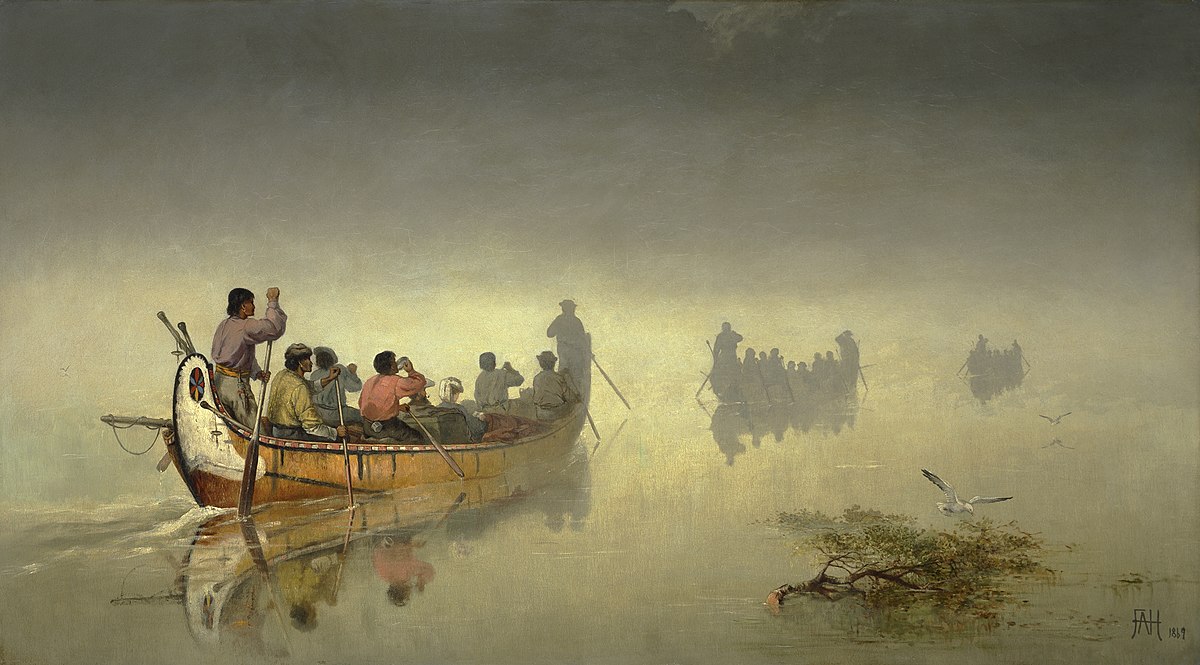
“Canoes in a Fog, Lake Superior,” 1869, Frances Anne Hopkins (1838–1919) Glenbow Museum, Alberta, Canada. Public Domain. In the 17th and 18th centuries the Chicago Portage welcomed a similar scene of paddling travelers such as Native Americans, missionaries, soldiers, pioneers, voyageurs, trappers, and traders on the waterways of Illinois wilderness. Public domain.

Original section of the waterway at the Chicago Portage. The water originally flowed as part of the Des Plaines River. During construction of the Sanitary and Ship Canal in the late 1890’s it was cut off from the river and partially filled. For hundreds of years the Chicago Portage was that track of mostly land where in wet season travelers could paddle from the Chicago River to the Des Plaines River but in dry or semi-dry conditions, they had to carry canoes and supplies varying distances between rivers. It was here where the trio depicted in Ferdinand Rebechini’s sculpture pulled ashore in their canoe and portaged 350 years ago. November 2012. Author’s photograph.
Used and well-known by the Native Americans, the portage was first used by the Europeans in the mid-17th century. It became a major gateway for exploration and pioneer expansion to the West and for the fur trade. The portage at Chicago was discovered in September 1673 by Frenchmen Père Jacques Marquette and his guide Louis Jolliet as they returned from their voyage of exploration down the Mississippi River. A 36-year-old Marquette, already in bad health, spent his last winter of 1674-75 near the portage, and died in May 1675 near Ludington, Michigan. Numerous missionaries, soldiers, pioneers, voyageurs and traders into Illinois Country passed through the portage, including René Robert Cavelier, Sieur de la Salle (1643-1687) and Henry de Tonty (1649-1704). Starting around 1700, Europeans were kept out of the area by Native Americans who continued to use the portage extensively as the native peoples had done for centuries before the European arrival. Over the first half of the 18th century, the portage restricted non-Indian travel.
Ceded to the United States in 1795 in the Treaty of Greenville, the portage route was meticulously mapped and developed in the 19th century to meet the needs of greater interstate commerce. The Illinois and Michigan Canal was built along this route in 1848 mainly using Irish immigrant labor in its construction. In 1907, the Sanitary and Shipping Canal was built and remains in use today. The western terminus site is located in today’s city of Lyons, Illinois.
The monument stands at the western terminus of the 8-mile overland water route over the Continental Divide. This route connected Lake Michigan to the Mississippi River system, serving as the strategic raison d’être for establishing the city of Chicago.
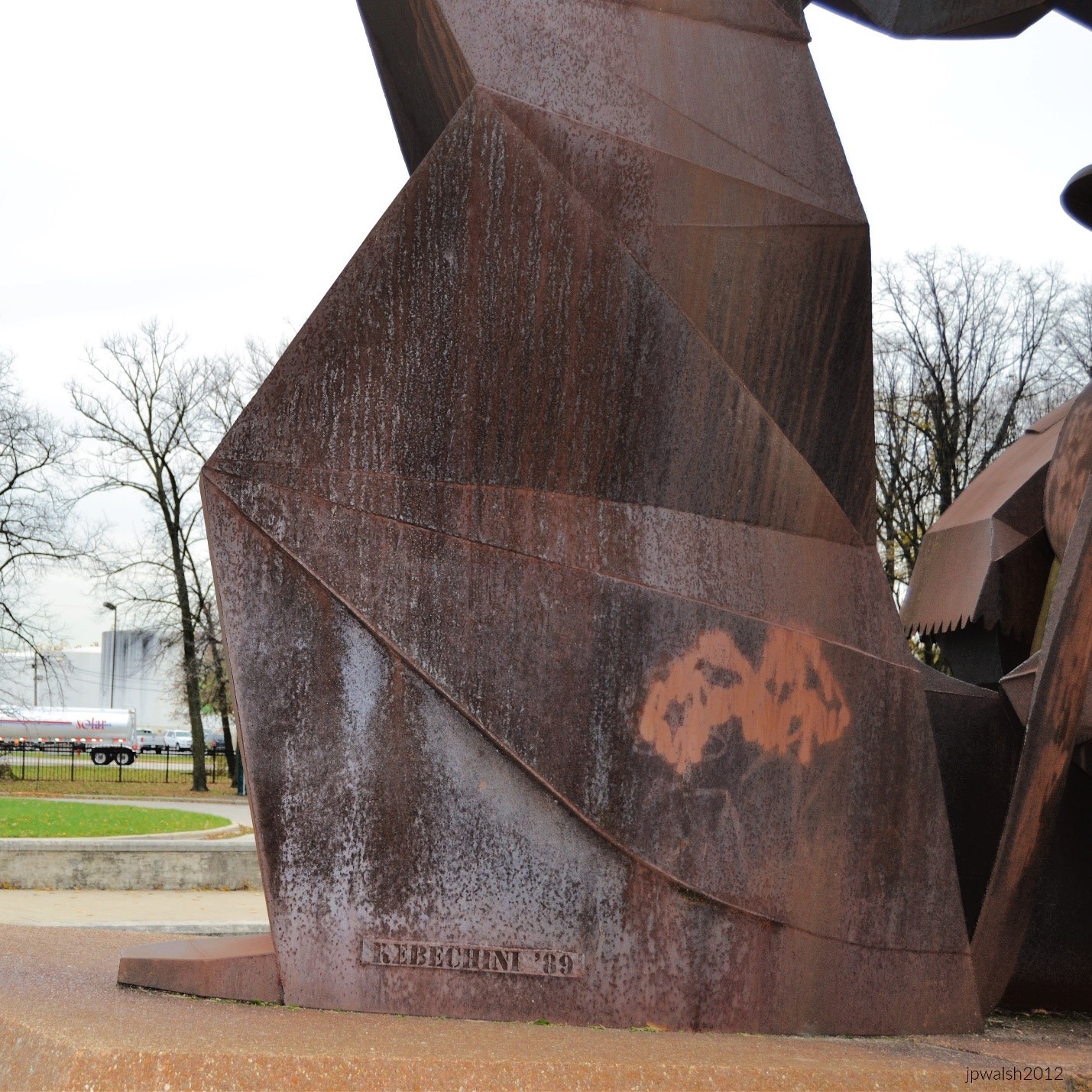
The artist signed his monumental Cor-Ten steel sculpture on the robe of the figure of Fr. Marquette. November 2012. Author’s photograph.
Since 1950, the historic Chicago Portage is owned and part of the Cook County Forest Preserve system. In 1952 the U.S. Department of Interior recognized the historic importance of the portage by officially designating it a National Historic Site. The site is also part of the I & M Canal National Heritage Corridor. The eastern end of the portage route is the site of Fort Dearborn, by Lake Michigan at the mouth of the Chicago River near today’s high-traffic DuSable (Michigan Avenue) Bridge. Fort Dearborn was originally constructed in 1803 to protect the trade route made possible by the portage and through what would soon became Chicago, the “City of the Century.”

Another view: Native American of Kaskaskia tribe leading French explorers Father Jacques Marquette, S.J. and Louis Jolliet through The Chicago Portage. Cor-10 steel sculpture by Ferdinand Rebechini (1923-2003) at The Chicago Portage National Historic Site in Lyons, Illinois, November 2012. Author’s photograph. 5.12 mb
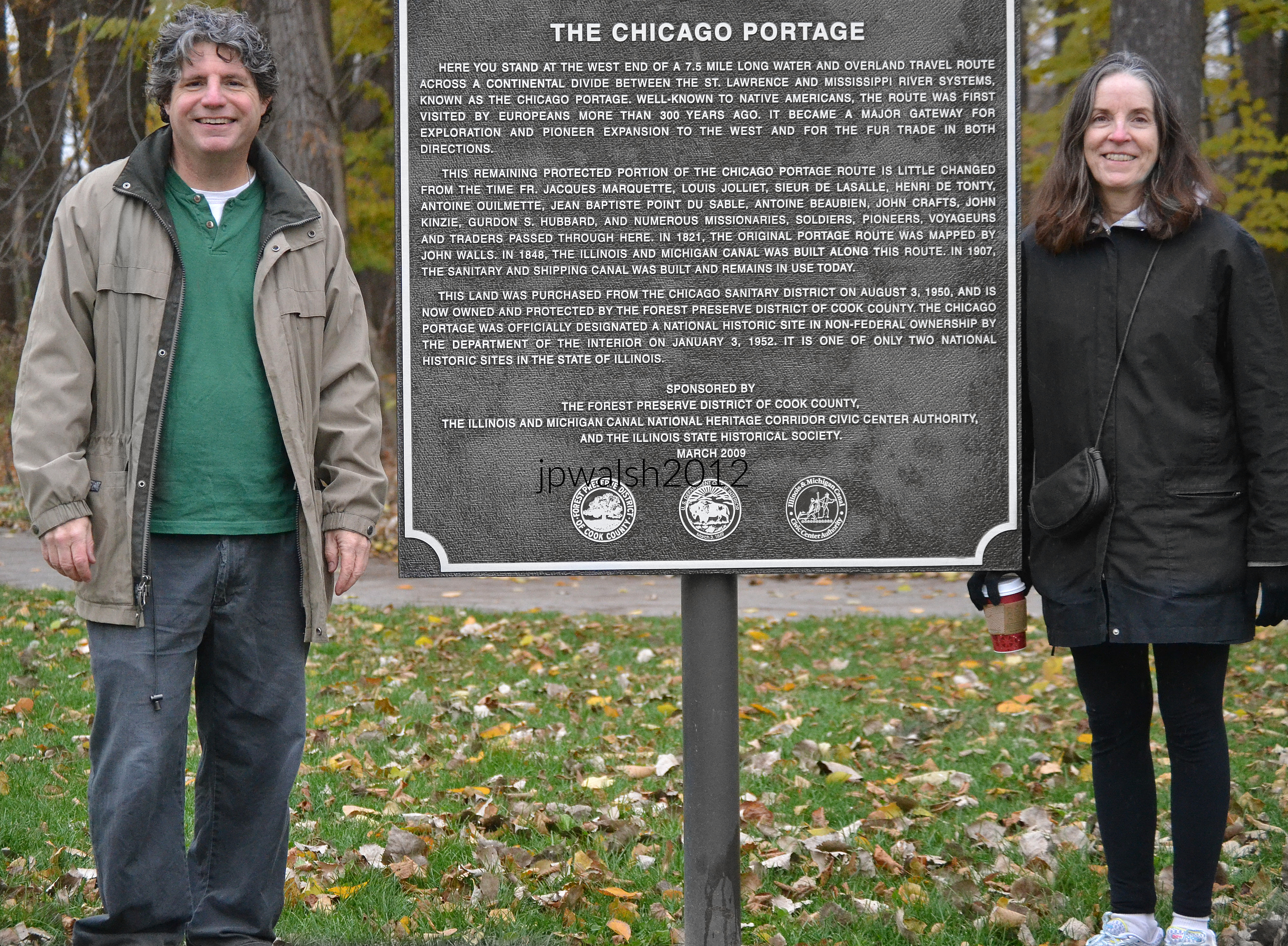
Author and wife visit the Chicago Portage National Historic Site. November 2012. Author’s photograph.
Over centuries, this key Indigenous trail evolved into a heavily mapped trade asset, leading to the construction of Fort Dearborn (1803), the Irish-built Illinois and Michigan Canal (1848), and eventually the modern Sanitary and Ship Canal (1907).
FURTHER READING:
https://web.archive.org/web/20121019040703/http://www.cr.nps.gov/history/online_books/explorers/siteb1.htm

