
FEATURE Image: Holy Trinity Orthodox Cathedral, 1121 N. Leavitt, Chicago. The walls of the church building are load-bearing brick covered with stucco. The bell tower and octagonal belfry, dome, and roof are made of wood with metal trim and latticework. July 2015. Author’s photograph. 2.80 mb
Holy Trinity Orthodox Cathedral demonstrates how Louis H. Sullivan (1856-1924), best known for his commercial architecture, adapted his design genius to a modest immigrant church, creating a distinctive synthesis of Russian provincial tradition, Eastern Orthodox worship, and Sullivan’s own ornamental imagination within Chicago’s Ukrainian Village.

Chicago. Holy Trinity Orthodox Cathedral. July 2015. Author’s photograph. 6.48 mb
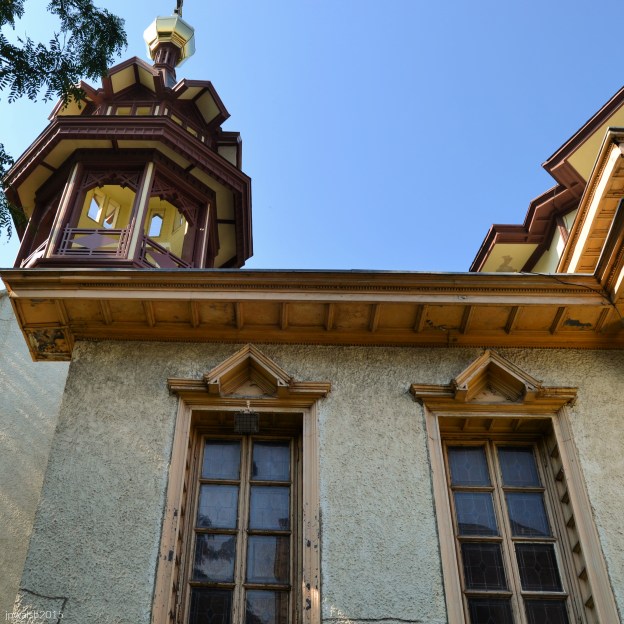
Louis H. Sullivan designed the bell tower (above and below) with its ornamentation and eaves and soffits for Holy Trinity Orthodox Cathedral in Chicago’s Ukrainian Village.

Chicago. Holy Trinity Orthodox Cathedral. October 2016. Author’s photograph. 4.16 mb
how Louis Sullivan adapted traditional Russian architecture to create the bell tower of Holy Trinity Orthodox Cathedral The octagonal open lantern where the bells hang is o a classic feature of 17th-century Russian wooden architecture, traditionally referred to as an “octagon on a cube” (vosmerik na chetverike). Rising above the open belfry is a steep, grey-shingled tent-shaped roof. This architectural style was historically popular in Russia for its ability to keep heavy snow from piling up on church towers. The Wave-Like Roofline and slender window slats are Sullivanesque. Crowning both the main tent roof of the bell tower and the smaller side turret are brilliant golden onion domes. In Orthodox theology, the onion dome symbolizes a burning candle flame reaching up toward heaven.
Built in 1903 on a limited budget, the church is a relatively small structure whose architectural impact far exceeds its size.
Chicago. Holy Trinity Orthodox Cathedral. July 2015. Author’s photograph. 6.24 mb
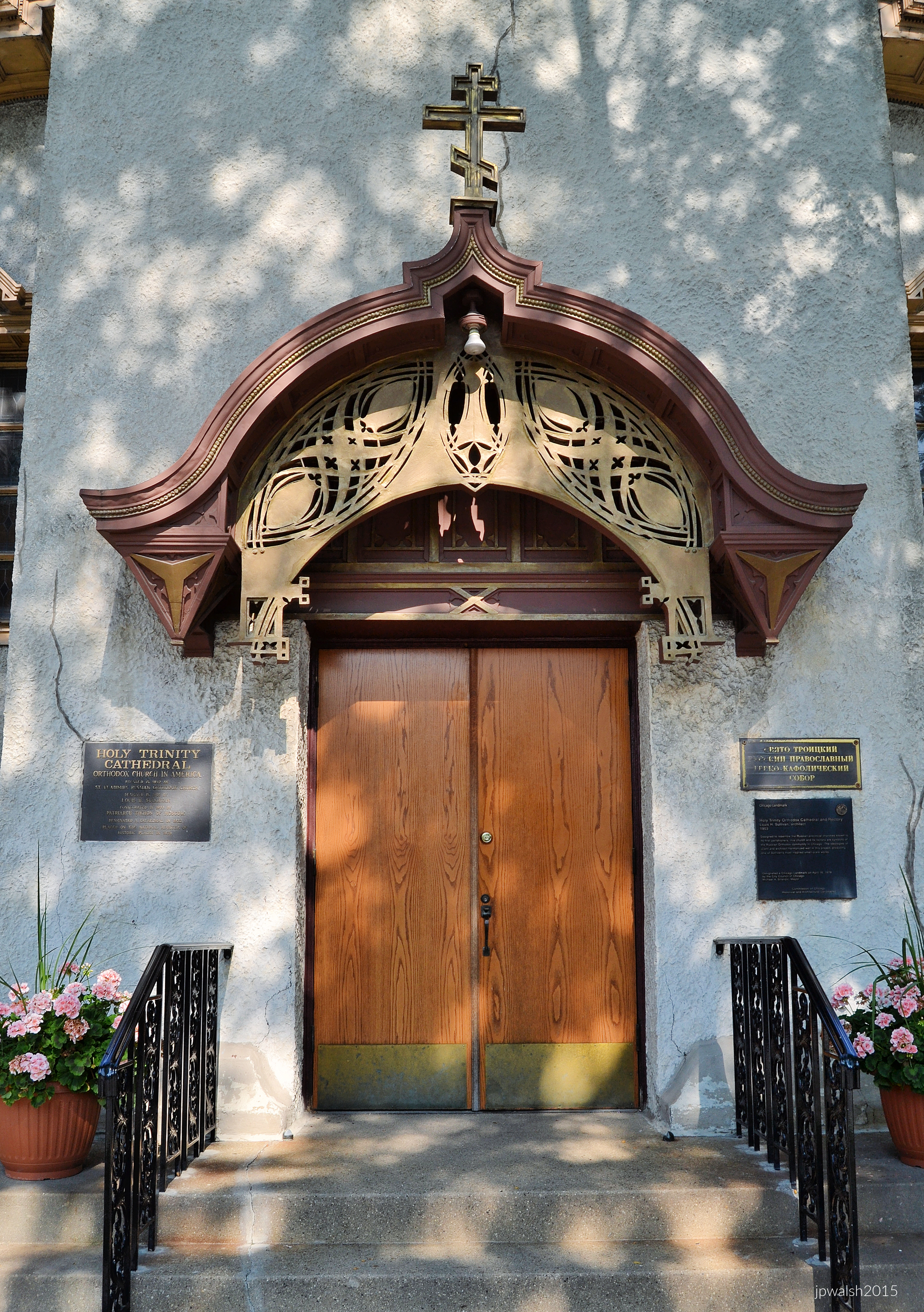
Louis H. Sullivan designed the portal canopy (above) and its ornamentation such as the fretwork. Sullivan also designed the window frames (example below).
Louis H. Sullivan designed key architectural elements of the cathedral, including the bell tower, portal canopy, window frames, and decorative ornament.

Chicago. Holy Trinity Orthodox Cathedral. July 2015. Author’s photograph. 5.53 mb
Louis Sullivan’s genius directly merges with traditional Russian Orthodox geometry in this window, which serves a vital role in illuminating the church’s interior. The top of the window frame features a uniquely Sullivanesque, multi-tiered, stepped triangular pediment that beautifully complements the sharp lines of the building’s exterior roof eaves. Along the sides, the outer wooden posts feature finely routed parallel grooves and subtle decorative blocks. This style of ornamentation is a hallmark of Sullivan’s organic philosophy—using natural light and shifting shadows to give rigid wood components a rich, rhythmic texture.
Furthermore, each major pane of leaded glass features a complex geometric pattern centered on an octagon. While the octagon served as Sullivan’s favorite transitional shape to bridge the gap between square and circle, it simultaneously held a profound meaning for the Orthodox parish. This eight-pointed geometry carries a deep spiritual resonance, symbolizing the “Eighth Day” of creation (the eternal Kingdom of God) and echoing the architectural octagons found in the cathedral’s main dome and bell tower.
Chicago. Holy Trinity Orthodox Cathedral. October 2016. Author’s photograph. 5.84 mb
Holy Trinity Cathedral was built on a limited budget. It is a small building at 47 x 98 feet situated on an east-west axis. The main body of the church is square with extensions and an octagonal dome above. The picturesque country-church entrance has a metal and wood canopy whose design and ornamentation were created by the architect, Louis H. Sullivan (1856-1924). Dedicated in 1903, the church was designated a cathedral in 1923.
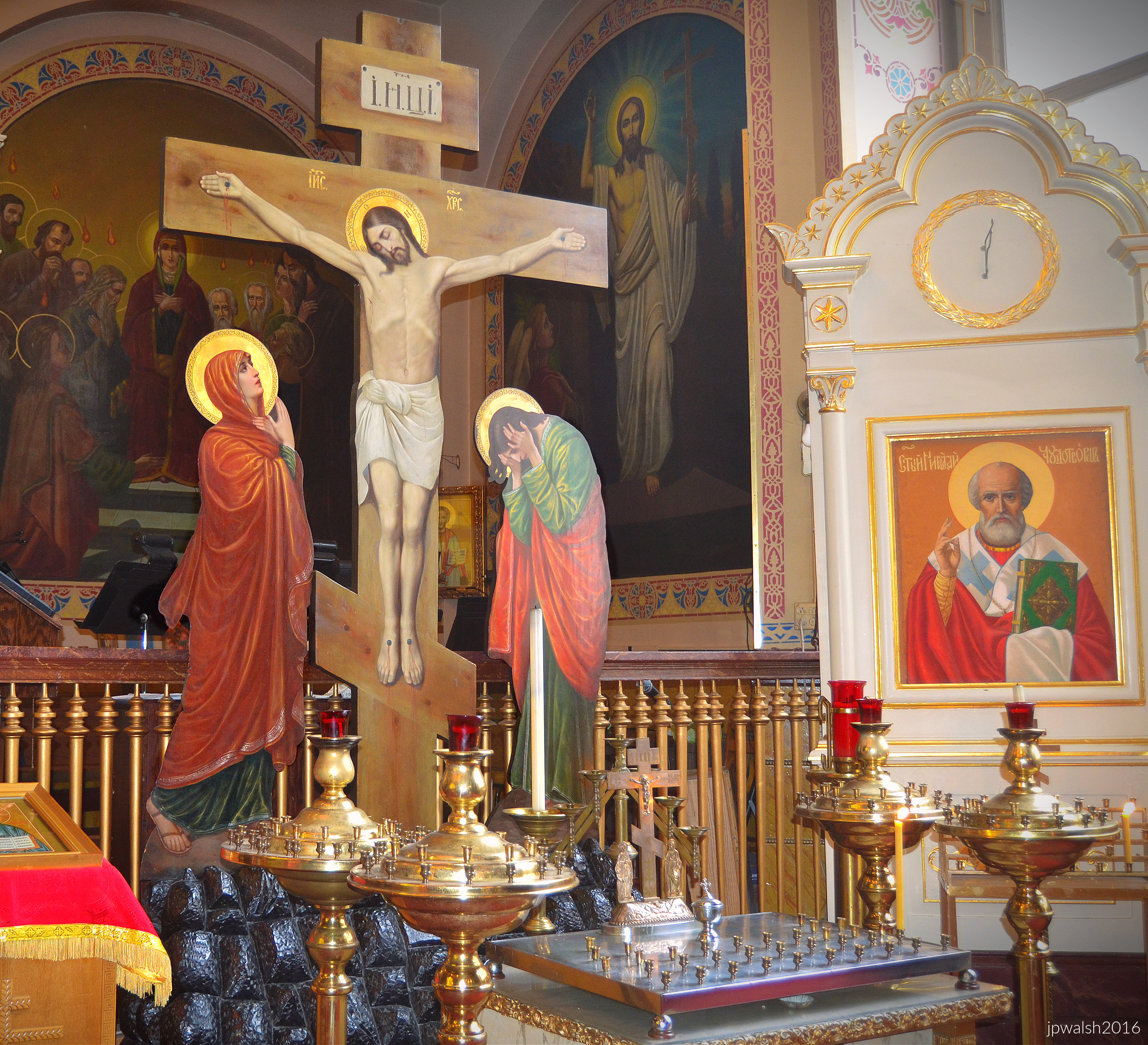
Prominently featured in the foreground is a traditional Slavic-style wooden cutout Crucifixion scene, known as a Golgotha. Mounted inside an ornate white-and-gold carved wooden kiot (shrine framework) is a distinct icon of Saint Nicholas the Wonderworker.
The icons, the painted Golgotha cutout figures, and the surrounding sanctuary murals were painted by artist Genrik Borutsky and his workshop crew between 1902 and 1903.

Chicago. Holy Trinity Orthodox Cathedral. July 2015. Author’s photograph. 5.64 mb

Chicago. Holy Trinity Orthodox Cathedral. July 2015. Author’s photograph. 2.80 mb
This exterior view of Holy Trinity Orthodox Cathedral captures the masterful architectural synthesis achieved by Louis Sullivan in 1903. Commissioned by 29-year-old Saint John Kochurov of Chicago in 1899, Sullivan deliberately blended traditional, rustic Russian provincial church aesthetics with modern American Prairie School and organic design principles.
Rather than grand stone or brick used in churches, Sullivan utilized a rough-textured stucco facade paired with heavy, natural wood ornamentation. Peeking out from the roofline on the left is the wooden octagonal lantern of the bell tower. Its open-air arched windows, multi-tiered flared roof profiles, and crowning golden onion dome are textbook elements of classical Russian Orthodox wooden church design. The deep, dramatic wooden overhang of the roofline supported by exposed structural wood rafters is a hallmark element of both Prairie School architecture. Above the two multi-paned windows are distinct, sharp triangular wooden pediments that are distinctively Sullivanesque. The building’s bell tower is organically shaped around the dome.
The church building was completed for around $27,000 in 1903 (approximately $1 million in 2022) with Sullivan donating half his commission to the church project.
Who is St. John of Chicago?
After 12 years of fruitful missionary work in the American Midwest—where he helped establish several additional parishes and co-organized early Orthodox mutual aid societies—Father John returned to his native Russia in 1907.
In 1916, he was assigned to serve at St. Catherine’s Cathedral in Tsarskoye Selo, a suburb of St. Petersburg. In October 1917, the violence of the Bolshevik Revolution erupted directly in his town. To ease panic, Father John organized an outdoor prayer procession through the streets, pleading for peace among the warring factions.
On October 31, 1917, Bolshevik forces stormed the town. Because he had prayed publicly for peace rather than endorsing the revolution, Father John was arrested by a Red Guard mob, dragged to the outskirts of town, and shot to death. This tragic event earned him the solemn historical distinction of becoming the proto-hieromartyr (the very first clergyman killed) of the Soviet era. He was officially canonized and glorified as a saint by the Russian Orthodox Church in December 1994, and his memory is deeply celebrated every October 31st by Orthodox Christians globally, particularly at the cathedral he built in Chicago.
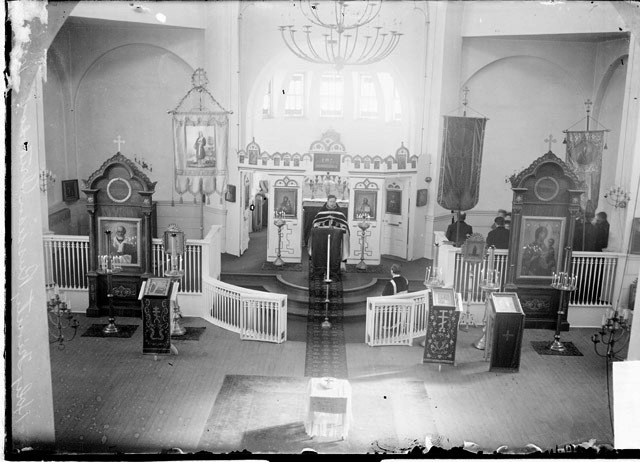
Historic photograph of the interior of Holy Trinity Orthodox Cathedral in Chicago, originally taken in 1905 by a photographer for the Chicago Daily News. The image captures a service in the cathedral shortly after its completion, with Saint John Kochurov likely visible leading the parish.

Same view over 110 years later. Chicago. Holy Trinity Orthodox Cathedral. October 2016. Author’s photograph. 6.95 mb
The Eastern Orthodox central plan creates an interior where the congregation stands in a square space topped by an octagonal dome. For Easter services and the like, the cathedral is filled to capacity with parishioners and others spilling out the front door with its decorative canopy onto the public sidewalk.
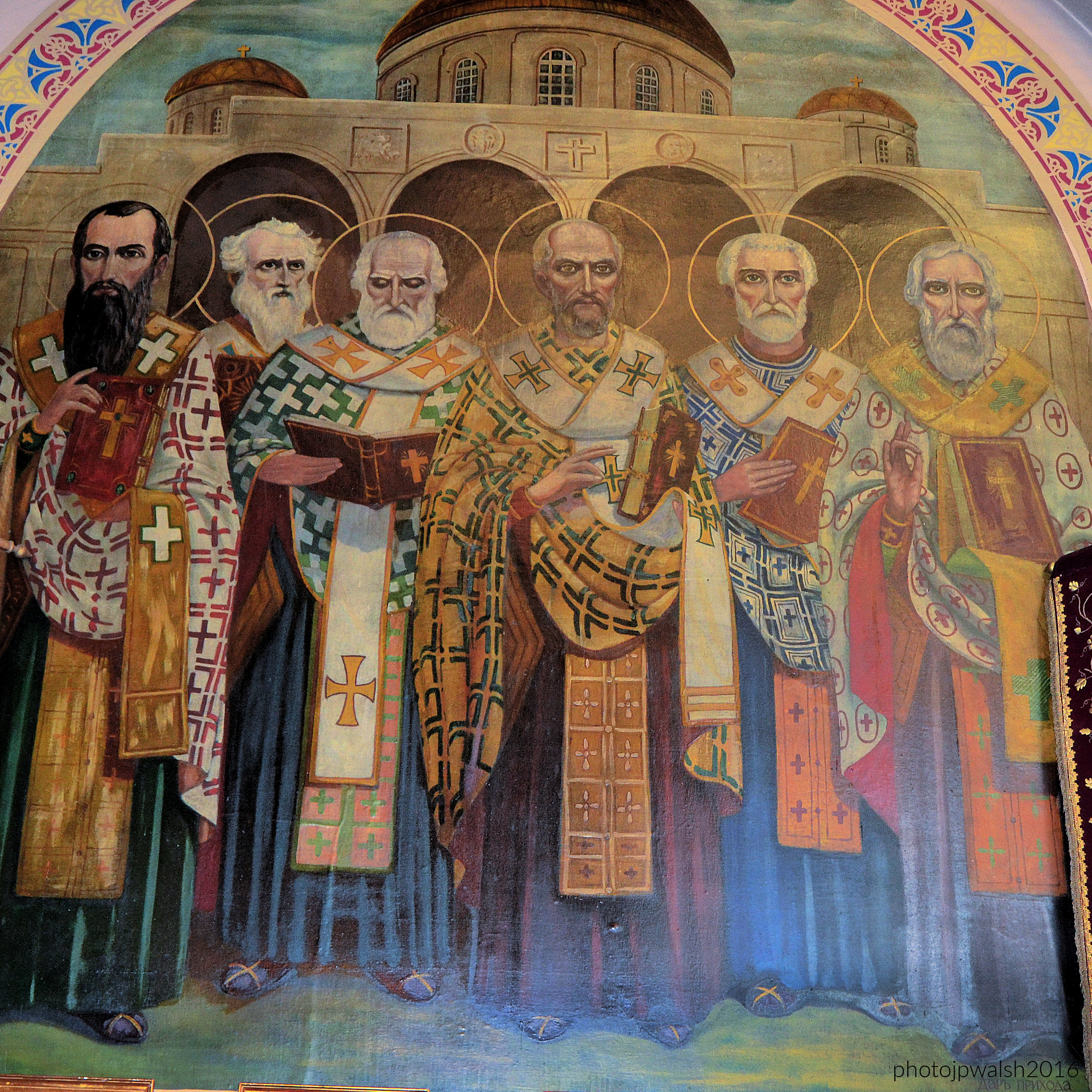
Chicago. Holy Trinity Orthodox Cathedral. October 2016. Author’s photograph. 4.08 mb
Painted by Genrik Borutsky between 1902 and 1903 during the initial interior decoration of the Holy Trinity Orthodox Cathedral in Chicago this mural is an exact full-scale replica of the fresco “The Ecumenical Councils” designed by the legendary Russian master Viktor Vasnetsov between 1885 and 1896 for St. Vladimir’s Cathedral in Kyiv, Ukraine.
The mural depicts a grouping of the Great Church Fathers and Bishops of the Early Christian Church. In front of a Byzantine domed cathedral is, from left to right, Saint Athanasius the Great (c. 296–373), Patriarch of Alexandria; Saint Gregory of Nazianzus (c. 329–390), Theologian; Saint Basil the Great (c. 330–379), Archbishop of Caesarea; Saint John Chrysostom (c. 347–407), Archbishop of Constantinople; Saint Gregory of Nyssa (c. 335–395) or Saint Cyril of Alexandria; and Saint Nicholas of Myra (c. 270–343).
The congregation was composed largely of immigrants from regions near present-day Ukraine and the Carpathian Mountains.

Chicago. Holy Trinity Orthodox Cathedral. October 2016. Author’s photograph. 4.41 mb
The parishioners that built this church were rural people who had emigrated from southern Russia near the Ukraine as well as the area of the Carpathian Mountains.

Chicago. Holy Trinity Orthodox Cathedral. October 2016. Author’s photograph. 5.18 mb 99%
The photograph captures the sanctuary (altar area), the most sacred part of an Orthodox church, situated behind the iconostasis screen and accessible only to clergy.
• The Holy Table (Altar Table): In the foreground sits the square Holy Table, draped in bright red vestments and a gold liturgical stole (epitrachelion). Resting on top are liturgical items, including a heavy book of the Gospels and a hand cross.
• The Seven-Branch Candlestick: Positioned directly behind the Holy Table is an ornate, golden seven-branched candelabra modeled after a tree, flanked by hanging processional banners.
The murals along the curved apse wall represent the Great Hierarchs and Liturgists of the Church, rendered by Genrik Borutsky in 1902–1903 as exact copies of Viktor Vasnetsov’s masterpiece designs. Depicted, left to right, are Saint Gregory of Nazianzus; Saint Basil the Great; Saint John Chrysostom; and Saint Nicholas of Myra.
High above the central gold tabernacle structure is a separate, framed icon depicting the Holy Trinity (the Hospitality of Abraham).

Chicago. Holy Trinity Orthodox Cathedral. October 2016. Author’s photograph. 8.26 mb
The image depicts Saint Mary Magdalene, as indicated by the Church Slavonic inscription at the bottom: “СВ РАВНОАП МАРIЯ МАГДАЛИНА” (Saint Equal-to-the-Apostles Mary Magdalene). In the Orthodox tradition, her title “Equal-to-the-Apostles” highlights her vital role in proclaiming Christ’s resurrection to the disciples. She carries the alabaster jar she brought to the empty tomb to anoint Jesus’s body.
While the architectural structure of the Holy Trinity Orthodox Cathedral in Chicago was designed by legendary architect Louis Sullivan, the church’s traditional interior iconography and stenciled murals were executed based on the work of famous Russian artist Viktor Vasnetsov (V. N. Vasnetoff).
Vasnetsov was a leader of the 19th-century Russian revival movement, famed for blending historical Slavic folklore with classic Byzantine iconographic principles. The elaborate decorative borders, geometric framing, and gold accents wrapping around the pillar echo this late 19th-century style rather than Sullivan’s signature secular Art Nouveau ornamentation.

Chicago. Holy Trinity Orthodox Cathedral. October 2016. Author’s photograph. 6.27 mb
The stenciled artwork (above) is not by Louis H. Sullivan. Rather, the interior murals and iconographic schemes throughout the cathedral were executed by artist Genrik Borutsky and his team. Borutsky did not paint original compositions; instead, he meticulously painted full-scale copies of the monumental frescoes designed by legendary master Viktor Vasnetsov for St. Vladimir’s Cathedral in Kyiv, Ukraine. Vasnetsov’s influential “Russian Revival” style defined late 19th-century Orthodox art by blending strict Byzantine iconographic rules with softer, emotional realist elements.
The two saints painted on this adjoining corner pillar are St. John the Baptist and St. Nicholas the Wonderworker.
The church stands as one of Sullivan’s most unusual and personal works, distinct from the skyscrapers and commercial buildings that made him famous.
SOURCES:
Chicago Churches and Synagogues: An Architectural Pilgrimage, George Lane, S.J., and Algimantas Kezys, Loyola University Press, Chicago, 1981, p. 106-107.
Alice Sinkevitch, AIA Guide to Chicago, 2nd Edition, Harcourt, Inc., Orlando, 2004, p. 260.