


FEATURE Image: Completed in 1885 at a cost of $500,000 (equivalent to nearly $16 million in 2024), Dearborn Street Station in Chicago’s South Loop stood as a grand Romanesque composition of Italian brick and granite. Its architect, New Yorker Cyrus L. W. Eidlitz, would later design One Times Square (1904), the famed Manhattan tower that has served as the site of the annual New Year’s Eve ball drop since 1908. see – https://www.in2013dollars.com/us/inflation/1885?amount=500000 – retrieved February 27, 2024. November 2017. Author’s photograph. 6.44mb
Dearborn Street Station is one of Chicago’s most significant surviving railroad landmarks, embodying the city’s rise as a national transportation hub while showcasing the architectural achievement of Cyrus L.W. Eidlitz. Despite fire, alteration, and the end of passenger rail service, the station endures as a rare and tangible link to Chicago’s railroad age and urban development.

The Hoosier leaving Dearborn Street Station in Chicago (its clock tower visible at right) for Indianapolis. Public Domain (Pre-1978, no mark).

The Dearborn Street Station in Chicago with its original hipped roofs, including on the tower, c. 1908. Public Domain.
The Dearborn Street Station is Chicago’s oldest existing train station though it has not operated as one since 1971. It is a U-shaped Italian brick three-story Romanesque structure with a granite base that was originally 80 feet tall to the roof line.
The 32-year-old architect of Dearborn Street Station, Cyrus L. W. Eidlitz, came from an illustrious East Coast family of builders and architects.
Cyrus L. W. Eidlitz who built the Dearborn Street Station in Chicago in 1885 was from an influential American family of architects and builders—his father, Leopold Eidlitz (1823-1908), was a founder of the American Institute of Architects (AIA). Cyrus L. W. Eidlitz is best known for designing One Times Square, the former New York Times Building, on Times Square in 1904. He also founded HLW International, one of the oldest architecture firms in the United States. The reconstruction of Dearborn Station in Chicago in 1923 following its devastating fire was done by an unknown architect two years after Cyrus L. W. Eidlitz’s death.

Original facade completed in 1904 of One Times Square in 1919 by Cyrus L. W. Eidlitz who designed and built the Dearborn Station in Chicago in 1885. Public Domain.
Dearborn Street Station (1885) is Chicago’s oldest surviving railroad terminal building. Cyrus L.W. Eidlitz designed the station in a robust Romanesque style using Italian brick and a granite base.

Today’s flat roof is a modification by an unknown architect from its elaborate original hipped roof that was lost in a 1922 fire. The eye-catching Flemish tower, originally 166 feet tall, was also modified after the same conflagration. The station building marks the southern terminus of Dearborn Street which today extends about 4 miles to its northern terminus at the southern boundary of Lincoln Park. Author’s photograph.

Looking south to the Dearborn Street Station which sits at the southern terminus of the 4-mile downtown Dearborn Street corridor. PHOTO: “South Dearborn Street” by Reading Tom is licensed under CC BY 2.0.
The station’s frontage on Polk Street extends 212 feet. Originally the station extended 446 feet south along Plymouth Court with the train sheds 600 feet long with 8 tracks. The station’s train shed was demolished in 1976. In 1986 the station was converted to offices and shops (I had my Bank One branch in the Polk Street Station). Today it is the Dearborn Station Galleria in the South Loop Printing House Historic District.
Following demolition of the train sheds in 1976 the first phase of the Dearborn Park residential development south of the Dearborn Street Station building quickly sprang to life.

The 1885 clock tower of the Dearborn Street Station is visible at the left. Open land which for almost 100 years had been the Dearborn Street Station‘s busy train tracks into a shed equal to two football fields in length were cleared off to make room for Dearborn Park residential development. The photograph is dated from 1977 by William C. Brubaker. PHOTO: “Site for Dearborn Park residential development” by UIC Library Digital Collections is licensed under CC BY-NC-SA 2.0.
Its distinctive clock tower and monumental presence made it a defining feature of Chicago’s South Loop.

Dearborn Station Clock Tower. PHOTO: “Dearborn Station Clock Tower” by Atelier Teee is licensed under CC BY-NC-ND 2.0
The Dearborn Station had 8 tracks that accommodated 12 coaches and engines with 122 trains arriving and departing daily. The station served as a major transportation gateway, accommodating numerous railroads.
Chicago & Eastern Illinois (1877-1976):

C&EI The Danville – Chicago Flyer at Steger, Illinois on November 26, 1965. Public Domain.

Map of the Dixie Route to Florida and connecting lines, published by the C&EI, L&N, and NC&StL railroads, 1926. Public Domain.

Preferred Share of the Chicago and Eastern Illinois Railroad Company, issued 1889. Public Domain.
Chicago and Atlantic Railway, (later the Chicago and Erie Railroad, 1871-1941):

Atchison, Topeka & Santa Fe (1859-1996):
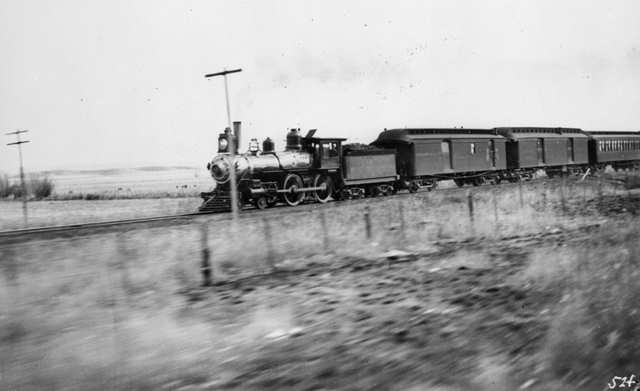
AT&SF passenger train, c. 1895. Public Domain.

Map of “The Santa Fé Route” and subsidiary lines, as published in an 1891 issue of the Grain Dealers and Shippers Gazetteer. Public Domain.
Louisville, New Albany & Chicago, or Monon (1897-1971):

Chicago, Indianapolis and Louisville Railway, route map, 1903, Unknown author – Poor’s Manual of the Railroads of the United States. Public Domain.
Grand Trunk Western Railroad Company (1859-1991):

A 1976 map of the proposed routes to be turned over by Conrail on the GTW, DT&I and P&LE. Public Domain.

Grand Trunk Western Railroad locomotive shop, Battle Creek, Michigan, 1908. GT Western RR was one of the lines into Dearborn Street Station in Chicago. Public Domain.
The Wabash Railroad (1837-1964):

1886 map of the Wabash, St. Louis and Pacific Railway. Public Domain.

System timetable back and front cover, 1887. Public Domain.

Wabash system map, early 20th century. Public Domain.
The Erie Railroad (1832-1960):

An 1855 map of the New York and Erie Railroad. Public Domain.
Chicago & Western Indiana (1880-present):

The Kansas City Chief at Dearborn Station on February 5, 1968. The glowing face of the station clock in the clocktower is visible upper-left. Photograph by A Roger Puta. Public Domain.
All lines operating into Dearborn Station, except for the Santa Fe (above), travelled over the C&WI.
Colossal damages in December 1922 fire.

On December 21, 1922, fire destroyed the roof of the Dearborn Street Station. The blaze started on the third floor and raged throughout that top floor. Hundreds of passengers and employees were safely evacuated and there was one reported injury. The Chicago Tribune reported that when the fire reached the central tower it roared up the long shaft which became a blazing torch. The crowds watched in amazement as the tower clock stopped and the hands on its three faces crashed into the raging fire below.

The original ornate steeply pitched tiled roofs and dormers were lost in a fire in 1922 and not replaced.

SOURCES:
AIA Guide to Chicago, 2nd Edition, Alice Sinkevitch, Harcourt, Inc., Orlando, 2004, p. 154.
History of Development of Building Construction in Chicago, Second Edition, Frank A. Randall, Revised and Expanded by John D. Randall, University of Illinois Press, Urbana and Chicago, 1999, pp. 104-105 and 221-223.
Chicago’s Famous Buildings, 5th Edition, Franze Schulze and Kevin Harrington, The University of Chicago Press, 2003, pp. 89-90.
http://www.connectingthewindycity.com/2017/12/december-21-1922-dearborn-station.html – retrieved February 27, 2024.


