


FEATURE image: The Westwork of the Collegiate Church of St. Gertrude in Nivelles, Belgium, fronts an expansive historical building of the 11th century. Nivelles is an ancient settlement about 25 miles south-east of Brussels in Belgium’s French-speaking region of Wallonia. February-March 1992. Author’s photograph.
The Collegiate Church of St. Gertrude stands as one of the finest surviving monuments of Ottonian and early Romanesque architecture in Western Europe, embodying the religious, political, and cultural influence of the abbey founded by St. Gertrude in the 7th century while illustrating how medieval architecture connected local identity with continental Christian traditions.
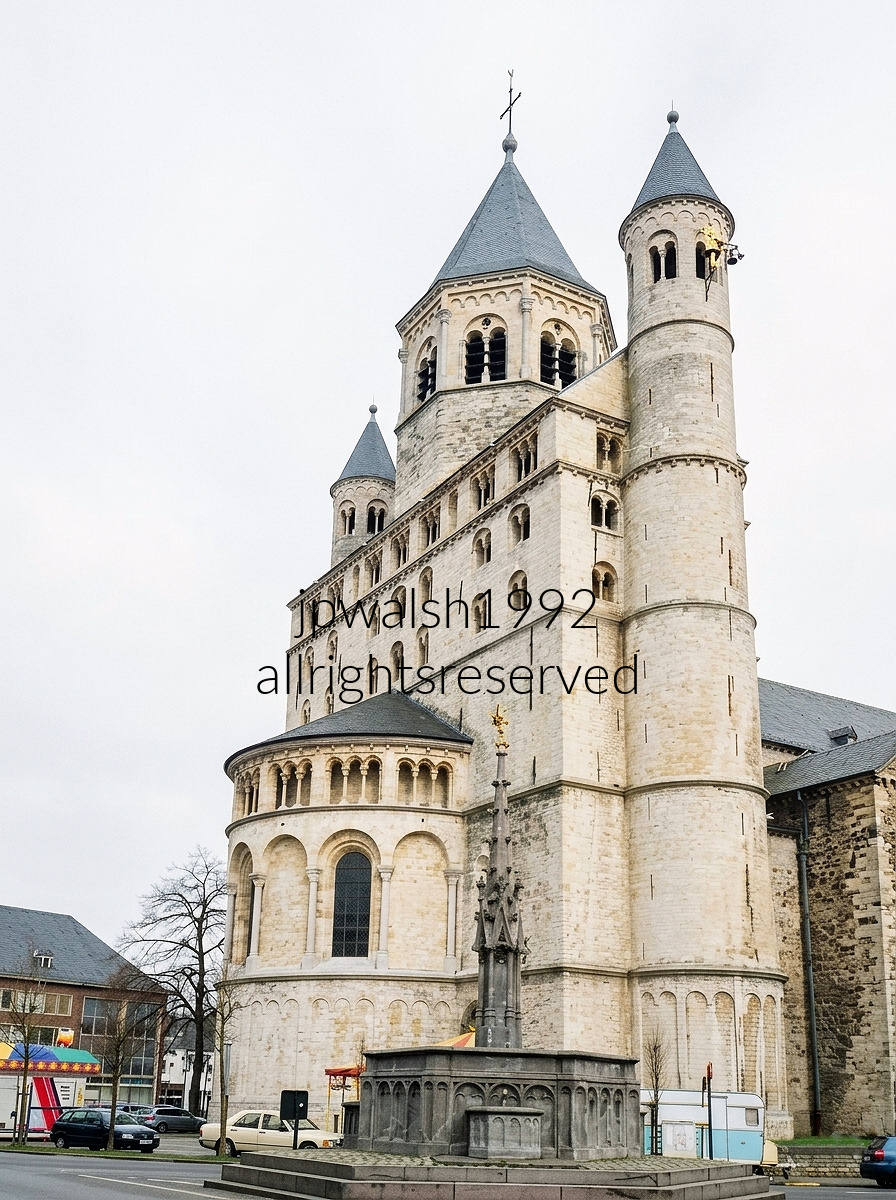
The Collegiate Church of St. Gertrude on Grand’ Place, c. 1050, Nivelles, Belgium. It contains the tombs of its foundress, Bl. Ita of Metz and her daughter, St. Gertrude of Nivelles, the monastery’s first abbess in the 7th century. February-March 1992. Author’s photograph.
The massive westwork, towers, and disciplined geometry reflect the transition from Carolingian traditions to Romanesque architecture. The church’s architectural simplicity emphasizes volume, proportion, and structural clarity rather than later Gothic ornamentation.

Interior, Minster (Collegiate Church of St. Gertrude), Nivelles, Belgium, c. 1050. February-March 1992. Author’s photograph.
This structure was built in the early 11th century and consecrated by Wazo of Liège (c.985-1048) in the presences of Henry III, Holy Roman Emperor (1016-1056). it demonstrates how Nivelles emerged as a major religious center in the medieval Low Countries and survived centuries of political upheaval, war, and restoration, to become a living document of European history.
WHO IS ST. GERTRUDE OF NIVELLES, PATRON SAINT OF CATS, GARDENERS AND TRAVELLERS?
St. Gertrude of Nivelles (c. 628-659) was the daughter of Blessed Pepin of Landen (c. 580-640) and Blessed Ita of Metz, O.S.B. (592-652) who founded Nivelles monastery. Gertrude was born about 45 miles north east of Nivelles in Landen, Belgium on the boundary of Wallonia in Flanders.

St. Gertrude de Nivelles, from the Hours of Cardinal Albrecht of Brandenburg (1490-1545), Archbishop and Elector of Mainz, c. 1522. Opaque water-based paint mounted on board by Flemish artist Simon Bening (c.1484-1561). Carnegie Museum of Art, Pittsburgh, Pennsylvania.
The Abbey of Nivelles, founded through the efforts of St. Gertrude and her family in the 7th century, evolved into a major religious institution whose legacy survives in the Collegial Church of St. Gertrude, one of the most important Romanesque monuments in Belgium.

St. Gertrude of Nivelles is an unofficial, modern patron saint of cats. Her feast day is March 17—the same as St. Patrick of Ireland. By the 15th century St. Gertrude was being called upon by the populace to invoke against rats, mice, and plagues. It was the next small, logical step to connect her with being a friend to cats who naturally are used to keep mice away.
From Royal Villa to Monastery
In the 7th century, the territory was part of the Austrasian Frankish kingdom and Pepin had established a personal presence there. Following Pepin’s death when Gertrude was about 12 years old, the bishop of Maastrict in today’s Netherlands encouraged Ita to transform Pepin’s royal villa into a monastery. Pepin and Ita’s daughter, Gertrude, become the monastery’s first abbess.
A Family Devoted to Religious Life
Ita joined her daughter in the monastery to live out their days in a life of work and prayer. In the distant past, older well-endowed individuals often retired to monasteries or convents. A modern corollary may be that some retirees today choose to establish themselves in church-sponsored retirement villages. Ita’s other daughter (Begga) also eventually became an abbess; another son (Bavo), a hermit. One final son (Grimoald) took his father’s place as Mayor of the Palace. (see – http://www.santiebeati.it/dettaglio/37900 and https://www.newadvent.org/cathen/06533c.htm)
St. Gertrude: Abbess, Traveler’s Patron, and Saint
In addition to being the patron of cats and gardeners, St. Gertrude was an early medieval patron of travelers. From her birthplace of Landen to Nivelles, Belgium, it is a distance of around 40-45 miles, or a one or two-day journey on foot.
St. Gertrude was superior of the monastery her parents established and, though a young abbess, Gertrude was known for her wise rule. St. Gertrude died at a young age on account of her personal austerities and was venerated as a saint.
War Damage and Reconstruction
The impressive appearance of the westwork of the Collegial Church of St Gertrude in Nivelles is the result of a reconstruction finished in 1984 following severe damage it sustained during World War II by bombing from the German Luftwaffe (air force) in May 1940.
From Benedictine Abbey to Collegiate Church
The church was built in the 11th century to serve as a Benedictine abbey of cloistered nuns whose first abbess was St. Gertrude of Nivelles. The community of nuns developed so that by the 15th century Nivelles became professionally staffed and was designated a collegiate church. The dramatic church building is classified a major European Heritage site and remains one of the finest examples of the pure Romanesque style in Belgium.
The Romanesque Crypt and Early Medieval Burials
Its Romanesque crypt is one of the largest of its kind in Europe where tombs of the Merovingian (5th-7th centuries) and Carolingian (7th-9th centuries) periods have been found.

St. Gertrude of Nivelles. As patron of gardeners, it was widely believed in medieval times that fine weather on her feast day predicted a prosperous, fertile season for crops.
Along with her protection against rodents, sheltering travelers was her most famous patronage during the Middle Ages, long before her popular modern association with cats. St. Gertrude became the guardian of the road due to her real-life monastic work as well as a spectacular medieval miracle legend.
St. Gertrude’s Inn
During the 7th century, Gertrude’s monastery in Nivelles sat along highly traveled European trade and pilgrimage routes. The 11th Collegiate Church of St. Gertrude Illustrates that enduring connection between sacred space, pilgrimage, and civic identity in the Low Countries. Deeply committed to the Christian virtue of hospitality, Gertrude built a dedicated, large hospice at the monastery to provide food, safe shelter, and medical care to any weary traveler.
The Miracle of the legendary Sea Monster
Her patronage of travelers was forever established by a famous seafaring legend. According to medieval accounts, Gertrude sent some of her monks on an ocean voyage to Ireland for a missionary journey. Out on the open water, a terrifying storm struck, and a massive sea monster emerged from the deep to capsize their ship.
In utter panic, one of the monks cried out, “O Lord, through the merits of Gertrude, deliver us!” The moment her name was spoken, the sea monster plunged back into the abyss, the storm broke, and the ship sailed safely to shore.
The “Sint-Geertenminne” (Gertrude’s Cup)
Because of this miracle, Gertrude became the protector of anyone crossing water or embarking on a long journey. This birthed a highly popular medieval custom across northern Europe known as the Sint-Geertenminne (Saint Gertrude’s Cup or Drink):
- Before a traveler, soldier, or pilgrim set out on a long or hazardous trip, they would gather with family and friends to drink a special toast of wine or beer from a dedicated decorative cup in Gertrude’s honor.
- This blessing was believed to wrap the traveler in Gertrude’s “spiritual cloak” of protection, ensuring they would survive the road, avoid shipwrecks, and return home safely.
- Even people who were dying drank this final toast to ensure Gertrude would grant their soul safe passage from earth to heaven.
SOURCE: The Saints: A Concise Biographical Dictionary, edited by John Coulson, Guild Press, New York, 1957.




Pingback: My Street Photography: Europe 1970s-2000s (46 Photos). - CORRIDORS│An Educational Website in the Arts and History. Featuring My Photography and Videos.