


FEATURE image: “Jordi Savall à l’Arsenal.” by iJuliAn is licensed under CC BY-NC-SA 2.0.
Marc-Antoine Charpentier’s sacred music stands among the most eloquent artistic expressions of the French Baroque, uniting theological depth, emotional power, and musical innovation to transform Catholic devotion into a profoundly moving spiritual and cultural experience. Through works such as Messe et Motets pour la Vierge, Charpentier helped shape the religious and artistic identity of Louis XIV’s France while creating music that continues to resonate centuries later.

Le Concert des Nations in 2005. Fair Use.
Le Concert des Nations is a period instrument orchestra founded in 1989 by Catalan maestro and viola da gamba virtuoso Jordi Savall (b. 1941) whose repertoire spans the Baroque era, the Age of Enlightenment, and the Romantic period. Performing orchestral, choral, and symphonic works with historical authenticity, the ensemble takes its name from Le Concert des Nations, a 1726 chamber music masterpiece by celebrated French Baroque composer and musical theorist François Couperin (1668-1733). Savall chose the name because Couperin’s work represented a symbolic bridge where national musical styles—French, Spanish, Italian, and German—coexisted and harmonized. This perfectly mirrored Savall’s organizational vision: an international orchestra primarily bringing together specialists from Latin nations to revitalize historical European repertoires under a singular, unified artistic spirit.

Presumed portrait of François Couperin by 17th century anonymous French artist. oil of canvas. see- http://collections.chateauversailles.fr/#c5bd04a2-447c-430a-8d49-40848da99695
François Couperin: “Couperin the Great”
A presumed portrait of French Baroque composer, organist, and harpsichordist François Couperin (1668-1733), often referred to as Couperin le Grand (“Couperin the Great”), is preserved today in the collection of the Palace of Versailles. The unsigned oil painting, dated c. 1730, depicts Couperin dressed in an elegant chamber robe with a lace cravat and holding a scroll of sheet music. The prominent inclusion of a quill and silver inkwell on the table beside him underscores his stature not only as a performer but also as a composer and influential musical theorist.
Couperin was arguably the most important figure in French instrumental music between the eras of Jean-Baptiste Lully and Jean-Philippe Rameau. His reputation rests in large part on his four published books of harpsichord (clavecin) pieces, comprising more than 230 works, as well as his landmark 1716 treatise, L’art de toucher le clavecin (The Art of Harpsichord Playing). This revolutionary manual on keyboard technique and interpretation exerted a lasting influence on generations of musicians, including Johann Sebastian Bach and Johannes Brahms. Equally significant was Couperin’s role as a mediator between national traditions, becoming the foremost advocate for a synthesis of French elegance and Italian expressiveness.
Charpentier and Couperin: A Shared Musical World
While no surviving documentary evidence confirms that Couperin and Marc-Antoine Charpentier (1643-1704) ever met, the two composers worked within the same Parisian musical environment and shared important artistic affinities. Charpentier belonged to an older generation and served as a crucial pioneer whose innovations helped shape the musical landscape inherited by Couperin.
The Italian Influence in France
At a time when the French musical establishment dominated by Lully often regarded Italian music with suspicion, Charpentier took the bold step of traveling to Rome to study with Giacomo Carissimi. There he absorbed the expressive possibilities of Italian sacred music, cantatas, and sonatas, later introducing many of these elements into French religious composition. His music expanded the emotional range and harmonic vocabulary of French sacred works while demonstrating that Italian and French styles could coexist productively.
Laying the Groundwork for the High Baroque
Charpentier’s achievements helped prepare the way for the next generation of French composers. As Couperin developed his own sonatas, motets, and keyboard works, he embraced many of the possibilities opened by Charpentier’s example. What Charpentier had pioneered, Couperin refined and systematized, ultimately perfecting a celebrated union of Italian dramatic vitality and French courtly grace.
This stylistic reconciliation would become one of the defining artistic achievements of the French High Baroque. In that sense, although Charpentier and Couperin belonged to different generations, they may be viewed as collaborators across time: one laying the foundation, the other bringing the project to its fullest realization.

Print (c. 1680’s) of M. Charpentier in the lower left corner with two ladies displaying a sheet of musical notations. Public Domain.
Messe et Motets pour la Vierge by Marc-Antoine Charpentier (1702):
Canticum in honorem Beate Virginis Mariae inter hominess et angelos (H.400)
In Nativitatem Domini Canticum: nuit (H.416)
Stabat Mater pour des religieuses (H.15)
Litanies de la Vierge a 6 voix et 2 dessus de violes (H.83)
Missa Assumpta Est Maria (H.11a)
What is Charpentier’s Messe et Motets Pour La Vierge about?
Marc-Antoine Charpentier (French, 1643-1704) was a prolific composer who had a diverse list of clients in Paris and the composer continually adapted his work. His religious music is complex for its musical relationships and its theological structures.
Starting in the sixteenth century one of the Catholic Church’s responses to Protestant reformers during the so-called “Catholic Counter Reformation” was the renewal of its devotion to the Virgin Mary.
Charpentier’s composition of Messe et Motets Pour La Vierge is not trivial. It supports varied and comprehensive expressions of Marian devotion. This includes a didactic dialogue in her honor (Canticum in honorem Virginis Mariae Beatae homines…); a sorrowful Virgin at the foot of the Cross (Stabat mater dolorosa); a litany of the Virgin; and a great Mass in her honor for God’s glory (Assumpta est Maria…).
Added to the theological variety of musical forms are its different musical styles for soloists, chorus and orchestra.
Charpentier’s final product is sublime and leads directly to the Mass worship on the Feast of Mary’s assumption into heaven which is August 15.
His Messe et Motets pour la Vierge reflects the Catholic Church’s renewed devotion to the Virgin Mary during the Counter-Reformation in a composition that incorporates multiple forms of Marian devotion, including hymns, litanies, motets, and a Mass honoring the Virgin.

Louis XIV with his mother and brother, 1643, Philippe de Champaigne (1602-1674), Kunsthalle Hamburg. The crown of France being offered to the young Louis (future King Louis XIV) by the Virgin Mary while his mother (Anne of Austria) and brother (Philippe, Duke of Anjou) attend. Public Domain.
Charpentier’s Messe and the Palace of Versailles
Intriguing facts coincide in this live early music performance of the Messe et Motets Pour La Vierge (Mass and Motets for the Virgin) by Charpentier and the Palace of Versailles in whose Royal Chapel it was recorded in 2007. The ninety-one-minute music video in this post is directed by Olivier Simonnet and broadcast by MEZZO.
In the Jules Hardouin-Mansart-designed chapel of 1699 (completed in 1710) is performed some of the greatest music ever composed by early music ensemble Hespèrion XXI and period instrument orchestra Le Concert des Nations led by Jordi Savall.
Fourteen miles west of Paris, there are many ways to visit Versailles’ château and grounds as it is very big and expansive. The château has over two thousand windows (exact count: 2,153).
Performances at the Royal Chapel of Versailles connect Charpentier’s music to the cultural and artistic ambitions of the Sun King’s France. His compositions reveal how music, architecture, liturgy, and royal patronage intersected in Baroque Europe

The vaulted ceiling in the Royal Chapel at Versailles (1699-1710). Hardouin-Mansart (1646-1708) designed it without transverse ribs so to create a unified surface, It is dedicated to the Holy Trinity: iGod the Father in his Glory by Antoine Coypel (1661-1722) is in the center. In the apse is The Resurrection by Charles de La Fosse (1636 – 1716). Above the Royal tribune is The Descent of the Holy Ghost by Jean-Baptiste Jouvenet (1644– 1717).
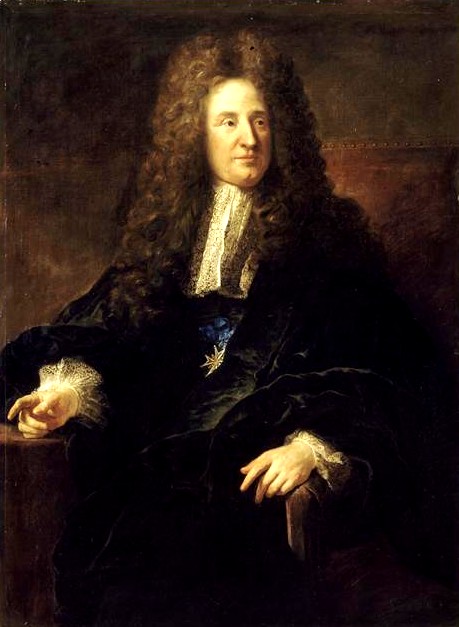
Portrait of Jules Hardouin-Mansart (1646-1708), Premier architecte du Roi by François de Troy (9 January 1645 – 21 November 1730), 1699. Palace of Versailles. see – http://collections.chateauversailles.fr/#14206cd6-00df-409f-8ae8-600784935955

From the United Center to the Court of the Sun King
In 2012, when former Chicago Bulls superstar Michael Jordan listed his estate for sale, it hit the market at a staggering $29 million. For that price, the legendary athlete’s residence boasted an impressive 32,683 square feet situated on seven acres of prime land near Chicago.
Yet, how does the King of B-ball stack up against Louis XIV’s Palace of Versailles? The royal French château spans an unimaginable 720,000 square feet anchored across two thousand acres of land. A visitor who finishes wandering the 30 rooms of Jordan’s mansion could transition to wandering Versailles’ twenty-three hundred rooms.
A Treasury of Baroque Art
As one might expect, there is an overwhelming amount of historic art to absorb inside the château. By official inventories, the palace walls and vaults play host to 6,123 paintings, 1,500 drawings, 15,000 engravings, 2,000 individual sculptures, and more than 5,000 pieces of masterfully crafted period furniture.
While the structural expansion of the palace took place in waves beginning in the 1670s, it is particularly fascinating to hear Marc-Antoine Charpentier’s Messe et Motets Pour La Vierge performed inside its Royal Chapel. Composed in 1702, this brilliant piece of contemporary liturgical music was uniquely hosted in an architectural space that, at the time, was also brand new. The sacred structure was eventually completed in 1710 under the direction of the First Architect to the King.
The Masterpieces of Hardouin-Mansart
The genius French Baroque architect Jules Hardouin-Mansart was the mastermind who designed both the breathtaking Galerie des Glaces (the Hall of Mirrors) and the soaring Royal Chapel at the Palace of Versailles.
While they share a designer, their production timelines and artistic decorators varied across the decades:
- The Hall of Mirrors: Construction began in 1678 and concluded in 1684. Its magnificent vaulting ceiling was painted entirely by the King’s first painter, Charles Le Brun.
- The Royal Chapel: Construction began much later in 1699. Because Le Brun had passed away years prior, the chapel’s majestic, vaulted ceilings were instead adorned with sweeping biblical frescoes painted by Baroque masters Antoine Coypel, Charles de La Fosse, and Jean Jouvenet.
Charpentier’s music blends soloists, chorus, and orchestra into an integrated religious and artistic expression while his legacy endures through modern historically informed performances that bring early music to contemporary audiences including Messe et Motets pour la Vierge which demonstrates the sophistication of French sacred music at the dawn of the eighteenth century.
Performance Vocalists and Musicians
Emmanuel Bardon, countertenor
Yves Bergé, bass
Pascal Bertin, countertenor
Daniele Carnovich, bass
Raphaële Kennedy, soprano
Jean François Novelli, tenor
Jordi Ricart, baritone
Arianna Savall, soprano
Judit Scherrer-Kleber, mezzo-soprano
Elisabetta Tiso, soprano
Luis Vilamajo, tenor
Jordi Savall, pardessus de viole
Guido Balestracci, bass viol
Bruno Cocset, bass violin
Imke David, haute-contre de viole
Xavier Diaz-Latorre, theorbo
Luca Guglielmi, organ and harpsichord
Marc Hantai and Charles Zebley, transverse flutes
Xavier Puertas, violone
Joanna Valencia, tenor viol




Pingback: Marc-Antoine Charpentier (1643-1704) : Messe et Motets Pour la Vierge (1702). Avec Jordi Savall / Mass and Motets for the Virgin (1702) by Marc Antoine Charpentier (French, 1643-1704) | Apologie du Grand Siecle
Pingback: Marc-Antoine Charpentier (1643-1704) : Messe et Motets Pour la Vierge (1702). Avec Jordi Savall / Mass and Motets for the Virgin (1702) by Marc Antoine Charpentier (French, 1643-1704) | Apologie du Grand Siecle
I have noticed you don’t monetize your website, don’t waste your traffic, you can earn additional cash
every month because you’ve got high quality
content. If you want to know how to make extra bucks, search
for: best adsense alternative Wrastain’s tools