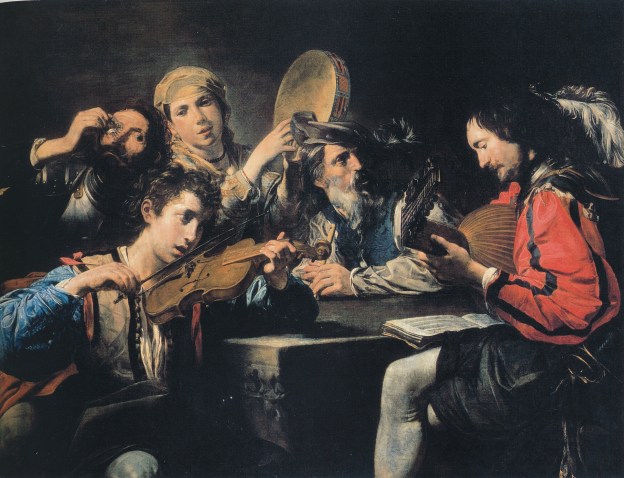
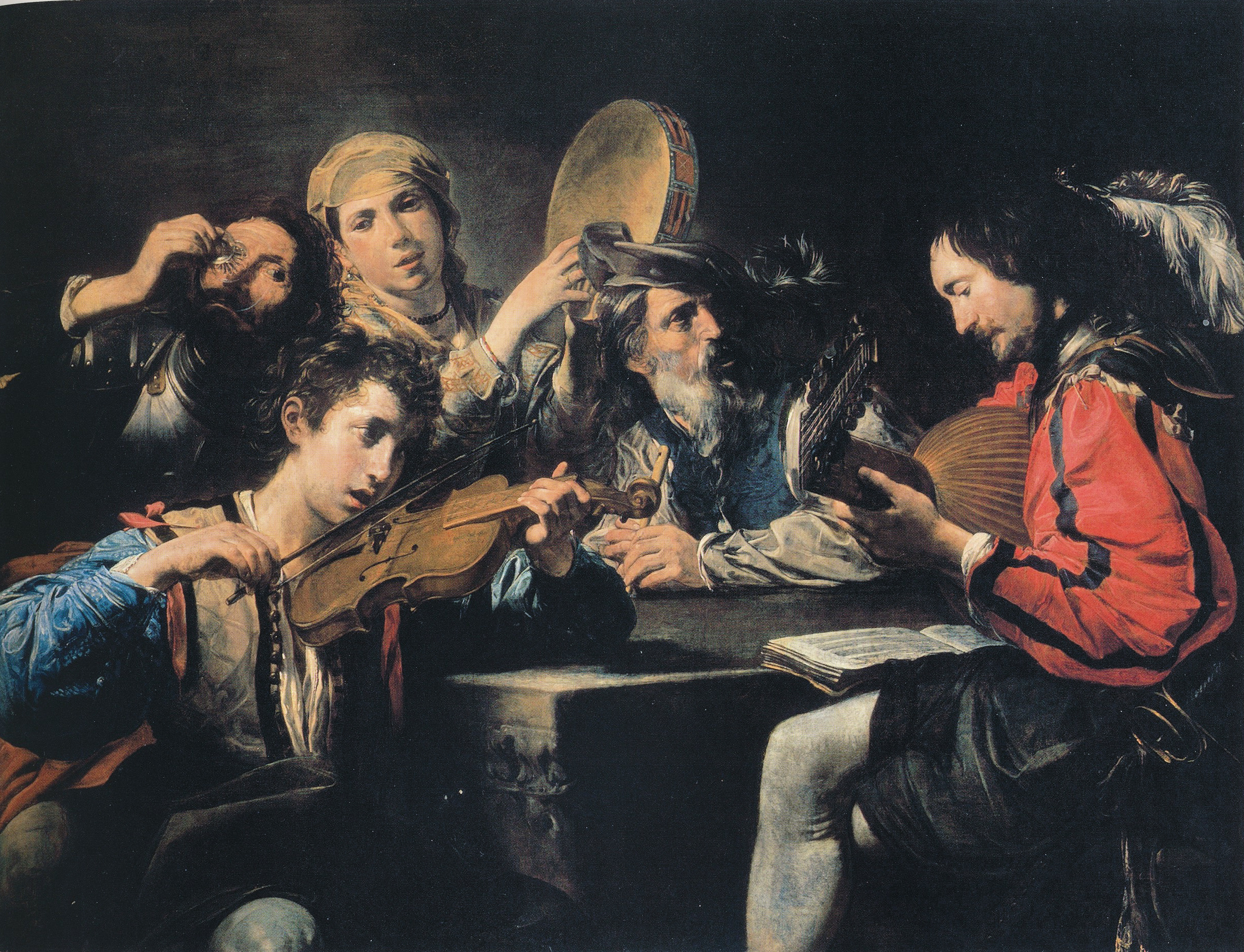
FEATURE IMAGE: Valentin de Boulogne (1591-1632), A Musical Party, 1623/26, oil on canvas, 44 × 57 3/4 in. (111.76 × 146.69 cm), Los Angeles County Museum of Art. https://collections.lacma.org/node/186803
Valentin de Boulogne was one of the most accomplished French painters of the 17th century, transforming Caravaggio’s revolutionary realism into a sophisticated visual language of psychological depth, religious drama, and human emotion. Working in Rome at the height of the Baroque era, he helped make French art an international force while bridging the worlds of Italian Caravaggism and the emerging French classical tradition.
Ruins of the Coliseum in Rome, Circle of Willem van Nieuwlandt, II, c. 1600, Pen and brown ink, with brush and brown and gray wash, on pieced cream laid paper, 35.3 × 61.3 cm (13 15/16 × 24 3/16 in.) The Art Institute of Chicago. https://www.artic.edu/artworks/95904/ruins-of-the-coliseum-in-rome
INTRODUCTION
Le Valentin de Boulogne (c.1591/1594-1632), sometimes called Jean Valentin, Jean de Boulogne Valentin, or simply Le Valentin, was a French painter. Born in Coulommiers-en-Brie about 35 miles east of Paris, Le Valentin may have been at least half Italian. His artwork was certainly influenced by Italian painting more than any other though he was familiar with Northern or Flemish painting. Le Valentin may have been in Rome as early as 1612. German painter and art-historian Joachim von Sandrart (1606-1688) remarked in 1675 that Valentin reached Rome before Simon Vouet (1590-1649) who had arrived around 1614. Whether in 1612 or definitely by 1620 (Le Valentin appears in the census), Le Valentin spent the rest of his life In Rome. In the Eternal City Le Valentin was greatly influenced by Simon Vouet (French, 1590-1649) and Bartolomeo Manfredi (Italian, 1581-1622), a leading Caravaggiste or follower of Carravaggio (Italian, 1571-1610).
Le Valentin’s oeuvre is today around 55-60 paintings, most of them identified by modern scholarship (i.e., Jacques Bousquet; Roberto Longhi). Le Valentin’s major commissions date from the last seven years of his life. Opportunities to acquire his artwork was rare, though avid collectors such as Cardinal Mazarin (1602-1661) and Louis XIV collected them.
Major patrons included the powerful Barberini family, Cardinal Mazarin, and eventually Louis XIV.
Joachim von Sandrart, Self Portrait, 1641.Bartolomeo Manfredi, The Martyrdom of St. Bartholomew (detail).Simon Vouet, Self-portrait, c. 1626–1627 Musée des Beaux-arts de Lyon.
Valentin was closely associated with the community of French artists working in Rome, including Simon Vouet and Nicolas Poussin.
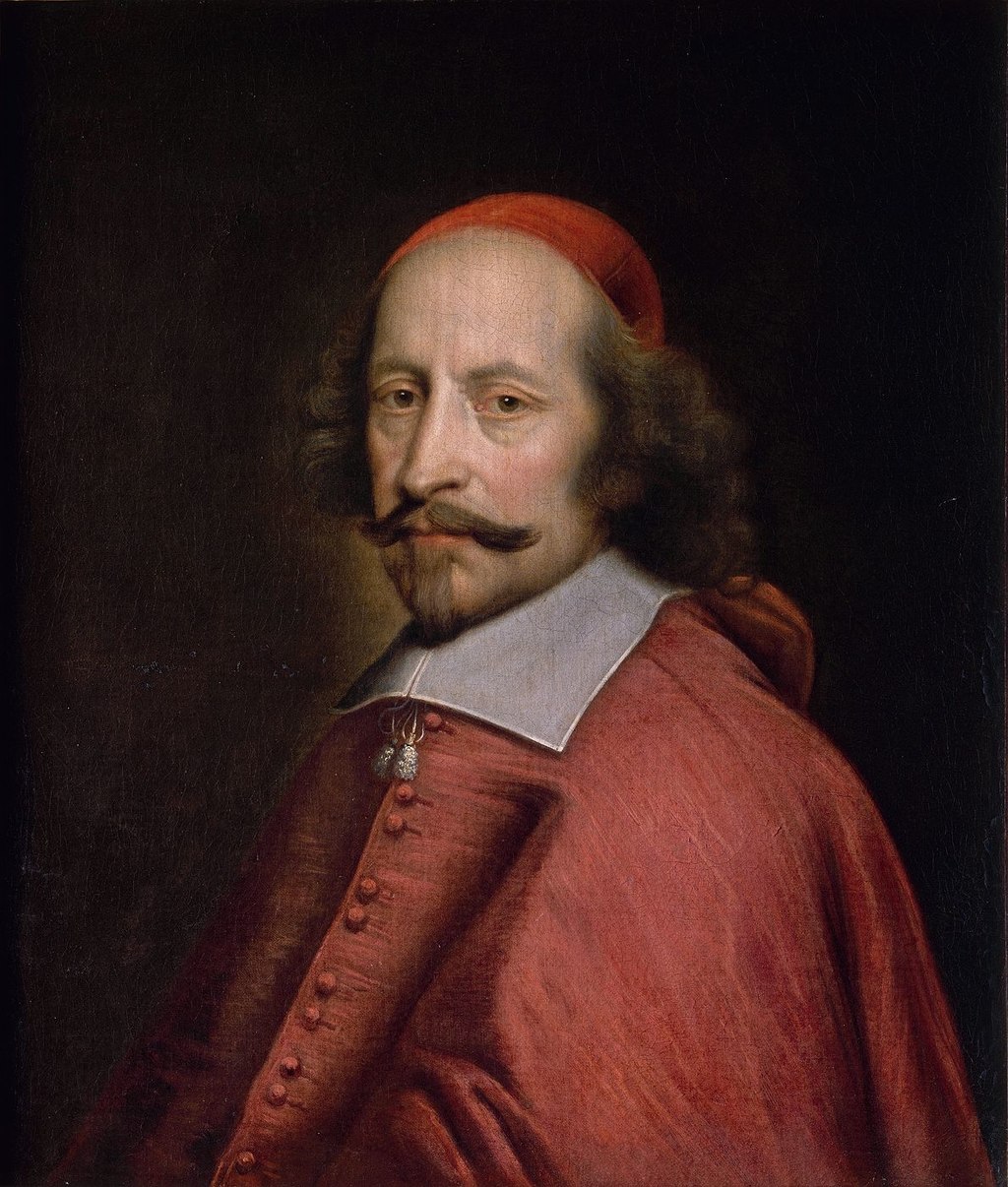
Cardinal Mazarin by Pierre Mignard, Musée Condé, Chantilly, France.Louis XIV, Charles Le Brun, Château de Versailles.Piazza del Popolo, Rome. “Piazza del Popolo.. Rome” by Nick Kenrick.. is licensed under CC BY 2.0
Dominating the left side of the photograph of Piazza de Popolo is the dome and Neoclassical portico of Santa Maria in Montesanto. This church sits alongside its counterpart, Santa Maria dei Miracoli (partially obscured), framing the entrance to the Tridente streets. Pope Alexander VII commissioned these twin churches to build a grand theatrical backdrop to greet arrivals. In the lower-right foreground, the stone balustrade and sculptures belong to the Fontana della Dea Roma designed by Giuseppe Valadier. The statue group overlooks the expansive, oval open square. For centuries and at the time of Le Valentin’s arrival to Rome, this square was the primary northern entrance to the city. Anyone traveling to Rome via the ancient Via Flaminia entered through the Porta del Popolo (the northern gate) right into this piazza, making it the traveler’s very first impression of the Eternal City. Later, in the early 19th century, architect Giuseppe Valadier redesigned the piazza into its famous harmonious oval shape, seamlessly connecting the urban space to the natural landscape of the Pincio Hill. The piazza serves as the origin point for three major arterial streets—Via del Corso, Via del Babuino, and Via di Ripetta—which fan out into the heart of Rome’s historic center.
Valentin de Boulogne spent most of his artistic career in Rome, where he became one of the leading followers of Caravaggio.
In Rome Le Valentin forged close ties with other French artists and lived with many of them in and around the Piazza del Popolo to the Piazza di Spagna. Most French painters born in the 1590s made a stay in Rome – and influenced art in France in the 17th century. Reasons young painters fled to Italy in the early 17th century included depletion of opportunity in Paris due to the professionalization of artistic practice in and outside the capital although establishment French art was no longer flourishing. Conversely, Roman art – and not only the schools of Michelangelo and Raphael but new horizons afforded by Annibale Carracci (1560-1609) and Caravaggio (1571-1610) -was at an apex. The Eternal City was drawing international artists from Paris and elsewhere and, between 1610 and 1630, the Roman style became internationalized. The dialogue among artists in Rome in this period was exciting – and its outcomes often unpredictable. The culture of Rome (and the papacy) could actually be liberating for foreign, usually destitute, often libertine talented young artists who had great ambitions for a prominent commission as they were exposed to Rome’s virtue and vice almost equally. Many of these young artists, even ones whose artworks survive, exist today virtually anonymously. Le Valentin de Boulogne is one of the better-known artists of the period, although his precise name is uncertain and his artwork requires connoisseurship based on modern scholarship.
Annibile Carracci, Self-portrait, 1604, Hermitage Museum, St. Petersburg, Russia.Caravaggio, David with the Head of Goliath, included a self portrait of the artist, 1610, oil on canvas, Borghese Gallery, Rome.
In 1626 Valentin, in Rome several years, was invited by Vouet to organize with Nicolas Poussin (1594-1665) the festival of the Accademia di San Luca ‘s patron saint. Around the same age, Vouet led the academy whose artists’ association was founded in 1593 by Federico Zuccari (1539-1609). This appointment signaled that Valentin was an active and respected rising French artist in Rome in these years. Though Caravaggio died in 1610 his influence was still felt very strongly in Rome in the 1620s.
Two of Caravaggio’s masterpieces—The Martyrdom of Saint Peter and The Conversion of Saint Paul—hung in the neighboring church of Santa Maria del Popolo which Le Valentin certainly had opportunity to study. In Italy, Valentin took swift, direct, and enduring inspiration from Caravaggio’s chiaroscuro and realistic depiction of characters drawn from Roman street life, including extensive use of half figures. As one of the young Caravaggisti, Valentin applies these elements to his artwork, whether genre or, later, Biblical subjects.
None of the works from Le Valentin’s earliest Roman years is documented, but it is believed he produced his Card Sharps (Dresden, Staatliche Kunstsammlungen), The Fortune Teller (Toledo Museum of Art), and Soldiers Playing Cards and Dice (The Cheats) (NGA) – and probably in this order – between 1615 and 1620.
In Le Valentin’s compositions which often contain several actors in a scene, the French artist’s realism and Caravaggio-inspired technique is often imbued with energetic rhythm in which diagonals and geometric concurrences play a role. This schematic suggests animation in the subject matter while retaining the human figures’ inner reserve and mystery. This creates a psychological quality in his artwork that is unique whichever drama is unfolding in the picture. Louis XIV who was an admirer of le Valentin acquired and hung several of his paintings in his bedroom at Versailles. Cardinal Mazarin, another art collector with a keen eye, acquired works by Valentin, some of which today are in the Louvre.
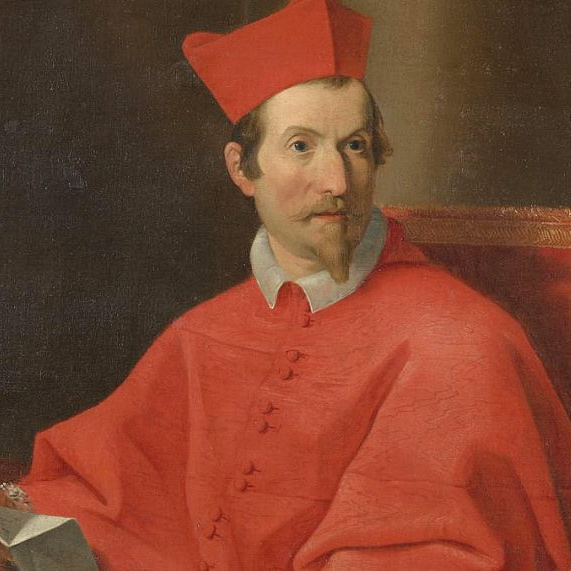
Andrea Sacci, Cardinal Francesco Barberini, Wallraf-Richartz-Museum, Cologne, Germany, oil on canvas, c. 1631-1633 (detail).
By way of Le Valentin’s important young patron, Cardinal Francesco Barberini (1597-1679) – made a cardinal in 1624 by his uncle, Pope Urban VIII (1568-1644) – Valentin became a competitor to his artist friend Nicholas Poussin. Le Valentin’s first documented work commissioned in May 1629 and completed in the spring of 1630 called Martyrdom of SS. Processus and Martinian is a compendium to a slightly earlier work by Poussin–both in the Vatican (Poussin’s was a different stylistic statement called Martyrdom of S. Erasmus). Valentin had further won the patronage of Cavaliere del Pozzo (1588-1657), the secretary of Cardinal Francesco Barberini and one of Rome’s leading art patrons. Paid the handsome sum of 350 crowns for Martyrdom of SS. Processus and Martinian , after 1630 Valentin’s artwork continued to command high prices and prestige.
His paintings combined dramatic chiaroscuro, realism, and intense psychological observation.
Valentin de Boulogne, Martyrdom of Saints Processus and Martinian, 1629–30, Oil on canvas, 118 7/8 × 75 9/16 in. (302 × 192 cm), Vatican Museums, Vatican City/Jan van den Hoecke (Flemish, 1611-1651), Portrait of Cassiano dal Pozzo. Pozzo’s portrait was painted by Le Valentin though it is lost.
Though SS. Processus and Martinian is Le Valentin’s most important public work, he also produced many pictures for private commissions. There are several pictures by, or today attributed to, Le Valentin in many of the world’s leading art museums. Le Valentin produced artwork especially for the ruling Barberini family and their circle.
How Le Valentin died in 1632 is not certain though it was sudden and of natural causes. The professional artist who is admired in today’s major art institutions reportedly left no money to pay for a funeral. Identified as a “Pictor famosus” on his death certificate, Le Valentin was buried at Santa Maria de Popolo on August 20, 1632 paid for by Cassiano dal Pozzo (1588-1657).
His subjects ranged from tavern scenes and musicians to biblical narratives, martyrs, saints, and allegories. Remarkable among Caravaggisti, Valentin infused his figures with unusual emotional complexity and interior life.
One of the most moving and beautiful stories in the Bible is the judgment of King Solomon in the case involving two disputing harlots over who was the mother of a living child (I Kings).
Both had had a child, though one died and the other lived. To have an offspring was considered a blessing. One harlot claimed that her living child had been taken from her bosom at night by the other harlot. She replaced the child with her dead child after “she had smothered him by lying on him” (I Kings 3:19).
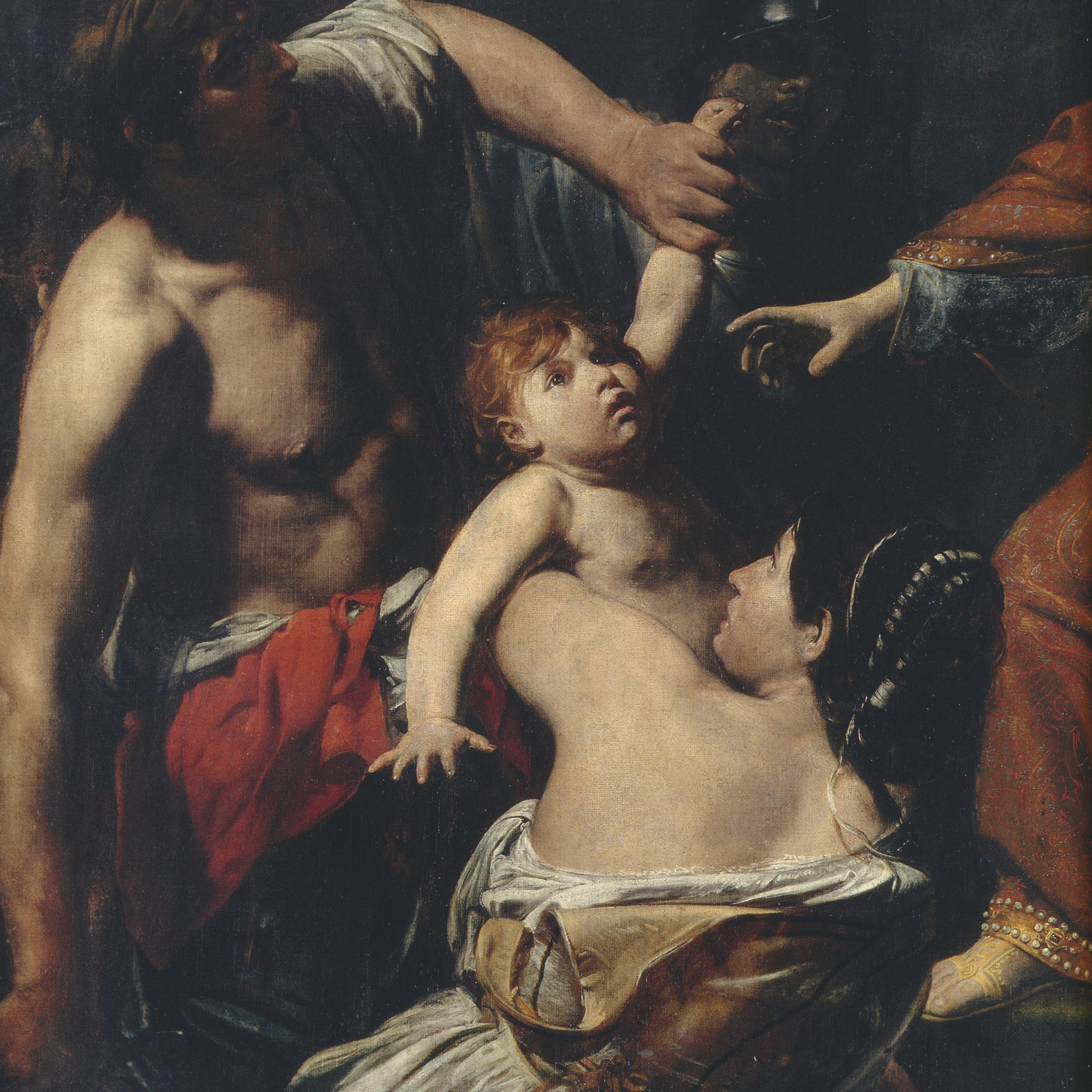
Since this was a case of one harlot’s word against another’s Solomon had no simple and fair resolution at hand. King Solomon said: “Cut the child in two and give half to one woman and half to the other” (I Kings 3:25). Le Valentin shows the viewer what is at stake – a real flesh and blood child. The import of Solomon’s judgment could not be missed. Le Valentin’s women are modeled on those mothers and others the artist observed along Via Margutta.
Detail. Judgment of Solomon. Le Valentin.
When one harlot said, “Divide it! it shall be neither mine nor yours!” and the other harlot said, “Please, my lord, give her the living child. Please do not kill it!”, the king’s judgement changed.
Solomon spoke again and said, “Give her the child alive, and let no one kill him, for she is his mother” (1 Kings 3: 16-28). Solomon knew a woman privileged to be a mother would seek to see the child live most of all.
It is this final pronouncement that Solomon appears to give in Le Valentin’s painting, as the complete biblical episode can be readily seen in the gestures and expressions of its characters.
Acquired by Louis XIV at Cardinal Mazarin’s death in 1661, The Judgment of Solomon has long been presented as a counterpart to The Judgment of Daniel. These canvases, which may actually be pendants, share the same format and show examples of just judgment in the Bible. The Judgment of Solomon is dated later than The Judgment of Daniel. There is a variant of it by Le Valentin in Rome at the Barberini Gallery in the same format and oil medium. The Louvre painting was restored in 1966.
The subject is taken from chapter 13 of the Book of Daniel, the book’s addendum. In Babylon, a pair of wicked elders covet Suzanne, “a very beautiful and God-fearing woman” who was the wife of the “very rich” and “most respected” Joachim. After these wicked elders surprised Suzanne in her bath, she refuses their advances and they denounce her for adultery with the intent to put her to death.
Daniel condemns these wicked elders for “growing evil with age” including their past sins of “passing unjust sentences, condemning the innocent, and freeing the guilty.” Daniel interrogates them and, by their own words, shows the assembly they are lying. The painting depicts that moment of judgment.
His work reflects the international artistic culture of Rome in the early Baroque period.
Detail. Judgment of Daniel. Le Valentin.
Le Valentin depicts Daniel in the painting instead of Suzanne in her bath which was a more popular subject. Suzanne is at right, her hands across her chest, “As she wept, she looked up to heaven, for she trusted in the Lord wholeheartedly” (Daniel 13:35). A guard seizes one of the wicked elders as the other shows surprise and incredulity. Young Daniel, at left, is seated on a throne under a red canopy and stretches out his hand in judgment over the scene for their sin. For each judgment by Le Valentin the artist was inspired in some of its details by Raphael’s artwork in Rome. Louis XIV acquired the painting in 1662.
Valentin de Boulogne, Martyrdom of Saints Processus and Martinian, 1629–30, Oil on canvas, 118 7/8 × 75 9/16 in. (302 × 192 cm), Vatican Museums, Vatican City.
Within iconography that is cyclonic, two Roman soldiers are placed on the rack to be tortured after they refused their commander’s orders to sacrifice to an idol. The soldiers had been converted to Christianity by Saints Peter and Paul when they guarded them in prison. The altar to Jupiter is on the upper left while, at right, the commander clutches his eye with his left hand after God blinded him in retribution for the idolatry. The foreground figures build on 16th century Franco Italian Mannerist style. One has his back to the viewer; another grinds the wheel of the rack; and, a third bends down with his arm outstretched. All are advanced expressions of realistic figural development and rendered in spatial perspective correctly.
Le Valentin’s powerful painting is an artwork with a psychological dimension. To the left, a hooded figure, Lucina, is a Christian woman who encourages the martyrs to be steadfast as an angel out of heaven extends a palm of martyrdom. To the right, realistically portrayed, is a Roman soldier indifferent to another brutal slaying by the authoritarian government in the face of nascent, meddling, heroic, and expanding Christians in their pagan global empire.
With his attention to detail, Le Valentin’s picture accomplishes an exciting imagined drama based on Renaissance-inspired natural world observation and by way of colorful contemporary 17th century formulations that give a viewer visionary immersion into a complex and significant Bible scene.
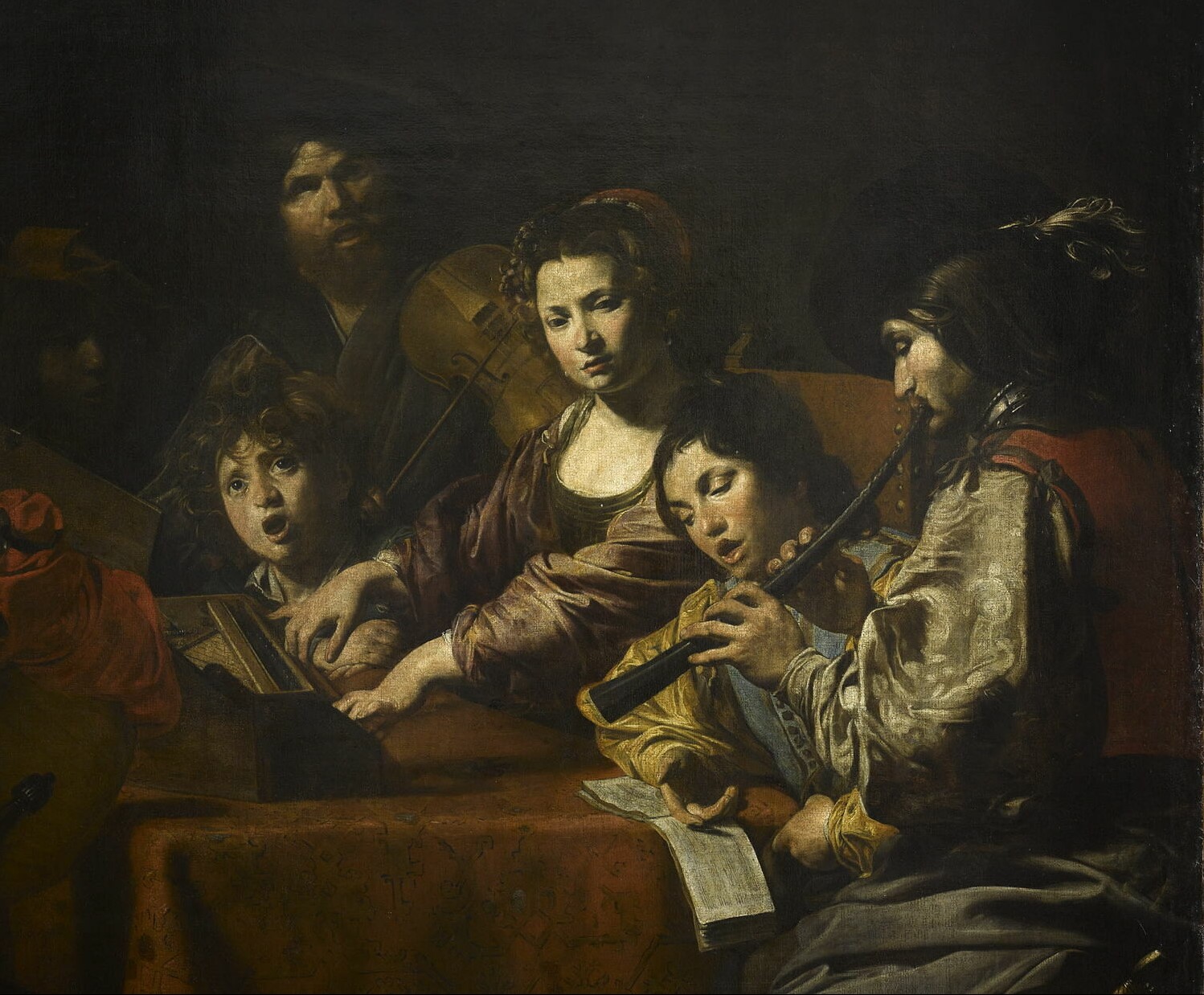
Some of Le Valentin’s great ambition as an artist is demonstrated by this large format canvas whose composition includes eight realistically delineated figures including 5 musicians and 3 singing youths. The five instruments are depicted accurately as well as the demeanors of the musicians and singers. Instruments have been identified by others as a polyphonic spinet, an alto, a chitarrone, a bass viol and a cornetto.
Detail. Concert in an Interior. Le Valentin.
The painting had been dated at around 1626, though more recent connoisseurship dates it to around 1628 or 1630. It was restored in 1940. It was owned by that avid art collector, Cardinal Mazarin.
Valentin de Boulogne (1591-1632), The Concert in bas-relief, 1624/26, oil on canvas, 1.73 m x 2.14m, Louvre.Detail. The Concert in bas relief. Le Valentin. Detail. The Concert in bas relief. Le Valentin.
Le Valentin painted seven figures gathered around a classical bas-relief. There are a pair of drinkers, one in the foreground, the other in the background; two singers; and three musicians – a violinist, guitarist and lutenist.
The painting, filled with mystery and gravity, is Caravaggesque and not merely telling a story or depicting a genre scene of performance. The painting has been dated to as early as 1622 by some connoisseurs. It was owned by Cardinal Mazarin and restored in 1959. It entered the collection of the Louvre in 1742.
Valentin never ceased producing genre paintings as attested by Concert with Eight Figures and Fortune Teller (both Musée du Louvre, c. 1628), and what is thought to be his very last painting, the Gathering with a Fortune Teller (Vienna, Liechtenstein Collection) in 1632.
Valentin de Boulogne (1591-1632), Musicians and Soldiers, c. 1626, oil in canvas, 155 x 200 cm, Musée des Beaux-Arts, Strasbourg.
This is a tavern scene with impromptu music-making among transitory musicians. They are playing for a pair of drinking soldiers. Le Valentin’s painting is Caravaggesque with its interplay of shadows and light, dark palette, and depiction of realistic figures, and a psychological vivacity that is imbued by Le Valentin. It is by his passion and energy for Caravaggio that Le Valentin helped revolutionize art in 17th century Europe.
Valentin de Boulogne (1591-1632), Jesus and Caesar’s Coin, around 1624, oil on canvas, 1.11 m x 1.54m, Louvre.
In Matthew’s Gospel the Pharisees were plotting to entrap Jesus by his own words. They sent some of their followers along with local government types (“Herodians”) to flatter Jesus as a truthful and humble man. They asked him to reply to a question: “Is it lawful to pay the census tax to Caesar or not?” (Mt 22:17).
Jesus, knowing their motivation, responded hardly very nicely, by calling them “hypocrites.” He asked them to show the coin that paid Caesar’s tax.
Le Valentin’s painting depicts the moment when the Pharisee’s henchmen show Jesus the coin with Caesar’s image and inscription on it. Jesus tells them: ”Repay to Caesar what belongs to Caesar and to God what belongs to God” (Mt 22: 21).
Owned by Louis XIV it was put in his dressing room at Versailles in 1680. The Louvre acquired it during the French Revolution in 1793.
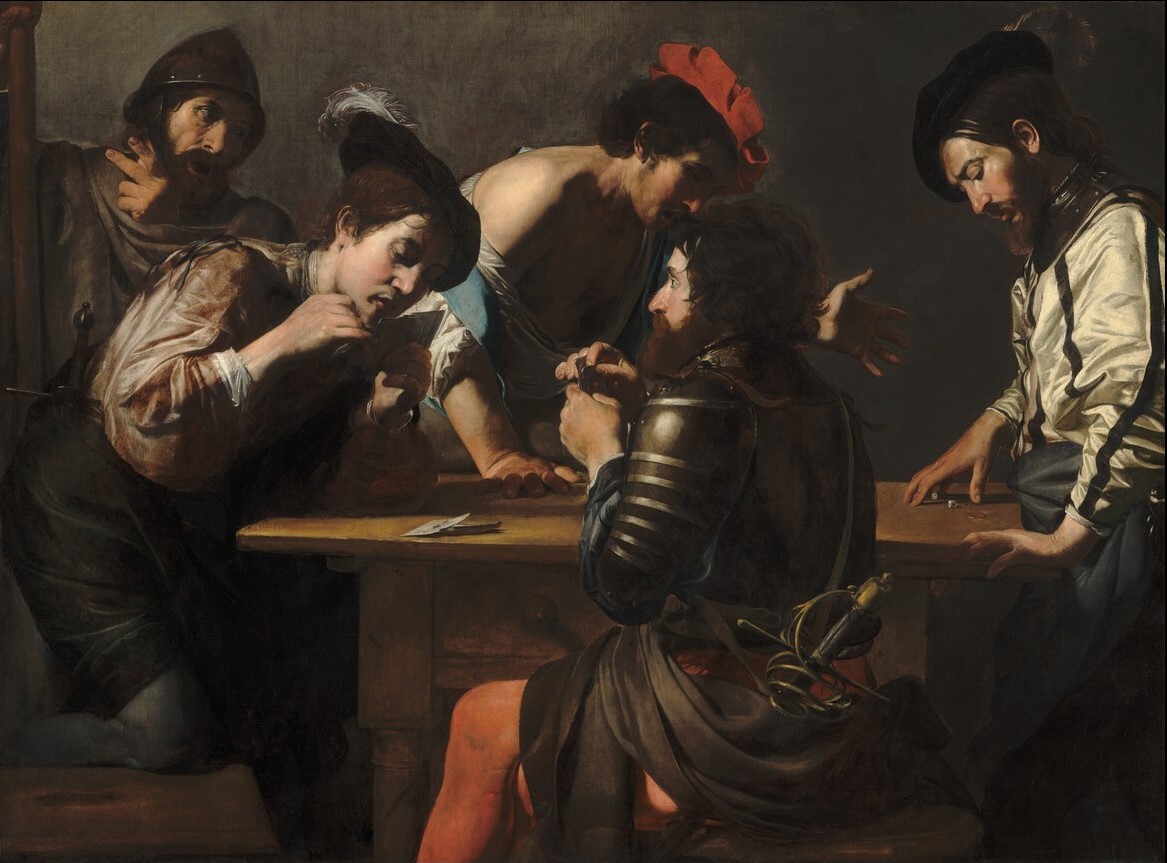
Valentin de Boulogne (1591-1632), Soldiers Playing Cards and Dice (The Cheats), c. 1618/1620, oil on canvas, 121 x 152 cm (47 5/8 x 59 13/16 in.), The National Gallery of Art, Washington DC. https://www.nga.gov/collection/art-object-page.107315.html
This painting is inspired by Caravaggio’s The Cheats in the Kimbell Art Museum in Fort Worth, Texas. Le Valentin’s painting, only discovered in 1989, shows a group of soldiers idling in Rome and identifiable by their piecemeal armor and other livery. The crowding of the figures into the picture space adds to the scene’s tension.
In this early painting in Rome, Le Valentin presents a scene of its contemporary street life. These figures are seriously gaming at a table where two players (center and right) roll dice and two others (left and center) play cards. A fifth figure in the background signals to his accomplice what is in the hand of the card player in a feathered hat. It is an early artwork that Le Valentin gives a psychological dimension.
As had been Caravaggio’s practice, the artwork is painted alla prima, that is, directly onto the prepared canvas without under-drawing or any preliminary work which works to give it greater spontaneity. The painting is indebted to Caravaggio not only for its subject, but for its vivid sense of actuality with which Le Valentin invested his protagonists as well as for the chiaroscuro, and a thinly and rapidly-applied brushed execution.
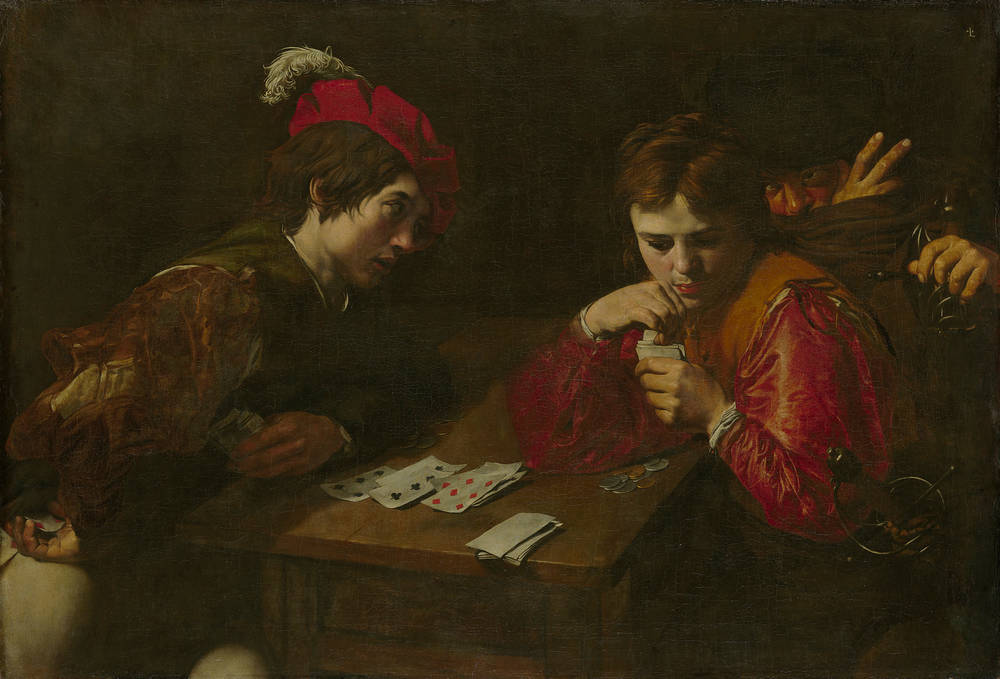
This painting is one of the first genre pictures Le Valentin painted in Rome. It is a pair of figures to which Le Valentin would soon numerically expand in his pictures. The composition is simple and sturdy.
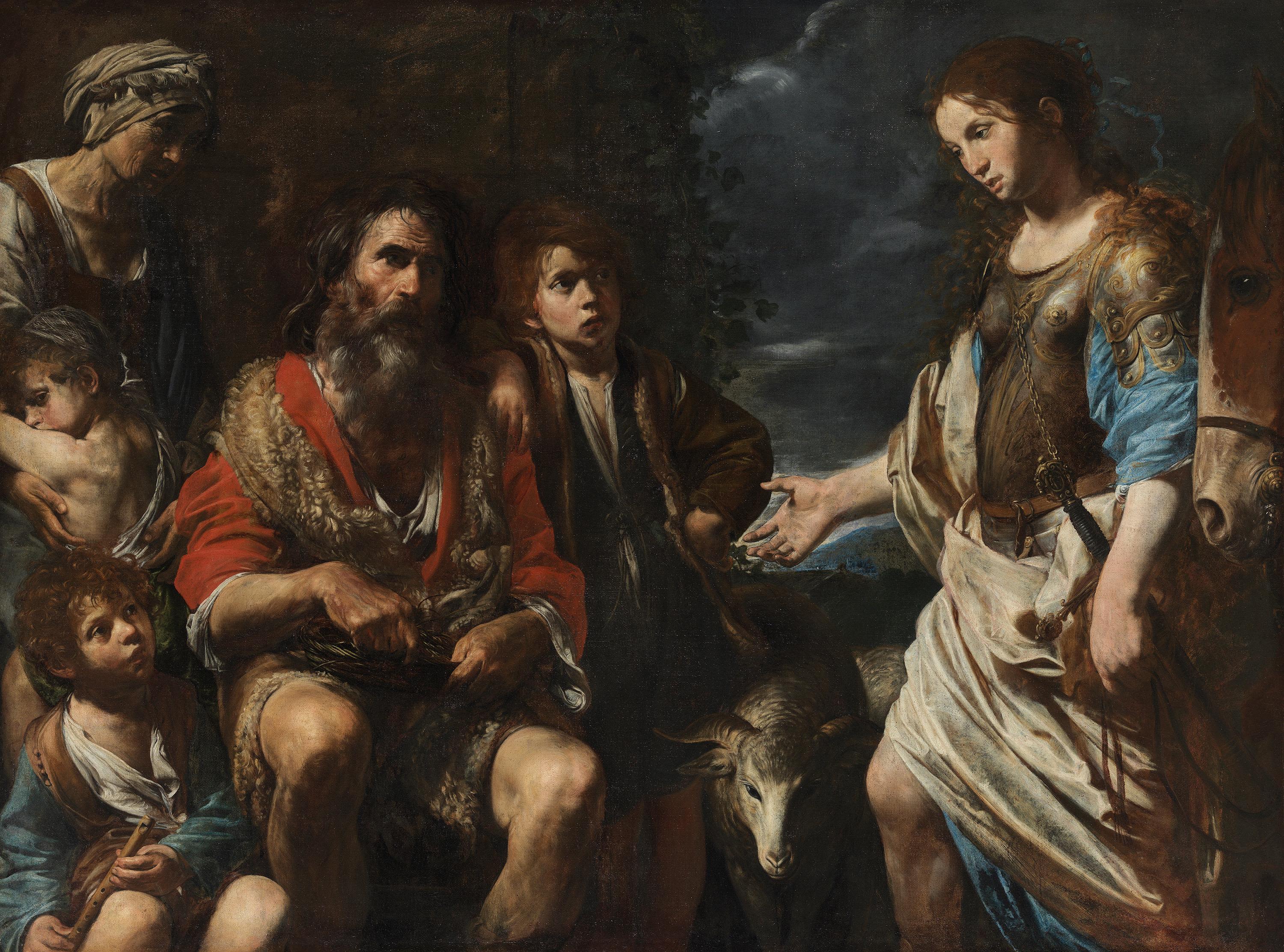
Valentin de Boulogne (1591-1632), Herminia among the Shepherds, c. 1630, oil on canvas, 134.6 x 185.6 cm (53 1/8 x 61 5/8”) Bayerische Staatsgemäldesammlungen – Alte Pinakothek München. https://www.sammlung.pinakothek.de/de/artwork/RQ4XPr8410
Erminia, the king’s daughter, escapes her persecutors and asks a peaceful shepherd family for shelter. The scene is based on a contemporary (1576) epic poem The Liberated Jerusalem by Torquato Tasso (1544-1595). The picture was a private commission whose patron was likely a Roman art collector and cognoscente. Valentin’s painting combines Caravaggesque chiaroscuro with exquisite coloring. In this realistic depiction of a human encounter between characters who represent contrasting social experiences, the subject matter is rendered psychologically sensitively.
Valentin de Boulogne (1591-1632), Crowning of thorns of Christ, around 1616/17, oil on canvas, 173 x 241 cm Bayerische Staatsgemäldesammlungen München-Alte Pinakothek, Munich https://www.sammlung.pinakothek.de/de/artwork/bwx0jkJGm8
One of the great artworks of Le Valentin’s early phase in Rome, biblical subjects painted before 1620 such as The Crowning of Thorns of Christ were interpreted in the street-life idiom, with expressive protagonists and bystanders resembling the cast of characters in his genre paintings. Although the painting was earlier believed to be by Caravaggio, it may have been a pendant to Le Valentin’s much-later Abraham Sacrificing Isaac (c. 1629) in The Montreal Museum of Fine Arts.
This is Le Valentin’s most ambitious of 3 such “crowning with thorns” pictures. The artist in horizontal-format depicts Jesus before his going to Calvary. Christ is mocked and tormented; a crown of thorns is pressed onto his head (Matthew 27: 27-31; Mark 15:16-21; Luke 23:11; John 19: 1-3). With its dramatic lighting and shadows, the naturalistic depiction of Christ’s body and soldiers in contemporary costume is Caravaggesque.
Le Valentin’s scene adheres to the Bible episode: a whole cohort of soldiers surrounded Jesus, stripped off his clothes and threw a scarlet military cloak on him. Henchmen have weaved a crown out of thorns and are placing it on Jesus’s head. Another puts a reed as a faux scepter into Jesus’s right hand. To mock him they kneel before him and say: “Hail, King of the Jews!” The soldiers spit on Jesus and then take the reed away and strike him repeatedly with it. When they were done with these violent actions, the soldiers stripped Jesus of the military cloak, dressed him in his own clothes and led him out to be crucified.
Le Valentin’s Passion theme is a later vertical-format picture of a subject he had painted masterly before. In these last years the subject matter had gained in classical beauty as well as psychological involvement compared to Le Valentin’s earlier artwork. The painting covers over a discarded portrait of Cardinal Barberini which suggests Valentin’s close relationship with the ecclesial prince, very likely being in his employ. What caused the artist to revisit the subject of a brutalized Christ is unclear though it may have been based on the artist’s own struggles or that of his employer whose portrait he painted over.
Valentin de Boulogne (French, 1591–1632), Noli me tangere c. 1620. Oil on canvas. Perugia, Galleria Nazionale dell’Umbria.Valentin de Boulogne (French, 1591–1632), Christ and the Samaritan Woman c. 1620. Oil on canvas. Perugia, Galleria Nazionale dell’Umbria.Valentin de Boulogne (1591-1632), Martyrdom of St. Lawrence, 1622/24, oil on canvas, 195 x 261 cm, Prado, Madrid. Spain.
St. Laurence (225-258)—Laurentius is Latin for ”laurelled”—became a popular early Roman martyr. Laurence has been continually highly honored by the church since the 4th century and is a patron of Rome.
In the mid 3rd century, Laurence was archdeacon to the new pope, Sixtus II (257-258). Sixtus II was martyred along with his seven deacons, including Laurence, during the persecution of Christians by Emperor Valerian (199-264). When Laurence met the pope, the pope was under arrest and Laurence expressed the desire to join him in his sufferings. Sixtus promised Laurence that martyrdom would soon be his but in the meantime asked his archdeacon to distribute the church property among the poor. Word of this planned dispersal reached the ears of the Emperor and Laurence was arrested.
Following the pope’s martyrdom by decapitation, Laurence, in prison, was ordered three days’ reprieve to collect and hand over the church treasures to the emperor. Instead, Laurence gathered and distributed these goods to Rome’s poor folk and presented the people to the emperor. These paupers appeared in Le Valentin’s painting to the left.
Infuriated, the emperor ordered the Catholic deacon to sacrifice to Rome’s gods which Laurence refused to do (in prison Laurence converted his guard) and was summarily condemned. After undergoing a series of tortures, the 32-year-old Laurence was martyred by the method of being roasted alive over a fire on a spit. The saint is famously quoted as telling his executioners: “One side is roasted, so you can turn me over and roast the other side.”
In the Prado Le Valentin gives orderly arrangement to a complex scene of 15 figures and a horse. It shows the saint during his martyrdom isolated in the center of the composition. As with Caravaggio’s figures, the soldiers are in modern costume, use of chiaroscuro is evident, and further drama is added by the use of diagonals whose construction suggest movement that add to the tension of the naturally rendered figures. However, Le Valentin uses these derived elements unconventionally.
St. Laurence is the patron saint of people whose occupation involves working with fire such as traditionally cooks, bakers, brewers, textile cleaners, and tanners and also those whose occupation values fire prevention such as traditionally librarians, archivists, miners, and poor people. St. Laurence of Rome is also, truly, the patron saint of comedians.
Valentin de Boulogne (1591-1632), St Luke, Evangelist, 1624/26, oil on canvas, 120 x 146 cm, Palace of Versailles, Versailles.Detail. St. Luke Evangelist. Le Valentin.
Dating from the years 1624-1626, le Valentin painted all four Evangelists (Matthew, Mark, Luke and John) for the same religious order in Rome whose name is unknown. They entered the collections of the Sun King in 1670.
Valentin de Boulogne (1591-1632), The Last Supper, c. 1625, oil on canvas, Galleria Nazionale d’Arte Antica, Palazzo Barberini, Rome.
For his The Last Supper, Le Valentin was, at least through engravings, aware of Leonardo da Vinci’s Last Supper (c. 1495–1498) in Milan and Raphael’s Last Supper (1518-1519) in Palazzi Pontifici, Vatican. Le Valentin explores the 12 apostles’ reactions. Commissioned by Asdrubale Mattei (d. 1638), one of Rome’s nobili, to decorate a gallery in his family’s palace, the picture depicts a central event presented in the gospels. The moment that is depicted in these Last Supper paintings is when Christ announces that one of his disciples will betray him. Judas, in the foreground left, was treasurer for Jesus’s disciples and betrayed Jesus for a bribe payment of 30 pieces of silver. The picture, with its simple and monumental composition, so impressed Jacques-Louis David (1748-1825) in 1779 that he copied it and sent it from Rome to Paris.
An Old Testament Judge, Samson was born in a miraculous fashion and with an angel telling his mother and father, “No razor shall touch his head” (Judges 13:5). Samson is often depicted with his locks unshorn. As a youth Samson displayed an incredible physical strength attributed to “the spirit of the Lord rushing upon him” (Judges 14:6).
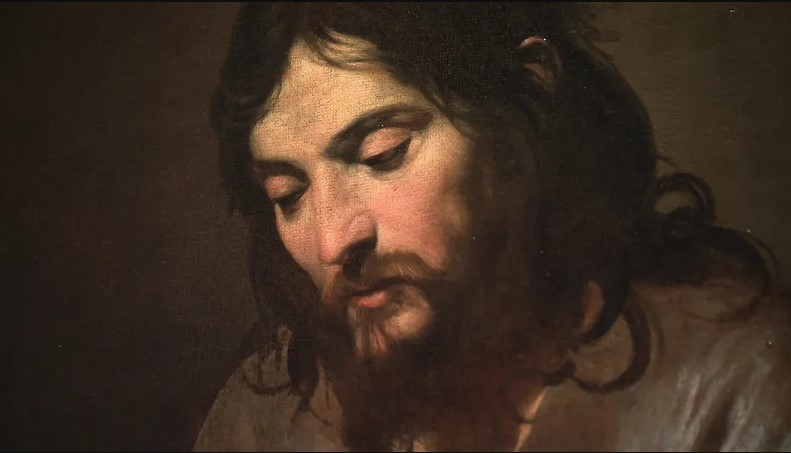
Le Valentin’s picture presents Samson’s legendary strength by showing the solid demeanor of his physical body as well as objects which hold symbolic value of his strength. These include that he killed a lion with his bare hands and liberated the Israelites by slaughtering a thousand Philistines with a donkey’s jawbone (Judges 15: 15-16). The strength of his arm is displayed as his fingers curl under his jaw as his wandering gaze looks off with intense interiority. One contemporary allusion in the painting is Samson’s breastplate which is joined at the shoulder by a clasp in the form of a bee which was the emblem of the Barberini family who commissioned the painting. It is speculated that the facial features of Samson in a picture before his fateful meeting with Delilah (Judges 16), may be a self-portrait of Le Valentin.
Valentin de Boulogne (1591–1632), Judith with the Head of Holofernes. c. 1626-27. Oil on canvas. Musée des Augustins, Toulouse.
The story of Judith in the Old Testament relates of a woman of great beauty and reverence to the God of Israel who is highly respected by her people and its leaders. The nation, desperate for survival, turns to Judith who is given the opportunity to kill their enemy’s military leader which she believes she can and must do and that all believed impossible as Israel’s military defeat by their enemies was a foregone conclusion.
The story has a femme fatale aspect as Holofernes was captivated by Judith’s physical appearance, but the Biblical episode of the execution, while a climax of her mission, pales in comparison with the relating of Judith’s overall dedication to her people and her God, a femme forte, which carries on into her long life of blessedness to her natural death. Le Valentin chooses that sacred element of the Bible book when he shows an iconic Judith, triumphant woman of Israel, holding in her hands the decapitated head of one of Israel’s once-formidable mortal enemies. Judith is shown as a heroic woman with her hand raised as she admonishes: “But the Almighty Lord hath disappointed them by the hand of a woman.”
For Le Valentin’s artwork, Judith is an icon of God’s justice to his obedient people. Purchased for French King Louis XIV from German banker Everhard Jabach, the picture was installed in the king’s bedroom at Versailles to be especially admired.
The picture belongs to Le Valentin’s period of maturity for it displays the artist’s full interpretation of the realism of Caravaggio and Manfredi though, as expressed here, with a new appreciation for colors. The pretext of a Judith who, according to the Bible, had adorned herself in her best finery so not to dissuade Holofernes’s gaze (Judith, 13, 14), allows le Valentin to illuminate the dress’s rich fabrics with monochrome refractions, while the jewels and hair are bathed in ethereal light.
The Four Ages of Man is a painting commissioned by Cardinal Barberini. It is an allegorical work whose human figures are painted by Le Valentin in natural poses. Groups of figures around a table were common in the work of Caravaggio and his northern followers. The allegory of the ages of man was a common subject for paintings during the sixteenth and seventeenth century, though its quantity of ages varied.
The allegory presents humanity in four categories of age – childhood (holding an empty bird trap); youth (playing a lute); adulthood (with a book and victor’s laurel); old age (with coins of wealth and delicate glassware).
The theme had its origin in classical literature: Ovid’s Metamorphoses and Dante’s Inferno acknowledged the stages of human life according to physical growth and decline. Contemporary poems were written on the subject that Le Valentin may have known.
In the 17th century, the painting was owned by Michel Particelli, seigneur d’Emery (1596–1650) in Paris. In the 18th century it was in the Orléans collection at the Palais Royal. During the French Revolution and the dispersal of the collection in 1791, the painting was brought to England where it is today.
Le Valentin painted many half- or three-quarter-length figures of saints, prophets and narrative scenes including this painting. The scene of Christ expelling the moneychangers from the Temple of Jerusalem is told in all four gospels of the New Testament. Le Valentin adapted the method of half-length, full size street figures depicted in dark, precisely lighted spaces and emerging in relief from the shadows from the Caravaggistes.
Gospel readers would recognize that the cleansing of the temple was prophesied in the Old Testament as a sign of the ushering in of the Messianic Age (Zechariah 14:21). In the synoptic gospels (Matthew, Mark and Luke) the episode appears at the close of Jesus’s public ministry and in John’s gospel at the start (2:13-17). The chronology of the episode in Jesus‘ ministry is generally not considered its most important element.
Le Valentin shows the “whip of cords” held by Christ, a detail mentioned only in John (Jn 2:15). There are overturned tables, a bench, and scattered coins. Le Valentin depicts the gestures, movements and emotions of the characters involved, focused on a wrathful Christ and fear of the unrighteous.
While in Synoptics the point of the episode appears to be the dishonesty of the Temple money changers, in John’s gospel Jesus’s wrath is directed to the Temple institution itself. In John’s Gospel Jesus declares the Temple is to be “My Father’s house.” Though not a term unique to John, he uses it more than any other Gospel writer (27 times).
Derived from Caravaggio are the types of ordinary people, distinct contrasts of light and shade and the natural plasticity of the figures involved in the composition.
The painting entered the Hermitage collection in 1772.
Valentin de Boulogne (French, 1591–1632), Expulsion of the Money Changers from the Temple. Oil on canvas, 195 x 260 cm (76 ¾ x 103 1/8 in.). Palazzo Corsini, Rome.
The painting’s structural asymmetry lends energy to the scene. With Christ’s raised arm, he is a menace to the money changers. Le Valentin, taking inspiration from Caravaggio, unabashedly renders a scene in grand format of violence in the gospels. The painting was rediscovered in Rome in the mid19th century.
Valentin de Boulogne (1591-1632), Allegory of Rome, 1628, oil on canvas, 330 x 245 cm, Villa Lante – Institutum Romanum Finlandiae Foundation. https://irfrome.org/en/villa-lante-4/architecture/salone-en/ Villa Lante in Rome is an example of the work of the 16th century Raphael school in the reign of the Medici popes. The Renaissance villa, which was a residence for Roman aristocracy, was purchased in 1950 by the Finnish state. The Institutum Romanum Finlandiae Foundation started operating there in April 1954.
The oil painting called Allegoria d’Italia by Le Valentin was originally called Historia d’Italia. Its massive volumes imbued with inner life are rendered using a brown palette and highlights that retained the Caravaggiste tradition. Le Valentin’s redoubling his commitment to Caravaggio in the late 1620s was on display in this painting as other leading painters, such as Vouet, Poussin, Giovanni Lanfranco (1582-1647) and Pietro da Cortona (1597-1669), were deploying brighter “modern” colors.
In March 1628 Cardinal Barberini gave Le Valentin the commission for the Extraordinary Jubilee of 1628 and paid 113 crowns for it. This major painting which renewed Caravaggio-inspired technique in the late 1620s attracted greater attention to Le Valentin’s artwork not only by Caravaggeschi but the broader Roman art circles.
A young Roman girl wears an emperor’s cuirass, holds a spear and shield, as the personification of Italy. At her feet are the fruit and nuts of the land’s bounty. Below her image are two male figures, naked and bearded, who represent the Tiber and the Arno, Italy’s great rivers. The figure of the Tiber is joined by Romulus and Remus and the suckling wolf who founded Rome and the later Papal States. The Arno that runs through Florence is joined by its symbol of the lion. In the top left corner, a tree stump with a bee swarm symbolizes the Barberini.
The gospel story that Le Valentin depicts using the typical Caravaggiste method (half-length, full size street figures in shadow and light) is from John 8. The story had been painted by the Flemish and the Venetians. The plump young woman in a torn garment exposing her shoulders and full-formed breasts is taken into custody by soldiers in armor to Jesus. According to the law the woman should be publicly stoned for adultery. The Pharisees lay verbal and other traps repeatedly in the gospels for Jesus to say or do something that is expungable. Jesus’s response moves past their premise. Whereas Jesus will soon be arrested, tried, and condemned by the authorities for his “transgressions,” the focus of le Valentin’s artwork is Jesus showing mercy to the sinful woman. From a theological viewpoint, Jesus’s innovative teaching is again based on the appeal to an extant biblical tradition of God’s anger towards, and forgiveness of, harlotry or unfaithfulness when such sin is repented (Hosea 5:4). Jesus tells her: “Go and sin no more” (John 8:11). While the woman’s disheveled look suggests the nature of her sin, she represents humankind and points to Christ, the God-Man and prophesied suffering servant (Isaiah 53). Christ takes the harlot’s place as the arrested agitator and manhandled by soldiers along the Via Dolorosa. In that episode, Christ goes to the cross to shed his blood in the new covenant whose outcome for “adulterous” humankind is eternal forgiveness of sins and rising to new life.
The image of a young soldier singing in armor breastplate a love madrigal is unique in Valentin’s oeuvre. The painting was part of the collection of Cardinal Mazarin, minister to Louis XIV.
Valentin de Boulogne (1591-1632), Return of the Prodigal Son, c. 1615–16, oil on canvas, 59 1/16 × 70 1/16 in. (150 × 178 cm), Museo della Venerabile Arciconfraternita della Misericordia, Florence.
One of Jesus’s most famous parables, The Prodigal Son tells the story of a young man who demanded his “full share of [his father’s] estate that should come to [him],” and departed to waste it “on a life of dissipation” (Luke 15). When the lost son falls on hard times, he seeks his father’s house though “only as a hired servant.” The forgiving father who has been on the look-out for his lost son (dressed in rags) since the day of his departure welcomes him back as a son “who was dead and has come back to life.” Which of the other figures may be the older brother who is unhappy about his dissolute brother’s return is not clear. Le Valentin treats the parable as a human story of repentance, forgiveness, and unconditional love.
The attribution to Le Valentin and its dating for this artwork is the result of modern scholarship. Art historians can thereby draw conclusions and make conjectures about the development of Le Valentin’s early artwork in Rome -he uses a larger format, growing complexity of compositional qualities and its subject matter, and the retention of low-life characters and stylistic indebtedness to Caravaggio as he moves beyond him.
A dark tavern filled with low-life characters provides the setting for a scene of fortune and deceit. As a gypsy fortuneteller reads the palm of a young soldier he is looking pensively as she speaks his fate, there are carousers and thieves in the scene. The picture is emblematic of Le Valentin – the techniques of a somber palette and dramatic lighting and tabletop groupings but also a mysterious mood and psychological depth to the complex interplay among its characters.
Valentin de Boulogne (French (active Rome), 1591-1632), Portrait of Roman Prelate, 128 x 94 cm, private collection.
The prelate is dressed in the robes of a papal chamberlain. Modern scholarship has proposed various individuals as the sitter from cardinals to lawyers.
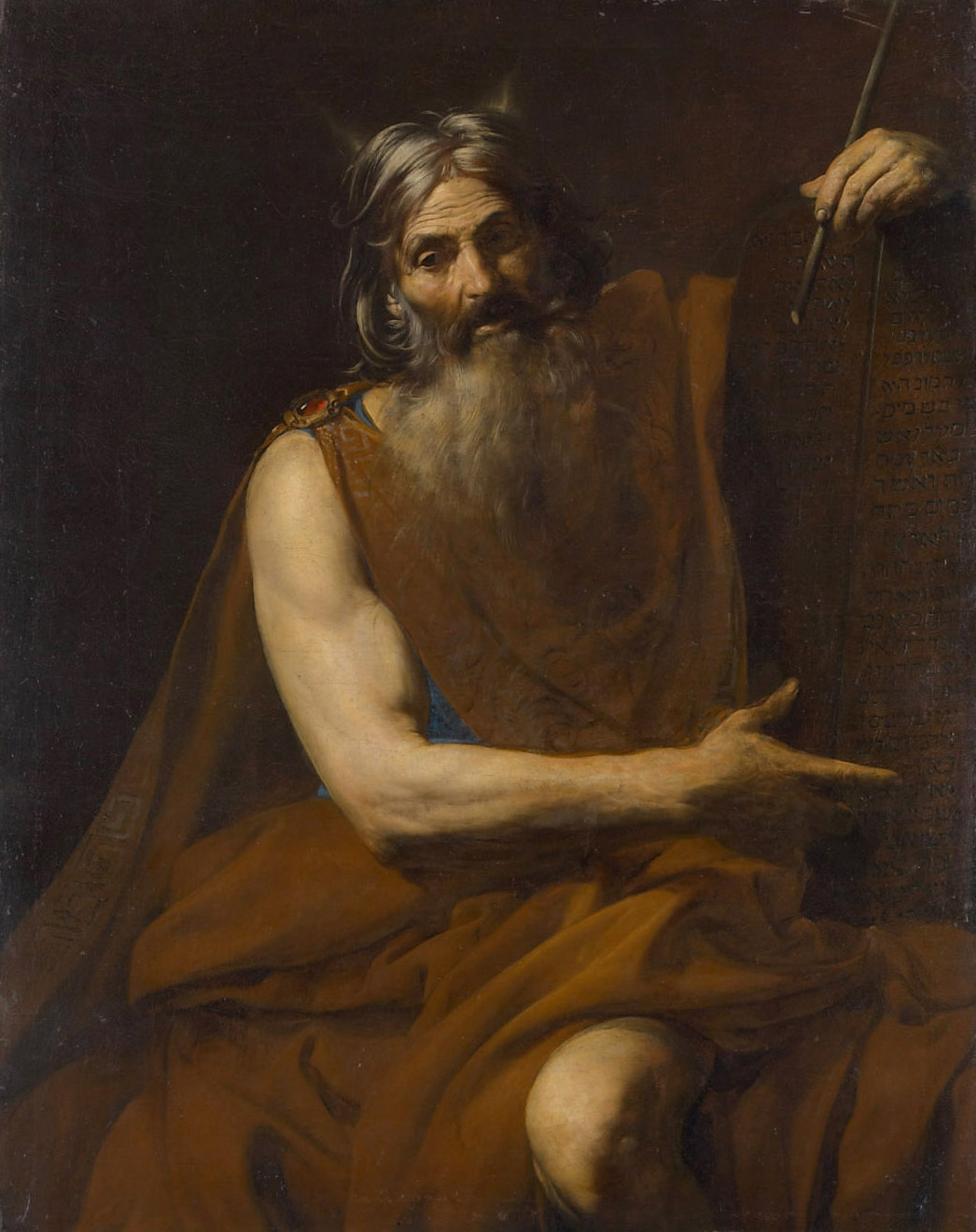
Moses led the Israelites out the slavery of Egypt into the freedom of the Promised Land during the Exodus. The event is told and retold in the Old Testament and Moses as Liberator and Law Giver is its most significant figure. Le Valentin shows him holding a miraculous rod that he used to open the Red Sea (Exodus 14), struck the rock to produce water (Numbers 20) and, after its transformation into an iron snake, healed the ill (Numbers 21). Moses points to the stone tablets of the Ten Commandments of God (Exodus 20; Deuteronomy 5). This late work by Valentin is characteristic in its dark and pensive tone that is reminiscent of Caravaggio.
The picture is one of Valentin’s last paintings before his death in 1632. Prince Hans Adam Il von und zu Liechtenstein (b. 1945) acquired the work in 2004. Throughout his painting career, Le Valentin never ceased producing genre paintings.
Though he died young in 1632, Valentin’s paintings became prized by major collectors and entered leading European collections.
Sources:
Bousquet, Jacques. Mannerism: The Painting and Style of the Late Renaissance. Translated by Simon Watson Taylor. New York: Braziller, 1964.
Brown, Raymond E., Joseph A. Fitzmyer, and Roland E. Murphy, eds. The Jerome Biblical Commentary. Englewood Cliffs, NJ: Prentice Hall, 1968.
Chatâlet, Albert, and Jacques Thuillier. French Painting From Fouquet to Poussin. Translated by Stuart Gilbert. Geneva: Skira, 1963.
Conisbee, Philip. Art for the Nation. Exhibition catalogue. Washington, D.C.: National Gallery of Art, 2000.
Conisbee, Philip, and Frances Gage. French Paintings of the Fifteenth through the Eighteenth Century. The Collection of the National Gallery of Art Systematic Catalogue. Washington, D.C.: National Gallery of Art, 2009.
Coulson, John, ed. The Saints: A Concise Biographical Dictionary. New York: Guild Press, 1957.
Fried, Michael. After Caravaggio. New Haven: Yale University Press, 2016.
“Gifts of European Art from The Ahmanson Foundation.” Vol. 2, French Painting and Sculpture. Edited by Leah Lehmbeck. Los Angeles: Los Angeles County Museum of Art, 2019.
“Hoogewerff, G. J.” Dictionary of Art Historians. Accessed October 27, 2026. arthistorians.info.
Lemoine, Annick, Keith Christiansen, Patrizia Cavazzini, Jean-Pierre Cuzin, and Gianni Papi. Valentin de Boulogne: Beyond Caravaggio. New York: Metropolitan Museum of Art, 2016.
Schmid, Vanessa I., with Julia Armstrong-Totten. The Orléans Collection. New Orleans: New Orleans Museum of Art; Lewes: In association with D. Giles, 2018.
Tasso, Torquato. The Liberation of Jerusalem. Translated by Max Wickert. Oxford: Oxford World’s Classics, 2009.
The New American Bible. New York: Catholic Book Publishing Corp, 1993.
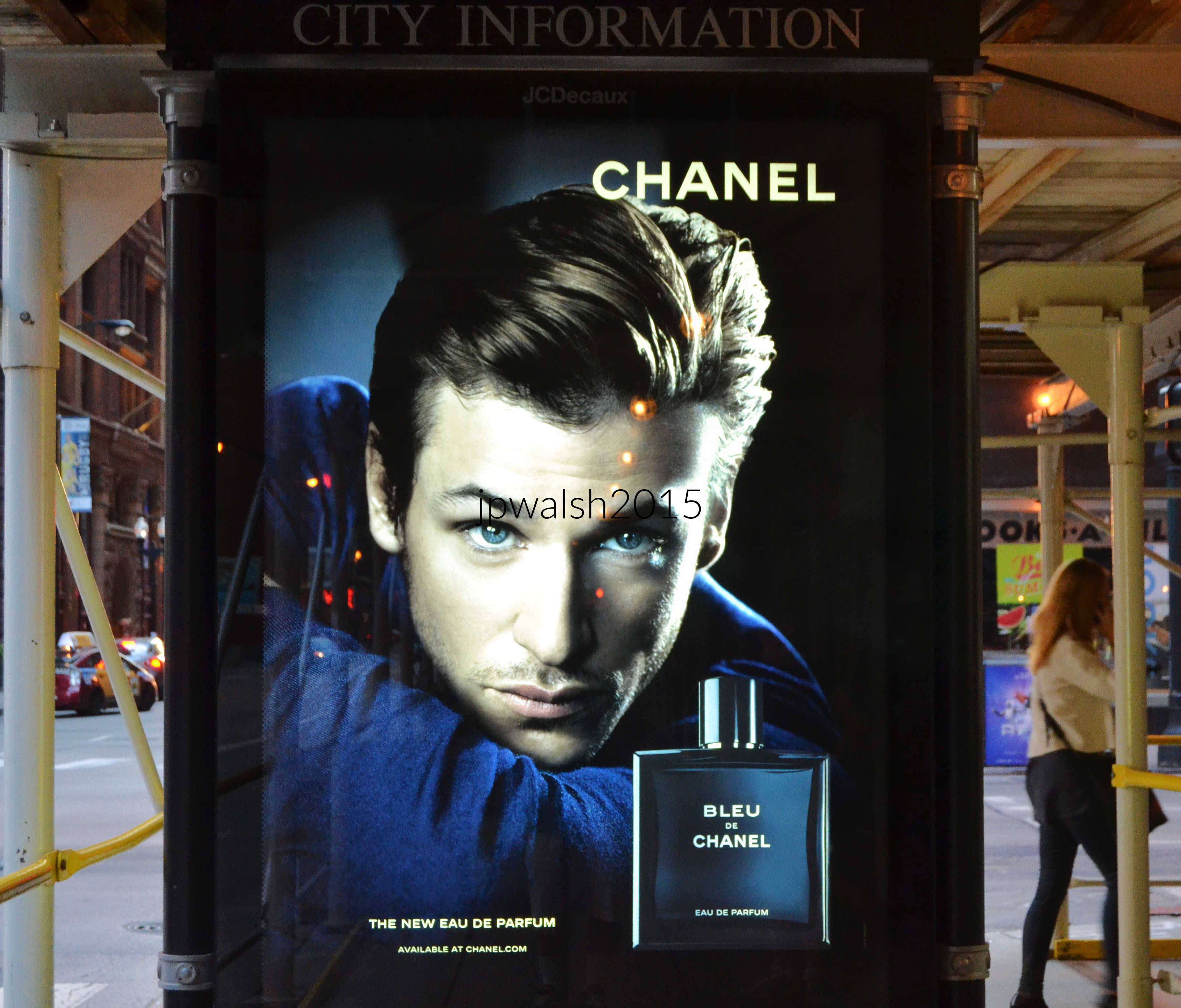
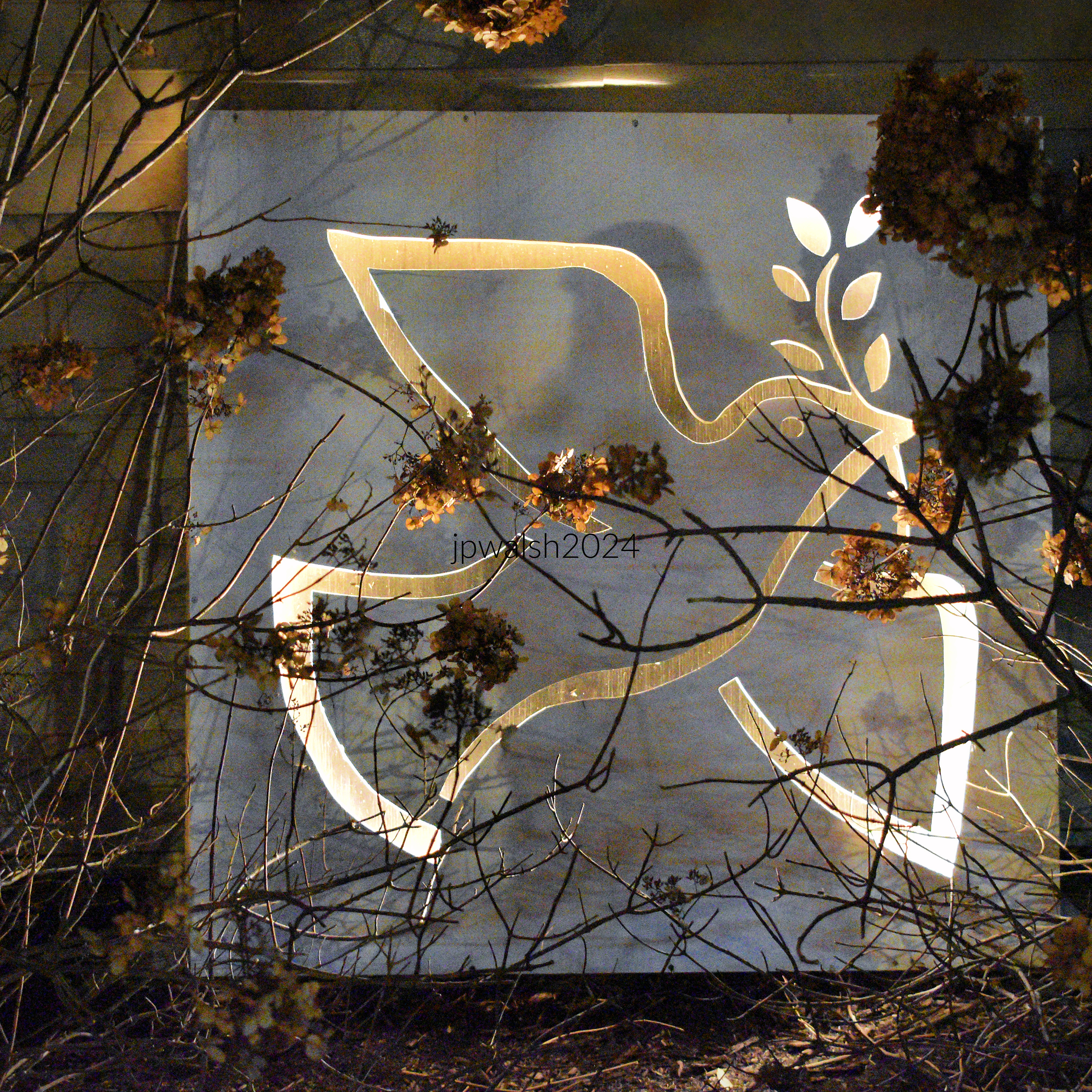
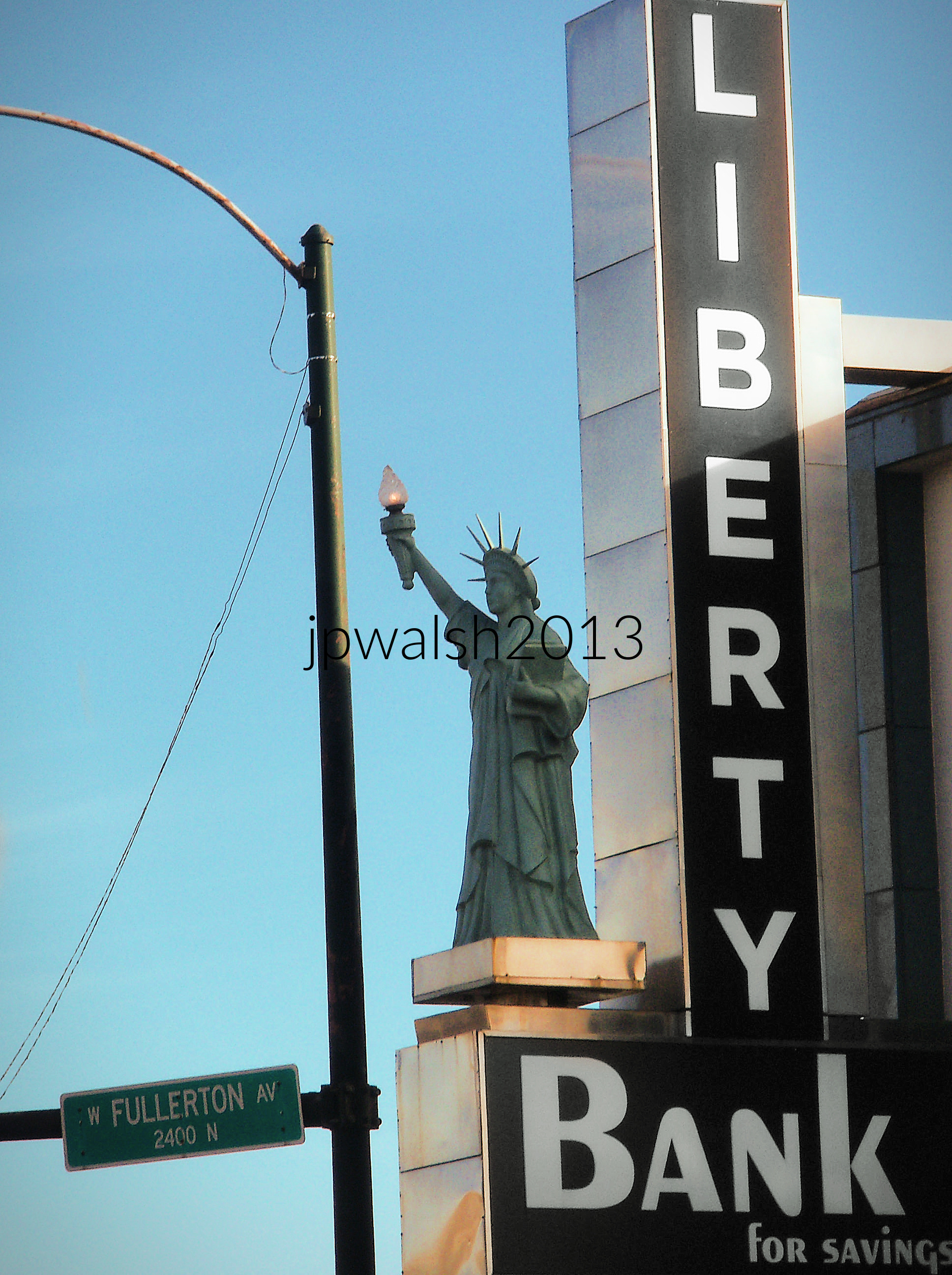
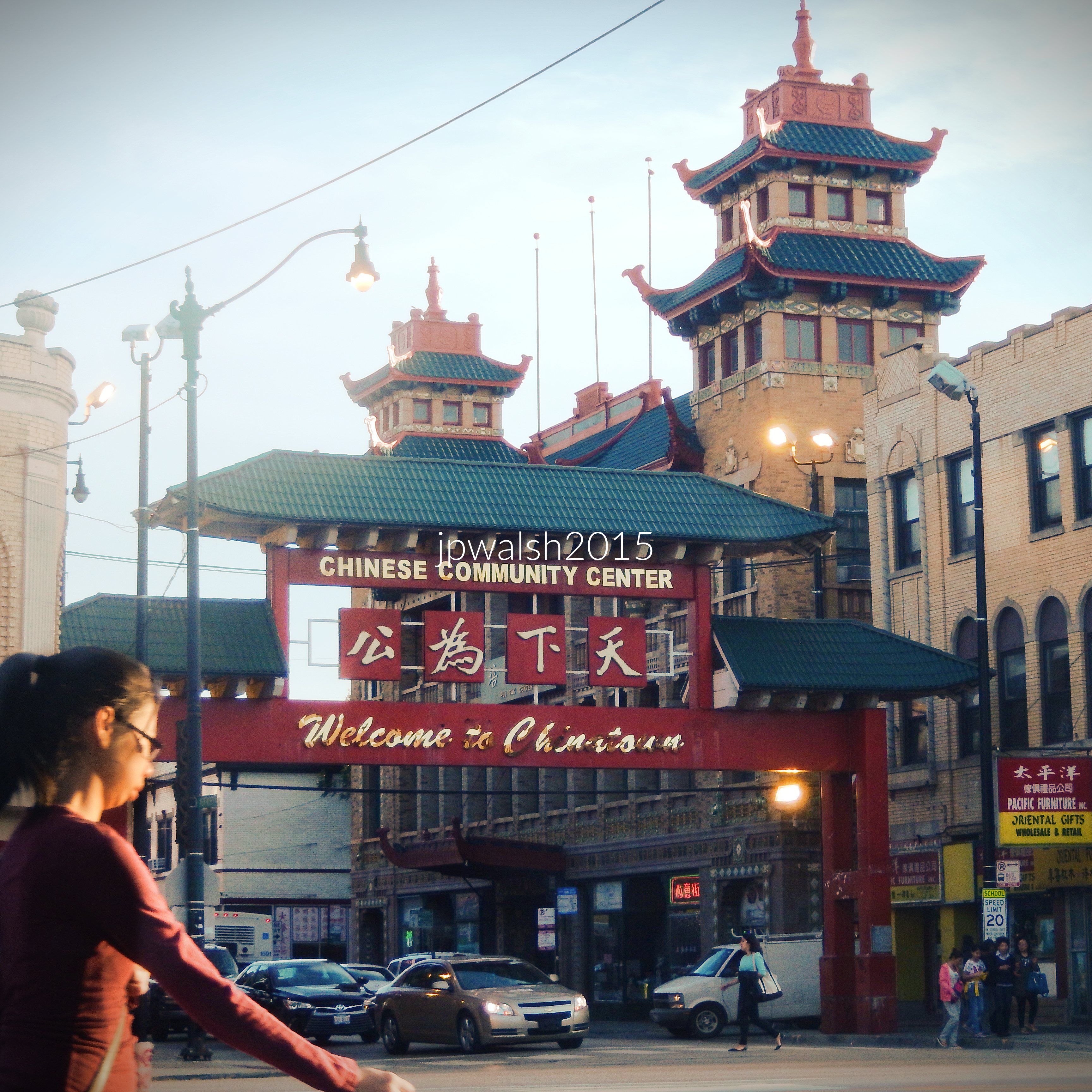
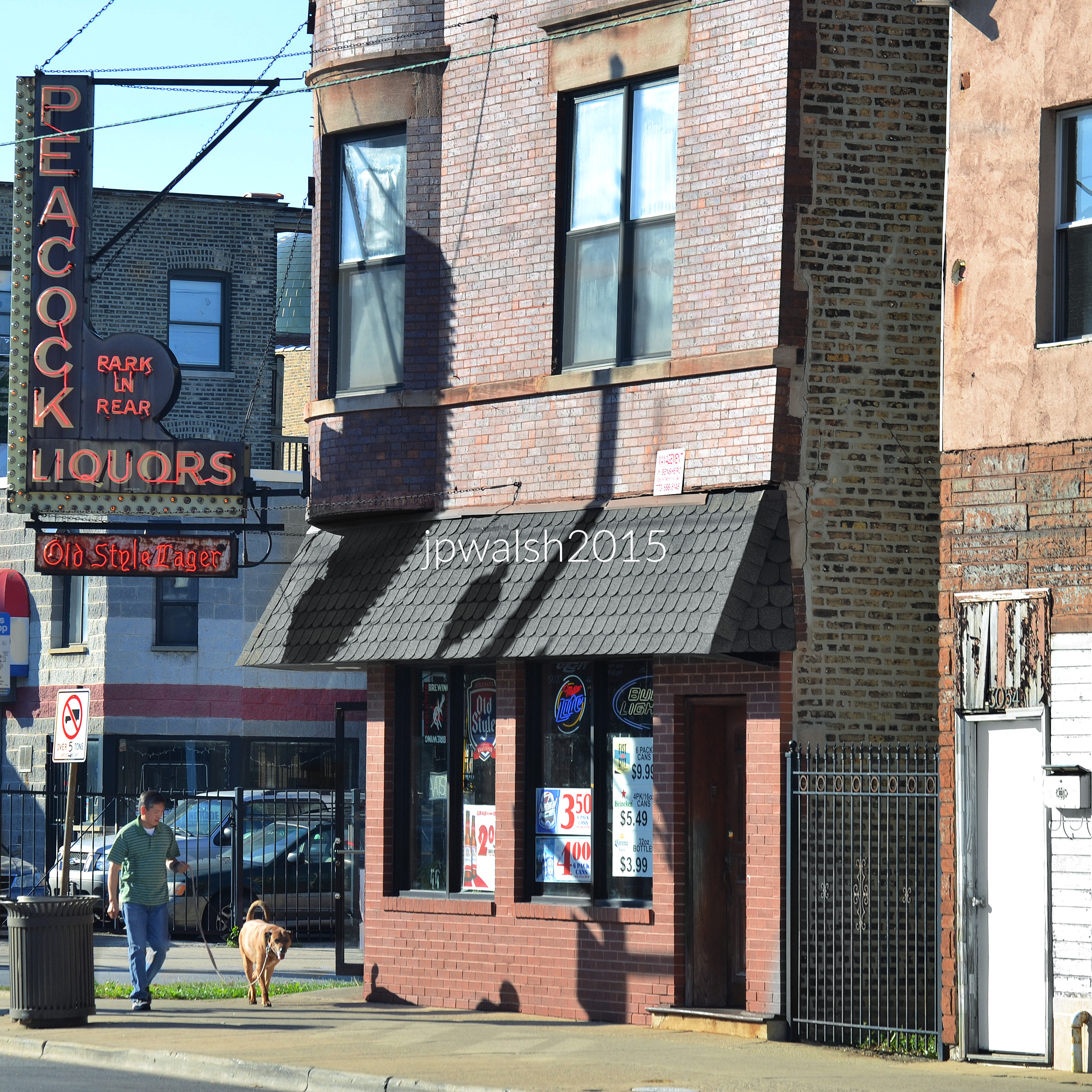
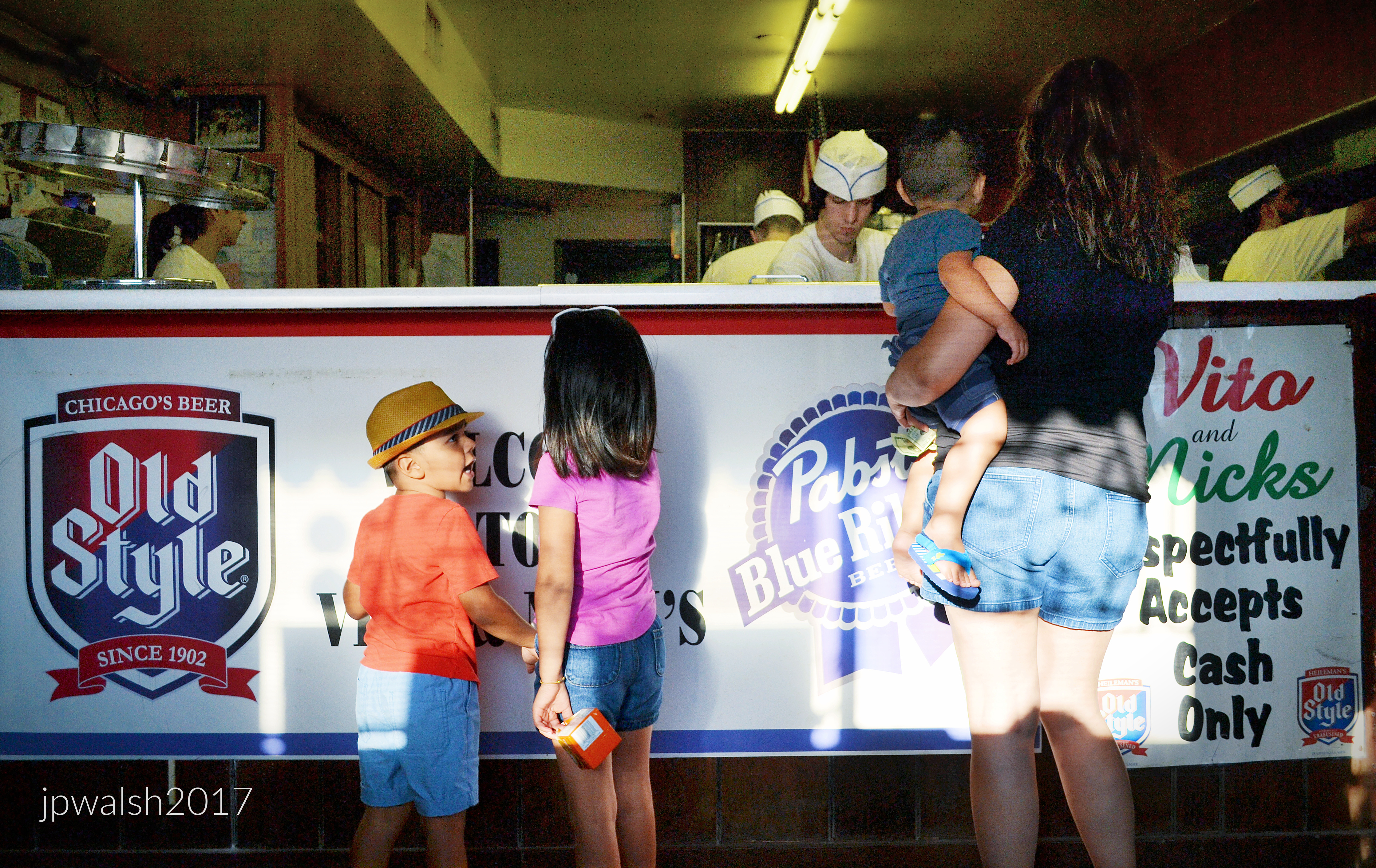
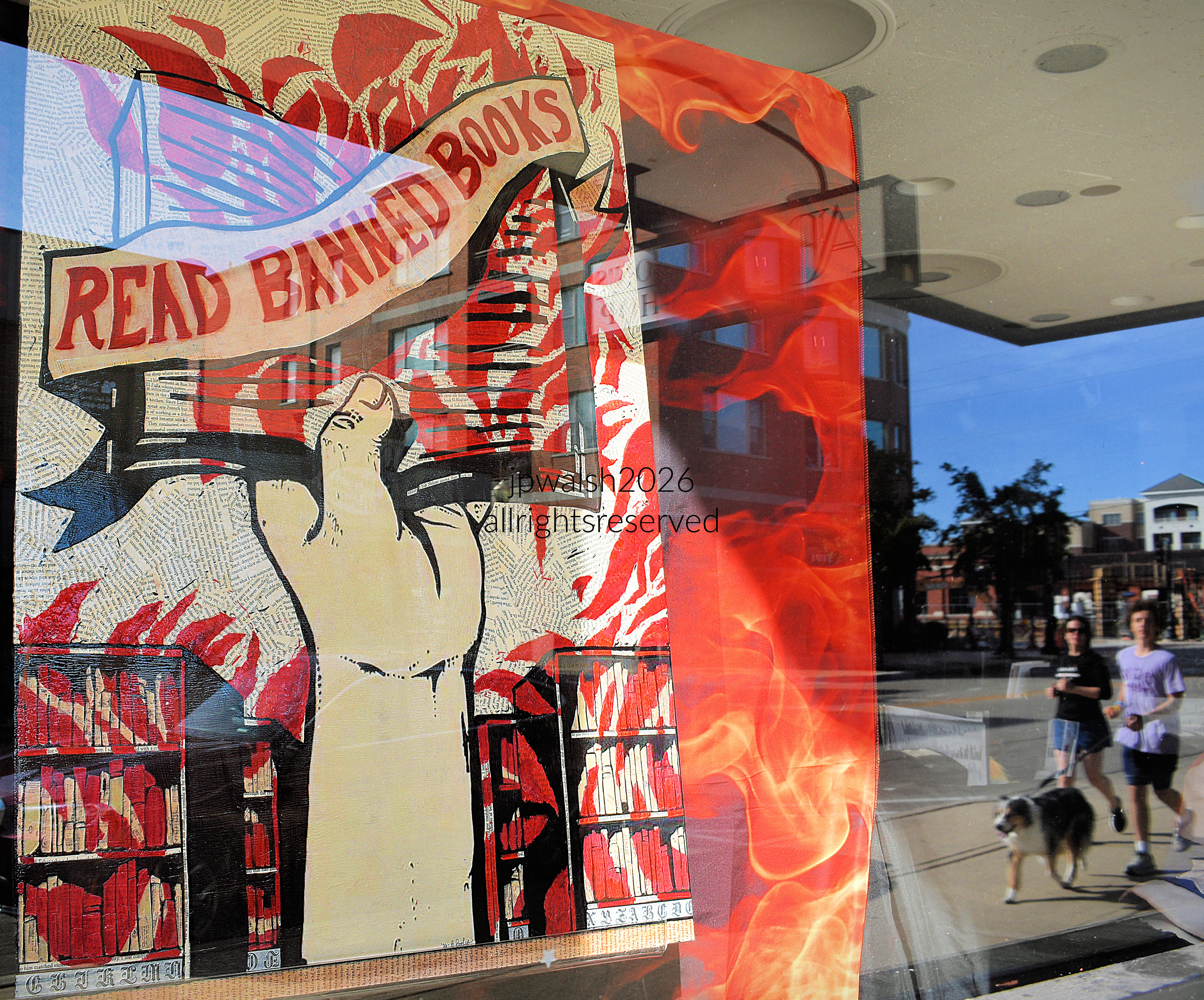
Signs serve as visual blueprints of community identity, tracking economic activity, institutional history, and the constant evolution of a place. As everyday markers of culture, commerce, religion, and memory, they collectively provide a living record of the eras they inhabit.
All photographs and text by John P. Walsh.
August 2024 Chicago 90% 7.91 mb1459 (1)September 2024 99% 7.23 mb_2004 (1)August 2015. Chicago. 3.53mb DSC_0697 (1)August 2024 74% 7.84 mb 0880 (1) (90)September 2024 8.96mb_2038 (1)September 2024 97% 7.92mb _2052 (1)July 2016. In business 1962 to 2022. 4.80mb DSC_0916 (1)Elk Grove Bowl: Bowling alley closing after nearly 60 years in Elk Grove Village – ABC7 Chicago – retrieved March 19, 2026. August 2016. In business from 1961 to 2015. 80 W Higgins Rd, Hoffman Estates, IL 60169 3.69mb DSC_0076 (1). REMEMBERING HOFFMAN LANES – History of Schaumburg Township – retrieved March 19, 2026. October 2022. 99% 7.05 mb 9395 (1)October 2024. 92% 7.82mb _2841 (1)October 2024. 6.75mb_2803 (1) to o&e11 – October 2024 80% 7.85mb_3929October 2024. 78% 7.92mb _4000November 2024. 91% 7.95mb 4514November 2024. 88%7.86mb _4986 0&eDecember 2024. 81% 7.87mb _5986May 2024. Fox River Valley. 99% 6.42mb _6451August 2015. 4.34 mb _0344 (1)January 2016. 3314 W. 63rd St., Chicago. Marquette Photo Supply opened in November 1944. Owner Joe Herbert sold and repaired photo equipment and processed film. His father and brother operated the barbershop next door. The family lived in an apartment behind the store. For decades, Mr. Herbert supplied equipment to photography students at many high schools, including nearby all-girls Mother McAuley. A beloved presence in the neighborhood, the shop closed in 2017 when Mr. Herbert passed away. 96% 7.91mb see – https://chicago.suntimes.com/2017/9/14/18318528/joseph-joe-herbert-dies-ran-marquette-photo-supply-for-73-years – retrieved January 30, 2025. May 2016. State & Chicago. 5.32mb DSCN2408 (1)November 2017. Below the fold. 4.85mb DSC_3148 July 2016. Established in 1928. 3259 E. 95th Street, Chicago. DSC_0793 (1)August 2017. Chicago. 7.57mb DSC_1554March 2025. 95% 7.91 mb DSC_7840October 2017. 5.38 mb DSC_2973November 2017. 89% 7.80mb DSC_3398April 2025. 99% 7.23mb DSC_8741May 2018. 90% 7.75mb DSC_7149January 2018. Chicago. Downtown. 3.71 mbMay 2025. 99% 6.99mb DSC_0078 (1)October 2024 3.87mb DSC_3187 (1)October 2015. October 2015. St Cornelius Church, 5430 W. Foster Ave, in Chicago when it was still an active parish church. Built in 1964, it closed in 2020 for lack of mass attendance and was desacralized in 2021. In 2024 the church building was sold to be redeveloped as a funky 1960’s style club and pickleball court. The site redevelopment will include parking and an event space with stage for pinball games, beverage lounge, and record spinning area. St. Cornelius for whom the church was named was a 3rd century pope who was banished from Rome by the Roman emperor Trebonianus Gallus and who died in exile. 5.91mb DSC_0311 (1) see – https://www.chicagobusiness.com/commercial-real-estate/former-st-cornelius-church-be-pickleball-court-and-club – retrieved June 23, 2025. June 2025. Downers Grove, Illinois. 97% 7.88mb DSC_1850July 2025. 99% 7.33mb DSC_3614June 2018. Chicago. 6.42mb DSC_9166 June 2018. Chicago. 6.25mb DSC_0827June 2025. 90% 7.90 mb DSC_2406 (1) January 2016. 3.70 mb DSCN1968 (1) July 2015. Chicago. 3.23 mb DSC_0387 (1)July 2015. Chicago. 3.19mb DSC_0592 (1)December 2017. Chicago. 89% 7.94mb DSC_3767 (1)November 2025. 99% 7.35mb DSC_8897December 2025. 6.27mb DSC_9476 (1)December 2025. Chicago 78% 7.83mb DSC_0012December 2025. Chicago. 81% 7.83mb DSC_0041February 2013. 1.64mb 2101_6381 (1)
Liberty Bank’s origin dates back to 1898 when parishioners of All Saints Polish National Catholic Church on Chicago’s North Side (2392 N. Milwaukee Avenue)came together to form a mutual savings institution committed to “neighbors helping neighbors.”
FEATURE image: Ulysses and Penelope, Francesco Primaticcio called Le Primatice (1504-1570), Toledo Museum of Art, c. 1560, oil on canvas, 44 3/4 x 48 3/4 in. (113.6 x 123.8 cm).
French art in the 16th century emerged from a dynamic exchange between native traditions and Italian Renaissance innovation, culminating in the School of Fontainebleau, where royal patronage, humanism, Mannerism, and court culture forged a distinctly French artistic identity that would shape European art for generations.
Jean Perréal (1455-1529), Portrait Louis XII, c. 1514, Windsor collections de S.M. la Reine d’Angleterre.
Jean Perréal’s most important attribution is this portrait of Louis XII who was King of France from 1498 to 1515. Louis XII was married three times – the first annulled; the second leaving the king a widower, and, in his last three months of life, to Mary Tudor (1496-1533), the favorite sister of King Henry VIII of England. Despite these wives, the king had no living sons. The Salic Law prohibited his line to continue on the French throne through his daughters. When Louis died in 1515, his throne eventually passed to his cousin, Francis I.
Jean Perréal (c.1455-1530) was Court painter to the Bourbons and later worked for the kings of France starting with Charles VII. Perréal journeyed to Italy several times. In 1514 he went to London to paint Mary Tudor’s portrait and supervise her new dresses as Mary, aged 18 years, sister of the English king, married the 52-year-old King Louis XII of France.
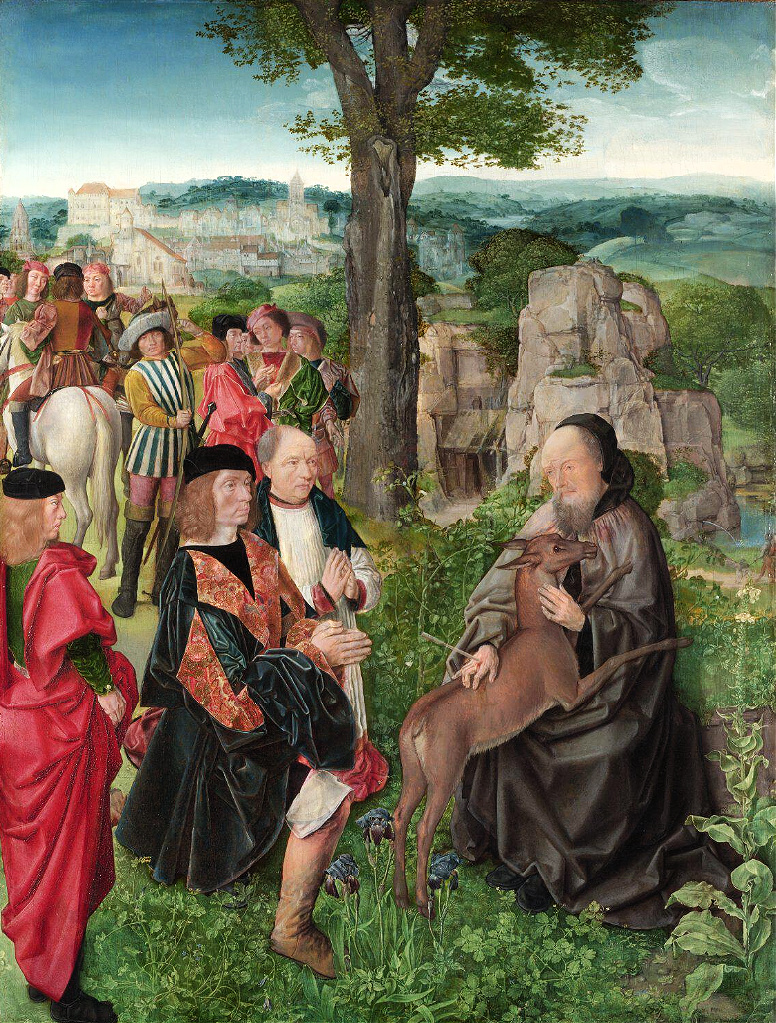
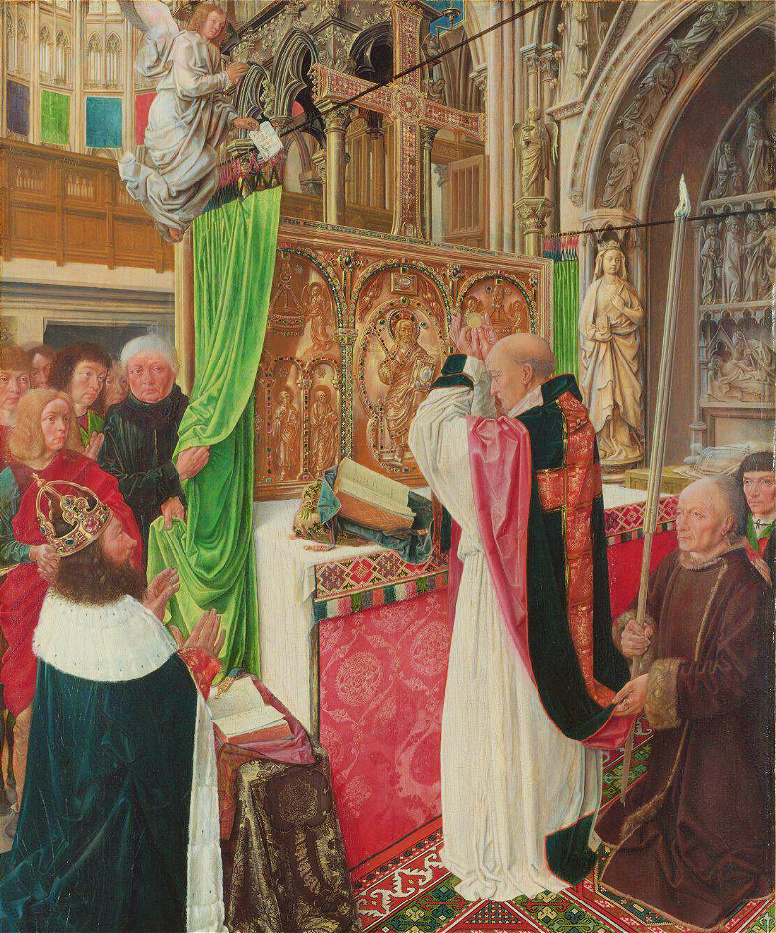
Master of Saint Giles (active 1490-1510), St. Giles protects a wounded deer for Charles Martel, c. 1500, National Gallery, London, oil on oak, 63.4 × 48.4 cm.Master of Saint Giles (active 1490-1510),Virgin with Child, c. 1500, Louvre.Master of Saint Giles (active 1490-1510), St. Giles’ Mass, c. 1500, National Gallery, London, oil on oak.
The Master of Saint Giles was a Flemish or Flemish-trained painter who was active in France. He is named after artworks in London attributed to the artist called Scenes from the Legend of St. Giles. As the artist’s identity is obscure, the saint depicted in his artwork is shrouded in legend.
St. Giles is possibly an 8th century hermit in France who became the patron saint of beggars, the handicapped, and blacksmiths which was an important trade in the Middle Ages. In one work, the artist depicts a famous story about St. Giles. Before King Flavius’s hunting party, he protected a deer from their bows and arrows. The king was apologetic and Giles persuaded him to establish a Provençal monastery in which St. Giles served as its first abbot.
The Italian Renaissance entered France largely through the French wars in Italy and the patronage of King Francis I, who invited leading Italian artists to France.
IlRosso (1494-1540), La Fontaine de Jouvence (The Fountain of Youth), c 1535, fresco, Chateau de Fontainebleau, Galerie Francois I.
France conducted wars in Italy starting in 1494 that continued into the 16th century. By way of this warmongering, many of the Italian Renaissance’s ideas and practices were brought back to France. In the 12th century French ideas, particularly of chivalry and the troubadours, were brought back to Italy following trade expeditions by Italian merchants. After fighting ceased, King Francis I invited Italian artists into France, most famously Leonardo da Vinci (1452-1519) in 1516. Following more war in Spain, Francis I in 1526 began a revolution in art in France making the Château de Fontainebleau one of the most active artistic centers in Europe. It attracted many Italian artists such as Primaticcio or Primatice (c. 1504-1570) and Il Rosso (1495-1540). The French Renaissance, under the influence of Italian masters, synthesized French and Italian art whose style was later described as the School of Fontainebleau. Il Rosso or Rosso Fiorentino was a friend of Pontormo (1494-1557) and worked under Andrea del Sarto (1486-1530), a founder of Italian Mannerism. He first worked in Florence (1513-1523) and then in Rome (1524-1527). German troops of the Holy Roman Emperor Charles V (1500-1558), making war in Italy, sacked Rome in 1527. By these means, what Rome lost, France gained: Il Rosso wandered about Italy for a while so that by 1530 he was in Venice and, in that same year, onward to France. At Il Rosso’s arrival to Fontainebleau he became, soon with Primaticcio, one of the founders of the Fontainebleau style which had a tremendous influence on French painting from that time until about 1610. Reputedly a neurotic person, Il Rosso’s death was accounted a suicide by Vasari though that is unconfirmed. The classic style found in Il Rosso’s The Fountain of Youth was increasingly replaced by his later emotionally charged style as in Pietà in 1540.
Artists such as Rosso Fiorentino (Le Rosso), Primaticcio, and Niccolò dell’Abbate introduced new approaches to painting, decoration, mythology, and architectural design.
Primaticcio (c.1504-1570) was a founder of the Fontainebleau School in France with his fellow Italian artist Le Rosso in the 1530s. Primaticcio was a talented artist of universal range – from painting and interior decoration to sculpture and architecture.
From the mid1520s to 1532 Primiticcio trained in Mantua under Giulio Romano (c. 1499-1546). He was called to France by King Francis I in 1532 where he worked at Fontainebleau with Le Rosso. Between 1540 and 1542 the artist represented the king in Italy on an art buying expedition. In that time when he was away Rosso died, and Primiticcio, upon his return to France, began working with Niccolò dell’Abbate (c. 1509-1571) at Fontainebleau. It was in this period that he produced decorations in the galerie d’Ulysses that have been lost. In 1546, and again in 1563, Primaticcio went to Italy where on one trip he made casts of Michelangelo’s sculpture and in the other met Vasari.
The style of the painting is Mannerist which predominated in the 16th century. Mannerists went beyond the depiction of nature to flights of imagination and invention. For a stylistic statement, forms were twisting and elongated giving them greater pliability. Mannerists rejected the High Renaissance’s reliance on strict perspective and symmetry and preferred to construct compressed spaces with shaded tones, harsh colors, and the overall feeling of dreaming while awake.
After battling the Trojans and other subsequent troubled adventures, Greek hero Odysseus (Ulysses) has returned home to his wife, the faithful Penelope. Into the night, the reunited lovers recount their lives apart from one another. While Penelope counts the number of suitors on her hands who she held at bay, Ulysses cradles her chin in a gesture of tenderness and compassion. The composition is based on one of 58 wall frescos of scenes from Homer’s Odyssey at the palace of Fontainebleau near Paris. Unfortunately, the Gallery of Ulysses, Primaticcio’s masterpiece, was destroyed in 1738 after it had been allowed to decay over 200 years.
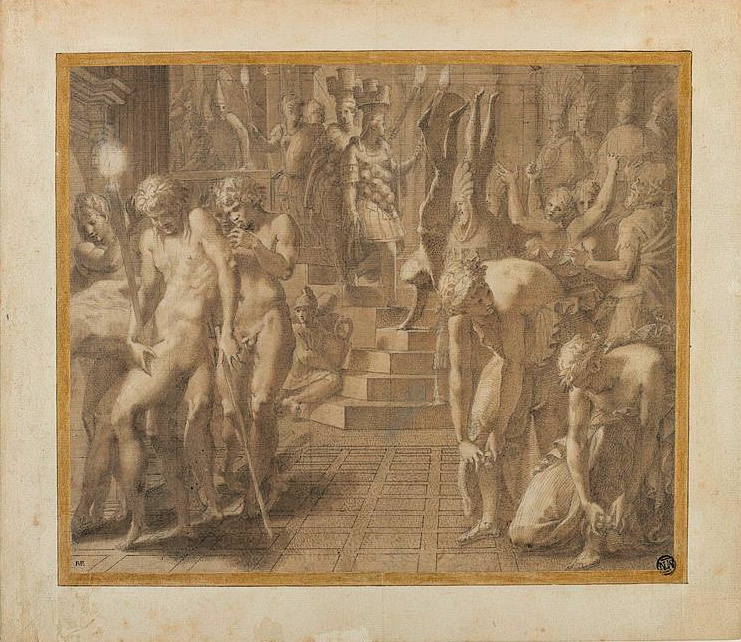
A preparatory drawing by Primaticcio in the Louvre for a lost composition of the cycle of L’Histoire d’Alexandre painted in the Room of the Duchess of Etampes in Fontainebleau. It was the masquerade that brought about the fire in Persepolis, an historic event that took place in 330 BCE when Alexander the Great conquered the Achaemenid Persian Empire following the battle of Guagamela the year before.
It is not disputed in history that after Alexander arrived to the Persian capital city of Persepolis it was looted and burned to the ground, destroying many great cultural treasures. Though recorded by several historians, accounts vary. The first century Roman historian Quintus Curtius Rufus wrote that while drunk during a large celebration with his companions, attendants and courtesans, Alexander himself started the fire as the rest joined in. (see – https://www.worldhistory.org/article/214/alexander-the-great–the-burning-of-persepolis/
Artistic innovation extended beyond painting into tapestry, drawing, interior decoration, and courtly visual culture.
Niccolò dell’Abbate (c. 1509-1571), The Death of Eurydice, c. 1550s-1560s, oil on canvas, 189.2 × 237.5 cm, National Gallery London.
Niccolò dell’Abbate was from Modena in Italy. He was influenced by the sculptural and optical illusion achieved in the artwork of Andrea Mantegna (1431-1506). He was also influenced by Correggio (1489-1534), a master of chiaroscuro. By 1552 dell’ Abbate was in France helping Primaticcio at Fontainebleau with the royal chateau’s interior decorations though most of his artwork has disappeared. The Death of Eurydice is a fine example of the Mannerist landscape which the artist is responsible for having introduced into France.
Mannerist aesthetics emphasized elongated forms, imaginative compositions, emotional intensity, and sophisticated allegory. Classical mythology, biblical narratives, courtly ideals, and humanist scholarship became dominant artistic themes.
Le Maître de Flore (active 1540-1560), Le triomphe de Flore (The Triumph of Flora), private collection (Vicenza).
Le Maître de Flore is a French painter of the mid16th century Fontainebleau School. The use of the moniker Maître de Flore derives from this and another artwork.
The School of Fontainebleau became the most influential artistic center in France during the 16th century, blending Italian Mannerism with French tastes.
The painting above by the Master of Flore in the Metropolitan Museum of Art in New York is seen as depicting the birth of Cupid, with attendants in the birthing room assisting Venus. The composition, which is animated and decorative, is an example of the School of Fontainebleau, the high art style developed in 16th century France by Italian artists under the sponsorship of the French king.
Perhaps the most famous artwork to come out of the School of Fontainebleau is an anonymous work in the Louvre entitled Diana the Hunter. With influences of both Le Rosso and dell’ Abbate, Italian masters of the school, it is believed to depict Diana de Poitiers, the legendary French beauty and mistress of Henry II.
School of Fontainebleau, Woman in her Toilet, c, 1550, Musée des Beaux-Arts, Dijon.
A recurring theme of the Italian masters and French artists in the 16th century is that of the naked woman, shown half-figure in her bath, or dressing. Some have an allegorical significance, others are combined with a portrait. This particular work which depicts some beauty of the day was so admired that there are known 16th century copies of it in Basel and in Massachusetts.
Jean Cousin the Elder (1490-1560), Saint Mammès coming to surrender to the court of the governor of Cappadocia, around 1541, tapestry, 440 × 450cm, Paris, Louvre Museum.
Jean Cousin was born in Sens and died in Paris. He was a French painter, engraver and sculptor.
St. Mammès was martyred under Emperor Aurelian in Cappadocia around 275. In Asia Minor he was highly revered by early Christians. In the 8th century his relics were taken to France and into Langres cathedral. Around 1540, eight tapestries were produced for the cathedral chancel depicting scenes from the saint’s life. Three of the tapestries survive: two in Langres and one in the Louvre.
In the Louvre tapestry, St. Mammès is accompanied by a lion to visit Aurelian who condemned him to death. In the background building the saint’s execution is already taking place. The tapestry’s elements point to the wave of influence that was the Italian Renaissance: its expansive landscape; its compositional use of perspective; and its classicizing architecture and buildings’ decoration, all of which came together in Francis I’s School of Fontainebleau. The tapestry’s varied and nuanced use of color lend a painterly appearance to the woven artwork.
Pseudo Félix Chrétien (active 1535-37), Three men lower barrels into the cave, Städel Museum Frankfort.
The picture displays a scene at one of the likely nearby hôtels that housed merchants, diplomats and others so to be close by the king. It is evident by Félix Chrétien ‘s artwork that creative activity went far beyond the confines of the royal chateaux. Many painters whose names and works are unknown flourished in 16th century France. Italian Renaissance techniques are used in the painting such as its correctly rendered spatial perspective, realistic figural development, and the typical gestures found in the latest Franco-Italian Mannerist style.
French portraiture flourished through artists including Jean Clouet, François Clouet, and Corneille de Lyon, who documented the royal court with remarkable precision and psychological presence.
Jean Clouet (1485-1540), François Ier, 1524, Louvre.
Jean Clouet was the Court Painter to King Francis I. While Clouet was an influential artist in the establishment of Renaissance portraiture in France, his only documented painted portrait is that of Francis I’s librarian, Guillaume Budé (1467–1540).
A leading humanist of the sixteenth century, Budé’s fingers hold his page and a quill in the midst of writing. The words on the page in Greek presents an epigram: “While it seems to be good to get what one desires, the greatest good is not to desire what one does not need.”
Jean Clouet, Guillaume Budé, c. 1536, The Metropolitan Museum of Art, New York, oil on wood, 15 5/8 x 13 1/2 in. (39.7 x 34.3 cm).
Jean Clouet, also called Jean Clouet II and Janet, was probably the son of a Flemish painter who was the Court Painter to the Duke of Burgundy. Jean Clouet II made a number of portrait drawings of the Court that survive, most in Chantilly.
Jean Clouet, Portrait of Admiral Bonnivet, c. 1516. Musée Condé, Chantilly, France.French Anonymous, Head of a bearded man, capped with a hat, three-quarters to the right. End of 16th century. Louvre.Francois Clouet (before 1520-1572), Portrait of Pierre Quthe, 1562, Louvre.
François Clouet was the son of Jean Clouet II and succeeded him as Court Painter to the king in 1541. Like his father, he was also called Janet and specialized in portrait drawings, most of which are housed in Chantilly. Francois Clouet’s first signed painting was the 1562 portrait of Pierre Quthe in the Louvre. Its style was influenced by the Florentine artists, particularly Angelo Bronzino (1503-1572).
François Clouet, A Lady in Her Bath, c. 1571, oil on oak, 92.3 × 81.2 cm (36 5/16 × 31 15/16 in.), National Gallery of Art, Washington, D.C.
The identity of Clouet’s model has long been debated. She may have been Marie Touchet, the mistress of Charles IX, or possibly Diane de Poitiers, the legendary French beauty and mistress of Henry II. The painting is boldly composed as it evokes poses of Venus, the love goddess, found in Italian art but also in its presentation of fecundity such as the nurse suckling a child and a bowl of ripe fruit of the season. The raised curtain is a device used in royal portraiture though here it may be just decorative.
François Clouet, La reine Marguerite enfant, c. 1560, Chantilly. Workshop of François Clouet, Marie de Gaignon, marquise de Boissy (1524-1565), c. 1550-1565, Louvre.Corneille de Lyon (active 1533-1574), Portrait de Marot, c. 1540, Louvre.
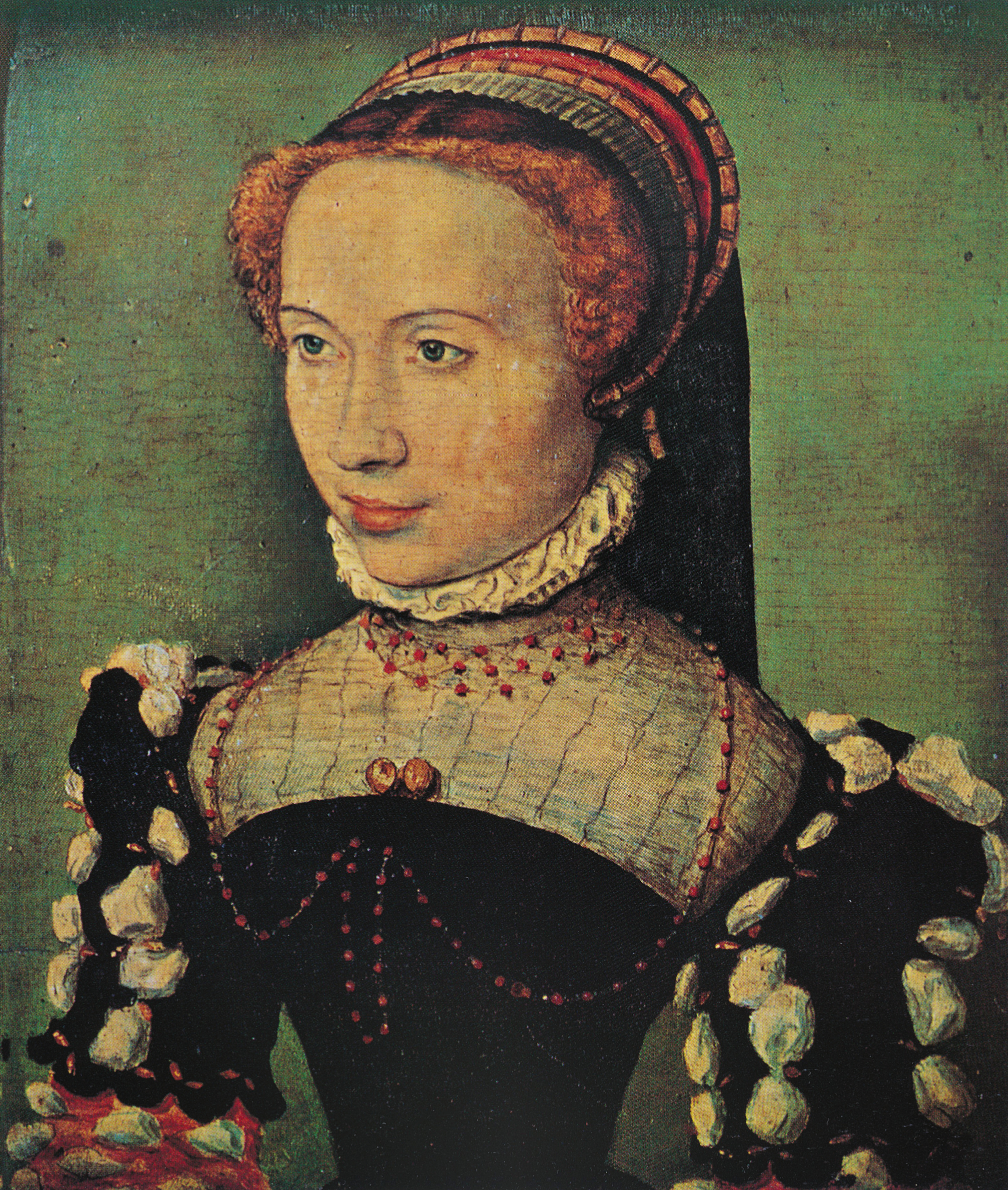
Corneille de Lyon (active 1533-1574) was born in The Hague and worked in Lyons, France for over 30 years starting around 1540. A contemporary and rival of François Clouet (c. 1520-1574), Corneille de Lyon is well documented as a popular leading painter in the French style. As the artist did not sign or date his works, it is virtually impossible to positively identify his artwork. It was only in 1962 that his first work –and nearly all of them are miniature in scale – was positively identified. The nature of his work was described by contemporaries. In 1551 the Venetian ambassador who visited the artist’s studio observed: “We paid a call to an excellent painter who…showed us the whole Court of France, both gentleman and ladies, depicted with the utmost likeness on a great many small panels.”
Working in oil on wood panel, Corneille de Lyon was Peintre et Valet de Chambre du Roi to Henry II (1519-1559) and Charles IX (1550-1574). Corneille likely did paint the entire court. Portraits usually show half-length figures dressed in dark colors against a neutral, somewhat iridescent and greenish background. Groups of such portraits are of uneven quality marking studio artists supervised by the master. The precise drawing of facial features with its smooth planes and enamel-like techniques conveys sitters of placid expression whether their gaze is distant or engaged. Costumes are portrayed with detailed realism yet in a rich, modulated and less definite form.
Painter to the king since 1551, Corneille became a landowner by gift of the king in 1564. In June 1564 one of the artist’s high-born visitors to his home was Catherine de‘ Medici (1519-1589), then regent. Before his death in 1574, the Netherlandish-born Corneille, with his family and household, became Roman Catholics after working in the French Court for nearly 35 years.
Corneille de Lyon (active 1533-1574), Portrait of Gabrielle de Rochechouart, c. 1574, Oil on wood, 16.5 x 14 cm, Musée Condé, Chantilly.Pierre Dumonstier “the Uncle” (c.1545-c.1610), Portrait of an Unknown Man, chalk drawing with watercolor, c. 1580, Musée Jacquemart-André.
Towards the close of the 16th century, there were two families of French artists who were active – namely, the Dumonstiers and the Quesnels.
The Dumonstiers were descendants of one of Le Rosso’s fellow workers at Fontainebleau in the 1530s. Pierre Dumonstier (c.1545-c.1610) was one of three brothers, all of whom were portrait painters. The brothers had close links to the royal house, particularly to Catherine de’ Medici. Pierre produced several drawings, many in color giving them a somewhat painted appearance. Portrait of an Unknown Man is a chalk drawing with watercolor.
In terms of style, what in the beginning of the 16th century produced precise drawing of facial features in portraiture gave way by the end of the century to greater modeling fluency so to achieve intense expression. Portraiture’s overall format, however, remained constant: a face isolated on a neutral background rendered with close analytic attention.
The Quesnel artistic dynasty began with a court painter to James V of Scotland (1513-1542). One of that painter’s sons, François Quesnel (1543-1619), produced many drawings. His painted portrait of Mary Ann Waltham is signed and dated by the artist. Quesnel concentrates on rendering the face with the rest of the body and costume handled perfunctorily. This dichotomy of attention to form was the case in the drawings as well. It may be that the master produced the face in these portraits and left the body and costume to studio assistants.
François Quesnel (1543-1619), Mary Ann Waltham, 1572. 22 x17.5 in., Private, UK.
By century’s end, France had transformed from a receiver of Renaissance influences into a major artistic center in its own right.
SOURCES:
A Dictionary of Art and Artists, Peter and Linda Murray, Penguin Books; Revised,1998.
La Peinture Française: XVe et XVIe Siècles, Albert Châtelet, Skira, Genève Suisse, 1992.
French Painting: From Fouquet to Poussin, Albert Châtelet and Jacques Thuillier, Skira, 1963.
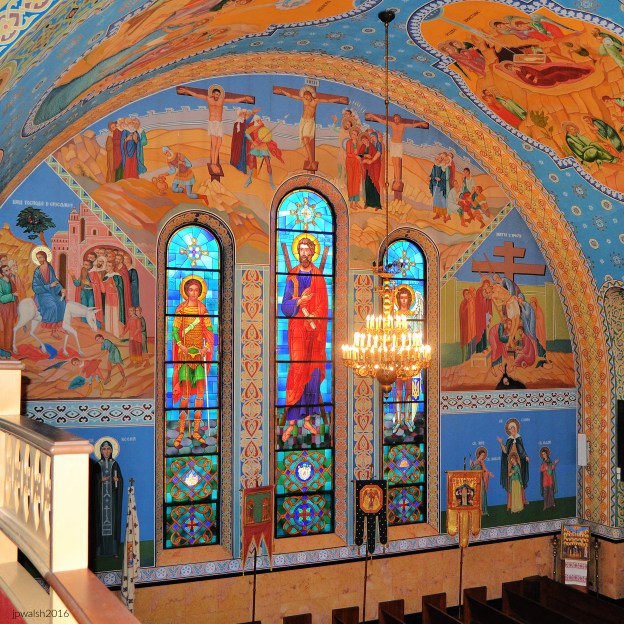
FEATURE image: Stained glass, paintings, banners, and chandelier blend together and provide a more complete picture of people and episodes of the faith. North wall and ceiling. Chicago. Sts. Volodymyr and Olha Church. October 2016. Author’s photograph. 5.88 mb
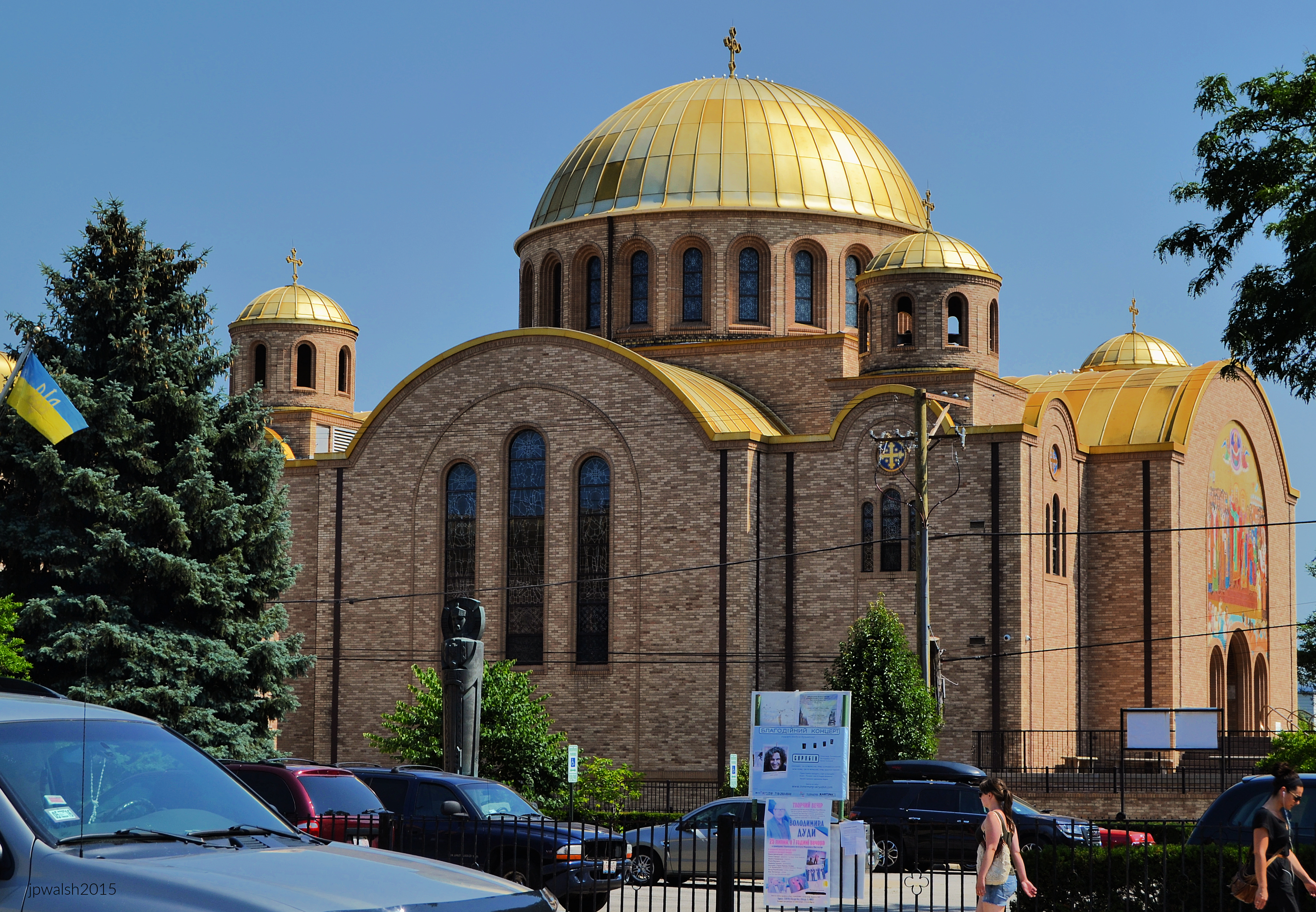
Sts. Volodymyr and Olha Church (1975) stands as a powerful expression of Ukrainian religious and cultural identity in Chicago, blending traditional Byzantine forms with modern architectural design. Architect Yaroslaw Korsunsky created a monumental house of worship whose soaring domes, geometric forms, and richly symbolic design connect an immigrant community to centuries of Eastern Christian tradition while asserting its presence within the modern American city.
Chicago. Sts. Volodymyr and Olha Church. July 2015. Author’s photograph.
At 739 N. Oakley Boulevard Sts. Volodymyr and Olha Church in Chicago displays with its gold domes. The tradition-minded parish, founded in early 1970s, serves a busy urban community.
Chicago. Sts. Volodymyr and Olha Church. July 2015. Author’s photograph. 2.52 mb
The building’s design balances monumentality, symbolism, and modern construction techniques.
Sts. Volodymyr and Olha Church, Chicago. The huge mosaic over the main entrance memorializes the conversion of the Ukrainians to Christianity in 988 by St. Volodymyr of Kyiv or Vladimir of Kiev (957-1015). The mosaic was executed by Hordynsky, Makarenko, and Baransky. The church is built in the modern Byzantine style. In addition to the colorful and bright mosaic, the upward angle and its perspective adds to the feeling of entering into a sacred space. Along with the archways and curve of the main golden dome, the eye focuses on the artwork’s bright figures. July 2015. Author’s photograph. 7.68 mb
Chicago. Sts. Volodymyr and Olha Church. July 2015. Author’s photograph. 5.42 mb
WHO IS ST. VOLODYMYR?
St. Volodymyr is the apostle to proto-Russian and Russian Christianity. He was the great prince of Ukraine in Kiev. It was ruled by the Varangians, a barbarous Viking tribe from Scandinavia – and Volodymyr (or Vladimir) of Kiev was as barbarous as any of them.
In 988, when Volodymyr was about 31 years old, he was converted to Christianity. The missionaries came from the Byzantine world at Constantinople. The results were immediate: Ukraine was now in close contact with the Byzantine world to the south and its Christian church under the pope.
Volodymyr married the daughter of the Byzantine emperor, Basil II (957-1025). But it was Volodymyr’s personal embrace of the Christian faith that infused the Ukrainian people with their deep and abiding faith. Having received baptism, he set out to be a Christian and not corrupted by money and power that proved a serious temptation for many church and state leaders in the Dark Ages.
Volodymyr used his temporal powers to evangelize the people – his personal example his greatest asset to its success. Though he encouraged various activities and programs in the lives of the people – including the multi-faceted work of Greek missionaries – it was his sincere, transparent, and fundamental reform of his own life that by far had the greatest impact on the Ukrainian people. More than one thousand years after his rule, Volodymyr is still recalled as a generous, humble and devout soul.
As a Christian ruler Volodymyr had doubts about inflicting the death penalty. Though assured by his Byzantine church counselors that his Catholic faith allowed him to follow the law which allowed for it, Volodymyr corrected them and said that that sort of reasoning was not satisfactory to his faith.
Volodymyr, the great prince of Kiev, died a poor man – not only various from his origin but, again, that of many of the ecclesiastics now in the realm. Before his death, Volodymyr dispersed all his money and personal belongings to the poor and to his family and friends. St. Volodymyr’s feast day is July 15. He is patron of Ukrainian and Russian Catholics.
WHO IS ST. OLHA?
Saint Olha was the wife of the Kyivan Great Prince Igor. Igor signed a peace treaty with the Greeks in 944. The treaty of 944 was drawn up at Constantinople and allowed for Christianity in Ukraine. This toleration already indicates some sympathy for Christianity among the powerful in Kiev. Igor himself, however, in his official position did not embrace Christianity nor officially allow the presence of a structure of Church hierarchy. The treaty was drawn up to quietly allow co-existence of Christians in a pagan Viking culture.
Yet when the Byzantine emissaries arrived in Kyiv, pagan opposition had emerged from the Varangians. The Christians were thrown into abeyance and Igor was murdered in 945. Into this volatile situation the burden of government fell upon Igor’s widow — the Kyiv Great-Princess Olha, and her three-year-old son Svyatoslav (945-972). Her first act was to avenge Igor’s murder.
Olha belonged to one of the obscure ancient-Rus’ princely dynasties, whose Slavic line had intermarried with assimilating Varangian newcomers. Olha’s Varangian names includes Helga and Olga.
Though still a pagan, Olha’s revenge on the Varangians on behalf of her late husband was a victory for the realm’s Christians. Further, having weakened the influence of petty local princes in Rus’, Olha centralized the whole of state rule. She became a great builder of the civil life and culture of Kyivan Rus. Her centralization became an important network of the ethnic and cultural unification of the nation which, when Olha became a Christian, aided in the building of a network of churches. Her essential activities proved key in developing what is the modern Ukrainian national identity. At the same time, important trade with Poles, Swedes, Germans, and so forth, led to significantly expanding foreign connections. One noteworthy development was that wooden buildings were replaced with stone edifices.
Rus’ had become a great power. Only two European realms could compare with it in the tenth century – the Byzantine empire in the east, and the kingdom of Saxony in the west. Both these empires were Christianized and pointed the way to future greatness for Rus’. In 954 Great-princess Olha sailed to Constantinople. Though a display of Rus’ military might on the Black Sea, it was a spiritual mission. Olha’s might and the Byzantines’ wealth and beauty were mutually impressive.
Constantinople was the city of the Mother of God as dedicated by Constantine the Great in 330. Olha made the decision to become a Christian. She was baptized by Patriarch Theophylactus (917-956) with her godfather being the emperor Constantine Porphyrogenitos (905-959). She took the Christian name Helen for Constantine’s mother. Following the rite, the Patriarch said: “Blessed are you among the women of Rus’, for you have forsaken the darkness and have loved the Light. The Rus’ people shall bless you in all the future generations, from your grandson and great-grandson to your furthermost descendants.” Olha replied: “By your prayers, O Master, let me be preserved from the wiles of enemies”. It is precisely in this way, with a slightly bowed head, that Saint Olha is often depicted in religious artwork. During her state visit, and following her baptism, Great princess Olha of Rus’ was fêted throughout Constantinople
Saint Olha devoted herself to efforts of Christian evangelization among the pagans, and also church construction, including Saint Sophia Cathedral. Yet, many despised her new found Christianity and paganism became emboldened. They looked to the reign of Svyatoslav who angrily spurned his mother’s Christianity. Meanwhile Byzantine church and state leaders were not eager to promote Christianity in Rus’. In Olha’s lifetime, Kyiv favored paganism and had second thoughts about even accepting Christianity. By order of Svyatoslav, churches were destroyed and Christians murdered. Byzantine political interests found the church and state looking to undermine Olha’s influence and favored the Rus’ pagans.
Olha attempted to help Svyatoslav during a period of wartime, though Kyiv was a backwater to his imperial interests for the next 18 years. In the spring of 969 the Pechenegs besieged Kyiv and Olha headed the defense of the capital. Svyatoslav rode quickly to Kyiv, and routed the nomads. But the warrior prince wished to rule elsewhere than Kiev. Svyatoslav dreamed of uniting all Rus’, Bulgaria, Serbia, the near Black Sea region and Priazovia (Azov region), and extend his borders to Constantinople. Olha warned her son that his plans were bound to fail as the Byzantine Empire was united and strong.
On July 11, 969 Saint Olha died. In her final years, with the triumph of paganism, she had to secretly practice her faith. Before her death, she forbade the pagan celebration of the dead at her burial and was openly buried in accord with Orthodox ritual. A priest who accompanied her to Constantinople in 957 fulfilled her request.
Considered by Ukrainians the holy equal of Great Prince Volodymyr, St. Olha was invoked by St. Volodymyr on the day the people of Rus’ were baptized. Before his countrymen, St. Volodymr said of St. Olha: “The sons of Rus’ bless you, and also the generations of your descendants.”
Cardinal Major Archbishop Josyf Slipyj (1892-1984), “Confessor of the Faith” and Founder of Sts. Volodymyr and Olha Church. Cdl. Slipy was imprisoned by the Soviet authorities from 1945 to 1963 for refusing to convert to Russian Orthodoxy. He was finally set free through the intervention of Pope John XXIII and President John F. Kennedy.
Chicago. Sts. Volodymyr and Olha Church. July 2015. Author’s photograph. 7.46 mb
A beautiful outdoor garden with the residential streets of Ukrainian Village as its background is the setting for the larger-than-life-sized statue of Major Archbishop Josyf Slipyj (1892-1984). He was made a cardinal by Pope Paul VI in 1965 and is a “Confessor of the Faith.” The founder of the parish, Cdl. Slipyj blessed the new church building’s cornerstone. Supporting the Ukrainian state and refusing to convert to Russian Orthodoxy, he was imprisoned by the Soviet authorities from 1945 to 1963. Through the intervention of St. Pope John XXIII and U.S. President John F. Kennedy, Josyf Slipj was released by Nikita Khrushchev in early 1963 and participated in the Second Vatican Council.Josyf Slipyj died in Rome in 1984 and his cause for canonization as a saint of the Catholic Church has been introduced at the Vatican.
Sts. Volodymyr and Olha Church sit in Chicago’s Ukrainian Village.
Ukrainian Village. October 2016. Author’s photograph. 317 kb 30%
Ukrainian Village. October 2016. Author’s photograph. 316 kb 20%
Chicago. Sts. Volodymyr and Olha Church. October 2016. Author’s photograph. 6.86 mb
High above the sanctuary is a magnificent view of the main dome painted in bright colors with the figure of Christ Pantocrator. Christ gives his blessing as he holds an open book with the Greek letters: alpha and omega. It signifies one of Christ’s titles: “I am the beginning and the end” (Revelation, 21:6, 22:13).
Chicago. Sts. Volodymyr and Olha Church. October 2016. Author’s photograph. 5.88 mb
North Wall.
Chicago Sts. Volodymyr and Olha Church. October 2016. Author’s photograph. 7.84 mb
South Wall.
Chicago. Sts. Volodymyr and Olha Church. October 2016. Author’s photograph. 4.54 mb
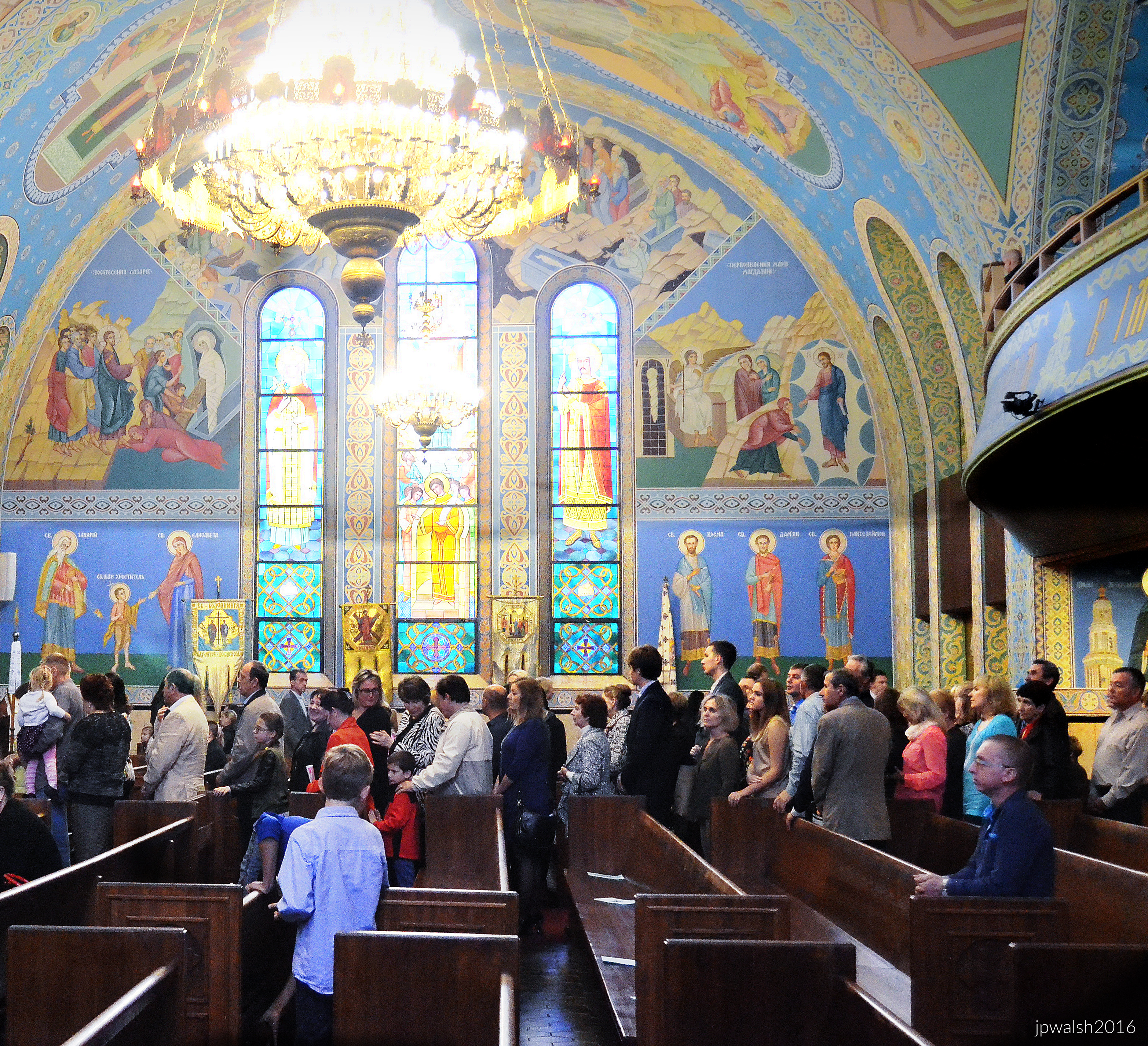
Parishioners praying and going to Communion at Sunday Mass.
Chicago. Sts. Volodymyr and Olha Church. October 2016. Author’s photograph. 4.54 mb
Chicago. Sts. Volodymyr and Olha Church. October 2016. Author’s photograph. 5.40 mb
With the artists’ skills, the bright colors and evocative forms of the artwork surround churchgoers as they move toward the altar at Communion during the Divine Liturgy.
Chicago. Sts. Volodymyr and Olha Church. October 2016. Author’s photograph. 6.18 mb
Chicago. Sts. Volodymyr and Olha Church. October 2016. Author’s photograph. 544kb 30%
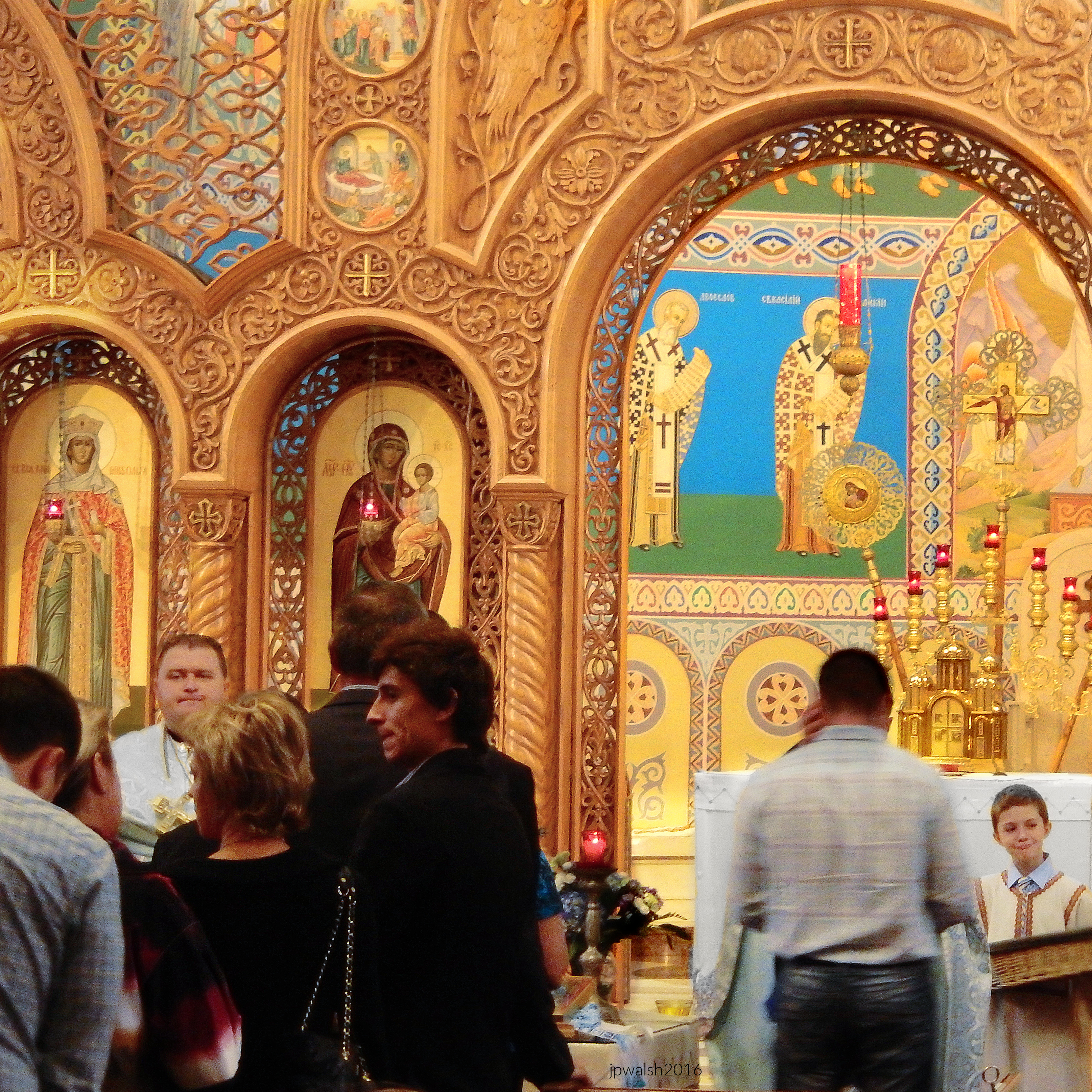
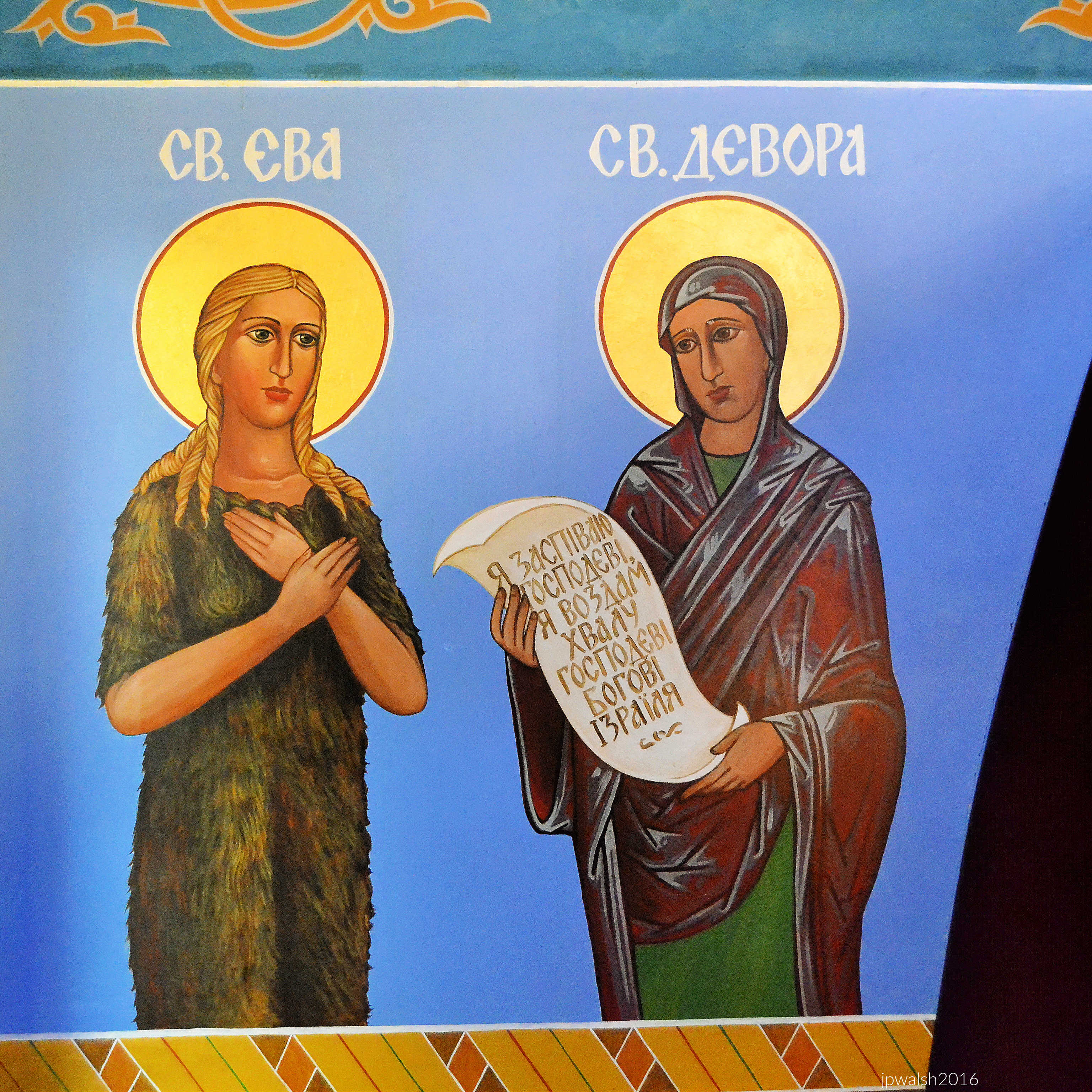
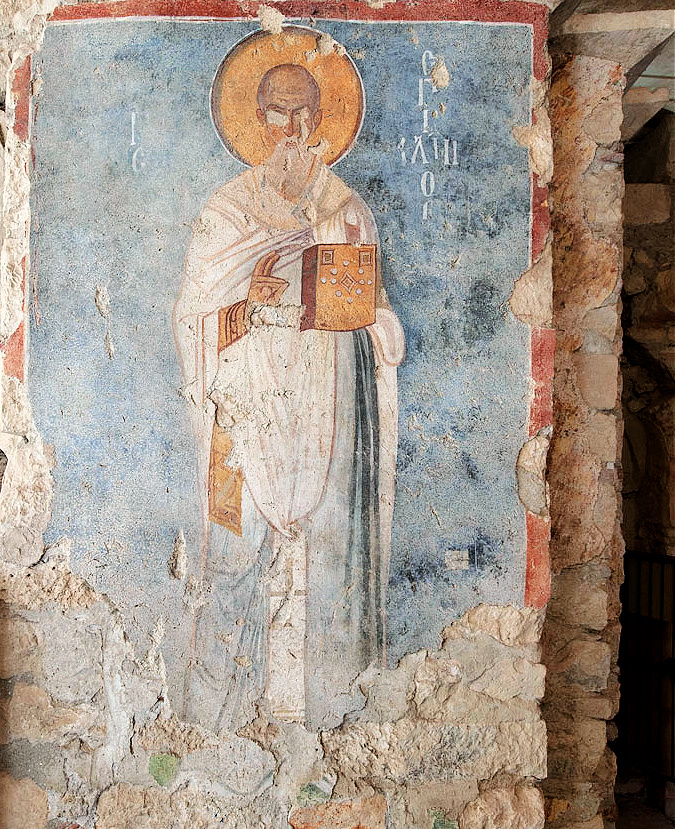
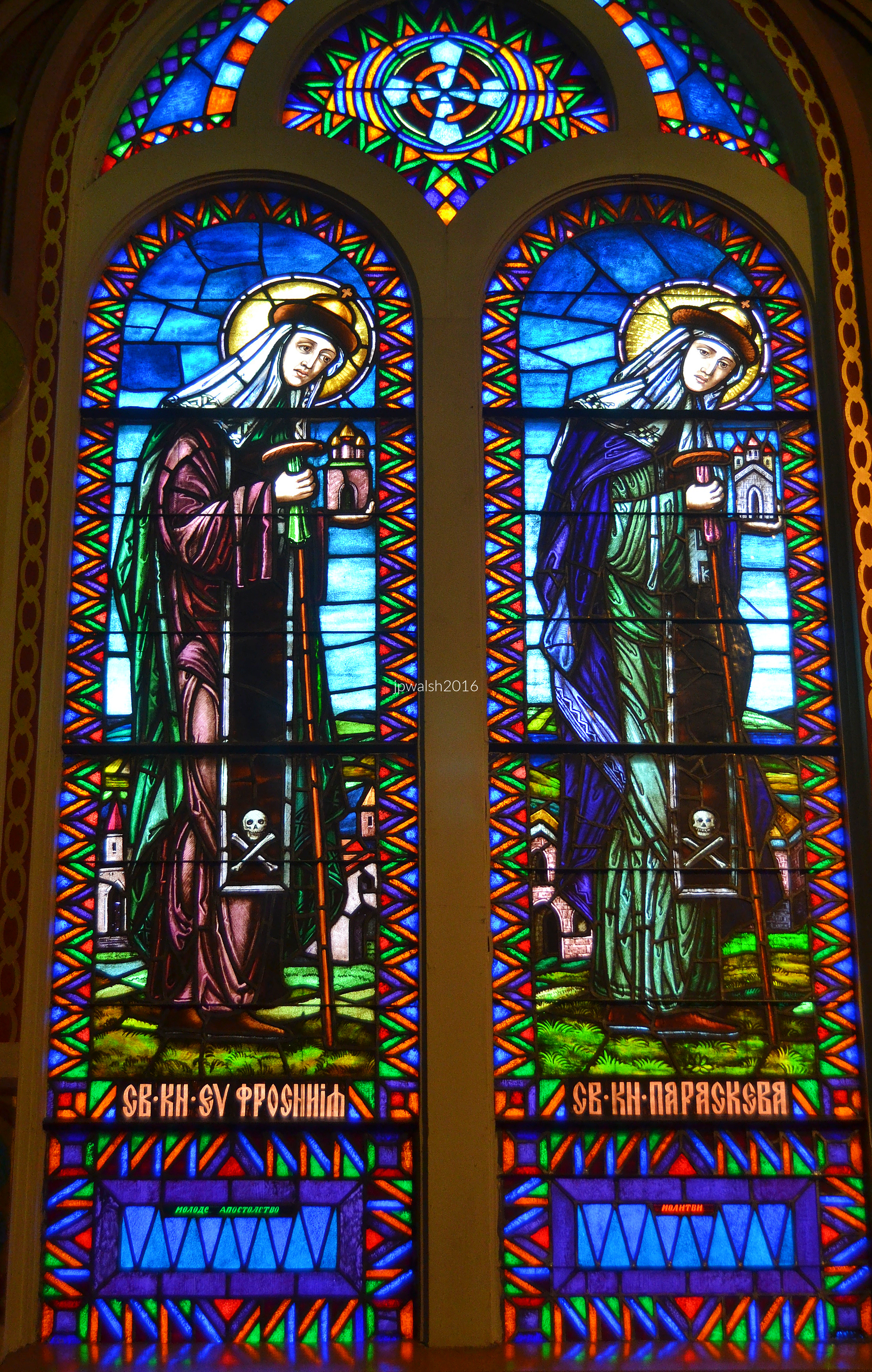
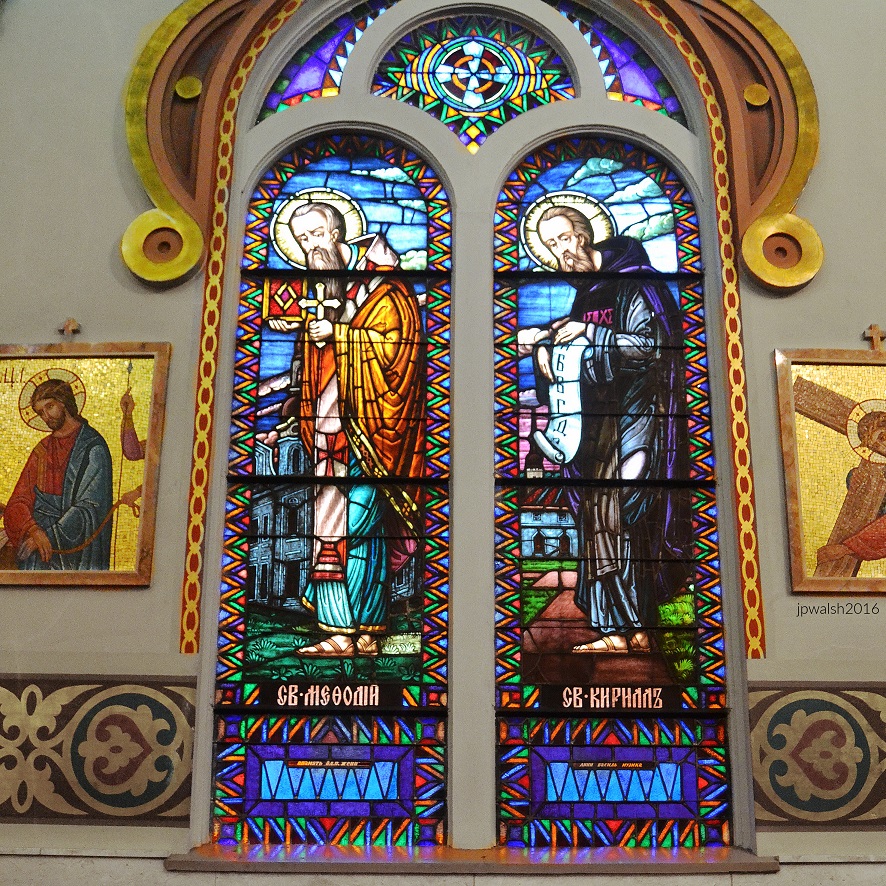
The colorful and vibrant decorations that include paintings, carvings, vestments, books, stained glass, and more, are integral to the parish’s liturgy and life.
Chicago. Sts. Volodymyr and Olha Church. October 2016. Author’s photograph. 5.46 mb
Chicago. Sts. Volodymyr and Olha Church. October 2016. Author’s photograph. 4.35 mb
Icon of Sts. Volodymyr and Olha with a smaller icon of the Blessed Virgin.
Chicago. Sts. Volodymyr and Olha Church. October 2016. Author’s photograph. 4.47 mb
Every nook and cranny of the church is decorated with colorful images from religious and Catholic Ukrainian history. The natural light streaking down from the main dome’s windows adds a heavenly glow.
Chicago. Sts. Volodymyr and Olha Church. October 2016. Author’s photograph. 6.15 mb
Two female haloed saints in a modern art style are marked by their unique attire as one holds an unfurled scroll with words in Ukrainian. Christianity arrived into Ukraine by way of the Greco-Byzantine world over 1000 years ago.
Chicago. Sts. Volodymyr and Olha Church. October 2016. Author’s photograph. 4.90 mb
A painting of the dormition of Mary is emphasized by an icon of Mary and the child Jesus. Colors, forms, and subject matter are very high quality, soft and peaceful, making them pleasant to look at and pray with.
Chicago. Sts. Volodymyr and Olha Church. October 2016. Author’s photograph. 6.18 mb
The wood carvings and full-length portrait icons are gorgeous. The fresh flower arrangements further brighten the scene.
Chicago. Sts. Volodymyr and Olha Church. October 2016. Author’s photograph. 7.68 mb
Visitors are joined by worshippers lighting candles and praying before a large icon of Mary and the child Jesus.
Chicago. Sts. Volodymyr and Olha Church. October 2016. Author’s photograph. 10.68 mb
The main altar gate of carved wood with icons and gold curtain. The Last Supper in center above.
SOURCES:
Coulson, John, ed. The Saints: A Concise Biographical Dictionary. Guild Press, 1957, pp. 577; 760-761.
Howe, Jeffrey. Houses of Worship: An Identification Guide to the History and Styles of American Religious Architecture. Thunder Bay Press, 2003.
Pacyga, Dominic A., and Ellen Skerrett. Chicago: City of Neighborhoods. Loyola University Press, 1986, p. 193.
Sinkevitch, Alice. AIA Guide to Chicago. 2nd ed. Harcourt, Inc., 2004, p. 260.
John P. Walsh, 2015-16. All rights reserved. All text and photos are the property of the author, except for materials explicitly credited as public domain or licensed content.
FEATURE image: St. Nicholas Ukrainian Catholic Cathedral (1915), 2238 W. Rice Street, Chicago, Illinois. July 2015. Author’s photograph. 7.16 mb
Inspired by Kyiv’s ancient St. Sophia Cathedral, St. Nicholas Ukrainian Catholic Cathedral in Chicago demonstrates how immigrant communities used architecture, art, and worship to preserve identity while establishing a permanent presence in the American urban landscape.
Chicago. St. Nicholas Ukrainian Catholic Cathedral. July 2015. Author’s photograph. 7.16 mb
At the western main entrance are the stars and stripes of the U.S. flag and the blue and yellow Ukraine flag. An avenue of trees lines the south side of the cathedral building. With its huge size and detailed architecture, St. Nicholas stands prominently on its 20 city lots. Worthmann & Steinbach was a Chicago-based architectural firm active in the first three decades of the 20th century. It was a partnership of German-born Henry W. Worthmann (1857-1946) and John G. Steinbach. The firm, with offices in Chicago and Oak Park, Illinois, designed many of the great Polish cathedrals in Chicago and for Eastern Catholic and Lutheran clients. Clement L. Pointek collaborated with Worthmann & Steinbach until he formed his own architectural firm with principal Joseph A. Slupkowski (1884-1951). The church interior was renovated in the wake of Vatican II liturgical reforms in the mid 1970s by Ukrainian-American architect Zenon Mazurkevich (1939-2018).
Its design was modeled after the historic St. Sophia Cathedral in Kyiv, linking Chicago’s Ukrainian community to the architectural heritage of Ukraine.
The huge yellow brick church building in Chicago’s tree-lined Ukrainian Village neighborhood is 155 feet long and 85 feet wide. Among its details, the building is renowned for its frescos and mosaics. St. Nicholas Ukrainian Catholic Cathedral’s impressive design and footprint on the skyline of one of Chicago’s neighborhoods was built as a worthy emulation of the 11th century (former) St. Sophia Cathedral in Kyiv, Ukraine. The church on Chicago’s near West side was built by the firm of Worthmann and Steinbach which built many churches in Chicago in the 1910’s and 1920’s. In the mid1970s the church interior was completely renovated and restored by a Ukrainian artist. Ukrainian Catholics follow the Byzantine-Slavonic Eastern Rite and acknowledge the pope in Rome as their spiritual leader.
Who is St. Nicholas the Wonder Worker?
St. Nicholas, Demre, Turkey. St. Nicholas of Myra (270-340) is one of the church’s most popular and revered saints. St. Nicholas, who is the historical inspiration for Santa Claus, is the patron saint of children and those in dire need. St. Nicholas is an important religious figure for Latin and Eastern Rite Roman Catholics and Orthodox Christians. He was the bishop of the ancient Lycian town of Myra in the eastern Mediterranean which is today’s Demre in Turkey. He is patron saint of prisoners, the falsely accused and convicted, and travelers. Nicholas is also patron saint of Greece, Sicily, Apulia in Italy, and the Lorraine in France. The St. Nicholas Church that exists today in Demre (Myra) was built around 520 A.D over an older church where St. Nicholas was bishop and was the saint’s burial place. Remarkably, St. Nicholas’s corpse remained incorrupt and exuded a fragrant odor of myrrh. For centuries St. Nicholas’s relics were in the cathedral in Myra. In 1087 his relics were removed from Myra to Bari, Italy, where they are today. The sweet myrrh smell that exudes from the saint’s body is said to still take place today. Many miracles have been attributed to St. Nicholas during his lifetime and after his death so that he came to be called “The Miracle/Wonder Worker” of Myra.
History of the Cathedral parish
St. Nicholas Ukrainian Catholic parish was founded in 1905 by a group of 51 Ukrainian working immigrants. These Ukrainians arrived on Chicago’s northside in the late 1890’s from western and Carpathian Ukraine. Irish, Germans and Poles were already well established in Chicago by this time and built churches. The Ukrainians not only arrived later, but also were committed to their eastern-rite, Greek Catholic origins. They actively looked to fend off incorporation into the Latin rite under a mostly Irish Catholic hierarchy in the Chicago diocese. To this effect, the parish board adopted a resolution stating: “[T]hat all property of said church which may hereafter be acquired be held in the name of its incorporated name but under no conditions shall said church or its priests or pastors be ever under the jurisdiction of bishop or bishops except those of the same faith and rite.”
Founded by Ukrainian immigrants in 1905, the parish became a focal point for preserving Ukrainian religious and cultural traditions in Chicago.
By 1911 it became clear that a new, larger church was needed for the growing Ukrainian community. Twenty lots were purchased on Rice Street between Oakley and Leavitt for $12,000 and building began. In 1913, Bishop Soter Ortynsky blessed the cornerstone of the new church. This Ukrainian Catholic church parish community relocated out of its original site and ventured about one mile directly west to build their new church under Fr. Nicholas Strutynsky. Fr. Nicholas had recently arrived from Ukraine and remained at St. Nicholas parish until 1921.
In 1941, St. Nicholas parish was host to the Eucharistic Congress for Eastern Rites. Twenty years later, in 1961, St. Nicholas Parish became St. Nicholas Ukrainian Catholic Cathedral when it became the seat of the Eparchy for much of the United States. Msgr. Jaroslaw Gabro, a native son of the parish, became the first bishop of the newly created Ukrainian Catholic eparchy.
Completed in 1915, the magnificent, Byzantine-Slavonic structure with thirteen onion domes representing Christ and His 12 apostles was erected. The first liturgy was celebrated on Christmas Day, January 7, 1915 (Julian calendar). A Ukrainian heritage school (Ridna Shkola) was also founded. By the early 1960s the school had over 1000 students. In 2022, St. Nicholas Elementary School has about 150 students.
The cathedral was completed in 1915 and designed by Worthmann & Steinbach, with Clement L. Pointek associated with the project.
When Bishop Gabro announced that churches in the eparchy would need to follow the Gregorian religious calendar that is used in the Latin west, some parishioners left St. Nicholas. In 1974 these parishioners, adhering to the ancient Julian religious calendar. erected Sts. Volodymyr and Olha Church three minutes away on foot across Chicago Avenue.
In 1980 Bishop Gabro who passed away was succeeded by Bishop Innocent Lotocky and a healing began between the estranged Ukrainian churches that continues today. In 1988, an ecumenical commemoration of the millennium of Christianity in Ukraine brought together Ukrainian churches in Chicagoland. Following the collapse of the Soviet Union in 1990, a new wave of immigrants from Ukraine began arriving in Chicago and joined St. Nicholas Cathedral. In 1993 Bishop Innocent Lotocky retired and was succeeded by Bishop Michael Wiwchar. In 2003 Bishop Michael Wiwchar was succeeded by Bishop Richard Stephen Seminack.
Chicago. St. Nicholas Ukrainian Catholic Cathedral. October 2016. Author’s photograph. 3.87 mb
The height of the cathedral building is appreciated looking up from its north side near its main entrance. Metal onion domes turned green by a century of oxidization cap the building’s 16 towers.
A major interior renovation between 1974 and 1977 introduced extensive frescoes and mosaics inspired by medieval Ukrainian Byzantine art.
Chicago. St. Nicholas Ukrainian Catholic Cathedral. October 2016. Author’s photograph.7.54 mb
The architecture, supported by columns, is curvaceous and spectacularly colorful.
The gold and blue fresco above the altar includes a pair of depictions of the former 11th century St. Sofia Cathedral in Kyiv on whose design and appearance St. Nicholas Ukrainian Cathedral is inspired. Kyiv is the capital city of the Ukraine and its cathedral is one of the finest examples of East Russo-Byzantine architecture. Kyiv/Kiev, Ukraine became the first capital of proto-Russia in the mid9th century as Slavic lands were organized by Norsemen who, simultaneously, as the fierce Vikings were plundering through much of Europe as they transported their culture.
Before the 9th century was over, the first Christian missionaries had arrived from Constantinople to the south into Russia and Ukraine and many Slavs became Christian. From the 10th to 13th centuries Kyiv, like Moscow to its north centuries later, became the intellectual and religious center of the country, where there were established innumerable monasteries, churches, and convents.
The entirety of murals and ornamentation are permanently affixed on interior surfaces by being painted directly on them. The only icon that was not renovated at this time was the one at the rear of the sanctuary depicting Christ with his apostles and Mother Mary. It was kept from 1928.
Chicago. St. Nicholas Ukrainian Catholic Cathedral. October 2016. Author’s photograph. 11.84 mb
Hanging from the center highest dome of the church is a 9-tiered golden chandelier with 480 brilliant lights. The chandelier was made in Greece and is one the largest such chandeliers in North America. The ceiling is in gold leaf and wall decorations depict Christ and the Virgin with Old and New Testament figures such as saints, prophets, and patriarchs, all in bright colors.
Chicago. St. Nicholas Ukrainian Catholic Cathedral. October 2016. Author’s photograph. 5.96 mb
A propensity of brown and gold in a color scheme that works. The formidable dome is an integral aspect of the interior decoration.
Chicago. St. Nicholas Ukrainian Catholic Cathedral. October 2016. Author’s photograph. 7.22 mb
Suspended beneath the great central dome of St. Nicholas Ukrainian Catholic Cathedral in Chicago, a nine‑tier chandelier of 480 lights—crafted in Greece—casts a radiant glow across the interior. Directly beneath it unfolds the scene of Pentecost (Acts 2:1–13): the twelve apostles and Mary, robed in vivid primary colors, sit together as the Holy Spirit descends upon them, symbolized by a dove emerging from heaven. The moment marks the fiftieth day after Easter and the tenth after the Ascension.
The cathedral’s iconographic program draws directly from the mosaics of the eleventh‑century Cathedral of St. Sophia in Kyiv, one of the masterpieces of Ukrainian Byzantine art. When St. Nicholas was renovated between 1974 and 1977, the interior work was led by Boris Makarenko (1925–2008), a specialist in Ukrainian Byzantine style, who adapted the ancient Kyivan models with meticulous attention to color, gesture, and theological symbolism.
Boris Makarenko was born in the Poltava region of Ukraine between Karkiv and Kyiv. With the outbreak of World War II, Ukraine was thrown into turmoil and Boris was drafted into the Soviet Army. He deserted with a group of friends and joined the Ukrainian Resistance. Boris fought his way across Europe and was eventually recruited into the British Army. Unable to return to his homeland, Boris immigrated in 1950 to the United States. He worked under the famed Ukrainian sculptor Mykola Mukhyn and eventually in a German-based firm where he learned and mastered the techniques of interior ecclesiastical art, restoration, and design. By the late 1950s, Makarenko founded his own studio in Philadelphia, Pennsylvania.
Using classical methods, mosaics are created by utilizing pieces of smalti and gold whether the mosaics are on the exterior and or in the interior of the church building.
Typically, Italian smalti is poured thicker and cut into thinner pieces. Since they are cut from the inside of exposed molten glass they are more vibrant, consistent and reflective in colors. Italian smalti can provide a coarse or smooth surface depending on how they are laid into a working surface. To begin to understand the complexity and richness of the frescos and mosaic interior of St. Nicholas, the general rule is for each square foot of mosaic surface, about 600 pieces side to side are required. The amount of pieces for the cathedral are into the many tens of thousands.
Chicago. St. Nicholas Ukrainian Catholic Cathedral. October 2016. Author’s photograph. 6.02 mb
The altar was built to face ad orientem, properly, “to the east.” This was the tradition and practice of the Catholic Church for nearly 2,000 years. The gold and decorations are outstanding.
In an Eastern Christian (Byzantine Rite) iconostasis, the placement of the primary figures follows a precise theological arrangement. Inside St. Nicholas Ukrainian Catholic Cathedral, the 4 Large Front Icons (Main Tier) are left to right: Saint Nicholas (Far Left) The Theotokos (Mother of God) (Inner Left), Jesus Christ (Christ Pantocrator) (Inner Right) and Saint John the Baptist (Far Right)
The 2 Small Front Icons (Deacon’s Doors) are the Archangel Michael (Left Deacon’s Door) and Archangel Gabriel (Right Deacon’s Door).
Chicago. St. Nicholas Ukrainian Catholic Cathedral. October 2016. Author’s photograph. 5.34 mb
Icons are visual symbols of eternal truth in the Christian Faith: the designs are based on archetypal images preserved and regenerated from the very beginnings of Christianity. Iconographers write icons in traditional media using egg yolk tempera and oil-based pigments. The predominance of the gold color that marks these interior paintings and decorations is gold leaf. Called “gilding,” the use of gold leaf pertains to iconography. plaster carvings, wood carvings, and metal.
Stained Glass, 1915, Munich Studio of Chicago:
Chicago. St. Nicholas Ukrainian Catholic Cathedral. October 2016. Author’s photograph. 6.87 mb
• Left Panel: Saint Apostle Paul (labeled in Cyrillic as СВ АПЛЪ ПАВЕЛЪ).
• Right Panel: Saint Apostle Peter (labeled as СВ АПЛЪ ПЕТРЪ).
Stained Glass by Munich Studio of Chicago
The colorful stained-glass is original to the 1915 church. They depict saints of the Catholic Church and were created by the Munich Studio of Chicago. The walls include tall, faceted windows displaying a hybrid of traditional and dalle-de-verre type glass techniques. Akin to mosaic, the latter stained-glass technique lends itself to abstract and highly stylized designs. The Munich Studio of Chicago was a major stained-glass studio in Chicago composed of skilled craftsmen and artists. In addition to the hagiography the windows depict, they also represent the artistic investment of the founding parishioners of St. Nicholas. While the term stained glass covers “colored, enameled, or painted glass”, Chicago’s pioneer “glass stainers” were primarily glass painters who used dark brown vitreous oxide and silver stain to paint designs on pieces of colored and/or opaque white glass. After the kiln firing the pieces were assembled like fragments of a puzzle and connected to each other with strips of malleable lead – called cames – which were fitted and soldered around each piece to create the full window.
The founder of The Munich Studio, Max Guler, was of middle-European extraction, as were the congregations of many of the churches who commissioned his firm for their windows. Guler came to Chicago about 1896 from the city of Munich, Germany where he had studied China painting. In 1898 his name appears in the Chicago city directory as an artist. Four years later the firm of Guler, Kugel and Holzchuh, presumably a small glass shop, is listed; and in 1903 the Chicago city directory first lists The Munich Studio, stained glass, 222 W. Madison, 5th f1r., with Guler as president. Catalog listings from 1910 to 1925 note thirty-two major church installations in Chicago and scores more elsewhere.
In 1913 the company moved from Madison Street to larger quarters at 300 West South Water Street (now Wacker Drive), and in 1923 to 111 West Austin Street (now Hubbard Street), at that time employing over 30 craftsmen, seven doing only glass painting. The Munich Studio imported most of its glass from France and Germany with domestically-made glass from firms in Indiana and West Virginia. As with European stained glass, they were painted with iron oxide and yellow stain and fired in ovens. The Munich Studio continued to prosper until 1930 when the Great Depression brought all building to a near standstill. Since it depended primarily upon the construction of new churches for its business, the economic downturn caused the company’s closing in 1932.
Chicago. St. Nicholas Ukrainian Catholic Cathedral. October 2016. Author’s photograph. 7.15 mb
• Left Panel: Saint Princess Euphrosyne (labeled in Cyrillic as СВ • КН • ЕУФРОСИНIЯ). She is typically associated with Saint Euphrosyne of Polotsk, a 12th-century princess who rejected marriage to enter a monastery, became a noted patron of literacy and copyist of books, and founded multiple convents.
• Right Panel: Saint Princess Paraskeva (labeled in Cyrillic as СВ • КН • ПАРАСКЕВА). She represents Saint Paraskeva (often associated with Paraskeva of Polotsk or the beloved eastern European traditions of St. Paraskeva/Petka), a princess known for her ascetic life, devotion, and works of charity.
Chicago. St. Nicholas Ukrainian Catholic Cathedral. October 2016. Author’s photograph. 5.92 kb 30%
Mosaics of the Stations of the Cross were created by Boris Makarenko.
• Left Panel: Saint Great Martyr Barbara (labeled in Cyrillic as СВ • ВЛМЧ • ВАРВАРА).
• Right Panel: Saint Demetrius Great Martyr (labeled in Cyrillic as СВ • ДИМИТРIЙ ВМЧ), commonly known as Saint Demetrius of Thessaloniki.
Chicago. St. Nicholas Ukrainian Catholic Cathedral. October 2016. Author’s photograph.
• Left Panel: Saint Methodius (labeled in Cyrillic as СВ • МЕѲОДIЙ).
• Right Panel: Saint Cyril (labeled in Cyrillic as СВ • КИРИЛЛЪ). Saint Cyril holds an open scroll displaying the early Slavic alphabet (А, Б, В, Г…), directly referencing his historic invention of the Glagolitic script (the precursor to the Cyrillic alphabet) used to translate the Bible and liturgical texts for the Slavic peoples.
Artist Boris Makarenko played a central role in creating the cathedral’s rich iconographic program.
Chicago. St. Nicholas Ukrainian Catholic Cathedral. October 2016. Author’s photograph. 5.65 mb
The parents of the Virgin Mary:
• Left Panel: Saint Anne (labeled in Cyrillic as СВ • АННА).
• Right Panel: Saint Joachim (labeled in Cyrillic as СВ • ІОАКИМЪ).
Chicago. St. Nicholas Ukrainian Catholic Cathedral. October 2016. Author’s photograph. 8.62 mb
Transfiguration.
Chicago. St. Nicholas Ukrainian Catholic Cathedral. October 2016. Author’s photograph. 7.22 mb
Nativity.
Chicago. St. Nicholas Ukrainian Catholic Cathedral. October 2016. Author’s photograph. 5.35 mb
The cathedral became the seat of the Ukrainian Catholic Eparchy in 1961, elevating its ecclesiastical significance nationwide.
Chicago. St. Nicholas Ukrainian Catholic Cathedral. October 2016. Author’s photograph. 3.78 mb
The thirteen domes symbolize Christ and the Twelve Apostles, reflecting Byzantine theological symbolism.
Chicago. St. Nicholas Ukrainian Catholic Cathedral. October 2016. Author’s photograph. 3.67 mb
St. Nicholas Ukrainian Catholic Cathedral’s regal appearance and design is inspired by the Cathedral of St. Sophia in Kyiv. This includes its 13 domes, symbolic of Christ and his 12 apostles. The Chicago cathedral is also similar to the Kyiv model in that it has 5 major domes.
Chicago. Author & wife on steps of St. Nicholas Ukrainian Catholic Cathedral. July 2015. Author’s photograph. 6.41 mb
Above these main entrance steps, the façade of the cathedral displays a treasured mosaic depicting “Our Lady of Pochaev.” Above that image is the icon of St. Nicholas the Wonder (or Miracle) Worker, the cathedral’s namesake.
Story of “Our Lady of Pochaev”
Ukraine had been Christianized for about 200 years when, in 1198, when St. Francis of Assisi was about 17 years old, a monk climbed Pochaiv mountain in western Ukraine in order to pray. A pillar of fire appeared to the monk and some nearby shepherds. When the flames subsided, the Blessed Virgin Mary appeared. The apparition left her footprint out of which a spring of water flowed. This supernatural event led to many others so that the region became dedicated to Mary.
In 1559, Metropolitan Neophit sent to Anna Hoyska an icon of our Lady of Pochaev. The icon shows our Lady wearing a crown and holding the infant Jesus. She holds the end of her veil in the other hand. It is an icon where the cheek of the baby Jesus touches Mary’s face as the infant gives a blessing with his hand. At approximately 11×9 inches in size, the original icon is small. Made from red-pitched cypress, the artist and circumstances of its creation are unknown.
The icon immediately worked a miracle as Anna Hoyska’s blind brother regained his sight. Following her death, the icon was donated to a Basilian Monastery and eventually placed in the Church of the Dormition of the Blessed Mother. Monastery chronicles record numerous miracles during the icon’s stay at their Church.
In 1773, the icon was crowned by Pope Clement XIV. In 1831 Russian Czar Nicholas I expelled the Basilians and gave the monastery to Orthodox monks. In 2001, the icon was moved from Pochaev to The Cathedra of the Trinity of The Danilov Monastery in Moscow.
Chicago. St. Nicholas Ukrainian Catholic Cathedral. October 2016. Author’s photograph. 3.96 mb
This is the apolytikion for the feast of St. Nicholas of Myra, December 6, an important saint in the Christian Church, East to West, since the 4th century. In the Eastern Orthodox Church, the term “apolytikion” refers to a hymn sung as an important part of the liturgy typically in honor of a saint’s feast day. It often summarizes in a few lines the significance of the saint’s spirituality celebrated that day. The “apolytikion” can also be sung in conjunction with the Divine Office, such as Matins or Vespers. FROM THE GREEK: “A rule of faith and an image of meekness, a teacher of self-control, the truth of things has revealed you to your flock; therefore, I shall gain the heights through humility, the wealth through poverty. Father Hierarch Nicholas, pray to Christ our God that our souls may be saved.”
Heavenly City: The Architectural Tradition of Catholic Chicago, Denis Robert McNamara, James Morris, Liturgy Training Publications, Chicago, Illinois, 2005, pp. 114-115
Chicago Churches and Synagogues: An Architectural Pilgrimage, George Lane, S.J., and Algimantas Kezys, Loyola University Press, Chicago, 1981, p. 136-137.
Houses of Worship: An Identification Guide to the History and Styles of American Religious Architecture, Jeffrey Howe, Thunder Bay Press, San Diego, California, 2003.
AIA Guide to Chicago, 2nd Edition, Alice Sinkevitch, Harcourt, Inc., Orlando, 2004, p. 260.
Discovering Stained Glass in Detroit, Nola Huse Tutage with Lucy Hamilton, Wayne State University Press, Detroit, 1987.
The Saints: A Concise Biographical Dictionary, edited by John Coulson, Guild Press, New York, 1957, pp. 565-567.
FEATURE Image: Holy Trinity Orthodox Cathedral, 1121 N. Leavitt, Chicago. The walls of the church building are load-bearing brick covered with stucco. The bell tower and octagonal belfry, dome, and roof are made of wood with metal trim and latticework. July 2015. Author’s photograph. 2.80 mb
Holy Trinity Orthodox Cathedral demonstrates how Louis H. Sullivan (1856-1924), best known for his commercial architecture, adapted his design genius to a modest immigrant church, creating a distinctive synthesis of Russian provincial tradition, Eastern Orthodox worship, and Sullivan’s own ornamental imagination within Chicago’s Ukrainian Village.
Louis H. Sullivan designed the bell tower (above and below) with its ornamentation and eaves and soffits for Holy Trinity Orthodox Cathedral in Chicago’s Ukrainian Village.
how Louis Sullivan adapted traditional Russian architecture to create the bell tower of Holy Trinity Orthodox Cathedral The octagonal open lantern where the bells hang is a classic feature of 17th-century Russian wooden architecture, traditionally referred to as an “octagon on a cube” (vosmerik na chetverike). Rising above the open belfry is a steep, grey-shingled tent-shaped roof. This architectural style was historically popular in Russia for its ability to keep heavy snow from piling up on church towers. The Wave-Like Roofline and slender window slats are Sullivanesque. Crowning both the main tent roof of the bell tower and the smaller side turret are brilliant golden onion domes. In Orthodox theology, the onion dome symbolizes a burning candle flame reaching up toward heaven.
Built in 1903 on a limited budget, the church is a relatively small structure whose architectural impact far exceeds its size.
Louis H. Sullivan designed the portal canopy (above) and its ornamentation such as the fretwork. Sullivan also designed the window frames (example below).
Louis H. Sullivan designed key architectural elements of the cathedral, including the bell tower, portal canopy, window frames, and decorative ornament.
Louis Sullivan’s genius directly merges with traditional Russian Orthodox geometry in this window, which serves a vital role in illuminating the church’s interior. The top of the window frame features a uniquely Sullivanesque, multi-tiered, stepped triangular pediment that beautifully complements the sharp lines of the building’s exterior roof eaves. Along the sides, the outer wooden posts feature finely routed parallel grooves and subtle decorative blocks. This style of ornamentation is a hallmark of Sullivan’s organic philosophy—using natural light and shifting shadows to give rigid wood components a rich, rhythmic texture.
Furthermore, each major pane of leaded glass features a complex geometric pattern centered on an octagon. While the octagon served as Sullivan’s favorite transitional shape to bridge the gap between square and circle, it simultaneously held a profound meaning for the Orthodox parish. This eight-pointed geometry carries a deep spiritual resonance, symbolizing the “Eighth Day” of creation (the eternal Kingdom of God) and echoing the architectural octagons found in the cathedral’s main dome and bell tower.
Holy Trinity Cathedral was built on a limited budget. It is a small building at 47 x 98 feet situated on an east-west axis. The main body of the church is square with extensions and an octagonal dome above. The picturesque country-church entrance has a metal and wood canopy whose design and ornamentation were created by the architect, Louis H. Sullivan (1856-1924). Dedicated in 1903, the church was designated a cathedral in 1923.
Prominently featured in the foreground is a traditional Slavic-style wooden cutout Crucifixion scene, known as a Golgotha. Mounted inside an ornate white-and-gold carved wooden kiot (shrine framework) is a distinct icon of Saint Nicholas the Wonderworker.
The icons, the painted Golgotha cutout figures, and the surrounding sanctuary murals were painted by artist Genrik Borutsky and his workshop crew between 1902 and 1903.
This exterior view of Holy Trinity Orthodox Cathedral captures the masterful architectural synthesis achieved by Louis Sullivan in 1903. Commissioned by 28-year-old Saint John Kochurov of Chicago in 1899, Sullivan deliberately blended traditional, rustic Russian provincial church aesthetics with modern American Prairie School and organic design principles.
Rather than grand stone or brick used in churches, Sullivan utilized a rough-textured stucco facade paired with heavy, natural wood ornamentation. Peeking out from the roofline on the left is the wooden octagonal lantern of the bell tower. Its open-air arched windows, multi-tiered flared roof profiles, and crowning golden onion dome are textbook elements of classical Russian Orthodox wooden church design. The deep, dramatic wooden overhang of the roofline supported by exposed structural wood rafters is a hallmark element of both Prairie School architecture. Above the two multi-paned windows are distinct, sharp triangular wooden pediments that are distinctively Sullivanesque. The building’s bell tower is organically shaped around the dome.
The church building was completed for around $27,000 in 1903 (approximately $1 million in 2022) with Sullivan donating half his commission to the church project.
Who is St. John of Chicago (1871-1917)?
After 12 years of fruitful missionary work in the American Midwest—where he helped establish several additional parishes and co-organized early Orthodox mutual aid societies—Father John returned to his native Russia in 1907.
In 1916, he was assigned to serve at St. Catherine’s Cathedral in Tsarskoye Selo, a suburb of St. Petersburg. In October 1917, the violence of the Bolshevik Revolution erupted directly in his town. To ease panic, Father John organized an outdoor prayer procession through the streets, pleading for peace among the warring factions.
On October 31, 1917, Bolshevik forces stormed the town. Because he had prayed publicly for peace rather than endorsing the revolution, Father John was arrested by a Red Guard mob, dragged to the outskirts of town, and shot to death. This tragic event earned him the solemn historical distinction of becoming the proto-hieromartyr (the very first clergyman killed) of the Soviet era.He was officially canonized and glorified as a saint by the Russian Orthodox Church in December 1994, and his memory is deeply celebrated every October 31st by Orthodox Christians globally, particularly at the cathedral he built in Chicago.
Historic photograph of the interior of Holy Trinity Orthodox Cathedral in Chicago, originally taken in 1905 by a photographer for the Chicago Daily News. The image captures a service in the cathedral shortly after its completion, with Saint John Kochurov likely visible leading the parish. Public Domain.
Same view over 110 years later. Chicago. Holy Trinity Orthodox Cathedral. October 2016. Author’s photograph. 6.95 mb
The Eastern Orthodox central plan creates an interior where the congregation stands in a square space topped by an octagonal dome. For Easter services and the like, the cathedral is filled to capacity with parishioners and others spilling out the front door with its decorative canopy onto the public sidewalk.
Painted by Genrik Borutsky between 1902 and 1903 during the initial interior decoration of the Holy Trinity Orthodox Cathedral in Chicago this mural is an exact full-scale replica of the fresco “The Ecumenical Councils” designed by the legendary Russian master Viktor Vasnetsov between 1885 and 1896 for St. Vladimir’s Cathedral in Kyiv, Ukraine.
The mural depicts a grouping of the Great Church Fathers and Bishops of the Early Christian Church. In front of a Byzantine domed cathedral is, from left to right, Saint Athanasius the Great (c. 296–373), Patriarch of Alexandria; Saint Gregory of Nazianzus (c. 329–390), Theologian; Saint Basil the Great (c. 330–379), Archbishop of Caesarea; Saint John Chrysostom (c. 347–407), Archbishop of Constantinople; Saint Gregory of Nyssa (c. 335–395) or Saint Cyril of Alexandria; and Saint Nicholas of Myra (c. 270–343).
The congregation was composed largely of immigrants from regions near present-day Ukraine and the Carpathian Mountains.
The parishioners that built this church were rural people who had emigrated from southern Russia near the Ukraine as well as the area of the Carpathian Mountains.
The photograph captures the sanctuary (altar area), the most sacred part of an Orthodox church, situated behind the iconostasis screen and accessible only to clergy.
• The Holy Table (Altar Table): In the foreground sits the square Holy Table, draped in bright red vestments and a gold liturgical stole (epitrachelion). Resting on top are liturgical items, including a heavy book of the Gospels and a hand cross.
• The Seven-Branch Candlestick: Positioned directly behind the Holy Table is an ornate, golden seven-branched candelabra modeled after a tree, flanked by hanging processional banners.
The murals along the curved apse wall represent the Great Hierarchs and Liturgists of the Church, rendered by Genrik Borutsky in 1902–1903 as exact copies of Viktor Vasnetsov’s masterpiece designs. Depicted, left to right, are Saint Gregory of Nazianzus; Saint Basil the Great; Saint John Chrysostom; and Saint Nicholas of Myra.
High above the central gold tabernacle structure is a separate, framed icon depicting the Holy Trinity (the Hospitality of Abraham).
The image depicts Saint Mary Magdalene, as indicated by the Church Slavonic inscription at the bottom: “СВ РАВНОАП МАРIЯ МАГДАЛИНА” (Saint Equal-to-the-Apostles Mary Magdalene). In the Orthodox tradition, her title “Equal-to-the-Apostles” highlights her vital role in proclaiming Christ’s resurrection to the disciples. She carries the alabaster jar she brought to the empty tomb to anoint Jesus’s body.
While the architectural structure of the Holy Trinity Orthodox Cathedral in Chicago was designed by legendary architect Louis Sullivan, the church’s traditional interior iconography and stenciled murals were executed based on the work of famous Russian artist Viktor Vasnetsov (V. N. Vasnetoff).
Vasnetsov was a leader of the 19th-century Russian revival movement, famed for blending historical Slavic folklore with classic Byzantine iconographic principles. The elaborate decorative borders, geometric framing, and gold accents wrapping around the pillar echo this late 19th-century style rather than Sullivan’s signature secular Art Nouveau ornamentation.
The stenciled artwork (above) is not by Louis H. Sullivan. Rather, the interior murals and iconographic schemes throughout the cathedral were executed by artist Genrik Borutsky and his team. Borutsky did not paint original compositions; instead, he meticulously painted full-scale copies of the monumental frescoes designed by legendary master Viktor Vasnetsov for St. Vladimir’s Cathedral in Kyiv, Ukraine. Vasnetsov’s influential “Russian Revival” style defined late 19th-century Orthodox art by blending strict Byzantine iconographic rules with softer, emotional realist elements.
The two saints painted on this adjoining corner pillar are St. John the Baptist and St. Nicholas the Wonderworker.
The church stands as one of Sullivan’s most unusual and personal works, distinct from the skyscrapers and commercial buildings that made him famous.
SOURCES:
Chicago Churches and Synagogues: An Architectural Pilgrimage, George Lane, S.J., and Algimantas Kezys, Loyola University Press, Chicago, 1981, p. 106-107.
Alice Sinkevitch, AIA Guide to Chicago, 2nd Edition, Harcourt, Inc., Orlando, 2004, p. 260.
FEATURE image: Erected in 1939, St. Francis Xavier Church stands at 524 Ninth Street in Wilmette, Illinois, within a mature residential neighborhood just a few blocks west of Lake Michigan. Rather than dominate its surroundings, the church was deliberately designed to harmonize with the architectural character of Chicago’s North Shore, reflecting the desire of the local Roman Catholic community to create a dignified house of worship that blended naturally into its well-established suburban setting.June 2014. Author’s photograph 3.56mb
Though outwardly modest and deliberately integrated into its residential setting, St. Francis Xavier Church reveals the sophistication of twentieth-century Catholic design, using architecture, sculpture, and stained glass to transform doctrinal teaching into a fully immersive visual experience.
St. Francis Xavier church, Wilmette, Illinois. December 2018. Author’s photograph. 11.6mb
The English Gothic‑style church—typically associated with establishment mainline Protestants—was designed to be both sophisticated and simple. When the parish community formed in 1904, it built a smaller multi‑purpose church‑and‑school on this same corner of 9th Street and Linden Avenue. That first structure supported the parish through its early decades, serving as both classroom and worship space as the community grew into the congregation that would later commission the present building. Built by McCarthy, Smith & Eppig, St. Francis Xavier Church adopts the character of a sturdy country church, marked by low walls, massive external buttresses, and a sloped, elongated roof.
The church was intentionally designed to blend into the surrounding North Shore neighborhood rather than stand as a monumental urban landmark.Massive buttresses, low walls, and an elongated roof create the character of a sturdy English country church.
St. Francis Xavier church, Wilmette, Illinois. June 2014. Author’s photograph. 4.64mb
Erected in 1939, St. Francis Xavier Church sits within an established, well‑maintained residential neighborhood in Wilmette, Illinois, just blocks inland from Lake Michigan. The area’s Roman Catholics intentionally sought a design that would blend unobtrusively into the North Shore streetscape, ensuring the church harmonized with its surroundings rather than dominating them or otherwise stand out. Placing the 1904 parish under the patronage of St. Francis Xavier, the premier Jesuit missionary and intellectual, reflected the cultural and educational aspirations of the region’s affluent English‑speaking Catholic families, whose spiritual identity was shaped by the strong Jesuit presence on Chicago’s North Shore.
WHO IS ST. FRANCIS XAVIER (1506-1552), FIRST JESUIT MISSIONARY TO THE FAR EAST AND CO-PATRON OF FOREIGN MISSIONS?
Parish patron and namesake St. Francis Xavier is depicted in marble at the entrance to the sanctuary in Wilmette, Illinois. namesake. Holding a crucifix, the Basque Jesuit priest is dressed in a black cassock draped by an alb and stole. June 2014. Author’s photograph. 4.05 mb
The unobstructed interior provides clear sightlines to the sanctuary and reflects evolving twentieth-century liturgical priorities.The inverted-barque ceiling symbolically references St. Francis Xavier’s missionary voyages to Asia.
Nave looking to main altar. June 2014. Author’s photograph. 5.99 mb
Unobstructed Sanctuary
There are no columns interrupting the view toward the marble altar and crucifix. After Vatican II, the tabernacle was moved to a niche on the right; originally it stood on the main altar beneath the crucifix. The extra‑wide altar rail—with cross‑shaped legs meant to evoke being at table with Christ for communicants—was also removed.
Modern Streamlining
Although St. Francis Xavier Church is traditional in overall form, its detailing is modern, chic, and streamlined, giving the sanctuary a flexible, adaptable character suited to later liturgical changes.
Symbolic Ceiling
The ceiling is shaped like an inverted barque, a visual metaphor for St. Francis Xavier’s missionary voyages across the seas to the Far East.
Its architecture combines English Gothic Revival forms with a notably streamlined and modernized interior treatment.
View of sanctuary. July 2014. Author’s photograph. 5.85mb
Architects & Origins
Among the leading ecclesiastical designers of the 1930s, McCarthy, Smith & Eppig worked closely with Chicago’s Cardinal George Mundelein. Joseph W. McCarthy (1884–1965), once a young architect under Daniel Burnham, shaped much of Chicago’s Catholic built environment from the 1910s through the 1930s.
Wilmette Commissions
In 1939, McCarthy completed two major Wilmette churches—St. Francis Xavier and the more monumental St. Joseph—standing barely a mile apart. The design of St. Francis Xavier was executed primarily by the firm’s younger partners, David Smith and Arthur Eppig.
Design & Cost
The church’s restrained architecture, enriched by fine detailing, cost $200,000 to build in the late Depression years—roughly $4 million in 2022.
Beyond Chicago
While most of McCarthy’s work rose in the Chicago region, his portfolio also includes significant projects such as the cathedral in Springfield (1928) and the parish church built in 1918 for what later became the Diocese of Joliet.
Organ loft. December 2017. Author’s photograph. 7.90 mb 77%
There are 8 major stained-glass windows in St. Francis Xavier Church: four in the west wall and four in the east wall.
Panels of three different windows.October 2015. Author’s photographs
Smaller stained-glass oculi and panels are scattered throughout the interior. These stained-glass windows were designed by parishioner Henry Schmidt. They are quite beautiful, scintillating in their pseudo-English Tudor style, and illumined by the usually soft eastern and tree-obscured western exposures. While their subject matter feels somewhat chaotic—a hodgepodge in its traditional and idiosyncratic admixture of hagiography, scripture, and popular piety—one aspect of their enduring appeal is that the glass can be seen close up and at eye level. This intimate perspective is vividly captured in the side panels: the left detail illustrates the Agony in the Garden, showing Christ kneeling on the Mount of Olives as an angel descends with the chalice of His Passion; the center panel depicts the Finding in the Temple, with the twelve-year-old Jesus teaching the elders while Mary and Joseph look on; and the right panel depicts the Annunciation, capturing the Archangel Gabriel appearing to the Virgin Mary under the illumination of the Holy Spirit.
ST. PETER WINDOW & THE QUEENSHIP OF MARY WINDOW.
The visual program of the St. Peter stained-glass window —particularly its central panel showing St. Peter holding the keys next to the Latin words for Saint Peter, flanked by scenes of Mary’s active intercession by way of her heavenly coronation and Assumption into Heaven—beautifully illustrate this very link between established apostolic authority on earth and the heavenly governance of Christ and His Mother.
The window’s left panel of the Crowning of Mary as Queen of Heaven refers to the moment the Trinity receives her, body and soul, following the Assumption. In Catholic tradition—as in the Fifth Glorious Mystery of the Rosary—the Coronation marks her crown of heavenly glory. Though rooted in Scripture—especially the ‘woman clothed with the sun’ of Revelation 12:1—the literal act of the Trinity placing a crown on Mary is held as pious tradition rather than defined dogma like the Assumption. Consequently, parish practices such as a May Crowning remain devotional customs rather than formal liturgical acts.
St. Peter window. June 2014. Author’s photograph. 4.98 mb
CENTER PANEL: Saint Peter, leader of the apostles, holds the keys of the kingdom of heaven (Matthew 16:19). Peter holds a book, a representation of St. Peter’s New Testament letters (1 and 2 Peter) and sermons (Acts). Below is St. Peter’s Basilica in Vatican City in Rome with its famous dome.
LEFT PANEL: Crowning of Mary as Queen of Heaven by Triune God (Father, Son and Holy Spirit). From the Council of Ephesus in 431, depicting the Blessed Virgin Mary wearing a regal crown was used in Christendom.
RIGHT PANEL: While biblical texts point directly to the defined dogma (431) of Mary as Theotokos (Mother of God), the literal event of her Assumption is not explicitly recorded in the New Testament. Instead, this latter dogma (1950) dictates that at the end of her earthly life, she was taken—or ‘assumed’—body and soul into heavenly glory. Scriptural imagery of going ‘up’ to heaven is utilized here to express a profound spiritual reality, drawing a deliberate theological parallel to Jesus’ own Ascension (Acts 1:6–17; Luke 24:50–53). This phenomenon of a bodily assumption is mirrored in the Old Testament accounts of Moses and Elijah, both of whom later appeared alongside Christ at His Transfiguration (Matt 17:1–9; Mark 9:2–10; Luke 9:28–36; 2 Peter 1:16–21). Anchoring these soaring heavenly narratives visually, identical angel figures rest directly below the window panels.
Assumption (right panel), St. Peter Window. October 2015. Author’s photograph. 4.81mb DSC_0504 (1)
The Queenship of Mary, while in one continuous arc with the crowning of Mary, is an established doctrine of the Church. In 1954, Pope Pius XII formalized this long-standing tradition by issuing the papal encyclical Ad Caeli Reginam (To the Queen of Heaven), establishing the universal Feast of the Queenship of Mary. The systematically-minded Pope Paul VI later moved the memorial to August 22—exactly seven days after the Solemnity of the Assumption—to underscore their inseparable theological connection. The Queenship refers to Mary’s eternal, structural office and state of reigning over the entire Created Order. Catholic theology teaches that her reign is not passive; rather, Mary actively exercises her exalted role as Intercessor, Advocate, and Mediatrix of graces on behalf of the entirety of creation, both the living and the dead, until the end of time. The maternal character of her office stems from the ancient Davidic kingdom, where the queen was not the king’s wife, but the king’s mother. In ancient Israel, this Queen Mother held a powerful office of advocacy, listening to the needs of the citizens and bringing them directly to the King. Mary reigns in this exact Old Testament typological capacity. As Pope Pius XII noted, Mary’s authority is characterized entirely by maternal solicitude and humility. Her power to rule flows directly from her absolute submission to God’s will, meaning her crown is the ultimate reflection of perfect, Christian discipleship and sacrificial agape.
Queenship of Mary window. December 2018. Author’s photograph.
CENTER PANEL: The Queen of Heaven who reigns from the right hand of her son, is depicted in her role as mother of Jesus Christ. Below, a crown hovers over what may be a heart-shaped letter “M” for Mary’s first initial and/or her sacred heart.
LEFT PANEL: The presentation panel depicts Jesus being offered by Mary and Joseph in the Temple, where they meet Simeon, a ‘just and devout’ man of Jerusalem (Luke 2:25–35). Celebrated as the Fourth Joyful Mystery of the Rosary, the Presentation occurs forty days after Jesus’s birth. In accordance with Luke’s narrative, Mary and Joseph journeyed to the Temple in Jerusalem to fulfill the requirements of Mosaic Law: completing Mary’s ritual purification after childbirth and offering the prescription for the redemption of the firstborn son (Leviticus 12; Exodus 13:12–15)
RIGHT PANEL: Nativity of Jesus in Bethlehem (Luke 2: 1-7 and Matthew 1: 18-25) is the Third Joyful Mystery of the Rosary. Below each side panel are identical Angel figures.
ST. BONIFACE WINDOW.
St. Boniface Window. June 2014. 3.93 mb
CENTER PANEL: St. Boniface (675–754) is widely regarded as the “St. Patrick of Germany.” A missionary bishop who labored during Europe’s Early Middle Ages, Boniface was primarily responsible for organizing the Church in western Germany. While the ancient sees of Cologne and Mainz already existed, he fundamentally restructured and elevated them to serve as the pillars of his reform movement. Acting under the direct mandate of the Roman pope, Boniface anointed Pepin the Short (714–768)—son of Charles Martel (c. 688–741) and father of Charlemagne (747–814)—as King of the Franks. Pepin’s subsequent 751 coronation established a powerful precedent for future European royal coronations, marking a definitive milestone in the formation of the modern European state
LEFT PANEL: Jesus meets his mother is the fourth station of the cross. The Holy Face, below, is a devotion proclaimed by Pope Leo XIII in 1885.
RIGHT PANEL: Jesus mocked and crowned with thorns (Luke 22:63-65 and John 19:2-3) is the sixth station of the cross.
ST. PATRICK WINDOW.
St. Patrick Window. July 2014. 7.58mb
CENTER PANEL: St. Patrick (418–493) is one of the patron saints of Ireland, alongside St. Brigid (c. 451–525) and St. Columba (540–615). In Wilmette, Illinois, St. Joseph Church was founded in the 1840s to serve German immigrants, while St. Francis Xavier Church was established in 1904 as an English‑speaking territorial parish for the expanding North Shore community.
The depiction of Patrick as the archetypal, bearded Irish bishop—in green vestments, with miter and pastoral staff—rose to prominence in the late 1700s. His iconography includes a book, symbolizing both Holy Scripture and his own Latin works, the Confessio and the Epistola to Coroticus. Patrick also holds the traditional three‑leafed shamrock, the emblem he used to explain the Holy Trinity to the Irish people. Beneath him rests the harp, Ireland’s historic national emblem and one of the world’s oldest musical instruments.
LEFT PANEL:Jesus Christ’s Resurrection from the dead stands as the cornerstone of the Christian faith (1 Cor. 15:17). His empty tomb testifies to Christ’s deity (John 5:26; Rom. 1:4). Through the Resurrection, Christ redeemed humanity from sin (Rom. 4:24–25; Heb. 7:25), granted believers the promise of future resurrection (John 14:19; 1 Cor. 15:20–23), and infused them with spiritual power (Rom. 6:3–4; Eph. 1:19–21).
The window shows the resurrected Jesus holding the banner of victory over death, while a Roman guard collapses before the radiant light of the Risen Christ, accompanied by a ministering angel. Christ’s three‑part cruciform halo traditionally bears the Greek letters ὁ ὤν, meaning “He Who Is” (or “I Am Who Am”), a definitive sign of His divinity.
Although all four Gospels recount the aftermath of the Resurrection, none describe the moment or essence of the event itself — a mystery at the heart of Christian belief.
RIGHT PANEL: The Crucifixion of Jesus shows Him on the cross, flanked by Mary and John the Apostle at its base. Above Christ’s head appear the letters INRI, the Latin initials for Jesus Nazarenus, Rex Judaeorum, the official charge written by Pontius Pilate, meaning “Jesus the Nazarene, King of the Jews.” This title is recorded in John 19:19. Resting symmetrically below each side panel are identical anchoring angel figures, grounding the composition and framing the scene’s solemn balance.
Altar design includes tall candlesticks and a detailed, compact baldacchino. June 2014. 4.61 mb
The rood-beam crucifixion group by Fritz Muhlhauser revives a medieval English church tradition within a modern American Catholic setting.
Crucifixion scene in basswood. December 2018. Author’s photograph. 8.47mb
A striking depiction of the Crucifixion carved in basswood stands atop the sanctuary’s rood beam, positioned at the ceiling line directly above the main altar. Hand‑carved by German sculptor Fritz Muhlhauser, the work revives a medieval English Gothic tradition: the rood beam marking the threshold between nave and chancel, symbolizing the bridge between earth and heaven through Christ’s sacrifice.
Muhlhauser executed the composition in basswood (Lindenwood), a fine‑grained European carving wood prized for holding intricate facial expressions and sharp drapery folds without splitting. The sculptural grouping presents Christ on the cross, His head crowned with thorns beneath the INRI inscription, flanked by Mary on the left and John the Apostle on the right. At the base of the cross, Mary Magdalene, bowed in profound grief, embodies the faithful women who witnessed the Passion (John 19:25; Luke 23:27, 49).
Stylistically, the figures are elongated and vertically dramatic, allowing their features to read clearly from the pews far below while harmonizing with the soaring vertical lines of the church’s late Gothic Revival architecture.
STS. ANN AND MARY WINDOW.
Sts. Ann and Mary Window. December 2018. 16.24mb. Author’s photograph.
Overview & Architecture
The late Gothic Revival stained-glass window illustrates the sacred maternal lineage that prepared the world for Christ. These nave windows are positioned so that they are sitting almost entirely at eye level. This intimate placement allows parishioners to stand directly beside the glass so that it functions much like an illuminated manuscript page, inviting them to appreciate its rich colors, expressive faces, and intricate details. Compositionally, the window’s narrative layout reads from right to left in terms of scriptural chronology (the Annunciation on the right moving to the Visitation on the left), flanking and bowing inward toward the central, towering figures of Saint Ann and Mary.
Center Panel: St. Ann and the Child Mary
This panel features the child Mary alongside her mother, Saint Ann, celebrating the vital generational link of Mary’s own birth. Because nothing is explicitly recorded in the New Testament about Mary’s parents or her nativity, early apocryphal Christian texts—such as the Protoevangelium of James—provide the vital historical framework. see – CHURCH FATHERS: Protoevangelium of James – retrieved September 8, 2026. These texts detail the miraculous nature of Mary’s birth to her long-barren parents, cementing an enduring legendary tradition of her immaculate beginnings. This familial focus is reinforced by the distinct vertical typography stitched directly into the blue glass background borders, with clean, capital letters clearly marking “SAINT ANN” and “SAINT MARY”—a design that rewards close-up reading from the aisle. Anchoring the base of this central structure is a miniature depiction of an angel.
Left Panel: The Visitation
The left detail depicts the Visitation of the Blessed Virgin Mary to her cousin Elizabeth (Luke 1:39–45). Following the Annunciation, Mary journeyed into the hill country to remain at the home of Elizabeth and her husband Zechariah for three months. Both women were experiencing miraculous pregnancies—Mary carrying Jesus by virgin birth, and Elizabeth conceiving John the Baptist in her advanced age. The window captures the precise moment John the Baptist leaped with joy in Elizabeth’s womb upon hearing Mary’s greeting (Luke 1:41). The Visitation is celebrated as the Second Joyful Mystery of the Rosary.
Anchoring the base of this left panel scene is a miniature architectural tabernacle or ark; Luke heavily structured his Visitation narrative around Old Testament accounts in 2 Samuel and 1 Kings regarding the physical journey of the Ark of the Covenant. Accordingly, paragraph 2676 of the Catechism of the Catholic Church formally identifies Mary as the Ark of the New Covenant: “Mary, in whom the Lord himself has just made his dwelling, is the daughter of Zion in person, the Ark of the Covenant, the place where the glory of the Lord dwells. She is ‘the dwelling of God . . . with men.’”
Right Panel: The Annunciation
The right panel illustrates the Annunciation, wherein the Archangel Gabriel proclaims that Mary will bear the Son of God, Jesus Christ, greeting her with the words: “Hail Mary, full of grace, the Lord is with you!” It is through Mary’s faithful acceptance of the divine will—“Behold, I am the handmaid of the Lord; let it be to me according to your word” (Luke 1:26–38)—that the Incarnation takes place. A traditional vase of white lilies sits positioned between Gabriel and Mary, serving as a classic art-historical symbol of her perpetual virginity and spiritual purity. The Annunciation constitutes the First Joyful Mystery of the Rosary. Anchored at the base of this right-panel scene is the fruit of Mary’s womb, the infant Jesus, wrapped in swaddling clothes (Luke 2:7, 2:12). He appears as he did when Mary laid him in a manger in Bethlehem, because there was no room for them at the inn.
ST. JOSEPH WINDOW.
St. Joseph Window. December 2018.12.34 mb
CENTER PANEL: St. Joseph was the foster father of Jesus and served as His guardian protector. Joseph’s symbology includes his holding a carpenter’s square (Matt. 13:55) along with a white lily to symbolize his faithfulness and chastity toward Mary (Matt. 1:25), as well as his absolute holiness and obedience to God (Matt. 1:24; 2:14, 21, 22). This devotional aspect is made explicit by the vertical text framing his figure, reading “SAINT JOSEPH” on the left and “PRAY FOR US” on the right in stark, clean capital letters. An angel figure is positioned directly below St. Joseph.
LEFT PANEL: The left detail depicts the Holy Family in Nazareth, illustrating the hidden years where Jesus was obedient to Mary and Joseph and “progressed steadily in wisdom, age, and grace before God and men” (Luke 2:52). Jesus is shown being instructed by St. Joseph in the carpenter’s trade, holding a prophetic wooden cross upon His knees. The flowering grass below is highly decorative and signifies the flowering staff of St. Joseph, which symbolized that he was specially chosen by God to be Mary’s husband. This imagery was heavily drawn from the Old Testament type where Aaron’s staff, placed before the Ark of the Testimony, miraculously sprouted with almond blossoms as a divine sign of his election (Num. 17:8; Vulgate 17:23).
RIGHT PANEL: The right panel captures Mary and St. Joseph finding the twelve-year-old Jesus in the Temple sitting among the doctors of the Law (Luke 2:41–52), which constitutes the Fifth Joyful Mystery of the Rosary. This scriptural event marks the only time in the Gospels where Jesus makes a public appearance between His infancy narrative and His later baptism in the Jordan by John the Baptist at the start of His public ministry (Matt. 3:3–17; Mark 1:9–11; Luke 3:21–23; John 1:29–33). Compositionally, the twelve-year-old Jesus is visually elevated above the scroll-holding doctors, sitting upon a small stone cathedra or teaching chair, which subtly emphasizes His divine authority over the earthly teachers of the Law.
Compositional Harmony Across the Base
The window’s lowest register displays a deliberate symbolic balance between the two side panels. Directly beneath the Nazareth home scene on the left, an ornate vase holds three stylized lilies representing the domestic purity of the Holy Family. This perfectly counterbalances the stone tablets of the Ten Commandments on the right, which are inscribed with Roman numerals (I through X) beneath the Eye of Providence—a symbol of the Holy Trinity hovering within an equilateral triangle. Together, the window visually tracks Jesus’s growth from the quiet, private household raised by his parents (the left) into the public, formal structures of divine law where He takes up His true spiritual mission as the Son of God (the right).
ST. PAUL THE APOSTLE WINDOW.
St. Paul Window. June 2022. Author’s photograph. 4.28 mb
CENTER PANEL: This panel features St. Paul, the great Apostle to the Gentiles. He is depicted in a traditional pose of apostolic authority, with his right hand raised in blessing and his left hand holding a large volume representing the Holy Scriptures and his foundational New Testament epistles. The figure is framed by vertical typography in clean capital letters reading “SAINT” on the left and “PAUL” on the right. While Christian iconography and the traditional symbology of martyrs frequently depict Paul holding a sword—both as the historical instrument of his execution by beheading (c. 64–68 CE) and as a metaphor for the ‘sword of the Spirit, which is the word of God’ (Ephesians 6:17)—this specific window replaces that martial emblem with the written word, highlighting his role as the preeminent teacher, theologian, and writer of the early Church. An angel figure is positioned directly below St. Paul.
LEFT PANEL: The left panel portrays Pentecost (Acts 2:1–13), which immediately followed the timeline of the Ascension. The scene depicts the Apostles gathered in prayer alongside Mary, the Mother of Jesus, as they receive the promised outpouring of the Holy Spirit. The divine presence is symbolized by a radiant dove descending from Heaven, casting tongues of fire upon the faithful below. Affixed to the bottom register of this panel is a prominent inscription block that reads: “TEACH YE ALL NATIONS – MATTHEW 28.”
RIGHT PANEL: The right panel illustrates the Ascension of Jesus into Heaven, an event heavily witnessed and detailed throughout the New Testament (Luke 24:50–53; Acts 1:6–12; John 3:13; Romans 8:34; Ephesians 1:19–20). The composition captures the exact moment the Resurrected Christ physically departed from Earth, rising into the heavens before the gaze of His Eleven remaining apostles (Judas Iscariot betrayed Jesus and tragically hung himself). Visually reinforcing this mystery, a cloud of glory reaches down from the upper tracery to receive Christ as His divine humanity enters into the eternal intimacy of the Father, sealing His identity as the perfect God-Man. Symmetrically anchoring the overall window design, a stylized descending dove—the symbol of the Holy Spirit—rests within the lower register directly below this scene.
St. Paul Window: Ascension. October 2015. Author’s photograph DSC_0505 (1).
Thematic and Compositional Harmony
The window’s design displays a brilliant theological and visual unity across its panels. Liturgically and historically, the inscription at the bottom left—“Teach ye all nations” (Matthew 28:19)—functions as the structural catalyst for the entire visual program. The Pentecost panel directly above it provides the Apostles with the supernatural grace and tongues of fire required to execute this Great Commission, while the central panel of St. Paul showcases the ultimate historical fulfillment of that missionary command to the wider world.
Artistically, this narrative is bound together by the striking use of deep cobalt blue glass backgrounds behind all three central figure groupings. This deliberate choice creates a dense, uniform baseline that forces the fiery reds and golden ambers of Christ’s robes and the descending Holy Spirit to pop with staggering visual contrast when sunlight hits the glass.
ST. PAUL THE APOSTLE WINDOW in situ on the east wall. June 2014. Author’s photograh
THE GOOD SHEPHERD WINDOW.
The Good Shepherd Window. December 2018. 12.6mb
CENTER PANEL: This panel features Jesus Christ declaring Himself the ‘Good Shepherd’ (John 10). This title fulfills the Old Testament prophecies of Ezekiel, who foretold a singular Messiah-Shepherd sent to oversee the people of God (Ezek. 34:23–24; 37:24–25). Christ is depicted holding a pastoral staff with a lamb slung securely over His shoulders, symbolizing His protective care for the faithful. This messianic claim is rendered instantly legible by the stark vertical English typography stitched directly into the blue background glass, reading “I AM THE” on the left and “GOOD SHEPHERD” on the right. Positioned within the lower register directly below His feet is a triumphant Agnus Dei (Lamb of God) panel, portraying a haloed lamb holding the banner of victory over death. This iconography honors John the Baptist’s proclamation (John 1:29) and functions as an Old Testament typological echo of the ram provided by God to replace Isaac on Mount Moriah (Gen. 22:13), foretelling the ultimate sacrifice of the Son of God at Calvary.
LEFT PANEL: The left panel portrays the Scourging at the Pillar, which constitutes the Second Sorrowful Mystery of the Rosary and part of the severe bodily brutalities Jesus endured during His Passion (John 19:1–3). Bound to a marble column, Christ is flanked by two Roman torturers. Resting directly beneath His feet are the instruments of His flagellation: the leather-thonged whip (flagrum) and crossed wooden rods. Symmetrically anchoring the base of this narrative register, a standing angel figure rests directly below.
RIGHT PANEL: The right panel depicts Jesus in the Garden of Gethsemane during His Agony, positioned at the foot of the Mount of Olives the night before His Crucifixion (Luke 22:39–46). Knowing the immediacy of Judas’s impending betrayal, Jesus kneels in intense prayer, pleading: ‘Father, if you are willing, take this cup from me. Yet not my will, but yours be done’ (Luke 22:42). The window captures the exact fulfillment of the subsequent verse, where a ministering angel descends from heaven to strengthen Him (Luke 22:43). This angel holds out a golden Eucharistic chalice directly toward Christ’s face, visually transforming the abstract concept of the spiritual ‘cup of suffering’ into a tangible, liturgical reality. Mirroring the layout of the left side, an identical standing angel figure occupies the register directly below.
Compositional and Structural Balance
Architecturally, the entire triptych is bound together by identical, pointed trefoil-lobed arch borders (or ogival mandorlas) rendered in deep cobalt blue glass. This recurring geometric framing establishes a strict visual symmetry across the three windows, naturally drawing the viewer’s eye away from the chaotic flanking scenes of the Passion and focusing it onto the serene, central icon of the Good Shepherd.
This formal balance extends to the lower register of the window. The identical, standing angel figures flanking the base on the left and right face inward toward the central register. This deliberate layout creates a sacred, heavenly court at eye level, physically framing and guarding the triumphant Agnus Dei panel at the center of the visual program.
Organ loft. St. Francis Xavier Church, Wilmette, IL. December 2018. Author’s photograph. 446 kb 25%
WINDOW DETAIL An angel figure graces one of the stained-glass windows in St. Francis Xavier Church. There are several different angel figures throughout the church’s stained glass panels.
SOURCES:
Catechism of the Catholic Church. 2nd ed. New York: Doubleday, 1997.
Coulson, John, ed. The Saints: A Concise Biographical Dictionary. New York: Guild Press, 1957.
Lane, George, S.J., and Algimantas Kezys. Chicago Churches and Synagogues: An Architectural Pilgrimage. Chicago: Loyola University Press, 1981.
McNamara, Denis Robert, and James Morris. Heavenly City: The Architectural Tradition of Catholic Chicago. Chicago: Liturgy Training Publications, 2005.
The New American Bible. New York: Catholic Book Publishing Corp., 1993.
Pise, Chas. Constantine. Saint Ignatius and His First Companions. New York: P.J. Kenedy & Sons, 1892.
St. Francis Xavier Statue
Travel Triangle. “How to Reach Japan – Get Air/Flights, Trains, Road/Bus Details.” Updated 2025. traveltriangle.com.
St. Peter Window
Archdiocese of Saint Paul and Minneapolis. “What Are the Symbols of St. Peter, the Apostle?” Accessed November 4, 2026. archspm.org.
Christianity.com Editorial Staff. “What Are the ‘Keys of the Kingdom’?” Christianity.com, August 31, 2022. christianity.com.
United States Conference of Catholic Bishops. Crowning an Image of the Blessed Virgin Mary. Washington, DC: USCCB. PDF.
St. Patrick Window
Ireland Calling. “The Harp – National Emblem of Ireland.” Accessed November 4, 2026. ireland-calling.com.
Kelly, David. “St Patrick’s Writings: Confessio and Epistola.” St. Patrick’s Confessio, Royal Irish Academy, 2011. confessio.ie.
Basswood Crucifix
Moody Bible Institute. “The Resurrection of Jesus Christ.” Accessed November 4, 2026. moodybible.org.
Morgan, G. Campbell, Matthew Henry, and A.W. Pink. “Who Was Present at the Cross?” Christianity.com, updated February 8, 2024. christianity.com.
New World Encyclopedia. “INRI.” Accessed November 4, 2026. newworldencyclopedia.org.
Queen of Heaven Window
Newman Connection. “Solemnities & Holy Days: Presentation of Jesus in the Temple.” Catholic Blesseds, Saints, Solemnities & Holy Days, accessed November 4, 2026. newmanministry.com.
Reconstructed Windows (Sts. Anne, Mary, Joseph, Paul, Shepherd)
Aleteia. “Why Is St. Paul Depicted Carrying a Sword?” Aleteia, October 3, 2018. aleteia.org.
Christianity.com. “Why Is Jesus Called the Good Shepherd?” Christianity.com, accessed November 4, 2026. christianity.com.
Grasping God. “The Scourging of Jesus.” Accessed November 4, 2026. graspinggod.com.
Ray, Steve. “Mary, the Ark of the New Covenant.” Catholic Answers Magazine, May 20, 2019. catholic.com.
Virtual St. Joseph Altar. “The Symbols of St. Joseph.” Accessed November 4, 2026. virtualstjosephaltar.com.
Author & wife. St. Francis Xavier, Wilmette, Illinois.
FEATURE image: Portrait of Molière, c. 1658, Pierre Mignard (1612-1695), Château de Chantilly. Pierre Mignard is one of the major classic French portrait artists. When the artist crossed paths with Molière in Avignon in 1658, after having worked in Orange and Saint-Rémy, a great friendship started between the two men, until the death of Molière in 1673. The portrait of Molière in Chantilly probably dates from this Avignon meeting, as the writer appears to be under forty years old.
More than three centuries after his death, Molière remains the defining figure of French theater, his plays continuing to shape the repertory of the Comédie-Française and affirm his enduring place in French cultural life. Far more than France’s greatest comic playwright, the 17th-century actor-manager became a permanent presence in the nation’s theatrical tradition and cultural memory.
Pierre Mignard, self portrait, 1650.
Molière was born into a well-to-do family on January 15, 1622 at Rue St. Honoré in Paris and grew up near the Bastille at Rue Saint-Antoine. The greatest genius of the French theater was baptized at St. Eustache as Jean-Baptiste Poquelin. He adopted the stage name of Molière in the mid1640s after he founded his first theater troupe.
Nicolas Mignard (1606-1668). Molière (1622-1673) dans le rôle de César de la “Mort de Pompée”, tragédie de Corneille. Paris, musée Carnavalet.
Nicolas Mignard (1606-1668), self portrait, La Fondation Calvert Museum, Avignon. Mignard was a painter and older brother of Pierre Mignard.
Known as the “Shakespeare of France,” Molière was a profound theater actor, writer and poet. His plays’ wit and characters are timeless, including Tartuffe (1664), Don Juan (1665), and The Misanthrope (1666).
In 2007 French film, “Molière,” Romain Duris is Molière and Laura Morante is Elmire
The fictional film is told in flashback to 1645. It is a conflation of different periods in Molière’s life into one earlier period. In 1645, 23-year-old bachelor Molière was bailed out of debtor’s prison. Molière was married and much older when his great, controversial play, Tartuffe, appeared in the mid1660s.
In the film, Molière poses as “Monsieur Tartuffe” (a priest) who serves as tutor for Orgon’s children. In history, older Molière played the part of the householder and trusting husband, Orgon, in his play, Tartuffe. In the film, a young Molière as Tartuffe, as in the play, falls in love with Elmire, Orgon’s neglected wife of the household.
In this scene Molière delivers a letter to Elmire from her secret admirer which, unknown to her, was written by the debonaire M. Tartuffe (Duris as young Molière).
Today any type of true romance can be heart-warming, but in the 17th century romance was viewed through the lens of means and ends, either of which could be scandalous.
Molière’s great plays Don/m Juan and Tartuffe were halted in their tracks by French religious and royal authorities who were concerned that their characters and plots could provoke popular scandal. In the mid1660s, the Archbishop of Paris condemned Molière’s work -– and the libertine Molière himself — and then turned to the highest state authority, the king, with whom the top bishop was privileged to be closely aligned, to carry out his sentence. For Molière, the Ancien Régime was alive and well: the American and French Revolutions a distant century in the future.
“But I ought to warn you, strictly between the pair of us, that in Don Juan my master you see the greatest scoundrel that ever walked on Earth. He is a madman, a dog, a devil, a Turk. He is a heretic who believes in neither Heaven, nor saint, nor God, nor the bogeyman. He lives the life of an absolute brute beast. He is an Epicurean hog, a regular Sardanapalus who is deaf to every Christian remonstrance, and looks on all that we others believe as nothing but old wives’ tales. You say he has married your mistress. He would have done far more than that to gratify his desires. He would have married you, and her dog and cat as well. It costs him nothing to marry. That is the best baited trap he has.” – Sganarelle, servant of Don Juan, played by Molière. From Don Juan (1665).
“You see him as a saint. … I see right through him. He’s a fraud.” – Dorine, played by Madeleine Béjart, Act 1, Scene 1. From Tartuffe (1664).
“It’s true – those whose private conduct is the worst,/Will mow each other down to be the first/To weave some tale of lust, and hearts broken/Out of a simple kiss that’s just a token/Between friends.”– Dorine, played by Madeleine Béjart, Act 1, Scene 1. From Tartuffe (1664).
“See, I revere/Everyone whose worship is sincere./Nothing is more noble or beautiful/Than fervor that is holy, not just dutiful.“ – Cléante, played by La Thorillière, Act I, Scene 4. From Tartuffe (1664).
“What good would it do to dissent? A father’s power is great.” – Mariane, played by Mlle de Brie, Act 2, Scene 3. From Tartuffe (1664).
“Don’t be deceived by hollow shows; / I’m far … from being what men suppose.“ – Tartuffe, played by Du Croisy, Act 3, Scene 6. From Tartuffe (1664).
“There’ll be no sins for which we must atone,/Because evil only exists when it’s known.” – Tartuffe, played by Du Croisy, Act 4, Scene 5. From Tartuffe (1664).
“Ah! Ah! You are a traitor and a liar!/Some holy man you are, to wreck my life, / Marry my daughter? Lust after my wife?” – Orgon, played by Molière, Act 4, Scene 7. From Tartuffe (1664).
“Damn all holy men! They’re filled with deceit!/I now renounce them all, down to the man.” – Orgon, played by Molière, Act 5, Scene 1. From Tartuffe (1664).
“All that we most revere, he uses/To cloak his plots and camouflage his ruses.” – Dorine, played by Madeleine Béjart, Act 5, Scene 7. From Tartuffe (1664).
While “mixing it up” in politics has shown itself to be the Church’s normal path, it was Molière’s irreligious observations of such that proved a major theme in his wittiest dramas and brought him into trouble with the authorities. While a young King Louis XIV (1638-1715) approved orders that banned some of Molière’s farces, the royal personage was reluctant to do so. It had been the priests who were stung by Molière’s popular ridicule with its social risk of being overthrown by its witty truths. Yet the church’s well-connected desires to cancel Molière proved only partly successful in the mid-17th century and, afterwards, hardly at all.
Molière and His Times: Writers of 17th Century French Literature
The 17th century contained and continued the wealth of French literature in its many genres including these literati, among others, in poetry, novels, fairty tales, essays. philosophy, theology, and drama.
POETRY
François de Malherbe (1555-1628) by Robert Lefevre. The sitter in this portrait is the prominent French poet, critic, and translator François de Malherbe (1555–1628). This oil on canvas painting, completed posthumously in 1822 by the French Neoclassical artist Robert Lefèvre. Malherbe is historically recognized as the official court poet for King Henri IV and King Louis XIII. He is widely considered the first of the major Classiques of France. Instead of embracing the ornamental and free-flowing nature of Renaissance poetry, Malherbe introduced strict rules regarding rhythm, vocabulary, and structural purity, laying the critical foundation for 17th-century French classical literature. Public Domain.
Jean de La Fontaine (1621-1695) by Hyacinthe Rigaud. Carnavalet Museum, Paris. World-renowned French poet and fabulist, this famous portrait, originally painted by the celebrated French court artist Nicolas de Largillierre, captures La Fontaine in his later years. La Fontaine is universally famous for his Fables (Fables choisies, mises en vers), a massive collection of stories published in several volumes between 1668 and 1694. Public Domain.
Nicolas Boileau-Despréaux (1636-1711) dit Boileau, 1678, by Jean-Baptiste Santerre. French poet, satirist, and literary critic Nicolas Boileau-Despréaux (1636–1711), commonly known simply as Boileau. This famous 1699 canvas by the French Baroque painter Jean-Baptiste Santerre depicts Boileau at the height of his intellectual influence. Boileau was a monumental figure in 17th-century French classical literature, earning the moniker the “Lawgiver of Parnassus” for his fierce determination to reform French poetry. He vehemently rejected the ornamental, convoluted styles of the late Renaissance and early Baroque eras. Instead, he championed the virtues of bon sens (good sense), structural balance, clarity, and rational alignment with classical antiquity. His highly influential work, L’Art poétique (The Art of Poetry, 1674), laid down strict aesthetic rules regarding rhythm, genre parameters, and vocabulary that dictated French literature for generations to come. Public Domain.
NOVELS AND FAIRY TALES
Savinien de Cyrano de Bergerac (1619-1655), c. 1654, by Zacharie Heince. Novelist, playwright, and duelist Cyrano de Bergerac (born Savinien de Cyrano de Bergerac). This particular print, engraved by Zacharie Heince and François Chauveau, stands as one of the very few surviving contemporary, authentic portraits of the real man. While modern audiences know Cyrano primarily as the big-nosed, romantic protagonist of Edmond Rostand’s world-famous 1897 play Cyrano de Bergerac, the historical sitter was a brilliant, radical, and highly controversial intellectual of the French Baroque era who was a pioneer of Science Fiction (Comical History of the States and Empires of the Moon, published posthumously in 1657); libertine philosopher and bold duelist. Public Domain.
Charles Perrault (1628-1703), c. 1670, oil on canvas, 135.50 x 97.50 cm, by Charles Le Brun. French author and intellectual Charles Perrault (1628–1703) painted by the premier court artist of King Louis XIV, Charles Le Brun, this oil on canvas captures Perrault in his absolute prime as a major cultural force in 17th-century France. While Perrault was a high-ranking bureaucrat, he is universally immortalized today as the foundational figure of the modern fairy tale genre. In 1697, he published Histoires ou contes du temps passé (Stories or Tales from Past Times), famously subtitled Tales of Mother Goose (Les Contes de ma Mère l’Oye). His versions established the definitive structures for world-famous classics like Cinderella, Sleeping Beauty, Little Red Riding Hood, Puss in Boots, and Bluebeard. Perrault was at the dead center of the most explosive intellectual debate of his era, known as the Quarrel of the Ancients and the Moderns: Perrault boldly led the “Moderns” faction, arguing that French culture, science, and literature under Louis XIV had actually surpassed the achievements of ancient Greece and Rome. This pitted him directly against your previous portrait’s subject, Nicolas Boileau, who fiercely defended the “Ancients.” The Robe: He is draped in a heavy, dark brocade robe featuring subtle, woven floral patterns, projecting a somber but deeply wealthy and intellectual presence. Public Domain.
ESSAYS
Blaise Pascal (1623-1662), posthumous portrait, 1691. French polymath Blaise Pascal (1623–1662) is depicted by French Baroque portraitist François Quesnel (or after him) and captures Pascal’s intense, contemplative gaze during a life cut short at just 39 years old. Pascal was an absolute prodigy whose contributions profoundly reshaped mathematics, physics, and philosophy. In 1654, Pascal experienced an intense, mystical religious awakening (called his “Night of Fire”). He subsequently aligned himself with Jansenism, an austere, highly controversial Catholic reform movement centered at the Port-Royal Abbey. This deep spiritual pivot birthed two of the most influential works in French literature: Les Provinciales (The Provincial Letters): a brilliant, witty, and fiercely satirical defense of Jansenism that publicly eviscerated the moral casuistry of the Jesuits whose sharp prose style influenced writers like Voltaire and Nicolas Boileau and Pensées (Thoughts): A profound, posthumously published collection of personal notes on faith, human suffering, and reason. Pensées contains the world-famous “Pascal’s Wager”—a pragmatic, probabilistic argument stating that a rational person should live as though God exists, because the potential gain (eternal life) is infinite, while the potential loss (a finite earthly life) is minimal. PHOTO; “<div class=’fn’> <div style=’font-weight:bold;display:inline-block;’>Blaise Pascal (1623-1672)</div></div>” by unknown; a copy of the painting of François II Quesnel, which was made for Gérard Edelinck en 1691[réf. nécessaire]. is licensed under CC BY 3.0.
François de La Rochefoucauld (1613-1680) is universally famous in world literature for his groundbreaking 1665 book, Maximes (Réflexions ou sentences et maximes morales). With writing deeply cynical and realistic, he perfected the art of the aphorism and argued that almost all human actions, virtues, and displays of kindness are secretly driven by self-love (amour-propre), vanity, and hidden ego. This precise oil-on-canvas painting is titled François VI, duc de La Rochefoucauld, mémorialiste (1613–1680). It was officially commissioned from Théodore Chassériau in 1836 as part of King Louis-Philippe’s historical reconstruction project for the Palace of Versailles. Public Domain.
Jean de La Bruyère (1645-1696), posthumous portrait, 1775, attributed to Nicolas de Largillière. French philosopher, essayist, and moralist Jean de La Bruyère (1645–1696) is depicted at the height of his intellectual influence, immortalized in Western literature for his magnum opus, Les Caractères (The Characters, or the Manners of the Age), originally published in 1688. Rather than drafting a dense philosophical treatise, La Bruyère wrote a series of brief, razor-sharp psychological “portraits” and epigrams detailing the vanity, hypocrisy, and corruption of the court of King Louis XIV. After being rejected three times by the prestigious Académie Française, La Bruyère was elected in 1693—the exact year emblazoned at the bottom of the artwork. The painting belongs to a historic set of scores of uniform portraits of famous scholars commissioned under the direction of the Abbé de Dangeau starting in 1685 to honor the members of the Académie Française. Having survived seizure during the French Revolution, the painting was eventually gifted to King Louis-Philippe in 1839. Today, it resides in the historical collection of the Palace of Versailles. Public Domain.
PHILOSOPHY
Rene Descartes (1596-1650), c. 1648, by Jan Baptist Weenix (1621-16590, Utrecht Centraal Museum. Famous 1648 portrait from life of French philosopher, mathematician, and scientist René Descartes (1596–1650), recognized as the “Father of Modern Philosophy.” The painting created by the Jan Baptist Weenix (1621–1659) during Descartes’ extended residency in the Netherlands resides in the Centraal Museum in Utrecht. Descartes revolutionized Western thought by discarding medieval scholasticism and starting philosophy completely anew from a foundation of absolute skepticism. In seminal works like his Discourse on the Method (1637) and Meditations on First Philosophy (1641), he set out to doubt everything that could possibly be false—including his senses and the physical world. He arrived at one undeniable truth: the very act of doubting proved his own existence, immortalized in the phrase “Cogito, ergo sum” (“I think, therefore I am”). Beyond philosophy, Descartes fundamentally reshaped science by inventing analytic geometry (Cartesian geometry), which bridged algebra and geometry. While first half of Descartes’ work shares affinities with deconstruction, Descartes did not dismantle ideas just to leave them in ruins. In his Meditations, he explained that he was pulling down an old, unstable house solely so he could dig deep into the bedrock and find an indestructible foundation—which he found in the Cogito (“I think, therefore I am”). From that single, absolute truth, he meticulously rebuilt the entire structure of knowledge, science, and God. Deconstruction, philosophers usually point toward the Ancient Greek Skeptics (who argued we can never know absolute truth) or later thinkers like Friedrich Nietzsche (who systematically broke down morality and truth without trying to build a new system to replace them). Modern Deconstruction pioneered by the 20th-century French philosopher Jacques Derrida, argues that language, texts, and human ideas are fundamentally unstable, full of contradictions, and lack any ultimate “bedrock” or center. A deconstructionist tears down the house to show that the foundation itself is an illusion. Public Domain.
THEOLOGY
François Fénelon (1651-1715) by Joseph Vivien. François Fénelon (1651–1715), born François de Salignac de la Mothe-Fénelon, was a French Roman Catholic theologian, poet, and writer. His career at court skyrocketed in 1689 when Louis XIV appointed him as the tutor to his 7-year-old grandson, the Duke of Burgundy, who was second-in-line to the French throne. Fénelon was highly successful in reforming the young prince’s behavior, which earned him immense royal favor. In 1693, Fénelon was elected to Seat 34 of the Académie française. Following this, in 1694, the king rewarded him by naming him the Abbot of Saint-Valery, a lucrative post worth 14,000 livres a year ($250,000 in US dollars today).
In February 1695, Louis XIV nominated Fénelon to the archiepiscopal See of Cambrai, and he was consecrated as Archbishop in August by his close friend and mentor, Bishop Jacques-Bénigne Bossuet. However, a major theological rift soon destroyed their close alliance. Fénelon became entangled in the Quietism controversy—a mystical movement emphasizing passive contemplation that the Church feared led to moral passivity. Defending his friend Madame Guyon, Fénelon disagreed with Bossuet’s harsh anti-mystical interpretations. Fénelon outlined his defense in 1697 with the publication of Explication des Maximes des Saints (Maxims of the Saints). Deeply angered by this defiance, Louis XIV banished Fénelon from the royal court in August 1697, ordering him to remain confined strictly within his distant diocese of Cambrai. This triggered two years of fierce pamphlet warfare as Bossuet and Fénelon traded public blows.
The year 1699 brought the definitive end to Fénelon’s political status. On March 12, 1699, the Inquisition formally condemned Maximes des Saints, with Pope Innocent XII listing 23 specific propositions within the text as unorthodox. Fénelon immediately submitted to papal authority and set his personal opinions aside, effectively ending the Quietist dispute.
However, that exact same year, 1699, The Adventures of Telemachus was published without Fénelon’s permission – a dirty trick perpetrated by a rogue secretary in Fénelon’s household who, working in tandem with an opportunistic printer, was motivated by money in light of intense public curiosity. Archbishop Fénelon had written the manuscript years prior as an educational story for his royal pupil to teach the virtues of a wise, peaceful ruler. Yet, the text contained sharp, thinly-veiled critiques of Louis XIV’s aggressive warmongering and crushing taxation policies. It stood in sharp contrast to Bossuet, who had written Politique tirée de l’Écriture sainte to affirm the divine foundations of absolute monarchy. Fénelon explicitly wrote that “Good kings are rare and the generality of monarchs bad.” Infuriated by the book’s sudden public release, Louis XIV permanently stripped Fénelon of his royal tutorship title and ensured his permanent exile in Cambrai until his death in 1715.
It was during this twilight era of high ecclesiastical authority and restricted exile that the French Baroque artist Joseph Vivien (1657–1734) executed the famous portrait of the prelate. Capturing Fénelon’s gentle, humanitarian gaze in his robes as the Archbishop of Cambrai, the painting now resides in the historical collections of the Palace of Versailles. Public Domain.
Jacques-Bénigne Bossuet (1627-1704) by Hyacinthe Rigaud. French bishop, theologian, and famed court orator Jacques-Bénigne Bossuet (1627–1704) in an1698 oil-on-canvas portrait painted by French Baroque master Hyacinthe Rigaud. Bossuet was over seventy years old when he sat for this painting. The masterpiece resides in the permanent collection of the Uffizi Gallery (Galleria degli Uffizi) in Florence, Italy. Bossuet was the primary theoretical architect of the Divine Right of Kings. In his seminal work, Politique tirée de l’Écriture sainte (Politics Drawn from the Very Words of Holy Scripture), he argued that monarchs received their governing authority directly from God and were accountable to no earthly power—a philosophy that perfectly justified the absolute rule of King Louis XIV. Like his ultimate rival, Fénelon, Bossuet served at the absolute center of Versailles as the chosen tutor to King Louis XIV’s eldest son and heir, the Dauphin. Public Domain.
DRAMA
Pierre Corneille (1606-1684), 1647, by Charles Le Brun. Along with Molière and Racine, French dramatist and poet Pierre Corneille stands as one of the foundational pillars of 17th-century French classical theater. Corneille revolutionized the French stage by introducing complex psychological conflicts, epic political dilemmas, and big theme dramas of honor versus passion. His most celebrated and controversial work is the tragicomedy Le Cid (1637), a play that sparked a major intellectual debate—the famous Querelle du Cid—orchestrated by Cardinal Richelieu and the Académie Française, which criticized Corneille for deviating from strict classical unities. In 1647—the year visible at the bottom of the painting—Corneille reached the height of his public recognition and was elected to Seat 14 of the prestigious Académie Française. This famous oil-on-canvas portrait is painted by Charles Le Brun (1619–1690), who would later become the premier court painter to King Louis XIV and the artistic director of the Palace of Versailles. The original painting is housed in the historic collection of the Palais de l’Institut de France in Paris, with notable historical copies preserved at the Palace of Versailles. Public Domain.
French playwright and poet Jean Racine (1639–1699) revolutionized French tragedy by shifting the focus from epic external conflicts to raw, internal psychological torment. His characters are trapped by intense, uncontrollable passions—usually unrequited love—that lead inevitably to their doom. Racine authored some of the greatest tragedies in the French language, including Andromaque (1667), Britannicus (1669), and his absolute crowning achievement, Phèdre (1677). Following his theatrical retirement in 1677, King Louis XIV appointed Racine and his close friend Nicolas Boileau as official royal historiographers. This prestigious role granted him direct access to the king’s inner circle at the Palace of Versailles. The oil-on-canvas portrait is painted by the prominent French Baroque master Jean-Baptiste Santerre (1658–1717) and belongs to the historic collections of the Musée de l’Histoire de France at the Palace of Versailles. Public Domain.
French poet and tragic dramatist Jean de Rotrou (1609–1650). A contemporary and close friend of Pierre Corneille, Rotrou was an incredibly prolific playwright who helped bridge the gap between the late Renaissance theatre and the dawn of French classicism. Recognizing his immense talent, Cardinal Richelieu selected Rotrou as a core member of Les Cinq Auteurs (The Five Authors). This elite group of writers was chosen to execute Richelieu’s personal ideas and structural concepts for the stage. He is celebrated for tragedies and tragicomedies that blended Spanish romance with classical structure, most notably Le Véritable Saint Genest (1645), a fascinating play-within-a-play about a Roman actor who converts to Christianity mid-performance, and Venceslas (1647). Rotrou’s life ended heroically at just 40 years old. When a catastrophic plague broke out in his hometown of Dreux, where he served as a local magistrate (lieutenant particulier), he refused to flee. He stayed behind to maintain civic order and comfort the dying until he caught the disease himself and succumbed to it. This copperplate engraving was executed by the celebrated French printmaker Étienne Jehandier Desrochers (1668–1741). Public Domain.
French poet, dramatist, and novelist Paul Scarron (1610–1660) was the principal master of the 17th-century French burlesque literary genre and, interestingly, the first husband of Françoise d’Aubigné, who later became famous as Madame de Maintenon and secretly married King Louis XIV. Scarron is best remembered for his masterpiece, Le Roman Comique (1651–1657), a brilliant comic novel that chronicled the misadventures of a troupe of strolling players traveling through the French provinces. His home became one of Paris’s most vibrant literary salons, frequented by intellectuals, courtiers, and writers. This portrait was created by an anonymous artist of the 17th-century French School and housed in the permanent collection of the Musée de Tessé in Le Mans, France. Public Domain.
Molière’s Comedy: Wit And Types
Molière wrote drama based on actual facts of society and human nature. Using ludicrous incidents, he headed straight to a moral purpose. His plays were very instructive and had all the makings of high comedy. Molière attracted his audience as a premier dramatist of wit.
His characters are not individuals but types which are intense. This comic form is mainly indigenous to France and contrasted to Italy’s dramatic form of tragedy.
The City of Paris Plays a Role
Paris is a theatrical city. Similar to today’s Beaubourg in fine weather, there were outdoor performances at the Pont Neuf and Place Dauphine. The Hotel de Bourgogne on Rue Etienne Marcel was used in the 16th century by the Confraternité de la Passion for passion plays. In the mid1620s when America was wilderness there were street parades of comedians in Paris to lure spectators into the theatre. Stock farce characters included Aurlupin (a mean-spirited school teacher), Gros Guillaume (dressed in a flour sack), and Captain Fracasse (breaking plates and things). At the permanent flea market of St. Germain de Prés, spectacles were put on stage. Goods were sold, some of it junk, because, as Daumier observed, “people are always fooled.”
Molière’s mother died when he was 10 years old and he was raised by a nurse maid. In his later plays there are often such maids and servant girls.
In Paris, three rival theatre groups coexisted: that of the Marais; that of the Hôtel de Bourgogne; and, that of the Palais-Royal, directed by Molière. After Molière’s death, the actors of the Marais joined Molière’s troupe of actors by royal order. This new troupe settles at the Hotel Guénégaud, rue Mazarine. Public domain.
La Thorillière (1626-1680). François de La Thorillière was Molière’s companion and kept the register of the company during the 1663-1664 and 1664-1665 seasons. He moved to the Hôtel de Bourgogne after Molière’s death. In 1680 La Thorillière, head of the troupe of the Hôtel de Bourgogne and the last rival in Paris of Molière’s former troupe, died. The King ordered these two troupes of French actors established in Paris to play together going forward. Public Domain.
La Grange (1635-1692). On August 25, 1680, the actors of La Thorillière’s Hotel de Bourgogne and Molière’s former troupe now led by La Grange’s Hotel Guénégaud gave their first joint performance. On October 21, 1680, an official royal letter signed at Versailles, established the unique troupe, composed of 27 actors and actresses chosen by the King for their excellence, to have a monopoly of performances in French so to “make performances of comedies more perfect.” The repertoire includes Corneille, Molière, Racine, Jean Rotrou, Paul Scarron, and others. Public Domain.
Molière Schools in Paris and Orléans; penniless for 15 years
Molière was a commuter student at the Collège de Clermont behind the Sorbonne. Founded in the 1560s by the Jesuits who had a tremendous hold on educating the young in this period, it was renamed Lycée Louis-le-Grand in the 1680s. Nobility and the well-to-do bourgeois schooled together though segregated by a so-called “golden barrier” of identity (an illiberal, reactionary practice). Molière received a strict, excellent education and was a Latinist. He went to Orléans to study law but didn’t pursue it. His father sent him to Narbonne to become a royal tapestry maker (the family business) but Molière was idealistic and chose to be in theater. Following his bliss, twenty-something Molière, around the time of the 2007 film included above, was virtually penniless for the next 15 years.
In the shadow of the queen of the sciences (theology), cultural authorities of church and state officially ordered the boycott of theater as immoral. But the people in Paris mostly ignored these bans and theater life thrived.
Molière’s first theater production flops and he is bailed out of debtor’s prison by a street contractor
By the 17th century the Renaissance social fad of tennis had faded away and Molière rented empty courts for the theater. He joined Madeliene Béjart, four years older and from a family of actors, and established his first theater in June 1643 called Illustre Théâtre (“Illustrious Theater”). The first performances in the tennis court featuring the 22-year-old Molière and the others opened on January 1, 1644.
To build the theater, Molière fell into debt in 1644. The first performances were a complete flop and Molière was thrown into debtor’s prison for 3 days in July 1645. A paving contractor paid the bail to release the young actor/writer, a remarkable historical fact.
Madeleine Béjart (1618-72) playing Madelon in “Précieuses Ridicules” by Molière, oil paint on stone, French School, 17th century (after 1659,). Bibliotheque Nationale, Paris. Public Domain.
In Paris in the 1640s there were two official theatre troupes and Molière’s Illustre Théâtre was not one of them. The troupe did have a royal protector, the king’s brother. But no financial bailout was provided by Gaston d’Orléans (1608-1660) and Molière’s first theater had to be auctioned off with proceeds going to creditors.
Noble sponsors
Gaston d’Orléans (1608-1660) by Anthony Van Dyck, 1634. Musée Condé. Molière’s noble sponsor would not be held financially responsible for the bad luck of the young actor’s first theatre troupe in Paris.
In 1646 Molière and Mme. Béjart joined a troupe led by Charles Dufresne (1611-1684) and left for the provinces, specifically to Nantes and points south. Success as an actor was fleeting, and Molière was very close to returning to his father’s business as a tapestry maker. Molière, like his fellow actors, could not afford costumes and wore street clothes on stage. His was just one theatre troupe among the 1,000 or so in France. Others in the defunct Illustre Théâtre joined Molière in 1648. Dufresne handed over the direction of the troupe to Molière in 1650 who rechristened the troupe Comédiens de SAR le prince de Conti. The prince de Conti (1629-1666), fifth in line to be king, was Molière’s new patron and friend. At the domaine de la Grange des Prés at Pézenas in Languedoc, the actor-playwright discussed plays and theater with the prince.
Armand de Bourbon, prince de Conti (1629-1666). The prince in Languedoc was a patron and friend of Molière in the 1650s. Le musée du Vieux Nîmes.
Anne-Marie Martinozzi (1637-1672) was the wife of the prince de Conti. She was also the niece of Cardinal Mazarin, successor to Richelieu. Though there were interludes of life together at Pézenas with the prince, much of their marriage was lived apart. It is the princess who shows herself in love, writing her husband numerous letters. Château de Versailles.
In the 1650s, Molière’s troupe became moderately successful performing all over southern Mediterranean France. Though Molière kept a notebook to record his ideas and character types these personal items have been lost.
Portrait of Molière, c. 1658 , Pierre Mignard (1612-1695), Château de Chantilly.
The prince de Conti, Languedoc governor, was the king’s cousin, and, upon marrying Anne-Marie Martinozzi (1637-1672) in 1654, an in-law of sorts to Cardinal Mazarin (Anne-Marie was Mazarin’s niece). The prince de Conti, however, lived with his mistress at Pézenas among Molière’s free-spirited actors. In 1655 the prince, being engaged in military campaigns in Spain and experiencing failing health, had a religious awakening. He discarded the mistress, returned to his wife and banished the theatre. Molière had, overnight, been cancelled.
Allowance of theater in society based on moral grounds would continue to evolve as audiences continued to enjoy its entertainment value. Finding a need and filling it, Molière sold drama as morality and used witty plot and dialogue that slayed his subject close to the bone.
Molière’s Muse
Armande Béjart (1645-1700). Armande Béjart was in Molière’s troupe in 1653 under the name of Mademoiselle Menou and played child roles. Married to Molière in 1662, she was the inspiration for all his heroines: the Princess of Élide, Charlotte, Célimène, Lucinde, Elmire, Alcmène, Élise, Angélique, Lucile, Hyacinthe, Henriette. Armande and Molière’s daughter, Madeleine-Esprit, survived but their two sons did not. When Molière died in 1673, Armande encouraged the troupe, led by La Grange. In 1677 Armande remarried a man not in the theater named Guérin d’Etriché and they had a son. She became Mademoiselle Guérin on stage in the troupe brought together by Louis XIV in 1680 and retired in 1694.
After being cancelled by the prince de Conti who became an implacable enemy of the theater until his death in 1666, the reputation of Molière’s traveling troupe was being critically appreciated at the highest levels. In 1658, the king’s brother, 18-year-old Philippe d’Orléans, le Monsieur (1640-1701), arranged an audition for Molière and his troupe in Paris. The result was that King Louis XIV approved the Troupe de Monsieur to share the royal theater, the Petit-Bourbon. Molière immediately premiered there on November 2, 1658. The troupe soon had to build up its cast and repertoire to meet the Paris audience’s expectations and Molière looked to provide them with original comedies. This was notably aided by the addition, in 1659, of 24-year-old La Grange, who would play young romantic lead roles.
Molière enjoyed royal patronage and became a central figure in the cultural life of the French courtof Louis XIV.
Philippe d’Orléans (1640-1701). Musée des Beaux-Arts de Bordeaux. Le Monsieur, the king’s younger brother, wears an ostentatiously beautiful bow-tie. Pierre Mignard, Musée des Beaux-Arts de Bordeaux. Public Domain.
Also in 1659, having acquired the king’s favor, Molière set about to write the first of his great works: Précieuses Ridicules. In 1662 he married Madeleine Béjart’s younger sister (possibly daughter), Armande. The king was godfather to their child as Molière now performed at the Palais Royal for the king and the royal family. In the next years, Molière wrote plays about marriage, jealousy, and adultery, including The Imaginary Cuckold in 1660; Don Garcie de Navarre and The School for Husbands in 1661; and, a great success, The School for Wives in 1662. Opening in December 1662, by the end of May 1663, audiences filled the theatre to watch The School for Wives, a play whose scheming plot is more straightforward than its characters, in over 60 performances. It was afterward attacked by critics who expressed outrage for its sexual references and irreligiosity, but also, possibly, envy for its newness and blatant success. A flurry of artful broadsides between Molière and the King’s Actors at The Hôtel de Bourgogne followed in pamphlets and on their respective stages.
“People of quality know everything without ever having learned anything.” (Les gens de qualité savent tout sans avoir jamais rien appris.) – Mascarille, played by Molière, Act 1, Scene 8. From Précieuses Ridicules (1659).
“A man’s not simple to take a simple wife. Your wife, no doubt, is a wise, virtuous woman. But brightness, as a rule, is a bad omen. And I know men who’ve undergone much pain because they married girls with too much brain. I want no intellectual, if you please.” – Arnolphe, Act 1, Scene 1. From School For Wives (1662).
“It must be confessed that love is a skillful instructor. It teaches us to be what we never were before. By its lessons a complete change in our manners is often the work of a moment. It overcomes obstacles in our very nature, and its sudden effects seem like miracles. It makes misers liberal in an instant, cowards become heroes, and, dear gentlemen, it turns the most inexperienced mind into a nimble wit, as it gives understanding to the most simple.” – Horace, Act 3, Scene 4. From School For Wives (1662).
Jean-Baptiste Lully (1632-1687): Italian-born French composer to “The Sun King” King Louis XIV, and collaborator with Molière on comédies-ballets which culminated in 1670 with Le bourgeois gentilhomme.
Artist’s imaginary depiction of Lully’s Armide, Salle du Palais-Royal, 1761, by Gabriel de Saint-Aubin (1724-1780), Boston Museum of Fine Arts.
In 1664 famous French composer J.B.- Lully (1632-1687) began a series of 13 comedy-ballets with Molière including La Princesse d’Élide (1664); Le Mariage forcé (1664), L’Amour médecin, (1665), George Dandin ou le mari confondu (1668), Monsieur de Pourceaugnac (1669), Le Bourgeois gentilhomme (1670), and Psyché (1671). Their collaboration, which was sometimes stormy, ended in 1671. Lully was born as G.B. Lulli in Florence, Italy. He was brought from Florence to Paris in 1646 by the Duc de Guise and placed in the service of La Grande Mademoiselle, Mlle. De Montpensier (1627-1693), the duke’s niece, at her court in the Tuileries. She despised Cdl. Mazarin and was involved in the Fronde (1648-1653) which was defeated by Louis XIV. Following Mlle de Montpensier’s exile to her château at Saint-Fargeau in Burgundy, Lully, who had been learning the best of French and Italian music, was released from her service and in 1653 was made Louis XIV’s court composer (“compositeur de la music instrumentale”) where he was in charge of the king’s personal violin orchestra. An innovative composer, Lully employed his skills and talents to ballet, theater, and opera while ascending the ranks at court. In 1661 Lully became “surintendant de la music et compositeur de la musique de la chambre” which gave Lully, not yet 30 years old, greater responsibilities for the king’s music.
Full-length portrait engraving of Jean-Baptiste Lully by Henri Bonnart (1642-1711).
In 1662 Lully became a naturalized Frenchman, married Madeleine Lambert, and was appointed “maître de la musique de la famille royale.” In these early years, as he wrote operas and theatre music for Molière, the ostentatious Lully was envied by other musicians as his success at court continued unabated. In 1681, Lully was made sécretaire de Roi, an ennobling position, signed Monsieur de Lully, escuyer, conseiller, Secrétaire du Roy, Maison, Couronne de France & de ses Finances, & Sur-Intendant de la Musique de sa Majesté. In the 1680’s, the last decade of his life, Lully turned to writing religious music. In January 1687, while beating time during a performance with his cane on the floor, Lully injured his foot which became infected and he died soon after. Lully is the epitome of the French royal composer having written almost everything to the taste and service of the king. Lully’s three sons – Louis, J.B. and Jean-Louis -also became court composers in the king’s service. Louis XIV died in 1715.
Philippe Quinault (1635-1688) in 1670. When Lully turned to opera he teamed up with Philippe Quinault as librettist. Of the 13 tragédies lyriques Lully wrote between 1673 and 1686—a quintessentially French type of opera—he wrote 11 of them with Quinault.
1660’s: High point for Molière’s plays
The middle 1660s was a high point for Molière’s plays: Tartuffe; Festin de Pierre (Don Juan) and Le Misanthrope were all written in two or three years (1664-1666). These great comedies of genius, however, were not well received in their day as audiences continued to follow diktats of church and state who condemned the theater and this mocking satire of the authorities (themselves). In May 1664, Molière staged the first three acts of his developing Tartuffe at Versailles. Called The Hypocrite, the play was immediately banned by Louis XIV. When it opened again in 1667 as The Imposter, it was again immediately banned. Any future performance adventured excommunication with the threat extended to its audience. It was not until February 1669 that Louis XIV finally allowed the performance of Tartuffe in its complete five-act form where it instantly became the hottest ticket in Paris.
Molière: Last years
A now prosperous man wanting to continue to practice his theory of the stage as layman’s pulpit and yet retain his hard-earned social position, Molière in his final years turned to light and innocuous spectacles to teach and entertain French society. In 1665 Don Juan ran for 15 performances though it, too, was censored and its financial proceeds had to go to the Church.
“I expect you to be sincere and as an honourable man never to utter a single word that you don’t really mean.” – Alceste, played by Molière, Act 1, Scene 1. From The Misanthrope (1666).
“There’s a season for love and another for prudishness, and we may consciously choose the latter when the hey-day of our youth has passed—it may serve to conceal some of life’s disappointments.” – Célimène, played by Armande Béjart-Molière, Act 3, Scene 4. From The Misanthrope (1666).
“I’ll confront her in no uncertain terms with her villainy, confound her utterly, and then bring to you a heart entirely freed from her perfidious charms.” – Alceste, played by Molière, Act , Scene . From The Misanthrope (1666).
“The failings of human nature in this life give us opportunities for exercising our philosophy, which is the best use we can put our virtues to. If all men were righteous, all hearts true and frank and loyal, what purpose would most of our virtues serve?” – Philinte, played by La Grange, Act 5, Scene 1. From The Misanthrope (1666).
“You shall observe me push my weakness to its furthest limit and show how wrong it is to call any of us wise and demonstrate that there’s some touch of human frailty in every one of us.” – Alceste, played by Molière, Act 5, Scene 4. From The Misanthrope (1666).
A baptized Catholic, Molière died in 1673 at 51 years old. He was denied a religious burial because he was a theater actor. The Catholic Church impugned Molière’s work. Educated by the Jesuits, Molière never renounced his Catholicism, and was probably not an atheist. He was secretly buried in a Catholic cemetery in a section of unbaptized infants. In 1792, during the French Revolution, Molière’s remains were transferred to the museum of French Monuments. In 1817, Molière was placed in Père Lachaise Cemetery where he resides today.
Denied Catholic burial at his death in 1673, Molière is at rest in Père Lachaise Cemetery in Paris since 1817
Molière’s Tomb, Père-Lachaise Cemetery, Paris, 1854, Etching in warm black on ivory laid paper, The Art Institute of Chicago.
Molière’s legacy
Though he disguises himself as a virtuous man, Tartuffe is a hypocrite. As the French and the world celebrate Molière’s 400th birth anniversary they can reflect on the relevance of Molière’s drama for today. Molière would have sufficient material today to write and perform another of his witty comedy and drama for the 21st century. Any ridicule of contemporary types of recognized hypocrites would likely face the menace of cancellation similar to what Molière faced in the 1660s. Yet as antagonized power and interest look to lower the curtain on such work, its actors on stage with its original music, brilliant costume and witty plot and dialogue would meet with the roaring laughter and hand clapping of audiences indicating their approval that the show must go on.
Comedy scenes according to Molière (Lustspielszenen nach Molière), wallpaper, c. 1825-1830, Deutsches Tapetenmuseum, Kassel, Germany. Photo credit: “lustspiel Moliere 1825” by janwillemsen is marked with CC BY-NC-SA 2.0.
Jean-Baptiste Poquelin, known as Molière (1622–1673), became one of France’s greatest playwrights by transforming comedy into a penetrating critique of human folly, religious hypocrisy, and social pretension. Despite censorship and opposition from powerful institutions, his wit, memorable characters, and insight into human nature secured his enduring legacy in French theater and at the Comédie-Française.
Molière. Les Précieuses Ridicules. Edited by Gwénola Fièvre, Ernest Fièvre, and Paul Fièvre, Théâtre Classique, Aug. 2015, theatre-classique.fr/pages/pdf/MOLIERE_PRECIEUSESRIDICULES.pdf.
—. The Misanthrope. Translated by Henri van Laun, Dover Publications, 1992.
—. The Misanthrope. PDF file.
—. Tartuffe and Other Plays. Translated by Donald M. Frame, Signet Classics, 2015.