Category Archives: Saints

Hope in the Darkness: Alfred Delp, S.J., Nazi Resistance, and the Advent Meditations from Tegel Prison.

FEATURE image: Alfred Delp, S.J,

Alfred Delp, S.J., stands as one of the most compelling Christian witnesses of the Second World War: a Jesuit priest, intellectual, and Nazi resister whose prison meditations transformed personal suffering, political tyranny, and the certainty of death into enduring reflections on faith, freedom, conscience, and hope.

Alfred Delp, S.J. sailing. Fair use.

Arrested by the Gestapo on July 28, 1944—just eight days after the failed July 20 plot to assassinate Adolf Hitler—Delp was formally moved to Berlin’s notorious Tegel Prison in August 1944, following initial brutal interrogations and torture at the Gestapo’s Lehrter Straße Cell Prison (known as Moabit). Fr. Delp spent months imprisoned in Tegel, much of the time shackled. During imprisonment he wrote profound Advent and Christmas meditations, which were smuggled out of prison on scraps of paper.

Commentary written and texts compiled by John P. Walsh.

FIRST SUNDAY IN ADVENT.
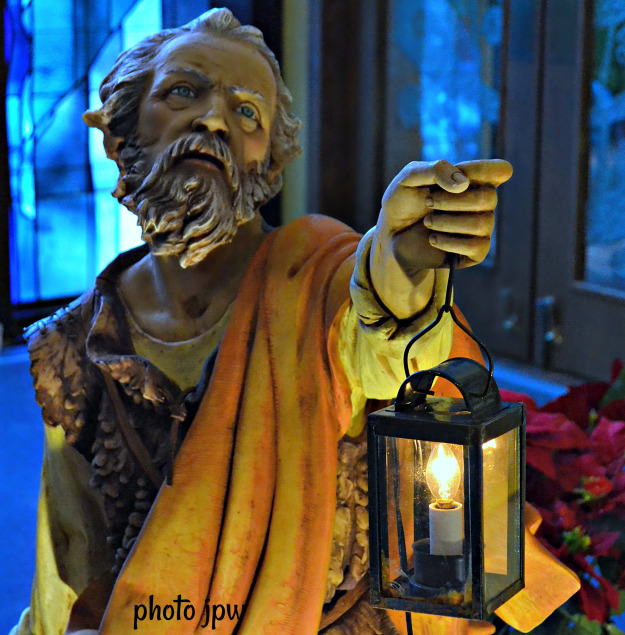
Christmas Nativity shepherd figure, Author’s photograph.

During World War II in Germany, Alfred Delp, S.J. (September 15, 1907 – executed, Berlin, February 2, 1945) was a member of the Kreisauer Kreis (The Kreisau Circle) composed of German men and women from a variety of backgrounds who opposed Adolf Hitler’s Nazi regime.

Fr. Delp was arrested by the Nazis in 1944 and, after six months in prison in shackles, the German Catholic priest and Jesuit was sentenced to death for high treason and executed by hanging on Candlemas 1945.

Following the Allied victory in 1945, Fr. Delp’s prison writings were assembled into a posthumous book called Facing Death (German: Im Angesicht des Todes). A highlight of the 37-year-old Delp’s writings are his seasonal sermons and meditations for Advent and Christmas which were written as he languished in a cell “three steps wide” surrounded by Nazi guards.

Fr. Delp’s writings, scrawled on numerous slips of paper and smuggled out before his death, have been compared to Dietrich Bonhoeffer’s Letters and Papers from Prison also written in Tegel prison in Berlin, Germany, during World War II. 

Father Delp was developing his thoughts and writing about the annual Advent drama at least as early as 1933 so his prison writings became a concluding chapter of a lasting adult interest as he faced his death.

Jesuit priest Alfred Delp was a member of the German Nazi Resistance and the Kreisau Circle, a group that opposed Hitler’s regime and envisioned a democratic Germany after the fall of the Third Reich.

Alfred Delp

German-born Alfred Delp S.J. (September 15, 1907 – Berlin, 2 February 1945).

Fr. Delp wrote his meditations and sermons on Advent and Christmas when he was a political prisoner of the Nazis in Germany in World War II. This photo was taken most likely in 1942 or 1943—prior to his arrest by the Gestapo in July 1944. It captures a rare, candid moment of Delp smiling outdoors, wearing his round wire-rimmed glasses and civilian clothing. At the time, Father Delp was a Nazi resister living a dangerous double life. He was serving as a parish priest at St. Georg’s Church in Munich while secretly utilizing a covert underground network to help Jewish refugees escape Nazi persecution into neutral Switzerland. By 1942, he had joined the Kreisau Circle at the invitation of Count Helmuth von Moltke. This clandestine group of Christian intellectuals, theologians, and socialists met secretly to design a humane, democratic, and Christian-principled social order for Germany to rebuild upon after the inevitable downfall of Adolf Hitler’s regime. Though the Kreisau Circle explicitly favored peaceful planning over violence, the Gestapo rounded up its members following the failed July 20, 1944 bomb plot to assassinate Hitler. Delp was arrested on July 28, 1944, severely tortured, subjected to a mock show trial, and ultimately executed by hanging on February 2, 1945. PHOTO: “Alfred Delp Mannheim” by Graf Foto is licensed under CC BY-SA 3.0.

From Alfred Delp, S.J., “Figures of Advent,” Advent of the Heart, Ignatius Press, San Francisco, 2006 (adapted):

“I see this year’s Advent (December 1944 in Berlin’s Tegel Prison) with an intensity and discomposure like never before….Along with these thoughts comes the memory of an angel that a good person gave me for Advent in 1942. It held a banner: ‘Rejoice, for the Lord is near.’ A war bomb destroyed the angel as well as that good person although I often sense that she continues to do angel-services for me. It is the knowledge of the quiet angels of annunciation, who speak their message of blessing into the distress of our world situation and scatter their blessing’s seeds which begin to grow in the middle of the night which informs and encourages us of the truth of a situation. These angels of Advent are not loud angels of public jubilation and fulfillment but, silent and unnoticed, they come into private and shabby rooms and appear before our hearts as they did long ago. Silently they bring the questions of God and proclaim to us the miracles of God, with whom nothing is impossible. Advent is a time of refuge because it has received a message – and so to believe in God’s auspicious seeds that the angels offer an open heart are the first things we must do with our lives. The next is to go through the days as announcing messengers ourselves. We wait in faith for the abundance of the coming harvest – not because we trust the earth or the stars or our own good sense and courage – but only because we have perceived God’s messages and know about His herald angels – and even have ourselves encountered one.”

SECOND SUNDAY IN ADVENT.
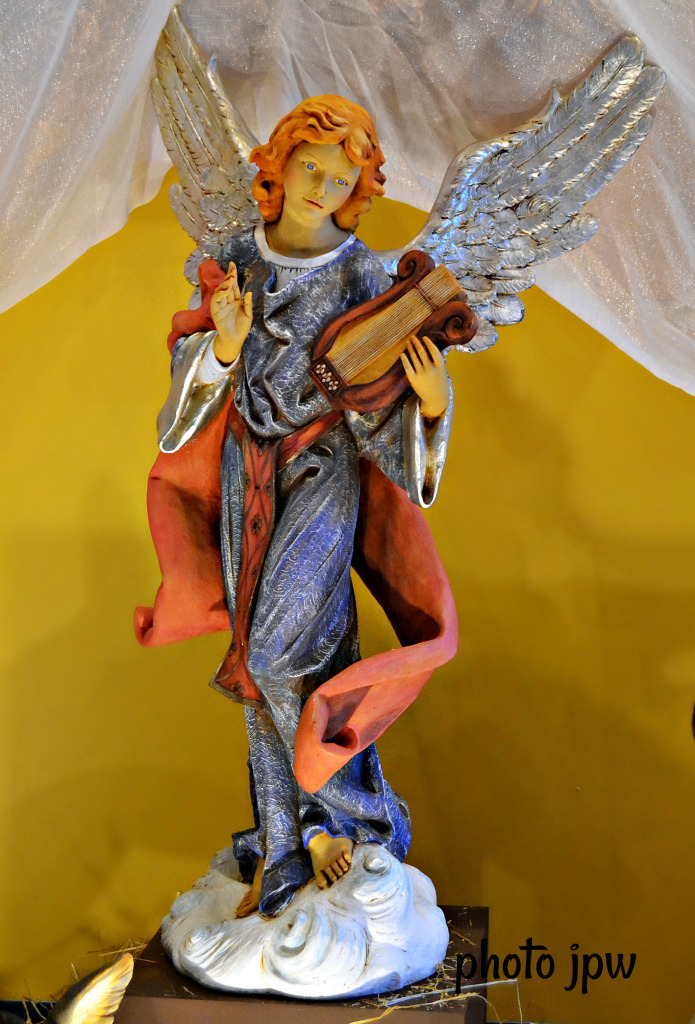
Standing Nativity Angel holding a lyre. Author’s photograph.

Thomas Merton in his introduction to Alfred Delp’s Prison Writings – a modern compilation of a young German Jesuit’s writings in prison in Berlin before he was executed for high treason as a Nazi resister in World War II – states that Fr. Delp was condemned because he and others “hoped to build a new Germany on Christian principles.” (p. xxv.)

Merton, a mid20th century Trappist monk, priest, and spiritual writer, links Fr. Delp’s political activity in the Kreisau Circle—an underground group of about twenty-five German dissidents of diverse backgrounds opposed to the Nazi regime—to broader Church doctrine and the western tradition of liberalism in evidence since the Ancient Greeks that “always hoped to attain a more equitable world order by peaceful collaboration among nations.” (ibid.)

For Fr. Delp, according to Merton, the stark choice before human beings remained the crucial one of global order or global destruction. Father Delp observed that even religious people in his time had fallen into the militaristic government’s syllogistic trap of “conquest first and a new and better world later.”

Fr. Delp’s concern when making this sort of choice is that “if the person who says it tolerates or helps further conditions which are fatal to mankind…or weakens his or her own spiritual, moral, and religious sense” – then even “the most pious prayer can become a blasphemy.” (ibid.) Fr. Delp proposed that any human indifference to honesty and justice originating in passionate conviction vitiates human nature which is left to then express itself in a vicious circle of fear and arrogance.

From Fr. Delp’s perspective, his active participation in Kreisauer Kreis for which he was executed by the Nazis in February 1945 pointed to the eschatological character of the Advent drama by the young Jesuit priest’s hope in his time for the political and social ruin of Germany which had sunk into bitter darkness and that it would find its way ahead by the light of each person’s burning candle “for honesty and justice.”

Hanging symmetrically from the classical pilasters are lush green pine Advent wreaths accented with vibrant, formal red ribbon bows. Against a peach-toned back wall is a dedicated devotional stand filled with dozens of glowing red glass prayer candles lit by parishioners. Author’s photograph.

Alfred Delp, S.J. Fair use.

From Alfred Delp S.J., Prison Writings, Orbis Books, Maryknoll, New York, 2004:

“So this Sunday we must again fold our hands and kneel humbly before God in order that his salvation may be active in us and that we may be ready to call upon him and be moved by his presence. The arrogance so typical of modern men and women is deflated here. At the same time, the icy loneliness and helplessness into which we are frozen melts under the divine warmth that fills and blesses us …If we are terrified by a dawning realization of our true condition, that terror is completely calmed by the certain knowledge that God is on the way and actually approaching. Our fate, no matter how much it may be entwined with the inescapable logic of circumstance, is still nothing more than the way to God, the way God has chosen for the ultimate consummation of his purpose, for his permanent ends. Light your candles – such candles as you possess – for they are the appropriate symbol for all that must happen in Advent if we are to live.”

THIRD SUNDAY IN ADVENT.

Part of a grand nativity scene, a young woman, Martha, dressed in traditional rustic garments, holds a woven basket overflowing with apples and pears, while a garland of red berries drapes down her skirt. Author’s photograph.

On Friday, July 28, 1944, two Gestapo men were waiting outside St. George’s church in Munich, a simple Baroque pile in an almost pastoral setting near the Englischer Garten.

Eight days before there had been an assassination attempt on Hitler’s life which failed. For active German dissidents to the Nazi regime in custody or, for the time being, still walking free, things were going to get worse.

Helmuth James Graf von Moltke (1907 – 1945), one of the leaders of the Kreisau Circle, a type of anti-Nazi salon, had been in prison since January 1944. Now, following the failed bombing at the Wolf’s Lair, Peter Yorck von Wartenburg (1904 –1944) who was the other leader of the Kreisau Circle, was immediately arrested and sent to Berlin where he was tried and executed on August 8, 1944.

St. Michael’s Church (Michaelskirche), Munich:
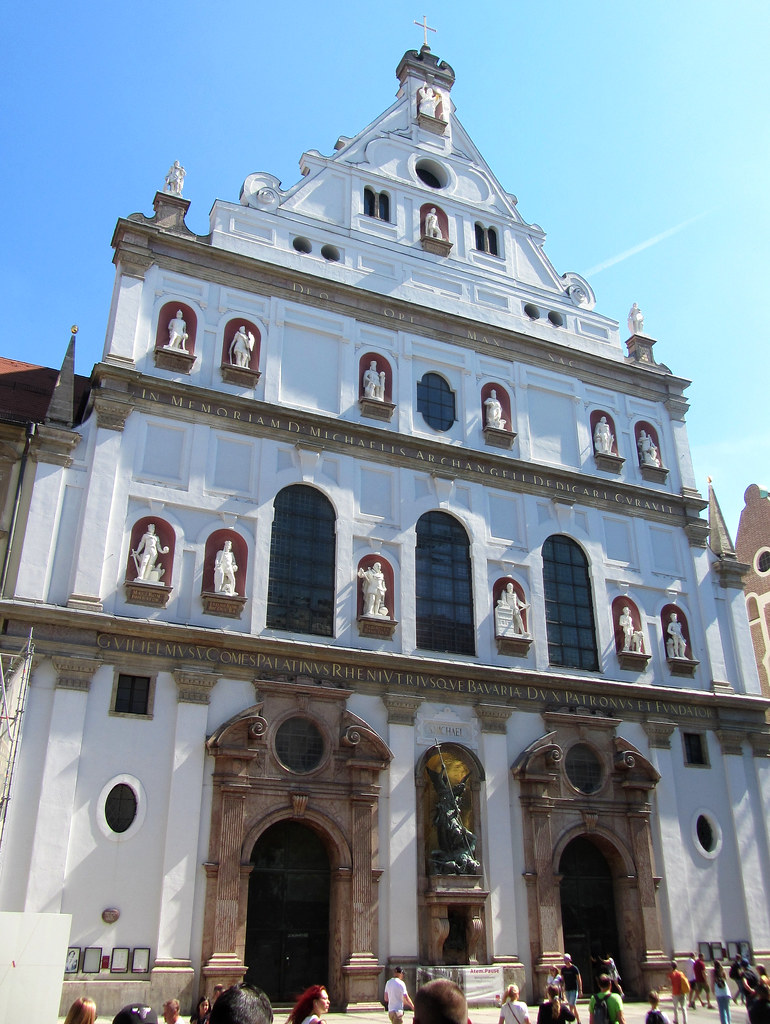
Facade of the Michaelskirche, Munich, Germany. PHOTO: “Facade of the Michaelskirche, Munich, Germany” by alexdavidbaldi is licensed under CC BY-NC-SA 2.0.
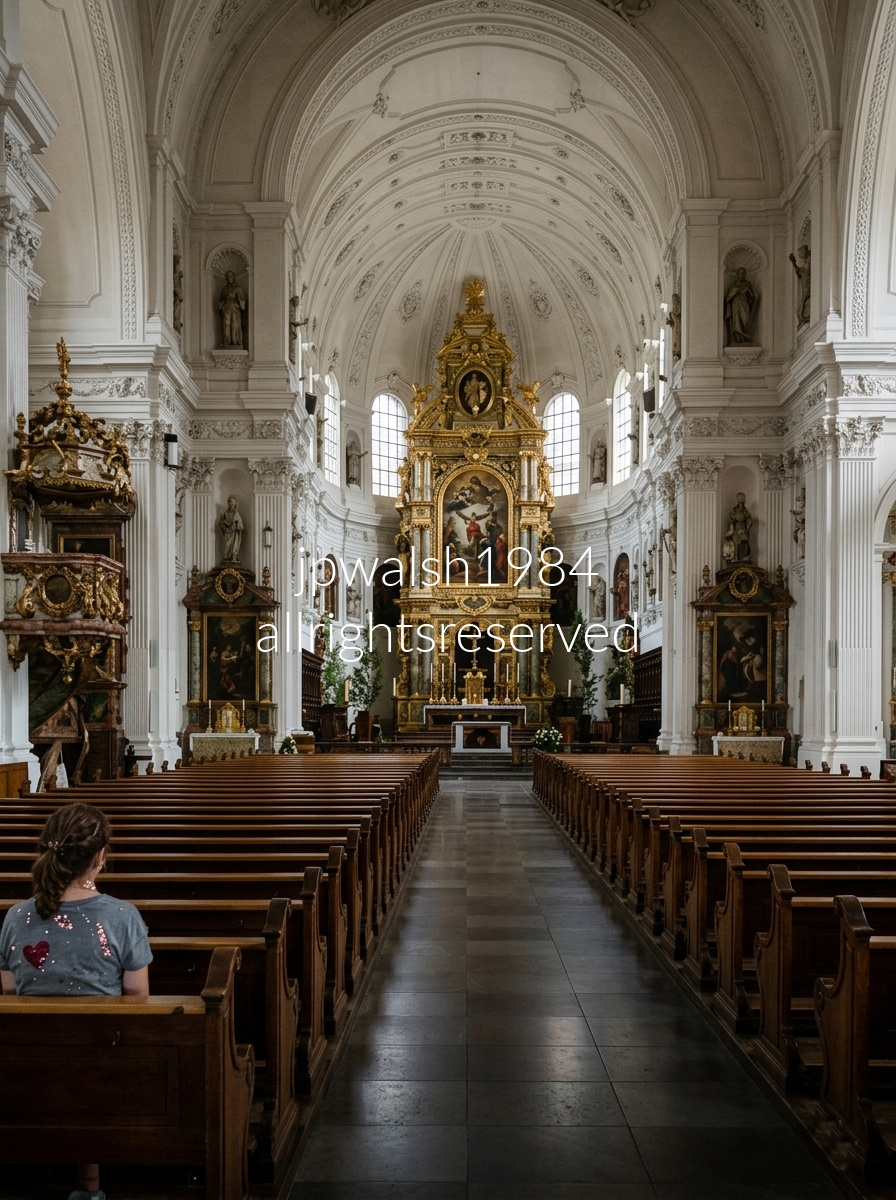
St. Michael’s Church (Michaelskirche), Munich. July 1984. Author’s photograph.

Beyond its architectural prominence as the largest Renaissance church north of the Alps, St. Michael’s maintains a deeply profound, historic connection to the German anti-Nazi resistance through Father Alfred Delp, S.J. The young Jesuit priest began his formal priestly ministry within these walls when he was ordained on June 24, 1937, by Munich’s celebrated Cardinal Michael von Faulhaber who delivered his famous anti-Nazi Advent sermons in 1933 which largely defined his ongoing critical tone towards the regime. Father Delp frequently ascended the pulpit of St. Michael’s to deliver powerful sermons that, alongside the courageous ministry of his fellow Jesuit Father Rupert Mayer, openly condemned the total incompatibility of National Socialist ideology with Christian values. This vocal opposition eventually led Delp to join the Kreisau Circle, a clandestine network of dissidents drafting plans for a humanitarian, Christian social order to rebuild Germany following the anticipated collapse of the Third Reich. Implicated in the wider resistance movements, Delp was arrested by the Gestapo in July 1944 and subsequently executed by hanging at Berlin-Plötzensee prison on February 2, 1945. In recognition of his enduring martyrdom, the Archdiocese of Munich and Freising has formally initiated the diocesan phase for Father Delp’s beatification process, ensuring that St. Michael’s continues to honor him as one of its most courageous historic voices.

St. Georg München-Bogenhausen, Munich:

St. Georg München-Bogenhausen

St. Georg München-Bogenhausen. The exterior with its historic cemetery of St. Georg Church in Bogenhausen, Munich. A diocesan parish, a church has existed on this site since the Middle Ages. The current building was reconstructed between 1766 and 1768 and designed by Late Baroque architect Johann Michael Fischer, with interior art created by master sculptors Johann Baptist Straub and Ignaz Günther. As St. Georg was a filial church to the larger Heilig Blut (Holy Blood) parish nearby, Father Delp was the church rector—though to the ordinary churchgoers who attended his anti-Nazi sermons every Sunday, he effectively acted as their pastor.

Jesuit Father Delp’s primary assignment in Munich was serving on the editorial staff of the Jesuit journal Stimmen der Zeit (“Voices of the Times”). When the Nazi Gestapo suppressed and seized the journal’s offices in April 1941, Delp was left without a formal station. The local Archdiocese of Munich stepped in and appointed him as the rector/administrator of this small parish to keep him active. While his regional Jesuit Provincial superior (Augustin Rösch) kept close contact with him and introduced him to the anti-Nazi Kreisau Circle, the day-to-day parish staff at St. Georg was otherwise standard diocesan clergy.

Interior, St. Georg München-Bogenhausen.

The ornate, highly detailed Late Baroque (Rococo) interior of St. Georg Church in Bogenhausen, Munich, Germany. The architecture and abundant decoration emphasize dramatic composition, theatrical lighting effects, and rich faux-marble finishes characteristic of 18th-century Bavarian church design. PHOTO: “St. Georg München-Bogenhausen, Hochaltar” by Rufus46, used under CC BY-SA 3.0 / Cropped from original.
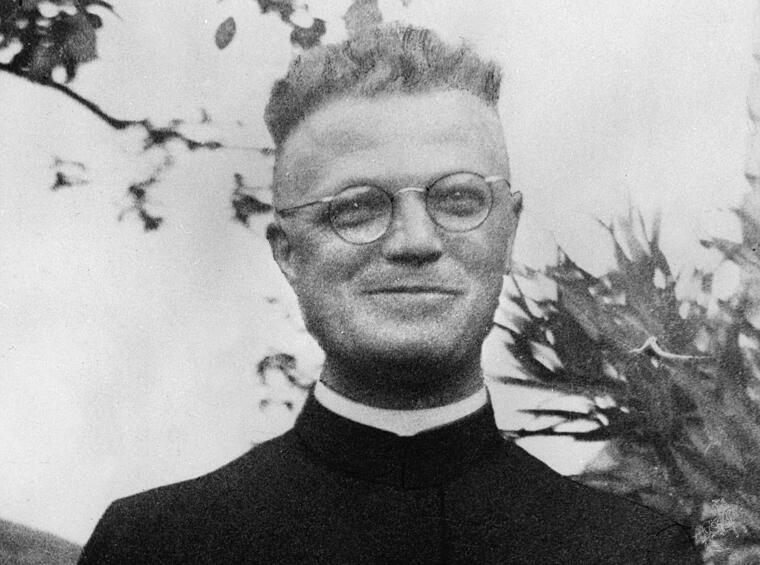
The danger surrounding Father Delp’s ministry was evident in the constant scrutiny of the Gestapo. Rather than denouncing the Nazi regime through direct political attacks, his sermons systematically dismantled its core ideology. From the pulpit, he rejected the State-as-God concept, affirming instead that only God possessed supreme authority. He also spoke forcefully about the intrinsic dignity, spiritual freedom, and equal worth of every human being, principles that stood in absolute opposition to Nazi racial doctrines and persecution.

The Gestapo fully understood what Delp was doing. Undercover agents and informants regularly filled the pews of St. Georg, reporting his sermons back to the authorities. Delp, in turn, knew they were there and occasionally mocked their presence from the pulpit itself. His dynamic and compelling preaching style drew large crowds, making his influence impossible to ignore. Ultimately, it was this fearless refusal to remain silent that kept him under permanent surveillance and led to his eventual arrest by the Gestapo. Portrait of Father Alfred Delp with glasses smiling [Photograph]. (n.d.). Historical Archives of the German Resistance / Public Domain.

One of the two Gestapo men waiting outside St. George’s to arrest Fr. Alfred Delp, S.J. happened to be an old schoolmate of his.

Like other Catholic bishops and priests who were known de facto dissenters working against the Nazi regime, especially its social and racial ideologies and practices, Fr. Delp had long been under close surveillance by the Gestapo.

As a member of the Kreisau Circle – that group of professionals of diverse religious, social, and political backgrounds with one thing in common (being dyed-in-the-wool anti-Nazis), Fr. Delp was their social scientist with a Ph.D. He illumined their minds to cutting-edge labor issues, including what could be the German worker’s role in a post-war liberated Germany.

Helmuth James Graf von Moltke

Helmuth James Graf von Moltke (March 11, 1907 – January 23, 1945).

Count Moltke had close sympathies with the democratic forces of the day and expressed open criticism as he watched the rise of Hitler. In 1933 he refused to accept Nazi appointments. After the outbreak of World War II, as an expert adviser on international law and the laws of war he served as war administration councilor in the Office for Foreign Affairs/Counterintelligence in the Armed Forces High Command in Berlin. He was particularly active in advocating for humane treatment of prisoners of war and observance of international law. In 1940 Moltke with Peter Graf Yorck von Wartenburg became the leading figures in a group that emerged as the Kreisau Circle with its discussions held in Berlin and Kreisau. Moltke, formulating memoranda on the establishment of a new political order in Germany, systematically extended his contacts to Protestant and Catholic church leaders and to leaders of the social democratic political opposition. Moltke was arrested on January 19, 1944 after he had warned members of the Solf Circle that they were under Gestapo surveillance. His involvement in the plans for a coup against Hitler was not exposed until after the failure of the assassination attempt of July 20, 1944. Helmuth James Graf von Moltke was sentenced to death by the People’s Court on January 11, 1945 and executed on January 23, 1945 in Berlin-Plötzensee.  http://www.gdw-berlin.de/home/ Fair use.

Under arrest, Fr. Delp disappeared into Nazi prisons in Munich and Berlin for almost three weeks. None of his friends could find him.

At Lehrterstrasse, a Gestapo prison in Berlin that specifically dealt with German resisters, the doctor-priest was regularly beaten. Fr. Delp was charged by the National Socialists with a half dozen crimes—being in Kriesau Circle; holding resistance meetings; knowing von Moltke and other anti-Nazis; knowing Claus von Stauffenberg who placed the bomb on July 20, 1944 to assassinate Hitler; knowing in advance of the assassination plot; and, displaying a general attitude of anti-Nazism.

The charge of knowing about the assassination plot before it happened greatly concerned Fr. Delp. He categorically denied it and, consequently worked vigorously through his lawyer to disprove it.

Having moved to Tegel Prison in Berlin on August 8, 1944, Fr. Delp’s whereabouts were finally discovered on August 15, 1944, by Marianne Hapig (1894-1973), a social worker and indefatigable friend to German resistance.

At Tegel, Fr. Delp found another significant friend—Harald Poelchau (1907-1972) the prison’s Lutheran chaplain since 1933. With the agency of chaplain Poelchau, the Catholic priest, Fr. Delp, had wafers and wine to say Mass. Also, messages could be smuggled in and out by way of the laundry.

It was through such a clandestine route that Fr. Delp made his final vows as a Jesuit on December 8, 1944. In front of a visiting witness, Fr. Delp pronounced the vow formula. Afterwards, he apologized for his emotion as he sank into a prison chair and wept.

Marianne Hapig.

Marianne Hapig (March 5, 1894 – March 23, 1973). Marianne Hapig discovered Father Delp’s presence at Tegel prison in Berlin after his disappearance following his arrest in Munich three weeks earlier. A career social worker and anti-Nazi Marianne Hapig and her lifelong jurist friend Marianne Pünder managed to smuggle Alfred Delp’s prison writings out of Tegel prison where soon after the war they were published. Fair use.
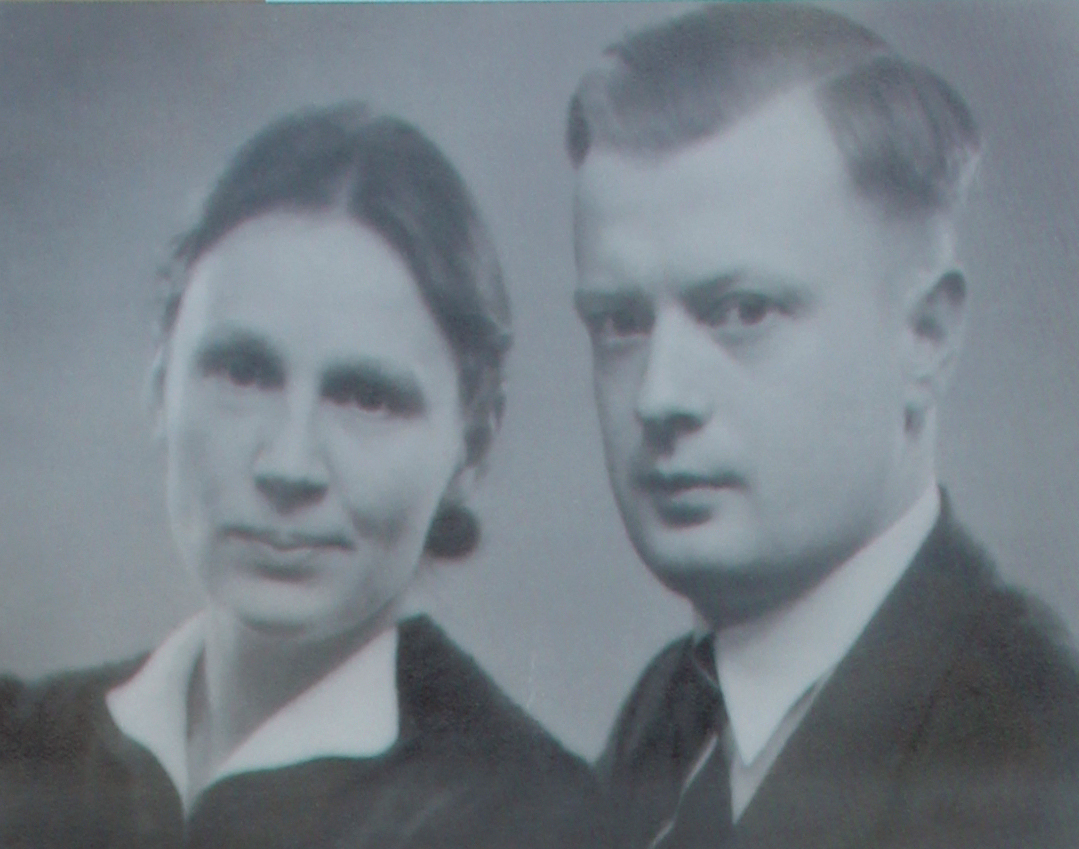
Dorothee und Harald Poelchau. Dorothee Poelchau (born Dorothee Ziegele; June 6, 1902 – November 4, 1977) was a German librarian and a prominent anti-Nazi resistance fighter who worked alongside her husband, Harald Poelchau. PHOTO: “Dorothee und Harald Poelchau (cropped)” by OTFW, Berlin is licensed under CC BY-SA 3.0.

Harald Poelchau (October 5, 1903 – April 29, 1972). Rev. Poelchau gained his doctorate in 1931 under Paul Tillich, the leading representative of Religious Socialism. At the end of 1932, Poelchau applied for a prison chaplain’s post in Berlin and became the first cleric to be employed by the National Socialist regime in a penal institution. As an official in the Justice Department he rapidly became an important source of support for the victims of National Socialist violence, and gave spiritual comfort to hundreds of people sentenced to death as they faced execution. From 1941 onwards he was a member of the circle around Helmuth James Graf von Moltke and attended the first major Kreisau Conference. After the failed coup attempt of July 20, 1944 Poelchau was able to pass on last messages and farewell letters to the relatives of many of those sentenced to death. Harald Poelchau managed to avoid being investigated by the Gestapo and survived the war. Fair use.

Many of Fr. Delp’s Advent writings come during these months in prison. They were smuggled out by Marianne Hapig and, her lifelong friend, Marianne Pünder. For more than a decade, Fr. Delp had written extensively on the Christian season of expectant waiting for the coming of Christmas.

Die gefesselten Hände (English: “Bound Hands”) by Tilman Riemenschneider (c.1460-1531).

During these months in prison, his hands almost always in chains, Fr. Delp had identified with a specific artwork as he wrote his Advent thoughts onto endless slips of paper. It was a sixteenth century German wood sculpture of St. Sebastian known as Die gefesselten Hände (English:“Bound Hands”) by Tilman Riemenschneider (c.1460-1531).

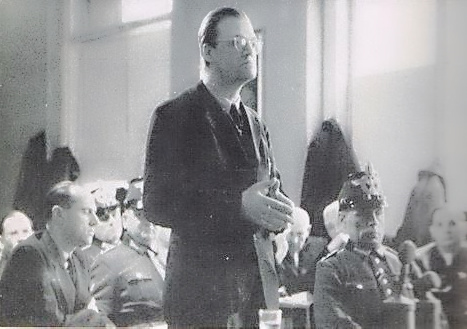
Alfred Delp, S.J. at his trial. Fair use.

In a moving ceremony while in prison and facing possible execution, Father Delp made his final Jesuit vows. Delp refused Nazi offers that could have secured his freedom if he abandoned his Jesuit vocation.

At his two-day trial in January 1945, rabid Nazi judge Roland Freisler was interested in one charge against Delp: the priest’s association with von Moltke. The leader of Kreisauer Kreis would be soon on death row and executed on January 23, 1945. Since 1942, Friesler’s reign of terror already included 5,000 death sentences as president of the People’s Court. It did not help that Fr. Delp was a Catholic priest and Jesuit.

So with Hitler, Friesler was maniacally anticlerical. Although many Nazis grew up as Catholics, in adulthood such notorious men as Hitler, Josef Goebbels, Martin Bormann, Heinrich Himmler, and others, held Christianity in utter and complete contempt. (Ian Kershaw; Hitler: a Biography; pp. 381–82). Once in power, Hitler believed that Christianity signified “the systematic cultivation of the human failure” and that its religious organization and central beliefs had to be marginalized and eventually purged from a heroic German worldview (Alan Bullock; Hitler: a Study in Tyranny; p. 218).

When Hitler invaded Poland in September 1939, the Superior-General of the Jesuits was just then a Pole, Wlodimir Ledóchowski, S.J. (1866 –1942). Ledóchowski who was in charge of neutral Vatican Radio made international broadcasts about Nazi wartime atrocities in many languages.

Wlodimir Ledóchowski, S.J. (1866 –1942). Ledóchowski, S.J. (1866 –1942) had been the Polish Superior-General of the Jesuits since 1915 when Hitler invaded Poland on September 1, 1939, setting off World War II. A renowned institutional builder, Ledóchowski established several notable institutes and colleges in Rome. In January 1940, Vatican Radio controlled by the Jesuits and with Pope Pius XII’s authorization broadcast the details of the Polish wartime situation. When the German ambassador protested the German language broadcasts, the Pope honored the request.  But Vatican Radio broadcasts in other languages of the Poland situation continued and in even more explicit detail. The British press at the time hailed Vatican Radio as “tortured Poland’s powerful advocate.” see – Peter Hebblethwaite; Paul VI The First Modern Pope, Paulist Press, 1993, p. 140. Portrait of Father Wlodimir Ledóchowski, S.J. [Photograph]. (n.d.). Historical Archives of the Society of Jesus / Public Domain.

That Fr. Delp remained a Jesuit—even after he was offered a plea deal by the Nazis to walk free of all charges if he renounced his religious faith—undoubtedly deserved the death penalty in Freisler’s court.

After the death sentence was pronounced on January 11, 1945, the typical procedure of immediate execution was delayed. During this time, the bombing by British and Americans intensified. Fr. Delp desperately hoped that the Allies would arrive in time to set political prisoners, including himself, free. But, finally, on February 2, 1945, at Berlin-Plötzensee Alfred Delp was taken from his holding pen by the Nazi executioner and executed by hanging. The next day, February 3, 1945, Roland Freisler presiding in his People’s Court, was killed by collateral damage in an Allied bombing attack.

Alfred Delp, S.J.

From Alfred Delp, S.J., “Meditation for the Third Sunday of Advent Written in Tegel Prison, Berlin, December 1944” (adapted), Advent of the Heart, Ignatius Press, San Francisco, 2006:

“Mankind is challenged again to stand and deliver. Only man does not merely exchange one set of chains for another – God’s calls are always creative. They increase the very reality within us that is called upon – precisely because of their realness and authenticity…Freedom is the breath of life. We sit in musty bomb cellars and cramped prisons and groan under the bursting and destructive blows of fate. We should finally stop giving everything a false glamour and unrealistic value and begin to bear it for what it is – unredeemed life. As soon as we do this, the jangling of chains and the trembling of nerves and the faintness of heart transform themselves into a small prayer – “Drop down, dew…” We should much more definitively unite our concrete destiny with those kind of connections and call upon God’s redeeming freedom. Then the narrowness widens, our lungs breathe in fresh air again, and the horizon has promises again. Existence still weeps and mourns, but already a soft, joyous melody of longing and knowledge is ringing through the mourners’ broken voices. With this knowledge and attitude humanity releases itself from the lonely relationship to things and circumstances. A person finds wholesomeness and healing – not the goal-oriented, cool distance of calculation, mechanization, and organization. It is rather that higher level of freedom, the perspective given to someone looking from the heights to what lies below. The voice of such a person is not so quickly silenced!”

“The conditions for true joy have nothing to do with conditions of our exterior life but consist of humanity’s interior frame of mind and competence, which make it possible now and again for the person to sense, even in adverse circumstances, what life is really about…And the first answer is found in the figure of John the Baptist who personifies Advent. Humanity must be brought to an absolute clarity about himself and honestly before himself and others. He must come down from all the pedestals of arrogance onto which he always climbs…From the high-horses of vanity and self-deception that, for a time, let themselves be trotted out so proudly. Those horses though finally throw off their “master” in the wilderness…Two criteria identify whether we are following an authentic impulse or not…Both are found once again in John the Baptist. The first is service – human honesty requires a person to see himself as a servant and perceive his reality as mission and an assignment…The second criterion keeps us on track- annunciation, which calls us to praise of God. An extended personal effort is required to keep giving oneself the impulse to rise above, move away from self. But at the same time this is how a human being attains the necessary openness in which he or she must continue if sincerely wanting to strive toward the great realities God has prepared for him or her.”

FOURTH SUNDAY IN ADVENT.

Advent Nativity
Advent Nativity awaiting the birth of Jesus. Author’s photograph.

Thomas Merton makes clear about Father Delp that his writings on Advent are usually a simple presentation of the traditional Christian faith with no special originality to his images. (p. xxxv, Prison Writings). It is Fr. Delp’s application of those facts based in his personal experience – as an active dissident and prisoner of a Germany in ruins during World War II – that restores the sometimes hackneyed outcome to Advent to its original hope.

In Fr. Delp’s world, if humanity is fully alert to the desperation and bitterness of the times, Advent’s basic image of God-made-man becomes immensely opportune and favorable for humanity’s future although not holding any foregone conclusions or sudden outcomes.

“The Spirit of the Lord is upon me, because he has anointed me to bring glad tidings to the poor. He has sent me to proclaim liberty to captives and recovery of sight to the blind, to let the oppressed go free, and to proclaim a year acceptable to the Lord.” Luke 4:18-19.

Thomas Merton views Father Delp’s Advent meditations in Pauline terms, although Fr. Delp found St. Paul sometimes had a ‘tendency to over-emphasize.’ (p. 55, ibid.). Humanity hopes in God’s close alliance so to win back or have restored a future that is not any longer in ruins and in which humanity and even created life itself is absurdly helpless to fix.

His show trial before the notorious Nazi “People’s Court” took place over two days, spanning January 8–9, 1945. He was officially sentenced to death on January 11, 1945, and subsequently executed on February 2, 1945.
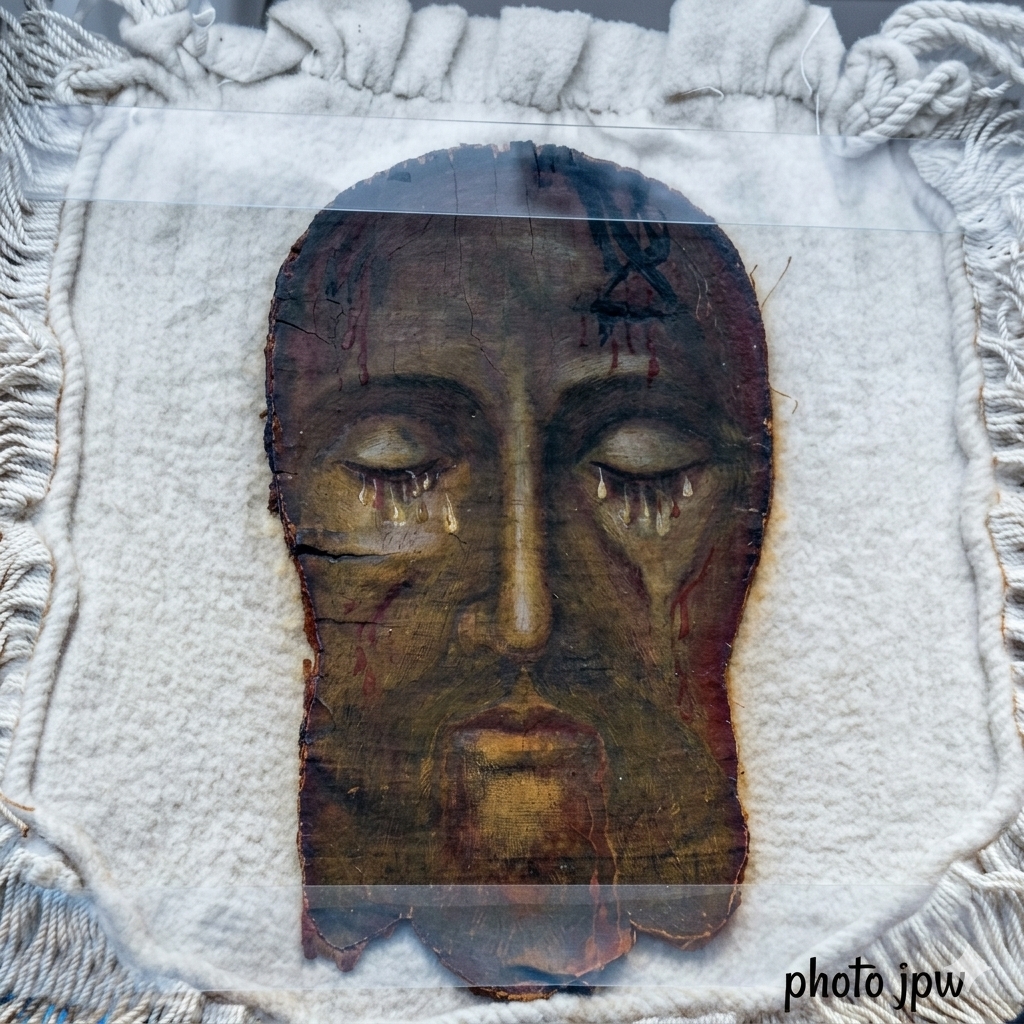
Holy Face painted by Saint Thérèse of Lisieux. National Shrine of St. Thérèse in Darien, Illinois. Author’s photograph.

Saint Thérèse of Lisieux (French, 1873-1897) traced and painted this image of the Holy Face of Jesus and tacked it to wool for hanging as a gift to her sister Céline who was at home at Les Buissonnets taking care of their widower father who was suffering from illness. The National Shrine of St. Thérèse in Darien, Illinois. It may be expected that a similar sort of facial expression was found on Father Delp. On February 2, 1945 Father Delp was imprisoned, tried and executed by the Nazis for “hop[ing] to build a new Germany on Christian principles.”

Alfred Delp S.J. Fair use.

From Alfred Delp S.J., Prison Writings, Orbis Books, Maryknoll, New York, 2004:

“God in the Christmas encounter is still the challenging God. The greatest misconceptions all center round the typical Christmas picture of God.  Humanity becomes so wrapped up in appearance that the breathtaking reality of the birth of God as a human child scarcely enters our mind and the soul doesn’t grasp its significance….Of course the externals, the sweet sentimental pictures, carols, cribs and so on, are a comfort….but there is a great deal more to the nativity than that. The truth of it is too tremendous to be appreciated unless one concentrates on it fully. Since the birth of God, humanity has been confirmed in the hope that when we turn to God’s throne for favor that God is on our side. This does not mean that God has dethroned Himself any more than it means that human life has become a primrose path in the wake of that stupendous event. We need to look critically at the tendency to sentimentalize the divine attributes by personifying them in an innocent child or over-beautifying the adult Jesus. The glamorizing of the nativity story – the making the whole tone of Christ’s life equal to a Baroque sermon full of ominous warnings and grave moralizing –  has contributed quite a lot to the West’s being paralyzed in the face of those conditions that hinder us and keep us trapped. God became man but nevertheless is God, master of all creation. Human beings must approach the God-made-man with reverence and adoration – disenthralling themselves in order to find themselves. It is the only way.”

Nativity window.

Nativity stained glass window (detail), Sts. Peter & Paul, Naperville, IL. Author’s photograph

His prison writings remain among the most powerful spiritual documents produced during the Third Reich, uniting Christian faith, human dignity, and resistance to totalitarianism

Alfred Delp, S.J. fair use.

BIBLIOGRAPHY:

Bullock, Alan, Hitler: a Study in Tyranny, Completely Revised Edition, Harper & Row, New York, 1964.

Delp, S.J., Alfred, Advent of the Heart, Ignatius Press, San Francisco, 2006.

Delp, S.J., Alfred, Prison Writings, Orbis Books, Maryknoll, New York, 2004.

Hebblethwaite, Peter, Paul VI The First Modern Pope, Paulist Press, New York, 1993.

Kershaw, Ian, Hitler: a Biography, W. W. Norton & Company, New York, 2010.

Kidder, Annemarie S., Ultimate Price Testimonies of Christians who Resisted the Third Reich, Orbis Books, Maryknoll, New York, 2012.

Royal, Robert, The Catholic Martyrs of the Twentieth Century A Comprehensive World History, Crossroad, New York, 2000.

This explanatory article may be periodically updated.

AUSTRIA. BL. FRANZ JÄGERSTÄTTER (1907-1943): Austrian Farmer, Husband and Father, Conscientious Objector in World War II, and Martyr.

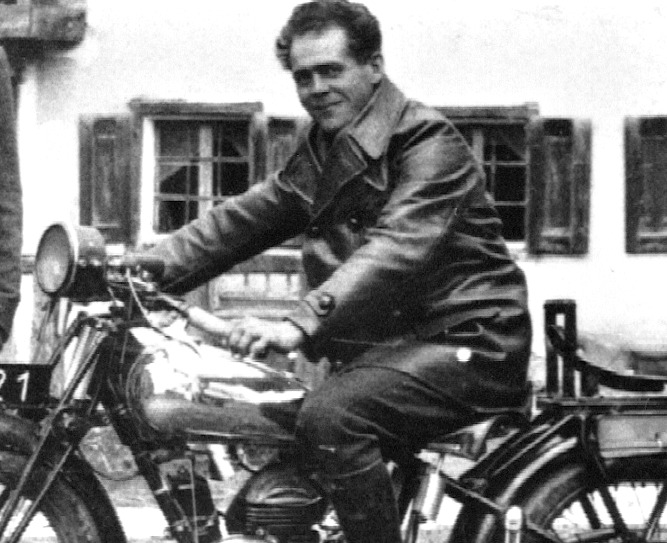
FEATURE image: Detail of Franz Jägerstätter on a motorbike in St. Radegund, Austria, in 1940.

By John P. Walsh

October 26, 2017/updated July 15, 2021.

In his 17-minute speech at the TED conference in April 2017, Pope Francis talked about the importance of human interdependence, equality, and inclusion. Perhaps surprisingly, the pope stressed the power of the human individual to make positive change. While one might expect a pope to wax on communal connections reflected in a Gospel passage such as, “For where two or three gathers together as my followers, I am there among them” (Matthew 18:20), Pope Francis looked instead to the radical nature of the single individual to bring about a message of hope into the world. Pope Francis said: “A single individual is enough for hope to exist and only then it turns into ‘us.’ And so, does hope only exist when it turns into us? – No. Hope starts with the individual ‘you.’ When there is an us, it starts a revolution.” Grounded in an individual’s conscience and action, hope for the world can begin. The pope’s message of hope by way of a single individual—and he encourages his TED auditors to be that individual— does not usually come without a price. What Mother Teresa of Calcutta (1910-1997) said on love the pope adapted to his or any message of hope: it cannot be done “unless it comes at your own expense.”

The power of the individual to be a cause of hope with potential to revolutionize even the nation is what Richard Attenborough (1923-2014) dramatizes from history in his 1983 Academy-Award-winning three-hour bio-pic film, Gandhi. In the setting of a segregated South Africa, young Indian lawyer Mohandas K. Gandhi (1869-1948) played by Ben Kingsley is visited at his ashram by a young American journalist (Martin Sheen) who tells Gandhi he is an awfully small minority to be taking on governments and empires. But Gandhi replies: “If you are a minority of one – the truth is the truth.”

Questions of the conflict of the morality of the individual conscience and the social morality which is directed to the attainment and conservation of the values represented by the state and nation is part of that which the young American journalist, dramatized in the film Gandhi, warned the hero about—and which remains in tension in any era, including today. The debate surrounding the nature or limits of individual conscience as well as its interaction with cultural values and things is bound to be— at least philosophically and even theologically— complex and indefinite. Arguments and subtleties about these topics become rife when the circumstances call for it. Following some of the definitions and descriptions of conscience from Dietrich Bonhoeffer (1906-1945) — and as only part of the range for hope that Pope Francis alludes to in his TED speech— the conscience’s normal function relates to resisting action demanded from within or outside the self. Although conscience, according to Bonhoeffer, is not called upon in the face of good—it simply acts—nor includes the whole fabric of life, when the individual conscience encounters a forbidden act, it views it as “a peril to life as a whole, that is to say, disunion with oneself.” Bonhoeffer’s Protestant theology will not boast of having a good conscience except to say that, by it, humans importantly discover their lack of knowledge of God as well as their own corruption and that by this self-knowledge expressed in conscience find a road to God. Bonhoeffer writes: “All knowledge is now based on self-knowledge….Knowledge now means the establishment of the relationship to oneself; it means the recognition in all things to oneself and of oneself in all things. For man who is in disunion with God, all things are in this disunion, what is and what should be, life and law, knowledge and action, idea and reality, reason and instinct, duty and inclination, conviction and advantage, necessity and freedom, exertion and genius, universal and concrete, individual and collective; even truth, justice, beauty and love come into opposition with one another, just as do pleasure and displeasure, happiness and sorrow…All these disunions are varieties of the disunion in the knowledge of good and evil. The point of decision of the specifically ethical experience is always conflict. But in conflict the judge is invoked; and the judge is the knowledge of good and evil; he is man.”

Franz Jägerstätter (May 20, 1907-executed, August 9, 1943).

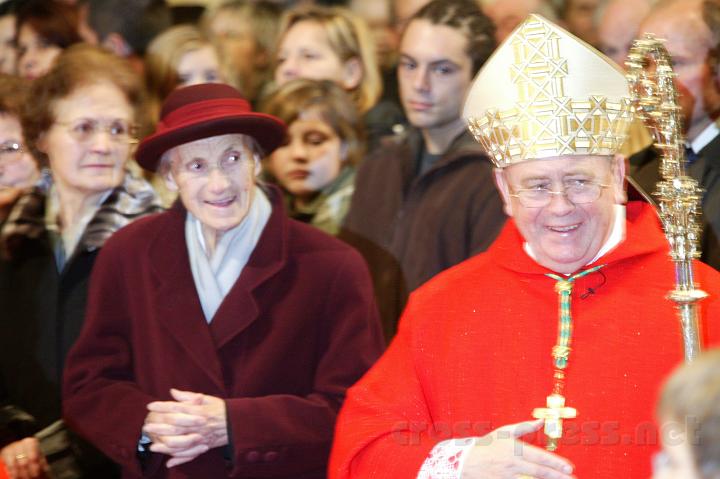
On October 26, 2007 at St. Mary Cathedral in Linz, Austria, Pope Benedict XVI in front of 5,000 pilgrims beatified Franz Jägerstätter, a relatively unknown 36-year-old Austrian farmer who was executed by the Nazis in August 1943 because—similar to Captain von Trapp in The Sound of Music (1965)—he was anti-Nazi and refused to fight in their armed forces.

Blessed Franz Jägerstätter’s widow, Franziska (1914-2013), who was 94 years old in 2007, and his four daughters, Maria, Aloisia and Rosalia, and, from a previous relationship, Hildegard, attended the beatification. Franziska rode to the cathedral in the sidecar of a motorcycle, in memory of her husband’s love of motorcycling. After being drafted three times into the German army, Franz Jägerstätter decided after his training and noncombatant military service ended in April 1941 that he would not comply with any future compulsory enlistment in the Third Reich. To this end, he compiled gut-wrenching notes with his opinions on his conscientious objection in the face of the Nazi régime. After her husband’s arrest in early 1943, Franziska hid his writings and brought them into the light of day after the war. By that time, Franz Jägerstätter lay buried in an obscure and sometimes defaced grave in St. Radegund, Austria, a mountainous village northwest of Salzburg. In notes written during his erratic military service—Jägerstätter had been sworn into the German army on June 17, 1940 at Braunau Am Inn which lasted only a few days before he received a deferment and then called-up again to serve from October 1940 to April 1941 until another deferment—the Austrian farmer examined issues surrounding his refusal to fight anymore. By expounding in writing as well as posing argumentative questions Jägerstätter judged what he should do in response to his deep-seated antipathy to the Nazi régime and its war effort. Despite suggestions for compliance and delay, Jägerstätter was called up a third and final time in March 1943 where he made clear to the Nazis his conscientious objection which led to his imprisonment, court martial trial, and execution in August 1943.

For his beatification in 2007—a first step to Catholic sainthood—Jägerstätter’s family and supporters recalled his clear rejection of National Socialism because of their racial policies, including the myth of racial purity; war glorification; state deification; and their declared program of annihilating all faith and religion. Jägerstätter’s total rejection of Nazism echoed Bishop Johannes Maria Gföllner of Linz (1867-1941) whose extensive writings and sermons in this period provided a phrase Jägerstätter would consider his motto: “It is impossible to be a good Catholic and a true Nazi.” When Hitler came to Linz on March 12, 1938 Bishop Gföllner refused to meet with him and lamented other bishops in Austria who were more ingratiating. Bishop Gföllner regarded the myth of racial purity propagated by Nazism as “a backsliding into an abhorrent heathenism.” In 1933 Gföllner wrote: “The Nazi standpoint on race is completely incompatible with Christianity and must therefore be resolutely rejected. This also applies to the radical anti-Semitic racism preached by Nazism. To despise, hate and persecute the Jewish people just because of their ancestry is inhuman and against Christian principles … “

Bishop Johannes Maria Gföllner (1867-1941), center, at a celebration in 1935.

Adopting as his role models St. Thomas More (1478-1535), St Thérèse of Lisieux (1873-1897), and the patron saint of Switzerland, hermit-ascetic St. Nicholas of Flüe (1417 1487), Jägerstätter challenged virtually everyone he knew or came into contact with—be it his mother, neighbors, or church or civil representatives— with his developing conviction to refuse to fight for the Third Reich – and received pushback, many believing they had his best interest in mind, from virtually everyone.

What was seen to be his civic duty and the only action he could conceivably follow so to “save his life,” Jägerstätter was having serious doubts over. Even Jägerstätter’s loving wife Franziska argued that he should comply with any conscription order. Less than two years before, in April 1938, Franziska had to insist that he not shirk attending the Anschluss plebiscite which Jägerstätter declared he had every intention to avoid. On March 12, 1938, less than one month before the plebiscite, German troops occupied Austria and, that same day, Hitler personally crossed the long-closed border to visit Linz. Under penalty of being sent to a concentration camp for electoral truancy, the official turnout for the Anschluss plebiscite on April 10, 1938 was reported at 99.71%—with 99.73% in favor of annexation of Austria into Nazi Germany. Thirty-year-old Franz Jägerstätter formed part of that microscopic minority in Austria who voted “no” to Hitler’s Anschluss that day and was the only one of St. Radegund’s 500 or so citizens to do so. It was also the last time that Franziska pressured Franz on a matter of his conscience by telling him to not skip the vote as he intended to do. It soon became clear that Franz’s anti-Nazi stance could cost him his life. Already people from every village were being taken off to concentration camps for the slightest infractions from absolute Nazi rule.

Mesmerized by the Nazi propaganda machine, Austrians knelt when Hitler entered Vienna, and Catholic churches were just more buildings mandated to fly the swastika flag, among other abusive measures and laws. When other Austrians would say, ‘Heil, Hitler,’ Franz would say, ‘Gröss-Gott!’ (“Praise God!”). Though never part of an organized resistance, Franz Jägerstätter was one of a handful of local denizens soon identified by an informer to the Gestapo as anti-Nazi which the town mayor—who on his own initiative did not report Jägerstätter’s vote to the authorities and had obtained Jägerstätter’s two deferments —quashed. One result of the denunciation was that the Gestapo began to monitor the accused’s phone calls, letters, and other communications.

When Jägerstätter witnessed immediate persecution of priests who spoke up against the Nazis (many were arrested and sometimes murdered) as well as learning the fate of euthanasia of the mentally ill, Jägerstätter quickly reasoned whether he should help that sort of regime to conquer the world. This outlook appeared to be shared by Pope Pius XII when, in a meeting with the German Foreign Minister in March 1940, he complained in writing about the persecution of the Church in Germany and Austria.

As 1941 turned into 1942 and then 1943, Franziska once and for all decided to stand by her husband in this matter of his refusal to fight for Hitler in the Wehrmacht after seeing him for many months and years argue his points alone. “If I had not stood by him,” she later explained, “he would have had no one.”

Franz Jägerstätter

Franz Jägerstätter on a motorbike in St. Radegund, Austria, following his first deferment in summer 1940 after a few days in the German army.

Für eine „klare Haltung gegen rechtsextreme Umtriebe“ hat sich die Katholische Aktion Oberösterreich (KA) ausgesprochen.

Franz Jägerstätter (third from the left) during training as a military driver in Enns, Austria, in November 1940 during his second call up.

While firmly against Nazi ideology, Franz’s ultimate refusal to serve in the German armed forces developed more deliberately. After being conscripted twice in 1940, it was during basic training on December 8, 1940 in Enns that Jägerstätter entered the Secular Franciscans. After taking “Third Order” vows in St. Radegund church in 1941, he grew more determined to be a pacifist in regard to the German war effort. Jägerstätter believed as an individual who formed his conscience and acted upon it —in his case, saying a resolute “no” to Nazism, including as a conscientious objector— would “change nothing in world affairs.” Jägerstätter hoped that his conscientious objection would be “a sign” that not everyone let themselves be “carried away with the tide.” Jägerstätter acted on his conscience until, as Mother Teresa of Calcutta observed on love, “it came at his own expense.” Any of his thoughtful wrangling—if he hoped it would sway others—did not occur. Almost thirty years after the fall of the Third Reich, some villagers continued to view Jägerstätter’s brand of pacifism as unnecessary, extreme, “religious,” and even traitorous in terms of national defense. At war’s end, except for his wife and daughters—and they were denied state benefits until the 1990’s—there was a handful of anti-Nazi resisters—some of whom were Catholic priests— who supported or otherwise mirrored Jägerstätter’s brand of conscientious objection. Many of the individuals who, similar to Jägerstätter, acted on what they recognized as a Biblical call to social justice laid in obscure, premature graves because they, too, had been condemned to death as enemies of the state.

Jägerstätter woods

Austrian farmer Franz Jägerstätter refused to support the Nazis and participate in the war effort, despite a tidal wave of pressure to do so in World War II.

EXCERPTS FROM FRANZ JÄGERSTÄTTER’S WRITINGS IN 1940:

ON CALLS TO PATRIOTIC DUTY.

“Who dares to assert that among the German people in this war only one person bears the responsibility, and why then did so many millions of Germans have to give their ‘Yes’ or ‘No’? Can one be reproached today for lacking patriotism? Do we still even have a mother country in this world? For if a country is supposed to be my mother country, it may not just impose duties—one must also have rights, and do we have rights here today? If someone becomes ineducable and might be a burden on the state, what happens to them? Would such a mother country be worth defending at all? Which we cannot speak of anyway, because Germany was attacked by no one. Once, I believe, we would have had the right to defend ourselves, and that was four years ago when we were still Austrians…”

ON THE ANSCHLUSS. 

“Let’s just ask ourselves: are Austria and Bavaria blameless that we now have a Nazi government instead of a Christian one? Did Nazism just simply drop on us from the sky? I believe we needn’t waste many words about it, for anyone who hasn’t slept through the past decade knows well enough how and why everything has come about in the way it has…In March 1938, what horror stories weren’t spread and invented here in Austria against Chancellor [Kurt] Schuschnigg (1897-1977), a still Christian-minded man, and against the clergy? Those few who didn’t catch the madness and who couldn’t be persuaded to cast that misguided ‘Yes’ vote were simply labeled fools or Communists, yet today the Nazis still haven’t given up the struggle to maybe win those fools over to the Nazi movement after all, or at least to sacrifice them to their ideology!”

ON WHETHER IT IS A JUST WAR.
“What Catholic can dare to say that these raids which Germany has carried out in several countries, and is still carrying out, constitute a just and holy war?”

ON THE CONSEQUENCES OF HITLER’S PROGRAM
“Oh, we poor German people, bedazzled by delusions of grandeur, will we ever return to reason again? As the saying goes: ‘Nothing comes about by chance, everything comes from above.’ Then did this war, which we Germans are already waging against almost all the peoples of the world, break over us as suddenly as, perhaps, a terrible hailstorm, which one is forced to watch powerlessly, only praying that it will soon stop without causing too much damage? For, thanks to the radio, newspapers, rallies, etc., nearly all of us knew what program Hitler was planning to carry out, and that the shrugging off of the debts and the demonetization of the Reich mark would bring about the very consequences which have now occurred in plenty …”

ON THE GERMAN INVASION OF THE SOVIET UNION.

“It is very sad to hear again and again from Catholics that this war, waged by Germany, is perhaps not so unjust because it will wipe out Bolshevism. It is true that at present most of our soldiers are stuck in the worst Bolshevist country, and simply want to make harmless and defenseless the people who live there and defend themselves. But now a question: what are they fighting in this country – Bolshevism or the Russian people? When our Catholic missionaries went to a pagan country to make them Christians did they advance with machine guns and bombs in order to convert and improve them? Most of these noble warriors for Christianity wrote home that if they only had the means to hand things out, everything would go much faster… If we look back a little into history, we note almost the same thing again and again: if a conqueror attacks another country with war, they have not normally invaded the country to improve people or even perhaps give them something, but usually to get something for themselves. If we fight the Russian people, we will get much from that country which is of use to us here. If one were merely fighting Bolshevism, these others things – minerals, oil wells or good farmland – would not be a factor.”

ON BEING MARRIED WITH YOUNG CHILDREN.

“Again and again, people try to trouble my conscience over my wife and children. Is an action any better because one is married and has children? Is it better or worse because thousands of other Catholics are doing the same?”

ON THE CHURCH HIERARCHY.

“If the Church stays silent in the face of what is happening, what difference would it make if no church were ever opened again?”

ON THE CAUSE OF ALL THE INJUSTICE AND SUFFERING. 

“Ever since people have existed on this earth, experience teaches us that God gives people free will and has only very seldom noticeably interfered in the fate of individuals and peoples, and that therefore it will be no different in the future either, except at the end of the world. Adam and Eve already completely ruined their destiny through their disobedience towards God; God gave them free will and they would never have had to suffer if they had listened more to God than to the tempter. Even His beloved Son would then have been spared infinite suffering. And so it will remain until the end of the world: that every sin has consequences. But woe to us if we always try to avoid shouldering those consequences and aren’t willing to do penance for our sins and errors.”

Nationalratspräsidentin Barbara Prammer gratuliert Franziska Jägerstätter zum 99. Geburtstag

Franz Jägerstätter’s wife Franziska (center) on her 99th birthday with two of their three daughters, Maria (left) and Aloisia (right) with local dignitaries in 2012.

2007-10-26_10.59.25 (1)

At the Beatification for Blessed Franz Jägerstätter, conscientious objector, on October 26, 2007 at St. Mary Cathedral in Linz, Austria.

2007-10-26_10.10.21

Franziska Jägerstätter with Bishop Ludwig Schwarz, Beatification of Franziska Jägerstätter, October 26, 2007.


Jagerstatter-window-Newman-Centre-rev-e1487610325818

Jagerstatter-window-Newman-Centre-rev-1-96x300

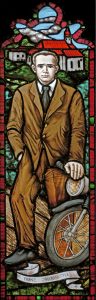
Austrian layman Blessed Franz Jägerstätter depicted in stained glass in St. Radegund with his beloved motorcycle. Jägerstätter said: “I can say from my own experience how painful life often is when one lives as a halfway Christian; it is more like vegetating than living.”

Franz Jägerstätter sought advice from friends and clergy about his intention to be a conscientious objector. His decision caused arguments in his family and among his friends. One local priest told Jägerstätter that his decision to not serve in the Nazi military was “suicidal” and although the church hierarchy had accommodated Nazism under the rationale to keep Austrian Catholic parish church doors open to bestow the sacraments, Jägerstätter was, at least in this instance, refused absolution. Since Bishop Gföllner’s pastoral letters had significant influence on Franz Jägerstätter’s evaluation of Nazism, he hoped to receive helpful advice from Gföllner’s successor, Bishop Joseph Calasanz Fliesser (1896-1960). Prepared as usual, Jägerstätter was accompanied to Linz by Franziska and brought eleven difficult questions to ask the bishop. “What Catholic,” Jägerstätter asked, “can dare to say that these raids which Germany has carried out in several countries, and is still carrying out, constitute a just and holy war?” With the Anschluss now three years in place, Jägerstätter met a new and more taciturn bishop. Jägerstätter asked: “Can one be reproached today for lacking patriotism? Do we still even have a mother country in this world? For if a country is supposed to be my mother country, it may not just impose duties. One must also have rights, and do we have rights here today? If someone becomes ineducable and might be a burden on the state, what happens to them? Would such a mother country be worth defending at all? Germany was attacked by no one. Once, I believe, we would have had the right to defend ourselves, and that was four years ago when we were still Austrians.”

Bishop Fliesser did not resolve Jägerstätter’s questions but sought to remind him of his family responsibility. Jägerstätter bristled at the bishop’s advice on several issues including that, as a soldier, he would not be held accountable by the church for following orders. Jägerstätter wrote: “We may just as well strike out the gifts of wisdom and understanding from the Seven Gifts for which we pray to the Holy Spirit. For if we’re supposed to obey the Führer blindly anyway, why should we need wisdom and understanding?”

To try to see the bishop more fairly, some have claimed his cautious response was that he feared Jägerstätter could be a Nazi spy. Others claimed that such a pall of collective social dread had settled over the populace that the bishop could not understand or accept how one individual farmer could be so truly courageous. Jägerstätter appreciated the perilous situation that priests and bishops faced if they went against the Third Reich. As a Catholic, Jägerstätter was called to step into the breach so that “the Church would not stay silent in the face of what was happening…(for then) what difference would it make if no church were ever opened again?” Ultimately, at Jägerstätter’s Nazi trial in July 1943 that condemned him, Jägerstätter said: “The Bishop has not experienced the grace that has been granted to me.”

Franz Jägerstätter was born on May 20, 1907 between Salzburg and Braunau am Inn as the illegitimate child of Franz Bachmeier, a farmer’s son, and Rosalia Huber, a housemaid. Jägerstätter was 15 months younger than Dietrich Bonhoeffer, the famous German pastor, theologian, and anti-Nazi dissident, who was imprisoned and murdered by the Nazis for his nonconformity to the dictates of their politics. Little Franz was first cared for by his widowed grandmother, Elisabeth Huber, and attended a crowded one-room school in St. Radegund where, during World War I, there were episodes of widespread hunger and other disadvantages.

1024px-Sankt_Radegund_Jaegerstaetterhaus

Birthplace of Franz Jägerstätter. Born on May 20, 1907, Jägerstätter was an illegitimate child of a housemaid and a farmer.

After Franz’s father was killed in World War I, Rosalia married prosperous farmer Heinrich Jägerstätter in 1917 who adopted the boy. After Franz’s formal education ended when he was 14 years old, he remained an avid lifelong reader. “People who don’t read,” Jägerstätter quipped, “will never be able to stand on their own feet. They will all too easily become a football for the opinions of others.” Many in St. Radegund were impressed by this popular young man who rode a motorbike he bought in the mining town of Erzberg, Austria, with his work earnings.

Jägerstätter

Franz Jägerstätter at 18 years old. The young man was an avid reader, worker, and motorcycle rider.

Franziska Schwaninger. From the village of Hochburg, Austria, about 8 miles from St. Radegund, she was from a religious family and considered becoming a nun in Ranshofen teaching kindergarten. Told by the nuns to come back in six months, Franziska met Franz Jägerstätter at a turning point in his life. The two light-hearted young people — “We were very jolly and laughed a lot,” she said — had a short engagement before they were married.

Working as a farmer in Teising, Germany and, in 1927, in the iron ore industry in Eisenerz, Austria, Jägerstätter returned to St. Radegund in 1930 where, in 1933, this “raufer” (brawler) soon fathered an out-of-wedlock child. There was no question that 26-year-old Jägerstätter would not marry Theresia Auer, a working maid. At first, he even disputed his paternity, but then helped care for both the mother and child (named Hildegard) and forged an affectionate lifelong father-daughter bond. This experience started Jägerstätter on a different path in life. His future wife, Franziska Schwaninger (1913–2013) of Hochburg, Austria, was working as a dairy and kitchen maid when in 1934, the 21-year-old Austrian woman met Jägerstätter at a local parish social. One of the first questions Franziska asked the “raufer” Franz was whether he attended church. From the start of their relationship, her religiosity influenced him. Franz and Franziska were married on April 9, 1936, during Holy Week. Supported by his wife’s deep faith, Franz, in addition to his farm work, became the sexton in the local church and started going to mass daily where he received communion. In the next four years Jägerstätter and Franziska had three daughters. Franziska included Jägerstätter’s illegimate daughter as part of the family. After 1945, however, Hildegard lost contact with her half-sisters. This family riff is attributed to their grandmother Rosalia (Jägerstätter’s mother) who never liked Theresia Auer, Hildegard’s mother.

After their wedding Franz and Franziska set out to Rome, Italy, and received Pius XI’s papal blessing. Within the year Pius XI published and had proclaimed from Catholic pulpits in Germany his encyclical Mit brennender Sorge (“With Burning Concern”) which condemned leading aspects of the Third Reich. Bishop Gföllner of Linz ordered that the papal encyclical be read from the pulpit of every parish in pre-Anschluss Austria. The contents of the encyclical worked to add to newlywed Jägerstätter’s mistrust of the Nazi regime. It was around this time that Jägerstätter reported having a dream. In it a fine-looking train was traveling through the mountains and adults and children flocked to it with a majority of adults boarding it. Then, in the dream, someone took Jägerstätter’s hand and told him: “This train is going to hell.” As during the Fatima apparition on July 13, 1917, Jägerstätter had a vision of hell but also purgatory. Jägerstätter reported that “the suffering in purgatory (was) so great.” For Jägerstätter the dream image of the fine-looking moving train was Nazism.

wedding

Franziska Schwaninger (1913–2013) of Hochburg, Austria, married Austrian farmer Franz Jägerstätter on April 9, 1936, during Holy Week. After their wedding they set out to Rome, Italy, for their honeymoon and received Pius XI’s papal blessing.

Franz Jägerstätter

The peasant mother of Franz Jägerstätter (left), his three daughters, Maria, Aloisia and Rosalia, and his wife, Franziska. Franziska sent this photograph to Franz on November 3, 1940 when he was in the military service (basic training) from October 1940 to April 1941. It was the town mayor who  obtained repeated deferments for Franz Jägerstätter.

Jägerstätter children

Photograph of Maria, Louisi and Rosi.

The young Austrian farmer and husband was well aware of what he termed the constant “creeping up” of Nazism and it led him to make an extensive examination of their outlook and track record. Jägerstätter asked: “Is membership in the Nazi movement…a help or hindrance for us Catholics in achieving blessedness?” While Jägerstätter notes that money is flowing into Christian associations in Germany at a record pace, the simple farmer observes that in several instances it is of “no value” to the state which is reliant on its propaganda and military and police power. “So the Führer wants to constantly test his people to see who’s for or against him. In Germany, before Hitler took over, they used to say that Nazis were not allowed to take Communion. And how do things look now in this great German Reich? Some people go, so it seems, quite placidly up to the altar rail, even though they’re members of the Nazi Party, and have let their children join the Party, or are even training to become Nazi educators themselves. Has the Nazi Party, which has been murdering people in the most atrocious way for more than two years now, really changed its program, making it permissible or a matter of indifference for its members to take Communion? Or have the church leaders already given their decision or approval, so that it’s now allowed for Catholics to join a party which is hostile to the Church? Yes, sometimes it makes you want to just shout out. If you think it over a little, could it come as a surprise if even the most fair-minded were to go crazy in such a country? The way things look, we’re not going to see any bloody persecution of Christians here after all, as the Church now does almost everything the Nazi Party wants or orders.”

Though Jägerstätter accepted the prospect for himself of persecution and suffering for standing up to a murderous Nazi state, he sought to not “throw stones” at the church hierarchy since “after all, they are human.”

After many delays, Jägerstätter was finally called to active duty a third time on February 23, 1943. It was the day after the first leaders of the Munich-based White Rose Nazi resistance student movement Hans Scholl (1918-1943) and Sophie Scholl (1921-1943), who were brother and sister, were executed for high treason. Three weeks earlier, the German public was informed of the official surrender of the German Army at the Battle of Stalingrad. It marked the first time the Nazi government admitted to a failure in the war. Able-bodied Austrian farmer Jägerstätter reported to duty at Enns (Austria) on March 1, 1943 and promptly declared his mulled-over conscientious objection. The Nazis responded by putting him in jail. A priest from home visited him and repeated the well-worn advice to do his civic duty and come out of jail. Jägerstätter refused and was sent to Linz prison for the rest of March and April 1943 and then transferred to Tegel prison in Berlin in May 1943.

Incarcerated at Tegel in the same time period was Dietrich Bonhoeffer who was there from his arrest on April 5, 1943 until October 1944 when Bonhoeffer was moved to Gestapo headquarters in Berlin on Prinz-Albrecht-Strasse (today’s Niederkirchnerstrasse) where he stayed until February 1945. With Bonhoeffer’s execution by hanging at Flossenbürg concentration camp on April 9, 1945, the theologian had been also transferred to Buchenwald concentration camp and to Regensburg. There is no known evidence that Franz Jägerstätter and Dietrich Bonhoeffer met one another at Tegel. Jägerstätter did learn at Tegel that an Austrian Catholic priest (Franz Reinisch) had been executed as a conscientious objector citing reasons very much like Jägerstätter’s own. That single individual’s martyrdom, echoing Pope Francis’s TED talk, brought a message of hope to Jägerstätter’s plight. Jägerstätter was now clear that he could “change nothing in world affairs (but) at least be a sign that not everyone let themselves be carried away with the tide.”

Bonhoeffer wrote some of his best-known letters at Tegel and Franz also sent missives. In one letter to his wife Franziska, Jägerstätter wrote: “Most beloved wife, today I received with joy your dear letter. Not a God or a church gives a commandment requiring that we must under a burden of sin commit ourselves in an oath to obeying the civil authorities in all matters. I cannot take an oath in favor of a government that is fighting an unjust war. The true Christian is to be recognized more in his deeds than in his speech. Let us love our enemies, bless those who curse us, and pray for those who persecute us. For love will conquer and endure for all eternity.”

Franziska’s letters to Franz were equally a source of encouragement and reassurance for husband and wife. In a letter dated February 20, 1941, Franziska wrote to Franz: “It is a great comfort to me that you love praying so much, and so can maybe manage to bear everything patiently during this difficult time. From your letters I gather that, despite everything, you aren’t unhappy and often find time to go to church to find consolation and courage there.”

hofgang_ta_1

Yard at Tegel prison in Berlin.

jager6

The sign Jägerstätter’s daughters hold reads: Lieber Vater komm bald! (Dear Father come [home] soon!). This photograph was sent to their father in Tegel prison and brought the 36-year-old husband and father to tears of joy.

About ten minutes by motor car from Tegal prison, the Reichskriegsgericht (“Reich Court-Martial”) filed almost 1,200 sentences of capital punishment for various forms of treason, spying, resistance (frauen und männer des widerstand) and conscientious objection (kriegsdienstverweigerer). In the period between August 1939 and February 7, 1945, nearly 90% of these death sentences were carried out. In the same building dealing with charges of treason were also proceedings associated with Hitler’s “Night and Fog” decree. That order of December 7, 1941 directed that any persons captured in occupied territories who acted to undermine German troops were to be taken “by night and fog” to Germany to face trial in special courts that could ignore normal conventions and procedures for the prisoner’s humane treatment.

Accused by the Third Reich of undermining Wehrkraftzersetzung (“military morale”) —as had been passive resisters Hans and Sophie Scholl of the White Rose — Franz Jägerstätter was found guilty at military trial at the Reichskriegsgericht, the highest German military court during the period of national socialism, and sentenced to death on July 6, 1943. Standing before the second panel of the national court martial led by lieutenant general staff judge Werner Lueben (1894-1944), Jägerstätter was “condemned to death for sedition” and sentenced to loss of civil rights and of eligibility for military service- an official judgment that punitively cut the person off from society. The written judgment of the court is a summary of Jägerstätter’s path to conscientious objection. It reads: “In February 1943 the accused was again called up, by written command, for active service with motorized replacement unit 17 in Enns from 25 February 1943. At first, he ignored the call-up, because he rejects National Socialism and therefore does not wish to do military service. Under pressure from relatives and the persuasion of his local priest, he finally reported on 1 March 1943 to the permanent company at motorized replacement unit 17 in Enns, but immediately announced that because of his religious views he refused to do armed military service. During questioning by the court officer, despite detailed instruction and advice as to the consequences of his conduct, he maintained his negative attitude. He explained that if he fought for the National Socialist state, he would be acting against his religious conscience. He also assumed this negative attitude during questioning by the court investigating officer of Division No. 487 in Linz, and by the representative of the national court martial. However, he declared himself willing to serve as a medical orderly as an act of Christian charity. At the main trial he repeated his statements and added that it was only during the last year he had reached the conviction that as a believing Catholic he could not perform military service and could not simultaneously be a National Socialist and a Catholic. That it was impossible. If he had obeyed the earlier call-up, he had done so because at that time because he had regarded it as sinful not to obey the commands of the state. Now God had made him think that it was not a sin to reject armed service, that there were things over which one should obey God more than man. Because of the command ‘Love thy neighbor as thyself’ he could not fight with weapons. He was however prepared to serve as a medical orderly. The accused had already been a soldier for six months (1940-41 call-up), had taken the oath of loyalty to the Führer and Supreme Commander of the Army, and during his period of service was amply informed about the duties of the German soldier. Nevertheless, despite being told about the consequences of his conduct, he stubbornly refuses for personal reasons to fulfill his patriotic duty in Germany’s hard struggle for survival. Accordingly, the death sentence is pronounced.”

Facade of Reichskriegsgericht, Berlin.

In this building at Witzlebenstrasse 5, Berlin, on July 6, 1943, the Austrian farmer Franz Jägerstätter was sentenced to death by the Supreme Military Court of the Third Reich (Reichskriegsgericht) on grounds of his conscientious objection to military service in the Nazi war effort. In addition to dealing with various charges of treason, this building dealt with proceedings associated with Hitler’s “Night and Fog” decree. The order of December 7, 1941 directed that persons captured in occupied territories who acted to undermine German troops were to be taken “by night and fog” to Germany to face trial in special courts which could ignore procedures and conventions for a prisoner’s humane treatment.

OLYMPUS DIGITAL CAMERA

Memorial sign outside today’s former Reichskriegsgericht building in Berlin. It reads in English: “In this building, Witziebenstrasse 4-10, was from 1936-1943 the Reichskriegsgericht. The highest court of armed forces justice sentenced here over 260 conscientious objectors and countless men and women of the resistance because of their attitude towards National Socialism (Nazism) and war to the point of executing them to death.”

Following his July 6, 1943 condemnation by the supreme military tribunal, Jägerstätter was given several weeks at Tegel to ponder his conscience’s perilous consequence. The Third Reich, desperate for manpower in 1943, allowed conscientious objectors to recant their objection unconditionally and be immediately assigned to a military probation unit.

Though fourth century BCE Greek philosophers Aristotle and Plato, and later, Thomas Aquinas (1225-1274) and Robert Bellarmine (1542-1621) argued for state authority, they also warned of its risks and potential abuses so that, for Aquinas in his Summa Theologica there was the right to resist tyranny and, for Bellarmine, there was no intrinsic divine right of kings. However, the practice of conscientious objection was relatively rare in Western societies prior to World War II. Following the military defeat of Hitler the Catholic Church moved to vocalize a mission to be a moral advocate in terms of social justice. Throughout World War II individuals like Franz Jägerstätter but also Dietrich Bonhoeffer, Hans and Sophie Scholl, Alfred Delp, S.J. (1907-1945), Blessed Nikolaus Gross (1898-1945), Max Metzger (1887-1944), Eugen Bolz (1881-1945), Ernst Volkmann (1902-1941) and others stood up for their faith as well as human rights and were executed as enemies of the state. In their lifetimes these martyrs’ actions received little to no sympathy from bishops or ordinary Catholics because social justice— including conscientious objection—was basically absent from standard church teaching. Even with the advent of democracy, there remained the church’s ancient teaching that governments derive their authority from God and citizens should obey them. Despite this theology and the law, the obvious illegitimacy of the Nazi regime that led to the disobedience, refusal, and conscientious objection of individuals such as Jägerstätter, Bonhoeffer, the Scholls, etc., and who cited Biblical and philosophical truth and justice as greater than state authority and, often, the authority of politically-drenched church hierarchs – helped begin the formation of a greater religious sense for the situational dynamics of the individual’s conscience within the state. Pope Pius XII (1939-1958) proved sufficiently intrepid to try to get in front of this new spiritual juggernaut of social justice that had, even with church-state concordats in place, many martyrs’ spilled blood upon it in World War II. On February 18, 1946, the 69-year-old Pius XII appointed as new Cardinals three German bishops who had publicly opposed the Third Reich. Yet for the remainder of this pope’s time on the seat of Peter, the church’s goals and objectives for social justice remained mostly vague and ambiguous.

LEADING RESISTORS TO HITLER’S NAZI REGIME WHO WERE EXECUTED BY THE STATE PRIOR TO AND DURING WORLD WAR II.

Dietrich Bonhoeffer

DIETRICH BONHOEFFER (1906 – 9 April 1945). Lutheran pastor and theologian, it was after the failure of the July 20, 1944 plot on Hitler’s life—and discovery of Abwehr documents (Abwehr was a German military intelligence organization Bonhoeffer had joined) relating to the plot—that Bonhoeffer, already under Nazi arrest, was accused of conspiracy.  Bonhoeffer was executed by hanging at Konzentrationslager Flossenbürg on April 9, 1945, just two weeks before the camp was liberated by American soldiers.

Hans-et-Sophie-Scholl

HANS SCHOLL (German, 1918 – 22 February 1943) and SOPHIE SCHOLL (German, 1921 – 22 February 1943). Upon distributing anti-Nazi political resistance leaflets on February 18, 1943 at Ludwig-Maximilians-Universität München, students Sophie Scholl, Hans Scholl and Christoph Probst were immediately arrested. On February 22, 1943 they were tried in the Volksgerichtshof and found guilty of high treason. They were executed by beheading the same day.

For more on the Scholls and the White Rose please visit: https://johnpwalshblog.com/2021/02/22/long-live-freedom-hans-and-sophie-scholl-and-the-white-rose-in-germany-1942-1943/

Alfred Delp

ALFRED DELP, S.J. (German, 1907 – Berlin, 2 February 1945) was a member of the Kreisauer Kreis composed of men and women from a variety of backgrounds who were opposed to Hitler’s Nazi regime. Delp was arrested in 1944, sentenced to death and executed in 1945. Delp’s book Facing Death, written during his six months’ imprisonment has been compared to Bonhoeffer’s Letters and Papers from Prison.

For more on Father Delp, please visit:
https://johnpwalshblog.com/2017/12/23/the-prison-meditations-of-alfred-delp-s-j-1907-1945-for-advent-and-christmas/

Nikolaus_und_Elisabeth_Groß

Blessed NIKOLAUS GROSS (German, 1898 – 23 January 1945) and ELIZABETH KOCH GROSS (1901-1971). An anti-Nazi journalist, Nikolaus Gross was arrested on August 12, 1944 in connection with the failed plot to kill Hitler at the Wolf’s Lair (July 20, 1944). In September 1944 he was taken to Tegel prison where Elizabeth visited him twice and saw torture markings on his body.  Gross was hanged on January  23, 1945 at Plötzensee Prison.

bolz

Servant of God EUGEN BOLZ (German, 1881 – 23 January 1945) was a politician and member of the resistance to the Nazi régime. Bolz had been Protestant Württemberg’s first Catholic president when the Nazis came to power in 1933. Since Bolz loathed the Nazis, they immediately forced him from office and sent him to a concentration camp. When he was released, Bolz went into semi-retirement near Ulm, where he was constantly monitored by the Gestapo. In 1942 Bolz secretly accepted the post of Culture Minister in a shadow German “government in waiting” ready to replace Hitler. But when the plot to kill Hitler failed on July 20, 1944, Bolz was arrested where he was tried and, on January 23, 1945,  beheaded at Plötzensee Prison.

MMetzger

MAX METZGER (German, 1887 – 17 April 1944) was  a Catholic priest and longtime peace activist in Germany. After Hitler came to power in 1933, Metzger was arrested many times by the Gestapo. A pamphlet writer, his 1943 essay on German state reorganization in a post-war world was given to a courier who betrayed him.  Metzger was arrested on June 29, 1943. The presiding judge at his trial said Metzger and people like him should be “eradicated.” Fr. Metzger was executed in Brandenburg prison on April 17, 1944.  

Father Franz Reinisch

FRANZ REINISCH (1903-1942), an Austrian Catholic priest, was conscripted for military service in the Third Reich on September 12, 1941. Reinisch refused to swear allegiance to Hitler but publicly noted he would swear allegiance to the German people so to join the Wehrmacht. Reinisch was arrested and charged with undermining military morale. Brought to Tegel, a prison chaplain denied Reinisch communion for failure to perform his civic duty. Tried and convicted, Reinisch was moved to Brandenburg in Berlin where he was beheaded by guillotine on August 21, 1942.

Papst-Franziskus-Pater-Reinisch385

Pope Francis with a portrait of Franz Reinisch.

Ernst-Volkmann-639x1024

ERNST VOLKMANN (1902-1941). Ernst Volkmann had to die because he refused to fight for Nazi Germany on religious grounds. In 1929, he married Maria Handle from Bregenz, Austria, with whom he had three children. He ignored all Wehrmacht conscription orders, which is why Ernst Volkmann was arrested in June 1940. The Berlin court sentenced him to death on July 7, 1941. A month later on August 9, at 5:05 am, Ernst Volkmann was beheaded in the Brandenburg-Görden prison.

HELMUTH JAMES GRAF VON MOLTKE (1907 – January 23, 1945). Count Moltke had close sympathies with the democratic forces of the day and expressed open criticism as he watched the rise of Hitler. In 1933 he refused to accept Nazi appointments. After the outbreak of World War II, as an expert adviser on international law and the laws of war he served as war administration councilor in the Office for Foreign Affairs/Counterintelligence in the Armed Forces High Command in Berlin. He was particularly active in advocating for humane treatment of prisoners of war and observance of international law. In 1940 Moltke with Peter Graf Yorck von Wartenburg became the leading figures in a group that emerged as the Kreisau Circle with its discussions held in Berlin and Kreisau. Moltke, formulating memoranda on the establishment of a new political order in Germany, systematically extended his contacts to Protestant and Catholic church leaders and to leaders of the social democratic political opposition. Moltke was arrested on January 19, 1944 after he had warned members of the Solf Circle that they were under Gestapo surveillance. His involvement in the plans for a coup against Hitler was not exposed until after the failure of the assassination attempt of July 20, 1944. Helmuth James Graf von Moltke was sentenced to death by the People’s Court on January 11, 1945 and executed on January 23, 1945 in Berlin-Plötzensee.  http://www.gdw-berlin.de/home/

Portrait-of-Pope-Pius-XII-008

After the war was over, Pope Pius XII (1939-1958) named three German bishops who had publicly defied the Third Reich to be Cardinals. These were Blessed CLEMENS AUGUST GRAF VON GALEN (1878-1946), KONRAD MARIA VON PREYSING (1880–1950) and JOSEF FRINGS (1887 – 1978). The development for social justice as a mission of the church would remain vague and ambiguous until later popes.

For Jägerstätter, in regard to Hitler’s demand of virtually religious avowal to the Nazi state— including serving in or supporting Germany’s military expeditions based on their war ideology—these political pressures had reached the limits of the individual’s duty to obey even when faced with the demureness of a social majority or institutions: “Yet Christ also demands that we should make a public avowal of our faith, just as the Führer Adolf Hitler demands a public avowal from his fellow countrymen. God’s Commandments do indeed teach us that we should obey the secular authorities, even if they aren’t Christian, but only as long as they don’t order us to do anything wrong. For we must obey God even more than men.”

On August 9, 1943, Franz Jägerstätter was taken from Tegel to Brandenburg-Görden (or Brandenburg/Havel) prison in the Görden quarter of Brandenburg an der Havel less than 60 miles west of Berlin. Built with a capacity of 1,800, it sometimes held over 4,000 during Nazi rule.

In Franz Jägerstätter’s last letter written from Brandenburg-Görden prison where he was executed on August 9, 1943, the 36-year-old Austrian farmer, husband and father, conscientious objector, and soon martyr wrote these words: “Now I’ll write down a few words as they come to me from my heart. Although I am writing them with my hands in chains, this is still much better than if my will were in chains. Neither prison nor chains nor sentence of death can rob a man of the Faith and his free will. God gives so much strength that it is possible to bear any suffering…. People worry about the obligations of conscience as they concern my wife and children. But I cannot believe that, just because one has a wife and children, a man is free to offend God.”

Offered a New Testament by the prison chaplain, Jägerstätter, lifetime avid reader, sexton, secular Franciscan, and thoughtful and articulate conscientious objector whose biblical passages he had drunk deeply in the pursuit of his solitary self-sacrificial path, particularly in light of his sacramental marriage to Franzika in 1936, calmly refused. Jägerstätter told Fr. Albert Jochmann from Brandenberg: “I am completely bound now in inner union with the Lord, and any reading would only interrupt my communication with God.” The prisoner was then led out to the executioner’s guillotine and, along with 16 other prisoners with the same fate that day, beheaded. Under the Nazis. there were 1,800 people executed in Brandenburg, its murderous operation well-known by the townspeople.
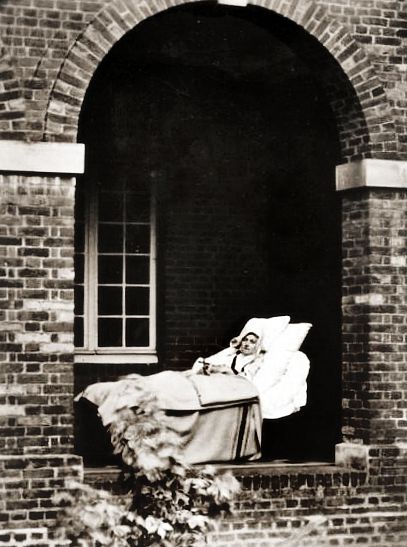
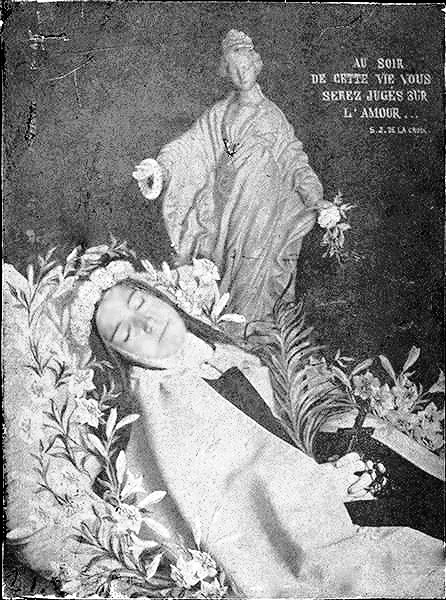
That same evening, only hours after the scheduled 4 p.m. execution, Fr. Jochmann told a group of Austrian nuns that Franz Jägerstätter was the first and only saint he ever met. Jägerstätter’s remains, like the other victims of Nazi executions at Brandenburg, was cremated at the municipal crematorium. Placed in separate urns, the ashes were to be buried anonymously. But Fr. Jochmann and other priests asked cemetery staff to disclose specifically marked burial places that then allowed the nuns at the hospital to plant flowers that marked the graves. The nuns who brought back Franz Jägerstätter’s ashes to be buried in St. Radegund in 1946 were the same order of nuns which Franziska Jägerstätter had looked into joining at Ranshof as a single woman before she met her husband.

Franz Jägerstätter was martyred on the same day as St. Teresa Benedicta of the Cross or St. Edith Stein (1891-1943) who died in Auschwitz. Franziska did not learn of her husband’s death until about a month later. She had sent him a letter in early September 1943 but the response came from the prison chaplains at Tegel and Brandenburg who informed her of his death. Sometime after that, Franziska received from the Nazis the official announcement of the execution of her husband, Franz Jägerstätter, together with his last letter.

Franz Jägerstätter’s final essay

First page of Franz Jägerstätter’s final essay written in prison. The first sentence reads: “Now I’ll write down a few words as they come to me from my heart. Although I am writing them with my hands in chains, this is still much better than if it were my will in chains.”

Before receiving the official announcement and last letter, Franziska wrote back to the prison chaplains (Fathers Jochmann and Heinrich Kreutzberg) revealing some of her loving relationship with her now-late husband: “Have received your kind letter with the words of comfort, many thanks. I particularly thank you from the bottom of my heart for visiting my dear husband so often in prison. It must have made him very happy, to receive words of comfort from representatives of Christ even in his cell, and to even be able to receive the dear Lord Jesus in the Holy Communion, as he always did his best to follow the Commandments. So it will not have been too great a sin that he did not obey the state, and I hope that, with God’s help, he will surely have safely reached his eternal goal after all. I feel very sorry he’s gone, because I’ve lost a dear husband and a good father to my children, and I can also assure you that our marriage was one of the happiest in our parish – many people envied us. But the good Lord intended otherwise, and has loosed that loving bond. I already look forward to meeting again in Heaven, where no war can ever divide us again. I want to say again, with all my heart: may God reward you for all the good you have done my dear husband. With deepest respect and gratitude, Franziska Jägerstätter.”

FRANZ JÄGERSTÄTTER’S LEGACY TODAY.

In terms of Franz Jägerstätter ‘s legacy, a few cursory observations.

Trappist monk and writer Thomas Merton (1915-1968) was influenced by the life of Franz Jägerstätter. Merton included a chapter on Jägerstätter in his popular 1968 book Faith and Violence (University of Notre Dame Press – available in several reprinted editions).

Trappist monk and writer Thomas Merton (1915-1968) was influenced by the life of Franz Jägerstätter. Merton included a chapter on Jägerstätter in his popular 1968 book Faith and Violence.

Gordon Zahn (1918-2007) from Loyola University in Chicago, wrote A Solitary Witness: The Life and Death of Franz Jägerstätter in 1964. Zahn was a conscientious objector during World War II who related that one of the great moments of his life was when he heard a student during the Vietnam War say he was burning his draft card “in memory of Franz Jägerstätter.” Jägerstätter who was a conscientious objector to the Nazi war effort, was not necessarily an absolute pacifist regarding just war. Gordon Zahn was a guiding light in the Catholic peace movement as a co-founder of Pax Christi USA. Pax Christi focuses on human rights and security, disarmament and demilitarization, a just world order and religion and peace. Its president Kevin Patrick Dowling, is a South African Redemptorist. See – http://www.paxchristi.net/about-us/why-pax-christi – retrieved July 7, 2021.

Gordon Zahn wrote A Solitary Witness: The Life and Death of Franz Jägerstätter in 1964. Zahn was a conscientious objector during World War II and a co-founder of Pax Christi, the Catholic Peace and Human Rights movement.

The Refusal (Der Fall) is a 94 minute-dramatized film about Franz Jägerstätter orginally released in West Germany in 1971.

The Refusal (Der Fall) is a 94 minute-dramatized film about Franz Jägerstätter directed by Alex Corti with a screenplay by Hellmut Kindler. It stars Kurt Weinzierl and Julia Gschnitzer as Franz and Franziska Jägerstätter. The sympathetic portrayal of the conscientious objector was originally released in (West) Germany in 1971. Nearly 30 years after Jägerstätter’s execution, actual villagers who knew the film’s protagonist were interviewed.

Jägerstätter (August Diehl): “I thought we could build our nest high up in the trees. Fly away like birds.”
Ohlendorff (Johan Leysen) – “Instead of suffering for the truth, I paint it.”

One of the most recent projects on the life and legacy of Franz Jägerstätter is Terrence Malick’s 2019 biopic film A Hidden Life. The award-winning film stars August Diel and Valerie Pachner as Franz and Franziska Jägerstätter and this film’s evocative narrative makes it clear how the married couple journeyed together through the entirety of Franz’s conscientious objector resistance to Hitler and the Nazi war effort in imprisonment, ostracization by society, and death. The title—A Hidden Life —derives from the early 1870’s novel Middlemarch by George Eliot which, in turn, derives from Paul’s Letter to the Colossians (chapter 3; verse 3).

Jägerstätter’s individual witness helps give loving form and meaning to the whole of Creation itself —God’s creation —and unto God Himself who is often impugned by human beings for having abandoned humanity to evil and hopeless guilt. An early Nazi interrogator questions Jägerstätter’s specific circumstantial decision to resist injustice with a possible challenge by way of a larger context so for him to ponder his stubborn individual refusal to fight for the state authority, in this case, Hitler: “Are you alone wise? How do you know what is good or bad? You know better than I? Did heaven tell you this? Heard a voice? There’s a difference between the kind of suffering we can’t avoid and a suffering we choose. You’ve forgotten what the world looks like. The light. The sky. I didn’t make this world the way it is. And neither did you. We all have blood on our hands. No one is innocent. Crying, bloodshed, everywhere. He who created this world. He created evil. Conscience makes cowards of us all. Take care, my friend. The Antichrist is clever. He uses a man’s virtues to mislead him.”

A standard practice for Nazi operators of the camps, for instance, was to make sure that all its staff were certain to “have blood on our hands.”

While the Nazis emphasized the isolation and control of imprisonment they had over Jägerstätter —and one can view Jägerstätter with pity for this —the film makes increasingly clear as its narrative develops that the conscientious objector to an unjust project stands for himself and all others who, by one or another reason or cause, are not privileged to speak for themselves fully by standing up for what is right. When the prisoner’s defense attorney presents terms to go free that includes an oath of loyalty to Hitler, he tells Jägerstätter, “See here, I’m going to leave this paper with you. Keep it with you. Sign, and you’ll go free.” Jägerstätter, in the Nazi state’s shackles, replies, “But I am free.”

Jägerstätter expresses God’s creation as loving and meaningful despite the nay-sayers by freely accepting the required suffering and self-sacrifice based on his faith in the example and person of Jesus Christ to do it. From Tegel prison Jägerstätter writes, “I’ll write a few words, just as they come from my heart. Even though I’m writing them with bound hands, that’s still better than if my will were bound. These men have no friends. No loving hand to hold theirs. What are you here for? Treason. They’ve seen sorrow. Shame. Destruction. What strong hearts! When you give up the idea of surviving at any price, a new light floods in. Once, you were in a rush, always short of time. Now you have all you need. Once, you never forgave anyone. Judged people without mercy. Now you see your own weakness, so you can understand the weakness of others.”

FRANZISK
9826f1d34acadbe11e8700d7cddac88a--putz-a-call

Grave of Blessed Franz Jägerstätter, St. Radegund, Austria.

FOOTNOTES of this blog post are available at: https://www.academia.edu/50082395/Bl_Franz_Jagerstatter_1907_1943_Austrian_Farmer_Husband_and_Father_Conscientious_Objector_and_Martyr

SOURCES:

Pope Francis TED Speech, April 2017 – – https://www.ted.com/talks/pope_francis_why_the_only_future_worth_building_includes_everyone?language=en. Web. – retrieved October 26, 2017.

Gordon Zahn, A Solitary Witness: The Life and Death of Franz Jägerstätter, Templegate Publications; revised edition, 1986.

Dietrich Bonhoeffer, Ethics,The Macmillan Company, New York, 1968.

Diözese Linz, Franz Jägerstätter 1907 – 1943 – Martyr, Katholische Kirche in Oberösterreich, n.d. Web. – retrieved October 26, 2017.

H. Richard Niebuhr, Christ and Culture, Harper & Row Publishers, NY, 1975.

Robert A. Krieg, Catholic Theologians in Nazi Germany, Continuum, NY, 2004.

Martin Conway, Catholic Politics in Europe, 1918-1945, Routledge, 1997.

Walter M. Abbott, S.J., The Documents of Vatican II, Guild Press, NY, 1966.

The Holy See, The Vatican, n.d, Bl. Franz Jägerstätter (1907-1943) – Biography. Web. – retrieved October 26, 2017.

Erna Putz, Franz Jägerstätter Martyr – A Shining Example in Dark Times, Grünbach: Steinmassl, 2007, Print and Web. – retrieved October 26, 2017.

https://www.academia.edu/50082395/Bl_Franz_Jagerstatter_1907_1943_Austrian_Farmer_Husband_and_Father_Conscientious_Objector_and_Martyr

Beyond Town Walls: How Assisi’s Despised Outcasts Sparked the True Calling of Saint Francis in Roberto Rossellini’s “The Flowers of St. Francis” (1950).

FEATURE Image: Saint Francis kissing the leper, Zacarías González Velázquez, oil on canvas, c. 1787, 217×264 cm, Prado, Madrid. The painting is part of a serial of thirty-three scenes on the “Life of Saint Francis” commissioned for the Basilica of Saint Francis the Great in Madrid done by multiple Spanish painters. The artist was inspired by Saint Bonaventure’s biography of St. Francis that recounts this scene of Francis, dressed in the luxurious clothes of a rich knight, as he dismounts from his steed to kiss a leper. see – Saint Francis Embracing a Leper – The Collection – Museo Nacional del Prado – retrieved October 4, 2017.

By John P. Walsh

The April 20, 1949 photograph of Roberto Rossellini and Ingrid Bergman captures a pivotal turning point at which artistic collaboration, personal scandal, and cinematic innovation converged. As public fascination with their relationship intensified, Rossellini turned toward the creation of The Flowers of St. Francis (1950), a film whose central episode, Francis’s embrace of a leper despite his initial revulsion, presents spiritual transformation as the triumph over fear and self-interest. In doing so, the Italian neorealist director fashioned a work that also served as a retreat from public controversy into a world of humility, simplicity, and faith.

PHOTO: Roberto Rossellini and Ingrid Bergman – “Roberto Rossellini and Ingrid Bergman” by classic film scans is marked with CC BY 2.0.

A Photograph at the Eye of the Storm

Italian director Roberto Rossellini and Swedish actress Ingrid Bergman are seen in a photograph taken by an uncredited Associated Press photographer on April 20, 1949, during a press conference at Rome’s Excelsior Hotel. Bergman had just arrived in Italy after writing her famous, career-altering letter to Rossellini, and the announced purpose of the gathering was to discuss their forthcoming collaboration, Stromboli.

The image captures a pivotal moment. Rossellini was already celebrated as the leading architect of Italian neorealism through such postwar landmarks as Open City and Paisan, while Bergman was one of the world’s most admired film stars and an Academy Award winner. Their expressions and proximity suggest a shared artistic purpose and creative excitement. Yet the photograph also unintentionally records the beginning of a relationship that would soon become one of the most scrutinized scandals in international celebrity culture, dominating headlines and ultimately leading to their marriage on May 24, 1950.

From Public Scandal to Spiritual Retreat

Ironically, while caught in this intensifying media storm, Rossellini turned toward one of the most serene and spiritually focused projects of his career: Francesco, giullare di Dio (The Flowers of St. Francis, 1950). The film emerged in part from his desire to escape the relentless attention surrounding his private life. In place of scandal, fame, and controversy, Rossellini sought a subject grounded in humility, simplicity, peace, and detachment from worldly concerns.

Co-written with the young Federico Fellini, the film drew its structure and themes from two fourteenth-century Franciscan texts: I Fioretti di San Francesco (The Little Flowers of St. Francis) and La Vita di Frate Ginepro (The Life of Brother Juniper). Rather than constructing a conventional biographical narrative, Rossellini assembled a series of nine loosely connected episodes that celebrate the joy, innocence, and spiritual freedom of Saint Francis and his followers.

Neorealism and Franciscan Simplicity

Remaining faithful to his neorealist principles, Rossellini rejected professional actors and cast actual Franciscan friars from the Monastery of Nocera Inferiore as Francis and his companions. The production sought not spectacle but authenticity. Equally important was Rossellini’s ambition to strip away any cinematic artifice in favor of directness and humanity so to recreate on screen the visual spirit of Giotto’s proto-Renaissance frescoes of the Life of St. Francis.

Viewed in retrospect, the 1949 photograph of Rossellini and Bergman marks far more than the beginning of Stromboli. It stands at the intersection of two parallel stories: one a highly publicized romance that captivated the world, the other the creation of a film devoted to spiritual humility and transcendence. The contrast reveals the remarkable complexity of Rossellini’s career at the very moment his personal and artistic lives became inseparably entwined.

https://youtu.be/bHHH6kP3hGE?si=peIL38eajdR53KNi – retrieved January 29, 2026.

The Embrace That Changed a Life

One of the most important episodes in the life of St. Francis of Assisi (c. 1181-1226) appears midway through Roberto Rossellini’s 1950 film Francesco, giullare di Dio (The Flowers of St. Francis). In a powerful five-minute sequence (Beginning at 41:00), Francis deliberately seeks out and embraces a leper, one of the most feared and socially ostracized figures of the medieval world.

This encounter marks a decisive turning point. Until this moment, Francis had recoiled from lepers, sharing the fears and prejudices common to his age. By overcoming that revulsion and embracing the suffering man before him, he crossed the threshold from worldly, military ambition to love, humility and poverty based in spiritual commitment.

A Moment of Spiritual Transformation

Following the embrace, Francis collapses to the ground in tears and cries out, “My God, my Lord and my all! O great God!” The emotional outpouring signals a profound inner conversion. What begins as an act of compassion becomes an encounter with the divine.

For Francis, embracing the leper means more than helping someone in need. It represents the conquest of his own fear, pride, and self-interest. The rich young man from Assisi discovers a new path rooted in humility, love, and obedience to God.

The Bridge Between Two Lives

Historically and spiritually, the embrace of the leper forms the bridge between Francis’s failed military and worldly aspirations and his lifelong dedication to radical poverty, humility, and service. In Christian tradition, it is the pivotal catalyst of his transformation, the moment when he turns away from status and ambition and begins the journey that would make him one of the most beloved saints in history.

Rossellini captures this episode as the emotional and spiritual center of The Flowers of St. Francis. By portraying Francis’s willingness to embrace society’s most vulnerable outcast, the film affirms that true conversion begins not with power or achievement, but with the courage to overcome fear and recognize the dignity and humanity of others.

Is the film scene historically accurate?

The event of the embrace is historically accurate though dramatized in Rossellini’s film after Francis’s brotherhood is established. Rather, in history it occurred at the beginning of the Italian saint’s conversion – in fact, was its cause. This is an important distinction since the embrace was most significant for St. Francis. It could even be argued that without Francis’s embrace of the leper, there would be no St. Francis of Assisi at all.

In Francis’s own Testament written in 1225—one year before his death at 44 or 45 years old—the saint stated directly that his embrace of the leper became the cause of his conversion.

For a rich young man such as Francis in medieval Europe who, during an age of many French popes, sought chivalric glory in military arms, he naturally spurned the contagion of leprosy that was an incurable disease and diligently avoided lepers. As Francis put it, when he embraced the leper he “exercised mercy” to him as Francis bridged his natural ambition and religious doubt with trust in God’s grace by embracing Assisi’s despised.

In that way, the leper— a common sight throughout medieval Europe and one that readily filled the lighthearted Francis with horror—became the astonishing means for the saint’s conversion of faith.

Special order of knights founded by pope cared for lepers in Italy.

In thirteenth-century Europe, by law lepers had to live apart from the rest of society owing to their contagious infectious disease.

As early as the 6th century under Pope St. Symmachus (495–514) there were general hospitals in Rome that cared for lepers though a network of specialized leper houses became more prevalent by the 11th-century. In 1130, the hospitaller and military Order of Saint Lazarus was established so that at the Third Lateran Council in 1179, two or three years before St. Francis’s birth, Pope Alexander III helped formalize the church’s role in the care of lepers, emphasizing their separation for care rather than mere social isolation.

St. Thomas Becket takes leave of Pope Alexander III in the autumn of 1165. 13th century miniature attributed to Matthew Paris, British Library. Public domain.

In the time period that Rossellini’s poignant film scene is set — it is either 1205 or 1206—there existed in Europe tens of thousands of church-run “hospitals” for lepers. One such leper hospital was a short walk outside Assisi’s town walls. Called San Salvatore delle Pareti, the leper hospital near Assisi that began to intrigue a young Francis is today a farm field.

Before his famous encounter of embracing the leper, Francis —then around 24 years old—had to work up gradually to the crucial moment of embracing a leper.

After Francis gave up his several quests to be a soldier, he returned to Assisi disappointed and disenchanted. Though he found refuge in the embrace of family and childhood friends, the same impulses that led Francis to abandon a military career even before it started, now prompted him to walk beyond the comforts of Assisi’s walls onto the road that led to the leper hospital.

Young Francis visits the leper hospital — and it changes his life.

Near the hospital, Francis interacted very tentatively, first with those caring for lepers —a charitable church activity first recognized by Pope Gregory the Great (540-604 CE)—and then at times with the lepers themselves. 

Miniature of Gregory the Great writing under the inspiration of the Holy Spirit, in a 12th-century copy of his Dialogues, British Library, London. Public Domain.

Come la notte Francesco pregando nella selva incontro il lebbroso —or, in English, “How St. Francis praying one night meets a leper.” This specific historical and cinematic moment represents the bridge between Francis’s failed worldly, military ambitions and his lifelong commitment to love, humility and poverty based in spiritual commitment.

The Flowers of St Francis Trailer – retrieved January 29, 2026

To start, it was the sickening smell peculiar to the leper hospital wafting into Francis’s nostrils that made him flee.

But as his visits continued Francis—who by now was living as a hermit— journeyed to the leper hospital to leave them a charitable gift. After leaving it on the roadside, Francis vanished as bell-clanging lepers appeared.

It took Francis many more visits to the leper hospital as well as, in solitude, dwelling on his own thoughts and prayers to finally reach what he believed was God’s answer for him.

As clearly dramatized in Roberto Rossellini’s wonderful film, Francis discovered a deeper courage and confidence in himself—and in the same moment a supernatural faith— when along the road to the leper hospital he stepped up to leave for the leper the charitable embrace of one of the rich sons of Assisi.

Yet, following that encounter, Francis realized that the leper had given him a gift also.

After that Francis was free to profoundly pursue whatever track God called him to run. Francis could now be called to renounce the world’s riches. He married his “Lady Poverty” in their joyous mystical marriage so that even today, in the 21st century, poverty remains a major Franciscan charism. Francis and Lady Poverty have been married for over 800 years.  

Following a lifetime spent in heroic Franciscan mendicancy, this world-famous Umbrian saint “Francesco” proclaimed to his Franciscan family and the world that it was at that exact moment when he embraced the leper—and the leper embraced him—that a life in and for God truly started.

St. Francis of Assisi has the indelible mark of the leper. He conquered fear and embraced the other in love no matter how godforsaken. Done in the context of divine trust and love, that faith-filled action set each man free.

SOURCE: St Francis of Assisi: A Biography by Johannes Jørgensen (1912). Translated from the Danish with the author’s sanction by T. O’Conor Sloane, Image books, 1955.

Sassetta (c.1392-c.1451), St. Francis in Ecstasy, back of the Sansepolcro altarpiece, 1437-44, Panel, 80 3/4 x 48 inches. Villa I Tatti, Florence.

God Cherishes Simplicity: Saint Thérèse of Lisieux (1873-1897) and the Little Way.

FEATURE image: Thérèse Martin (St. Thérèse of Lisieux) at 15 years old in a photograph taken in October 1887.

Saint Thérèse of Lisieux demonstrated that sanctity is achieved not through dramatic achievements but through humility, trust, suffering accepted with love, and fidelity to ordinary daily life, a spiritual vision that transformed an unknown Carmelite nun into one of the most influential figures in modern Christianity.

Thérèse Martin at 8 years old in 1881.

Thérèse Martin at 8 years old in 1881 with her sister Céline. The Martin family had moved from Alençon to Lisieux to be with the Guerin relatives. Zélie Martin had died four years before.

By John P. Walsh

October 1 is the feast day of Saint Thérèse of Lisieux (French, 1873-1897), one of only four women “doctors” in the Roman Catholic Church, and popularly known as The Little Flower of Jesus.  Her religious name is Thérèse of the Child Jesus and the Holy Face and, with St. Francis of Assisi, she is one of today’s most popular saints. For a young Norman woman who died at 24 years old in an obscure convent in northern France that is a surprisingly solid list of titles and accolades.

Yet, when she died on September 30, 1897, the Carmelite nuns in her community at the Carmel in Lisieux didn’t think they had any accomplishments to cite for her obituary. Her sister Céline (1869-1959), a nun in the same convent as Thérèse, observed: “In general, even in the last years, she continued to lead a hidden life, the sublimity of which was known more to God than to the Sisters around her.”1

Born Marie-Françoise-Thérèse Martin in 1873, she was the youngest of five sisters and lively and precocious. She lost her mother Zélie Martin (née Guérin, 1831-1877) to breast cancer as a four-year-old. The next decade – according to Thérèse’s journal (The Story of a Soul, begun in 1895) – was the most “distressing” years of her life.2 

Thérèse’s mother was the breadwinner in the Martin house and after she died little Thérèse naturally turned to her father Louis (1823-1894) for nurturing along with her four older sisters — especially the second eldest, Pauline.

For the rest of the 1870s and into the 1880s, Thérèse was the high-spirited baby sister in the family home called Les Buissonnets in the Normandy town of Lisieux.

Les Buissonnets, at 22 Chemin des Buissonnets in Lisieux, Normandy, is the historic brick home where St. Thérèse of Lisieux spent her childhood. The Martin family moved here in November 1877 after the death of her mother, Zélie Martin, in Alençon. Thérèse lived in this house from age four until she left at fifteen to enter the Carmel of Lisieux in 1888, beginning the religious life that would define her legacy.

Thérèse was born in Alençon in 1873 and raised in Lisieux after the death of her mother.

Les Buissonnets, St. Thérèse of Lisieux’s childhood home in Lisieux, France. October 2002. Author’s photograph.

St. Azélie-Marie “Zélie” Martin née Guérin (1831 -1877) and St. Louis Martin (1823 –1894), the mother and father of Saint Thérèse of Lisieux. The married couple were canonized together in the Catholic Church by Pope Francis on October 18, 2015.

As three of Thérèse’s sisters left the family homestead to enter convents -– two of them to a Carmelite convent (“Carmel”) in Lisieux and another later to a Visitation convent in Caen– the two youngest sisters, Céline and Thérèse, remained at home with their father.

Although Louis adored Thérèse and called her his “little flower,” Thérèse was headstrong and obstinate and she seemed to do chores with the attitude like she was doing the household a big favor. The young child also began to have panic attacks. Though intelligent and educated, at ten years old Thérèse believed she saw a statue of the Blessed Virgin given to her by her mother in her bedroom smile at her. While unusual, from that point forward, the girl’s nerves calmed. These early tantrums left a mark on her reputation. They, along with some of her later writings in journals, letters, and poems, left the future saint prey for others in her lifetime and after her death to be called “immature” and “sentimental,” even “neurotic.”3  

Doubtless some of Thérèse’s thoughts sound naïve, though she writes profoundly: “At times when I am reading certain spiritual treatises in which perfection is shown through a thousand obstacles…my poor little mind quickly tires; I close the learned book that is breaking my head and drying up my heart and I take up Holy Scripture. Then all seems luminous to me; a single word uncovers for my soul infinite horizons, perfection seems simple to me, I see it is sufficient to recognize one’s nothingness and to abandon oneself as a child into God’s arms.”4

Marie.

Marie (1860-1940), the eldest Martin sister. After she entered the Carmel in Lisieux, she was called Sister Marie of the Sacred Heart.

Pauline.

Pauline (1861- 1951). Thérèse’s “favorite” sister. When Pauline entered the Carmel in Lisieux her name was Mother Agnes of Jesus.

OK LEONIE
Léonie.

Léonie (1863-1941). She entered the Visitation Sisters in Caen and took the name Sister Françoise-Thérèse.

Céline.

Céline (1869-1959) was four years older than Thérèse and closest in age. She entered the Carmel in Lisieux after Thérèse and took the name Sister Geneviève of the Holy Face.

On April 9, 1888, a 15-year-old Thérèse entered the Carmel de Lisieux on Rue du Carmel, less than a one-half mile walk from Les Buissonnets. Younger than a typical postulant, exceptions had to be made. She received the habit after some delay mostly because of her father’s declining health in January 1890. Although her profession was also postponed, Thérèse’s spiritual life was deepening through her reading of another Carmelite, St. John of the Cross (1542-1591).

St. Thérèse of Lisieux as a young nun read deeply of Saint John of the Cross who said many beautiful things about having a close relationship with Jesus. 

In due time, despite difficulty in prayer and doubts about becoming a nun, Thérèse received the black veil in September 1890. In early 1891 the 18-year-old Thérèse was made sacristan’s aide, a duty she carried into 1892 as her father lay slowly dying. During this time her reading and prayer transitioned to the Gospels and she began to write poems for which she had talent. Founded in 1838 as a “progressive” convent so that by the 1890’s the nuns were allowed to practice photography within its walls, the Carmel was also a working-class foundation comprised of daughters of shop-keepers and craftspeople brought up to expect a day’s work for a day’s wage. Thérèse, like another young French mystic saint, St. Bernadette Soubirous, sought to be useful.

When Thérèse’s favorite sister Pauline was elected prioress in early 1893, Thérèse was appointed novice master (though a novice herself) and embarked on her artistic avocation of picture painting. Scheduled to graduate from the novitiate in September 1893 it was postponed in part due to convent politics. The duty of doorkeeper’s aide was added to Thérèse’s tasks.

In the spring of 1894 Thérèse began to experience chest pains and a hoarse throat that grew worse by that summer. After her father died in July 1894, Céline entered the Carmel six weeks later. It was at that time that Thérèse began to seriously formulate her “little way” of seeking holiness of life based on scripture passages. Before 1894 had ended, her sister Pauline (Mother Agnes Of Jesus) ordered her to begin to record her life story in a journal (The Story of a Soul). The novice composed her journal in segments in her free time over the next two and a half years.

Early in 1895 Thérèse voiced the first prediction of her death as her prayer life was working out an idea for what she would dedicate her life to. It would be a life with God whom she called Merciful Love. On June 9, 1895, the Feast of the Holy Trinity, during Mass, Thérèse decided to offer herself to Merciful Love who is the Lord. Thérèse confided these spiritual developments to Céline so that by summer 1895 Thérèse recommended the same devotion to more nuns in the community.

Sister Geneviève recounted later in her memoirs: “Coming out of Mass, eyes all on fire, breathing holy enthusiasm, Thérèse dragged me without saying a word to follow our Mother who was then Mother Agnes of Jesus. She told him in front of me how she had just offered herself as a Holocaust Victim to Merciful Love, asking her permission to deliver us together. Our Mother, in a great hurry at the moment, allowed everything without really understanding what it was about. Once alone, Thérèse confided in me the grace she had received and began to compose an act of offering.” (”Au sortir de la messe, l’œil tout enflammé, respirant un saint enthousiasme, Thérèse m’entraîna sans mot dire à la suite de notre Mère qui était alors Mère Agnès de Jésus. Elle lui raconta devant moi comment elle venait de s’offrir en Victime d’Holocauste à l’Amour Miséricordieux, lui demandant la permission de nous livrer ensemble. Notre Mère, très pressée en ce moment, permit tout sans trop comprendre de quoi il s’agissait. Une fois seule, Thérèse me confia la grâce qu’elle avait reçue et se mit à composer un acte d’offrande.”)

June 11, 1895.

Céline (Sister Geneviève) and Thérèse, June 11, 1895.

Throughout 1895 Thérèse continued to write–composing poems and giving them as gifts on special occasions, writing plays and painting pictures. Her spirit was characterized by humility.

Thérèse wrote: “How shall she prove her love since love is proved by works? Well, the little child will strew flowers, she will perfume the royal throne with their sweet scents, and she will sing in her silvery tones the canticle of Love.”5 (the emphases are Thérèse’s).

Therese at 3 years old
July 1876, Thérèse.

Taken in the first part of July 1876, Thérèse is 3 1/2 years old. As a child she was stubborn and headstrong. For this photography sitting, Thérèse was fidgety and ill at ease. Looking as if she might cry, the photographer had to take her photograph several times so to achieve this image of Thérèse with a pouting look. Thérèse’s mother, Zélie Martin, accompanied her youngest child during the photography session and had to reassure her throughout.

February 1886.

Thérèse was 13 years old in this photograph taken in February 1886. Just months later, at Christmas 1886, Thérèse made her first Holy Communion and at once her nervous childhood sensitivity stopped. That December 1886 she wrote about these occurrences, stating: “I felt love enter my soul, and the need to forget myself and please others, and since then I have been happy.”

October 1887.

Pretty and well-dressed Thérèse at 15 years old in a photograph taken in October 1887. At the time this photograph was taken Thérèse was seeking the permission of Bishop at Bayeux, Flavien-Abel-Antoinin Hugonin (1823-1898), to enter the convent of Carmel. She entered on April 9, 1888.

Thérèse 1887.

Thérèse entered the Carmelite convent in Lisieux at age fifteen after obtaining special permission because of her youth.

Carmel Lisieux
saint-therese-of-lisieux07

Above: Recent photograph of the Carmelite convent (Carmel) where Thérèse Martin entered at Lisieux in April 1888 and photograph of Carmel taken in September 1894 by Céline. Thérèse stands on the steps, third from the right.

Bishop Flavien-Abel-Antoine Hugonin (July 3, 1823 – May 2, 1898).

Bishop Hugonin of Bayeux and Lisieux had confirmed Thérèse on June 14, 1884. Nearly four years later, he authorized, with some reluctance on account of her young age, Thérèse’s entrance in Carmel at 15 years old. Soon after, Bishop Hugonin presided over her clothing on January 10, 1889 as he showed continued solicitude for the young Carmelite novice he had specially approved. Less than two months before his own death in May 1898, Bishop Hugonin, on March 7, 1898, gave his verbal imprimatur to Thérèse’s Story of a Soul.

Therese Carmel Jan 1889
saint-therese-of-lisieux
Thérèse January 1889.

Above: Thérèse as a novice in Carmel in January 1889. She was 16 years old and in the convent nine months. The photographs were taken by Fr. Gombault, the bursar of the minor seminary.

Late 1894.
MartinSisters-768x546

Thérèse (right) was one of five Martin sisters who became religious nuns. The photograph was taken by Céline in late 1894 or early 1895.

Original oil oval portrait painting of Thérèse by Céline based on her photograph of Thérèse around Christmas 1894. Céline later claimed that this image captured the real Thérèse. National Shrine & Museum of St. Thérèse, Darien. Author’s photograph.

Therese late 1894/95.

Detail of a photograph of Thérèse taken by Céline in late 1894 or early 1895. The photographic image was the basis for an oval portrait painting done by Céline in the same time period.

Thérèse dressed as Joan of Arc in winter 1895.

A series of photographs taken by Céline from January 21 to March 25, 1895, in the convent courtyard. Thérèse is dressed as Joan of Arc. Thérèse played the part of La Pucelle in a play Thérèse had written called Joan of Arc Accomplishing Her Mission.

A longtime revered figure in France, Joan of Arc was not yet a canonized saint in late winter 1895 (Joan became a saint in 1920 and is today patron of France).

saint-therese-of-lisieux

In March 1895 Thérèse was 22 years old. In a little over a year Thérèse’s symptoms of tuberculosis indicated a serious turn for the worse in her health. Over the next two years, her health continued to decline so that by summer 1897 Thérèse was on her death bed.

saint-therese-of-lisieux
Therese as Joan of Arc
Close up of a photograph taken by Céline of Thérèse dressed as Joan of Arc in 1895.

Thérèse developed her famous spiritual philosophy known as the “Little Way,” rooted in humility, simplicity, and complete trust in God and love of Him.

Thérèse knew her great desire to be a missionary to Vietnam was now impractical. In June 1895 Thérèse decided to have an earthly mission within convent walls of “merciful love” and the “little way.” Like young Joan of Arc, Thérèse’s spiritual mission began on earth and would continue in heaven. So that a little over 6 months before her early death at 24 years old, Thérèse implored the favor by the command of Our Lord and of the Angels of “spending her heaven doing good on earth.”

saint-therese-of-lisieux

Community of 22 Carmelite nuns in a photograph taken by Céline on Easter Monday, April 15th, 1895. First row left to right: Geneviève of the Holy Face (Céline). Second row left to right: Mother Agnès of Jesus (Pauline) and Thérèse of the Child Jesus.

Teresa-de-Lisieux

Easter Monday, April 15, 1895.


saint-therese-of-lisieux23

Photograph taken by Céline for the feast of the Good Shepherd, April 27 or 28, 1895. Thérèse is at right between two of her white-veiled novices.

saint-therese-of-lisieux37

teresa_di_lisieux

Above photograph (including close-up) was taken by Céline in July 1896. Thérèse had been ill for several months.

Carmel_023b

After July 3, 1896, photograph taken by Céline.

Thérèse 1896.

Thérèse holds a lily in a photograph taken by Céline in the convent garden in July 1896.

Carmel, July 1896.

Photograph of the community taken by Céline. July 1896.

saint-therese-of-lisieux
November 1896.

Photograph taken by Céline in early-mid November 1896 of her sisters and cousin showing the work of the sacristan. Thérèse stands at right. In September 1896 Thérèse wrote a letter to her sister Marie whose text called Manuscript B became part of The Story of a Soul.

Thérèse recorded her spiritual experiences in The Story of a Soul, one of the most influential religious autobiographies of the modern age.

Photocopied pages of Thérèse’s original notebook entries in Thérèse’s own handwriting. National Shrine & Museum of St. Thérèse, Darien. Author’s photograph.

Published transcriptions of The Story of a Soul (“HISTOIRE D’UNE AME”) have varied over the years by way of editorial additions, omissions or consolidations that have taken liberties with Thérèse’s original notebook entries whose form can be like a shower of roses of her memory. One version of the spiritual classic that was updated to 1911 had followed her second exhumation in 1910 in the presence of the bishop of Bayeux which led to the start of her canonization process in 1914 (Thérèse of Lisieux was canonized in Rome on May 17, 1925). The text provides in French the following transcription of these photocopied pages in Thérèse’s own handwriting. They appear in chapter 4 (“CHAPITRE IV”) of the 1911 publication where Thérèse discusses her life in the mid-1880s as a child and teenager which includes her first Communion, Confirmation, and her personal experiences of light and darkness. Thérèse relates her deliverance from her interior pains which left her with an indescribably deep sweet peace that followed her into the convent of Carmel in Lisieux in 1888 and stayed with her in that place amid the greatest trials until her death there in 1897. These pages are part of the display at the National Shrine and Museum of St. Therese in Darien, Illinois.

French:

A cette époque, il m’eût été bien doux de faire oraison; mais Marie, me trouvant assez pieuse, ne me permettait que mes seules prières vocales. Un jour, à l’Abbaye, une de mes maîtresses me demanda quelles étaient mes occupations les jours de congé, quand je restais aux Buissonnets. Je répondis timidement: «Madame, je vais bien souvent me cacher dans un petit espace vide de ma chambre, qu’il m’est facile de fermer avec les rideaux de mon lit, et là, je pense…—Mais à quoi pensez-vous? me dit en riant la bonne religieuse.—Je pense au bon Dieu, à la rapidité de la vie, à l’éternité; enfin, je pense!» Cette réflexion ne fut pas perdue, et plus tard ma maîtresse aimait à me rappeler le temps où je pensais, me demandant si je pensais encore… Je comprends aujourd’hui que je faisais alors une véritable oraison, dans laquelle le divin Maître instruisait doucement mon cœur.
Les trois mois de préparation à ma première communion passèrent vite; bientôt je dus entrer en retraite et pendant ce temps devenir grande pensionnaire. Ah! quelle retraite bénie! Je ne crois pas que l’on puisse goûter une semblable joie ailleurs que dans les communautés religieuses: le nombre des enfants étant petit, il est d’autant plus facile de s’occuper de chacune. Oui, je l’écris avec une reconnaissance filiale: nos maîtresses de l’Abbaye nous prodiguaient alors des soins vraiment maternels. Je ne sais pour quel motif, mais je m’apercevais bien qu’elles veillaient plus encore sur moi que sur mes compagnes. Chaque soir, la première maîtresse venait avec sa petite lanterne ouvrir doucement les rideaux de mon lit, et déposait sur mon front un tendre baiser. Elle me témoignait tant d’affection, que, touchée de sa bonté, je lui dis un soir: «O Madame, je vous aime bien, aussi je vais vous confier un grand secret.» Tirant alors mystérieusement le précieux petit livre du Carmel, caché sous mon oreiller, je le lui montrai avec des yeux brillants de joie. Elle l’ouvrit bien délicatement, le feuilleta avec attention et me fit remarquer combien j’étais privilégiée. Plusieurs fois, en effet, pendant ma retraite, je fis l’expérience que bien peu d’enfants, comme moi privées de leur mère, sont aussi choyées que je l’étais à cet âge.
J’écoutais avec beaucoup d’attention les instructions données par M. l’abbé Domin, et j’en faisais soigneusement le résumé. Pour mes pensées, je ne voulus en écrire aucune, disant que je me les rappellerais bien; ce qui fut vrai. Avec quel bonheur je me rendais à tous les offices comme les religieuses! Je me faisais remarquer au milieu de mes petites compagnes par un grand crucifix donné par ma chère Léonie; je le passais dans ma ceinture à la façon des missionnaires, et l’on crut que je voulais imiter ainsi ma sœur carmélite. C’était bien vers elle, en effet, que s’envolaient souvent mes pensées et mon cœur! Je la savais en retraite aussi; non pas, il est vrai, pour que Jésus se donnât à elle, mais pour se donner elle-même tout entière à Jésus, et cela le jour même de ma première communion. Cette solitude passée dans l’attente me fut donc doublement chère.
Enfin le beau jour entre tous les jours de la vie se leva pour moi! Quels ineffables souvenirs laissèrent dans mon âme les moindres détails de ces heures du ciel! Le joyeux réveil de l’aurore, les baisers respectueux et tendres des maîtresses et des grandes compagnes, la chambre de toilette remplie de flocons neigeux, dont chaque enfant se voyait revêtue à son tour; surtout l’entrée à la chapelle et le chant du cantique matinal: O saint autel qu’environnent les anges!*

see HISTOIRE D’UNE AME – https://www.gutenberg.org/files/36708/36708-h/36708-h.htm

English translation:

At that time, it would have been very sweet for me to make prayers; but Mary, finding me quite pious, allowed me only my vocal prayers. One day, at the Abbey, one of my mistresses asked me what my occupations were on my days off, when I stayed at Les Buissonnets. I replied timidly: “Madam, I often go to hide in a small empty space in my room, which it is easy for me to close with the curtains of my bed, and there, I think…—But what are you thinking? said the good nun, laughing.—I think of God, of the rapidity of life, of eternity; well, I think!” This reflection was not lost, and later my mistress liked to remind me of the time when I thought, asking me if I still thought… I understand today that I was then making a true prayer, in which the divine Master gently instructed my heart.
The three months of preparation for my First Communion passed quickly; Soon I had to retire and during this time become a boarder. Ah! What a blessed retreat! I do not believe that one can taste such joy anywhere else than in religious communities: the number of children being small, it is all the easier to take care of each one. Yes, I write it with filial gratitude: our mistresses of the Abbey then provided us with truly maternal care. I do not know for what reason, but I could see that they watched over me even more than my companions. Every evening, the first mistress came with her little lantern gently to open the curtains of my bed, and placed on my forehead a tender kiss.
I listened very carefully to the instructions given by Father Domin, and I carefully summarized them. For my thoughts, I would not write any, saying that I would remember them well; which was true. With what happiness I went to all the services like the nuns! I was noticed in the midst of my little companions by a large crucifix given by my dear Léonie; I put it in my belt like missionaries, and it was thought that I wanted to imitate my Carmelite sister in this way. It was to her, indeed, that my thoughts and my heart often flew away! I knew she was retired too; not, it is true, so that Jesus might give himself to her, but to give herself entirely to Jesus, and that on the very day of my First Communion. This solitude spent waiting was therefore doubly dear to me.
At last the beautiful day between all the days of life dawned for me! What ineffable memories left in my soul the smallest details of those hours of heaven! The joyful awakening of dawn, the respectful and tender kisses of mistresses and great companions, the washroom filled with snowflakes, with which each child saw himself clothed in turn; especially the entrance to the chapel and the singing of the morning hymn: O holy altar that surrounds the angels!

saint-therese-of-lisieux
June 7, 1897.

The second pose of three posed photographs taken by Céline in the sacristy courtyard on June 7th, 1897. It was taken 4 days after Thérèse had been asked to complete the last section of A Story of a Soul. Thérèse, who holds the image of the “Holy Face” of Jesus, was in the midst of her 18-month “dark night” of faith. She knew she would die soon and Céline made these photographs intentionally as a “final remembrance” of her 24-year-old sister. After many months of sickness and suffering, Thérèse died on Thursday, September 30, 1897.

Thérèse desired missionary service and ultimately viewed prayer and sacrifice as her missionary vocation.

Circumstances were growing more difficult for Thérèse in terms of her health and spirituality. In 1896 a new prioress of Carmel confirmed Thérèse’s role in the novitiate where she could continue to teach her “little way” and work in the sacristy and the laundry room. In addition to finding it difficult to pray, in April 1896 she began to spit blood, a sure sign of the seriousness of her illness. These last eighteen months of her life proved a dark period for the normally vivacious five-foot three-inch Norman young woman. Her physical pain was often unrelenting and the dreams she had of becoming a foreign missionary to Vietnam had to be abandoned. Yet, the priest in charge of foreign missions, Father Adolphe Roulland (1870–1934) whom Thérèse had met in July 1896 as he was going to China, asked her to be a “spiritual sister” to the mission priests. This charge meant not only to pray for the priests but in her correspondence with them to “console and warn, encourage and praise, answer questions, offer corroboration, and instruct them in the meaning of her little way.”6

In 1896 Father Adolphe Roulland (1870-1934) of the Society of Foreign Missions asked the Carmel of Lisieux for a “spiritual sister.”

In a letter from Thérèse to Fr. Roulland she wrote: “Reverend Father… I feel very unworthy to be associated in a special way with one of the missionaries of our adorable Jesus, but since obedience entrusts me with this sweet task, I am assured my heavenly Spouse will make up for my feeble merits (upon which I in no way rely), and that He will listen to the desires of my soul by rendering fruitful your apostolate. I shall be truly happy to work with you for the salvation of souls. It is for this purpose I became a Carmelite nun; being unable to be an active missionary,  I wanted to be one through love and penance just like Saint Teresa, my seraphic Mother….I beg you, Reverend Father, ask for me from Jesus, on the day He deigns for the first time to descend from heaven at your voice, ask Him to set me on fire with His Love so that I may enkindle it in hearts. For a long time I wanted to know an Apostle who would pronounce my name at the holy altar on the day of his first Mass….I wanted to prepare for him the sacred linens and the white host destined to veil the King of heaven…The God of Goodness has willed to realize my dream and to show me once again how pleased He is to grant the desires of souls who love Him alone.”7

Thérèse endured illness, spiritual darkness, and tuberculosis during her final years while continuing to write, pray, and encourage others.

The year 1897 was defined on the one hand by Thérèse’s physical decline because of tuberculosis and, on the other hand, her personal joy expressed in her conversations and poems. It was on the feast day of St. Joseph, March 19, 1897, during a personal novena to St. Francis Xavier (1506-1552), that Thérèse asked St. Joseph to obtain from God the favor of “spending her heaven doing good on earth.” She asked St. Francis Xavier for the same intercession.8

Bartolomé Esteban Murillo (1617-1682), St. Joseph and the Child Jesus, Glasgow.

Scene from the life of Saint Francis Xavier (The Baptism of the Infidels), artist unknown, 18th century, oil on sheet, Museo Nacional de Arte, Mexico City. https://munal.emuseum.com/objects/2113/escena-de-la-vida-de-san-francisco-xavier-el-bautismo-de-lo?ctx=79625158-60d8-4eb5-a9f6-30b75a54bbf5&idx=4

By April 1897 Thérèse was gravely ill and in May 1897 was relieved of all work duties and community prayer. Thérèse continued to write in her journal but abadoned it, too weak to write. In August 1897 Thérèse’s suffering was so great she confessed to the temptation of suicide. After August 19, 1897 Thérèse was too physically weak to even ingest the consecrated communion wafer. On September 30, 1897, Thérèse died in the convent infirmary. She was 24 years old. 

In her last hours Thérèse said: “Oh! It is pure suffering because there are no consolations. No, not one! O my God…Good Blessed Virgin, come to my aid! My God…have pity on me! I can’t take it anymore! I can’t take it anymore!…I am reduced…No, I would never have believed one could suffer so much…never! never!…I no longer believe in death for me…I believe in suffering…O I love Him. My God I love you…”9 These last words of the dying nun were reported by more than one witness.

At the centenary of her death in 1997, St. Pope John Paul II (1920-2005) made Thérèse a “Doctor of the Church,” one of only thirty-three such credentialed. By elevating Thérèse’s example of simple love, the Polish pope, himself called out from behind an Iron Curtain and lived to see it fall, clarified what may constitute a Church Doctor’s character and purpose.

Thérèse died in 1897 at only twenty-four years old after prolonged suffering.

August 30, 1897.

Sick Thérèse one month before her death, August 30, 1897. she promised, “After my death, I will let fall a shower of roses,” which is a sign of her own crucifixion and martyrdom in union with the crucifixion and resurrection of her mystically beloved Jesus Christ. The rose is an expression of the divine love linked to this faith-filled action of oblation that is shared with others in the Holy Spirit who ask for it.

St. Thérèse of Lisieux was beatified on April 29, 1923 and canonized on May 17, 1925. She is co-patron saint of all church missions with St. Francis Xavier and co-patron saint of France with St. Jeanne d’Arc (1412-1431). Thérèse is patron saint of AIDS sufferers, pilots, florists, bodily ills (particularly tuberculosis), and the loss of parents.

USE OBIT

Saint Thérèse of Lisieux’s obituary (above) was written by the nuns of her community and printed in Le Normand. In an English translation it reads: “It is with a spirited feeling of sadness that we learned Thursday evening of the death at the Monastery of Our Lady of Mount Carmel of a young person who gave the most beautiful years of youth to a life of prayer and sacrifice. Miss Marie-Francoise-Thérèse Martin, renounced the world at fifteen years of age and consecrated herself to God as Sister Thérèse of the Child Jesus. She departed after ten years of angelic life in the shadow of the cloister, and we have sweet confidence that death which put an end to long and cruel sufferings has come to take this youth in her bloom and already placed on her head the immortal crown, the goal of all our earthly aspirations. The funeral will be celebrated Monday morning at 9 o’clock in the Carmel chapel. Le Normand offers to the family of Sister Thérèse of the Child Jesus and to the Prioress and all the Carmelite sisters the tribute of its respectful condolences.”

Thérèse in death, October 1, 1897.

Thérèse died in the evening of September 30, 1897. The next morning, October 1, 1897, before her body left the infirmary where she died, Céline (Sister Geneviève), deeply impressed by Thérèse’s peaceful countenance in death, took one final photograph of her sister.

Sister Thérèse of the Child Jesus was buried in the Carmelite section at the municipal cemetery at Lisieux on the morning of October 4, 1897 after a funeral Mass at the Carmel.  An obscure figure at the time of her death, the funeral procession which followed her body to the cemetery was small that day. It was to this municipal cemetery grave that pilgrims first came. Miracles began to be reported to have taken place at her tomb through her intercession. One notable miracle was that of Reine Fauquet, a four-year-old girl from Lisieux, who was blind. On May 25, 1908, the child was brought by her mother to the tomb of Sister Thérèse of the Child Jesus where the child’s sight was suddenly restored.  A medical doctor who was not in favor of making Sister Thérèse of the Child Jesus a saint, signed the medical documents attesting to the cure.10  

Because of these events, a tribunal was convened by the bishop of Bayeux in August 1910 to interview witnesses at Lisieux. To investigate the corporeal remains of Sister Thérèse of the Child Jesus for its condition, the body was exhumed on September 6, 1910. The exhumation took place in the presence of the bishop of Bayeux, Thomas-Paul-Henri Lemonnier (1853-1927) and scores of others. The doctors who treated Thérèse before her death confirmed that the body decayed in the usual manner, finding only bones and bits of clothes.

The site of Therese’s first grave from 1897 to 1910 continues to be marked by the same cross. The site of her second grave in the same Carmelite section of the municipal cemetery is also marked. The second grave held her bodily remains in a cemented vault from 1910 until 1923. When Sister Thérèse of the Child Jesus was declared a “servant of God,” the first step on the road to sainthood, there was a second exhumation. It was to the second grave site that large and growing numbers of pilgrims came to implore the Little Flower’s intercessions. The cross that marked the second grave was completely covered by prayers and tributes to Sister Thérèse of the Child Jesus by pilgrims.

Sister Thérèse of the Child Jesus rapidly became the focus of international devotion, with reported miracles associated with her intercession.

Second exhumation of Thérèse of the Child Jesus, August 1917.

On the occasion of her beatification, Sister Thérèse of the Child Jesus’s remains were transferred for a third time on March 26, 1923 to the Carmelite Chapel at Lisieux. Saint Thérèse was canonized on May 17, 1925 by Pope Pius XI (1922-1939) and declared Doctor of the Church by Pope John Paul II (1978-2005) in 1997. Her feast day is October 1.

Reine Fauquet was 4 years old when she visited Thérèse’s grave in Lisieux and her eyesight was cured.

It is recorded that on May 26, 1908, Reine Fauquet who lived in Lisieux was cured of an eye disease following her visit to Thérèse’s grave in Lisieux. The 4-year-old child explained to her sister that she had an apparition of Thérèse: “I saw little Thérèse, right next to my bed, she took my hand, she laughed at me, she was beautiful, she had a veil, and it was all lit around her head” (“J’ai vu la petite Thérèse, là, tout près de mon lit, elle m’a pris la main, elle me riait, elle était belle, elle avait un voile, et c’était tout allumé autour de sa tête“). When Reine Fauquet met Thérèse’s sisters at the Carmel they asked her how Thérèse had been dressed in the vision. The child replied: “The same as you!′′ (“Pareille à vous!“).

Thérèse hand-made costumes for Christmas crèche. National Shrine & Museum of St. Thérèse, Darien. Spring 2018. Author’s photograph.

Using this light-blue dress with lace trim, on the evening of December 25, 1895, Thérèse created a ceremony for her community of sisters that celebrated the birthday of the Christ Child.

During the celebration each sister selected a folded note from a basket and handed it to an “angel” (one of the other sisters). The “angel” opened the note and sang its prayerful verse.

Each sister was then asked to offer to Jesus her best self in the coming year. Thérèse’s ceremony included a crib and wax figure of the infant Jesus for which Thérèse and her novice designed these hand-made costumes.

Sister Thérèse of the Child Jesus was canonized in 1925 and declared a Doctor of the Church in 1997.

Papal decree, August 14, 1921.

The papal decree of August 14, 1921 declaring Thérèse of the Child Jesus a “Venerable” of the Church. It was promulgated by Benedict XV.

Saint Thérèse of Lisieux (1873-1897) was beatified in 1923 and canonized in 1925 by Pope Pius XI (1857-1939). The bishop of Bayeux, Thomas-Paul-Henri Lemonnier (1853-1927) decided to build a large basilica dedicated to her in Lisieux, France. The cornerstone was laid after his death in 1929 by then-bishop of Bayeux-Lisieux, Emmanuel Célestin Suhard (1874-1949), soon to be named cardinal archbishop of Reims, both appointments by Pope Pius XI. The basilica project had the full support of that indomitable Roman pontiff who had placed his pontificate which began in 1922 under the sign of Saint Thérèse of Lisieux. Funded completely by private donations received worldwide, construction started in 1929 and continued unto its dedication in 1954. https://youtu.be/4uCfaHOy4KE?si=LsFactM78MBy8euY – retrieved January 27, 2026.

Basilica of Sainte-Thérèse in Lisieux, France. October 2002. Author’s photograph.

Architecture and Style

The Basilica of Sainte‑Thérèse in Lisieux is built in a Neo‑Byzantine–Romano style closely inspired by the Sacré‑Cœur in Paris. Its exterior is defined by massive towers, intricate arcade arches, and a monumental central dome that dominates the surrounding hillside.

Pilgrimage Significance

Drawing roughly 2 million visitors and pilgrims each year, it is the second most important pilgrimage destination in France after Lourdes. Though St. Thérèse of Lisieux is not buried here—her primary tomb is at the nearby Carmel of Lisieux where she lived—one of her arm bones, a major relic, is permanently enshrined in a reliquary in the basilica’s south transept.

Family Legacy

The basilica also houses the tombs of Saints Louis and Zélie Martin, Thérèse’s parents, who are buried in the crypt, making the site a central locus of devotion for pilgrims honoring the Martin family.

Completed and released in 2001, Thérèse de Lisieux, une course de géant (translated as “Thérèse of Lisieux, a giant’s race”) is a 35-minute documentary directed by Fabrice Maze and produced by Seven Doc. For decades, this film has served as the official introduction for visitors, screening on a continuous loop in the auditorium at the Centre d’Accueil Pastoral International Saint Jean-Paul II—the international visitor center located directly across from the Basilica. The title is inspired by a phrase describing St. Thérèse’s rapid spiritual journey, and the documentary beautifully traces her childhood, her life inside the Carmel convent, and her vast global legacy. Filmed entirely on-site in Lisieux and inside the Basilica throughout 2001, this video serves as a brief trailer for the feature.

Stained glass.

ENDNOTES:

  1. St. Thérèse of Lisieux: her last conversations, translated by John Clarke O.C.D., ICS Publications, Institute of Carmelite Studies, Washington, D.C., 1977, pp. 18-19. Her complete obituary printed in Le Normand reads: “It is with a spirited feeling of sadness that we learned Thursday evening of the death at the Monastery of Our Lady of Mount Carmel of a young person who gave the most beautiful years of youth to a life of prayer and sacrifice. Miss Marie-Francoise-Thérèse Martin, renounced the world at fifteen years of age and consecrated herself to God as Sister Thérèse of the Child Jesus.  She departed after ten years of angelic life in the shadow of the cloister, and we have sweet confidence that death which put an end to long and cruel sufferings has come to take this youth in her bloom and already placed on her head the immortal crown, the goal of all our earthly aspirations.  The funeral will be celebrated Monday morning at 9 o’clock in the Carmel chapel. Le Normand offers to the family of Sister Thérèse of the Child Jesus and to the Prioress and all the Carmelite sisters the tribute of its respectful condolences.”
  2. see Story of a Soul: the Autobiography of St. Thérèse of Lisieux,  translated by John Clarke O.C.D., ICS Publications, Institute of Carmelite Studies, Washington, D.C., 1996, pp. 51-67.
  3. The Hidden Face: A Study of St. Thérèse of Lisieux, Ida Friederike Görres, London, 2003, p. 83.
  4. Letter from Thérèse to Father Roulland, LT 226, dated May 9, 1897, Letters of St. Thérèse of Lisieux, Volume II, translated by John Clarke O.C.D., ICS Publications, Institute of Carmelite Studies, Washington, D.C., 1974, p. 1094.
  5.  Story of a Soul, p. 196. For this paragraph’s chronology see Letters of St. Thérèse of Lisieux, Volume II, 1297-1329.
  6. Görres, p.189.
  7. Letter from Thérèse to Father Roulland, LT 189, dated June 23, 1896, Letters of St. Thérèse of Lisieux, Volume II, translated by John Clarke O.C.D., ICS Publications, Institute of Carmelite Studies, Washington, D.C., 1974, pp. 956-957.
  8. see footnote 11 in Letters of St. Thérèse of Lisieux, Volume II, p. 1074.
  9. Last conversations, pp. 204-205; 230; 243.
  10. Thérèse and Lisieux, Pierre Descouvement and Helmut-Nils Loose, Toronto: Novalis, 1996, p. 316.

BIBLIOGRAPHY:

Story of a Soul: the Autobiography of St. Thérèse of Lisieux,  translated by John Clarke O.C.D., ICS Publications, Institute of Carmelite Studies, Washington, D.C., 1996;

Light of the Night: The Last Eighteen Months in the Life of Thérèse of Lisieux, Jean-François Six, University of Notre Dame Press, South Bend, Indiana, 1996;

St. Thérèse of Lisieux: her last conversations, translated by John Clarke O.C.D., ICS Publications, Institute of Carmelite Studies, Washington, D.C., 1977;

Letters of St. Thérèse of Lisieux,Volumes I and II, translated by John Clarke O.C.D., ICS Publications, Institute of Carmelite Studies, Washington, D.C., 1974;

The Hidden Face: A Study of St. Thérèse of Lisieux, Ida Friederike Görres, London, 2003;

http://floscarmelivitisflorigera.blogspot.com/2010/06/praying-for-priests-with-st-therese.html.

http://www.archives-carmel-lisieux.fr/

This explanatory article may be periodically updated.