Tag Archives: #ArtHistory

Master of Darkness: Caravaggio and the Baroque Imagination.

FEATURE Image: Caravaggio (Michelangelo Merisi), Judith Beheading Holofernes, c. 1598, oil on canvas, 56 ¾ x 76 ¾” 145 x 195cm Galleria Nazionale d’Arte Antica, Rome. https://barberinicorsini.org/opera/giuditta-e-oloferne/ – retrieved October 12, 2024.

Viewed chronologically, Caravaggio’s career reveals the emergence of a radically new artistic vision in which light, shadow, emotion, and everyday reality transformed both religious and secular painting, altering the course of European art around 1600.

Ottavio Leoni (1578-1630), Portrait of Caravaggio, c. 1621/25, red and white chalk on blue paper, 23.4 x 16.3 cm, Biblioteca Marucelliana, Florence.

INTRODUCTION.

The chalk portrait above is probably the most faithful likeness of Caravaggio. Born Michelangelo Merisi in 1571, Caravaggio became an influential figure in Italian and European art in and well after his lifetime. He revolutionized painting by his theatrical use of light, dramatic narrative, and the naturalistic physical depiction of everyday people. His depiction of figures in historical narrative using dramatic interplay of light and shadow called chiaroscuro along with its naturalistic composition was further modernized in its scenes’ inclusion of the emotional and psychological human state. These artistic qualities were admired and emulated by many young European artists going forward into the balance of the seventeenth century.

Caravaggio came to Rome around 1592 from Lombardy, where he was influenced by the works of Giovanni Girolamo Savoldo (c.1480-1548), Lorenzo Lotto (c. 1480-1557), Romanino (c.1484-1566) and Moretto (c. 1498-1554?). For a while he worked in the workshop of the leading late mannerist Giuseppe Cesari (1568-1640), but soon broke away from the established course in Roman-Florentine artistic mannerism. His completely new approach of intense realism and chiaroscuro — that is, dramatic use of light and darkness to situate a scene – made him the “master of darkness” and completely revolutionized art in Rome around 1600. Along with Annibale Carracci (1560-1609), Adam Elsheimer (1578-1610) and Peter Paul Rubens (1577-1640), Michelangelo Merisi, called Caravaggio, was one of the progenitors of 17th century painting.

Artworks.
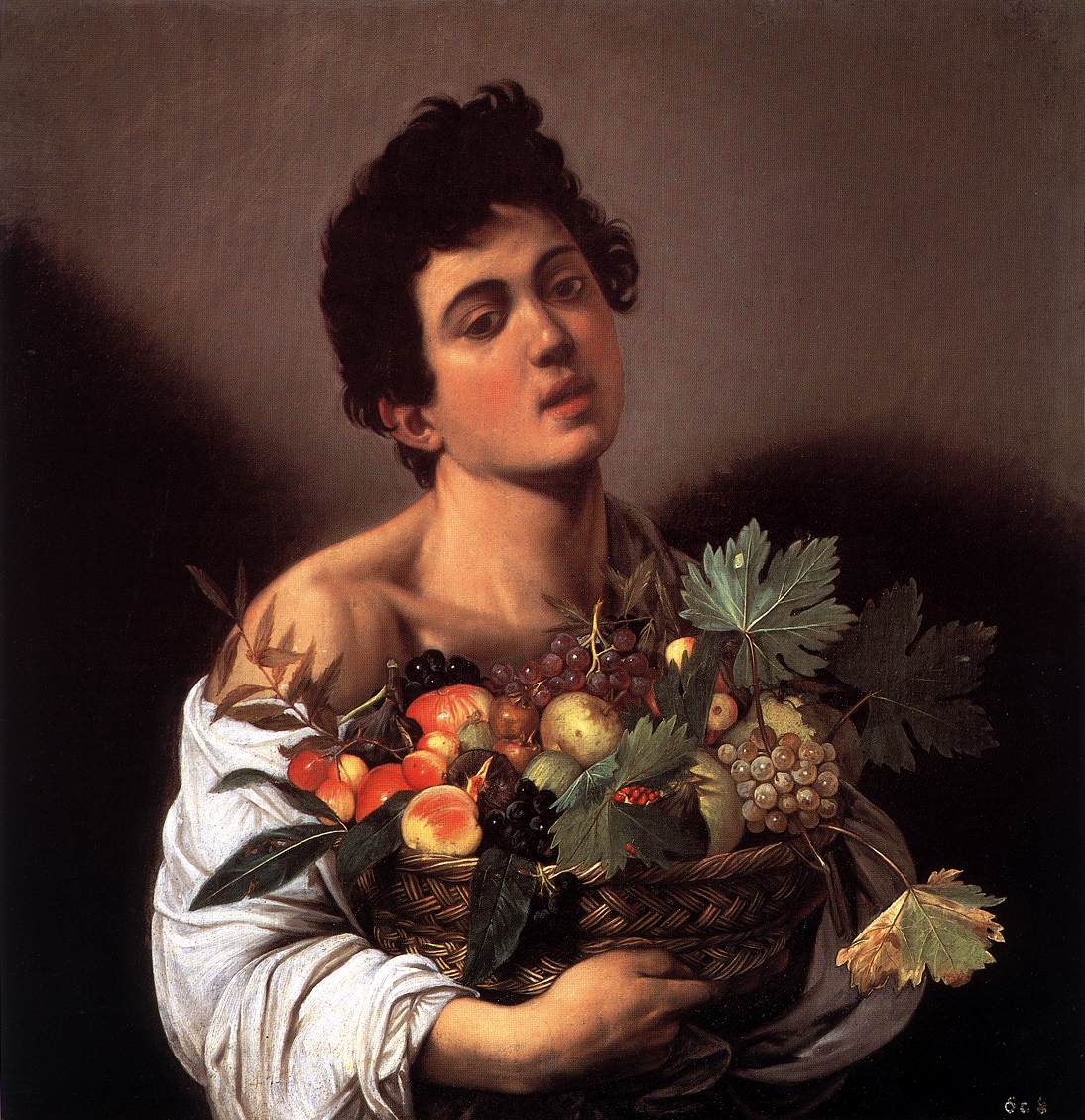
Caravaggio (Michelangelo Merisi), Boy With a Basket of Fruit (“Il Fruttaiuolo”), c. 1593/94, oil on canvas, 27 ½ x 26 3/8” 70 x 67 cm, Galleria Borghese, Rome. https://borghese.gallery/collection/paintings/boy-with-a-basket-of-fruit.html – retrieved October 10, 2024.

Caravaggio’s Il Fruttaiuolo (“Boy with a Basket of Fruit”) presents a remarkable contrast of the detailed, colorful, and sensuous depiction of fruits of the season and the refined and delicate innocence of an adolescent boy holding its basket. The placid scene of typical everyday life is enhanced by an expressive and careful execution. The model was Caravaggio’s friend, Sicilian painter Mario Minniti, at about 16 years old. According to Giovanni Pietro Bellori (1613-1696) who included Caravaggio in his Lives of the Artists, the artist learned “to paint flowers and fruit so well imitated that everybody came to learn from him how to create the beauty that is so popular today.”
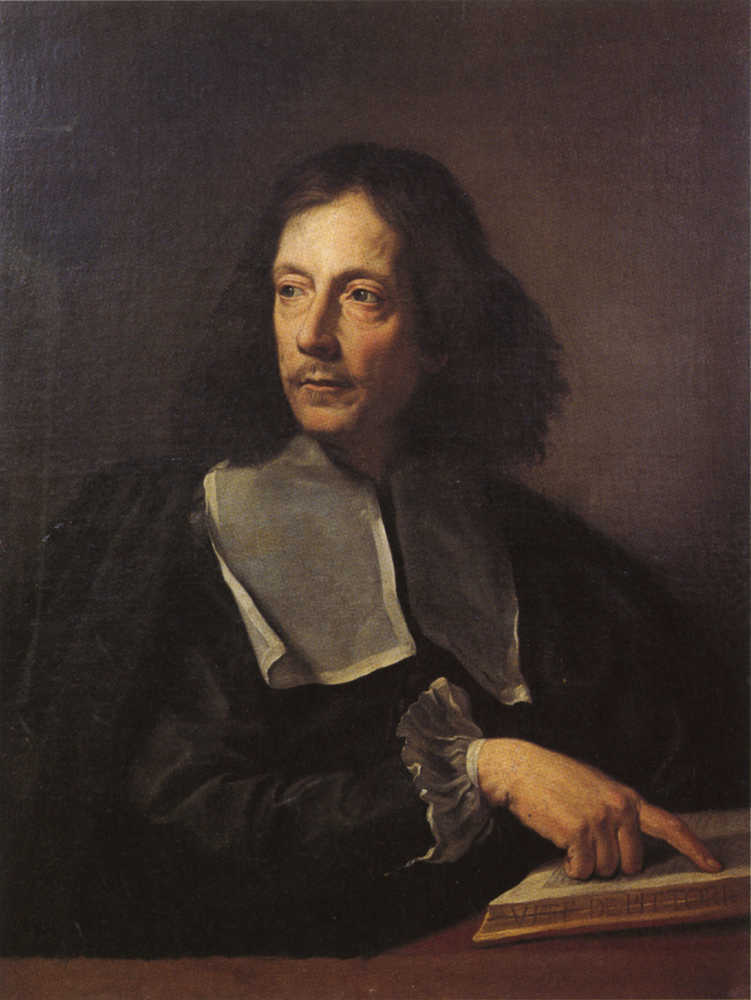
Carlo Maratta (1625-1713), Portrait of Gian Pietro Bellori who was Caravaggio’s most important biographer. Other early biographies of Caravaggio’s life were written by his doctor, Giulio Mancini (1559-1630) and by Giovanni Baglione (1566-1643), a rival artist.

Caravaggio (Michelangelo Merisi), The Young Sick Bacchus (Bacchino Malato), c. 1593/94, oil on canvas, 67 x 53 cm, Galleria Borghese, Rome. https://borghese.gallery/collection/paintings/young-sick-bacchus.html – Retrieved October 10, 2024.
https://www.collezionegalleriaborghese.it/en/opere/self-portrait-as-bacchus-known-as-sick-bacchus – retrieved October 10, 2024.

Caravaggio’s Il Bacchino Malato (“The Young Sick Bacchus”), also known as Bacchino malato (“The Sick Bacchus”) or Autoritratto in veste di Bacco (“The Self-Portrait as Bacchus”), is an early self-portrait by Michelangelo Merisi da Caravaggio, dated between 1593 and 1594. The artwork dates from Caravaggio’s first years in Rome when he moved to the Eternal City from his native Milan in 1592. The painting was in the collection of Giuseppe Cesari (1568-1640), Caravaggio’s early employer. In 1607 it was confiscated from Cesari by the Pope in exchange for the Italian mannerist’s freedom following an illegal firearms charge. The pope gifted it to his nephew, Cardinal Scipione Borghese (1577-1633), together with the Boy Peeling Fruit and Boy with a Basket of Fruit (“Il Fruttaiuolo“).

The painting is a realist portrait of a young man displaying the typical attributes of Bacchus, the god of drunkenness. The sitter is turned to the viewer in a three-quarter pose, holding in his hands a bunch green grapes held next to his ailing greenish complexion. The sitter has been identified as the artist since it is documented that he was in the Ospedale della Consolazione in Rome around this time for undefined reasons. This interpretation provides the origin for the artwork’s title.
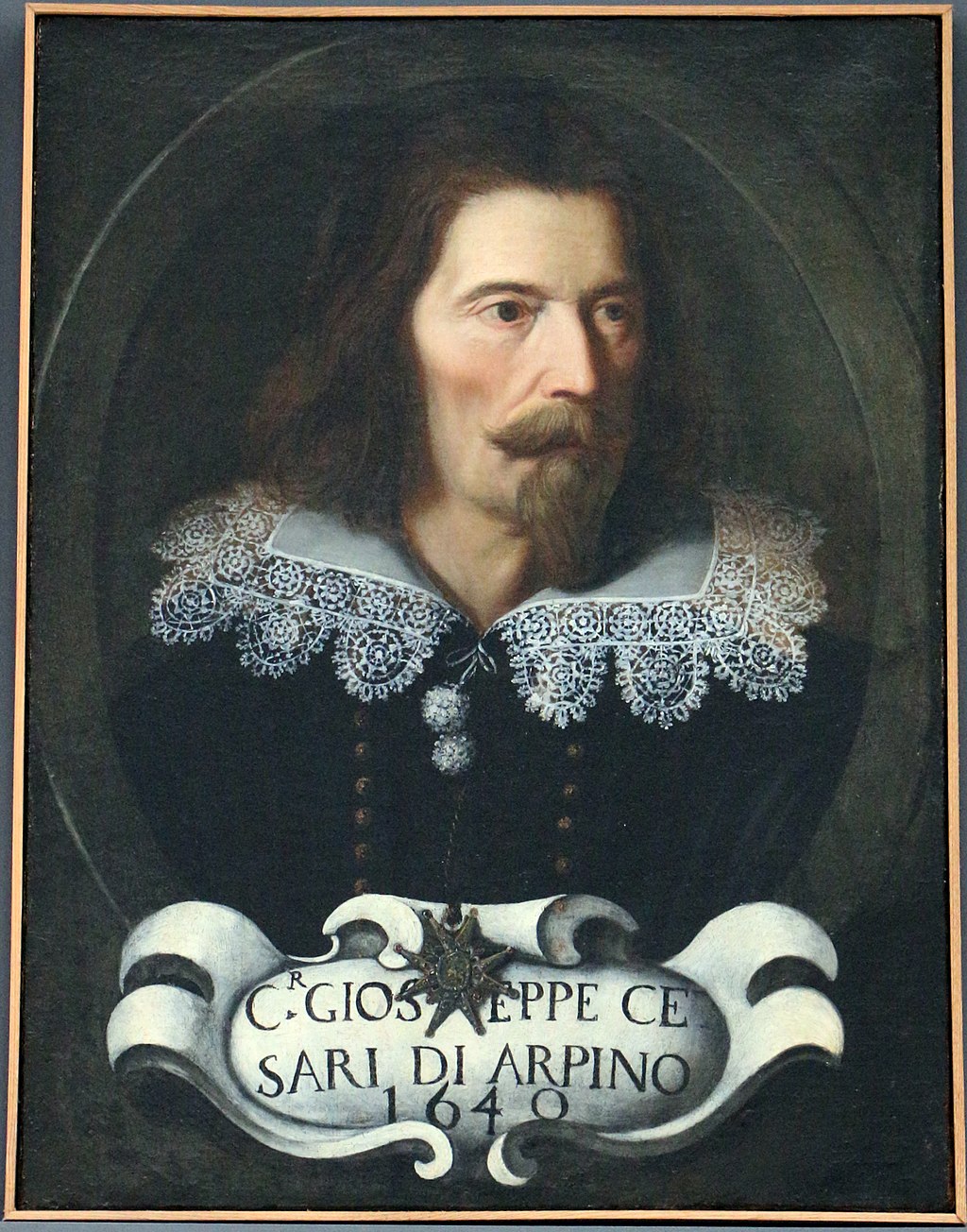
Giuseppe Cesari, Self-portrait, 1640, Accademia di San Luca. Cesari was Caravaggio’s first employer and in possession of The Young Sick Bacchus that was confiscated by the pope.

Ottavio Leoni, Portrait of Cardinal Scipione Borghese. The sitter was not only the pope’s nephew and a Cardinal in the Catholic Church but the recipient of early Caravaggio paintings by gift. Such a gift was not at random: the cardinal’s growing art collection, including Caravaggio and Bernini, formed the basis of the Villa Borghese in Rome.
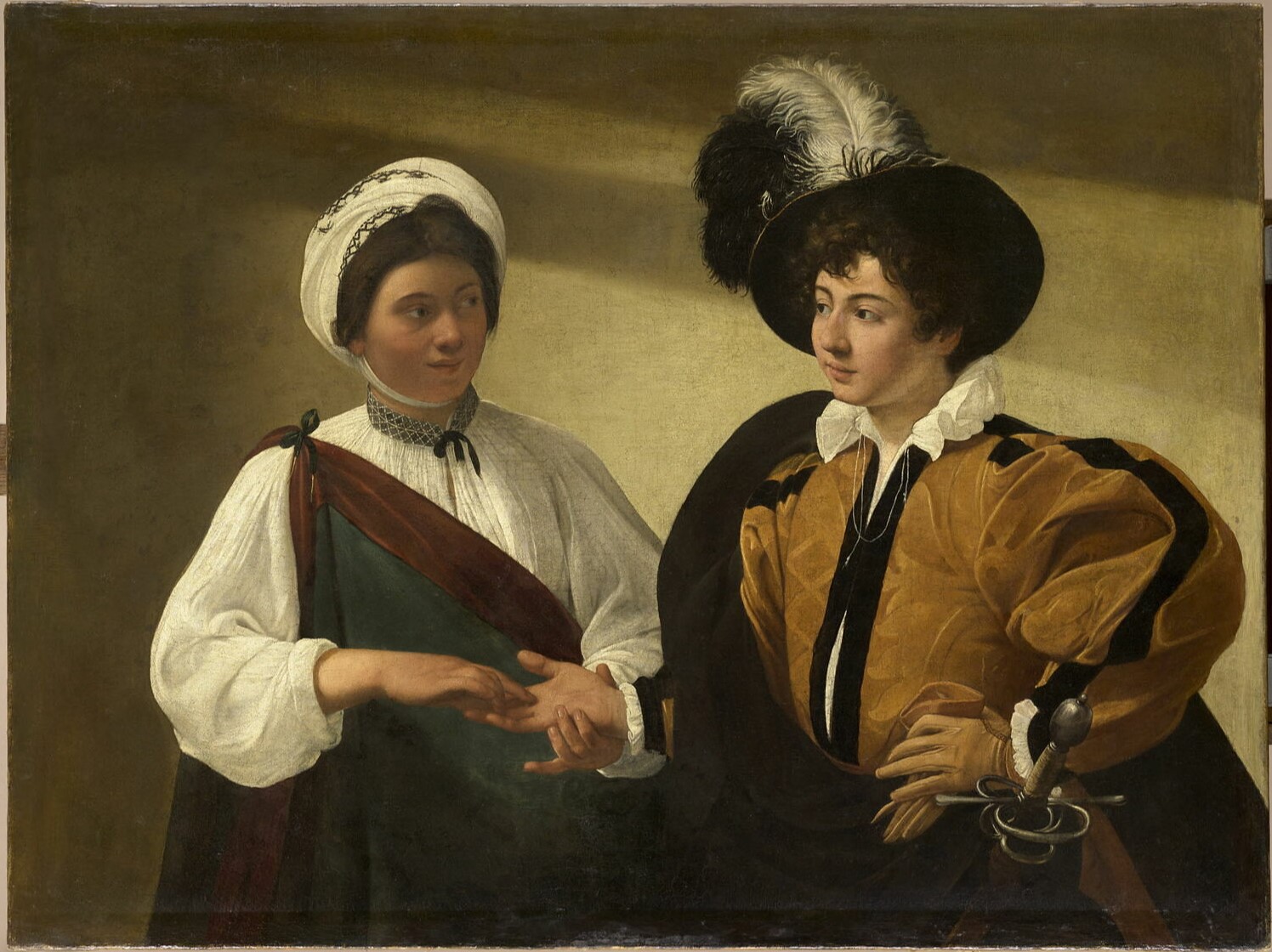
Caravaggio (Michelangelo Merisi), The Fortune-Teller (“La Buona Ventura”), c. 1594, oil on canvas, 39 x 52 3/8”, Louvre, Paris. https://collections.louvre.fr/en/ark:/53355/cl010062329 – retrieved October 10, 2024
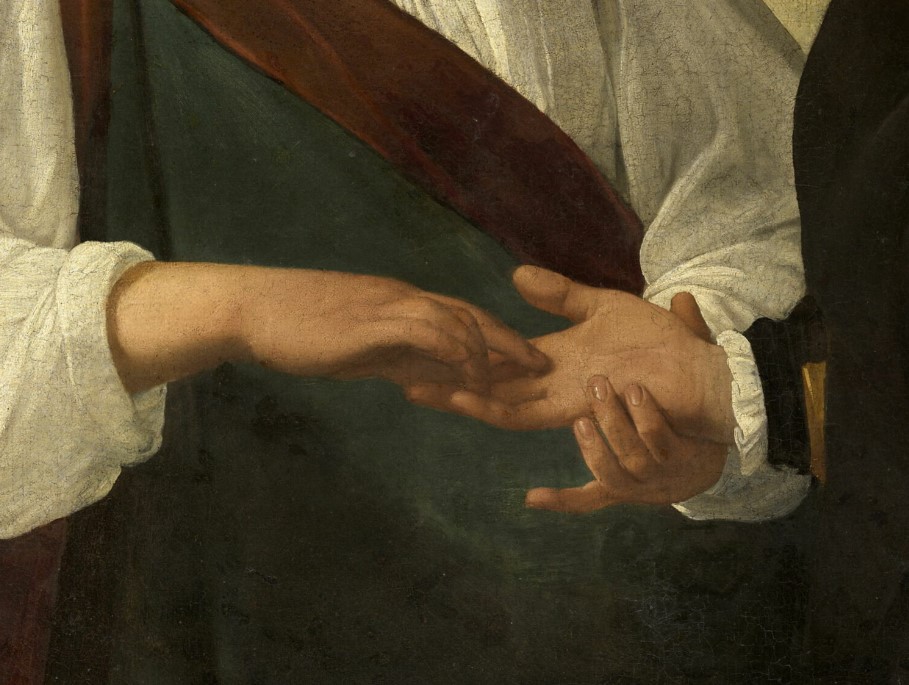
Detail of above.

According to Giulio Mancini, Caravaggio painted The Fortune-Teller for a proverbial song while staying with Archbishop Fantino Petrignani (1577-1601). By 1620 when Mancini was writing, the painting was owned by Roman art collector and Catholic prelate Alessandro Vittrici (d. 1650). Later (1657) it was in the collection of Catholic Cardinal Camillo Francesco Maria Pamphili (1622-1666) who sent it with Bernini (1598-1680) to Paris as a gift to Louis XIV.
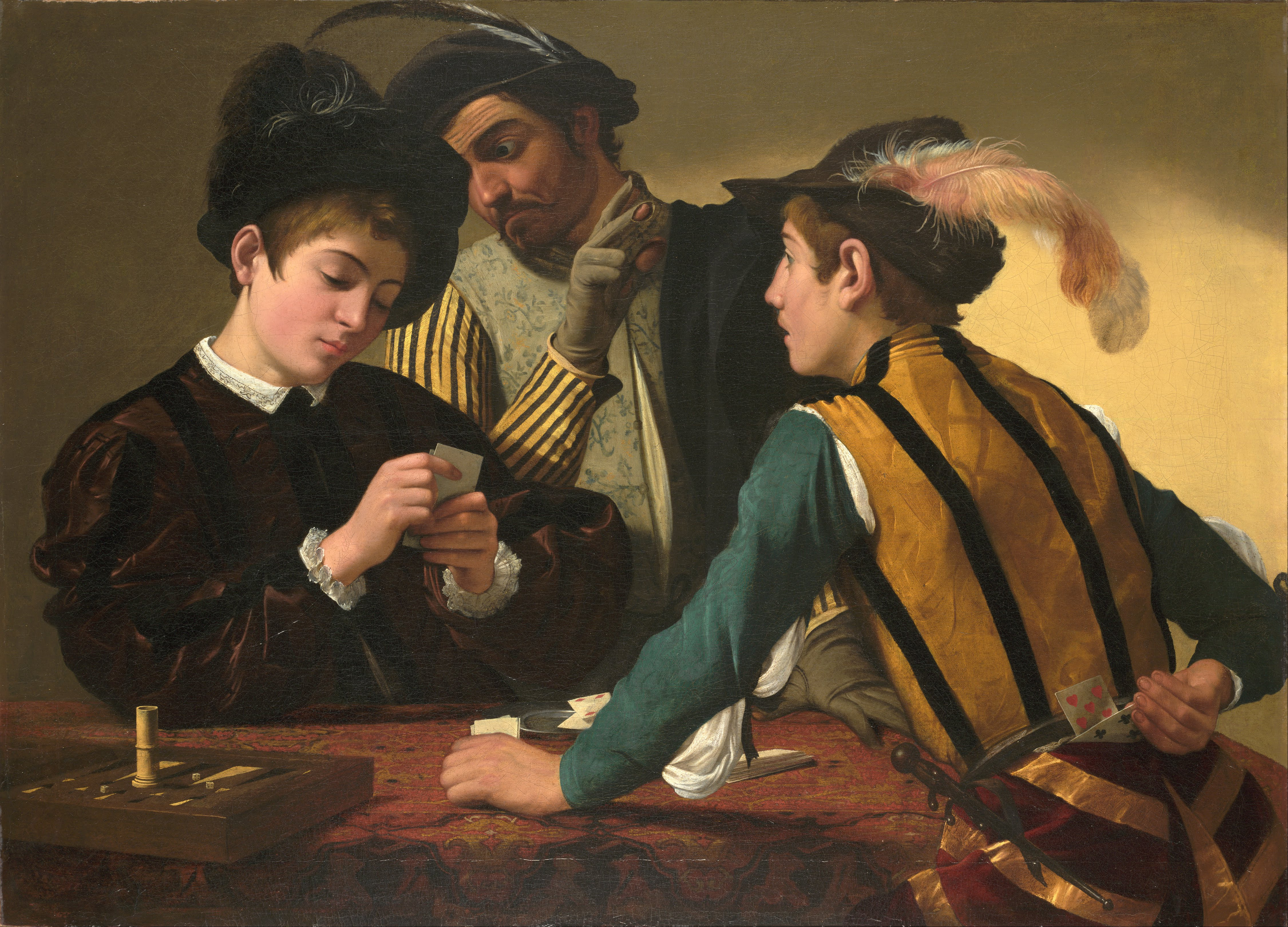
Caravaggio (Michelangelo Merisi), cardsharps,1594/95, oil on canvas, 37 1/16 x 51 9/16 in. (94.2 x 130.9 cm), Fort Worth, Kimbell Art Museum, Fort Worth, Texas. https://kimbellart.org/collection/ap-198706 – retrieved October 18, 2024.

Playing the game of primero the player at left is oblivious to a bearded cardsharp who uses his gloved fingers to signal to the other player the content of the cards. The other cheater is reaching for a hidden card from his pants behind his back. Caravaggio’s composition is novel with a naturalistic treatment of the figures whose distinct expressions and gestures convey a realistic and hard drama of being cheated and cheating. This painting was owned and stamped by Cardinal del Monte and in his inventory of 1627 following his death. It had been lost for almost a century when it was discovered in a European private collection and purchased by the Kimbell in 1987.
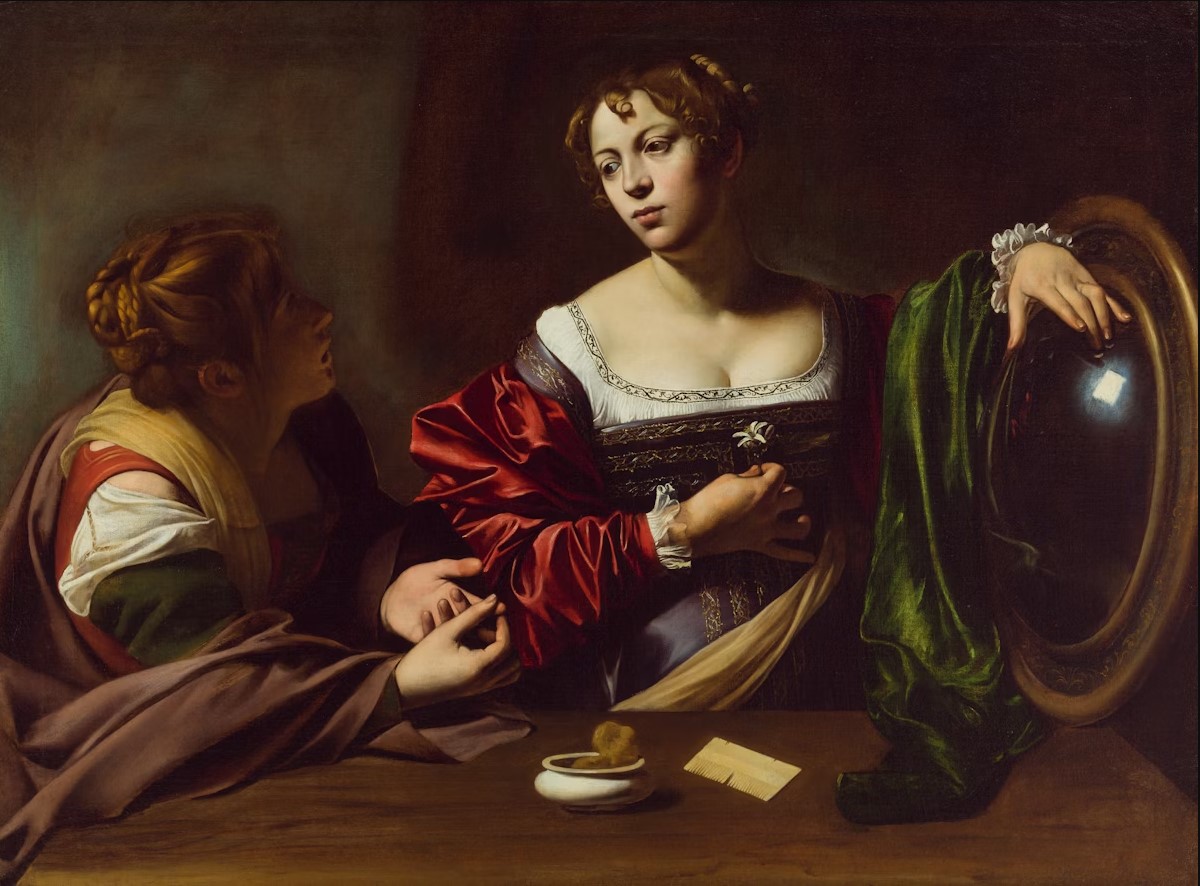
Caravaggio (Michelangelo Merisi), Martha and Mary Magdalene, c. 1598 Detroit Institute of Arts. 

“Caravaggio helped to popularize half-length religious paintings like this, made for private collectors rather than for public church settings. His greatest innovation was in depicting biblical characters as if they belonged to contemporary Roman society, basing them on studio models and dressing them in 17th-century attire, as he does here.” https://www.artic.edu/articles/1071/caravaggio-s-dramatic-life-and-paintings – retrieved October 15, 2024.
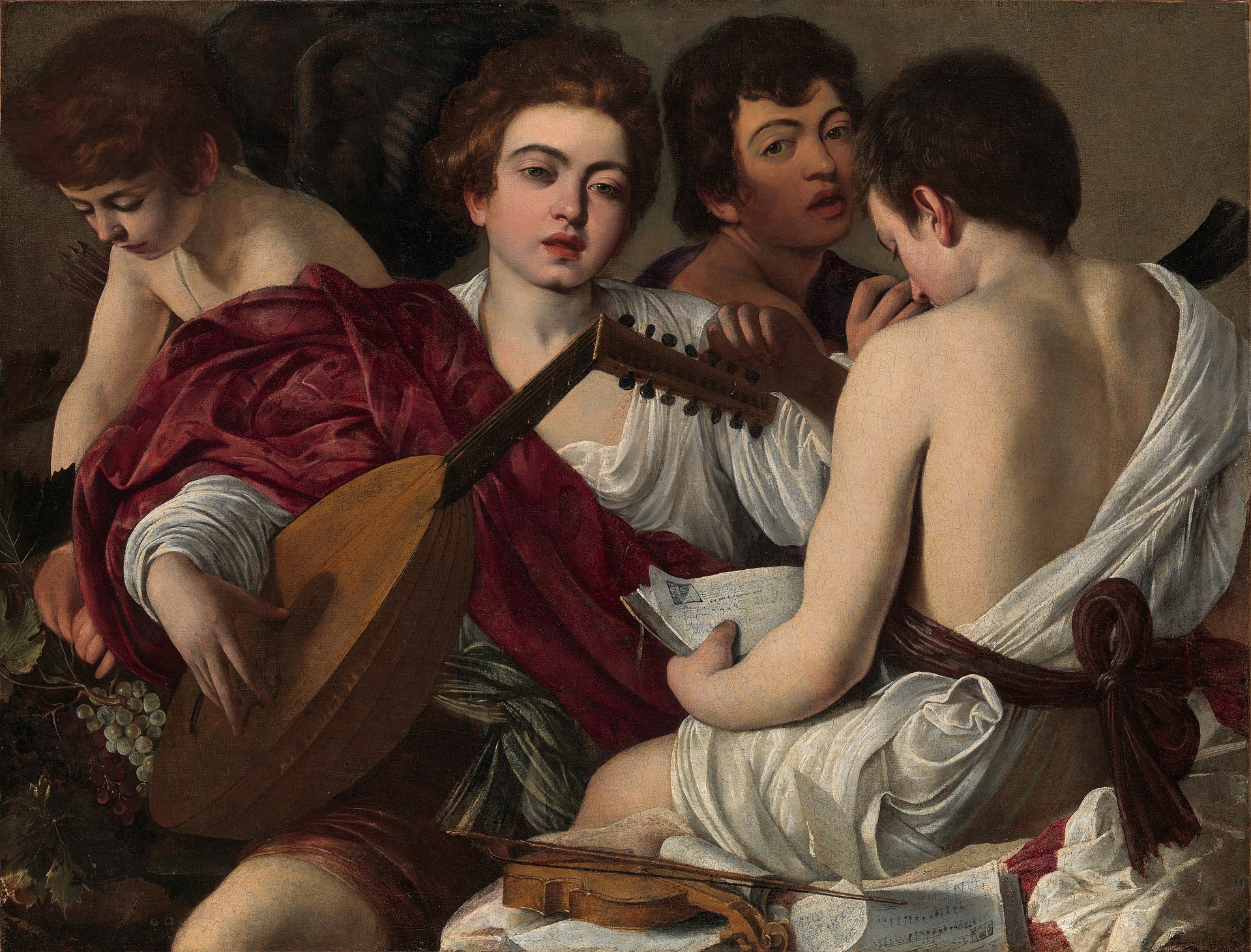
Caravaggio (Michelangelo Merisi), The Musicians, 1595/96, oil on canvas, 36 ¼ x 46 5/8” (92.1 x 118.4 cm), The Metropolitan Museum of Art, New York. https://www.metmuseum.org/art/collection/search/435844 – retrieved October 10, 2024.

The Musicians, painted by Caravaggio and now in The Metropolitan Museum of Art, was commissioned by Cardinal Francesco Maria del Monte (1549–1627), one of Rome’s most influential patrons of the arts. Conceived as an allegory of music—signaled by the presence of Cupid in the background—it is equally a portrait of contemporary musical practice, featuring individualized sitters. Among them is Caravaggio himself, second from the right, offering one of his rare youthful self-portraits.

During the Counter‑Reformation, the Catholic Church actively promoted a revival of music, and Cardinal del Monte was at the center of this cultural movement. At his residence, the Palazzo Madama, he hosted composers, rehearsals, and experiments in progressive musical forms, especially the emerging solo vocal style that departed from older polyphonic traditions. The Musicians was designed specifically for the Cardinal’s music room, its subject and atmosphere echoing the live performances that took place there.

In keeping with Caravaggio’s modernizing approach, the figures are not idealized classical types but real young men posed in quasi‑antique white robes. The self‑portrait—directly engaging the viewer—shows the artist holding a cornetto, a popular wind instrument of the period. Caravaggio also employs a spatial device familiar in later eighteenth‑century art: the prominently placed violin and open music manuscript in the immediate foreground. These objects project into the viewer’s space, drawing the spectator into the scene as an implied participant.

Ottavio Leoni, Francesco Maria del Monte, 1616.

Born in Venice of a Tuscan aristocratic family, Cardinal del Monte was an important connoisseur of the arts.  Four centuries later his fame rests on his early patronage of Caravaggio and an art collection which provides detailed provenance for many important works of the period. Del Monte was the single most influential force in Caravaggio’s life. Between 1595 and 1601, the Catholic cardinal became not only the painter’s primary patron but his intellectual mentor, legal shield, and diplomatic strategist—an alliance that lifted the volatile outsider into the ranks of Rome’s most sought‑after, and most controversial, artistic prodigies. Their bond was complicated by each’s share of eccentricities, intense legal vulnerabilities, and the uneasy overlap between church politics and the city’s street‑level underworld.

As mentioned, the relationship began when Del Monte purchased The Cardsharps from a local dealer and immediately recognized the raw, disruptive talent behind it. He brought Caravaggio into his official residence, the Palazzo Madama, granting him a stipend, room and board, and a dedicated studio. Within those walls, Caravaggio entered a rarefied world. Del Monte—an intimate friend and protector of Galileo —surrounded himself with mathematicians, natural philosophers, and experimenters in optics. Immersed in this court of scientific inquiry, Caravaggio refined the radical, directional lighting that would become his signature, transforming observation into revelation.

Del Monte also understood that private cabinet pictures could only carry an artist so far. Leveraging his position as a Vatican insider, he secured Caravaggio’s first major public commission: the Contarelli Chapel cycle in San Luigi dei Francesi. It was a turning point—Caravaggio’s explosive debut on the public stage and the moment his reputation as a revolutionary painter crystallized.

But the Cardinal’s protection had limits. Caravaggio’s temperament grew increasingly erratic, his nights spent among gamblers, swordsmen, and fugitives. By 1606, after the fatal brawl with Ranuccio Tomassoni, even Del Monte could no longer shield him. Caravaggio fled Rome under threat of execution, bringing to an abrupt end one of the most fertile and consequential artistic partnerships of the Baroque age.

Caravaggio (Michelangelo Merisi), The Lute Player, 1595/96, oil on canvas, 37 x 46 7/8” The Hermitage Leningrad.

The Lute Player was owned by Cardinal del Monte. It was sold to Vincenzo Giustiniani (1564-1637), an aristocrat Italian banker, art collector and intellectual, and appeared in his inventory in 1638. Caravaggio’s model for the painting is the same as for The Musicians.

Nicolas Régnier/Niccolò Renieri (1591-1667), Portrait of Vincenzo Giustiniani, c. 1630.

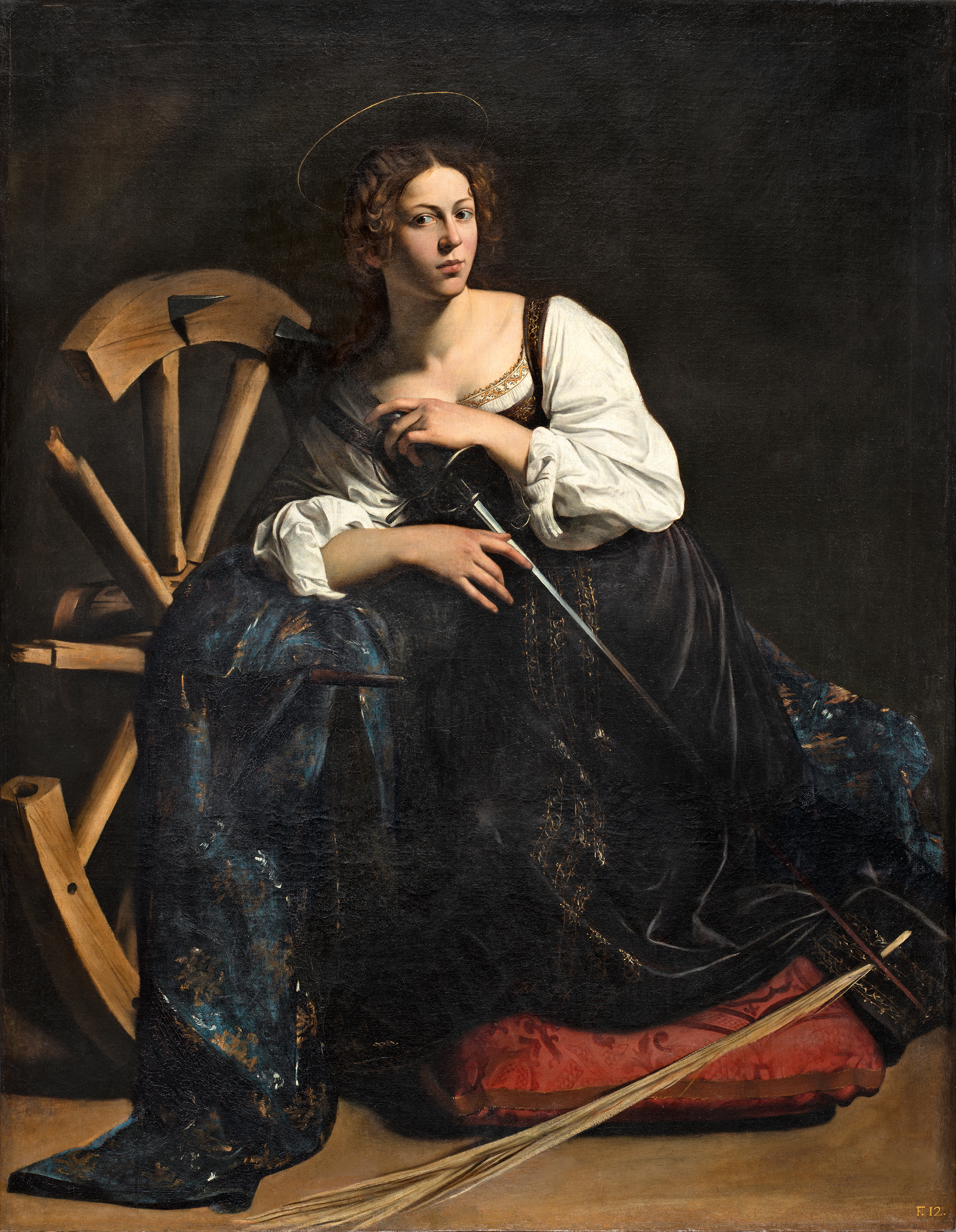
CARAVAGGIO (Michelangelo Merisi), Santa Catalina de Alejandría (St. Catherine of Alexandria), c. 1598-1599, oil on canvas, oil on canvas, 173 x 133 cm, Museo Nacional Thyssen-Bornemisza, Madrid. https://www.museothyssen.org/en/collection/artists/caravaggio-michelangelo-merisi/saint-catherine-alexandria – retrieved October 15, 2024.

Commissioned by Cardinal Francesco Maria del Monte, Caravaggio’s St. Catherine of Alexandria presents the saint in the unmistakable likeness of Fillide Melandroni, a well‑known Roman courtesan who played a decisive role in the painter’s artistic and personal life. Young artists routinely turned to women like Fillide for models—respectable women were simply unavailable for such work—and Caravaggio, more than most, transformed these marginalized figures into icons of startling dignity and psychological depth.

Richly robed and kneeling on a cushion, Catherine occupies the canvas with commanding stillness. She rests one hand on the spiked breaking wheel and gently cradles the sword—emblems of her martyrdom—while the dramatic fall of light isolates her against the darkness in Caravaggio’s signature chiaroscuro. The effect is intimate yet monumental: a saint rendered not as an ethereal ideal but as a living woman whose presence feels immediate, almost breathing qualities which would have an immense impact on European art in the 17th century.

Caravaggio heightens this immediacy with a device that would also echo through seventeenth‑century European painting: the saint’s body and attributes press toward the viewer’s space, collapsing the distance between sacred history and the spectator. It is precisely this fusion of realism, theatrical light, and emotional proximity that made works like St. Catherine so influential across the Baroque world.
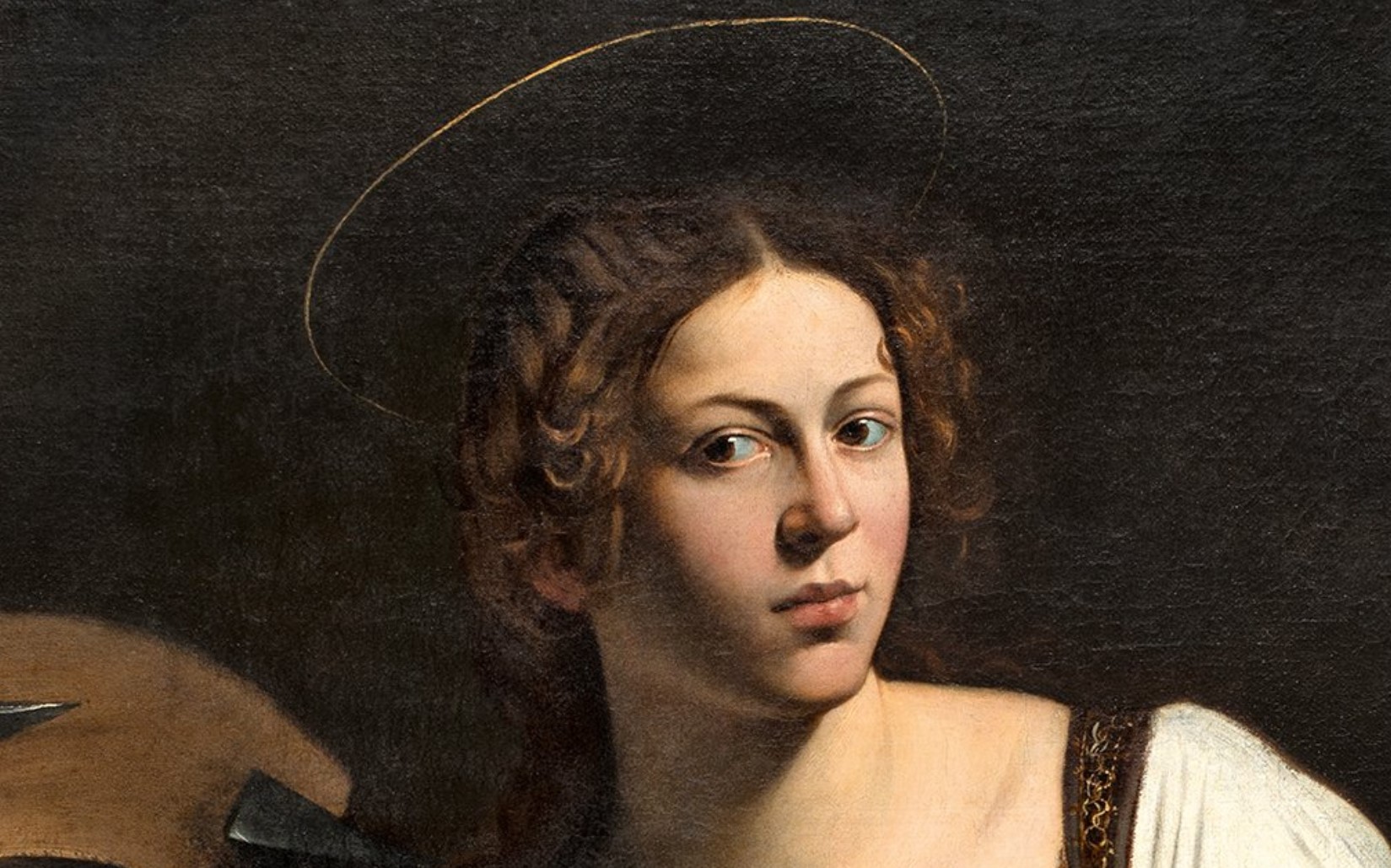
Detail of above: the face of St. Catherine of Alexandria (Fillide Melandroni).

Caravaggio (Michelangelo Merisi), Saint Francis of Assisi in Ecstasy, c. 1595-96, Oil on canvas, 36 3/8 x 50 5/8” 94 x 129.5 cm Wadsworth Atheneum, Hartford, CT. https://5058.sydneyplus.com/argus/final/Portal/Public.aspx?lang=en-US&p_AAEE=tab4&p_AABB=tab8 – retrieved October 11, 2024.

Caravaggio’s Saint Francis of Assisi in Ecstasy stands as his earliest known religious composition, and already the hallmarks of his mature style—intimacy, theatrical light, and emotional immediacy—are unmistakable. The subject, Saint Francis of Assisi (1182–1226), the Umbrian mystic famed for his radical poverty and fierce asceticism, often withdrew into solitude for forty‑day fasts, seeking to imitate Christ as literally as Scripture allowed. Medieval tradition holds that, like Christ in the wilderness, Francis was ministered by angels during these periods of spiritual extremity.

Caravaggio seizes on one such moment. In September 1224, on Mount La Verna in central Italy, Francis received the stigmata, the wounds of the crucified Christ—an experience granted to only a handful of saints. Caravaggio renders the episode with striking restraint: the saint collapses into the arms of an angel, his body slack with awe, while shepherds linger in the obscured background, half‑witnesses to a mystery they cannot fully comprehend. A faint trace of the wound appears beneath the rough folds of Francis’s tunic, a subtle but potent sign of the miracle.

The entire scene is carved out of darkness by Caravaggio’s directional light, a technique shaped by the scientific culture surrounding his patrons. Here, the light does not merely illuminate; it consecrates. It isolates Francis and the angel in a suspended moment of revelation, while the world around them recedes into shadow.

Caravaggio painted the work in Rome for Ottavio Costa (1554–1639), a Genoese banker and discerning collector who became one of his most loyal supporters. Centuries later, in 1943, Saint Francis of Assisi in Ecstasy became the first Caravaggio to enter a public collection in the United States, marking a milestone in the American reception of the Baroque master.

Caravaggio (Michelangelo Merisi), Rest on the Flight to Egypt, c, 1595/98, oil on canvas, 51 ¼ x 63” Galleria Doria- Pamphili, Rome.

La fête champêtre is a musical picnic whose tradition originated in Italy. Caravaggio’s composition is lyrical and complicated. As it is in the setting of the Holy Family’s flight to Egypt in Matthew’s Gospel, the characters are dressed humbly accompanied by the presence of an angel.

Caravaggio (Michelangelo Merisi), Boy Bitten By A Lizard, 1596/97, oil on cavas, 27 ½ 2 22 3/8”, The National Gallery, London.
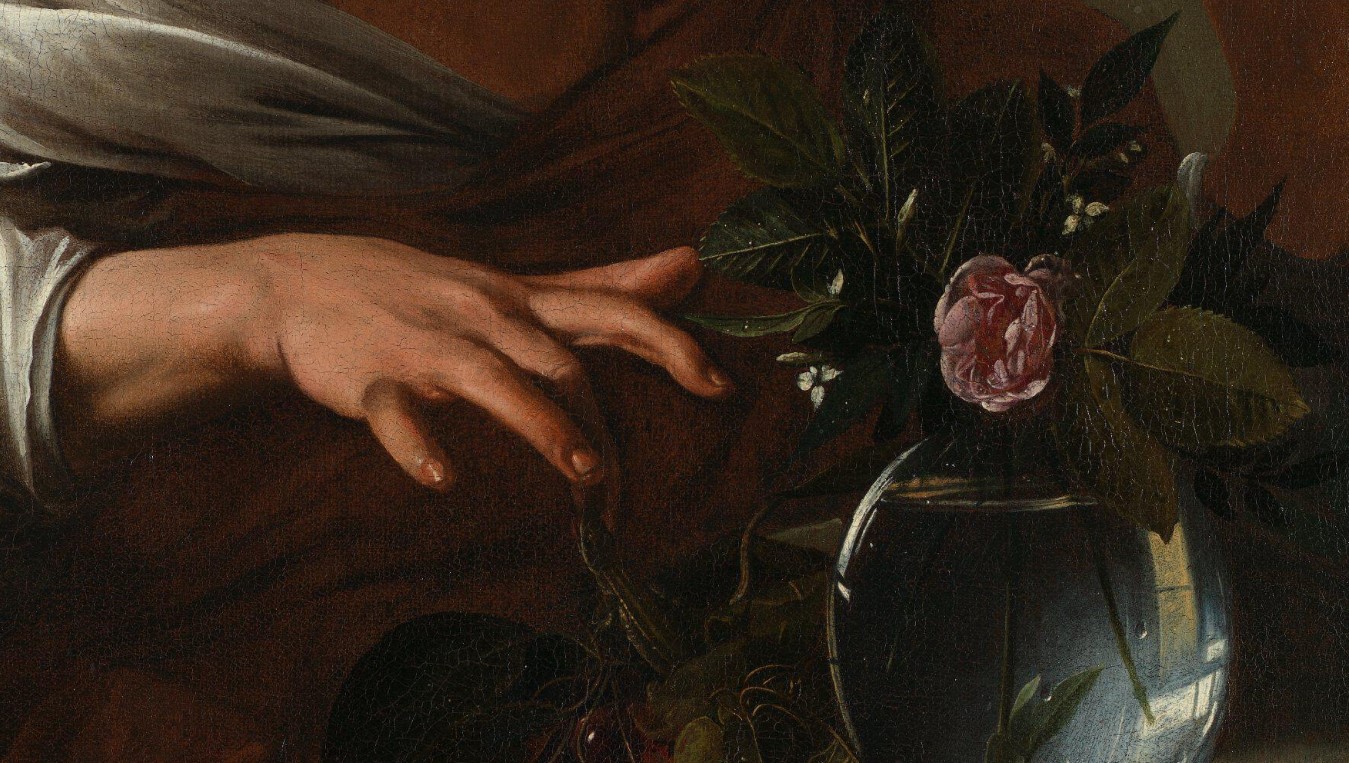
Detail of above.

Mancini relates that Caravaggio painted the subject when staying with an old Catholic prelate named Pandolfo Pucci. By the end of his residence Caravaggio nicknamed his temporary benefactor Monsignor Insalata, or “Mister Salad,” for the pittance of solid food he served his artist boarder. The mock heroic painting may be allegorical with the lizard conveying its traditional meaning of lust or death joined to cherries symbolic of love and roses that of sexually transmitted disease — and warning of all three. see – https://www.britannica.com/biography/Caravaggio/First-apprenticeships-in-Rome-Pucci-Cesari-and-Petrigiani – retrieved October 15, 2024.

Caravaggio (Michelangelo Merisi), Bacchus, c. 1597, oil on canvas, 37 3/8 x 33 ½”, Uffizi, Florence.
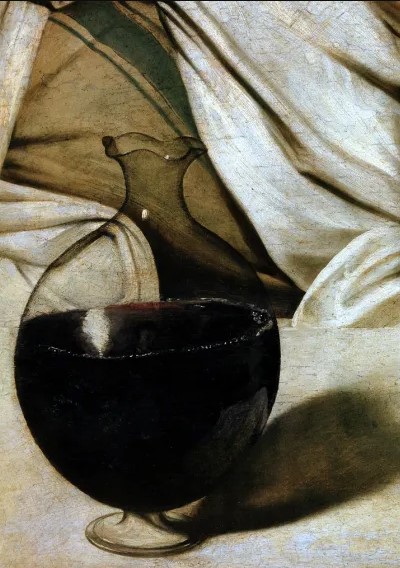
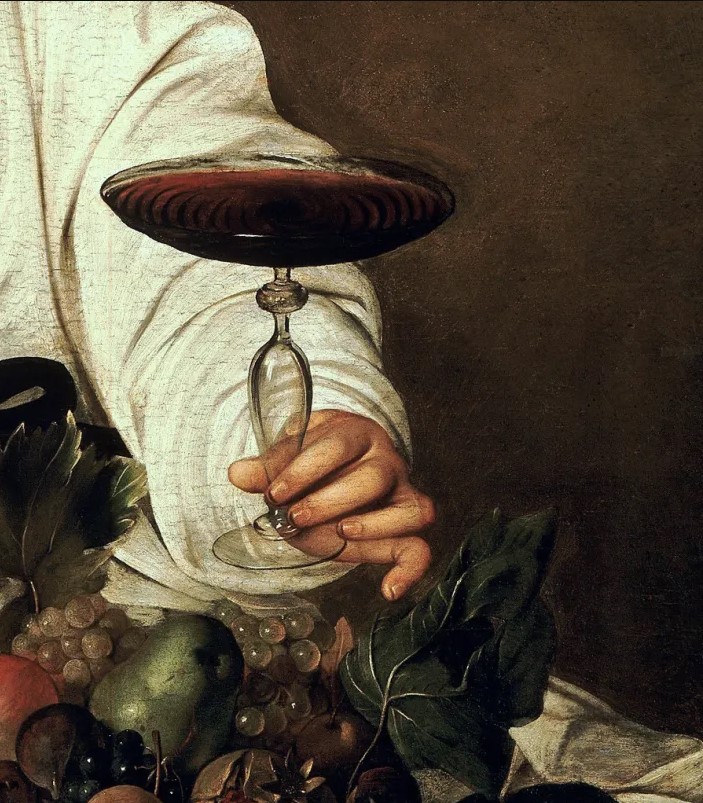
Detail of above.
Cardinal del Monte commissioned it from Caravaggio for a Medici.
Detail of above.

Commissioned by his principal patron, Cardinal Francesco Maria del Monte, Caravaggio’s Bacchus was presented as a diplomatic gift to Grand Duke Ferdinando I de’ Medici to mark his son’s wedding—a gesture that secured the painting’s place in the Medici collections for centuries. Today it stands as a cornerstone of early Baroque art, celebrated for its audacious rejection of idealized Renaissance classicism in favor of a startlingly earthbound realism.

Instead of a radiant, godlike deity, Caravaggio gives us a working‑class Roman youth—almost certainly his friend and frequent model Mario Minniti—costumed as the god of wine. Any pretense of antiquity is deliberately dismantled. Bacchus reclines not on a marble couch but on a striped mattress folded to imitate a Roman triclinium. His white “toga” is nothing more than a contemporary bedsheet, loosely draped over his body. The effect is both intimate and unsettling: a classical god rendered as a boy you might meet in the streets of Rome, invited into myth by costume alone.

The lower half of the canvas deepens the painting’s moral tension. Caravaggio arranges a sumptuous still life—apples, grapes, figs, a carafe of wine—but it is also a vanitas. The apples are bruised and worm‑eaten, the grapes overripe, the leaves already curling toward decay. This quiet rot serves as a memento mori, a reminder that youth, beauty, and sensual pleasure are as fleeting as the fruit that embodies them. Caravaggio’s realism becomes a form of philosophy.

Despite its current fame, Bacchus nearly vanished from history. After the fall of the Medici dynasty, the painting was relegated to a dark storage room in the Uffizi reserves—unframed, uncatalogued, and obscured beneath yellowed varnish. It remained forgotten until 1913, when art historians rediscovered and authenticated it as an irreplaceable treasure of the Baroque.

Caravaggio (Michelangelo Merisi), Jupiter, Neptune, and Pluto, 1597, oil on stucco, about 9/9”” x 5’11” Villa Ludovisi, Rome. https://villaludovisi.org/ – retrieved October 12, 2024.

The building and grounds of Villa Ludovisi in Rome, and their rich artwork, includes masterpiece frescoes by Guercino (1591-1666) and other leading lights of the 17th century Bolognese school. Caravaggio’s Jupiter, Neptune and Pluto is his only known oil painting on plaster. Cardinal de Monte purchased the villa and took up residence there in 1596. The cardinal sold it to the Ludovisi in 1621. Bellori relates that the subject matter for the fresco of these gods was to express the cardinal’s interest in medicinal chemistry (today’s pharmaceuticals).

Caravaggio (Michelangelo Merisi), Judith Beheading Holofernes, c. 1598, oil on canvas, 56 ¾ x 76 ¾” 145 x 195cm Galleria Nazionale d’Arte Antica, Rome.  https://barberinicorsini.org/opera/giuditta-e-oloferne/ – retrieved October 12, 2024.

Commissioned by Ottavio Costa, one of Caravaggio’s most loyal Roman patrons, the painting passed through several prominent Roman families before entering the Galleria Nazionale d’Arte Antica in 1970. Its subject is the famous episode from the Book of Judith, a Biblical tale of courage, seduction, and divine deliverance that had long captured the Christian imagination.

Judith—beautiful, eloquent, and revered in her community—is a widow living in the besieged city of Bethulia, threatened with destruction by the Assyrian general Holofernes. Because he is captivated by her beauty, Judith is granted unusual freedom within the enemy camp. She joins Holofernes at a banquet in his tent, where he drinks himself into oblivion. As the text puts it, “Holofernes, charmed by her, drank a great quantity of wine, more than he had ever drunk on any day since he was born” (Judith 12:20).

Once the attendants withdraw, Judith seizes her moment. The biblical account describes the scene with stark intensity: she stands beside the general’s bed and prays silently for strength, saying: “O Lord, God of all might, in this hour look graciously on the work of my hands for the exaltation of Jerusalem. Now is the time for aiding your heritage and for carrying out my design to shatter the enemies who have risen against us” (Judith 13:4–5). Taking Holofernes’ own sword from the bedpost, she grasps his hair, invokes the God of Israel, and strikes twice, severing his head. She then rolls his body aside and hands the severed head to her maid, who conceals it in a food bag before the two women slip back into the night (Judith 13:4–10).

Caravaggio chooses the exact instant when violence erupts—his first painting to depict action with such visceral, kinetic force. The scene unfolds like a frieze suspended in time: Judith leaning forward with grim resolve, her maid assisting with practiced efficiency, and Holofernes recoiling in shock as the blade bites into his neck. The theatrical light isolates the figures against darkness, heightening the sense of immediacy and moral gravity.

This painting marks a turning point in Caravaggio’s career. With Judith Beheading Holofernes, he demonstrates not only his mastery of chiaroscuro but also his ability to transform a biblical narrative into a moment of raw human drama—one that reverberated across the Baroque world.
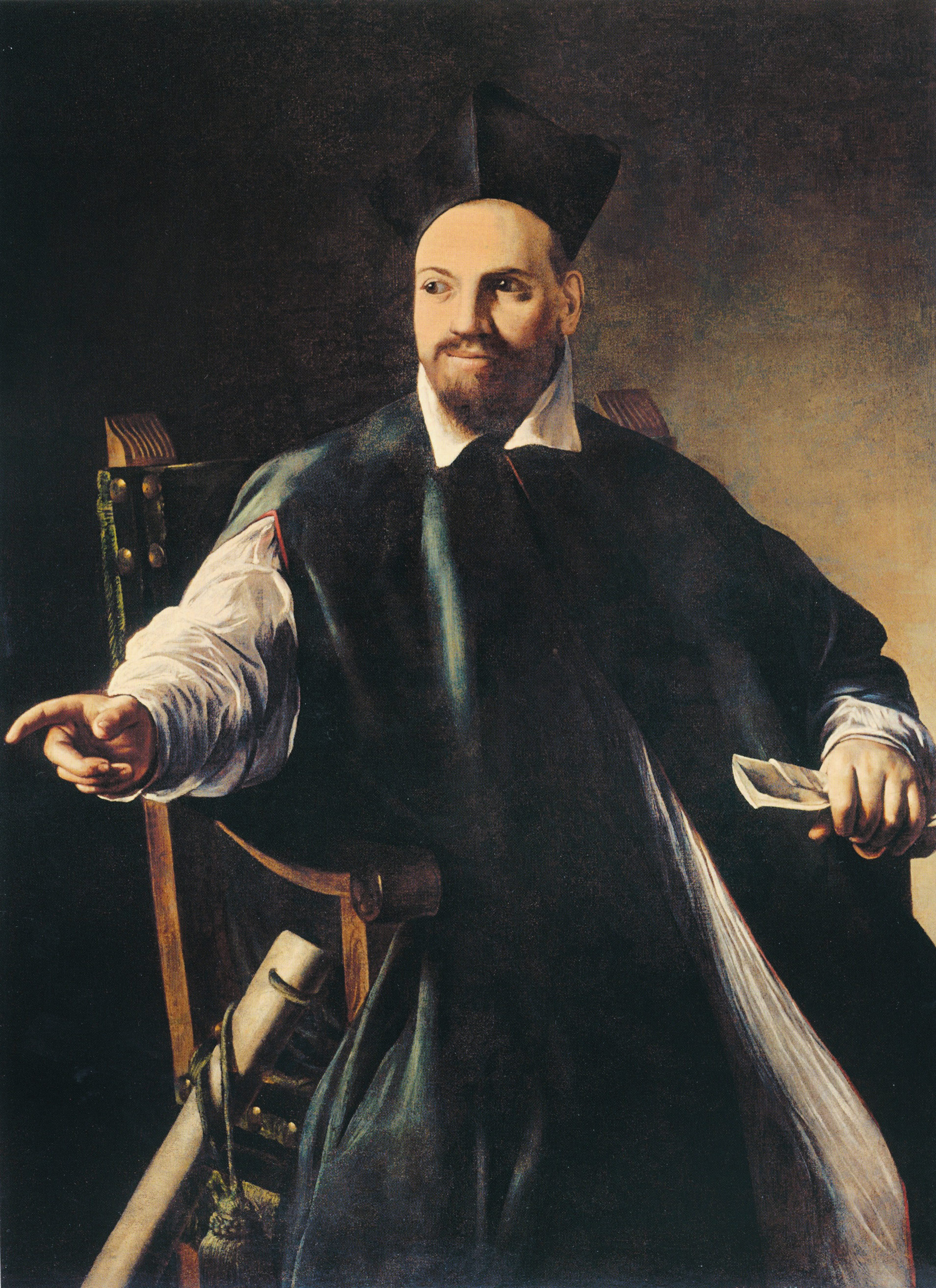
Caravaggio (Michelangelo Merisi), Portrait of Monsignor Maffeo Barberini, c. 1603, Private Collection, Firenze. Maffeo Vincenzo Barberini (1568-1644) became the future Pope Urban VIII whose reign began in 1623.

Caravaggio’s First Public Commission | Beyond Caravaggio | National Gallery

The words of Christ, who is there, have been spoken. But now time is suspended. How will Matthew reply? Christ is calling him. Do I go or not? Do I follow him or not? These paintings are completely dramatic. Caravaggio uses natural light but turns it into an astonishing symbol of divine illumination.
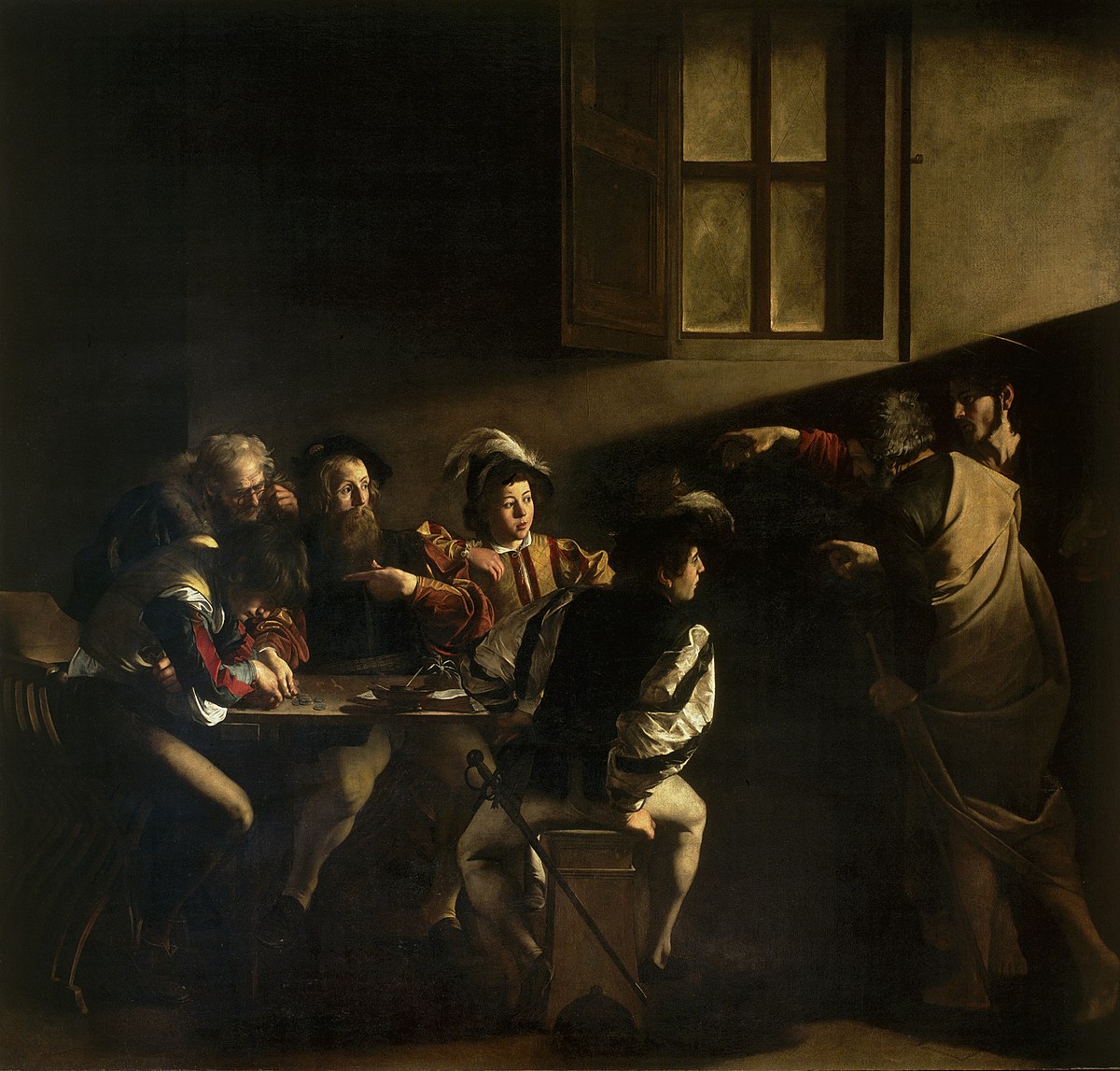
Caravaggio (Michelangelo Merisi), The Calling of Saint Matthew, 1599-1600, oil on canvas, 10’7 1/2 “ x 11’ 2” Contarelli Chapel, Church of Luigi dei Francesi, Rome.

Caravaggio’s The Calling of Saint Matthew (1599–1600), a monumental oil on canvas measuring 10’7½” × 11’2” (322 × 340 cm), occupies the left wall of the Contarelli Chapel in San Luigi dei Francesi, Rome. Commissioned as his first major public work when the artist was 28 years old, it quickly became a defining masterpiece of the Baroque—an image that rewired the expectations of religious art for an entire generation.

Caravaggio stages the biblical moment described in Matthew 9:9—Christ summoning the tax collector Levi (Matthew) to discipleship—not in a distant, idealized past but in a dark, contemporary Roman tavern, thick with shadow. The sacred enters the profane unexpectedly.

The composition unfolds in two distinct worlds. Around the counting table sit Matthew and his companions, absorbed in their unseemly gains, dressed in sumptuous late‑16th‑century velvet doublets, feathered hats, and sidearms—figures of worldly wealth and casual corruption. Into this scene step Christ and Saint Peter, barefoot and clothed in rough robes. Their presence feels out of sorts, yet the room shifts around them.

A single, razor‑sharp beam of light—Caravaggio’s signature tenebrism —enters from the upper right, cutting diagonally across the darkness. It travels in parallel to Christ’s extended hand, making the light itself a metaphor for divine grace and spiritual awakening penetrating a den of exploitation and greed. As the light strikes the faces at the table—some oblivious, others looking up startled— it settles fully on Matthew, who points to himself in shock.

In Counter‑Reformation Rome, the message was unmistakable. Caravaggio’s painting declared that the divine could break into the most ordinary, compromised corners of daily life—that salvation could arrive unannounced, even in a backroom thick with schemes of greed. It was a psychological jolt to the city’s viewers, a reminder that grace was not confined to altars or idealized visions but could happen anywhere to anyone, at any moment.
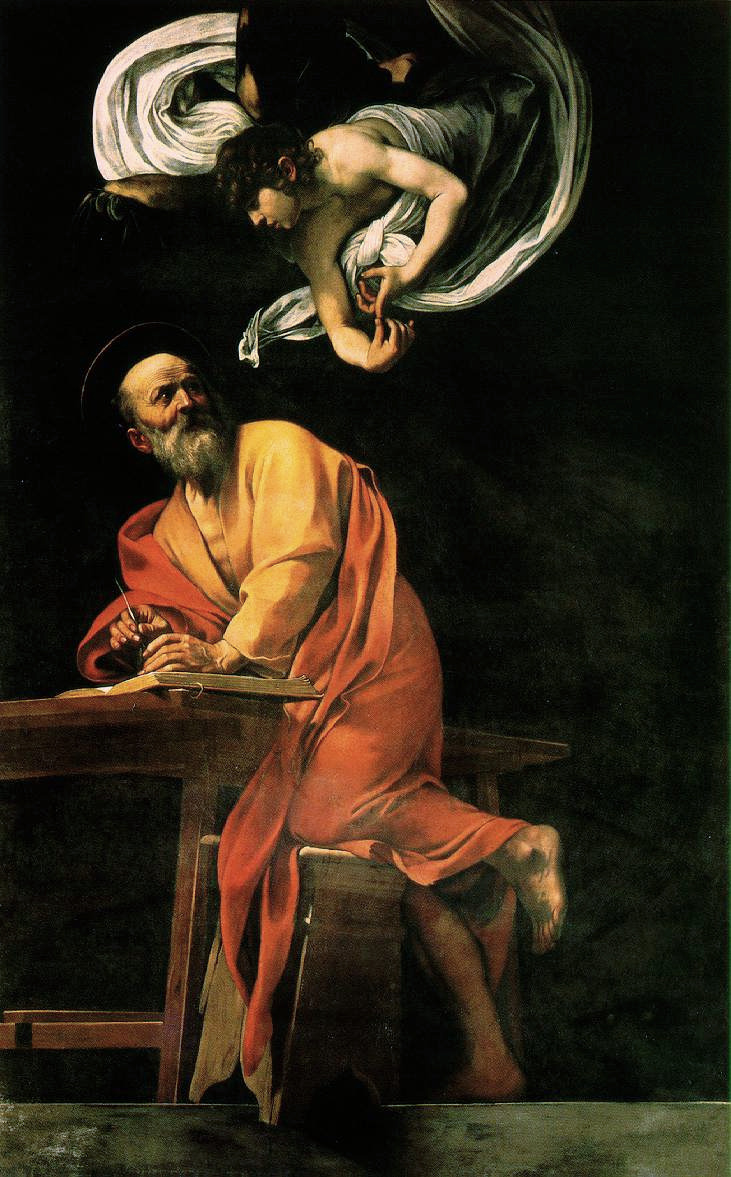
Caravaggio (Michelangelo Merisi), The Inspiration of Saint Matthew, 1602, oil on canvas, 9’8 1/2 “ x 6’ 2 ½” Contarelli Chapel, Church of Luigi dei Francesi, Rome.
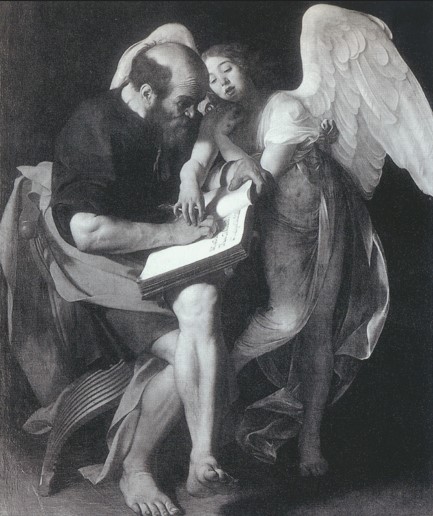
This first version of The Inspiration of St. Matthew by Caravaggio was rejected because the evangelist was considered too crude and the angel too familiar. The painting was destroyed during the Fall of Berlin in 1945 and known by photographs.
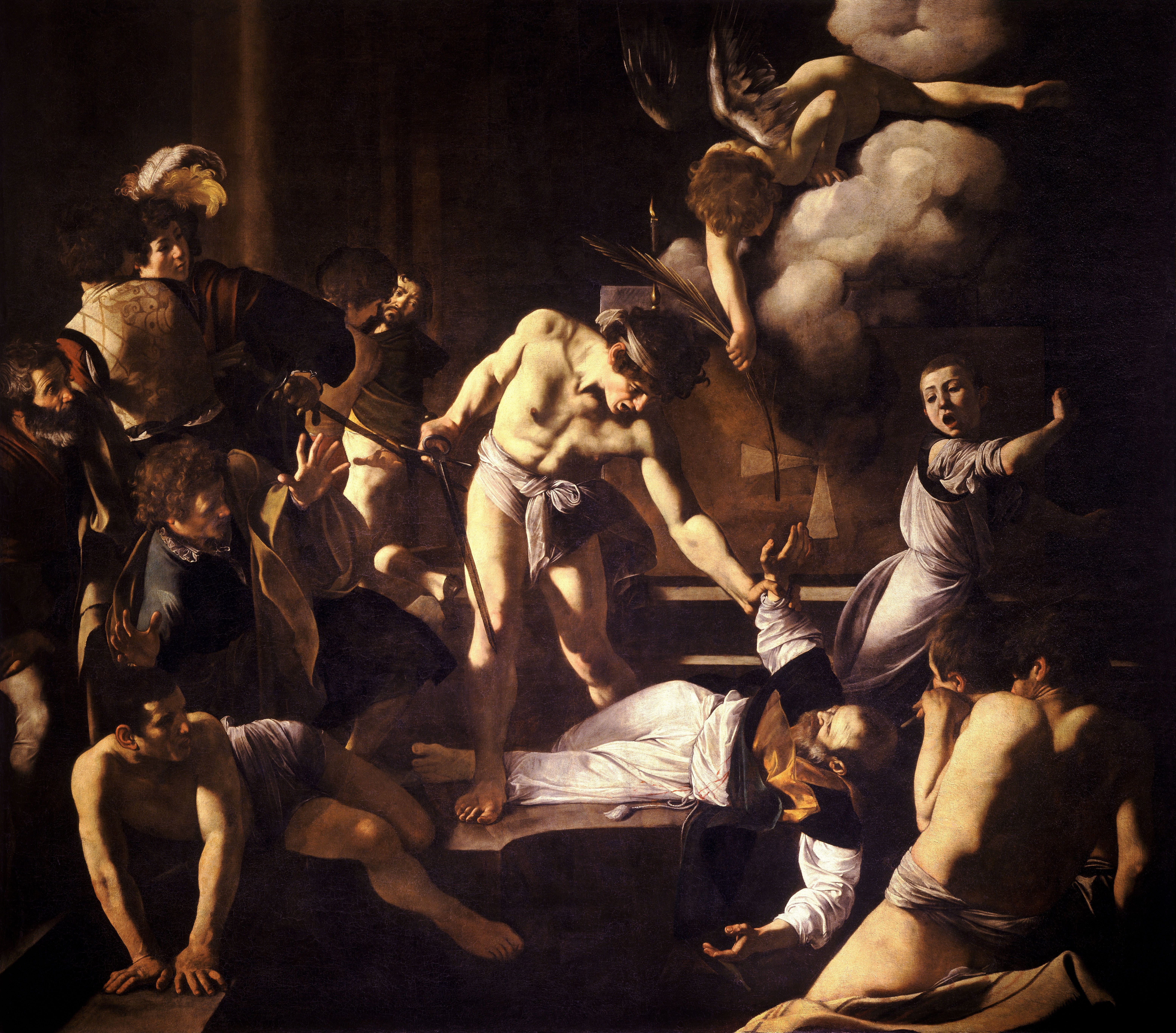
Caravaggio (Michelangelo Merisi), The Martyrdom of Saint Matthew, 1599-1600, oil on canvas, 10’7 1/2 “ x 11’ 3” Contarelli Chapel, Church of Luigi dei Francesi, Rome.

Permanently installed on the right wall of the Contarelli Chapel in San Luigi dei Francesi, Caravaggio’s The Martyrdom of Saint Matthew erupts across the canvas in a chaotic, centrifugal burst of bodies and motion. The composition radiates outward from a single, horrifying fulcrum—the moment of the apostle’s death—captured with explosive, almost cinematic intensity. With this work, Caravaggio established himself as the unrivaled master of psychological violence in early Baroque art.

The narrative follows the traditional account in the Golden Legend. Saint Matthew, having publicly condemned King Hirticus of Ethiopia for lusting after his own niece, the consecrated virgin Iphigenia, is murdered in retaliation. Caravaggio distills the entire hagiography into one blinding instant: the assassin, a half‑nude royal soldier, lunges forward to strike the fatal blow as Matthew collapses, bleeding, onto the altar steps.

Caravaggio pushes tenebrism to its outer limit. The saint lies sprawled on the ground, his arms flung open in a gesture that hovers between defense and surrender. The executioner grips Matthew’s wrist, towering above him with a drawn sword, his face twisted in a scream of fury. Around them, witnesses recoil in terror, their bodies spiraling outward as if blasted by the force of the violence.

Yet amid the earthly chaos, the supernatural breaks through. A cloud gathers above the altar, and an angel descends—not to rescue Matthew, but to complete the drama of martyrdom. Leaning down from heaven, the angel extends the palm of victory, placing it into the saint’s wounded hand at the very moment the assassin’s sword arcs downward.

The intersection of these three elements—the angel’s arm, the soldier’s blade, and Matthew’s reaching hand—forms a powerful diagonal axis, a visual declaration that divine salvation overrides mortal execution. In this collision of heaven and earth, Caravaggio transforms a brutal killing into a moment of transcendent destiny.
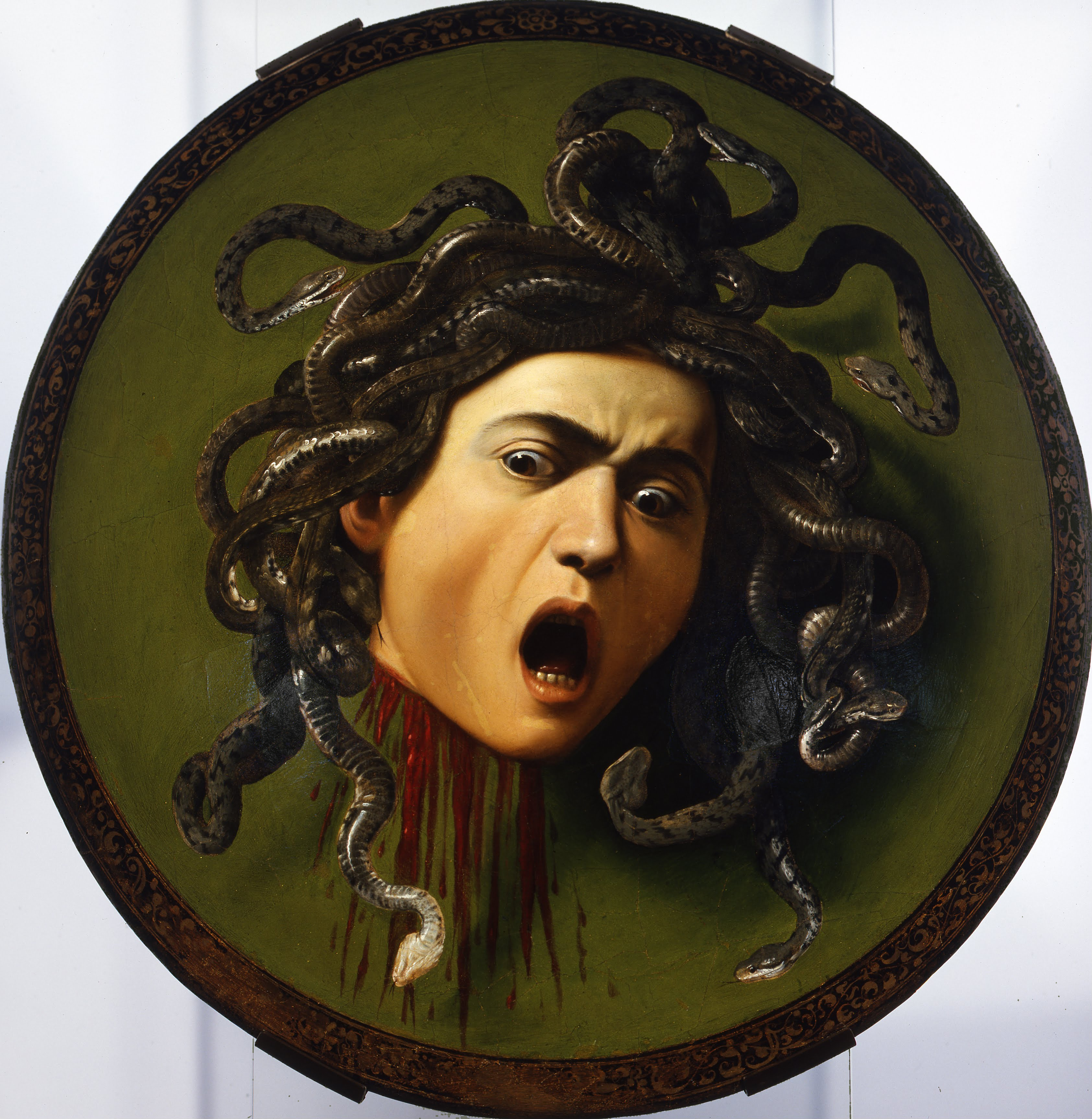
Caravaggio (Michelangelo Merisi), Medusa (detail), 1600/01, oil on canvas mounted on a convex poplar-wood shield, Uffizi, Florence.

Caravaggio’s Medusa is painted on an actual parade shield.

Caravaggio’s Medusa (1600/01), now in the Uffizi Gallery, is one of the most astonishing feats of early Baroque engineering and psychological terror. Painted in oil on canvas and mounted onto a convex poplar shield, the work fuses myth, optics, and raw anatomy into a single, unnervingly lifelike apparition. Commissioned by Cardinal Francesco Maria del Monte and presented as a diplomatic gift to Grand Duke Ferdinando I de’ Medici, it was proudly displayed in the Medici Armory as both a marvel of craftsmanship and a symbol of dynastic power.

Because the surface curves outward, Caravaggio had to deploy advanced foreshortening and perspectival distortion to counteract the shield’s bulge. He subtly elongates Medusa’s cheeks and distorts her jawline so that, when viewed head‑on, the surface appears flat—or even concave—a technical sleight of hand that would have impressed both artists and scientists in Del Monte’s Roman circle.

Caravaggio captures the exact, electric instant between life and death. Perseus has already struck, yet Medusa’s nervous system still fires. Her face becomes a study in catastrophic realization: eyes bulging with shock and fury, brow knotted in disbelief, mouth wrenched open in a silent, blood‑freezing scream. True to his radical naturalism, Caravaggio did not invent stylized serpents; he studied real vipers, painting them mid‑coil, mid‑strike, writhing in panic as their host dies beneath them. From the severed neck, bright arterial blood spurts outward in jagged, hyper‑realistic streams.

To deepen the mythic resonance, Caravaggio anchors the work in the classical story as told by Ovid. According to the Metamorphoses, Perseus could only approach Medusa safely by looking at her reflection in the polished bronze shield given to him by Athena. By painting Medusa’s head directly onto a shield, Caravaggio transforms the viewer into Perseus himself—the one who sees the monster only through a mediated surface. The painting becomes a weapon, a mirror, and a mythic reenactment all at once.

For modern viewers, the shield reads as pure horror: a severed head frozen in the moment of its final scream. But for the Medici, it carried a very different charge. Medusa—whose gaze could immobilize armies—became a potent emblem of political dominion, a symbol of a ruler whose power could paralyze enemies before they even approached.

Caravaggio (Michelangelo Merisi), Basket of fruit (canestra di frutta), c. 1600/01, oil on canvas, 18 1/8 x 25 3/8, Biblioteca Ambrosiana, Milan. https://www.ambrosiana.it/opere/canestra-di-frutta/ – retrieved October 13, 2024.

Caravaggio’s Basket of Fruit is the only autonomous still life by the artist known to survive, though his figure paintings are filled with exquisitely rendered fruit that function as symbolic subtexts. Across his oeuvre, these arrangements vary widely in species, ripeness, and composition, yet they share a distinctive naturalism—blemishes, curling leaves, and the quiet drama of decay rendered with almost scientific precision.

The painting belonged to Cardinal Federico Borromeo (1564–1631), cousin of Saint Charles Borromeo and, like him, Archbishop of Milan. A towering figure of the Counter‑Reformation, Federico championed religious art as a tool of pastoral instruction, yet he was also an unusually passionate collector of still life, a genre often dismissed as minor. Whether he commissioned Caravaggio’s painting or received it as a gift remains uncertain, but he valued it enough to bequeath it in his will to the Ambrosiana in Milan, the scholarly gallery and library he co‑founded in 1618.

The basket itself is instantly recognizable to anyone familiar with Caravaggio’s work. A nearly identical arrangement appears in the Supper at Emmaus in London’s National Gallery, painted around the same time. In both works, the fruit leans precariously over the edge, as if about to tumble into the viewer’s space—a hallmark of Caravaggio’s desire to collapse the boundary between the painting and the viewer.

Cardinal Borromeo lived in Rome from 1586 to 1601, precisely the years when Caravaggio’s reputation was rising with meteoric speed. During this period, he became deeply familiar with the painter’s radical naturalism. For a prelate devoted to both doctrinal clarity and the beauty of the created world, Caravaggio’s still life—so attentive to the fragile, transient nature of living things—would have held profound appeal.

Giulio Cesare Procaccini ((1574–1625), Cardinal-Archbishop Federico Borromeo, 1610, Museo diocesano di Milano.
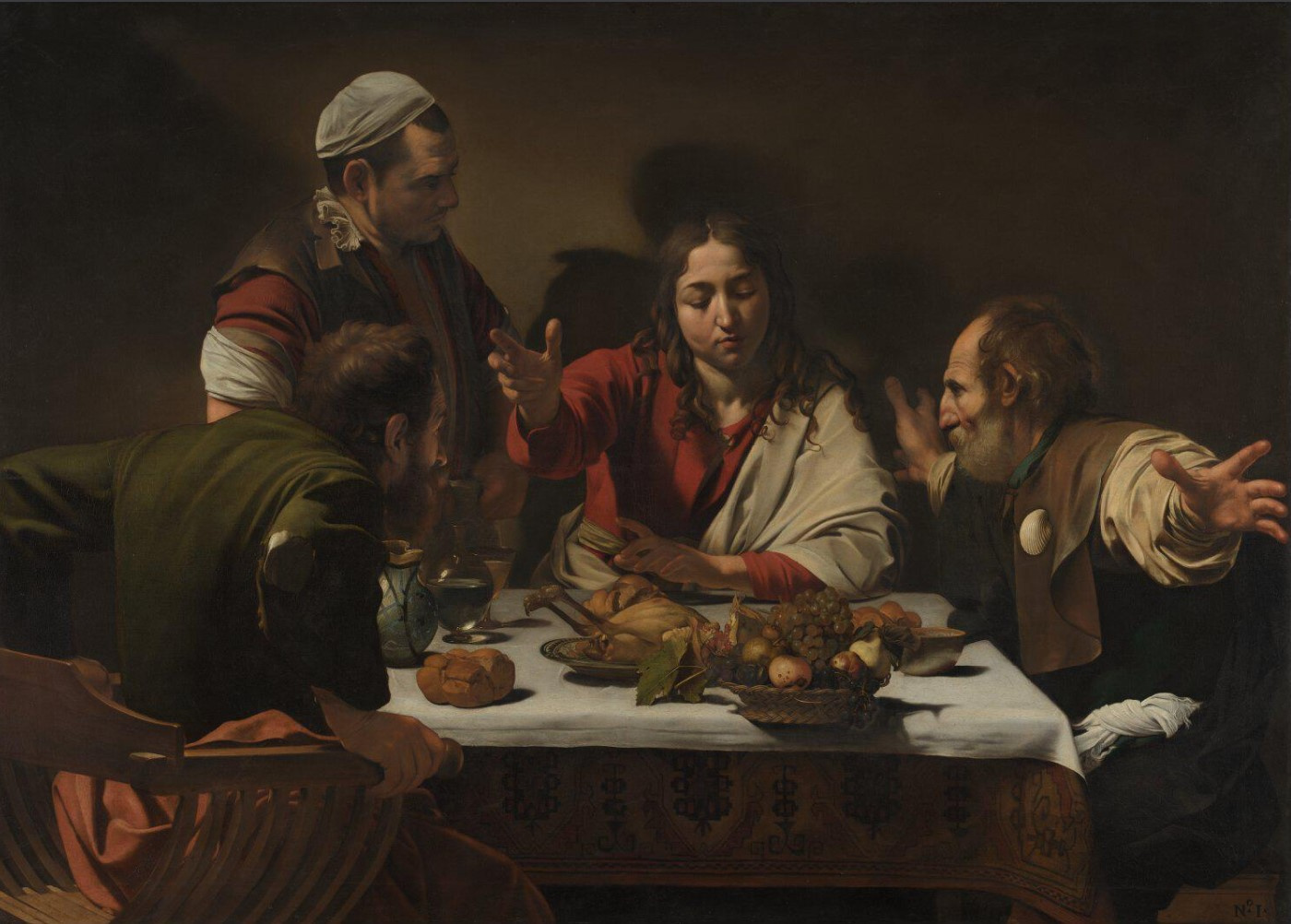
Caravaggio (Michelangelo Merisi), Supper at Emmaus, c. 1600/01, oil on canvas, 54 ¾ x  76 ¾” The National Gallery, London.

Caravaggio’s Roman career accelerated rapidly after the triumph of the Contarelli Chapel commissions. Almost immediately he was engaged for another prestigious project in Santa Maria del Popolo, decorating the Cerasi Chapel. Although these were technically private commissions, their placement in major Roman churches ensured that Caravaggio’s work circulated before a broad public. By 1600 he had become one of the most sought‑after painters in the city, attracting both established patrons and ambitious newcomers such as the wealthy Mattei brothers, prominent Roman bankers. For one of them, in the family palazzo, Caravaggio produced The Supper at Emmaus (1601), a work executed at the apex of his early fame and artistic maturity.

What distinguishes this painting is not only Caravaggio’s reliance on live models and his anatomically precise naturalism, but his increasingly sophisticated deployment of light as a bearer of meaning rather than mere aesthetic embellishment. Instead of depicting the journey to Emmaus, Caravaggio selects the climactic instant at the supper table when the risen Christ blesses and breaks the bread and the disciples suddenly recognize him—just before he vanishes from their sight. Light becomes the visual analogue of recognition itself: a revelatory force that cuts through the scene with theological and psychological clarity.

Caravaggio dramatizes this moment with unprecedented immediacy. One disciple thrusts himself forward, his elbow projecting into the viewer’s space; the other flings his arms wide in astonished realization. Meanwhile the innkeeper, who has not grasped the miracle unfolding before him, remains enveloped in the darker register of Caravaggio’s chiaroscuro, his face still in shadow. The contrast is not incidental: it marks the divide between those who have entered the “light” of recognition and those who remain outside it.

The composition’s theatricality intensifies this effect. Caravaggio’s half‑length, tightly cropped figures press against the picture plane, collapsing the distance between sacred narrative and beholder. Everyday objects—fruit basket, tablecloth, the disciples’ garments—jut outward with near sculptural immediacy, creating a sensuous, almost tactile realism that anchors the miracle in the viewer’s own world. The result is a painting that is simultaneously grounded in contemporary Roman life and elevated by a supratemporal luminosity that signals divine presence.

Yet the work was not universally admired. Critics objected that Caravaggio’s Christ looked too youthful and unbearded—“a man posing as Christ who certainly was not Christ,” as Bellori complained in 1672. Caravaggio got the criticism though Michaelangelo Buonarroti did the same thing in the pope’s Sistine Chapel. Others scoffed that the fruit on the table could not have been in season during the post‑Easter episode. Such criticisms, however, reveal the very innovation of Caravaggio’s method: his commitment to inventing a world that is believable precisely because it is rooted in the observable, even when that realism unsettles traditional expectations. Unlike earlier artists who idealized sacred history, Caravaggio insisted on painting from life, even in a religious history painting intended for private devotion.

The Supper at Emmaus thus exemplifies Caravaggio’s distinctive achievement: a fusion of radical naturalism and spiritual intensity that collapses historical distance, bringing the sacred into the viewer’s present while simultaneously lifting the everyday into a realm of revelation.
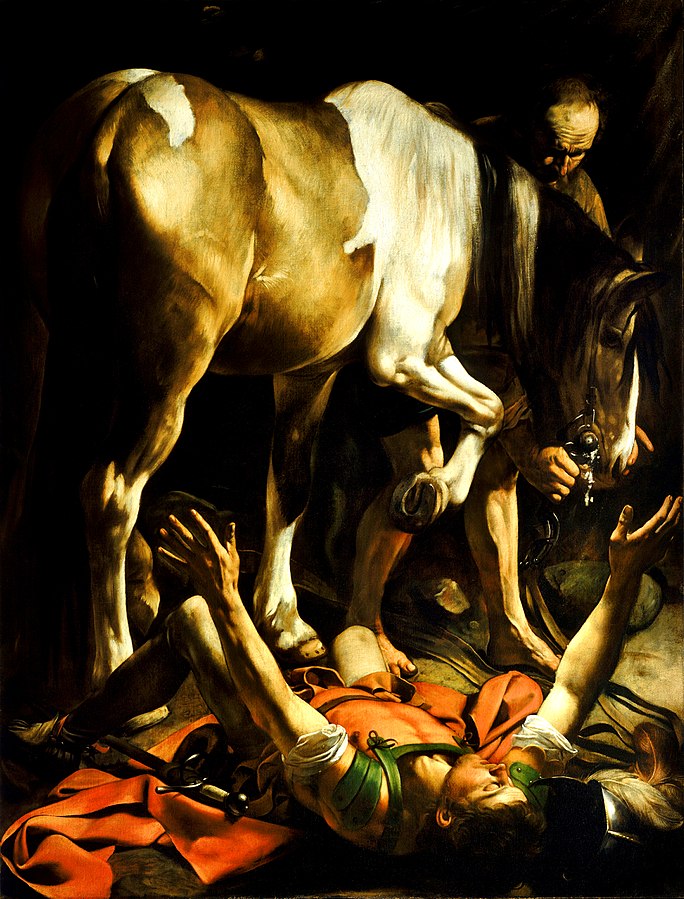
Caravaggio (Michelangelo Merisi), The Conversion of Saint Paul, 100/01, oil on canvas, 90 ½ x 70” Cerasi Chapel, Santa Maria de Popolo, Rome.
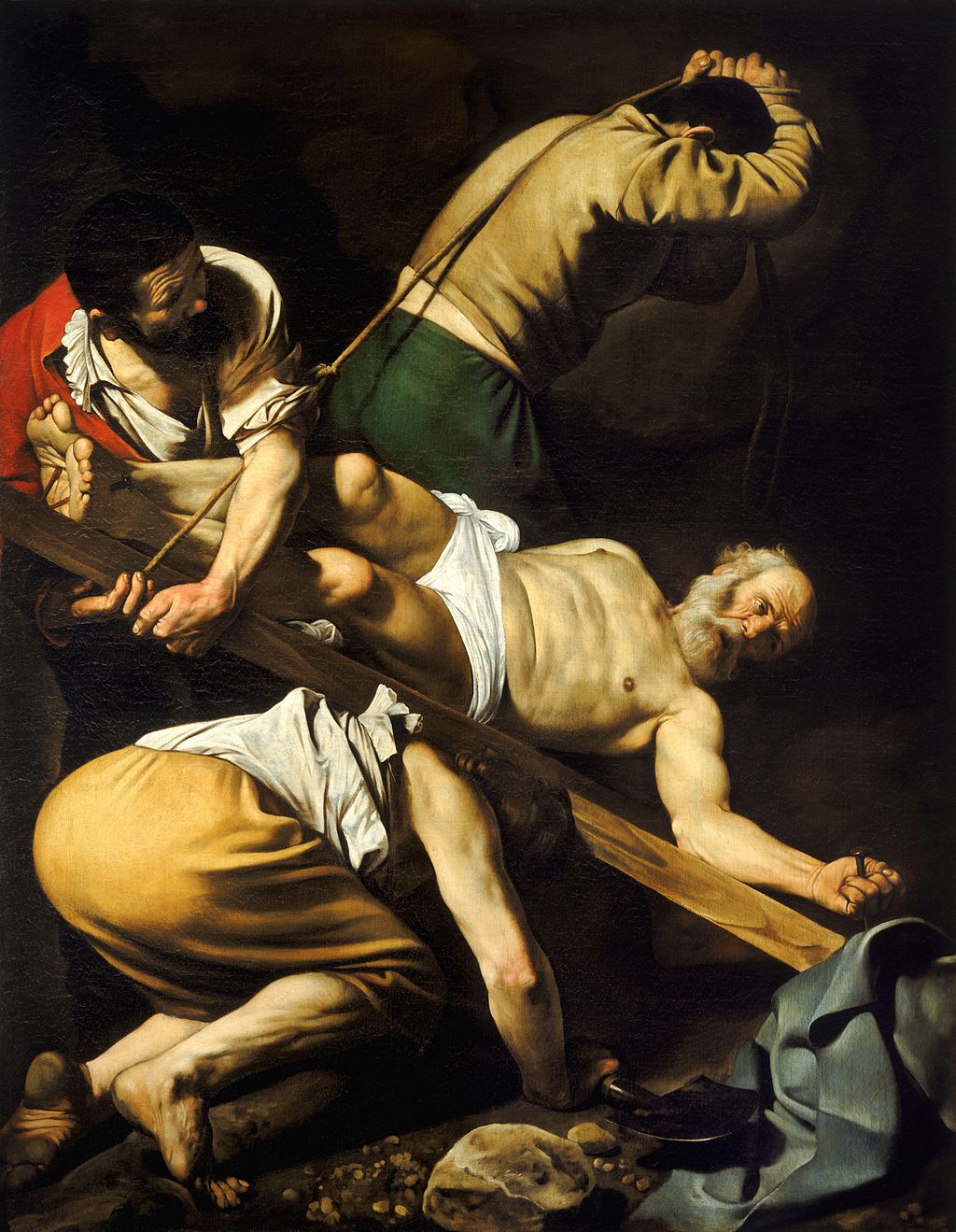
Caravaggio (Michelangelo Merisi), The Crucifixion of St. Peter, 1600/01, oil on canvas, 90 ½ x70” Cerasi Chapel, Santa Maria de Popolo, Rome.

The chapel was purchased by Tiberio Cerasi (1544-1601) in 1600 who worked as Treasurer-General for Pope Clement VIII. Cerasi had the chapel redone by Carlo Maderno (1556-1629). In 1601 Cerasi hired Caravaggio to paint The Conversion of St. Paul and The Crucifixion of St. Paul. Notably, his paintings’ first versions were rejected. The final paintings were installed in 1605 and the chapel consecrated in 1506. The Assumption of Mary over the altar was painted at the same time by Annibale Caracci. See – https://en.wikipedia.org/wiki/Cerasi_Chapel– retrieved October 14, 2024.
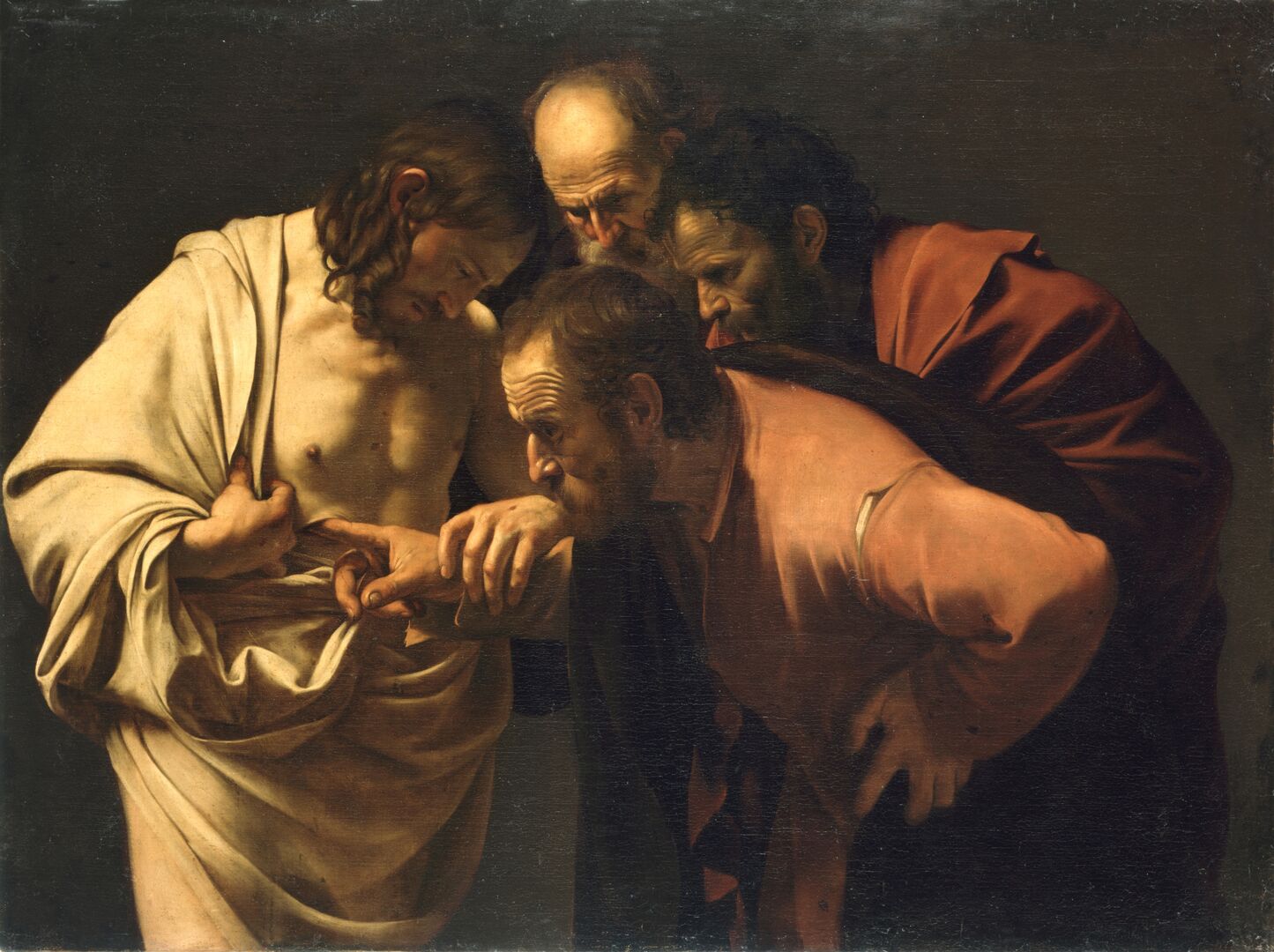
Caravaggio (Michelangelo Merisi), The Incredulity of Saint Thomas, 1601/02, oil on canvas, 42 1/8 x 57 ½” 118 × 156.5 cm Neues Palais, Potsdam.

Caravaggio’s The Incredulity of Saint Thomas presents the New Testament encounter (John 20:27–31) with uncompromising naturalism and the stark drama of chiaroscuro. The painting’s later history is as turbulent as its subject. Originally owned by the powerful Giustiniani family, it was sold under financial duress and purchased in 1815 from a Paris dealer by King Frederick William III of Prussia (1770–1840). The king intended to assemble a public art museum for Berlin, yet this work—astonishingly—was initially judged “lower quality,” perhaps because Caravaggio offers no visible markers of Christ’s divinity. Instead, he renders the risen Christ with the same corporeal immediacy as the apostles, a choice that unsettled early nineteenth‑century connoisseurs.

Of the five Caravaggios acquired by the Prussian monarch, only three ultimately entered the museum collection, including Cupid as Victorious at the Gemäldegalerie. The Incredulity of Saint Thomas was instead hung in the Berlin Palace, and later, in 1856, installed in the picture gallery at Sanssouci, where its psychological intensity found a more appreciative audience.

Caravaggio’s interpretation of the biblical scene is uncompromisingly direct. Christ guides Thomas’s hand into the wound in his side, the gesture rendered with surgical clarity. The apostles crowd around, their faces lit by a single, directional beam that isolates the moment of recognition. There is no halo, no ethereal glow—only flesh, shadow, and the shock of belief forced into being. Caravaggio transforms a theological lesson into a moment of tactile revelation, collapsing the distance between viewer and miracle. https://brandenburg.museum-digital.de/object/11898 – retrieved October 11, 2024.
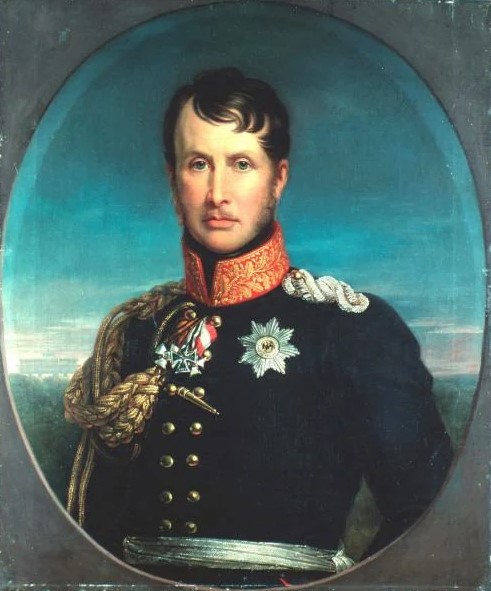
Frederick William III ruled Prussia during the Napoleonic Wars and, while shy and quiet by nature, reluctantly participated in the coalition against Napoleon in the German campaign of 1813. After Napoleon’s defeat in 1815, he took part in the Congress of Vienna and helped established the new postwar order in Europe. For the remainder of his reign, Frederick William III set about reforming Prussian institutions and centralizing royal control.

Caravaggio (Michelangelo Merisi), Victorious Amor, c. 1601/02, oil on canvas, 60 5/8 x 43 ¼”, Gemäldegalerie, Staatliche Museen, Berlin-Dahlem. https://recherche.smb.museum/detail/862322/amor-als-sieger?language=de&question=caravaggio&limit=15&sort=relevance&controls=none&collectionKey=GG*&objIdx=0 – retrieved October 11, 2024.

Caravaggio shows Eros prevailing over other human endeavors: war, music, science, government.
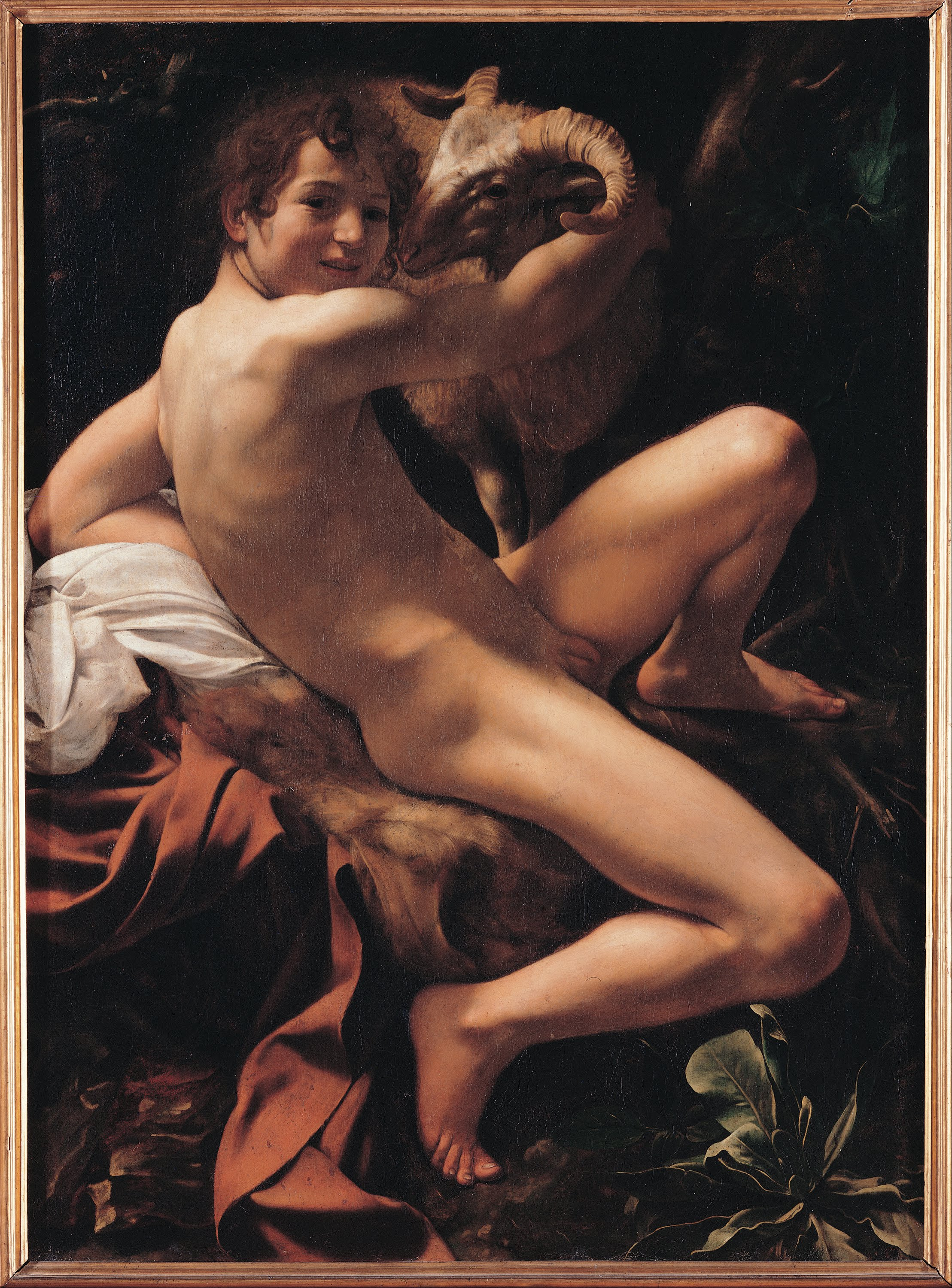
Caravaggio (Michelangelo Merisi), Youth With a Ram, 1602/03, oil on canvas, 52 x 38 ¼” Capitoline Gallery, Rome. https://www.museicapitolini.org/en/percorsi/percorsi_per_sale/pinacoteca_capitolina/sala_di_santa_petronilla_la_grande_pittura_del_seicento_a_roma/san_giovanni_battista – retrieved October 12, 2024.
 

Youth With A Ram was painted for Ciriaco Mattei (d.1614), one of the foremost art collectors of his time, and given to Cardinal del Monte by his son before his death. Mattei also commissioned Caravaggio’s Supper at Emmaus and The Taking of Christ.
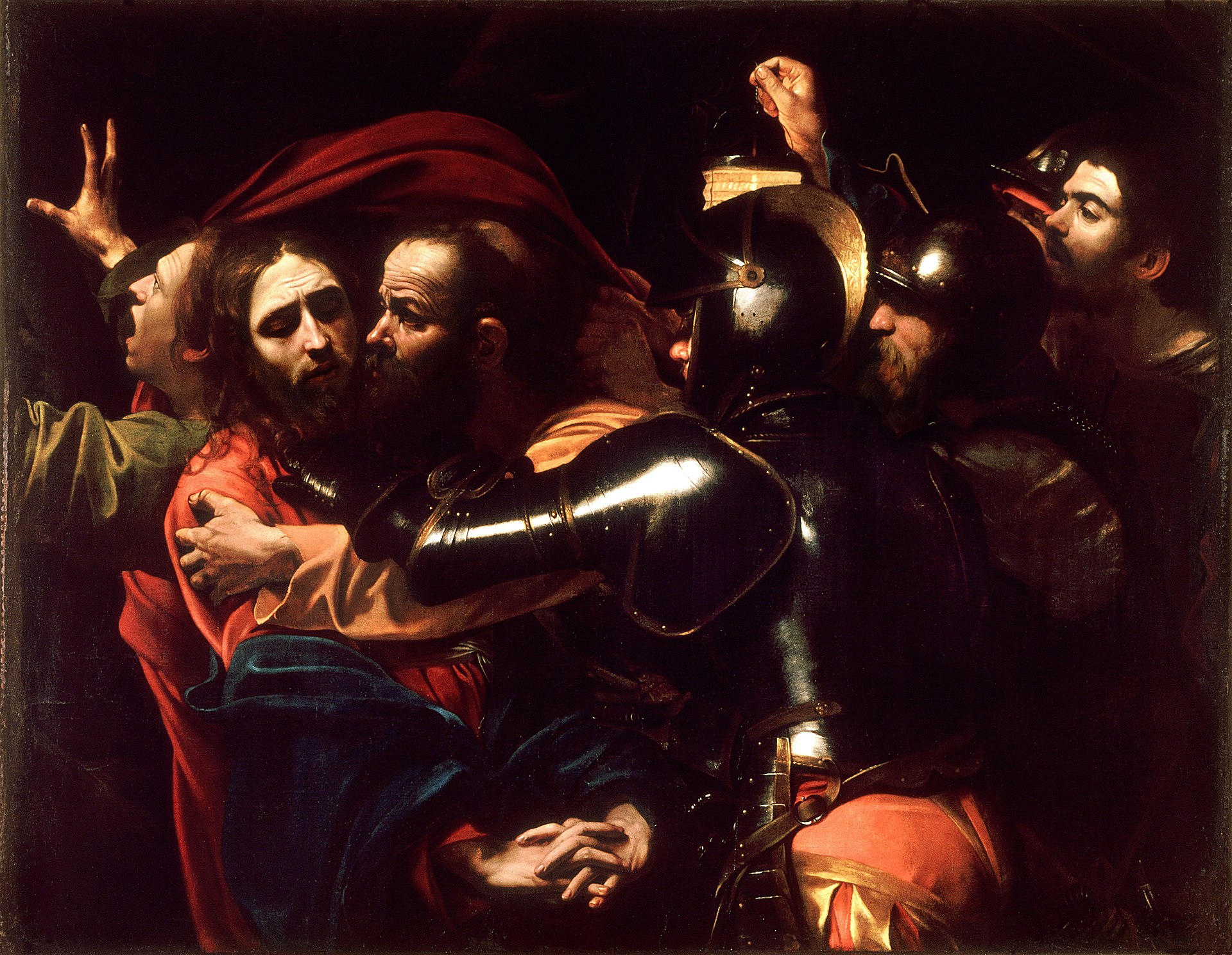
Caravaggio (Michelangelo Merisi), The Taking of Christ, 1602, oil on canvas, 133.5 cm × 169.5 cm (52.6 in × 66.7 in) National Gallery of Ireland. On loan from the Society of Jesus, Leeson Street., Dublin.
The painting includes a self portrait of Caravaggio.
Caravaggio (Michelangelo Merisi), The Sacrifice of Isaac, 1603, oil on canvas, 41 x 53 1/8” Uffizi, Florence. https://www.uffizi.it/en/artworks/sacrifice-of-isaac – retrieved October 12, 2024.

The painting illustrates the Old Testament story in which God subjected Abraham to an extraordinary test of obedience by ordering him to sacrifice his only son Isaac (Genesis 22: 1-19). Caravaggio faithfully depicts the crucial moment of this dramatic story, when old Abraham, at the very moment he is about to immolate a screaming Isaac, is blocked by an angel sent by the Lord.
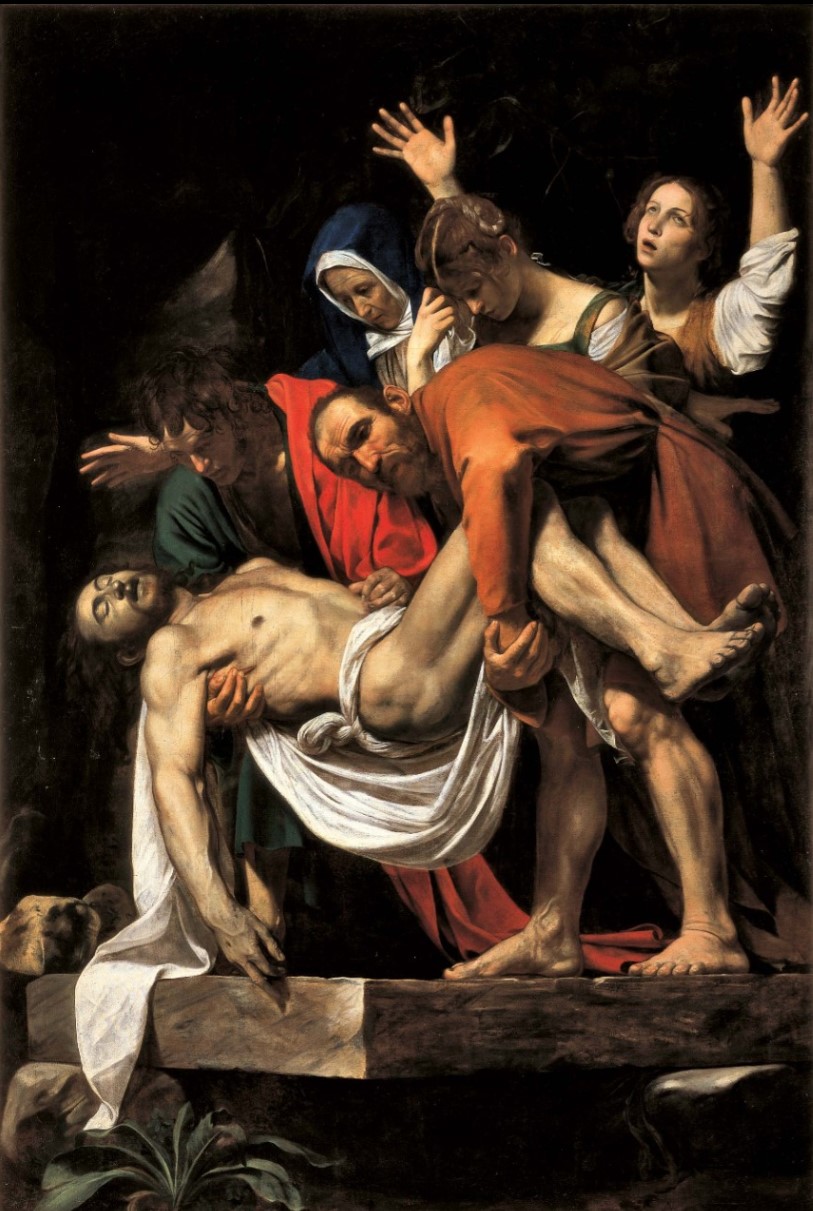
Michelangelo Merisi, called the Caravaggio, Deposition, circa1600-1604, Oil on canvas, 300 x 203 cm, Pinacoteca, Vatican, Rome. https://www.museivaticani.va/content/museivaticani/en/collezioni/musei/la-pinacoteca/sala-xii—secolo-xvii/caravaggio–deposizione-dalla-croce.html – retrieved October 12, 2024.

The Deposition, considered one of Caravaggio’s greatest masterpieces, was commissioned by Girolamo Vittrice for his family chapel in Santa Maria in Vallicella (Chiesa Nuova) in Rome. In 1797 it was included in the group of works transferred to Paris in execution of the Treaty of Tolentino. After its return in 1817 it became part of Pius VII’s Pinacoteca.
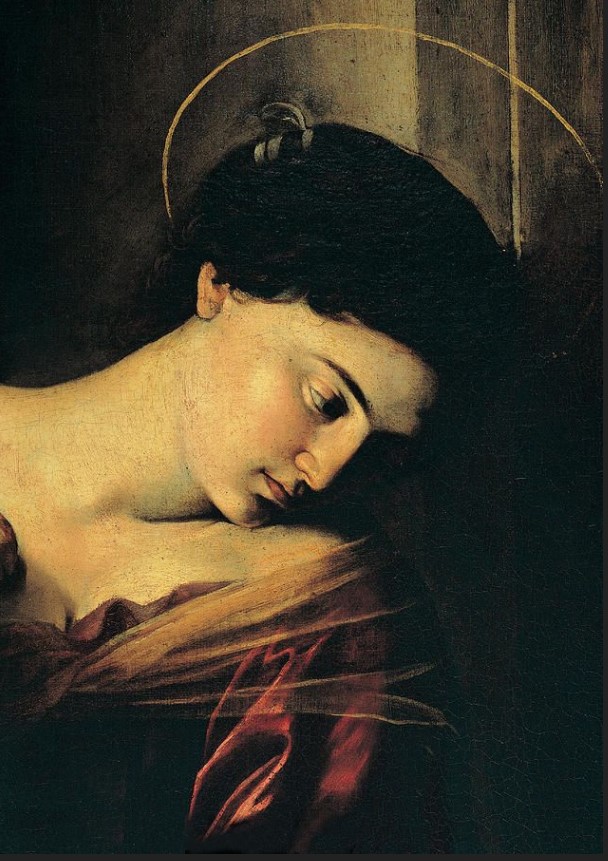
Michelangelo Merisi, called the Caravaggio, DETAIL The Madonna of Loreto (The Madonna of the Pilgrims), circa1603-1604, Oil on canvas, 8’ 8 ½ x 4’ 11”, Cavalletti Chapel, Church of Sant’ Agostino, Rome.
Michelangelo Merisi, called the Caravaggio, The Madonna of Loreto (The Madonna of the Pilgrims), circa1603-1604, Oil on canvas, 8’ 8 ½ x 4’ 11”, Cavalletti Chapel, Church of Sant’ Agostino, Rome.

The painting has been in the Cavalletti chapel in Rome since it was installed at the end of 1604.
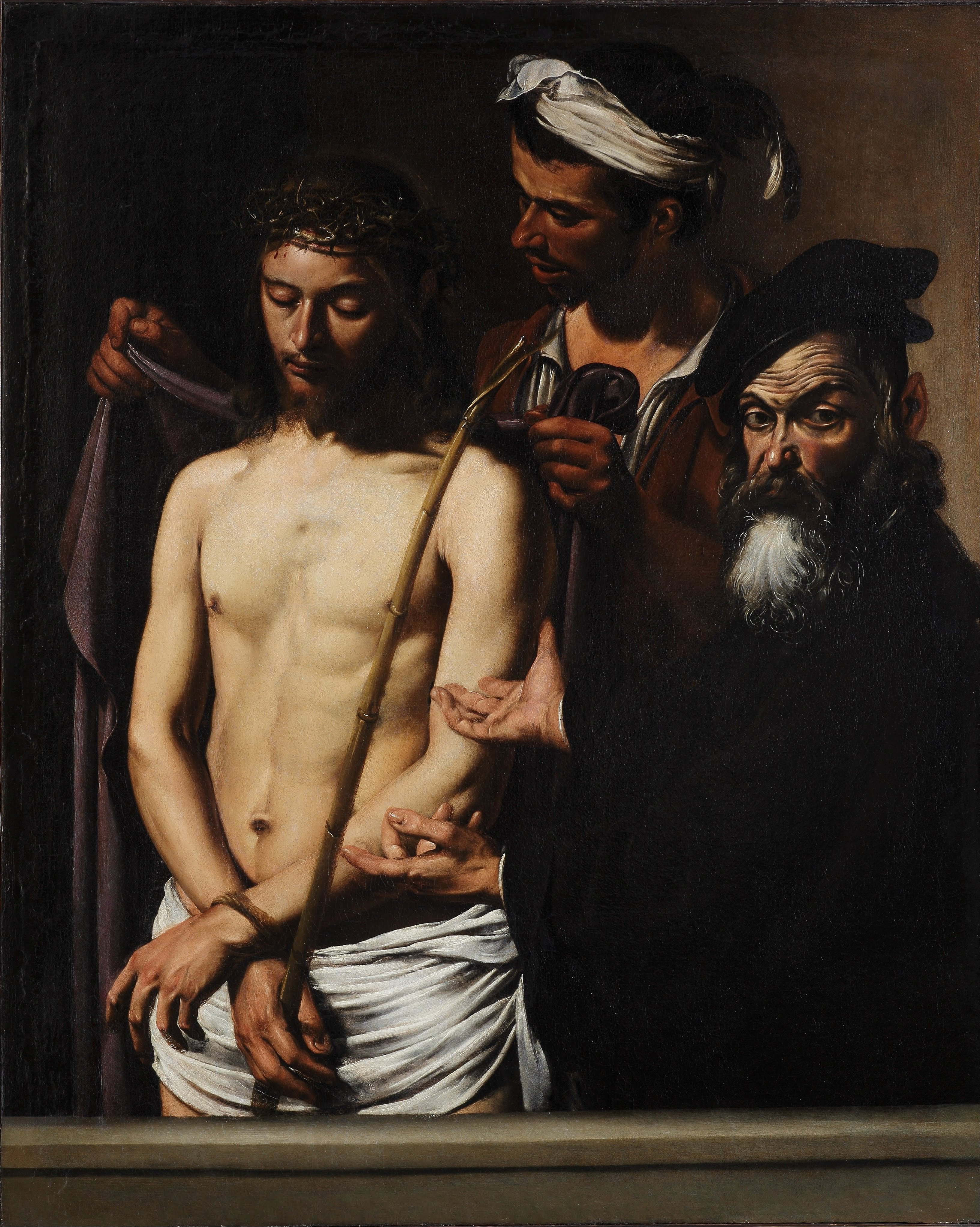
Michelangelo Merisi, called the Caravaggio, Ecce Homo, c. 1604-05, oil on canvas, 50 ½ x 40 ½” Civic Collection, Palazzo Rosso, Genoa.

The painting was made for a competition with Domenico Passignano (1559-1638) and Lodovico Cardi (“Il Cigoli”) (1559-1613) soon after Il Cigoli first arrived in Rome. Il Cigoli won the compettion and the whereabouts of Caravaggio’s painting until it arrived to Genoa is uncertain. It may be that Caravaggio himself took it to Genoa when he visited there in 1605.
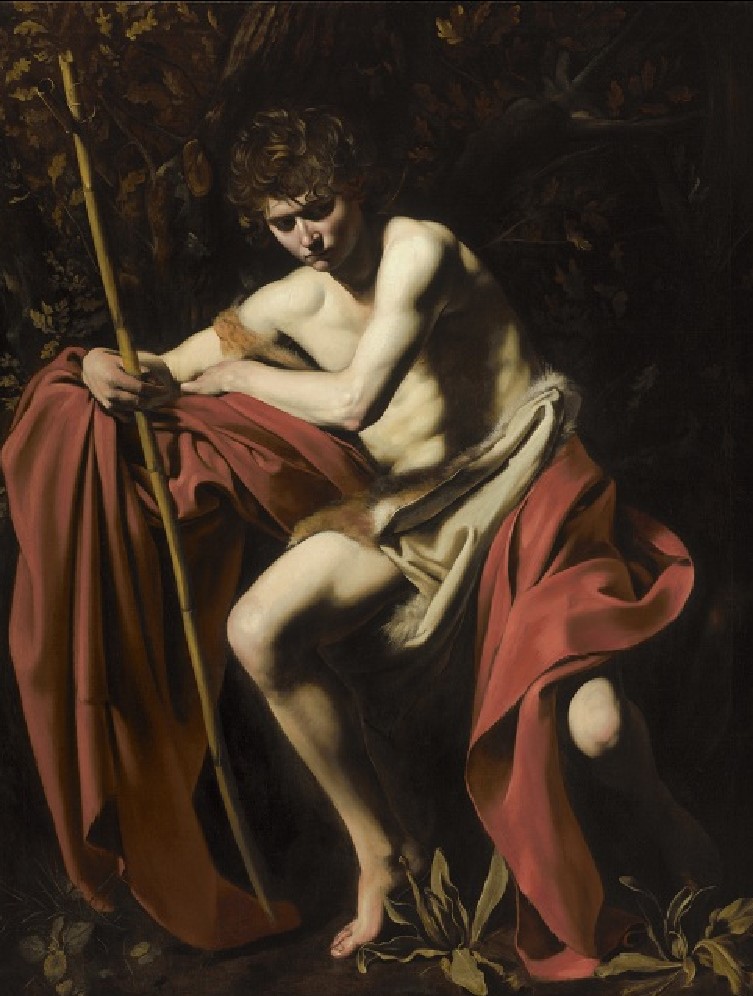
Michelangelo Merisi, called the Caravaggio, Saint John the Baptist, c. 1605, oil on canvas, 68 1/4 x 52” Nelson-Atkins Museum of Art, Kansas City, Missouri.

The painting was made for Ottavio Costa who then had a copy made for his chapel in Liguria while the original was lost. It resurfaced in the mid 19th century in England and was acquired by the Nelson-Atkins Museum of Art in the 1950s. Caravaggio reveals the qualities of the saint by his expression and pose. He is sober and downcast with a tense energy as his pose manifests the monumentality of the prophets on the Sistine Chapel ceiling. With his staff he quietly and contemplatively conveys zeal, passion and vitality. There is a sense of his singleness of purpose, joined even to a little madness, as a man driven by making straight the paths of the Lord.
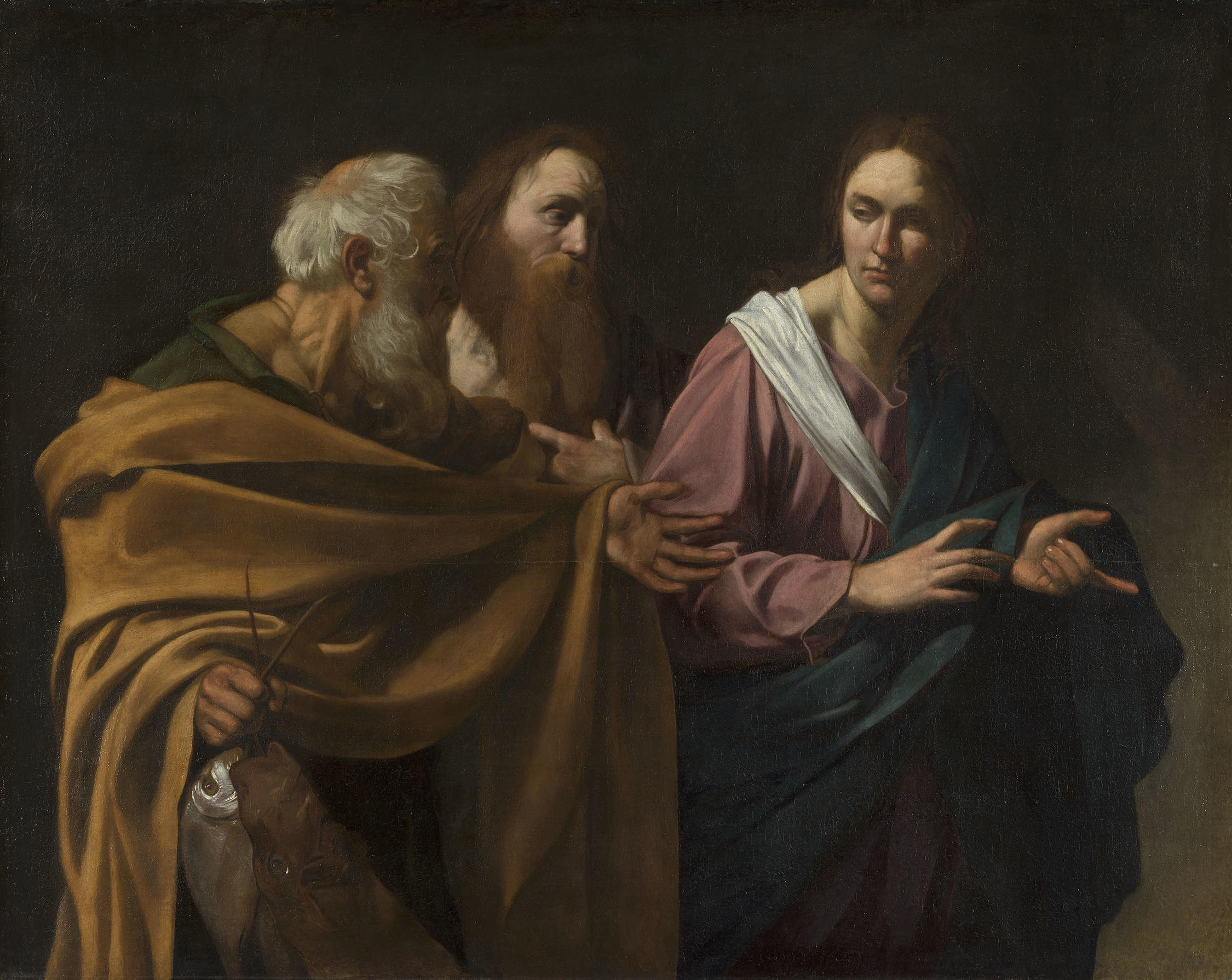
Michelangelo Merisi, called the Caravaggio, Call of Andrew and Simon,1602-1604, oil on canvas,140.1 x 176 cm, Royal Collection Trust, Hampton Court Palace, London, England. https://www.rct.uk/collection/402824/the-calling-of-saints-peter-and-andrew – retrieved November 15, 2024.

The painting was bought by King Charles I of England (1600-1649) in 1637. After the monarch’s defeat in the English Civil War (1642-1645), he was imprisoned and executed for high treason in 1649. During the Commonwealth (1649-1660), the painting was sold in 1651 and recovered at the Restoration. Caravaggio’s painting depicts the call of the very first disciples in the very first New Testament Gospel by Mark: “As he passed by the Sea of Galilee, he saw Simon and his brother Andrew casting their nets into the sea; they were fishermen. Jesus said to them, “Come after me, and I will make you fishers of men.” Then they abandoned their nets and followed him” (Mk 1:16-18). Caravaggio depicts Jesus without a beard as he turns back to invite them to follow him as he moves ahead. Fishermen, Simon Peter holds skewered fish on a stick while Andrew points to himself identifying the object of Jesus’s invitation.

As recently as 1987 this painting came to be attributed to Caravaggio and as the original of this painting’s subject matter. In varying copies of the work the furrow in Christ’s brow is painted faithfully though in this original it is not a painted feature but a canvas fold. There are other design features that, after recent cleaning and conservation, point to a later work of Caravaggio. Many small incisions are present in the artwork’s lower layers of paint that is an uncanny method used by the artist to lay out important points on the canvas for his design. Although the attribution can be argued to the contrary – such as the unusual use of the color blue which Caravaggio saw, according to Bellori, as the “poison of colors” – he did use the color and mostly softened as it is here. Blue, for instance, occurs in the Baptism of Christ (National Gallery of Ireland, c. 1603) and the Annunciation (Nancy, c. 1604). At the Supper at Emmaus (Brera, 1605-6) Christ also wears a robe of softened blue. In its telling broad brushwork, restrained colors, and minimal detail the painting was understood to be a Road to Emmaus painting as discussed by Giulio Mancini and Giovanni Baglione. But these early biographers’ references are likely to the Supper at Emmaus (National Gallery London, 1601). Dated stylistically by its economical, shadowed, and expressive manner, The Calling of Saints Peter and Andrew appears to be from the period of 1603-1606. This would be before Caravaggio killed Ranuccio Tomassoni (c. 1580-1606) in a brawl and fled Rome in May 1606. During the first years of the 17th century, the sensuous surface detail of Caravaggio’s art had become spare, dark and expressive. Further, The Calling of Saints Peter and Andrew places half-length figures interacting against a stark background, similar to such paintings as Doubting Thomas (Sanssouci, Potsdam) and the Betrayal of Christ (National Gallery of Ireland, Dublin), both of 1603. Before this painting reached England, there was a broadly interpreted copy of it that is today in a private collection by Bernardo Strozzi (1582-1644). Strozzi lived and worked in Rome, Genoa and Venice where he may have seen this painting by Caravaggio. When Charles I’s buying agent was later in Italy, he visited the same places as Strozzi had been, except Genoa.
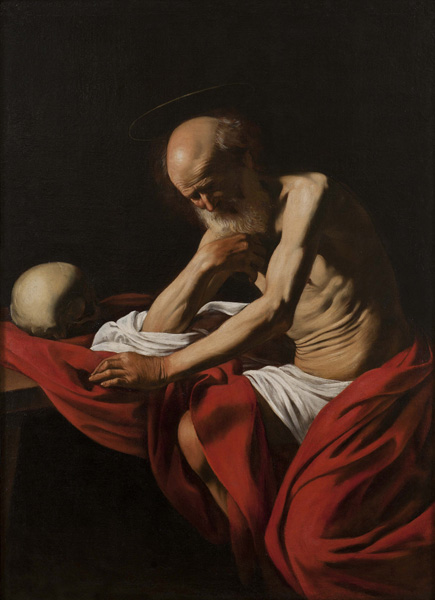
Michelangelo Merisi, called the Caravaggio, Saint Jerome penitent, 1605, oil on canvas,145,5 x 101,5 cm, Museum of Monserrat, Spain. https://www.museudemontserrat.com/ca/coleccions/pinturaantiga/95/caravaggio/490 – October 13, 2024.
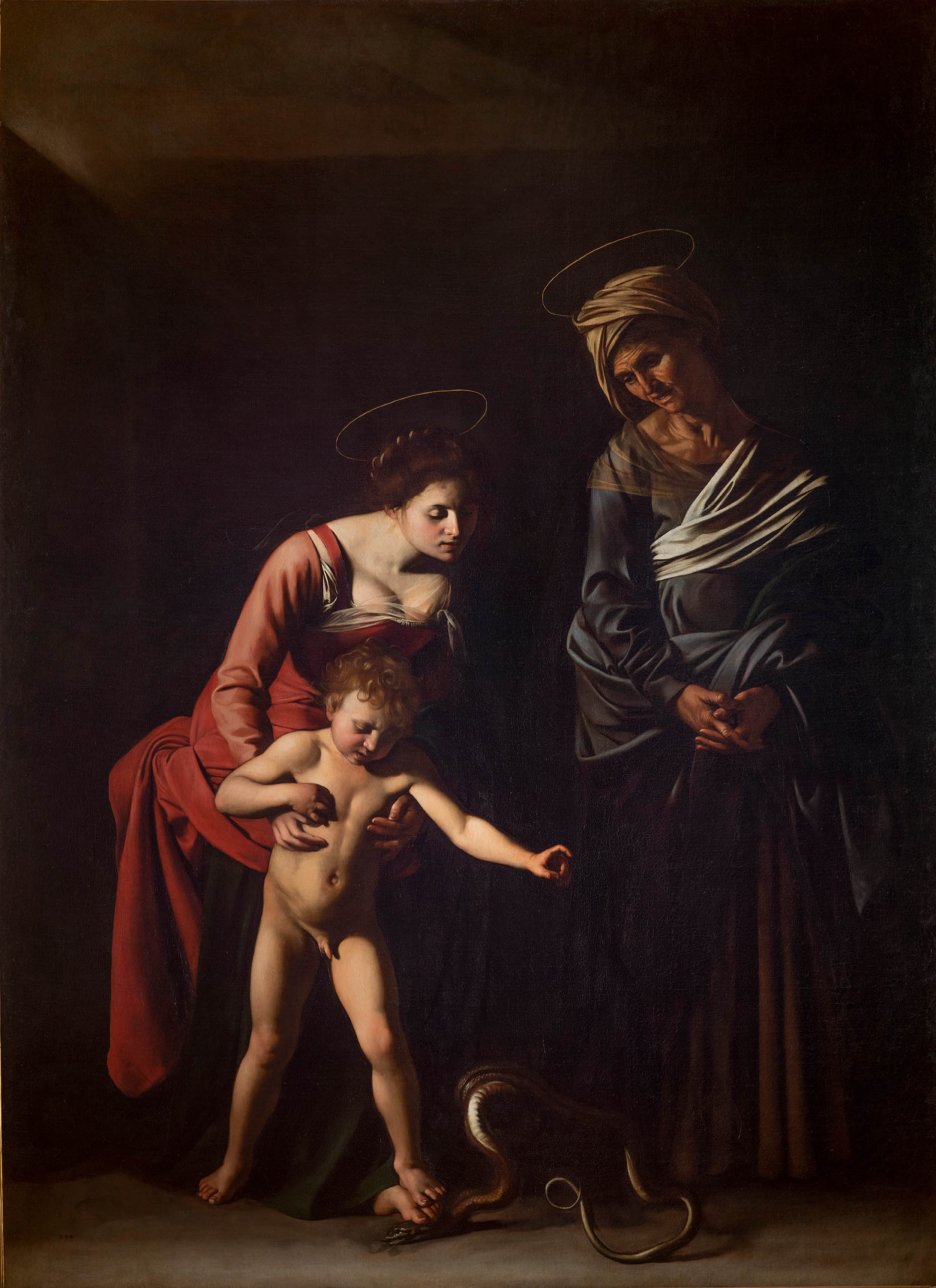
Michelangelo Merisi, called the Caravaggio, The Madonna Of the Snake (Palafrenieri), 1605/06, Borghese Gallery, Rome.  https://www.collezionegalleriaborghese.it/opere/la-madonna-dei-palafrenieri – retrieved October 13, 2024.

The painting was commissioned in 1605 by members of the powerful archconfraternity of the Palafrenieri who, following the renovation of St. Peter’s Basilica, asked the painter for a new work intended to replace an old painting that decorated the altar of their chapel dedicated to St. Anne. Painted within a few months, in April 1606 the work was exhibited and shortly afterwards moved to the nearby church of Sant’Anna dei Palafrenieri where, seen by Scipione Borghese, it was bought by him. For whatever reason the painting was controversial – perhaps the cleavage of the Madonna or the rendering of the nudity of the child – but Scipione Borghese proudly hung it in his own picture gallery. The painting depicts Mary as she crushes a snake – a symbol of sin – at her feet with the help of Jesus and witnessed by Anna, mother of the Virgin.
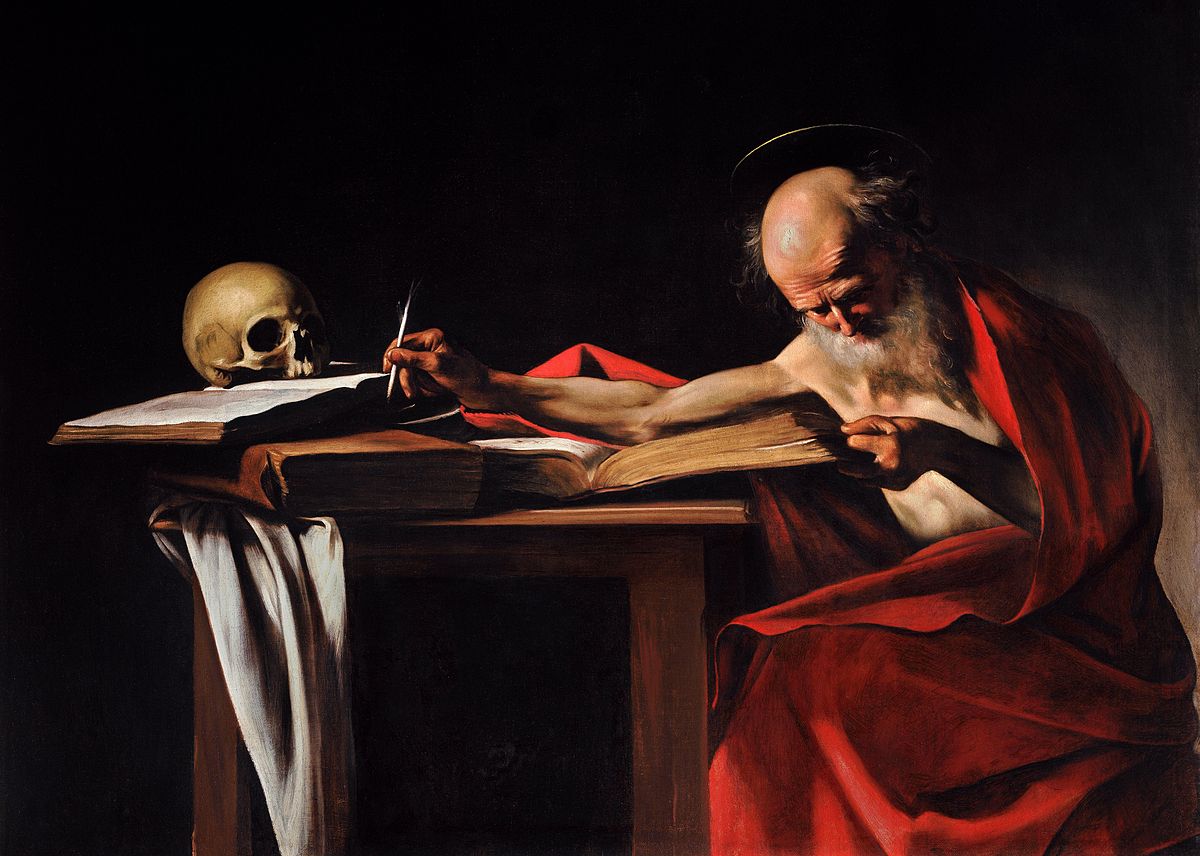
Michelangelo Merisi, called the Caravaggio, Saint Jerome writing, 1605/06, oil on canvas, 116 cm x 153 cm, Borghese Gallery, Rome.

According to Bellori, the painting was made by Caravaggio for Cardinal Scipione Borghese. The cardinal was not only an avid and refined art collector but one of young Caravaggio’s earliest and greatest admirers recognizing the Lombard’s talent despite personality flaws or lack of connections in Rome. The painting depicts Saint Jerome (c. 340s-420), Doctor of the Church, best known for his translation of the Bible from Greek into Latin as well as his commentaries on the Bible. Caravaggio depicts the priest and confessor writing and studying the Holy Scriptures as a scholar, now in old age, who has dedicated his life as a humanist engaged in the complex translation and exegesis of the Church’s sacred text. The composition is divided into large fields of color in warm tones (the saint’s complexion and reddish mantle) and cold tones (the skull and shroud-like white cloth) with Jerome’s arm outstretched with writing instrument in hand across the picture to symbolically portray the unity of the scholar-saint’s dialogue with these opposites of nature including life and death, past and present. As there are many unfinished details in the painting, the artist’s style points to his rapid execution of the work. https://www.collezionegalleriaborghese.it/opere/san-girolamo – retrieved October 13, 2024.

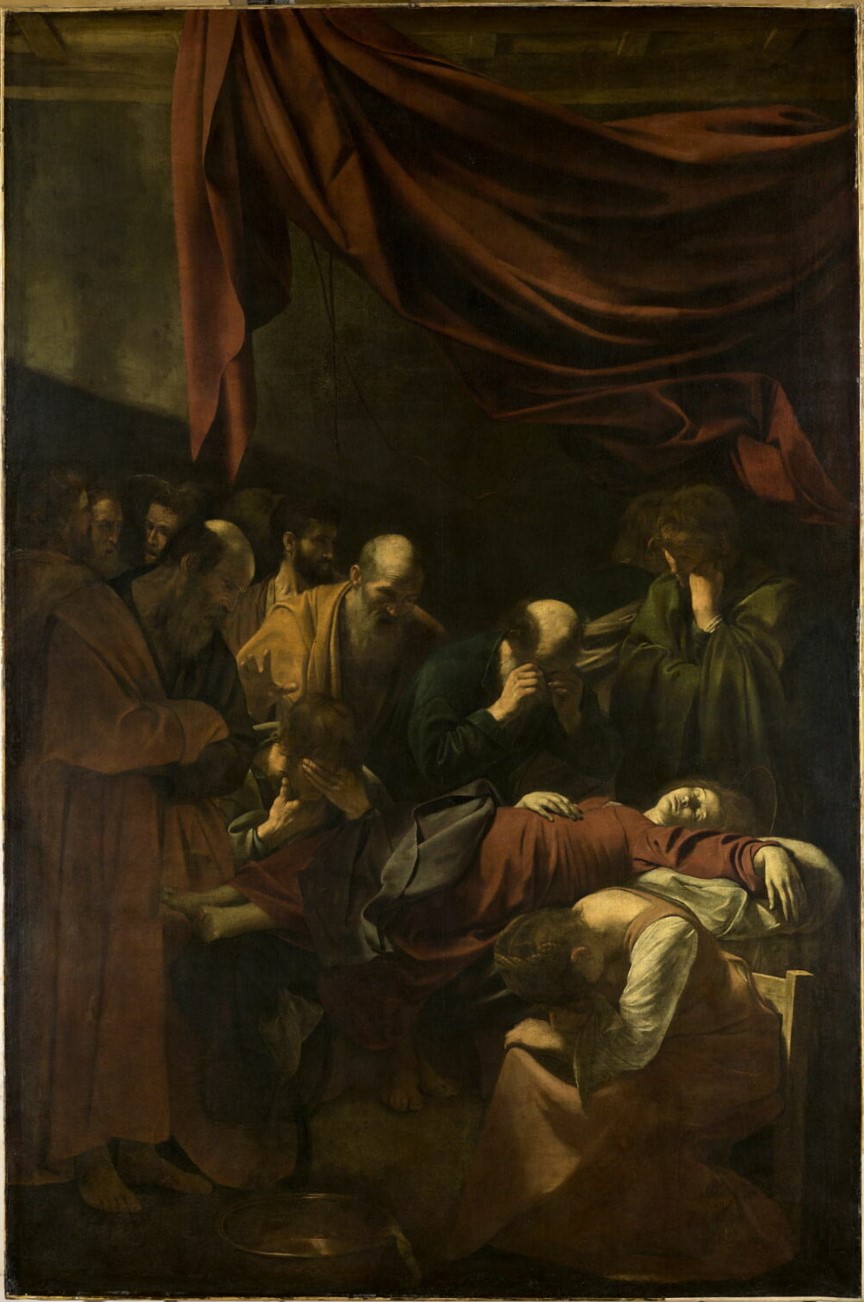
DETAIL Caravaggio (Michelangelo Merisi), The Death of The Virgin, c. 1605-1606, oil on canvas, 12’1 ½” x8’, Louvre, Paris.
Caravaggio (Michelangelo Merisi), The Death of The Virgin, c. 1605-1606, oil on canvas, 12’1 ½” x8’, Louvre, Paris.
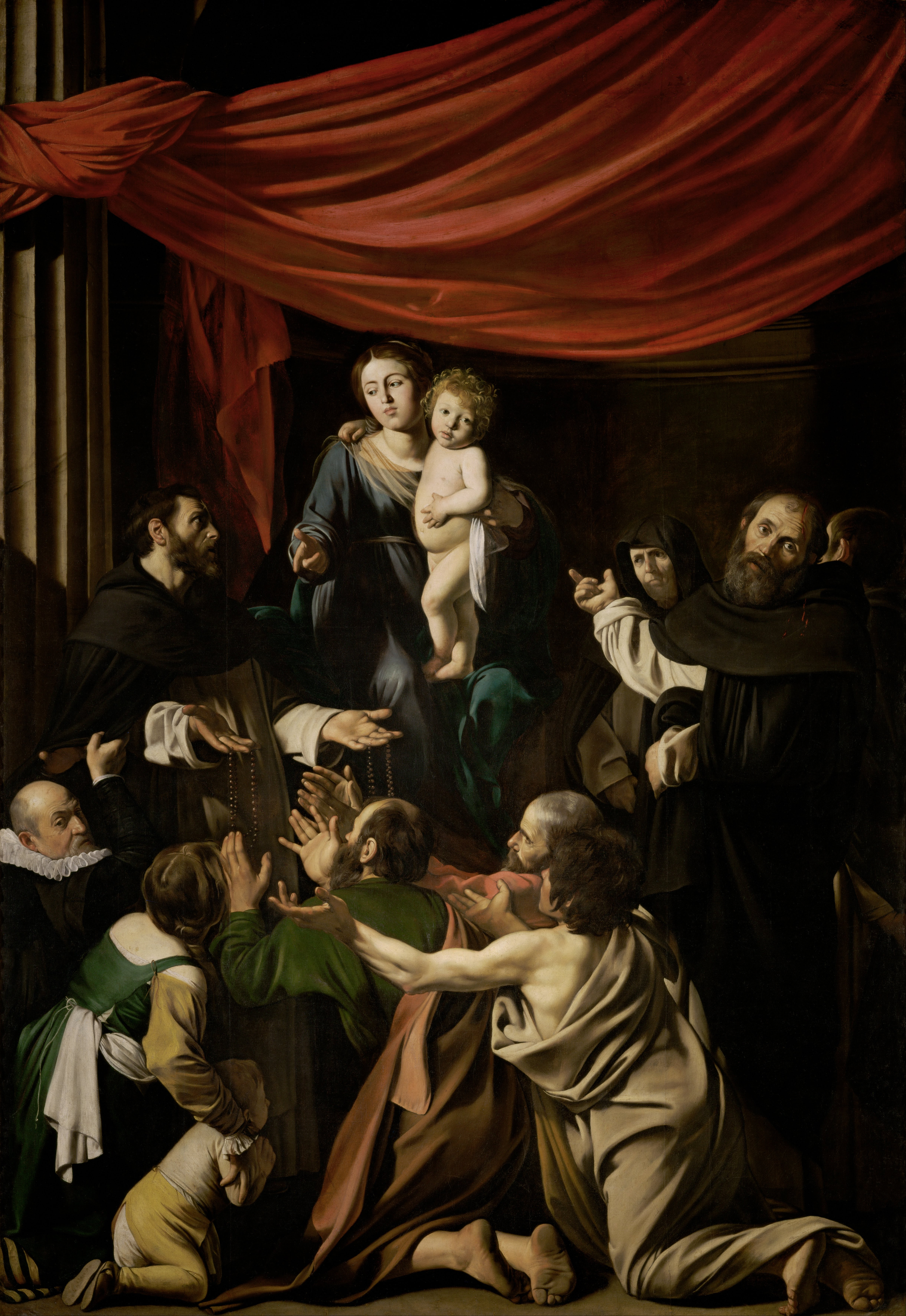
Caravaggio (Michelangelo Merisi), The Madonna of the Rosary, c. 1605-1607, oil on canvas, 11’11 ½” x8’ 4”, Kunsthistorisches Museum, Vienna.

The Madonna of the Rosary (1605-1607) is a monumental work of the Italian Baroque and one of the few large-scale, traditional altarpieces Caravaggio ever completed. Although its original patron remains unknown, the commission may have come from the powerful Colonna family, who sheltered the artist after he fled to Naples in 1606. Whoever commissioned it ultimately rejected the painting. It was taken to Naples and sold to Flemish art dealers, who transported it to Antwerp. There, a committee of artists, including Peter Paul Rubens and Jan Brueghel the Elder, purchased it for St. Paul’s Dominican Church.

The painting unfolds as both visual drama and Catholic Counter-Reformation theology, collapsing heaven and earth into a single charged moment. High above, the Madonna sits enthroned with the Christ Child as she presents the rosary to Saint Dominic, clad in the black-and-white habit of his order. The rosary serves as heaven’s answer to Dominic’s prayers in the struggle against the thirteenth-century Albigensian heresy. At right stands Saint Peter Martyr, the first canonized martyr of the Dominican Order, elevated to sainthood by Pope Innocent IV only eleven months after his death and even before the canonization of the order’s founder, Saint Dominic. To this day, Peter Martyr, the fiery preacher who fought heresy throughout Northern Italy and was murdered by an axe blow to the head in 1252, remains the fastest canonization in Catholic Church history. Gazing directly at the viewer, he points toward the Christ Child, identifying Jesus as the ultimate source of divine grace.

Below, Caravaggio brings sacred history to the world’s barefoot and struggling poor. Kneeling in the dirt, their grimy feet and outstretched hands reach for the rosaries being distributed through Saint Dominic. In the left foreground, a wealthy donor in a black coat and crisp white ruff kneels while looking directly outward, drawing viewers into the drama.

In 1781, the painting was confiscated from St. Paul’s Dominican Church when Emperor Joseph II pressured the Dominicans to surrender, or “donate,” the masterpiece to his imperial collection. Today, it remains one of Caravaggio’s essential late works and a centerpiece of the Kunsthistorisches Museum in Vienna, where its powerful blend of realism, devotion, and theatrical display continues to command attention.
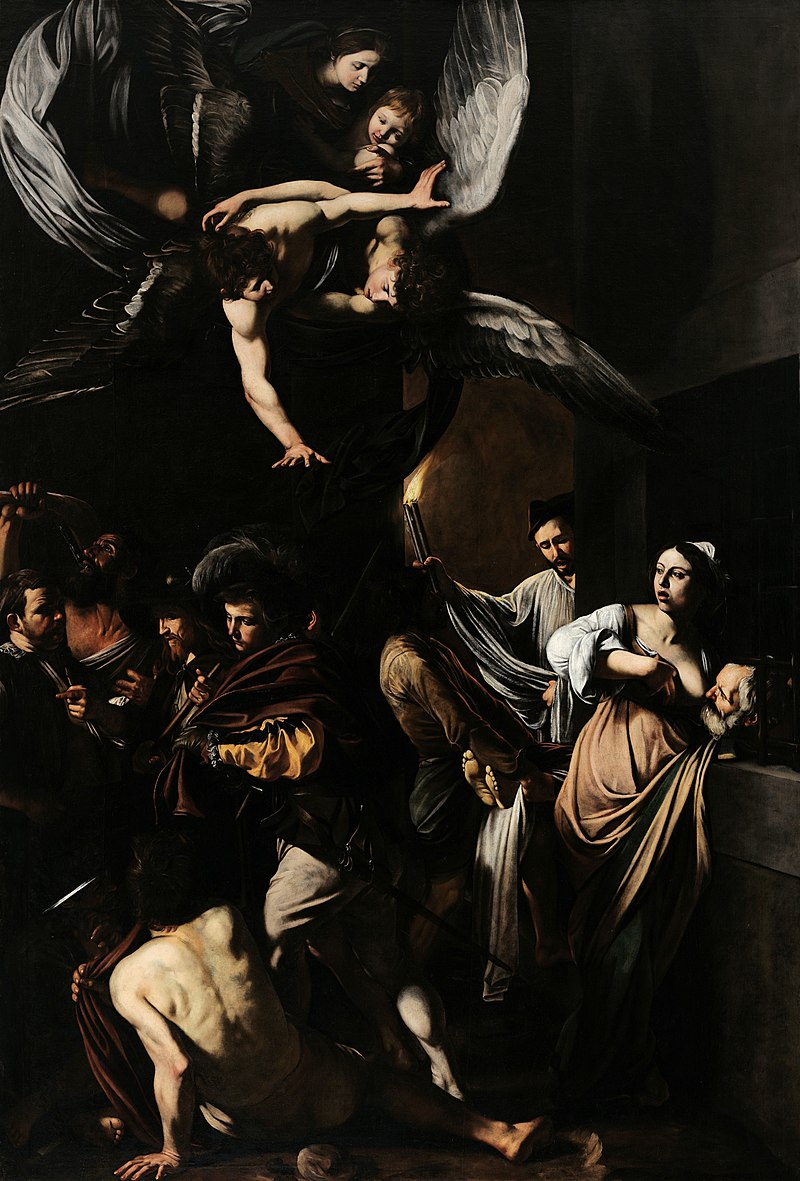
Caravaggio (Michelangelo Merisi), The Seven Acts of Mercy, 1606, Oil in canvas, 12’ 9 ½” x 8’ 6 ½” Pio Monte della Misericordia, Naples.

The Seven Acts of Mercy altarpiece was painted between September 23, 1606 and January 9, 1607 for which Caravaggio was paid 400 ducats. The commission required that the artist include the figure of the Madonna of the Misericordia and all the acts of mercy in one vertical canvas and whose overall achievement was a first in Italian art.
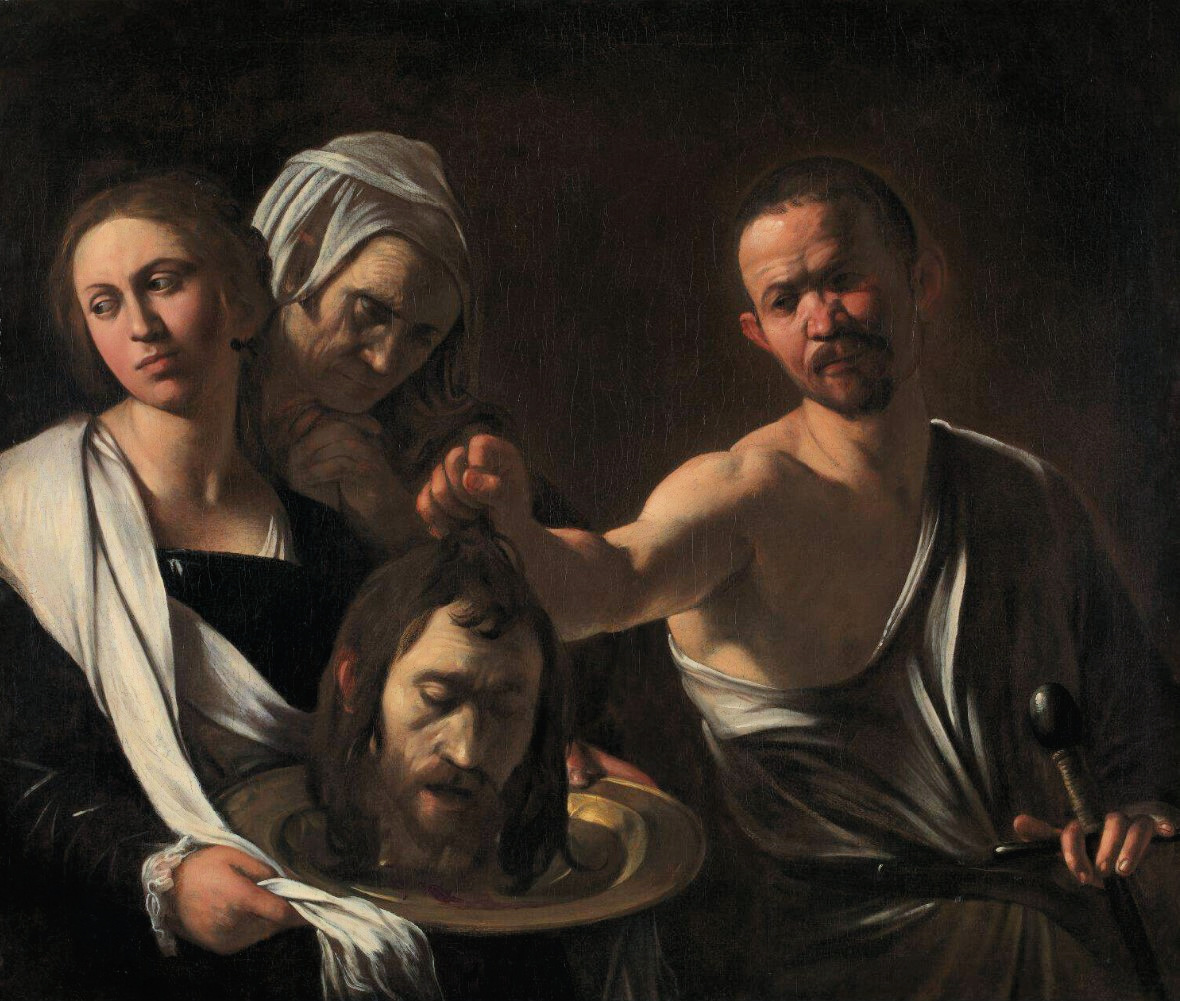
Caravaggio (Michelangelo Merisi), Salome, 1609/10, oil on canvas, 35 5/8 x 65 ¾” The National Gallery London.
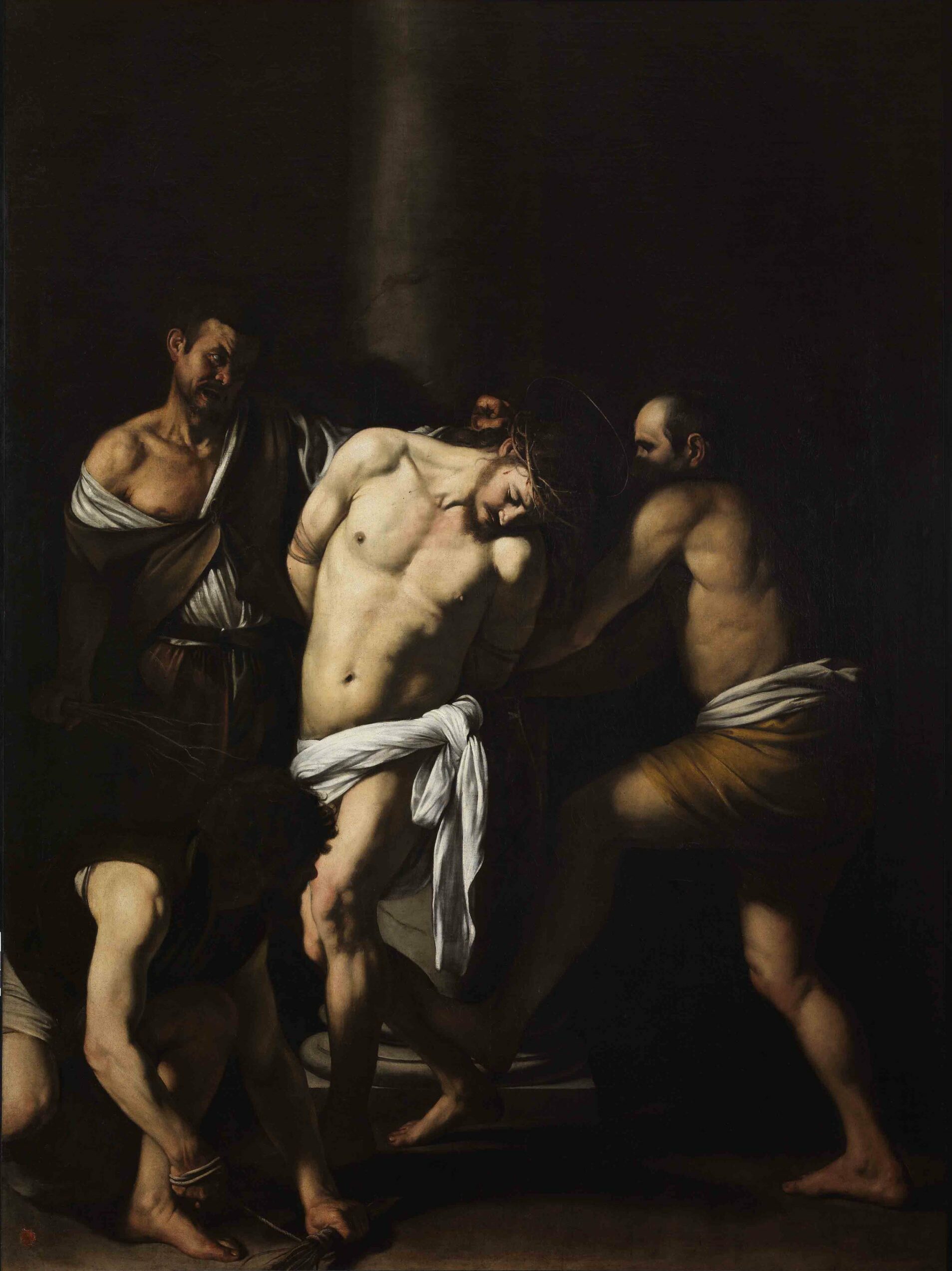
Caravaggio (Michelangelo Merisi), The Flagellation, 1607, oil on canvas, 9’ 4 ½” x 6’2” Capodimonte Museum, Naples.
Caravaggio (Michelangelo Merisi), David With the Head of Goliath, 1607 or 1609/10, oil on canvas, 49 ¼ x 39 3/8”, Borghese Gallery, Rome. https://borghese.gallery/collection/paintings/david-with-the-head-of-goliath.html – retrieved October 14, 2024.

The dramatic play of light and shadow throws into relief the melancholic expression on David’s face and the hauntingly lifelike head of Goliath, creating a palpable sense of guilt and redemption that resonates deeply with the viewer.
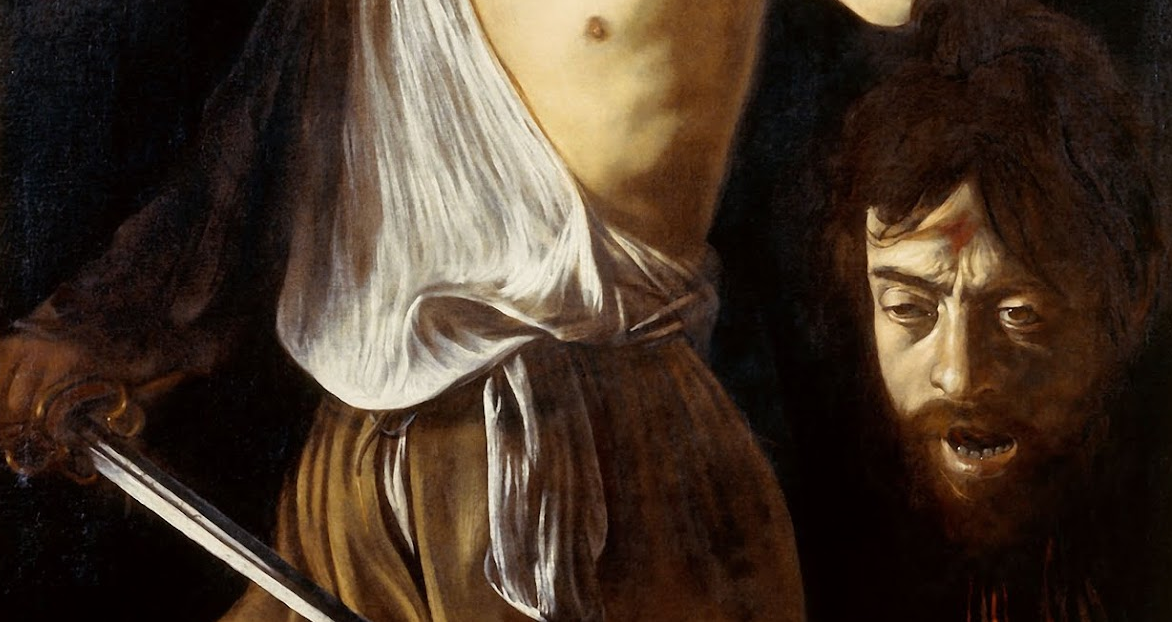
The head of Goliath is Caravaggio’s self portrait.

In addition to developing a considerable name as an artist, Caravaggio was a reputably volatile, bad-tempered and violent man. On May 29, 1606 Caravaggio killed Ranuccio Tomassoni in a fight, the cause of which is disputed, though it may have been over a Roman prostitute, Fillide Melandroni who had posed for Caravaggio several times. The capital crime forced Caravaggio to flee to Naples. A report written by the local coroner declared that the male victim died by Caravaggio’s attempt to castrate him, the code on the Roman street meriting it for a man who insulting another man’s woman. Caravaggio became a fugitive from the law though he continued to paint (Supper at Emmaus) and fled to Naples by the end of 1606. In Naples he painted Flagellation and Seven Works of Mercy, among others. He fled further to Malta and then to Sicily where Caravaggio moved from town to town across the island fearing some unnamed retribution. It was presumed that 38-year-old Caravaggio died from syphilis or perhaps malaria or the Malta Fever though there is current speculation the artist may have been murdered in revenge for his crimes by perhaps members of the Tomassoni family or the Royal Knights. see – https://www.italianartsociety.org/2018/05/on-29-may-1606-the-great-italian-baroque-painter-caravaggio-killed-ranuccio-tommasoni-in-rome/ ; https://thecinemaholic.com/ranuccio-tomassoni-caravaggio/– retrieved October 15, 2024.
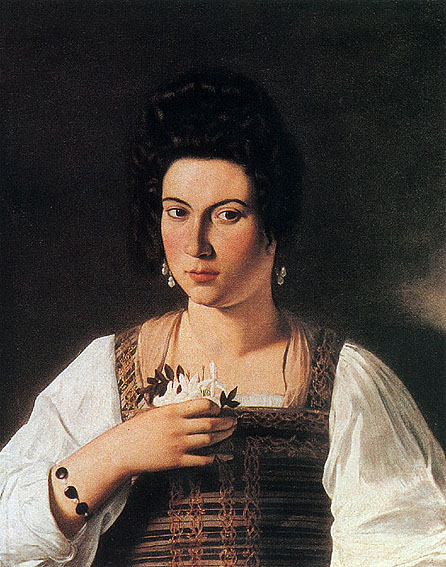
Caravaggio (Michelangelo Merisi), Portrait of a Courtesan (Fillide Melandroni), c, 1599. Destroyed Berlin 1945.
Caravaggio (Michelangelo Merisi), Supper at Emmaus,1606, oil on canvas, 141 x 175 cm, Pinacoteca di Brera, Milan.

Caravaggio’s later Supper at Emmaus in Milan’s Brera Gallery intensifies the drama and imposes greater stylistic discipline compared to the earlier London version painted five years prior. The gestures are more restrained and the palette more muted, allowing the dramatic accents to emerge with heightened clarity despite the overall reduction of detail. Objects are rendered with deliberate precision—the urn angled toward the viewer, the plates catching narrow rims of reflected light—each contributing to the painting’s controlled visual rhetoric.

The composition organizes itself in a semicircular sweep of gestures around the table, rising diagonally from Christ’s head to the sharply profiled disciple and then to the standing figures beyond. The entire scene is suffused with a concentrated, directional illumination that culminates on the face of the risen Christ, reinforcing the painting’s theological and dramatic center.

SOURCE: Brera Milan: Great Museums of the World (Great Museums of the World, volume 14), Newsweek, Inc. & Arnoldo Monadori Editore, 1970, pp. 68-69.
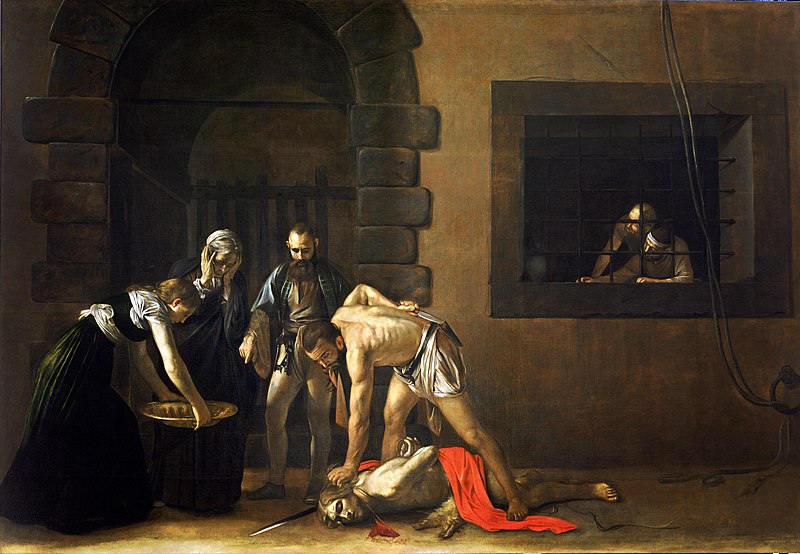
Caravaggio (Michelangelo Merisi), The Beheading of St John, 1608, St John’s Co-Cathedral, Valetta, Malta.
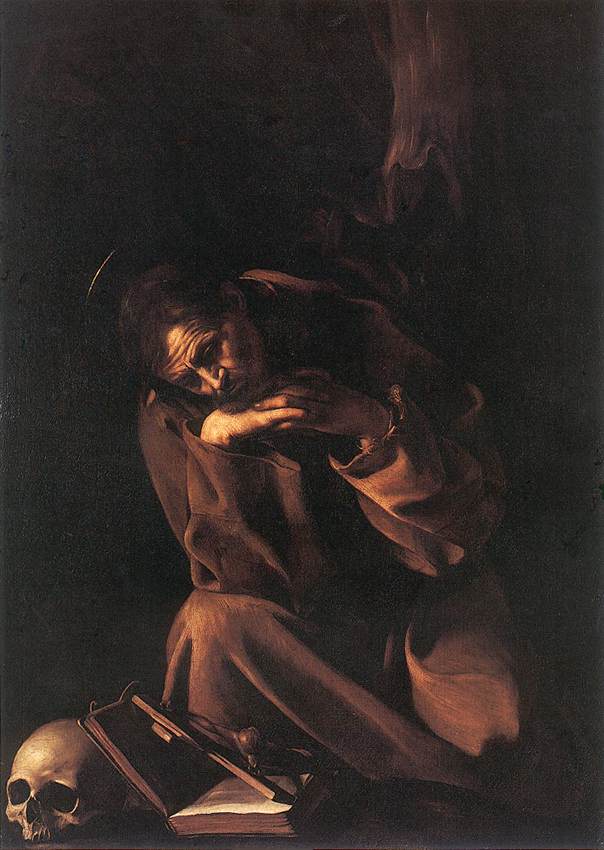
Caravaggio (Michelangelo Merisi), St. Francis of Assisi in Meditation, 1606/07, oil on canvas, Pinacoteca Civica Museo ala Ponzone Cremona.
Caravaggio (Michelangelo Merisi), Portrait of Alof de Wignacourt with his Page, 1606/07, oil on canvas, 195 x 134 cm, Louvre.

The subject was the Grand Master of the Knights of Malta. In exchange for this grand portrait, according to Bellori and Baglione, Caravaggio became a Knight of Malta on an accelerated timetable though soon after the artist fled the island in disgrace.
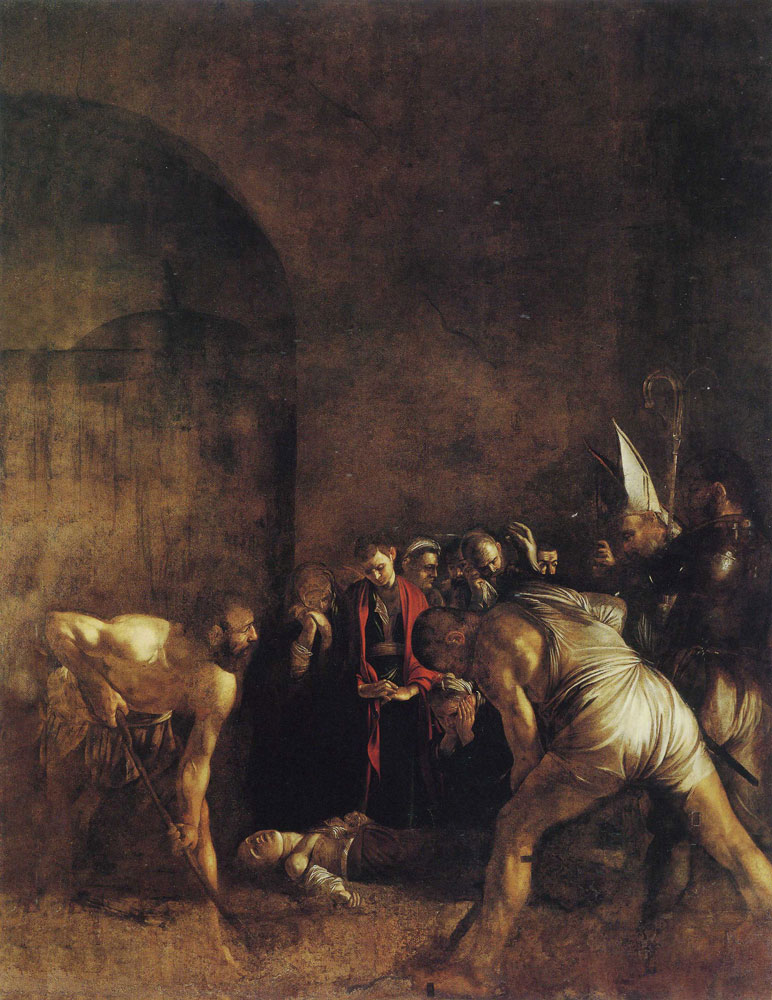
Caravaggio (Michelangelo Merisi), The Burial of Saint Lucy, 1608/9, oil on canvas, 13′ 4 1/2″ x 9′ 10″ 408 x 300 cm, Church of Santa Lucia,Syracuse in deposit at the Galleria Regionale, Palazzo Bellomo, Syracuse, Sicily.

The famous Caravaggio painting depicting the burial of Santa Lucia once hung in the Church of Santa Lucia al Sepolcro, but today is in Siracusa’s Palazzo Bellomo museum. The original church, built as early as the 6th century, was on the site of Saint Lucy’s martyrdom in the early 4th century. Beneath the sanctuary is a vast labyrinth of dark catacombs dating from the 3rd century which have never been completely explored and are closed to the public. Once containing the tomb of the decapitated saint, her remains were relocated to Venice during the Crusades and where they can be found today. This painting was made by Caravaggio between October 1608 in Malta and early 1609 in Sicily in a commission arranged by his old friend painter Mario Minniti. Caravaggio was on the run in Sicily starting in late 1608 when he arrived into Siracusa, and then onto Messina followed by Palermo. In Sicily, the exile Caravaggio painted Resurrection of Lazarus, The Adoration of the Shepherds (Adorazione dei pastori) and Ecce Homo. In late 1609 he returned to Naples and continued painting, including another St. John the Baptist and, his final artwork, The Martyrdom of St. Ursula. In Naples the artist was attacked in the street by four armed men shortly after his arrival where Caravaggio was seriously injured. see – https://www.frommers.com/destinations/syracuse-and-ortygia-island/attractions/santa-lucia-al-sepolcro; https://www.great-sicily.com/post/the-byzantine-era-in-sicily – retrieved October 15, 2024.

Caravaggio (Michelangelo Merisi), Adorazione dei pastori (The Adoration of the The Shepherds), 1609, oil on canvas, 10′ 3 1/2 ” x 6′ 11″, Messina, Sicily, Museo regionale interdisciplinare.

The work was painted for the Church of Santa Maria della Concezione in Messina. Francesco Susinno (1670-1739) states that the commision was a civic not religious one, though apparently the Archbishop of Messina, Franciscan Bonaventura Secusio (d. 1618), supported the project. see – https://federica90.wixsite.com/emozionearte/post/caravaggio-in-sicilia-l-adorazione-dei-pastori-di-messina – retrieved October 15, 2024.
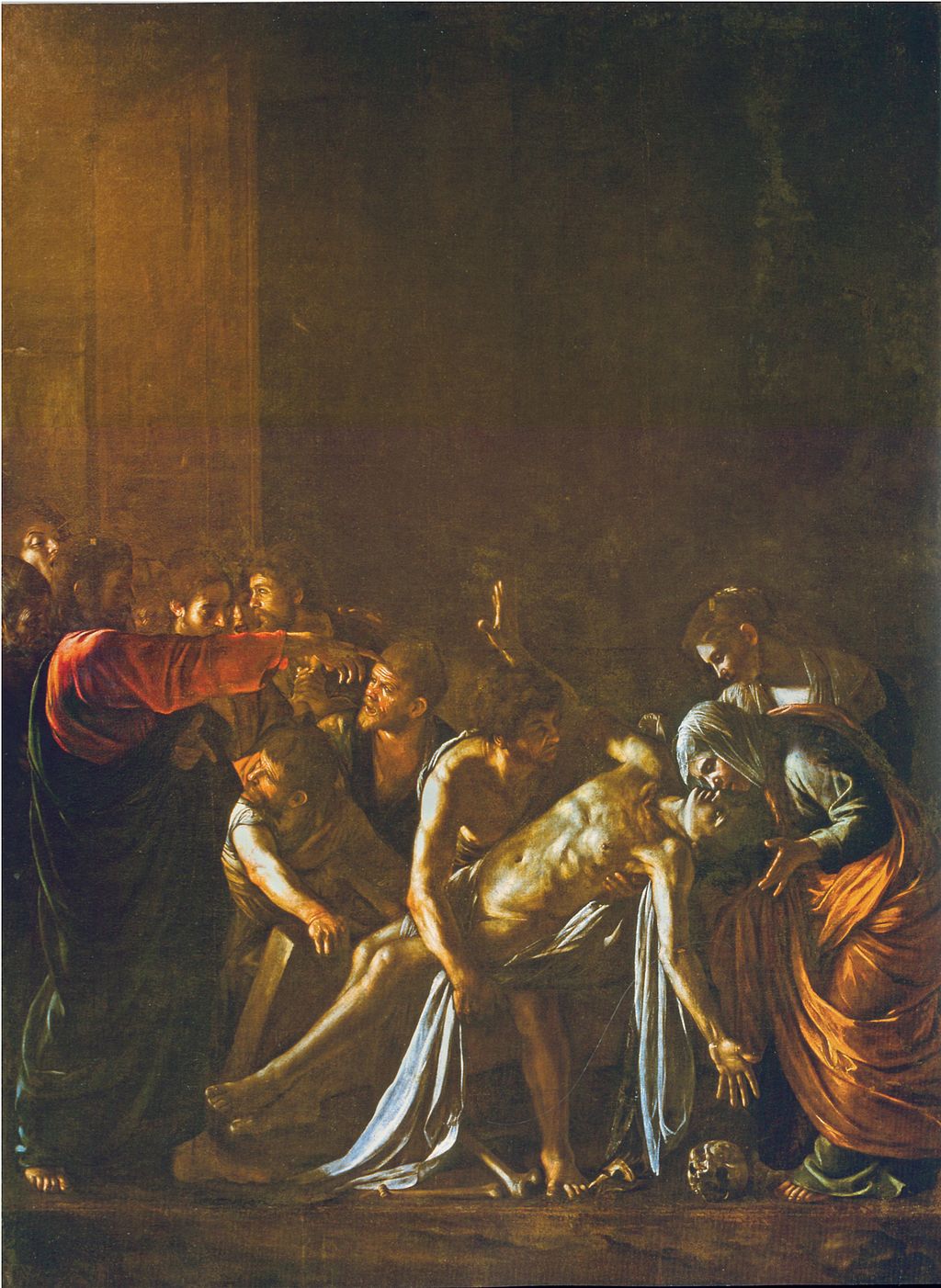
Caravaggio (Michelangelo Merisi), La Resurrezione di Lazzaro (The Resurrection of Lazarus), 1609, oil on canvas, 10′ 3 1/2 ” x 6′ 11″, Messina, Sicily, Museo regionale interdisciplinare.

In Malta Caravaggio became a Knight of Malta but got into another violent group brawl where a knight was badly injured. With a warrant put out for his arrest Caravaggio managed to flee to Sicily in October 1608. By December 1608 Caravaggio was found guilty in abstentia and removed from the Maltese order. The commission for this painting came from Giovanni Battista de’ Lazzari, a merchant of Genoese origin who had obtained permission to be buried in the choir chapel of the church of Saints Peter and Paul de’ Pisani (demolished in 1880) in Messina where Camillo de’ Lellis’ religious order, founded in 1591 and dedicated to the care of the sick, had a house. De’Lazzari’s signed contract on December 6, 1608, declared that his new altarpiece would have the Madonna and St. John with saints as its subject. But that was changed to the resurrection of Lazarus (Gospel of John, chapter 11). It is very likely the change was made by De’Lazzari in agreement with the Camillians. According to Susinno, the artwork’s 13 figures were staff members of the hospital where Caravaggio did the painting. see – https://federica90.wixsite.com/emozionearte/post/caravaggio-in-sicilia-la-resurrezione-di-lazzaro – retrieved October 15, 2024.
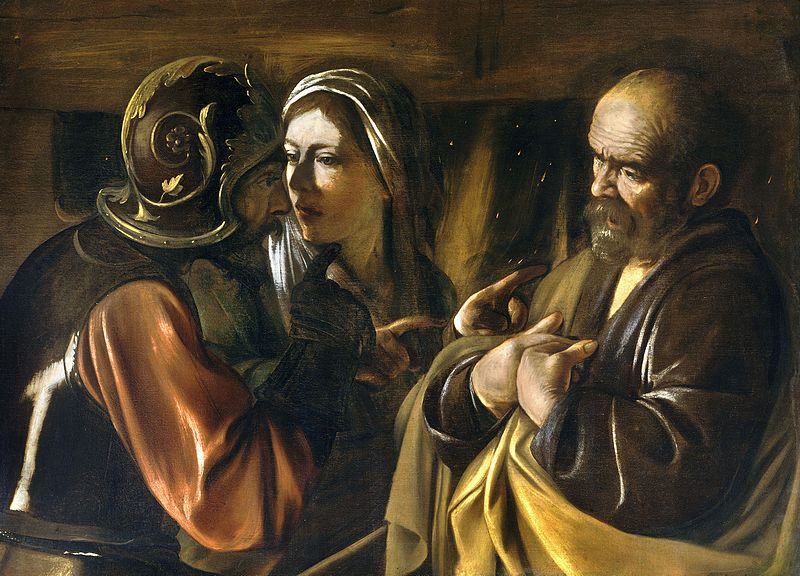
Caravaggio (Michelangelo Merisi), The Denial of St. Peter,1609/10, oil on canvas, 94 x 125.4 cm, The Metropolitan Museum of Art, New York.

The Denial of Saint Peter is generally thought to be one of the last pair of artworks by Caravaggio, the other being The Martyrdom of Saint Ursula. It was probably finished at Naples in the summer of 1610.
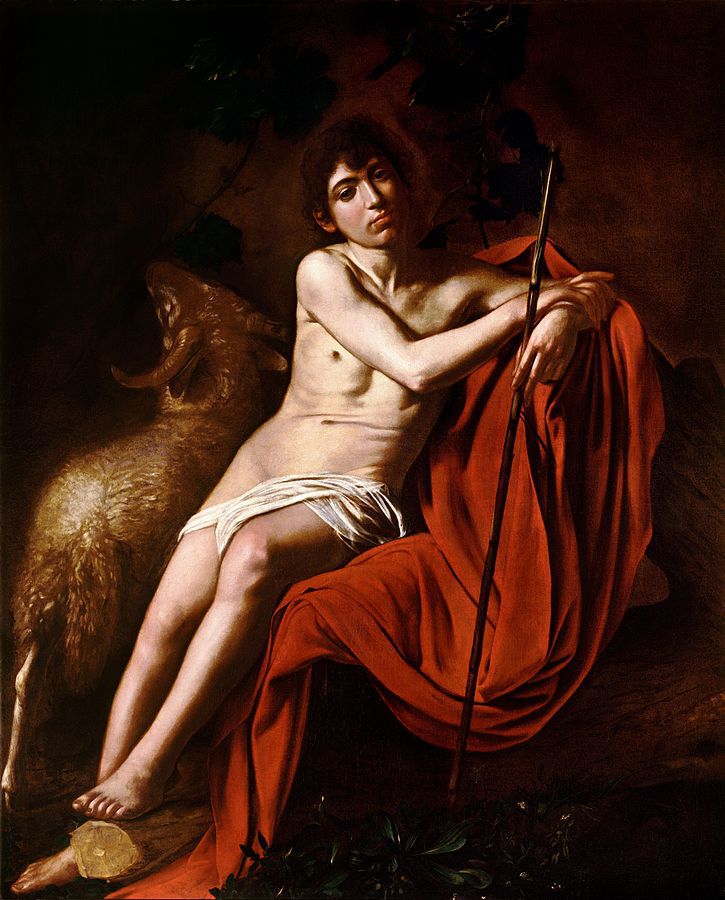
Caravaggio (Michelangelo Merisi), St. John the Baptist, 1610, oil on canvas, 159 x 124.5 cm, Galleria Borghese, Rome.

Caravaggio carried this painting and others sailing from Naples to Rome hoping for a pardon from the pope. Instead, when the desperate artist landed he was arrested and the boat was sent back to Naples with the paintings. Caravaggio died on July 18, 1610 in Porto Ercole. The papal nuncio secured this painting for Cardinal Scipione Borghese. see – https://www.dailyartmagazine.com/caravaggios-martyrdom-of-saintt-ursula/ – retrieved October 15, 2024.

LAST PAINTING.
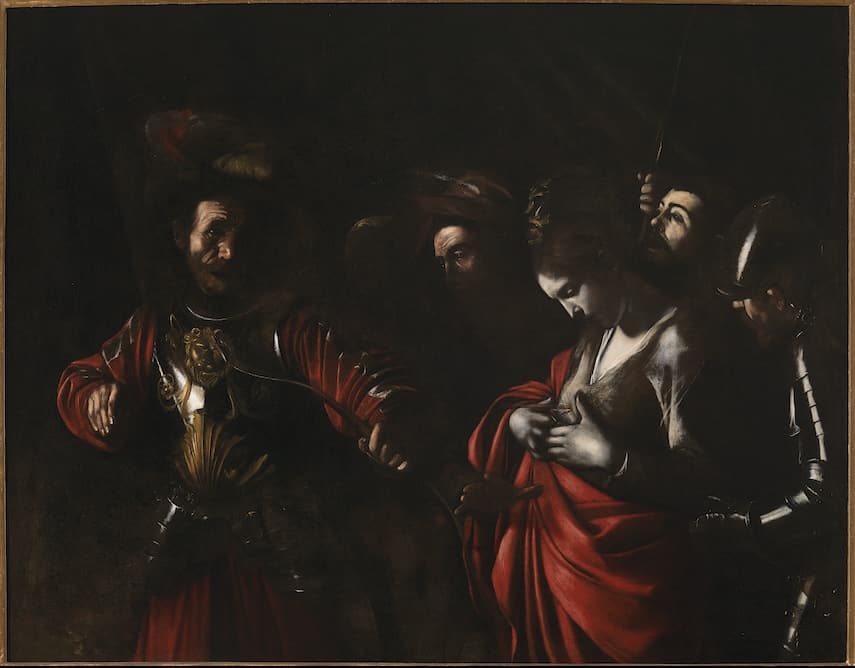
Caravaggio (Michelangelo Merisi), The Martyrdom of Saint Ursula, 1610, oil on canvas, 142 x180 cm,
Naples, Galleria di Palazzo Zevallos Stigliano.

Caravaggio’s The Martyrdom of Saint Ursula was painted in the last month of his life. It contains his characteristic and revolutionary chiaroscuro, naturalism, and depiction of psychological and physical emotion. The Martyrdom of Saint Ursula was commissioned by Genoese art patron Marcantonio Doria. The painting was finished in May and arrived in Genoa in mid-June 1610. Ursula was a venerated but almost completely legendary figure. In typical fashion Caravaggio dispels traditional religious iconography associated with Ursula — a crown, halo, palm branch, the 11,000 virgin martyr companions — for the painful moment in her story when the Barbarian king shoots the arrow into Ursula’s chest that kills her.

Caravaggio’s The Martyrdom of Saint Ursula marked a watershed in European art. His revolutionary style inspired subsequent generations of painters, such as Artemisia Gentileschi (1593—1651), Giovanni Baglione (1566-1643), and Orazio Gentileschi (1563–1639), that became known as the Caravaggisti. He also influenced international Baroque artists including Spaniard Diego Velázquez (1599-1660) and Dutchman Rembrandt van Rijn (1606-1669). see – https://www.widewalls.ch/magazine/the-martyrdom-of-saint-ursula-caravaggio – retrieved October 15, 2024.
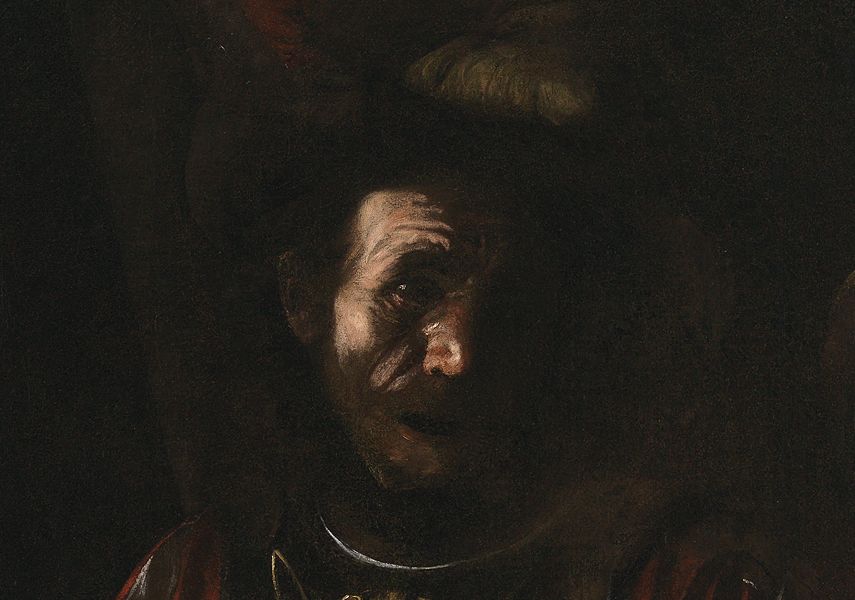
Detail of above.

SOURCES –

Caravaggio, Gilles Lambert, Taschen, Cologne, 2007.

Caravaggio, Alfred Moir, Harry N. Abrams, Inc., New York, 1989.

Caravaggio: The Complete Works, Sebastian Schütze, Taschen, Cologne, 2021.

Caravaggio, Timothy Wilson-Smith, Phaidon, London, 1998.

Caravaggio, Howard Hibbard, Harper & Row Publishers, New York, 1983.

Caravaggio The Artist and His Work, Sybille Ebert-Schifferer, Getty, 2012.
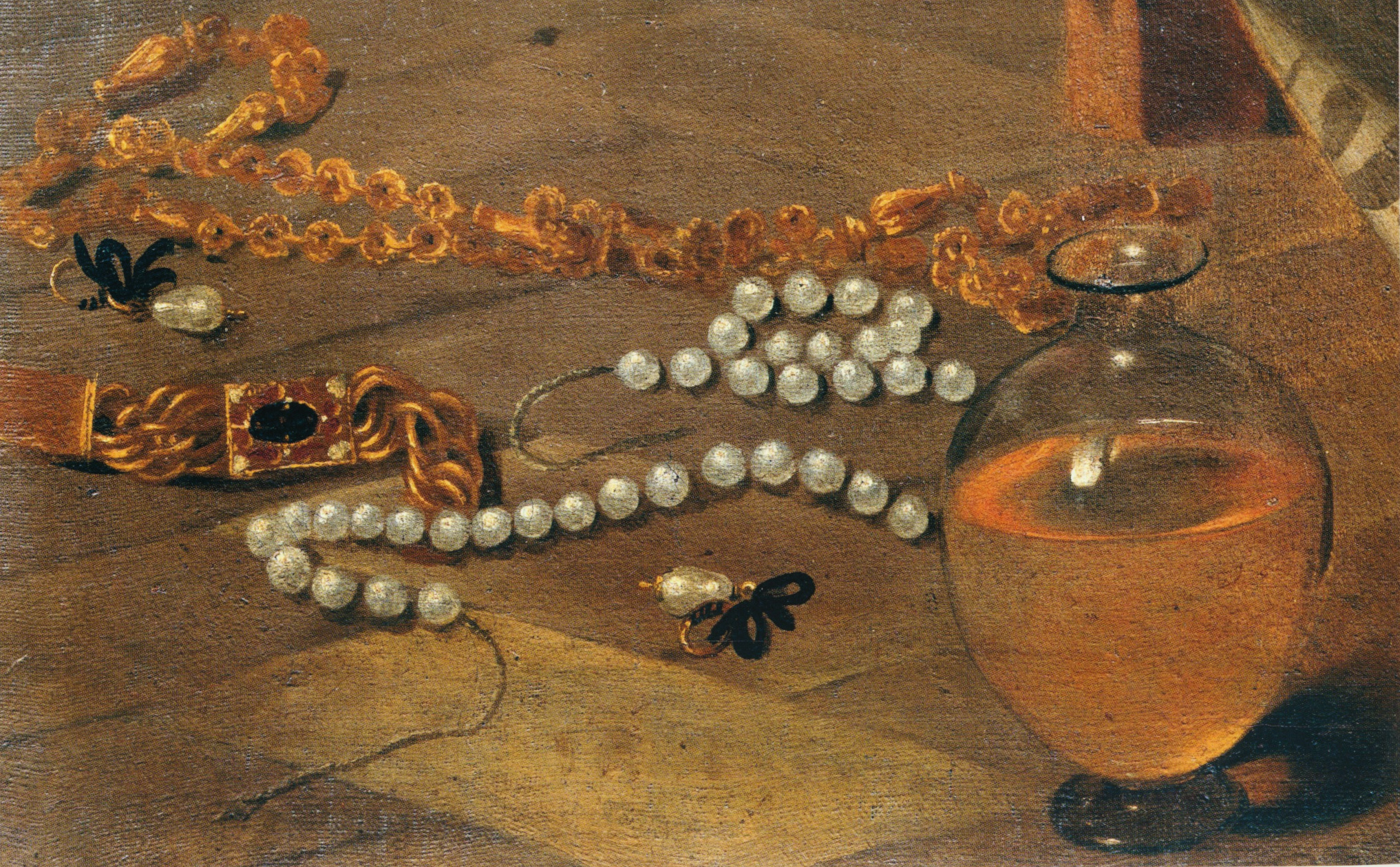
Caravaggio: Detail of The Pentitent Magdalene, c. 1597. Galleria Doria- Pamphili, Rome.

This explanatory article may be periodically updated.

Raphael (1483-1520) and the Making of the High Renaissance. (50+ artworks).

FEATURE Image: Raphael, Portraits of Agnolo Doni and Maddalena Doni, c. 1506, oil on panel, 24  ¾  x 17 ¾” Pitti Gallery, Florence.

Raphael, Self-portrait at 23 years old, 1504–1506. Tempera on panel, 47.5 cm × 33 cm (18.7 in × 13 in), Palazzo Pitti, Florence, Italy.

INTRODUCTION.

Urbino, Florence, and Artistic Formation Born in Urbino in 1483, an environment rich in the arts and humanist learning, Raphael had a remarkable capacity for personal growth and branded new incarnations of his artistic style regularly. He moved to Florence toward the end of 1504. Giorgio Vasari in his chapter on Raphael describes an episode where the artist of Urbino, already in his thirties with a reputation as a master, went back to study the nude (male) form with Michelangelo as his guide. Vasari’s admiration in telling this story goes beyond Raphael’s humility in assuming the role of student again (he studied constantly anyway) but that his learning always improved his artistic output.

Learning from Perugino, Leonardo, and Michelangelo In the study of nudes, however, artistic growth came perhaps not as the artist expected or intended. Whether Raphael entered the workshop of Perugino at that time or, as seems more likely, many years later when he was already an acknowledged artist, he quickly mastered Perugino’s delicate, ornamental style, with its open landscapes and gentle figures. It was said that contemporaries had trouble distinguishing Perugino’s work from Raphael’s, but Raphael’s compositions were more sophisticated even when he was a young artist. While Raphael mastered Michelangelo’s (and Leonardo’s) art forms convincingly, he also realized he was no match for the creator of the Sistine Chapel and other chiseled works insofar as the nude male forms.1

Testing Limits and Discovering Strengths Yet Raphael consolidated his strengths by testing his limits. A major strength, Vasari believed, was Raphael’s ability to draw and compose a wide range of subjects, such as landscape, architecture, draperies, and the human figure. Up to that time that had been what the artist was doing and would now unflinchingly continue to do on a grander scale, for example, in the Stanzae.

Rome and the High Renaissance Ideal In 1508 the pope called Raphael to Rome. Influenced by the idealized, classical art of the city’s ancient past, Raphael’s work took on a new grandeur. He also responded to the more energetic and physical style of Michelangelo, whose works he had already begun to study in Florence. Vasari believed Raphael had the gift to congeal the “poetic moment” by depicting in his painting the most significant gesture and force of action. With the possible exception of Leonardo, he is probably the unparalleled master of excellent design.2

Raphael and the Popes The precocious Raphael Sanzio also benefited from early opportunities given to him by his father to cultivate his talent. The artist’s own determination to succeed in his métier paid off when he was summoned to work at the Vatican by the Pope in 1509, arguably the greatest art patron in an age of art patrons. 3 The early sixteenth century was an age where patrons were as luminous as their artists and the coming together of Raphael and Julius II, and later Leo X, made for a celebrity team.

Vasari’s Judgment of Raphael While Vasari meticulously tells the reader of the artist’s “judicious” character – and that Raphael was extremely “amatory” and implying it aided in his death – the chronicler describes, often from memory, his preferences in Raphael’s art work.  His collective response, for example, to all four frescos in the Camera d’Eliodoro is that he is most impressed by Raphael’s interesting decorative details, beautiful movements and gestures, the sheer number of figures portrayed, and his ability to express complex ideas and stories on a two-dimensional surface.4

Raphael’s Enduring Legacy With Leonardo da Vinci (1452-1519) and Michelangelo (1475-1564) Raphael is one of the great masters of the High Renaissance. Raphael and his large team of assistants left behind a large body of influential work, especially in the Vatican where the artist spent the last 12 years of his life, although Raphael died at 37 years old. For most of the history of Western art, the easy grace and harmonious balance of Raphael’s style has represented an ideal of perfection. His work became widely influential through the dissemination of prints. Raphael was also the city’s leading portraitist, creating penetrating psychological images that engaged viewer and sitter with a new intensity.

FROM URBINO TO FLORENCE: THE FORMATION OF A MASTER

Raphael, S. Niccolo Da Tolentino Altarpiece, 1501, oil on panel, 44 x45 ¼ in., Capodimonte Museum, Naples, Italy.

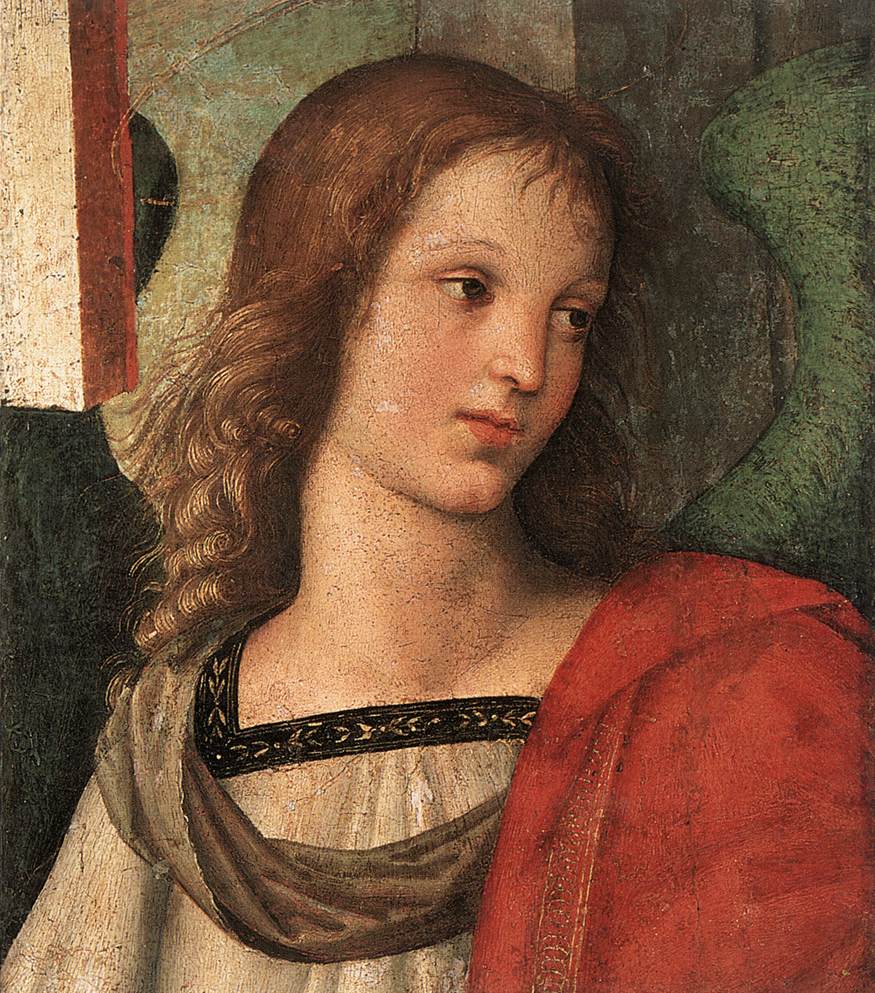
The Baronci Altarpiece is Raphael’s first recorded commission. It was made for the patron’s chapel in the church of Sant’Agostino in Città di Castello, a commune between Arezzo and Urbino, north of Perugia. In 1789 the artwork was badly damaged in an earthquake and surviving fragments were acquired by the Vatican until they mysteriously dispersed in the mid-19th century and found their way into different collections. Raphael’s commission of 1501 was to paint a large altarpiece dedicated to the Augustinian saint Nicholas of Tolentino (c. 1246– September 10, 1305). Nicholas was canonized by Augustinian Pope Eugene IV in 1446.  While today’s saints require 1-2 miracles, St. Nicolas Tolentino was credited at his canonization with 300 miracles – including 3 resurrections. (see – Encyclopedia of the Middle Ages, Volume 2, André Vauchez, Richard Barrie Dobson, Michael Lapidge. Chicago: Fitzroy, Dearborn, 2000).

Raphael, angel, fragment Baronci altarpiece. Pinacoteca Tosio Martinengo, Brescia.
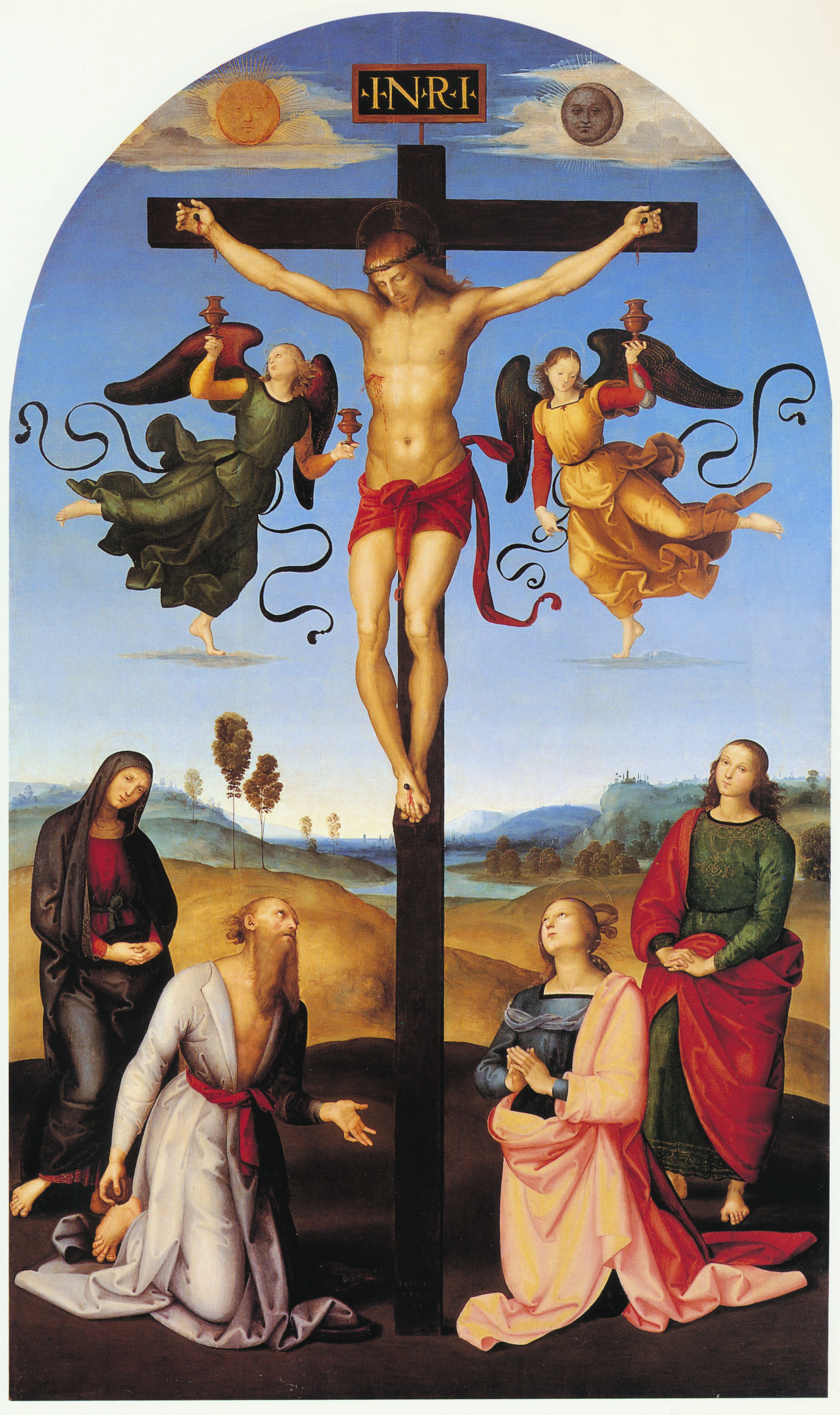
Raphael, The Crucifixion, 1502-03, oil on polar, 283.3 × 167.3 cm, National Gallery, London.

The Crucifixion was done in 1503 for Domenico Gavari for his S. Domenico chapel in Città di Castello. Angels are poised on toes on a cloud as their cups catch Christ’s dripping blood. Mary Magdelene and St. Jerome (holding a rock) are on their knees while the Virgin Mary and St. John stand. The sun and moon in the sky was characteristic of Crucifixion paintings in Umbria (p. 13, Jones & Penny). It was bequeathed to the National Gallery in 1924. Gavari was a close friend of Andrea Baronci, for whom Raphael painted the Saint Nicholas of Tolentino Altarpiece for the church of S. Agostino, also in Città di Castello. Saint Jerome, of course, was not present at the Crucifixion but is included in this scene because the chapel was dedicated to him. The overall design is based on several versions of the crucified Christ in a landscape painted by Perugino in the late 1480s and 1490s, and is especially similar to his altarpiece of the Crucifixion for the convent of S. Francesco al Monte in Perugia, commissioned in 1502 and completed 1506. https://www.nationalgallery.org.uk/paintings/raphael-the-mond-crucifixion – retrieved September 5, 2024.

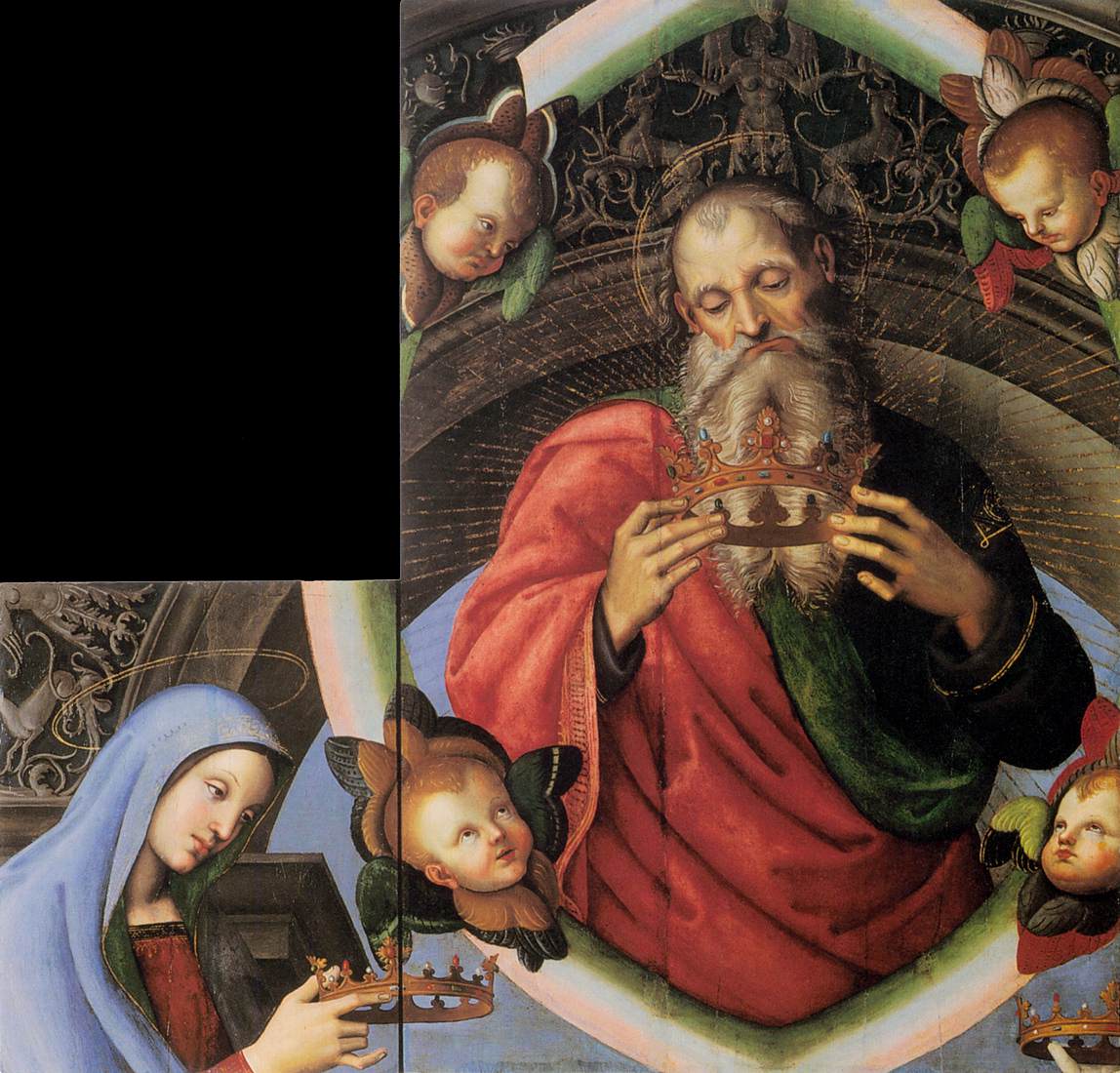
Raphael, Coronation of the Virgin (Oddi Altarpiece), 1503-1504, Oil on canvas, 8’9” x 5’4”, Pinacoteca, Vatican, Rome.

Raphael painted altarpieces for the Augustinians and Dominicans and the Oddi Altarpiece (above and below) was done for the Franciscans. It was commissioned by the Oddi family chapel in S. Francesco al Prato. The Oddi were in exile from Perugia since 1495 because of battles between families and returned in 1503. The altarpiece was part of honoring their family members. The painting is divided into an upper part depicting the coronation of the Virgin and, in the lower part, the Apostles at the time of the Assumption. In the center, the apostle Thomas holds the Virgin’s girdle that the Virgin lowered to him as a token of these supernatural events. This display of theology was precious to the Franciscans at the time who were promoting the Virgin Mary. They were likely very involved in directing the artist in its composition. (Roger & Jones, pp. 15-16).

Raphael, Coronation of the Virgin (Oddi Altarpiece), 1503-1504, Oil on canvas, 8’9” x 5’4”, Pinacoteca, Vatican, Rome. DETAIL.
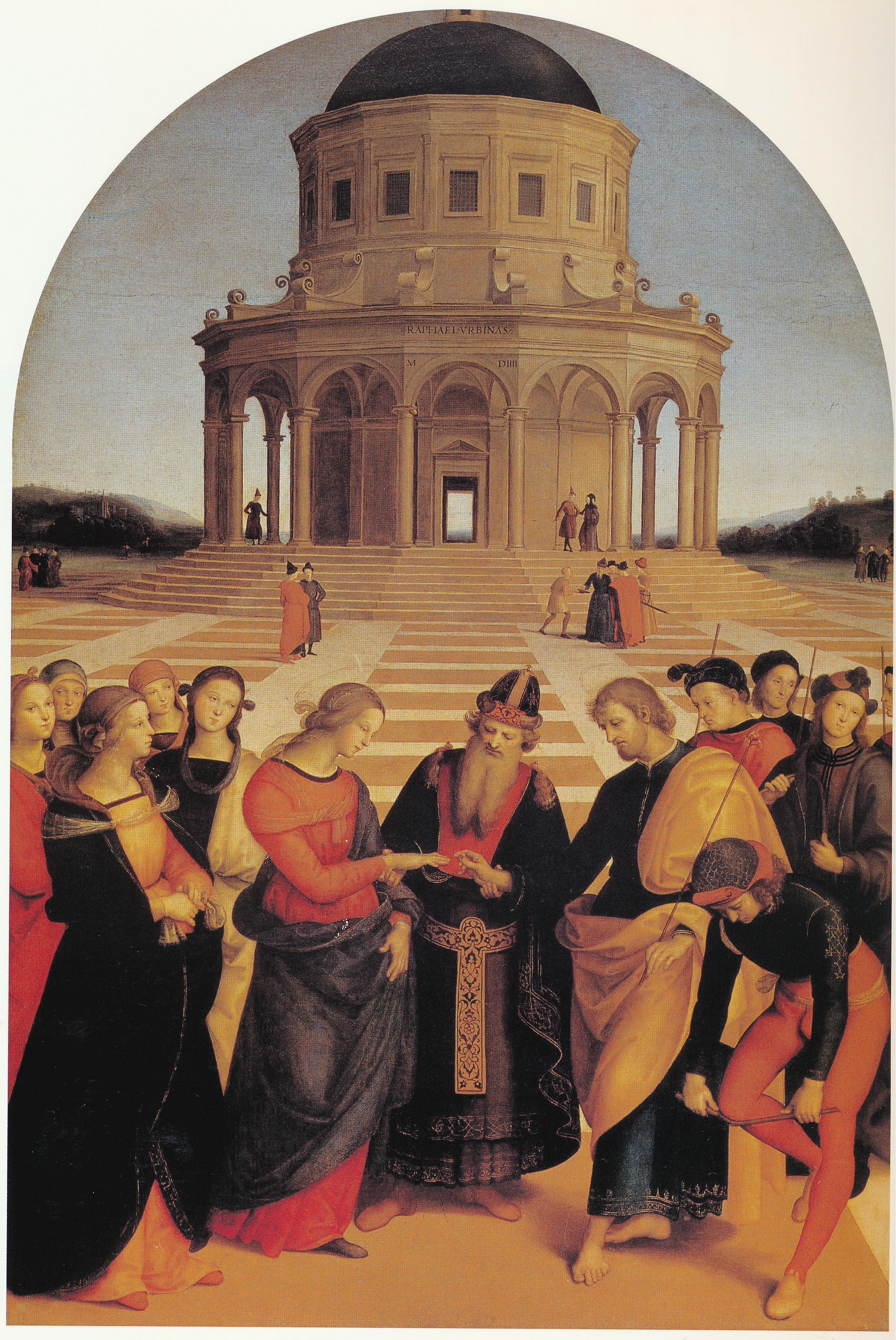
Raphael, Spozalizio (The Engagement of the Virgin Mary), 1504, oil on panel, 67 x 46 ½” Brera Gallery, Milan.

The composition of the Spozalizio reflects the influence of Perugino, specifically the fresco done by him in the Sistine Chapel in 1484. In terms of its architectural setting, Raphael was influenced by Piero della Francesca (c.1416-1492) and Bramante (1444-1514). The painting’s architectural structure shares centrality in the painting with the foreground figures done in a perspectival arrangement. Within the figures are members of the party positioned in depth. Joseph places a ring on Mary’s finger whose positioning bisects the artwork. A tawny gold tone pervades the painting. It was commissioned by the Alberini family for a chapel in S. Francesco of the Friars Minor at Città di Castello in Perugia. (Brera Milan, p 34)

Raphael, The Madonna and Child Enthroned with Five Saints (Colonna Altarpiece), c. 1504-1505, oil on panel, 68 x 68” The Metropolitan Museum of Art, New York City.

Raphael painted the Colonna Altarpiece for the Franciscan convent of Sant’Antonio in Perugia. It hung in a part of the church reserved for the nuns. The pair of voluminous saints straddling each side of the throne reflect the progressive style of Leonardo da Vinci and Fra Bartolomeo (1472-1517) that Raphael was studying in Florence. The lunette above the main panel depicts God the Father holding a globe and raising his right hand in blessing situated between two angels and two seraphim. https://www.metmuseum.org/art/collection/search/437372 – retrieved September 5, 2024.

Raphael, The Small Cowper Madonna, c. 1505 59.5 x 44 cm (23 7/16 x 17 5/16 in.), National Gallery of Art, Washington D.C.

The Small Cowper Madonna includes an agreeable background landscape. In a vertical painting, a haloed woman and nude child sit before an expansive grass field extending behind them to a group of trees and buildings on a hill in the distance among hazy blue hills beneath a blue sky. https://www.nga.gov/collection/art-object-page.1196.html – retrieved September 8, 2024.

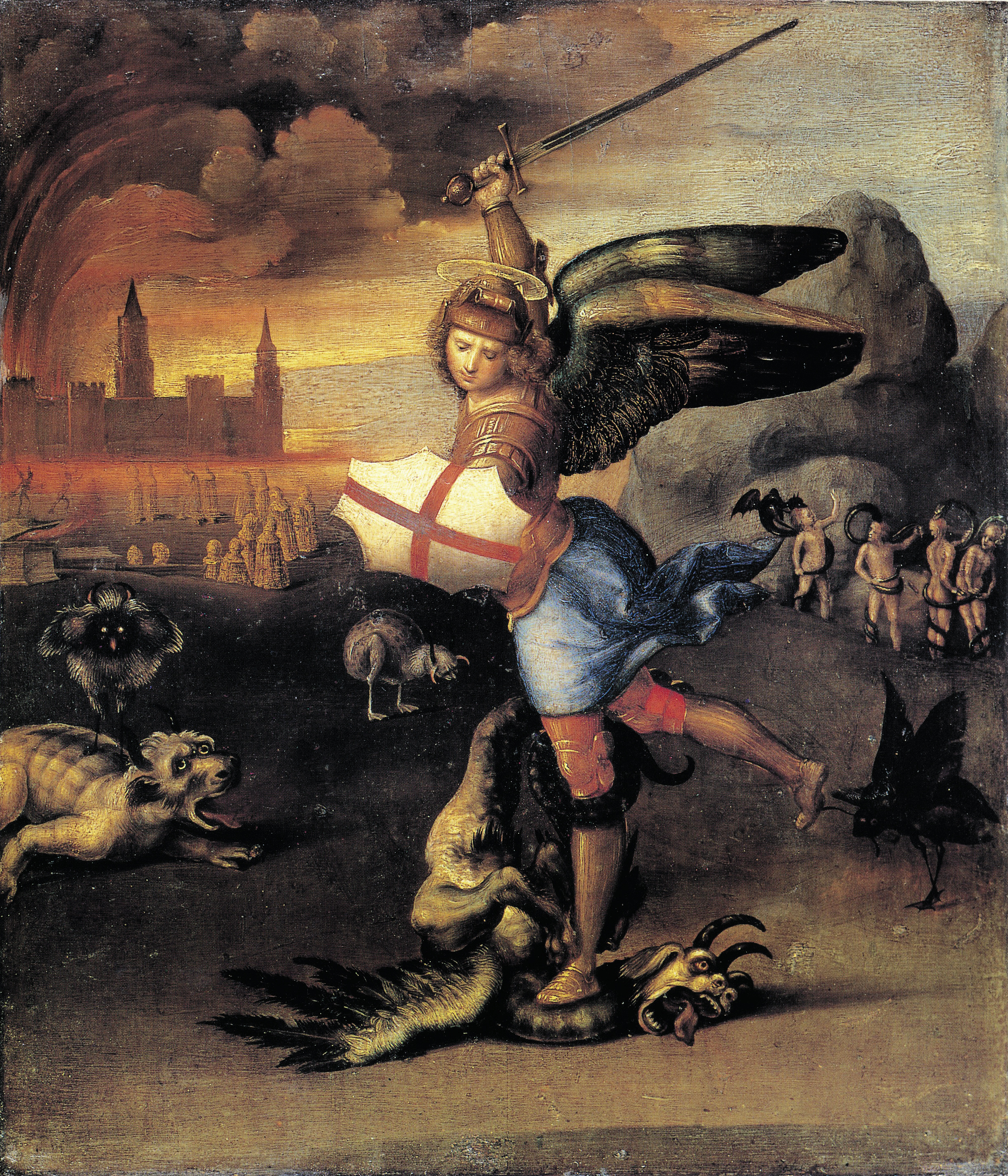
St. Michael the Archangel vanquishing Satan and Saint George slaying the Dragon.

These early works by the artist depict the popular subjects of St. Michael the Archangel vanquishing Satan and Saint George slaying the Dragon, each showing the martial subject of good combatting evil. These were early private commissions for the court of Urbino. Saint George was a Christian Roman soldier who, pious legend informs, subdued a dragon and, with the daughter of a pagan king, brought it to the city, where St. George killed it with his sword. These heroic actions witnessed by the king and his subjects led to their conversion to Christianity. The historic figure of Saint George was martyred around the year 290.  https://www.nga.gov/collection/art-object-page.28.html – retrieved September 4, 2024.

Raphael, Saint Michael and The Dragon, c. 1505, oil on panel, 12 ¼” x 10 ¼” The Louvre Paris https://collections.louvre.fr/en/ark:/53355/cl010060773 – retrieved September 4, 2024
Raphael, Saint Michael and The Dragon, c. 1505, oil on panel, 12 1/4 x 10 ¼” The Louvre, Paris https://collections.louvre.fr/en/ark:/53355/cl010060772 – retrieved September 4, 2024.
Raphael, Saint George and the Dragon, c. 1506, National Gallery of Art, Washington, D.C.
Raphael, The Three Graces, 1505-1506, oil on panel, 6 ¾ x 6 ¾” Condé Museum, Chantilly.

The panel of The Three Graces was recorded in the Borghese collection in 1650. It accompanied the Dream of Scipio, an oil on panel, today in the National Gallery of London. The figures were derived from ancient classical sculpture and depict, likely, Chastity, Beauty and Love. Chastity’s lower torso is veiled and an arm covers her breasts from view. Amor’s breasts, by contrast, are revealed. Chastity also wears no adornment as do Beauty and Amor. While the figures are modeled similarly, the space between them is disparate and Beauty blocks Chastity’s leg. (Jones & Penny, p. 8; Beck, pp. 62-63).

Raphael, Portrait of Agnolo Doni, c. 1506, oil on panel, 24  ¾  x 17 ¾” Pitti Gallery, Florence.

Agnolo Doni (above) is the only Florentine portrait in these first years mentioned by Vasari though paired with its companion portrait of Maddalena Doni (below). Doni was an art collector who married the daughter of Giovanni Strozzi in 1503. Agnolo was 10 years older than his wife who was in her teens. The portraits are painted on identically sized panel and are intended to hang next to one another. Raphael took great care in depicting the corporeal reality of his subjects, particularly appreciated in their faces and hands (though Agnolo Doni’s portrait is more detailed than his wife’s.) In both Doni portraits the sitters show-off their jewelry – such as rings and, in Maddalena’s portrait, a large pearl hanging around her neck. (Roger & Penny, p. 29-30)

Raphael, Portrait of Maddalena Doni, c. 1506, oil on panel, 24 ¾ x 17 ¾” Pitti Gallery, Florence.
Raphael, The Madonna of the Granduca, c. 1506, Oil on panel, 33 x 21 1/2 “ Pitti gallery, Florence.

Raphael’s Madonna del Granduca (The Madonna of the Grand Duke), a quintessential masterpiece of the High Renaissance painted around 1505–1506. The figures emerge from a stark, dark background that was added in the 17th century. Originally, Raphael painted a window opening to a landscape behind the Madonna. Raphael utilizes Leonardo’s sfumato technique—the subtle, smoky blending of colors and tones—visible in the gentle shadows defining Mary’s eyelids, chin, and the soft flesh of the infant. The painting gets its name from Ferdinand III, Grand Duke of Tuscany, who purchased it in 1799.

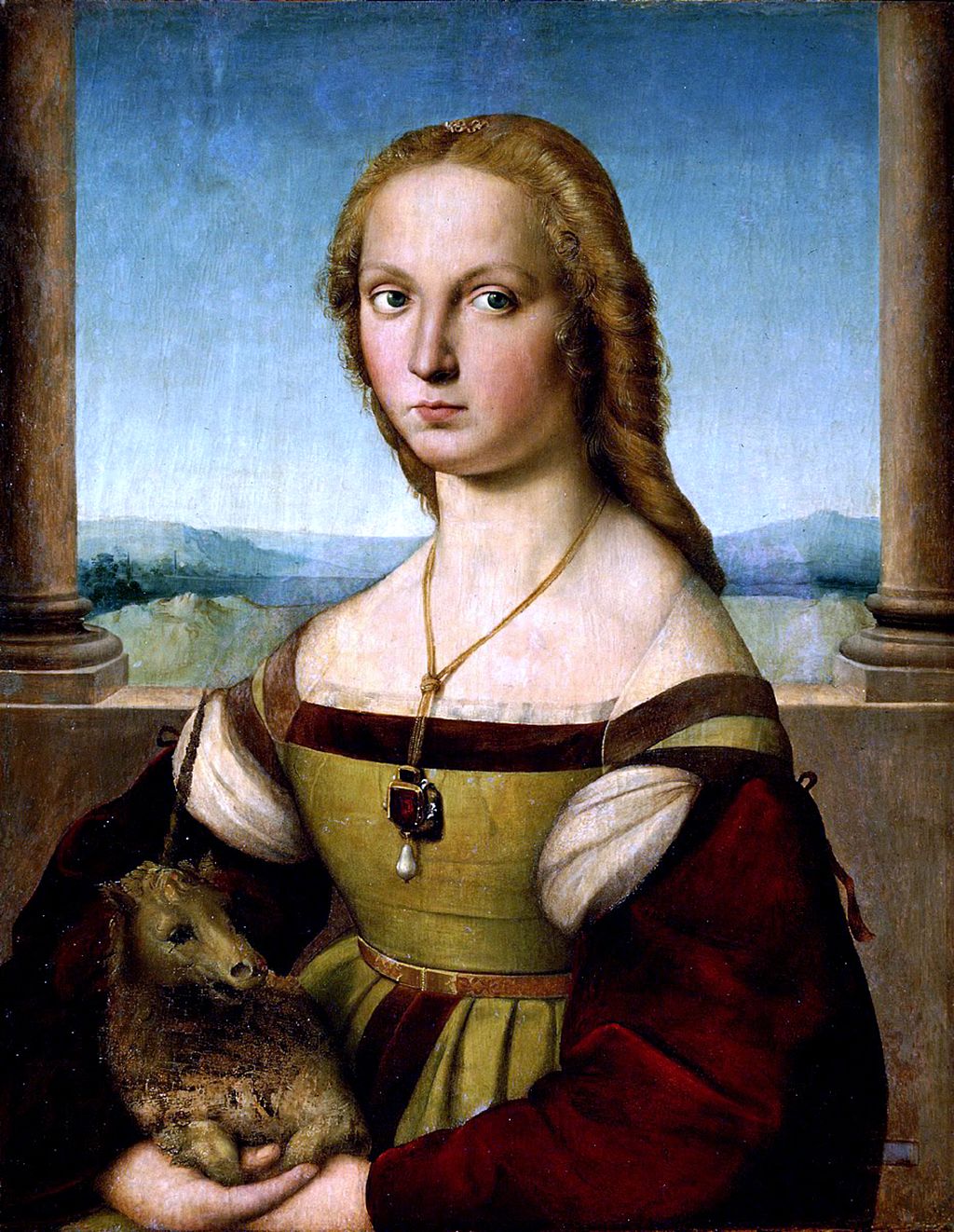
Raphael, Lady with a Unicorn, 1506, oil on panel, 65 cm × 51 cm (26 in × 20 in), Galleria Borghese, Rome, Italy.

Lady with a Unicorn was of uncertain attribution until recent times. In the 1760 inventory of the Gallery, the subject of the painting was identified as Saint Catherine of Alexandria and attributed to Perugino. A restoration of the painting in 1934 revealed a unicorn, the medieval symbol for chastity, and led to the painting’s attribution to Raphael. In 1959 an x-ray revealed a small dog under the unicorn which symbolized conjugal fidelity. https://en.wikipedia.org/wiki/Young_Woman_with_Unicorn – retrieved September 7, 2024.

Raphael, The Holy Family With Saints Elizabeth and John (The Canigiani Holy Family), c. 1506-07, oil on panel, 51 ½ x 42 1/8” Alte Pinakothek, Munich.

Visible on The Canigiani Holy Family on the hem of the Madonna’s scarf is inscribed, “Raphael Urbanas.” The fresco and easel painter was active mainly in Umbria, in Florence after 1504, and in Rome in 1509 until his death. It was painted for Domenico Canigiani where Vasari saw it later. It entered the Medici collection and when a Medici daughter married an Elector Palatine it accompanied her over the Alps to Germany. (Pinakothek Munich Great Museums of the World, Roberto Salvini, et. al., Newsweek NY 1969 pp. 126). In Raphael’s Florentine period, his work marks A transition away from the rigid, flat style of his master Perugino toward a more humanized, emotionally complex, and three-dimensional portrayal of sacred figures.

Raphael, Madonna del Cardellino, 1506-07, oil on panel, 42 1/8 x 30 ¼” Uffizi Gallery Florence.

The three figures in Madonna del Cardellino are closely integrated and display a greater sense of volume. The painting is dated 1507 on the hem of the Virgin’s garment. In the painting Saint John the Baptist presents a goldfinch (cardellino) to the Christ child which is a symbol of the Passion. (Roger & Penny, p. 33)

The Deposition, 1507, oil on panel, 72 ½ x 69 ¼” Borghese Gallery, Rome.

After seeing Leonardo’s Battle of Anghiari and Michelangelo’s Battle of Cascia in Florence Raphael’s style immediately applied their innovative principles changing the trajectory of his artwork. Leonardo da Vinci and Michelangelo were in a pitched battle for the future of art during their fabled competition to decorate the Great Council Hall in Florence. Raphael studied closely these complex drawings of heroic violence. Though Raphael was familiar with violent combat in Perugia and elsewhere, it was its depiction in these artworks in Florence that such dynamic convolutions began to appear in his own work such as The Deposition (above and below) although he may have had in mind Perugino’s Lamentation over the Dead Christ from 1495. In the finished painting the action takes place from right to left: a group of women attending to a swooning Virgin to the Magdalene grasping Christ’s hand to look into his face.  (Roger & Penny, pp. 37-44).

The Deposition, 1507, oil on panel, 72 ½ x 69 ¼” Borghese Gallery, Rome. DETAIL.
Raphael, La Belle Jardinière, 1507-08, oil on panel, 48 x 31 ½” The Louvre, Paris.

In La Belle Jardinière the arch-topped Madonna painting features Saint John the Baptist kneeling before the Christ child. It was Leonardo da Vinci who formulated the pyramidal structure for the Holy Family and half-length portrait, and it seems Raphael looked to explore his idea for his narrative. (Roger & Penny, p. 33)

Raphael, The Madonna of the Baldacchino, 1508, oil on canvas, 9’ x7’4” Pitti Gallery Florence.

The Madonna of the Baldacchino was started by Raphael and finished after his death (Roger & Penny, p. 44). It was Raphael’s first major commission in Florence for the Dei family chapel in the Santo Spirito basilica (1487) and remained unfinished when the 25-year-old artist was summoned to Rome by Pope Julius II, nicknamed the Fearsome, who reigned on Peter’s chair from 1503 to 1513. Pope Julius, born Giuliano della Rovere in 1443, took his name specifically from Julius Caesar (d. 44 BCE). In 1508, this “Battle Pope” as he was known, commissioned the Raphael Rooms and Michelangelo’s paintings in the Sistine Chapel at the Vatican. Raphael’s enthroned Madonna and Child is with, from left, Sts. Peter, Bernard of Clairvaux, James the Greater and St. Augustine of Hippo. The group is joined by two putti at the foot of the throne’s high pedestal steps. It is a large format painting whose size was increased when it was restored and “completed” at the end of the 17th century to meet the tastes of a Medici prince. Raphael is cited for being an imitator more than originator and this is exampled in the Christ Child playing with his toes whose pudgy type derives from the workshop of Florentine sculptor Luca Della Robbia (c. 1400-1482). The painting can be read right to left as St. Augustine, looking at the viewer, gestures, with St. James gazing in a similar direction, towards the throne and its occupants and then crosses to St. Bernard whose backward glance ends in conversation with St. Peter holding a book and large key. Once in Rome, Raphael continued these simple straight forward readings of his artworks’ often complex network of figures beginning in his famous frescoes in the Stanza della Segnatura (1508-1511) yet by then with greater refinement and heroism. In 1799 The Madonna of the Baldacchino was confiscated by French forces and taken to Paris only to be returned to Florence in 1813.  (Beck, pp. 78-79).

Raphael, St. Catherine of Alexandria, oil on panel, c. 1507, 71 x 56 cm, National Gallery of Art, London.

Raphael’s St. Catherine of Alexandria, a Fourth Century mystic and martyr, is not an object for devotion but dramatizes an example of devotion. The turned figure derives from Leonardo da Vinci and expresses an emotional animation that is one of the strongest depictions in Raphael’s oeuvre. (Roger & Penny, p. 44). The portrait is joined to a landscape as the saint leans on a spiked wheel which is her symbol as it was the manner of her death as a martyr. Raphael looks to capture the mystical or visionary aspect of the saint as she places her hand over her heart and gazes upwards to a golden break in the sky. The figure is very dynamic moving beyond Perugino’s influence of angelic air and distant landscapes and towards Michelangelo and Leonardo da Vinci whose monumentality and detailed arrangements Raphael studied in Florence. It is unknown who commissioned the artwork and for exactly what purpose it was intended.  https://www.nationalgallery.org.uk/paintings/raphael-saint-catherine-of-alexandria – retrieved September 6, 2024.

Raphael, The Niccolini-Cowper Madonna, 1508, oil on panel, 80.7 x 57.5 cm (31 3/4 x 22 5/8 in., National Gallery of Art, Washington, D.C.  https://www.nga.gov/collection/art-object-page.27.html – retrieved September 8, 2024.

The Niccolini-Cowper Madonna (also known as the Large Cowper Madonna) was painted in 1508 near the end of Raphael’s celebrated Florentine period. The infant Jesus reaches out to clutch the bodice of Mary’s dress which introduces a deeply human element, transforming a sacred, holy icon into an intimate moment shared between a mother and her playful toddler. Raphael utilizes Leonardo’s signature sfumato technique to build physical volume and three-dimensional realism. The painting belonged to the aristocratic Niccolini family in Florence. In 1780, it was purchased by George Clavering-Cowper, the 3rd Earl Cowper who also owned a smaller earlier version of the Madonna by Raphael.

RAPHAEL IN ROME: THE VATICAN COMMISSIONS

Commissioned by Pope Julius II in 1508 for his private apartments in the Apostolic Palace, The Raphael Rooms (Stanze di Raffaello) are a suite of four grand reception chambers that are now part of the Vatican Museums. These rooms include:

The Sala di Costantino. With its theme of the triumph of Christianity over paganism, it contains The Vision of the Cross, The Battle of the Milvian Bridge, The Baptism of Constantine, and The Donation of Constantine.

With its theme of Divine protection of the Church during political crises, the Stanza di Eliodoro contains The Expulsion of Heliodorus from the Temple, The Mass at Bolsena, The Liberation of Saint Peter and The Meeting of Leo the Great and Attila.

The Stanza della Segnatura (Julius II’s library/study), with its theme of harmony of human knowledge across Theology, Philosophy, Poetry, and Justice, includes The School of Athens, La Disputa, and The Parnassus.

With its theme of Glorifying Pope Leo X, Stanza dell’Incendio del Borgo (papal dining room) contains The Fire in the Borgo (L’Incendio del Borgo); The Battle of Ostia; Coronation of Charlemagne; and Oath of Leo III.

The Frescoes as Immersive Theater

Raphael’s artwork in these rooms has the effect of cinema in presenting nearly life-sized figures in space that, hoisted onto the wall like a massive theatre screen, fills the room’s field of vision. Further, as a modern-day film dispels incredulity to its medium and any message it conveys, absorbing the viewer, Raphael’s fresco makes intensely real the Catholic faith. 

Artistic Borrowing and Reinvention

Raphael frequently adapted individual figures and entire figural groupings from one fresco to another, refining successful visual ideas and integrating them into new compositions. This creative process enabled him to establish thematic and stylistic continuity across the Vatican rooms while continually enriching their complexity.

Michelangelo’s Influence

Raphael was also deeply influenced by Michelangelo’s newly unveiled Sistine Chapel ceiling. He studied its monumental prophets and sibyls closely, incorporating their sculptural power, dynamic poses, and psychological intensity into his own work. Rather than merely imitating Michelangelo, Raphael absorbed these innovations and transformed them within his own more harmonious and balanced visual language.

Perspective and Spatial Mastery

Beyond Michelangelo’s influence, Raphael was intensely interested in the challenges of foreshortening and the organization of large groups of figures within mathematically constructed perspectival settings. His ability to arrange complex assemblies of people within coherent architectural spaces contributed significantly to the intellectual clarity, visual grandeur, and persuasive realism that distinguish the frescoes of the High Renaissance.

Stanza della Segnatura

Raphael, c. 1509, fresco, 47 ½ x 41 ½” Ceiling, Stanza della Segnatura, Vatican, Rome.

At the time of the papal commission Raphael had little experience painting large frescos but revolutionized the tradition. The basic scheme of the decoration presents four tondi of abstract ideas of Theology, Poetry, Philosophy and Law. The Fall or Adam and Eve on the Brink of Disobedience, along with the Judgment of Solomon on the ceiling relates to themes of Theology and Law as the ceiling’s admixture of pagan scenes including Urania, and Apollo and Marsyas relate to Poetry and Philosophy.  (Roger & Penny – pp 50-52).

Raphael, The Fall, c. 1509, fresco, 47 ½ x 41 ½” Ceiling, Stanza della Segnatura, Vatican, Rome.DETAIL.

Theology and the Catholic Faith

Raphael, The Disputation over the Sacrament (Disputa), 1509-10, fresco, 25’3” at base, Stanza della Segnatura, Vatican, Rome.

In The Disputation angels in the vault accompany God the Father as a white-robed God the Son sits enthroned before a golden disc displaying his sacrificial wounds of the Cross. On each side of Christ sit the Virgin Mary and St. John the Baptist while on the raised tier sits figures from the Bible. The Holy Spirit descends in the form of a dove on the monstrance holding the Eucharist. Many preparatory drawings survive for this fresco. (Roger & Penny, pp.57-58)

Raphael, Detail, The Disputation over the Sacrament (Disputa), 1509-10, fresco, 25’3” at base, Stanza della Segnatura, Vatican, Rome.

Detail of the young scribe (or amanuensis) at the feet of Saint Augustine from the earthly zone of Raphael’s celebrated fresco, The Disputation of the Holy Sacrament (La Disputa), located in the Stanza della Segnatura in the Vatican Palace. Raphael painted these characters using pseudo-script.

Philosophy and Classical Learning

Raphael, The School of Athens, 1510-11, Fresco, 25’3” at base, Stanza della Segnatura, Vatican, Rome.

Compared to the architecture in his Spozalizio from 1504, Raphael’s architecture in The School of Athens is more massive and yet whose angular lines are softened by the contours of colossal statues in niches. One statue is Minerva above Jurisprudence while Apollo is on the left (and closest to the Parnassus fresco). The central figures below the arches, open sky behind them, are Plato with his Timaeus and Aristotle with his Ethics. Other recognizable figures include Socrates to the left of Plato and Pythagoras to the right of the door. (Roger & Penny p 74-78).

Raphael, The School of Athens, 1510-11, Fresco, 25’3” at base, Stanza della Segnatura, Vatican, Rome.

Euclid bends down to use one of his compasses surrounded by students and disciples.

Poetry and the Imagination

Raphael, Parnassus, c. 1511, fresco, 22’1 ½” at base. Stanza della Segnatura, Vatican, Rome.

Raphael painted a poet’s paradise in Parnassus where Apollo has the central place. The window which interrupts the base of the artwork looked out onto a hill in Rome called Mons Vaticanus that was known since classical times as sacred to Apollo. This fact with the fresco’s other siting challenges (window glare) Raphael was well aware of. Apollo plays the fiddle surrounded by poets and gorgeous muses with a background of laurel trees. Mortals are below on either side of the window. (Roger & Penny, pp. 68-69)

Stanza della Segnatura. The tile floors were designed by the Della Robbia brothers. Public Domain.

PAPAL POWER AND DIVINE INTERVENTION

Stanza di Eliodoro

Raphael, The Expulsion of Heliodoris From the Temple, 1512-13, Fresco, 24’7” at base. Stanza D’Eliodoro, Vatican, Rome.

The Stanza D’Eliodoro served as a Vatican audience chamber for the Pope. Each fresco depicts a story of divine intervention and the Pope felt impelled to record them like a civic authority would record an important battle scene in the town hall. The Pope had control over the message and even had himself inserted into these works and one of the best portraits of the pope by Raphael.5 Vasari believed that in the Expulsion of Heliodorus the message was clear: it was the Pope chasing avarice out of the church. Still others, more realistic perhaps, believed the theme to be the defense of the Church’s right to worldly possessions.6 While Julius II kept the treasury full and spent lavishly on public works, he also formally condemned his predecessor’s self-enrichment as well as the Church practice of buying and selling its offices. Others impute Pope Julius II making a parallel between Heliodorus’ expulsion and the Pope’s battle to expel rebellious cardinals who supported the French king against Rome.7 The first fresco painted in the Stanza D’Eliodoro and the one the room is named for is also, in my opinion, the finest: The Expulsion of Heliodorus. Heinrich Wölfflin in his book Classic Art provides the most satisfying brief account of this fresco, although there are other observers who offer insight and detail. The painting is based on an account found in 2 Maccabees, a book that treats of the events in Jewish history from the time of the high priest Onias III and King Seleucus IV to the defeat of Nicanor’s army (around 170 B.C). The biblical account of Heliodorus’ attempt to profane the Temple is a rich one and, in terms of the painting’s iconography, can be synopsized as such:

                  “There was great distress throughout the city. Priests prostrated themselves in their priestly robes before the altar, and loudly begged him in heaven…to keep the deposits safe for those who had made them…(T)he changed color of the (high priest’s) face manifested the anguish of his soul. The terror and bodily trembling that had come over the man clearly showed…People rushed out…in crowds to make public supplication because the Place was in danger of being profaned…Women, girded…filled the streets…While they were imploring the almighty Lord to keep the deposits safe and secure… Heliodorus went on with his plan. But just as he was approaching the treasury with his bodyguards, the Lord of spirits… (struck). There appeared to them a richly caparisoned horse, mounted by a dreadful rider. Charging furiously the horse attacked Heliodorus with his front hoofs…Then two other young men, remarkably strong…beautiful…splendidly attired, appeared…they flogged (Heliodorus) unceasingly…Suddenly, he fell to the ground enveloped in a great darkness…The man who a moment ago had entered that treasury with a great retinue and his whole bodyguard was carried away helpless…” (2 Maccabees, Chapter 3:14-28)

Raphael followed the biblical text closely. He depicts the three major parties in the religious story: the divine rider, two youths and Heliodorus; the figure of the anguished priest; and the “girded” women.  As he does in The Deliverance of Saint Peter, the Pope identifies with one of the major priestly characters in the art work if one detects, as some scholars do, the features of Julius II in the High Priest Onias III.8 The Stanza D’Eliodoro and its first fresco The Explusion of Heliodorus is a milestone for its scale, its composition, its form, its treatment of subject, its color, its narrative power, and its graceful draughtmanship.

Raphael, The Mass of Bolsena, c. 1512 Fresco 21’8” Stanza d’Eliodoro, Vatican, Rome.

The fresco of The Mass of Bolsena depicts a 13th century miracle connected to the Eucharist when a traveling priest, doubting the Real Presence of Jesus in the consecrated host, is given proof of its reality when the altar cloth he uses for Mass becomes stained with blood from the Host. The cloth relic was revered by Julius II and housed in Orvieto Cathedral where it is today. From its inception, the five handsome youths in the bottom right section of the fresco have been admired for their sturdy monumentality perhaps influenced by Michelangelo as well as its colors and costumes showing Venetian influence. (Beck, pp. 100-101).

Raphael, The Mass of Bolsena, c. 1512 Fresco 21’8” Stanza d’Eliodoro, Vatican, Rome. DETAIL.
Raphael, The Mass of Bolsena, c. 1512 Fresco 21’8” Stanza d’Eliodoro, Vatican, Rome DETAIL.
Santi, Raffaello, dit Raphaël Rencontre entre Léon Ier et Attila 1512/1513 LOUVRE https://collections.louvre.fr/en/ark:/53355/cl020101100 – retrieved September 4, 2024.
Raphael, The Liberation of Saint Peter From Prison, 1512-13, Fresco, 22’8” at base. Stanza d’Eliodoro, Vatican, Rome.

San Pietro in Vincoli in Rome (“St. Peter in Chains”) was Julius II’s titular church when he was a cardinal before becoming pope. It was also his uncle’s church before him, pope Sixtus IV (1471-1484). Pope Julius II made pilgrimage to the church in 1512 after the French evacuated from Italy. The liberation in the title of Raphael’s fresco probably refers to that of the Papal States with St. Peter taking on the physical characteristics of Julius II. The fresco was being painted during a year when the pope was dying which occurred in February 1513. Raphael’s use of light in the fresco is probably the boldest in art taking place at night in the whole of Renaissance art. (Beck, pp. 102-3).

Raphael, The Liberation of Saint Peter From Prison, 1512-13, Fresco, 22’8” at base. Stanza d’Eliodoro, Vatican, Rome.

Stanza dell’Incendio del Borgo

Raphael, The Fire in the Borgo, 1514-15, fresco, 22’1″ at base, Stanza dell’ Incendio, Vatican, Rome.

The name of the room comes from this fresco which Raphael began work on in the summer of 1514. It depicts a newly imagined historical event from the mid-9th century when a fire broke out in Rome. The pope (Leo IV) is seen giving a blessing from the balcony of Old St. Peter’s which, the story goes, tamped down the flames. In the meantime, Raphael depicted the event’s panic and drama among its foreground figures in its throes. Once more Raphael is re-inventing his art from only a couple of years earlier. As Raphael continued the practice of borrowing certain figures and themes from previous frescos, the overall classical style of the Segnatura and Eliodoro frescos are remarkably more spatially complex and intriguing in The Fire in the Borgo. Raphael absorbed what Rome offered: from Michelangelo’s latest art to the city’s ancient and contemporary architecture. The Ionic columns of Old St. Peter’s are accurately rendered as are the building fragment of Corinthian columns. (Beck, p. 110).

Raphael, the Fire in the Borgo, 1514-15, fresco, 22’1″ at base, Stanza dell’ Incendio, Vatican, Rome. DETAIL.

RAPHAEL THE PORTRAITIST

Four Rooms; Four Popes.

The popes responsible for commissioning, funding, and overseeing the completion of the Raphael Rooms amounted to three out of four consecutive reigns: Pope Julius II (r. 1503–1513) originated the commission. Under Julius, Raphael painted the Stanza della Segnatura and began the Stanza di Eliodoro. Julius II is buried in St. Peter’s Basilica.

Pope Leo X (r. 1513–1521) continued the project, keeping Raphael on as the chief Vatican artist. He oversaw the completion of the Stanza di Eliodoro, the Stanza dell’Incendio del Borgo, and the planning for the Sala di Costantino.

Pope Adrian VI, a Dutchman, then reigned after Leo X for a little over one year and eight months but halted work on the project. Adrian VI is buried in Santa Maria dell’Anima in Rome.

Finally Pope Clement VII (r. 1523–1534), Like Leo X, another Medici pope, finished the Sala di Costantino funded the late Raphael’s workshop assistants led by Giulio Romanoin 1524. Both Pope Leo X and Pope Clement VII are buried directly across from one another inside the choir of the Basilica of Santa Maria sopra Minerva in Rome.

Pope Julius II, Raphael, 1511-12.

Giuliano della Rovere (1443-1513) was described by Machiavelli in his works as an ideal prince. Becoming pope in 1503, he took the name Julius II in honor of Julius Caesar and was nicknamed the Warrior Pope. In 1506 Julius II organized the famous Swiss Guard for his personal protection and established the Vatican Museums. He was also the pope who instigated the rebuilding of St. Peter’s Basilica that exists today. The pope increased the power of the Papal States and, in 1508, he commissioned the Raphael Rooms and Michelangelo’s paintings in the Sistine Chapel. It was Julius II who also established the first bishoprics in the New World. Although the Tomb of Pope Julius II with its famous sculpture of Moses by Michelangelo is in San Pietro in Vincoli in Rome, the ensemble, extensively abbreviated than originally planned, was not finished until 1545, long after Julius II’s death in 1520. In fact, Julius II is buried in St. Peter’s Basilica.

Raphael, Portrait of Leo X and Two cardinals, 1517-18, oil on panel, 60  5/8 x 46 7/8” Uffizi Gallery Florence

This was an important group portrait commission for Raphael: the current Pope Leo X Medici (1513-1521) seated by his cousins, Cardinals Giulio de’ Medici on the left and Luigi de’ Rossi on the right. Giulio de’ Medici was soon to become the future pope Clement VII (1523-1534). Though highly individualized, Raphael captures a family resemblance between these Medici who were then the most powerful family in Italy and all about the same age. In 1517 Cardinal Giulio was an important art patron and had commissioned Raphael to do The Transfiguration, his last painting. Raphael demonstrates a wide range of artistic experience and skills so to pull any tool he needs for a successful outcome of any commission. In Urbino Raphael had been exposed to Flemish art and deploys its detailed technique in the bell and manuscript which 42-year-old Leo X uses a magnifier to see. The setting of the monumental portrait, in a room in the Vatican, is subtly captured by way of Flemish art ingenuity. The doorknob in front of cardinal Luigi de’ Rossi shows the reflection of an open window while the cape and biretta of the pope are highly detailed by the artist in its natural light. The Portrait of Leo X and Two Cardinals is considered the greatest group portrait of the 16th century. (Beck, pp. 120-121)

Portrait of Adrian VI after Jan van Scorel, c. 1625 (Centraal Museum, Utrecht)
https://www.nationalgallery.org.uk/paintings/raphael-the-garvagh-madonna – retrieved September 5, 2024.

Raphael’s Garvagh Madonna (also known as the Aldobrandini Madonna) was painted in Rome between 1509–1511.Though its commsiion is lost to history it was a cabinet painting for private devotion and likely commissioned  by a Roman aristocrat or paper courtier. The focal point is the pink carnation (dianthus) that the infant John the Baptist is handing to the Christ Child. The flower signifies Divine Love and the Passion of Christ. By the late 16th century, it entered the collection of the aristocratic Aldobrandini family in Rome and displayed in their apartments and at the Villa Borghese. During Napoleon’s invasion of Italy in 1799, an art dealer named Alexander Day acquired the painting and smuggled it to London.The painting was purchased in 1818 by the English nobleman George Canning, 1st Lord Garvagh and hidden for the next almost 50 years. In 1865 it was purchased by the National Gallery in London.

Raphael’s ‘Garvagh Madonna’ with Matthias Wivel, Curator of 16th-century Italian Paintings.
Raphael, La Vierge nourrissant l’Enfant, assise dans un paysage : la Madone Sergardi n.d. LOUVRE https://collections.louvre.fr/en/ark:/53355/cl020101084 – retrieved September 4, 2024.
Raphael, Portrait of a Young Cardinal, 1510-11, oil on panel 31 1/8 x 24” The Prado, Madrid. https://www.museodelprado.es/en/the-collection/art-work/the-cardinal/4c01eae6-feed-4135-88d9-6736140212fb?searchid=0bd968eb-2e7e-d4a3-a6b4-874288991a63 -retrieved September 4, 2024

Raphael was working on the frescos in the Vatican Palace when he painted this oil on panel portrait of a “Young Cardinal.” The sitter is not known though it likely is Cardinal Francesco Alidosi (1455-1511). Cdl. Alidosi was an influential diplomat and military leader and a favorite of Julius II (1503-1513). The sitter’s expression and pose of a resting arm on the edge of the painting’s base and the slight turn of the body seems to owe much to Leonardo da Vinci. The body is monumental compared to a placid and yet almost inscrutable slightly smaller head whose depiction, while directly observed, is somewhat idealized. When Della Rovere was elected as Pope Julius II in 1503, Alidosi became his secretary and primary collaborator. He was appointed papal chamberlain and then treasurer. Though labeled “unholy” by Venetian cardinal Pietro Bembo (1470-1547), Cld. Alidosi helped guide the vocation of Bl. Elena Duglioli dall’ Olio (1472-1520), an Italian aristocrat, who wanted to be a Poor Clare nun but was forced to marry by her family and for whose endowed chapel in Bologna Raphael painted an altarpiece. In 1504 Alidosi became a bishop whose sees ranged up and down all of Italy from Mileto in 1504 and Pavia in 1505. He occupied the seat of Pavia until he was murdered in broad daylight in 1511. There were accusations traded back and forth that Cdl. Alidosi was a traitor at a time when the French occupied parts of Italy among its warring Italian families. The independently powerful pope acted to protect his favorite as long as possible. About Alidosi one historian noted: ”A favorite has no friends.” There were many unconcerned witnesses to the brutal crime whose attack included blows that split his head in two. (Beck, pp. 92-93; Herbert M. Vaughan, B.A., The Medici Popes (Leo X and Clement VII), Methuen & Co., London, 1910, p. 64-65; “Alidosi, Francesco, detto il Cardinal di Pavia”. Dizionario Biografico degli Italiani – Volume 2 (in Italian). Treccani. 1960.)

Raphael, La Donna Velata, c. 1514, oil on canvas, 33 ½ x 25 ¼” Pitti Gallery, Florence.

In La Donna Velata and Portrait of Baldassare Castiglione, Raphael, the master portraitist, present near ideal depictions. Both portraits are of almost identical dimensions. The model Raphael used for La Donna Velata he used in other artworks of this period, including The Sistine Madonna. By the mid 1510s these portraits have become gentler in their modeling than the tight, detailed study of corporeal features done before. Raphael begins a display of a mastery of forms and colors that had great influence on future artists such as Rubens and Rembrandt. However, Raphael’s painting does not forgo his mastery of drawing exampled in the female sitter’s sleeve or the overall nobility of the male sitter. (Beck, pp. 108-09; 116-17).

Portrait of Baldassare Castiglione, c. 1515, oil on canvas, 32  ¼” x 26” the Louvre Paris https://collections.louvre.fr/en/ark:/53355/cl010066418 – retrieved September 4, 2024.
Raphael’s artwork inspired making copies by many later artists. This is “Etude d’après le portrait de Balthazar Castiglione par Raphaël” by Eugène Delacroix, c. 1818/1820 in the Louvre. https://collections.louvre.fr/en/ark:/53355/cl020142954 – retrieved September 4, 2024.
Raphael. Portrait of Bindo Altoviti c. 1515: Oil on panel 59,7 x 43,8 (24 in × 17 in), National Gallery of Art of Washington, D.C. https://www.nga.gov/collection/art-object-page.12131.html – retrieved September 5, 2024.

Portrait of Bindo Altoviti, painted circa 1515, presents its subject in a dramatic and highly original pose: a three-quarter back view with his head turned sharply over his shoulder to meet the viewer’s gaze. Bindo Altoviti (1491-1557) was a young, immensely wealthy and politically influential Florentine banker based in Rome. Among the most important patrons of the High Renaissance, he maintained close relationships with Raphael, Michelangelo, and Benvenuto Cellini. A passionate supporter of the arts, he was also a determined political opponent of the Medici family.

The striking twist of Altoviti’s body imbues the portrait with an unusual sense of movement and psychological immediacy. Raphael employs sfumato, particularly around the jawline, eyes, and flowing golden-brown curls, to create subtle transitions of light and shadow that enhance the figure’s sculptural presence. Soft illumination highlights the sitter’s youthful features against a rich dark-green background, while his hand rests lightly against his chest, drawing attention to the prominent gold ring on his finger. His attire, a sumptuous blue mantle draped over a dark tunic, conveys exceptional wealth and social standing while avoiding overt ostentation.

Raphael, The Way to Calvary (Lo Spasimo), 1516-17, oil on canvas, 10 ½ x 7’ 6 1/2” The Prado Madrid.

Raphael’s Christ Falling on the Way to Calvary (famously known in Italian as Lo Spasimo di Sicilia) was painted around 1516-1517, originally on panel before later being transferred to canvas. The painting captures the dramatic moment when Christ falls beneath the Cross and turns to look directly at his mother, who swoons in grief (the spasimo). She is supported by a group of weeping women, including Mary Magdalene, who kneels in the lower right foreground. Raphael fills the composition with intense movement and emotional tension. On the left, Roman soldiers and executioners tug brutally at ropes and force Christ onward, while Simon of Cyrene struggles to lift the heavy wooden cross. In the distance, a winding road leads toward Calvary, where other crosses are already being prepared beneath a turbulent sky.

The painting was commissioned by Jacopo Basilio for the new church of Santa Maria dello Spasimo in Palermo, Sicily. Although the church itself was never completed, Raphael’s masterpiece embarked on a remarkable journey. En route to Sicily, the ship carrying the work was wrecked at sea, yet the carefully packed painting somehow washed ashore near Genoa unharmed. It took the direct intervention of Pope Leo X to compel the Genoese authorities to surrender the masterpiece to its rightful owners in Palermo.

In 1661, the painting was acquired by the Spanish Viceroy of Sicily on behalf of King Philip IV of Spain, an avid collector of Raphael’s works. Transported to Madrid, it was installed in the royal chapel. During the Napoleonic Wars, French troops seized the painting and carried it to Paris, where restorers transferred it from panel to canvas. Following Napoleon’s defeat, the work was returned to Spain, where it eventually entered the collection of the Museo del Prado, its home today. The painting reflects Raphael´s interest in the depiction of extreme physical and psychological states. https://www.museodelprado.es/en/the-collection/art-work/christ-falls-on-the-way-to-calvary/870c8293-1691-4a90-88ff-b554a2bc3fe8?searchid=d42d76c7-eb9f-501b-f628-d03605a6ca9c – retrieved September 4, 2024.

Raphael, The Alba Madonna, c. 1511, oil on canvas (transferred from panel), diameter 37 ¼” National Gallery of Art, Washington, D.C.

Raphael’s major commissions for papal and aristocratic patrons did not interrupt his sustained engagement with the Madonna theme, a subject he had refined since his years in Umbria and Florence. The Alba Madonna exemplifies this continuity. The Virgin is presented as a Virgin of Humility, seated directly on the ground, her pose reinforcing the theological emphasis on Christ’s lowly Incarnation. She wears a rose‑pink gown beneath a topaz‑blue mantle, her hair drawn back from her face, and one finger marking a page in the book resting on her lap.

The Virgin occupies the dominant share of the tondo’s surface, receiving the young John the Baptist as he approaches with flowers gathered in the fold of his garment — a visual shorthand for his role as the forerunner who prepares and presents Christ to the world. All three figures direct their attention toward the small cross held by the Christ Child, a sign of his identity as the Lamb of God and of the sacrificial destiny that defines his mission.

Raphael integrates figure and format with characteristic finesse: the Madonna’s rounded features and gently curving posture echo the circular panel on which the scene is painted. The background opens onto an expansive plain leading to a turquoise body of water, with distant mountains rendered in deeper blue beneath a luminous sky, establishing a serene atmospheric recession typical of Raphael’s mature style. (Roger & Penny, p. 88.) https://www.nga.gov/collection/art-object-page.26.html – retrieved September 4, 2024.

Raphael, Galatea, c. 1512, fresco, 9’8 1/8” x 7’4”, Villa farnesina, Rome.

Raphael took a poem by Florentine poet Poliziano (1454-1494) for inspiration for this fresco. The poet gives a detailed description of the Palace of Venus. Galatea is described as riding on the sea in a chariot pulled by a pair of dolphins whose reins she holds. Around her is her entourage playing amorously in the sea. In 2007, the bodies of Poliziano and philosopher Giovanni Pico della Mirandola (1463-1464) were exhumed from Florence’s Church of San Marco to determine the causes of their deaths. Forensic tests showed that both men of letters likely were poisoned but it is only speculation as to why or by whom. (see – http://news.bbc.co.uk/2/hi/europe/6920443.stm – retrieved September 7, 2024). (Roger & Penny, p. 93).

Raphael, The Sistine Madonna, 1512-13, oil on canvas, 8’8” x 6’5” Gemäldegalerie Alte Meister Staatliche Kunstsammlungen, Dresden.

Raphael’s The Sistine Madonna was made for the high altar of a newly rebuilt church of Pope St. Sixtus (d. 257) in Piacenza, Italy. St. Sixtus kneels on a cloud before the Virgin and Christ Child with a hand over his chest. The saint is interceding for the worshippers of Piacenza to whom he gestures outward with his other hand. Opposite is St. Barbara, patron of soldiers, with the symbol of a tower behind her. (Roger & Penny p. 128)

Raphael, The S. Cecilia Altarpiece, 1513-14, oil on canvas, 86 ½ x 53 ½” The National Gallery of Bologna (Pinacoteca Nazionale di Bologna).

In The S. Cecilia Altarpiece Raphael depicts St. Cecilia with an organetto slipping from her hands as she looks skyward to the preferred sound of heavenly music. Also included are Sts. Paul, John the Evangelist, Augustine and Mary Magdalene. It was an altarpiece for a chapel in S. Giovanni in Monte in Bologna founded by Elena Duglioli dall’ Olio (1472-1520). The Italian aristocrat wanted to become a Poor Clare nun. Though forced to marry by her family, she persuaded her husband not to consummate the marriage. This act of chastity was attributed to her devotion to St. John the Evangelist, patron of virginity, and St. Cecilia. Elena’s benefactor in the enterprise of her religious vocation was influential Cardinal Alidosi. Elena died on September 23, 1520, and her remains are incorrupt in the church of San Giovanni in Monte. In 1828 she was beatified by Pope Leo XII (1760-1829). Her feast day is September 23. (Roger & Penny, pp. 144-146).

Raphael, The S. Cecilia Altarpiece, 1513-14, oil on canvas, 86 ½ x 53 ½” The National Gallery of Bologna (Pinacoteca Nazionale di Bologna).
Raphael, Madonna della Sedia (The Madonna of the Chair), 1514-15, Oil on Panel, diameter 28” Pitti Gallery, Florence.

Raphael’s tondo Madonna della Seggiola (Madonna della Sedia or Madonna of the Chair) was painted in Rome around 1513-1514. Its title derives from the ornate gilded chair (seggiola) on which the Virgin sits, a detail that reflects the courtly refinement of Raphael’s Roman years under Pope Leo X. The painting is celebrated for its profound tenderness and maternal warmth: Mary draws the Christ Child closely to her while the young Saint John the Baptist gazes upward in adoration, his hands clasped in prayer and a delicate reed cross foreshadowing the Crucifixion. Unusually, Mary looks directly out at the viewer with an intense and knowing expression, inviting us into what might otherwise seem a private family moment. During the Napoleonic Wars, the painting was seized by French forces in 1799 and taken to Paris, where it was admired as one of the finest treasures in Napoleon’s collection. Following Napoleon’s defeat, it was returned safely to Florence in 1815.

Raphael, Portrait of a Nude woman (“Fornarina”), oil on panel, c. 1518, 85 x 80cm, galleria Nazionale ( Palazzo  Barberini), Rome.

Raphael’s Secret Muse: La Fornarina and the Artist’s Great Love

Raphael’s famously intimate and sensual masterpiece, La Fornarina (The Baker’s Daughter), was painted around 1518-1520, during the final years of the artist’s life. The half-nude sitter is widely identified as Margarita Luti, believed to have been Raphael’s secret longtime mistress and the great love of his life.

A Forbidden Romance

Although Raphael was officially engaged to Maria Bibbiena, the niece of a powerful Vatican cardinal, the artist repeatedly postponed the marriage. Contemporary accounts suggest that his devotion to Margarita overshadowed all other personal and sometimes professional commitments. The Renaissance biographer Giorgio Vasari wrote that Raphael’s passion for Margarita was so consuming that it distracted him from some of his most important artistic commissions, including work for the Vatican.

Margarita as Venus

Margarita’s pose, with one hand resting lightly on her breast and the other across her lap, deliberately echoes the ancient Venus Pudica (“Modest Venus”) type of classical Greco-Roman sculpture. Through this visual reference, Raphael transformed his working-class lover into Venus, the goddess of love, elevating her from earthly companion to idealized beauty.

Her appearance is rich with symbolic details. She wears an exotic striped silk turban adorned with a delicate pearl ornament. The pearl, margherita in Italian, serves as a playful visual pun on her first name. Such references suggest that the painting was not merely a portrait but an intensely personal tribute.

A Private Declaration of Love

Unlike Raphael’s public commissions, La Fornarina appears to have been a private work, likely kept within the artist’s workshop rather than displayed for patrons. One of the painting’s most striking details is the dark blue and gold band encircling Margarita’s upper left arm. Inscribed with the words “RAPHAEL URBINAS” (“Raphael of Urbino”), the band functions almost like a signature worn on the body of the beloved. Rather than simply identifying the artist, it creates a profound connection between painter and sitter, suggesting a mutual bond that transcends the conventions of portraiture.

The Hidden Wedding Ring

Modern scientific analysis and X-ray examinations of the painting have revealed a remarkable hidden history. Beneath the visible paint layers, conservators discovered that Margarita originally wore a large gold wedding ring on the third finger of her left hand. The surrounding landscape also once contained myrtle and laurel, traditional Renaissance symbols associated with marriage, fidelity, and enduring love.

These discoveries have fueled longstanding speculation that Raphael and Margarita may have entered into a secret union, or at the very least that Raphael wished to portray her as his wife rather than merely his mistress.

The Cover-Up After Raphael’s Death

After Raphael’s sudden death in 1520, his workshop assistants, most notably Giulio Romano and Gianfrancesco Penni, altered the painting. The wedding ring was painted over, and portions of the symbolic background were modified or removed.

Many scholars believe these changes were intended to protect Raphael’s posthumous reputation and avoid a potentially damaging scandal. Publicly, the artist was known as the unmarried fiancé of a powerful cardinal’s niece. Evidence of a secret marriage or romantic attachment to a baker’s daughter would have embarrassed both elite Vatican families and Raphael’s estate during a sensitive period following his death.

As a result, La Fornarina survives not only as one of the Renaissance’s most beautiful portraits but also as one of its most intriguing love stories, a work in which a Renaissance artist’s passion, symbolism, and secrecy are woven beneath the surface of the paint itself.

Raphael, The Miraculous Draught of Fishes (Luke 5: 1-11), 1514-15, Tempera on paper, 11’10” x 13’2” Victoria and Albert Museum, London


The Raphael Cartoons are designs for tapestries and were commissioned by Pope Leo X (1513-21) shortly after his election in 1513. The tapestries were intended to hang in the Sistine Chapel in Rome, built by Pope Sixtus IV (1471-84). The decoration of the chapel under Sixtus addressed the lives of Moses and Christ. The tapestries continued this theme, illustrating scenes from the lives of St. Peter and St. Paul.

Raphael, Tête d’évêque, de trois quarts vers la droite, c. 1514/1517 LOUVRE https://collections.louvre.fr/en/ark:/53355/cl020101216 – retrieved September 4, 2024.
The Visitation, c. 1517. Oil on panel transferred to canvas. The Prado. https://www.museodelprado.es/en/the-collection/art-work/the-visitation/c02d195f-fdc4-4c61-bedf-e19216dd7335?searchid=714a2f53-0e6d-7d8f-5ff7-bee7652ec831 – retrieved September 4, 2024.

The Visitation was commissioned by Giovanni Branconio, the Apostolic Protonotary, at the behest of his father, Marino Branconio, for the family chapel at the church of San Silvestre de Aquila. Marino´s choice of subject matter was undoubtedly guided by the fact that his wife was named Elizabeth and his son, John. In 1655, this work was acquired by Felipe IV (1605-1665), who deposited it at El Escorial. It entered the Prado Museum in 1837.

Raphael, The Holy Family of Francis I. 1518 Oil on canvas 81 ½ x 55  1/8” The Louvre Paris.

Raphael’s grand late masterpiece, The Holy Family of Francis I (also known as The Great Holy Family), was painted in 1518 during his Roman period. At the center of the composition, the infant Christ springs from his cradle into the embrace of his mother, the Virgin Mary. Beside her, Saint Elizabeth supports her young son, Saint John the Baptist, whose hands are clasped in prayer as his gaze points to Jesus. Two angels join the scene, one holding a crown of flowers above Mary’s head, symbolizing her role as the Queen of Heaven. A pensive, heavy-lidded Saint Joseph leans on his hand, quietly contemplating the gathering and awaiting the Holy Family’s next move.

More saccharine than Raphael’s other work, the painting reflects his growing attraction to the monumental, proto-Mannerist tendencies inspired by Michelangelo’s Sistine Chapel ceiling. It also bears the mark of Raphael’s increasingly busy workshop, with most of it executed by his assistant Giulio Romano. Commissioned by Pope Leo X as a diplomatic gift for King Francis I of France and Queen Claude, the painting was sent to the French royal court at Fontainebleau in 1518. The gift formed part of the Vatican’s broader effort to cultivate French goodwill and maintain a political counterweight to the growing power of the Holy Roman Emperor.

Raphael, The Transfiguration, 1518-20, oil on panel, 13’3 ¾ x 9’1 ½” Pinacoteca, Vatican, Rome.

Raphael died in April 1520 while working on The Transfiguration. Although most of the painting was already complete, his sudden passing marked the abrupt end of a brilliant but short career—Raphael was only 37 years old. Cardinal Giulio de’ Medici, the future Pope Clement VII, had commissioned the work for the Cathedral of Narbonne in France, but following the artist’s untimely death, it was instead displayed at his funeral in the Pantheon.

During its creation, the project was fueled by intense artistic rivalry. Sebastiano del Piombo, who was mentored by Michelangelo in Florence, was simultaneously producing The Raising of Lazarus for the exact same cathedral, creating a direct competition for Raphael’s work. Today, Sebastiano’s anxious letters to Michelangelo serve as our primary historical record for the progress and development of Raphael’s painting.

Initially, Raphael planned to depict only the mountaintop Transfiguration. This episode is detailed in the Synoptic Gospels but completely omitted from the Gospel of John. This omission is particularly notable because Matthew, Mark, and Luke all record that John was personally present for the magnificent event, alongside Peter and James the Greater. Ultimately, John’s omission makes thematic sense: while the Synoptic writers use the Transfiguration as a dramatic, mid-narrative revelation of Jesus’s heavenly nature, John’s entire Gospel establishes that exact divine premise right from its opening verses.

Raphael’s depiction ultimately became the definitive template for how the event on Mount Tabor has been popularly imagined ever since. He captured Christ rising majestically into the air, His face and clothes turned a dazzling white, elevated above Moses and Elijah, whom the Gospels describe Jesus as being in conversation with. Below them, the three chosen Apostles careen in various prostrations of overwhelming wonderment, shielding themselves from the brilliant light.

Raphael famously expanded the traditional scene to include the scriptural episode that immediately follows: the story of a demoniac boy whom the remaining Apostles fail to heal. In the biblical account, Christ descends the mountain after His transfiguration and cures the child, who appears here frantically gesturing in the lower right corner. In the composition, the divine peace of the Transfiguration sits elevated and farther back from this earthly, chaotic turmoil below. On the left side of the canvas, two figures—identified as the patron saints of Narbonne—can be seen making their way up the mountain to pay homage.

This inclusion was a nod to the patrons, if not a guarantee of Raphael’s full fee. As the Renaissance biographer Giorgio Vasari famously noted, Raphael lived more like a prince than a painter. His lifestyle was expensive, and Giulio Romano, one of Raphael’s chief artistic and financial heirs, eventually had to sue the benefactors in 1522 to secure the final payment for the masterpiece.

Debate continues among art historians over exactly how much of Raphael’s studio executed the final canvas, particularly in the wake of his sudden death. Even so, it is clear the workshop assisted extensively during Raphael’s lifetime, as his highly productive working method required. Nevertheless, the core invention, the preparatory drawings, and the vast majority of the brushwork were distinctly Raphael’s own. Art historians Roger Jones and Nicholas Penny note that for this final painting, Raphael looked back to the very beginning of his career, modeling many of the expressive heads in The Transfiguration after Leonardo da Vinci’s unfinished 1481 masterpiece, The Adoration of the Magi.

Just as in the Gospel narrative, light drives the artistic coloration, invention, and emotion of the painting. A blinding, heavenly radiance engulfs Peter, James, and John at the top, while a second, much sharper earthly light isolates the expressive faces, hands, and frantic gestures from deep shadows below. This complex illumination and intense contrast became an essential touchstone for later, highly influential Baroque painters, most notably Caravaggio. Vasari remarkably notes that when Raphael passed away, the loss plunged the entire papal court into deep, unmitigated grief, so much so that the Pope quite openly and bitterly wept at the tragic passing of this noble craftsman.

Conclusion

With Leonardo da Vinci and Michelangelo, Raphael became one of the defining figures of the High Renaissance. His achievement lay not only in individual masterpieces but in his ability to unite classical ideals, Christian theology, portraiture, architecture, and human emotion into a harmonious artistic vision that shaped the course of Western art for centuries.

FOOTNOTES:

1. Giorgio Vasari, Lives of the Artists, translated by George Bull (Penguin Books, Harmondsworth, Middlesex, England, 1965) pages 316-18.

2. Ibid., page 318 and Edizioni Musei Vaticani, Michelangelo and Raphael in the Vatican, (Tipografia Vaticana, Città del Vaticano, 1995) page 169.

3. Vasari, Lives, pages 285 and 291.

4. Ibid., pages 299-302.

5. Roger Jones and Nicholas Penny, Raphael, Yale University Press, New Haven and London, 1983, page 113 and 17. Carlo Ludivico, Vatican Museums Rome, page 119

6. Roger Jones and Nicholas Penny, Raphael, Yale University Press, New Haven and London, 1983, page 117 and Vasari, Lives, page 301.

7. Frederick Hartt, History of Italian Renaissance Art: Painting, Sculpture, Architecture, Harry N. Abrams, Inc. New York, Third Edition, 1987, page 513.

8. New American Bible, (Catholic Book Publishing Company, New York) page 546 and 550; Beck, Raphael, page 98.

BIBLIOGRAPHY:

Brera Milan Great Museums of the World, Carlo Ludovico Ragghianti, Newsweek NY 1970 pp. 34

Pinakothek Munich Great Museums of the World, Roberto Salvini, et. al., Newsweek NY 1969 pp. 126

Lives of the Artists, Giorgio Vasari, translated by George Bull, Penguin Books, Harmondsworth, Middlesex, England, 1965, pages 316-18

Michelangelo and Raphael in the Vatican, Edizioni Musei Vaticani, Tipografia Vaticana, Città del Vaticano, 1995 p. 169

Raffaello. Franzese, Paolo (2008). Milano: Mondadori Arte. 

Raphael, James H. Beck, harry N. Abrams, Inc., Publishers, New York, 1994.

Raphael, Roger Jones and Nicholas Penny, Yale University Press, New Haven and London, 1983.

Encyclopedia of the Middle Ages, Volume 2, André Vauchez, Richard Barrie Dobson, Michael Lapidge, Chicago: Fitzroy, Dearborn, 2000.

History of Italian Renaissance Art: Painting, Sculpture, Architecture, Frederick Hartt, Harry N. Abrams, Inc. New York, Third Edition, 1987.

Raphael, Beck, James H., Harry N. Abrams, Inc. Publishers, New York, 1994.

The Medici Popes (Leo X and Clement VII), Herbert M. Vaughan, B.A., Methuen & Co., London, 1908.

“Alidosi, Francesco, detto il Cardinal di Pavia”. Dizionario Biografico degli Italiani – Volume 2. Treccani. 1960.

This explanatory article may be periodically updated.

The Fireworks of Versailles: How the World’s Most Advanced Pyrotechnics Have Lit the Sun King’s Palace Since the 17th Century.

Feature image: 18 août 1674: feu d’artifice sur le Canal, 1676, by French Academy designer and engraver Jean Le Pautre (1618-1682). Flamboyant ephemeral architectures were erected at Versailles for a 17th century summer evening on the Canal that forms the base of elaborate pyrotechnics. Public Domain.

When the French Sun King, Louis XIV (reign, 1638-1715) made his decision to build a palace complex at Versailles, surrounded by the greatest gardens and waterworks the world had ever seen, fireworks (feux d’artifices), were an essential part of the grand entertainments which the king put on for the French court and the thousands of visitors who assembled to celebrate for various special occasions.

Louis XIV’s reign fused monarchy with light, a 17th‑century symbol of order, power, and divine radiance. The young king chose Versailles not because the marshy valley naturally suited his vision of a court devoted to spectacle, but because it carried the intimate imprint of his father, Louis XIII — the hunting lodge, the modest garden, the remembered landscape of childhood. What followed was not a palace adapted to its terrain, but a terrain forced to yield to an unprecedented royal design. The site’s limitations were absorbed, reshaped, and ultimately overwhelmed by the scale of the Sun King’s project, turning an unremarkable valley into the stage for absolute monarchy. PHOTO credit: “King Louis XIV, 1638-1715 / Roi Louis XIV, 1638-1715” by BiblioArchives / LibraryArchives is marked with CC BY 2.0.

For the next century, Versailles became the premier stage for royal light shows — vast productions of fireworks, illuminations, and night‑time spectacle. Though fireworks were first invented in China, it was Rome that embraced them in the 14th century and launched Europe’s courtly tradition of celebratory rockets. France quickly followed, importing Italian artists, architects, and pyrotechnic masters whose displays soon surpassed anything on the continent.

A key reason Louis XIV moved his court out of cramped Paris and the Louvre was to gain the space required for these grand outdoor entertainments. At Versailles, the king could stage the full range of divertissements du Roi — not only fireworks and illuminations, but elaborate festivals of music, dance, and theater that turned the gardens into a glowing extension of royal power.

Décoration du feu d’artifice et de l’illumination de la place de Louis XV, à l’occasion de la paix, et la dédicace de la statue équestre du Roi, le 22 juin 1763. Chez Louis-Joseph Mondhare (1734-1799), rue S. Jacques à l’hotel Saumur. Bibliothèque nationale de France, département Estampes et photographie. Public Domain. See – https://www.europeana.eu/en/item/9200518/ark__12148_btv1b8409645h?q=paix%20paris%201763 – retrieved July 14, 2024.

One of Versailles’ most spectacular celebrations came in 1770, when fourteen‑year‑old Marie Antoinette arrived from Austria to marry the heir to the French throne. Louis XV marked the occasion with days of festivities and a guest list numbering in the thousands. The scale was unprecedented: the French Academy of Sciences collaborated with the king’s bureau de Menus‑plaisirs to engineer a display capable of launching 20,000 rockets at once, followed by the coordinated illumination of 15,000 lanterns across the gardens. It was court spectacle elevated to scientific precision — a fusion of dynastic celebration, technological ambition, and the theatrical grandeur that defined Versailles.

Portrait of Archduchess Marie Antoinette, by Swedish-Austrian Martin van Meylens the Younger (1698-1770), c. 1768, Schönbrunn Palace, Vienna. Public Domain.

Les Grandes Eaux Nocturnes de Feu — Versailles’ midsummer night spectacular — turn the gardens into a blazing stage of water, light, music, and fire. A 2½‑hour promenade of illuminated fountains and baroque soundscapes builds toward the “de Feu” climax: monumental flame effects and a full pyrotechnic performance by Groupe F, France’s world‑renowned masters of fireworks.

Even today, crowds stream to Versailles just west of Paris, gathering to watch cutting‑edge pyrotechnics ignite the night above the palace. The modern displays play off the same elements that once dazzled the Sun King: the vast pools, canals, and fountains that mirror every burst of color and amplify the spectacle across the gardens’ sweeping geometry. In these moments, the waterworks and the fireworks merge into a single theatrical composition — a living continuation of the courtly entertainments that defined Versailles at its height.

SOURCES:

https://www.smh.com.au/entertainment/art-and-design/leading-lights-why-sydneys-nye-fireworks-pale-in-comparison-to-the-pyrotechnics-of-versailles-20161130-gt0dyj.html – retrieved July 11, 2024.

Les Jardins de Versailles, Pierre-André Lablaude, Editions Scala, 1998, pp. 38-39.

At the Milwaukee Art Museum, Oskar Kokoschka’s Lady in Red (1911) Reveals the Fiercely Independent Vision of a Young Modernist

Feature Image: Oskar Kokoschka (Austrian, 1886-1980), Lady in Red (Dame in Rot), 1911, oil on canvas, 21 11/16 × 16 in. (55.09 × 40.64 cm), Milwaukee Art Museum. see – Collection | Milwaukee Art Museum – retrieved June 5, 2026. Author’s photograph, 2016.

Oskar Kokoschka’s Lady in Red (1911) serves as a defining declaration of his radically independent modernist vision, employing psychological intensity, emotional aggression, and expressive distortion to reveal the sitter’s inner life while deliberately resisting containment within the traditional boundaries of German Expressionism.

Lady in Red is not merely a portrait but a declaration of Oskar Kokoschka’s fiercely independent artistic identity at a pivotal moment in his early career. The painting embodies his emerging commitment to psychological intensity, expressive distortion, and individual vision while resisting easy classification within German Expressionism. Rather than offering a conventional likeness, Kokoschka sought to reveal the sitter’s inner life through emotionally charged color, fractured form, and confrontational presence. Kokoschka’s greatness stems precisely from his refusal to submit to artistic movements or ideological programs. Lady in Red (Dame in Rot) is an early manifestation of the independence that would define Kokoschka’s career and make him one of modern art’s most distinctive voices.

Oskar Kokoschka in 1916, photographed by Marta Wolff (1871–1942), a Berlin‑based portrait photographer. Wolff’s career—and life—were cut short under Nazi persecution. On September 1, 1942, she was deported from her last residence in Wiesbaden to Theresienstadt, where she died of pneumonia on September 22, 1942. see – https://oskar-kokoschka.ch/fr/1001/Biographie – retrieved May 1, 2024. Public Domain.

Early Berlin Years

When Austrian painter Oskar Kokoschka (1886–1980) created Lady in Red, now in the Milwaukee Art Museum, he was a struggling young artist living in Berlin. At just twenty‑four, he entered the city’s avant‑garde circles, moving among writers, painters, and theatre figures who were reshaping modern culture.

Connections to the Avant‑Garde

Kokoschka knew several members of Die Brücke as well as artists and writers associated with Der Sturm, the influential art and literary magazine. His visibility rose quickly: in June 1910, dealer Paul Cassirer organized Kokoschka’s first major exhibition, placing him in the center of Berlin’s experimental art world.

Independence from Expressionism

Despite these associations, Kokoschka’s involvement with the German Expressionists remained limited. He resisted being absorbed into any movement, insisting on developing his own artistic language. Reflecting on this independence, he later wrote that he was “not going to submit…to anyone else’s control. That is freedom as I understand it” (Oskar Kokoschka, My Life, translated from the German by David Britt, New York, Macmillan, 1974, p. 67).

Developing the Art of “Seeing”

As Kokoschka refined what he called the art of “seeing”—a method grounded in heightened depth perception and psychological intensity—the Berlin press seized on his volatility. Critics labeled him “the wildest beast of all,” a phrase that captured both his unpredictability and the raw emotional force of his early work.

Between 1900 and 1930, Berlin emerged as a world capital of modern art. Among its most influential figures was Paul Cassirer (1871–1926), a dynamic tastemaker with strong ties to the Paris market, particularly Galerie Durand‑Ruel. In 1910 Kunstsalon Paul Cassirer organized Oskar Kokoschka’s first major exhibition, the same year he mounted Berlin’s first significant show devoted to Édouard Manet. As secretary of the Berlin Secession (1898), the influential dealer Paul Cassirer had long championed artists working outside academic conventions. His decision to organize Kokoschka’s first major exhibition in 1910 introduced the young Austrian painter to Berlin’s avant-garde public and affirmed Cassirer’s commitment to artistic innovation. Although Kokoschka resisted affiliation with any movement, the dealer recognized in his psychologically intense and radically independent work the same spirit of rebellion that had inspired the Secession’s break with official art institutions. Public Domain.

Exchanges with the Expressionists

Though Kokoschka studied the art of past masters to forge a distinct personal style, he remained in conversation with the artists of Die Brücke. Their shared debates over form, color, and the expressive possibilities of the figure helped create the artistic climate of Berlin and Vienna in the years before the First World War.

Lady in Red: A Key Early Statement

Painted around 1911, Lady in Red at the Milwaukee Art Museum stands at a pivotal moment in Kokoschka’s early career, when he was forging the fiercely independent artistic identity that would define his oeuvre. The portrait belongs to the same period in which he was debating formal problems with Die Brücke, resisting the codification of Expressionism, and articulating his belief that the artist’s task was existential rather than ideological. In this sense, Lady in Red is not simply a portrait—it is a declaration of Kokoschka’s emerging stance as a radically individual modernist.

Oskar Kokoschka (Austrian, 1886-1980), Lady in Red, c. 1911. Author’s photograph, 2016.

Within Kokoschka’s oeuvre, Lady in Red stands as an early, forceful articulation of the qualities that would define his mature work:

  • Psychological penetration rather than surface likeness
  • Expressive distortion used as a tool of revelation
  • Emotional aggression that challenges the viewer
  • A refusal to submit to any movement’s stylistic program

Psychological Intensity and the Art of “Seeing”

The painting exemplifies Kokoschka’s developing method of “seeing,” his term for a heightened perceptual and psychological engagement with the sitter. Rather than offering a flattering likeness, Lady in Red confronts the viewer with the sitter’s emotional presence—rendered through agitated brushwork, acidic color contrasts, and angular distortions that destabilize the composition. These qualities align with the emotionally aggressive canvases meant to unsettle, provoke, and force the viewer into an encounter with the subject’s inner life.

A Portrait That Defies the “-ism” and Shaped by Upheaval

Although the painting shares Expressionism’s interest in subjective intensity, Lady in Red resists the movement’s stylistic conventions. Kokoschka’s palette is harsher, his forms more fractured, his psychological probing more confrontational than those of his contemporaries.

Created just before his catastrophic affair with Alma Mahler and the wartime traumas that would scar him physically and psychologically, Lady in Red captures Kokoschka at a moment of intense personal searching. The painting’s emotional volatility anticipates the turbulence that would soon engulf his life.

It is a portrait that embodies the very independence that earned him the label “the wildest beast of all.”

The Alma Mahler Affair

In 1912, Kokoschka entered a turbulent and ultimately destructive relationship with Alma Mahler (1879–1964), widow of composer Gustav Mahler (1860–1911). The affair consumed him emotionally and creatively. When it collapsed in 1915, the rupture was so profound that Kokoschka volunteered for frontline service in World War I.

Alma Mahler, the young widow of composer Gustav Mahler (1860–1911), began a tumultuous affair with Kokoschka in 1912. During their 1913 trip to Italy, he cast their relationship into art, immortalizing them together in his 1914 masterpiece Die Windsbraut (Bride of the Wind), a swirling, dreamlike vision of passion and instability. Public Domain.

Oskar Kokoschka, Die Windsbraut (The Bride of the Wind), 1913. Oil on canvas, 180.4 x 220.2 cm, Kunstmuseum, Basel, Switzerland. Often read as an autobiographical testament to Kokoschka’s relationship with Alma Mahler, the painting features portrait‑like evocations of both figures. Alma, widow of composer Gustav Mahler, had begun a turbulent affair with the artist in 1912. Upon completing the work, Kokoschka described it to Berlin dealer Herwarth Walden as his “Tristan und Isolde” (Spielmann 2003, p. 153), invoking the unfulfillable nature of a difficult love. Later in 1914, the title Die Windsbraut (Bride of the Wind) emerged in conversation with the poet Georg Trakl. see – Kunstmuseum Basel – Sammlung Online – Die Windsbraut – retrieved May 1, 2024.

War Service and Wounds

Kokoschka enlisted in the 15th Austrian Dragoon Regiment, where he saw brutal combat. In 1915, on the Ukrainian front, he suffered a bullet wound to the head and a bayonet wound to the chest, injuries that nearly killed him. The following year, he was wounded again—this time by grenade fire on the Isonzo Front—adding to the physical and psychological scars that would shape his postwar work.

Expressionism and the Artist’s Role

The Expressionists’ intense engagement with the upheavals of their time influenced each artist’s creative process. Amid this turbulence, Kokoschka insisted that the artist’s vocation was not rooted in prefabricated ideologies or party programs, but in the existential task of forging a personal vision. For him, artistic identity was not a stylistic allegiance but a way of being in the world. “There is no such thing as a German, French, or Anglo‑American Expressionism!” he argued. “There are only young people trying to find their bearings in the world” (Kokoschka, My Life, p. 37).

Defying the “-ism”

Kokoschka’s fierce individualism made him one of the great masters of Expressionism precisely because he refused to be contained by it. His canvases—charged with harsh, clashing colors, fractured angles, and psychological intensity—were designed to unsettle. They confront the viewer, provoking discomfort, agitation, even rage. In rejecting the dominant currents of modernism to pursue his own path, Kokoschka became, like Max Beckmann, one of the major figures who often sits uneasily within the standard narratives of twentieth‑century art.

The Outsider as Master

This marginal position, however, aligns with Kokoschka’s self‑image. His refusal to conform—to movements, to expectations, to the tidy categories of art history—was central to his identity. For the artist once branded “the wildest beast of all,” exclusion from the mainstream was not a failure but a vindication of the independence he prized.

Oskar Kokoschka, 1963, © ERLING MANDELMANN ©, “Oskar Kokoschka (1963) by Erling Mandelmann” by Erling Mandelmann is licensed under CC BY-SA 3.0. -Retrieved October 27, 2025.

SOURCES:


Auvers, 1890: The Final Chapter That Secured Vincent van Gogh’s Place in Modern Art.

FEATURE Image: Vincent Van Gogh (1853-1890), L’église d’Auvers-sur-Oise, vue du chevet (“The Church at Auvers”), June 1890, oil on canvas, 94 cm x 74 cm (37 in x 29.1 in), Musée d’Orsay, Paris. Vincent Van Gogh (1853-1890), staying in Auvers starting on May 20, 1890, liked the small farm town about 20 miles west of Paris with its artistic pedigree (Corot, Daubigny, Cézanne) and spoke of settling into permanent quarters in the village after renting an attic room in a local café. About his experience at Auvers Van Gogh wrote: “[C]es toiles vous diront ce que je ne sais dire en paroles, ce que je vois de sain et de fortifiant dans la campagne” (“[T]hese canvases will tell you what I can’t say in words, what I consider healthy and fortifying about the countryside.”) During his more than two months stay in Auvers, the artist made more than 100 drawings and paintings of local landscapes, gardens, and village scenes such as its Catholic church. On the evening of July 27, 1890, Van Gogh had acquired a pistol and shot himself in the chest near the Auvers chateau. After languishing in pain for two days, he died on the morning of July 29, 1890. Vincent Van Gogh was 37 years old. Public Domain.

Auvers-sur-Oise was the decisive final chapter of Vincent van Gogh’s life and career, where in just over two months he created an extraordinary body of work that secured his enduring place in artistic modernism, even as his life moved toward its tragic conclusion. In May 2005 I made a pilgrimage to the town where I visited the places associated with the artist’s final days, including Ravoux Inn, Dr. Gachet’s house, the church at Auvers, the wheat fields, and his grave.

Vincent van Gogh, Garden in Auvers, July 1890, oil on canvas, 64×80 cm, private collection. Though Van Gogh died in July 1890 his modernist artistic influence forged deep ties with the European avant-garde art movement throughout the 1890’s and beyond. Public Domain.

By John P. Walsh

Auvers-sur-Oise: Van Gogh’s Final Home

In a peripatetic life, the last place where Vincent Van Gogh (1853-1890) lived was Auvers-sur-Oise, a small commune, a short distance northwest of Paris. Since Auvers was on a rail line in the orbit of Paris, Van Gogh moved to the small town with its farming community so he could live independently yet remain close to his art dealer younger brother Theo Van Gogh (1857-1891) who lived with his wife and family in the hustle and bustle of Paris. After leaving Saint-Paul Asylum, Saint-Rémy, where Van Gogh had admitted himself as a patient since May 1889, he traveled to the French capital in May 1890 where he visited Theo and Jo. He was then onwards to Auvers where, by arrangement of Theo, the artist was under the supervision of Dr. Paul Gachet (1828-1909), a mental health physician who was also an avid modern art collector and had his house, family and practice in the town.

After leaving the asylum at Saint-Rémy in May 1890, Van Gogh settled in Auvers-sur-Oise under the supervision of Dr. Paul Gachet while remaining close to his brother Theo in Paris.

Author at the graves of Vincent Van Gogh (1853-1890) and his brother, Paris art dealer Theo Van Gogh (1857-1891). They have been side by side in the Auvers cemetery in France since 1914. Photo: Author’s collection. May 2005.

During his stay from May to July 1890, Van Gogh produced more than 100 drawings and paintings, making it one of the most prolific periods of his career.

Life at the Ravoux Inn

Vincent arrived to Auvers on May 20, 1890 and stayed in the Saint-Aubin hotel until he moved into a rented attic room in a café of Arthur Gustave Ravoux and his wife, Adeline Louise Touillet, who charged him three and a half francs per night for room and board. Located in Place de la Mairie, a 5-minute walk from the train station, the artist’s daily schedule involved rising at dawn and going outside to draw and paint.

Entrance to Vincent Van Gogh’s rented room in Ravoux’s inn in Auvers. It was here that the artist lived for two months in the town. This is the same room is where Van Gogh returned after he shot himself on July 27, 1890, and died two days later here surrounded by family and friends. Author’s photograph, May 2005.

After roaming the town where he made friends of villagers, visited Dr. Gachet’s, and journeyed into nearby farm fields, Van Gogh returned to Ravoux’s café for lunch that was served at noon. In the afternoon he might sometimes work in the “painters’ room” at the inn or visit with other painters staying at the inn, such as compatriot Anton Matthias Hirschig (1867-1939) and Spanish painter Martinez de Valdivielse. These acquaintances proved more significant for history insofar as they provided eyewitness testimony of Van Gogh’s death and funeral. Following dinner at Ravoux’s, Van Gogh climbed the inn’s simple staircase to his single room in the center of the attic landing and retired at about nine in the evening.

Vincent Van Gogh, View of Vessenots near Auvers, May 1890, oil on canvas, 55×65 cm, Thyssen-Bornemisza, Madrid, Spain. Public Domain.

Fields of Auvers. Author’s photograph, May 2005.

Vincent Van Gogh, Daubigny’s Garden, midJune 1890, oil on canvas, 51 cm x 51.2 cm, Van Gogh Museum, Amsterdam. Other versions of Daubigny’s Garden are in the Hiroshima Museum of Art in Japan. see – https://www.hiroshima-museum.jp/en/collection/eu/vangogh.html – retrieved March 11, 2024) and the Van Gogh Museum in Amsterdam (see – https://www.vangoghmuseum.nl/en/collection/s0104V1962 – retrieved March 11, 2024. The square-format flat decorative painting, painted on a simple tea towel that was mounted to canvas, became Van Gogh’s first painted attempt of the garden. It acts as a modernist talisman reminiscent of Paul Sérusier’s 1888 cigar box painting and looks ahead to the decorative landscapes of the Nabis in the 1890’s and of Gustave Klimt (1862-1918) 15 years later. Public Domain.

Vincent Van Gogh, Daubigny’s Garden, 1890, oil on canvas, 56 cm × 101 cm (22 in × 39.8 in), Kunstmuseum Basel, Basel, Switzerland. Van Gogh made three versions of the Auvers garden of Barbizon artist Charles-François Daubigny (1817-1878) between May and July 1890. Daubigny, who moved to Auvers in 1860. was a landscape artist who painted en plein aire. A short walk from the Ravoux inn, Daugigny’s widow still lived in the house in Auvers in 1890. For this painting Van Gogh stepped outdoors into Daubigny’s garden to look back towards the house (the Church of Auvers is distinctly drawn in the painting’s upper right corner). Van Gogh admired Daubigny since the 1870’s as he other Barbizon painters such as Jean-François Millet (1814-1875) and Camille Corot (1796-1875). see – https://www.vincentvangogh.org/garden-of-daubigny.jsp – retrieved March 11, 2024. Public Domain.

Van Gogh’s Auvers paintings reveal artistic innovations that anticipated later modernist movements and influenced future generations of artists.

Little has changed in appearance in Auvers from the time of Van Gogh’s stay in May-July 1890. Author’s photograph, May 2005.

Irises bloom along the side of a road in Auvers that leads to Dr. Gachet’s house. Author’s photograph, May 2005.

Vincent Van Gogh, Still Life Pink Roses, June 1890, oil on canvas, 32 x 40.5 cm, Ny Carlsberg Glyptotek, Copenhagen, Denmark. Public Domain.

Van Gogh, Dr. Gachet (second version), June 1890, Musée d’Orsay, Paris. As a token of friendship, Van Gogh painted two authenticated versions of Dr. Gachet’s portrait in June 1890 at Auvers. Van Gogh came to Auvers because of the role Dr. Gachet played as the artist’s therapist. The well-regarded physician was an avid modern art collector and painter who had participated in art circles since the 1850’s with Gustave Courbet (1819-1877). Dr. Gachet was instrumental in having Paul Cézanne come to Auvers to paint in 1873. In anticipation of Vincent’s arrival from Saint-Rémy, it was Camille Pissarro (1830-1903) living in Pontoise who recommended Dr. Gachet to Theo Van Gogh. Vincent Van Gogh thought fondly of Dr. Gachet as a brother. When Dr. Gachet visited Theo in Paris in early July 1890, he told him he believed that Vincent was “completely recovered” and “that there need be no fears of a further attack” (quoted in Complete Paintings, p. 718). Van Gogh saw Dr. Gachet as another brand of eccentric and painted him in these portraits as a deep thinker who reflected a sensitive nature tending to melancholy. Public Domain.

Van Gogh, Portrait of Adeline Ravoux, June 1890, oil on canvas, 52x 52 cm, Cleveland Museum of Art. In their therapeutic conversations, Dr. Gachet in June 1890 encouraged Van Gogh to make portraits of local sitters in Auvers. Van Gogh had done portraits of Arlesiens in the “Studio of the South” in 1888 and many self-portraits. Adeline Ravoux was the 15-year-old daughter of Van Gogh’s Auvers innkeepers. About one month after this portrait was made, the girl with her parents witnessed Vincent’s return to the café after he shot himself. Later, in a memoir she wrote: “Vincent walked bent, holding his stomach, again exaggerating his habit of holding one shoulder higher than the other. Mother asked him: “M. Vincent, we were anxious, we are happy to see you to return; have you had a problem?” He replied in a suffering voice: “No, but I have…” He did not finish, crossed the hall, took the staircase and climbed to his bedroom.” see –  http://www.vggallery.com/misc/archives/a_ravoux.htm – retrieved March 11, 2024. Public Domain.

Van Gogh, Young Girl Standing Against Wheat, late June 1890, 66.7 x 45.8 cm (26 1/4 x 18 1/16 in.), National Gallery of Art, Washington, D.C. The painting’s lack of horizon creates a flat wall behind the sitter who appears in close proximity to the picture plane as she fills the pictorial space. Van Gogh shadowed her face under her hat and gave her a “distant, unfocused” gaze. All of these elements contribute to the portrait’s emotional distance. see – Painting the Difference: Sex and Spectator in Modern Art by Charles Harrison, University of Chicago Press, 2006. Public Domain.

Van Gogh, Marguerite Gachet at the Piano, June 1890, chalk on paper, 30.5 cm x 23.8 cm, Van Gogh Museum, Amsterdam. Marguerite Gachet was the daughter of Dr. Gachet. In this sketch which resulted in a similarly composed painting, the sitter had recently turned 21 years old. For the painting that is today in the Kunstmuseum Basel, Van Gogh made two sketches in late June 1890. https://www.vangoghmuseum.nl/en/collection/d0427V1962r – retrieved March 11, 2024.  Public Domain.

Van Gogh, L’église d’Auvers-sur-Oise, vue du chevet (“The Church at Auvers”), June 1890, oil on canvas, 94 cm x 74 cm (37 in x 29.1 in), Musée d’Orsay. Public Domain.

As in Van Gogh’s 1890 painting above, the church at Auvers (“Notre-Dame-de-l’Assomption”), situated in a bright midday sun, sits in deep shadow. Author’s photograph, May 2005.

An Extraordinary Final Burst of Creativity

Van Gogh proved quite productive in Auvers, painting several notable canvasses in and around the town and countryside, particularly landscapes and other outdoor subjects en plein aire. In these two months, the painter produced 74 paintings and 33 drawings, including the portraits of Dr. Gachet and Adeline Ravoux, The Church of Auvers, and Field of Wheat with Crows. In a letter of around July 10, 1890, Van Gogh wrote to Theo and Jo that he painted three large canvases at Auvers since visiting them in Paris on July 6, 1890. During that visit the artist also met with Henri Toulouse-Lautrec (1864-1901) and art critic Gabriel-Albert Aurier (1865-1892). In addition to Daubigny’s Garden, these large canvasses likely included Wheatfield with Crows and Wheatfields Thunderclouds (both Van Gogh Museum Amsterdam). Van Gogh described them as “immense stretches of wheatfields under turbulent skies…searching to express sadness [and] extreme loneliness” (“immenses étendues de blés sous des ciels troublés… chercher à exprimer de la tristesse, de la solitude extreme”). See – https://vangoghletters.org/vg/letters/let898/print.html – retrieved March 11, 2024.

Vincent Van Gogh, Sorrowing Old Man (“At Eternity’s Gate”), 1890, 80 cm × 64 cm (31.5 in × 21.2 in), oil on canvas, Kröller-Müller Museum, Otterlo, The Netherlands. The painting was completed at St. Rémy shortly before Van Gogh moved to Auvers-sur-Oise. 

Van Gogh, Wheatfield with Crows. July 1890, oil on canvas, 50.2 cm × 103 cm (19.8 in × 41 in), Van Gogh Museum, Amsterdam. Many have claimed this to be Van Gogh’s last painting.

At the wheatfield in Auvers where Van Gogh painted “Wheatfield with Crows,” one of his last paintings, in July 1890. Author’s photograph, May 2005.

Van Gogh, Wheatfield Thunderclouds, July 1890, oil on canvas, 50.4 cm × 101.3 cm (19.8 in × 39.9 in), Vincent Van Gogh Museum, Amsterdam.

Auvers fields. Author’s photograph, May 2005.

The Tragic Events of July 1890

On July 27, 1890, Vincent, as he did each day, went into the fields to paint. Though the artist appeared to be in good spirits, the artist shot himself later that day near the chateau after going for a walk towards evening. Though able to walk the 10 minutes back mortally wounded to Ravoux’s inn, he told them nothing upon entering the café. The Ravoux’s, sensing something was wrong, called for Mazery, the village doctor and Dr. Gachet. Though these doctors bandage the wound, Van Gogh’s condition is inoperable. In the hot attic room, Van Gogh suffered into the next day, when Theo was sent for. He arrived immediately on July 28 from Paris to be by his brother’s side. Van Gogh died the next morning of July 29, 1890.

Funeral in the Wheat Fields

This suicide sent ripples of shock through the village, as some townspeople had witnessed these events. During my visit to Auvers in May 2005, after exiting Van Gogh’s room where he died, I told the innkeeper that the story was sad (“c’est triste”). She countered, “C’est emouvante” (“It’s moving”). Vincent was buried the next day, July 30, 1890, in Auvers’ new graveyard. His funeral was attended by Theo, Dr. Gachet, the Ravoux’s, assorted villagers, and friends from Paris. These last included artists Emile Bernard (1868-1941), Charles Laval (1862-1894), and Lucien Pissarro (1863- 1944), Camille Pissarro’s son. Petit boulevard art dealer and art materials supplier Julien (Père) Tanguy (1825-1894) was also in attendance. Van Gogh’s casket was strewn with yellow dahlias and sunflowers and Dr. Gachet gave remarks as did Theo Van Gogh. Later, in a letter to his wife, Theo wrote about the proceedings: “[Vincent] was buried in a sunny spot among the cornfields, and the cemetery does not have that unpleasant character of Parisian cemeteries.” (see- Kort geluk, 1999, p. 281). The mortal remains of Van Gogh were transported to the cemetery by a rented hearse from the next town because Auvers’ Catholic priest would not allow the community’s hearse to be used. A proposed church service was also cancelled. The homiletics were left to Dr. Gachet who said: “Vincent was an honest man and a great artist, and there were only two things for him – humanity and art. Art mattered to Vincent Van Gogh more than anything else and he will live on through it” (quoted in Complete Paintings, p. 719).

Graves of Vincent and Theo Van Gogh, Auvers-sur-Oise, France. Author’s photograph, May 2005.

Eyewitness Accounts of Van Gogh’s Last Days

Three days after the funeral, Emile Bernard wrote to Aurier about “our dear friend Vincent.” Aurier had written in January 1890 about the intense fixity of Van Gogh’s art. The art critic conjectured that it may be the catalyst for change in French art. In his essay entitled Les Isolés: Vincent van Gogh published in Mercure de France, Aurier prophesied for an artist-savior figure: “A man must come, a Messiah, a sower of Truth, to rejuvenate our geriatric art, indeed perhaps the whole of our geriatric, feeble minded, industrial society” (quoted in Complete Paintings, p. 698). Van Gogh, aware of these statements, did not think he was Aurier’s man. On August 2, 1890 Emile Bernard wrote to Aurier: “On Sunday evening [Vincent] went out into the countryside near Auvers, placed his easel against a haystack and went behind the chateau and fired a revolver shot at himself. Under the violence of the impact (the bullet entered his body below the heart) he fell, but he got up again, and fell three times more, before he got back to the inn where he was staying (Ravoux, place de la Mairie) without telling anyone about his injury. He finally died on Monday evening, still smoking his pipe which he refused to let go of, explaining that his suicide had been absolutely deliberate and that he had done it in complete lucidity…. On the walls of the room where his body was laid out all his last canvases were hung making a sort of halo for him and the brilliance of the genius that radiated from them made this death even more painful for us artists who were there. The coffin was covered with a simple white cloth and surrounded with masses of flowers, the sunflowers that he loved so much, yellow dahlias, yellow flowers everywhere. It was, you will remember, his favorite color, the symbol of the light that he dreamed of as being in people’s hearts as well as in works of art….The sun was terribly hot outside. We climbed the hill outside Auvers talking about him, about the daring impulse he had given to art, of the great projects he was always thinking about, and of the good he had done to all of us. We reached the cemetery, a small new cemetery strewn with new tombstones. It is on the little hill above the fields that were ripe for harvest under the wide blue sky that he would still have loved…perhaps.Then he was lowered into the grave…Then we returned. Theodore Van Ghog [sic] was broken with grief; everyone who attended was very moved, some going off into the open country while others went back to the station…” see – https://www.webexhibits.org/vangogh/letter/21/etc-Bernard-Aurier.htm – retrieved March 11, 2024.

Van Gogh, Two Women Crossing the Fields, July 1890, oil on paper on canvas, Marion Koogler McNay Art Museum, San Antonio, Texas.

By contrast, Anton Hirschig, the Dutch artist who roomed next door to Van Gogh at Ravoux’s, wrote a letter much later, in 1911, to Albert Plasschaert (1874-1941) in which he recounted a more terrible scene following Van Gogh’s shooting himself. Hirschig wrote: “He lay in his attic room under a tin roof. It was terribly hot. It was August. He stayed there alone for some days. Perhaps only a few. Perhaps many. It seemed to me like a lot. At night he cried out, cried out loud. His bed stood just beside the partition of the other attic room where I slept: Isn’t there anyone willing to open me up! I don’t think there was anyone with him in the middle of the night and it was so hot. I don’t think I ever saw any other doctor like his friend the retired army doctor: It’s your own fault, what did you have to go kill yourself for? He didn’t have any instruments this doctor. He lay there until he died.”

The Beginning of a Legacy

Theo Van Gogh died in Holland on January 25, 1891, nearly 6 months to the day after Vincent’s death. Theo was buried in Holland but exhumed and reinterred next to his older brother Vincent’s grave in Auvers cemetery in 1914. While Vincent Van Gogh, the man, was never larger than life, as an artist he produced an explosion of life on paper and canvas. Van Gogh came to art late (30 years old in 1883) and produced incessantly for the next 7 years. His oeuvre was beautifully powerful, and none of it more remarkably for the future of modernism than that done in Auvers-sur-Oise in May to July 1890.

SOURCES –

Harrison, Charles. Painting the Difference: Sex and Spectator in Modern Art. Chicago: University of Chicago Press, 2006.

Musée d’Orsay. “Van Gogh à Auvers-sur-Oise: Les derniers mois.” Accessed March 8, 2024. https://www.musee-orsay.fr/fr/agenda/expositions/van-gogh-auvers-sur-oise.

Van Gogh Letters. “Bibliography.” Van Gogh Museum / Huygens Institute. Accessed March 8, 2024. https://vangoghletters.org/vg/bibliography.html.

Van Gogh Museum. “Collection.” Accessed March 10, 2024. https://www.vangoghmuseum.nl/nl?page=3263&collection=451〈=en.

Van Gogh Museum. “Collection Item d0427V1962r.” Accessed March 11, 2024. https://www.vangoghmuseum.nl/en/collection/d0427V1962r.

Van Gogh Route. “Van Gogh in Auvers-sur-Oise.” Accessed March 8, 2024. https://vangoghroute.com/france/auvers-sur-oise/.

Van Gogh Route. “Van Gogh in Cemetery.” Accessed March 8, 2024. https://vangoghroute.com/france/auvers-sur-oise/cemetery/.

Vincent van Gogh Gallery. “Archives: Adeline Ravoux.” Accessed March 11, 2024. http://www.vggallery.com/misc/archives/a_ravoux.htm.

Walther, Ingo F., and Rainer Metzger. Vincent Van Gogh: The Complete Paintings. Cologne: Benedikt Taschen, 1996.

WebExhibits. “Van Gogh’s Letters: Letter to Émile Bernard / G.-Albert Aurier.” Accessed March 8, 2024. https://www.webexhibits.org/vangogh/letter/21/etc-Bernard-Aurier.htm.

http://www.vincentvangogh.org. “Portrait of Dr. Gachet, 1890 by Vincent van Gogh.” Accessed March 10, 2024. https://www.vincentvangogh.org/portrait-of-dr-gachet.jsp.


Van Gogh, View of Auvers-sur-Oise, July 1890, oil on canvas, 34 x 42.1 cm (13 3/8 x 16 9/16 inches), Museum of Art, Rhode Island School of Design. See – https://risdmuseum.org/art-design/collection/view-auvers-sur-oise-35770?return=%2Fart-design%2Fcollection%3Fsearch_api_fulltext%3Dvan%2Bgogh%26op%3D#content__section–description–1567076 – retrieved March 11, 2024.

Luminosity and Realism: The Revolution of 15th-Century Flemish Painting.

FEATURE Image: Petrus Christus (c. 1395-1472), Pietà, c. 1455–60. 39 ¾ x 75 ½ inches, Royal Museums of Fine Arts of Belgium, Brussels.

Fueled by the immense wealth of maritime trade hubs like Bruges and Antwerp, 15th-century Flemish art catalyzed the Northern European Renaissance by perfecting oil painting techniques, introducing brilliant surface luminosity, and blending meticulous naturalism with profound emotional realism.

Jan Van Eyck (or John of Bruges) (c. 1385-1441), detail, Marriage of Giovanni Arnolfini and Giovanna Cenami, 1434; National Gallery, London.

Introduction: The Wealth and Innovation of the Flemish School in the 15th century

Flemish art, as the name suggests, originates in Flanders which includes the Low Countries (Netherlands and Belgium) as well as northeastern France. The centers of Flemish art in the 15th century are Brussels, Bruges, and, later, Antwerp as well as other cities such as Liège and Tournai. Though the area had been settled as early as the 6th century, great growth and prosperity came to the region starting in the 14th century. As an international trade center centered in Bruges and, following the silting up of Bruges’ port, in Antwerp starting around 1525, Flanders experienced an influx of tremendous wealth joined to its attendant political connections and power. Such factors led to a high demand for Flemish art locally and far beyond its borders to royal courts, churches and other public and private patrons having marked influence on the European Renaissance. These rich cultural conditions in and around Flanders provided incentive for leading Flemish art masters to perfect their art technique and create magnificent pictures, particularly altarpieces, and display the latest naturalist styles, delineated forms, and bright colors within a European context. Flemish art developed systematically including its use of oil painting. This newly discovered and controversial medium greatly affected Flemish paintings’ surface luminosity by way of its range of cool colors and its ability to be applied in smooth facile layers. Most of these noteworthy Flemish painters in the 15th century found positions at court or as officials in prosperous urban centers. They became leading citizens whose workshops trained artists and made artwork for public and private consumption which worked to assure Flemish art’s primacy for the Northern European Renaissance into the 16th century.

International Gothic and the Burgundian Court

1 – Melchior Broederlam (c. 1350-1409), Champmol Altarpiece (The Annunciation and Meeting of Mary and Elizabeth), oil on wood, 1399, 65 ½ x 48 ¼ inches and 66 3/8 x 511/4 inches. Musée des Beaux-Arts de Dijon, France.
1 – Melchior Broederlam (c. 1350-1409), Champmol Altarpiece (The presentation in the Temple and Flight Into Egypt), oil on wood, 1399, 65 ½ x 48 ¼ inches and 66 3/8 x 511/4 inches. Musée des Beaux-Arts de Dijon, France.

This large diptych done for Philip the Bold, Duke of Burgundy (1342-1402) around 1399 is certainly painted over 600 years ago by Melchior Broederlam (c.1350-1409?). Broederlam was a painter in Ypres, Belgium, who entered the service as painter to Philip the Bold in 1385 and was in Paris by the early 1390’s. In the Champmol altarpiece – considered the earliest example of International Gothic in painting – Broederlam presents four stories in the life of the Virgin, some of which are contained in Luke themselves as scriptural diptychs including the Annunciation and the Birth stories of John the Baptist and Jesus. The first panel of the altarpiece presents the Annunciation (Luke 1:26–38) and the Visitation (Luke 1:39-56) while the second panel depicts the Presentation in the Temple (Luke 2:22-40) and The Flight into Egypt (Matthew 2:13-23). In the Champmol Altarpiece there is an attempt at realism by its placid gesturing figures in a landscape of crags and paths and also flowers at the foot of the picture’s imposing structures. At the same time there is a sense of unreality in the sense of it being a theatrical or stage setting in its flat, unitive display.

Sacred Narrative: The Presentation in the Temple

The Presentation of the Temple is the climax of the birth narratives. Up to now Luke and Matthew recounted the annunciations of Jesus and John, the Visitation of Mary to Elizabeth, the births of John and Jesus as well as the star, the stable, the Magi, the shepherds, the angels, surrounding Jesus’s birth in Bethlehem. The Presentation in the Temple was the highly anticipated strictly required formal religious ceremony for the “redemption of the firstborn” male and the first communal recognition and capstone of all these dramatic birth events described so far in Luke. Further, the setting is the Temple in Jerusalem, the very center of Jewish worship and life. This exciting and important place is where the infant Jesus and his mother are each presented for their purification in accordance with Mosaic Law. Jesus had been circumcised eight days after his birth and is now publicly presented to Yahweh in Jerusalem and formally stamped as a member of God’s chosen people. It is through the Jews that the salvation of the world is to be achieved, and Luke’s Gospel announces such hopes as fulfilled in Jesus. Though Mary’s purification at the Temple is ceremonial, it publicly reveals its agreement with what was told to her by the angel Gabriel at the Annunciation: that she is the symbol of the Jerusalem Temple (Luke 1:35).

Prophetic Witness: Simeon and Anna in the Temple

Also featured in this episode is Simeon, a righteous and devout man living in Jerusalem who, according to Luke 2:25-35, was promised by the Holy Spirit that he would not die until he had seen the Lord’s Messiah. Guided by the Spirit into the Temple, he recognized the infant Jesus during his presentation, took him up in his arms, and praised God, proclaiming Jesus as the savior for both Gentiles and Israel, a dramatic public witness to these public events whose testimony about the child “amazed” Mary and Joseph (Luke 2:33). Also present is Anna, an old prophetess, an honorable role found in both Jewish and Christian tradition who typically was a widow in service to the community. Both Anna with Judith, a devout widow in the Old Testament, are over 100 years old. Anna “never left the temple, but worshiped night and day with fasting and prayer” (Luke 2: 37). In the Rabbinic literature seven prophetesses are recognized – namely, Sarah; Miriam (Ex. 15); Deborah (Jgs. 4); Samuel’s mother, Hannah (1 Sm. 2); David’s wife, Abigail (1 Sm. 25); Huldah (2 Kgs 2); and Esther. Isaiah’s wife is also mentioned as a prophetess (Is. 8). With Anna, all these women were recognized for at least their holy lives, sometimes speaking in God’s name, as well as often their advanced years. At the Presentation Anna “gave thanks to God and spoke about the child to all who were awaiting the redemption of Jerusalem” (Lk 2:35).

Philip II the Bold, anonymous, 16th century, 40 cm (15.7 in); width: 30 cm (11.8 in), Palace of Versailles, oil on wood.

Jan Van Eyck and the Burgundian Court

From 1422 to 1424 Jan Van Eyck (or John of Bruges) worked for John III the Pitiless (1374–1425) of the House of Wittelsbach, who was bishop of Liège (1389–1418) as well as duke of Bavaria-Straubing and count of Holland and Hainaut (1418–1425). The artist was appointed court painter to Philip III the Good (1396-1467) who was born in Dijon and died in Bruges and who founded the Burgundian state that was France’s rival in the 15th century. Philip III was the most important of the Valois dukes of Burgundy.

Philip III wearing the chain of office. Copy of painting by Rogier Van der Weyden, c, 1450.

The Mastery of Light: The Madonna of Chancellor Rolin

2 – Jan Van Eyck (c. 1385-1441), Madonna of Chancellor Rolin (or The Virgin of Autun), Oil on wood, c. 1435, 26 x 24 ¾ inches (66x 62 cm), Musée du Louvre, Paris.

Van Eyck lived in Lille between 1425 and 1429 but relocated to bustling Bruges in 1430 where he bought a house and lived until his death in 1441. On behalf of the Duke’s business concerns (including a secret marriage), Jan Van Eyck made trips to Spain and Portugal in 1427-28, and several others into the mid1430’s. There are many authenticated paintings by Jan Van Eyck, although Madonna of Chancellor Rolin is considered highly likely. The concept of composing the work to be divided into a shadowed interior and bright exterior landscape – and unified in the picture – is original. The contrasts of light, subject and form and their relation is appealing to the eye. The figures of the Virgin and the Child are delineated gently and beautifully for the donor, who is depicted behind a prayer desk, to adore. Like Italian master Leonardo da Vinci (1452-1519), Van Eyck had many cultural interests and talents in the service of Philip III such as studies in anatomy, cartography, geometry and perspective that created the illusion of three-dimensional space. These artists’ common preoccupations and concerns in the arts united the Northern and Italian Renaissance more closely. If Van Eyck did not actually invent oil painting, his work perfected its techniques. Van Eyck’s abilities make him the major artist of the Early Netherlandish School whose position is challenged only by the Master of Flémalle (Robert Campin). It was painted for the chancellor of Philip III, Nicolas Rolin (c. 1376/80-1462) to decorate a personal chapel (Saint-Sébastien chapel) that he decided to build in 1426-1428 (completed in 1430) in the church of Notre-Dame-du-Châtel in Autun, a church destroyed in 1793.

The Monumental Legacy of the Ghent Altarpiece

3 – 4 Hubert Van Eyck (c. 1370-1426) and Jan Van Eyck (c. 1385-1441), Closed (above) and open panel of The Ghent Altarpiece, also called the Adoration of the Mystic Lamb, c. 1425, 53 ¾ x 93 ¼ inches, Saint Bavo’s Cathedral, Ghent.
St. Bavo’s Cathedral, Ghent, houses the Van Eyck brothers’ Ghent altarpiece. “Saint Bavo’s Cathedral, Ghent” by Arran Bee is licensed under CC BY 2.0.

Jan Van Eyck’s masterpiece is Adoration of the Mystic Lamb (1432), known as the Ghent Altarpiece, which he painted with his brother Hubert Van Eyck (c. 1370–1426). The Van Eycks’ artwork is known for its technical brilliance, intellectual complexity, and rich symbolism of which this very large (almost eight feet wide) and complex 15th-century polyptych is a prime testament. It was begun in the mid-1420s and completed by 1432. It marks a transition from the Middle Ages to the Renaissance in Northern European art. Its 22 panels opens and closes. When open, inside there are two rows of paintings. The middle section is Christ the King flanked by the Virgin and Saint John the Baptist. Other panels depict musicians, singing angels, and Adam and Eve. The center lower row depicts the Adoration of the Lamb with knights, hermits. judges and pilgrims who stream to behold the Lamb. In its 600-year history, there have been re-paintings, restorations and modern replacements (the original Judges panel was stolen in 1934). Little is known about Hubert Van Eyck to the point where he has been speculated in his obscurity to be a mythical figure, though this is quite unfounded. The painting was done for a nobleman’s family chapel in what become St. Bavo’s church in Ghent. The Eycks’ detail, fullness of form and luminous colors presents the mystery of the Mass whose subject is the miracle of the unity of heaven and earth in eternity. In contrast, the closed panel is beautifully calm and restrained in colors and composition. But it is just as masterful and, as it sits closed, offers a different mood for devotion.

Precursors to the Mona Lisa: Portrait of the Artist’s Wife

5 – Jan Van Eyck (c. 1385-1441), Portrait of Margaret van Eyck, 12 7/8 x 11 ½ inches (41.2cm x 34.6 cm), 1439, oil on wood, Groeningemuseum, Bruges, Belgium.

The portrait is of the artist’s wife executed in Bruges. The Van Eycks married in 1439. Like his other portraits the sitter is turned three-quarters to the left. Painted 60 years before Leonardo Da Vinci’s Mona Lisa (1503), there are affinities between them – a placid enigmatic female sitter, leftward turn, hands crossed at the lap, a possible landscape background that in the Van Eyck has been repainted.

Leonardo da Vinci, Mona Lisa (1503), Musée du Louvre, Paris.

The Next Generation: Petrus Christus and Flemish Genre Art

6 – Petrus Christus (c. 1395-1472), The Legend of Saints Eligius and Godeberta, 38 5/8 x 33 ½ inches, 1449, The Metropolitan Museum of Art, New York.

Following the death of Jan Van Eyck, Petrus Christus became the most important modern painter in Bruges who had settled there in 1444. The artwork was commissioned by the jewelers’ corporation in Bruges and depicts seventh century Saints Godeberta being given a ring by Saint Eligius to marry the Lord God as she decided to enter religious life. Though a religious painting, it is essentially a 15th century Flemish genre painting. And while not as graceful as Van Eyck’s artwork, the painting holds interest for its bold forms of figures and objects and the authority of a well-observed still life.

Landscape and Lamentation: The Deposition

7 – Petrus Christus (c. 1395-1472), Pietà, c. 1455–60. 39 ¾ x 75 ½ inches, Royal Museums of Fine Arts of Belgium, Brussels.

One of Petrus Christus’s most important works, the scene of the Deposition is poetically rendered in a mother’s lamentation over the dead Christ, her son, within the setting of a late afternoon landscape which is also perfectly rendered. The figures in the foreground are large and emphasize their placement in the space. The face of the Virgin constitutes the painting’s center. Holding the dead Christ in a sheet is NIcodemus and Joseph of Arimathea who asked Pilate for the body of Jesus so to bury him. The three figures who stand apart from the narrative’s central figures are depicted with equal stylistic power and whose strained grief they share.

Gustave Courbet, 1849-50, A Burial at Ornans, 315 cm × 660 cm (124 in × 260 in), Musée d’Orsay, Paris. The 19th century French realist artist made a trip to Amsterdam before he painted The Burial at Ornans and was likely influenced by Netherlandish painting he had seen on that trip.

Unwavering Physicality: The Master of Flémalle

8 – Master of Flémalle/Robert Campin (1375-1444), workshop, The Bad Thief (fragment), c. 1420, 56 ¾ x 20 3/8, Städel Museum, Frankfurt am Main, Germany.

The painterly style of the Master of Flémalle is earlier than Jan Van Eyck yet also progressing a naturalism that is realistic and of ordinary folk. The Master of Flémalle has been identified by consensus as Robert Campin whose pupils were Rogier van der Weyden (1399-1464)  and Jacques Daret (c. 1404- c. 1470). Campin is known to have lived and worked in Tournai, Belgium. This imposing, cruelly exact image depicts the corpse of one of the two criminals crucified with Jesus. Executed in the workshop of Robert Campin in Tournai around 1420 – around the same time as the Van Eycks’ Ghent Altarpiece – the fragment is all that remains though copies of the rest exist that show the Deposition and John the Baptist. The painting presents the bad thief in a corporeal monumentality next to an embossed gold background which is a legacy of medieval art. The painting’s unwavering physicality, however, is 15th century modern. The well-constructed faces of the two observers are modeled by shadows as foreshortening suggests movement. The lower left of the picture at the thief’s broken legs reveals, as Delevoy states, “the perspective of a landscape that is concisely constructed, geometric, and intellectual.”

Synthesizing Narrative and Observation: Campin’s Nativity

9 – Master of Flémalle/Robert Campin (1375-1444), The Nativity, c. 1420, oil on wood 87 x 70 cm, 32 5/8 x 27 ½, Musée des Beaux-Arts de Dijon, France.

The Nativity is the most famous work of the Master of Flémalle (Robert Campin). The single panel combines dreamed up images, and meticulous objective observation and rational knowledge to depict three episodes – (1) the legend of the midwives, (2) adoration of the shepherds, (3) the Nativity. The wooden stable, with its ox and ass, has a broken wall and holes in the roof. The Virgin dressed in white is kneeling with her hands held up in adoration as the Christ Child lies naked on the ground. Joseph is depicted as an old man and holds a lit candle that he shelters. The legend of the midwives is an apocryphal Gospel tale regarding Joseph’s anxiety during the birth and summoning these midwives with complicated headdresses. The stable door is swung open and three shepherds enter behind Mary and Joseph. Four angel figures hover above the scene holding strips of parchment with messages. There is an extensive, condensed, and detailed winter landscape in the background with a wide, curving road and castle perched on a hill.

Spatial Complexity and Symbolism: The Merode Annunciation

10– Master of Flémalle/Robert Campin (1375-1444), Annunciation Triptych (Merode Altarpiece), c. 1427-32, The Cloisters (Metropolitan Museum of Art), New York.

St. Luke 1: 26-29. “In the sixth month, the angel Gabriel was sent from God to a town of Galilee called Nazareth, to a virgin betrothed to a man named Joseph, of the house of David, and the virgin’s name was Mary. And coming to her, he said, “Hail, favored one! The Lord is with you.” Placid depiction of the Annunciation at the moment when the angel Gabriel alights in the Virgin’s chamber. The setting is a middle-class home and Mary is, for the moment, still completely unaware of the mystery that will now be told to her. A miniature figure with a cross comes through the oculus above the angel. The objects in the room– a lily, an immaculate towel, an extinguished taper– may be symbolic but certainly work to hold realistic tactile value. The robes in the foreground, one red, the other light blue, provide focus for the painting’s harmony and color. The Master of Flémalle experiments with Renaissance applications of perspective, depth, proportion (foreshortening) with material objects such as open shutters, an open door (left panel), and an unforgiving diagonal of the room’s bench. These material objects in varying perspectival space as well as varying light sources give the painting complexity. The right panel depicts old Joseph in his carpenter workshop. The left panel shows the painting’s donors on their knees witnessing this remarkable scene through the open door. There is speculation that the Master of Flémalle had painted the center panel and, as buyers showed interest, these donors commissioned the wings that were painted by workshop artists such as, likely, young Rogier van der Weyden (ca. 1400–1464) and Jacques Daret (ca. 1404–1468).

The Master of Emotion: Rogier Van der Weyden

11-Rogier Van der Weyden (1399-1464), The Deposition or The Descent from the Cross, c. 1435, oil on oak panel, 86 ¾ x 110 inches, 220 × 262 cm. El Museo Nacional del Prado, Madrid.

Rogier Van der Weyden was a major artist in Flanders in the mid15th century. He was a pupil of Robert Campin, the Master of Flémalle, from which he imbued his realistic, ordinary naturalism with, what Murray said, was “more emotion, warmth and sensitiveness.” Insofar as the power of his artistic technique, Van der Weyden is a peer of Jan Van Eyck. Van der Weyden’s colors are cooler than Van Eyck’s and he subordinates his technical abilities to display the feelings of his paintings’ subject matter, typically religious. In terms of composition the striking difference between Van Eyck and Van der Weyden is that Van Eyck crafts a setting for his panorama of iconic vignettes while Van der Weyden paints flat-on action, often intensely emotional – all of which contributes to the artwork as a whole. Both Van Eyck’s Adoration of the Lamb and Van der Weyden’s The Deposition or Descent from the Cross are the most influential Flemish paintings of the mid15th century. Van der Weyden’s overall oeuvre makes him, arguably, 15th century Flemish art’s most influential figure.

Van der Weyden’s The Deposition or Descent from the Cross are the most influential Flemish paintings of the mid15th century. The altarpiece was commissioned by the Grand Order of Crossbowman for the Church of Notre-Dame-Outside-the Walls of Dijon (13th century). PHOTO CREDIT: “France-003095 – Notre-Dame of Dijon” by archer10 (Dennis) is licensed under CC BY-SA 2.0.

Monumental Devotion: The Triptych of the Seven Sacraments

12- Rogier Van der Weyden (1399-1464), Triptych of the Seven Sacraments Altarpiece, c. 1445–1450, 78 ¾ x 87 ¾ inches. Royal Museum of Fine Arts, Antwerp.
Van de Weyden’s painting, The Seven Sacraments, set in St. Gudule Church in Brussels, makes evident that the purpose for this grand and modern building is to manifest the presence of Jesus Christ in the sacraments.  “St. Michael and St. Gudula Cathedral, Brussels” by tabula_electronica is licensed under CC BY-NC 2.0.

Van der Weyden married a woman from Brussels and relocated to that growing and prosperous city in the marshes of Flanders in 1426. By the mid1430’s Van der Weyden was the City Painter and did work for the Burgundian Court. In 1450 the artist traveled to Rome and Florence where the early Italian Renaissance was in full swing and whose art greatly influenced the Flemish master’s art through the 1450s and into the 1460’s. The Triptych of the Seven Sacraments Altarpiece was a return to the artist’s native city as it was painted for the Bishop of Tournai whose coat of arms appear on the upper portions of each panel. Set in the impressive Cathedral of St. Michael and St. Gudula in Brussels, the painting presents profound religious content in a finely drafted and colorful work – the left panel depicting the sacraments of initiation (baptism, confession and confirmation), the center of the Eucharist under a giant cross, and the right panel depicting the sacraments of ordination, marriage, and last rites.

Courtly Elegance: The Late Portraits of Van der Weyden

13- Rogier Van der Weyden (1399-1464), Portrait of Francesco d’Este (c. 1429-1476), ca. 1460, Oil on wood, 11 9/16 x 7 7/8 inches, The Metropolitan Museum of Art, New York.

Rogier van der Weyden painted several superb and sensitive portraits including Charles the Bold (Berlin), Le Grand Bâtard of Burgundy (Brussels), a Lady (National Gallery of Art, D.C.). Francesco d’Este was an Italian who received an education at the Burgundian Court. The d’Este family in Ferrara, Italy, was all-powerful when Rogier Van der Weyden visited there in 1450, though this portrait is done later. The sitter holds a hammer and ring whose significance is not explained with certainty.

Emotional Serenity and Architectural Precision: Dieric Bouts

14 – Dieric Bouts (c. 1415-1475), The Altarpiece of the Last Supper or Five Mystic Meals, 1464-67, 70 ¾ x 114 inches, Church of St. Peter, Louvain, Belgium.

Dieric Bouts was born in Haarlem, the Netherlands, around 1415, where little is known of his early life. Before 1448 Bouts was working in Louvain where he married a wealthy Catharina Van der Brugghen and would work there until his death in 1475. Bouts’ finest paintings are characterized by their subtle depiction of colors and light on semi-inert and dignified and emotionally calm figures in detailed and delicately beautiful landscapes. Rogier van der Weyden influenced Bouts’ earlier work (Bouts may have trained with him in Brussels) in its greater emotionalism. In the year of Van der Weyden’s death the Brotherhood of the Blessed Sacrament of Louvain commissioned an altarpiece to place in St. Peter’s Church in Louvain. The artist worked with theologians to establish an iconography for the Eucharist which he then translated to contemporary Louvain with an exceptional plasticity whose result is that it is one of 15th century Europe’s greatest artworks. Jan Van Eyck’s influence is manifest in Bouts’ elegant intellectuality (in turn, Bouts was influential on 15th century German painting). Its perspectival calculus is matched to shapes and forms that convey emotion within the work’s compositional rigor. The head of Christ whose raised hand blesses the bread occupies the center of the artwork as the apostles gather in groupings around a table which itself develops within the room’s structure. The four side panels are scenes from the Old Testament transmitted likely by those same Catholic theologians who advised Bouts as to Biblical precedents to Christ’s Last Supper – here, the Feast of the Passover, Elijah in the Desert, the Gathering of Manna, and Abraham and Melchizedek. In 1472, Bouts was appointed city painter in Louvain, an honorary title at a time when the city was undergoing massive urban development. After Bouts’ wife died in 1473, the artist remarried in 1474 but died himself in 1475. Bouts was buried beside his first wife in the Franciscan church in Louvain. His sons, Dieric and Albrecht, were artists who continued the family tradition into the 16th century.

Bouts’ The Altarpiece of the Last Supper of Five Mystic Meals was to be placed in a chapel across from Bouts’ The Martyrdom of St. Erasmus in St. Peter’s, Louvain. Both artworks are hanging in the same place where it was intended for almost 600 years. “BELGIUM – LEUVEN – St Peter’s Church (7)” by eso2 is licensed under CC BY-NC-ND 2.0.
St. Peter’s, Louvain. Choir and ridge 15th century. “St. Peter’s Church, Leuven” by dungodung is licensed under CC BY-SA 2.0.

Innovation in Movement: The Martyrdom of Saint Hippolytus

15 – Dieric Bouts (c. 1415-1475), The Martyrdom St. Hippolytus Triptych, 1470 – 1475 oil on wood, 35 ¾ x 35 ¾“ Groeningemuseum, Bruges, Belgium.

Unusual for Bouts this painting depicts the torture of martyrdom. There are many figures named Hippolytus in the early church. According to Prudentius’ 5th century account, one was the martyr Hippolytus who was dragged to his death by wild horses. The account led to this Hippolytus being considered the patron saint of horses. The square format panel preferred by Bouts depicts the martyrdom from above with foreshortened horsemen shown from the front. It is the first Flemish painting to depict movement not simply by using gesture. As Delevoy assesses, “The success of the picture lies in its timeless definition, its iconographic originality, its pictorial poetry, its popular feeling, its anecdotal interest.”

Civic Drama and Legal Moralism: The Justice of Emperor Otto III

16 – Dieric Bouts (c. 1415-1475), Justice of Emperor Otto III Beheading of the Innocent Count and Ordeal by Fire, 1470 – 1475. oil on wood, 127 ½ x 72 ¼ inches, Royal Museums of Fine Arts, Brussels.

This is one of two paintings that is certain to be by Bouts (the other is Five Mystic Meals). It was commissioned in 1468 by a Louvain magistrate for the new city hall and intended to be an ambitious project on the Last Judgment. But it remained uncompleted at Bouts’s death. Panels representing heaven and hell survive and these two thematically related panels illustrating an episode from the legend of the Holy Roman emperor Otto III (980-1002). A 13th century chronicle tells how the Empress falsely accused an innocent man of a crime and persuades Otto and his court to behead him (left panel). The second panel shows the beheaded man’s wife, convinced of her husband’s innocence, approaching Otto’s throne with his head and a hot iron. Calling on God as judge, the Empress’s guilt is revealed and the royal is burned at the stake depicted in the distance. There is no lack of drama in the skillfully drawn episodes with elongated bodies, fanciful clothes, and unique facial expressions. The central focus of the panels is neither Otto nor his court but the put-upon widow of the innocent man murdered by the state through duplicity.

Edgy Mysticism and Monumental Contrast: Hugo Van Der Goes

17 – Hugo Van Der Goes (c.1440-1482), Portinari Altarpiece: The Adoration of the Shepherds, 1476-78, 96 ½ x228 Inches, Le Gallerie degli Uffizi, Florence, Italy.

Hugo Van Der Goes (c.1440-1482) was the most important Netherlandish painter working in Ghent after Jan Van Eyck. A Ghent native, Van der Goes was in a guild there in 1467 and rose to its leadership between 1473 and 1475. Soon afterwards, the artist completed the Portinari Altarpiece for an Italian who was then residing in the Netherlands. The painting was sent immediately to Florence. Though not having the opportunity to have any great influence in the Netherlands, the Flemish 15th century art practice of cool colors and exquisite oil technique impressed the Renaissance Italians, notably Domenico Ghirlandaio (1448-1494). Also, its immense size – eight feet tall and 19 feet wide – and its virtuosity made an impact. By synthesizing Van der Weyden’s drama and sensuous expression and Bouts’ three-dimensional space, Van der Goes gives increased everyday tangible reality to his sacred subjects. Sharing Broederlam’s inquiries for visual appearances, Van Der Goes’ artwork creates new forms, types, and the impetus behind them based in popular sentiments and an edgy mysticism. So, in a 15th century sort of way, this is not your father’s Nativity (i.e, Master of Flémalle’s in 1420). It is ponderable, dense, significantly tactile and spatially voluminous. The Virgin, in prayer and in maternal caress, is in the exact center of the immense triptych. Also in the circle are St. Joseph, the shepherds, angels in the air and the Christ Child. The painting is a masterpiece of contrasts – between religious, secular, and rustic architectures; heavenly and earthly figures; peace and agitation; filled space and void; warm tones and cool colors.

Hugo Van Der Goes (c.1440-1482), Portinari Altarpiece (detail).
Hugo Van Der Goes (c. 1440-1482), Detail, Portinari Altarpiece, 1476-78, Uffizi Gallery, Florence, Italy.

Creative Solitude: The Later Years at Roode Cloister

18 – Hugo Van Der Goes (c.1440-1482), The Death of the Virgin, c 1472–1480. 58 ½ x 47 ¾  inches, 147.8cm x 122.5cm. Groeningemuseum, Bruges, Belgium.

Around 1475 Hugo Van Der Goes became a lay brother in an Augustinian Priory, the Roode Cloister. Founded in 1367, the cloister is on the southeastern edge of modern Brussels. The artist continued to paint and receive visitors there, traveled to Louvain and Cologne, and died in 1482.

Global Exchange: Justus van Gent in Urbino

19 – Justus (Joos) van Gent (c.1435-1475), Communion of the Apostles or Institution of the Eucharist, 1473-75, 113 x125 inches, Ducal Palace, Urbino, Italy.

Justus van Ghent was a master in Antwerp in 1460 and in Ghent four years later where he met Hugo van der Goes. By the time of his death Justus van Ghent was in Rome, a city that was increasingly attracting international artists, including from northern Europe. Van Ghent was in Urbino where he painted Institution of the Eucharist in Urbino. The commission was originally given to Italian artist Piero della Francesca (1415-1492) and its predella (the altarpiece’s painting at its lower edge) was completed by Uccello (1397-1475).

Serene Piety and Commercial Success: Hans Memling

20 – Hans Memling (c. 1433-1494), The Adoration of the Magi (c. 1470), 37 ¼ x 57 inches, c. 1480, oil on panel, El Museo Nacional del Prado, Madrid.

Hans Memling was a German, born near Frankfurt-am-Main. Memling was likely a student of Rogier van der Weyden and completely Netherlandish in his artistic style. Memling lived in Bruges and became a citizen in 1465. By 1480 the successful artist was one Bruges denizen who was paying the city’s largest amount of taxes. Though not innovative, Memling’s artwork depicts calm and peaceful figures full of piety. Memling also painted portraits successfully. Examples of his artwork are in collections all over the world.

21 – Hans Memling (c. 1433-1494), Bathsheba at her Bath, c. 1480-1485, 37 ¾ x 33 inches, Staatsgalerie Stuttgart, Germany.
22 – Hans Memling (c. 1433-1494), The Martyrdom of Saint Sebastian, c. 1475, 26 ¼ x 25 ½ (67.4 x 67.7 cm), oil on wood, Royal Museums of Fine Arts of Belgium, Brussels.

The Culmination of the Bruges School: Gerard David

23 – Gerard David (c.1460-1523), The Justice of Cambyses: the arrest of the Dishonest Judge, 1498, Groeningemuseum, Bruges, Belgium.

Gerard David was a Dutch painter born in Oudewater. David was in Bruges by 1484. He was the last major painter from Bruges and painted pious pictures in a gentle Netherlandish style right before the rise of a new Italianate style in Antwerp. David traveled to Antwerp in 1515 and joined the Guild but returned to Bruges and died there in 1523. Though many pictures are attributed to David, the pair of Justice paintings are certainly his.

24 – Gerard David (c.1460-1523), Altarpiece of the Baptism of Christ, 1502-1508, 52 ¾ x 73 ½ inches, Groeningemuseum, Bruges, Belgium.

Conclusion: A Lasting Legacy of Northern Realism

Through this sweeping northern tier, the 15th-century Flemish School completely redefined the boundaries of Western art. Fueled by the immense mercantile wealth of trade hubs like Bruges and Antwerp, these masters looked beyond the rigid traditions of southern courtly capitals to capture the world as it was truly seen—perfecting the luminous magic of oil painting, pioneering deep three-dimensional space, and infusing sacred narratives with raw, human emotion.

From the early, groundbreaking naturalism of Robert Campin and the Van Eyck brothers to the emotional intensity of Rogier van der Weyden and Hugo van der Goes, Flemish innovation did not remain confined to the Low Countries. Its profound influence rippled across Europe, fundamentally altering artistic practices in Germany and captivating the master painters of Renaissance Italy. By marrying a meticulous observation of daily life with a powerful, independent spirit, the early Netherlandish masters created an enduring, cohesive artistic ecosystem whose brilliant light continues to fascinate and inspire the world today.

SOURCES:

A Dictionary of Art and Artists, Peter and Linda Murray, Penguin Books; Revised,1998.

Early Flemish Painting, Robert L. Delevoy, New York: McGraw-Hill Book Company, Inc., 1963.

https://www.britannica.com/summary/Jan-van-Eyck –  retrieved February 5, 2024.

https://www.britannica.com/summary/Philip-III-duke-of-Burgundy – retrieved February 5, 2024.

https://www.uffizi.it/en/online-exhibitions/portinari-triptych#2 – retrieved February 6, 2024.

https://www.youtube.com/watch?v=e5I_MKCs8Zo – retrieved February 7, 2024.

https://sammlung.staedelmuseum.de/en/work/the-bad-thief-to-the-left-of-christ – retrieved February 4, 2024.

 https://www.mleuven.be/en/even-more-m/last-supper – retrieved February 2, 2024.

https://collections.louvre.fr/en/ark:/53355/cl010061856 – retrieved January 29, 2024

https://www.codart.nl/guide/agenda/dieric-bouts-creator-of-images/ – retrieved January 29, 2024

https://collectie.museabrugge.be/en/collection/work/id/O_SJ0188_I – retrieved January 29, 2024

https://www.metmuseum.org/art/collection/search/110001938?rndkey=20120109&pos=145&pg=10&rpp=15&ft=*&high=on– retrieved January 29, 2024

https://www.wga.hu/html_m/m/master/flemalle/nativity/nativi_.html – retrieved January 29, 2024

Both above: detail, Master of Flémalle, Annunciation Triptych (Merode Altarpiece), c. 1427-32, The Cloisters (Metropolitan Museum of Art), New York.

Let There Be Light: Abraham Rattner’s Masterpiece at the Chicago Loop Synagogue (1957).

FEATURE image: Chicago Loop Synagogue with stained glass window, Let There Be Light (1960) by American Expressionist artist Abraham Rattner (1895-1978). The synagogue was built in 1957 with this wall of stained glass. The colorful and semi-abstract artwork contrasts and complements with the architectural minimalism of the rest of the sanctuary. October 2015. Author’s photograph.

The Chicago Loop Synagogue is a remarkable fusion of mid-century modern architecture, Jewish religious symbolism, and monumental art, demonstrating how modern design can create a powerful expression of faith, identity, and spiritual experience.

Chicago Loop Synagogue, exterior. May 2024. Author’s photograph. 97% 7.89 mb

Chicago Loop Synagogue on Clark Street in downtown Chicago. PHOTO: “Chicago Loop Synagogue” by _jjph is licensed under CC BY-NC-SA 2.0.

Chicago Loop Synagogue was a midcareer project for a pair of leading Chicago Jewish architects of Modernism — Jerrold Loebl (1899–1978) and Norman Schlossman (1901– 1990). Loeble was a son of Hungarian immigrants and Schlossman was the grandson of immigrants from Germany. Both graduated from the Armour Institute (today’s Illinois Institute of Technology) and became partners in 1925. The third partner changed over the decades and in 2024 the firm is Loebl, Schlossman, & Hackl. Following World War II, the firm was Loebl, Schlossman & Bennett and the team created influential examples of Chicago’s mid-century Modernism. Richard Marsh Bennett (1907-1996) had been chairman of the Yale Architecture Department and stayed with the firm until 1974 when he returned to teach at the Harvard Graduate School of Design. The architectural firm’s designs included Weiss Memorial Hospital (4646 N Marine Drive) and The Darien (3100 N. Lake Shore Drive ) also built in the 1950s.

Chicago Loop Synagogue: Exterior Façade. May 2014. Author’s photograph. 4.58mb DSC_0057 (1).

Above: The exterior of the Chicago Loop Synagogue (above), located at 16 South Clark Street in downtown Chicago. Designed by the prominent mid-century modernist architectural firm Loebl, Schlossman & Bennett, the building was completed in 1957–1958 and occupies a compressed, mid-block urban footprint of roughly 5,000 square feet. Hemmed in closely by soaring office buildings, the synagogue makes a deliberate statement of scale and transparency rather than sheer height. The front wall embraces reserved mid-century minimalism. At street level, it features clear floor-to-ceiling storefront glass that allows a seamless view into the stone-lined lobby. Above the ground floor rises a monumental grid wall of muted, industrial-scale metal and glass framing panels. Capping the massive glass wall is a distinctive, jagged tripartite metal cornice or canopy. These three structural gables jut outward over the sidewalk, adding a playful, geometric crown to an otherwise stark grid facade. The copper/bronze material has weathered into a deep green verdigris hue.

PHOTO: “Hands of Peace | Chicago Loop Synagogue” by _jjph is licensed under CC BY-NC-SA 2.0.

Above and below: Perched directly over the main entry doors is a two-ton bronze sculpture titled Hands of Peace (1963), created by the acclaimed Israeli sculptor Henri Azaz (Nehemia Azaz). The abstract composition features a jumble of bold letters cascading over one another. Emerging directly from the text is a massive pair of stylized, open human hands sloping down toward the street.

Chicago Loop Synagogue: Hands of Peace. May 2014. Author’s photograph. 4.28mb DSC_0055 (3).

Above: The tumbled letters shape the words of the priestly benediction (the Birkat Kohanim) from the Book of Numbers (6:24–26) in both English and Hebrew. The sculpture spells out: “The Lord bless thee and keep thee; the Lord make His face to shine upon thee… and give thee peace.” The pair of down-sloping bronze hands mimic the physical stance used by the Kohanim (priests) when delivering a blessing over a congregation. By suspending this gesture directly over the sidewalk, the architecture acts as an open, perpetual blessing bestowed upon all downtown workers, visitors, and passersby stepping into or walking past the sanctuary.

Glass doors with wooden handles define the main entrance into Loop Synagogue off busy Clark Street in Downtown Chicago. PHOTO: “Chicago Loop Synagogue” by _jjph is licensed under CC BY-NC-SA 2.0

Chicago Loop Synagogue. September 2015. Author’s photograph. 4.73 mb

Above: The Ten Commandments meet the visitors in the foyer upon entering synagogue. For Jews, the Ten Commandments found in Exodus 20:2-17 and Deuteronomy 5: 6-21 are a special set of spiritual laws that the LORD Himself wrote on two stone tablets (luchot) that Moses brought down from Mount Sinai. In the Scriptures these laws are called the “Aseret Ha Devarim,” the “ten words” or “ten utterances.” In rabbinical writings, they are usually referred to as “Aseret Ha Dibrot,” and in Christian theological writings they are called the Decalogue which is derived from the Greek name “dekalogos” (“ten statements”) found in the Septuagint (Exodus 34:28 and Deuteronomy 10:4), which is the Greek translation of the Hebrew name. To the Jews the Torah has a total of 613 commandments which includes the ten from the Decalogue. 

Chicago Loop Synagogue. October 2015. Author’s photograph.5.04mb DSC_0034 (1)

Above: The synagogue’s Memorial space centers on the Memorial Window, a stained-glass work designed by American Expressionist artist Abraham Rattner (1895–1978). Created around 1960–1961, it coincided with the design and installation of his monumental three-story masterpiece, Let There Be Light, in the main sanctuary. Rendered in brilliant blues, golds, and emerald greens, the window presents a dynamic composition of symbolic Jewish imagery and occupies the landing of the main staircase and ramp system connecting the street-level lobby with the lower-level Beit Midrash (house of study) and social hall.

The walls on both sides are lined with illuminated Yahrzeit plaques commemorating past members of the congregation. Within this contemplative setting, Rattner’s window introduces a radiant note of hope, evoking eternal life, cosmic time, and the enduring cycles of Jewish tradition.

The window’s imagery incorporates a wide range of Jewish symbols. At left, a Hebrew inscription quotes Exodus 12:2 concerning the renewal of months: “This month shall be unto you the beginning of months…” Circular medallions depict symbols associated with major Jewish festivals, including the shofar of Rosh Hashanah, a basket representing the Seven Species, and the Lulav and Etrog used during Sukkot. In the upper left section, the Magen David (Star of David) appears alongside stylized references to the modern State of Israel. The lower portions of the composition incorporate views of ancient Jerusalem and the Western Wall, linking the themes of memory and renewal to Judaism’s historic spiritual center.

Author’s photograph.

PHOTO: “Chicago Loop Synagogue” by _jjph is licensed under CC BY-NC-SA 2.0.

Above: The dramatic contrasts and geometric rigor of The Chicago Loop Synagogues’ Mid-Century Modernist design are evident throughout the sanctuary. Long, sweeping rows of custom-designed wooden pews extend the length of the space, reflecting the era’s characteristic blend of corporate efficiency and spiritual order. A massive floating balcony cantilevers boldly over the rear portion of the sanctuary, emphasizing the building’s structural daring.

The wall beneath and behind the balcony is clad in dark, vertically grooved wood paneling, creating a rich visual counterpoint to the monumental sanctuary wall beyond. Rising to its full height, this soaring surface is constructed of large, ashlar-patterned stone blocks, whose rough, matte texture provides a powerful sense of permanence. The monolithic masonry evokes the ancient stone architecture of Jerusalem while remaining firmly rooted in a clean Modernist aesthetic.

Overhead, a matte-black, non-reflective ceiling seems to hover above the congregation, punctuated by precisely placed recessed spotlights. Their pinpoints of light resemble a star-filled night sky, dissolving the boundaries of the ceiling and enhancing the sanctuary’s remarkable sense of height and openness.

The limestone blocks of the North wall are cut at an angle to evoke the Western Wall of the Temple in Jerusalem. The Hebrew text inscribed on the wall is the Shema Yisrael, which is the central prayer and declaration of faith in Judaism. In English, it translates to: “Hear, O Israel: The Lord our God, the Lord is One.” October 2015. Author’s photograph. 4.41mb DSC_0970

The Holy Ark is made by Israeli sculptor and ceramicist Henri Azaz (1923-2008). Jutting into the prayer space from the far-left corner of the window, Rattner incorporated the ark that would house the Torah scrolls. The artist surrounded the ark with flames, integrated into the glass. leaping up and out, drawing attention to the presence of God in the very heart of the sanctuary. PHOTO: “Chicago Loop Synagogue” by _jjph is licensed under CC BY-NC-SA 2.0.

Chicago Loop Synagogue is a house of worship that is three floors, 450 seats, six Torahs, and a 40-foot-tall stained-glass window that fills the Eastern façade and congregation with filtered sunlight. October 2015. Author’s photograph. 5.25 mb DSC_0990

The Chicago Loop Synagogue was founded in 1929 to serve the religious needs of those whose business activities brought them downtown. October 2015. Author’s photograph. 3.43 mb DSCN1463 (1)

PHOTO: “Chicago Loop Synagogue” by _jjph is licensed under CC BY-NC-SA 2.0.

Visitors to the Chicago Loop Synagogue in the Main Sanctuary are guided by one of its members. October 2015. Author’s photograph. 4.26mb DSC_0019

Main Sanctuary. October 2015. Author’s photograph. 91% 7.77mb DSC_0969 (1)

Abraham Rattner, the Expressionist artist of the wall-filling colorful stained-glass window was born in Poughkeepsie, New York to a Russian-Jewish father and a Romanian-Jewish mother. Rattner studied to be architect but turned to painting studying at the Corcoran School of Art in Washington D.C. and the Pennsylvania Academy of the Fine Arts in Philadelphia. Rattner served as a camouflage artist in France during World War I and, after the war, joined many of “the Lost Generation” that writer and critic Gertrude Stein spoke about when referencing the post- war Ernest Hemingway and many others who lived in Europe, mainly Paris, in the 1920s. Rattner lived in Paris for 20 years, from 1920 until late 1939 where, during that extensive time period, he met Claude Monet (1840-1926). To avoid the coming Nazi invasion of France, Rattner and his wife Bettina Bedwell (1889-1947), a journalist and fashion illustrator from Nebraska who studied at the School of the Art Institute of Chicago and who married in 1924, returned to America, where they lived in New York City. Rattner was known for his rich use of color and abstraction in his artwork and whose subject matter often had to do with religion. In the post-World War II era he taught at several schools, including New York’s The New School (1947–55) and at Yale University (1952-1953). In 1949 Rattner married Esther Gentle (1899 – 1991), an artist and art dealer, and was a friend of writer Henry Miller (1891-1980) who wrote about their friendship in 1968 in A Word About Abraham Rattner.

October 2015. Author’s photograph. 7.77 mb 91% DSC_0977
The colors and design elements of this 31 x 40-foot glass artwork signify God’s relationship with the cosmos, humanity, and the Jewish people. After two years working on conceptual and design schemes, the artist Abraham Rattner spent a year fabricating the window – a presentation of cool blues and warm red and yellows studded with purples that take on shapes of planets, trees, Hebrew letters and the Israelite tribes. It was made in Paris’s 15th arrondissement at Atelier Barillet, the house and workshop of master glassmaker Louis Barillet (1880-1948). The artwork was the subject of a 1976 exhibition at the Smithsonian American Art Museum and a 1978 exhibit at the Skirball Cultural Center in Los Angeles. The window was made to fit inside the prayer space for which it was created. To create the stained-glass work, Rattner drew inspiration from the opening passages of Genesis, focusing on the hidden meanings of the words “And there was light” to channel cosmic creative energies of the Divine.
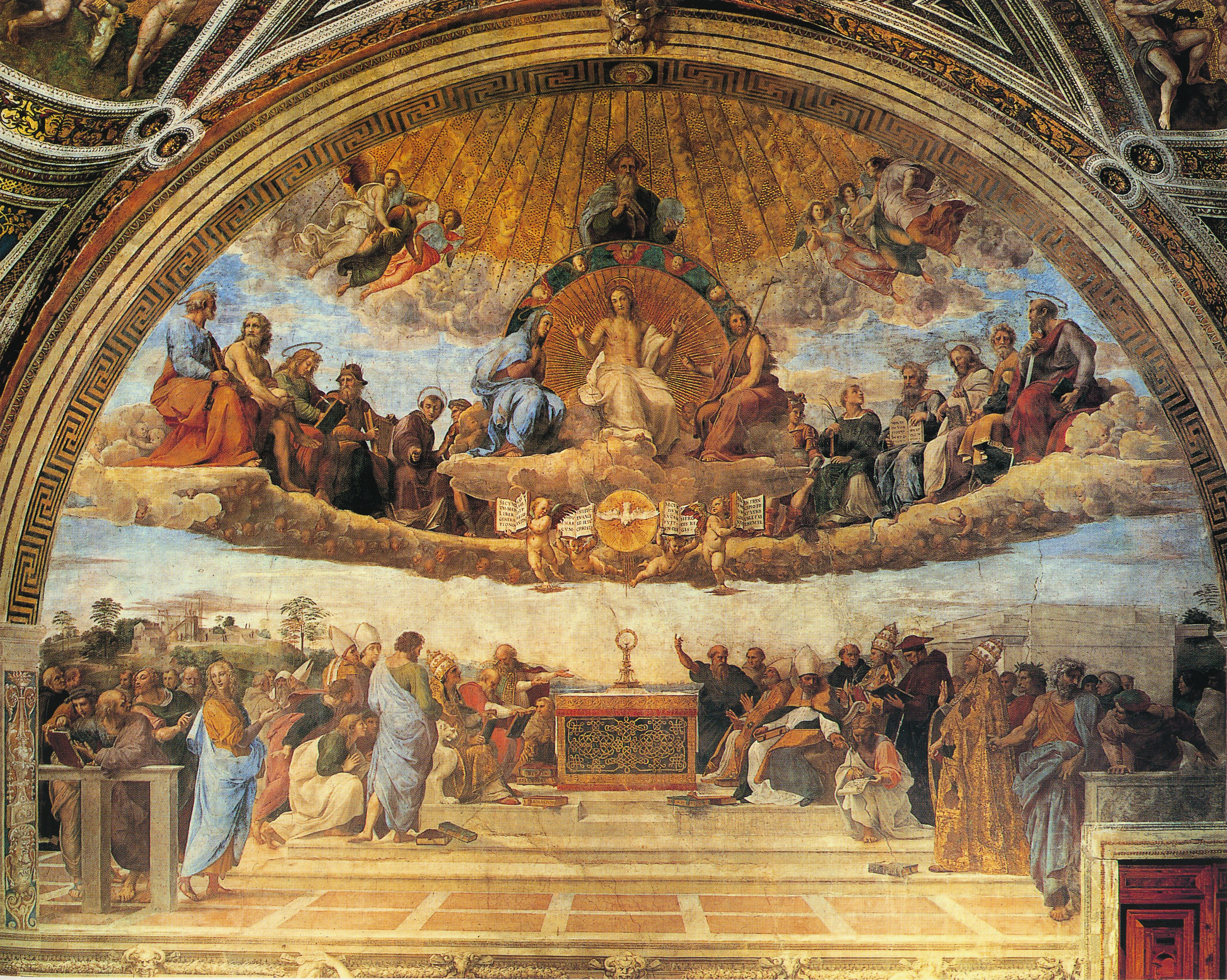
October 2015. Author’s photograph. 5.62 mb DSC_0023 (1)
Above: The Tree of Life is also visaged as the Menorah and is identified with the light of innermost perception – the spirit; thought; ideas; life; and of knowledge. This Primal Light, God’s light, radiates outward, extending and expanding throughout the universe.

October 2015. Author’s photograph. 4.68mb DSC_0026
Above: The Menorah poetically conceived as a tree of life and of light. The Menorah is the classic symbol of Judaism.

October 2015. Author’s photograph. 7.77mb DSC_0027
Above: The Star of David and the palm branch used on the Sukkot (Feast of Booths) harvest festival.

October 2015. Author’s photograph. 7.77mb DSC_0027
Above: The shofur or ram’s horn (above) is an ancient instrument used on High Holidays to call the people to repentance. In close proximity to the shofur is the etrog which is a fruit of the Holy Land which expresses earth’s bounty as well as the overflowing love of a human being’s heart for God.

Designed by Loebl, Schlossman & Bennett, the Chicago Loop Synagogue stands as one of Chicago’s most significant modern religious buildings, where architectural restraint is transformed by Abraham Rattner’s monumental stained-glass masterpiece into a profound visual statement of Jewish faith and heritage.

October 2015. Author’s photograph. 6.13mb DSC_0999 (1)
Above: View of the sanctuary from the balcony. The near perfect beauty of the Chicago Loop Synagogue is self-evident.

October 2015. Author’s photograph. 3.14mb DSC_0037 (1)
The prayer room on the first floor is used for daily prayer and other gatherings. Author’s photograph.

SOURCES AND FURTHER READING:

AIA Guide to Chicago. 2nd ed. Edited by Alice Sinkevitch. Orlando: Harcourt, Inc., 2004.

Bachrach, Julia. “Chicago’s Jewish Architects: A Legacy of Modernism.” Julia Bachrach Consulting (blog). February 1, 2018. https://www.jbachrach.com/blog/2018/1/30/chicagos-jewish-architects-a-legacy-of-modernism.

Chicago Loop Synagogue. Home page. https://www.chiloopsyn.org/.

Cooper, Alanna E. “Future in Question for Chicago Loop Synagogue and Its Monumental Stained-Glass Window.” Jewish Telegraphic Agency, April 14, 2021.

Lane, George, S.J., and Algimantas Kezys. Chicago Churches and Synagogues: An Architectural Pilgrimage. Chicago: Loyola University Press, 1981.

“Let There Be Light: The Chicago Loop Synagogue.” Chicago Modern: More than Mies (blog).

Preservation Chicago. “Chicago Loop Synagogue.” Accessed January 18, 2024. https://www.preservationchicago.org/.

Preservation Chicago. “THREATENED: Chicago Loop Synagogue Faces Uncertain Future.” April 30, 2021. https://www.preservationchicago.org/threatened-chicago-loop-synagogue-faces-uncertain-future/.

Smithsonian American Art Museum. “Abraham Rattner.” Accessed January 18, 2024. https://americanart.si.edu/artist/abraham-rattner-3946.

The Ten Commandments. “The Ten Commandments Bible List — What Are the Ten Commandments?” Accessed December 4, 2023. https://www.the-ten-commandments.org/the-ten-commandments.html.

Wikipedia, s.v. “Loebl Schlossman & Hackl.” Last modified January 3, 2026, 15:21. https://en.wikipedia.org/wiki/Loebl_Schlossman_%26_Hackl.

Wikipedia (français), s.v. “Louis Barillet.” Last modified April 21, 2026, 17:19. https://fr.wikipedia.org/wiki/Louis_Barillet.

Zolros, Peter. “A Sacred Spot in Chicago’s Loop.” Chicago History Museum (blog).

Chicago Loop Synagogue. ”In the beginning God created…” Author’s photograph.

Chicago Loop Synagogue. Author & wife. October 2015. Author’s photograph.

Architecture for a Universal Faith: Louis Bourgeois and the Baháʼí Temple (1912-1953) in Wilmette, Illinois.

FEATURE image: Architect Louis Bourgeois incorporated a variety of religious architecture and symbols including for Hindus, Buddhists, Native Americans, Jews, Christians and Muslims, to convey the Baháʼí principle of the unity of religion. Author’s photograph.

The Baháʼí Temple in Wilmette is one of America’s most distinctive religious monuments, where architect Louis Bourgeois fused spiritual ideals, innovative design, and intricate ornament into a landmark that took more than forty years to complete and remains a singular achievement in twentieth-century sacred architecture.

Text & Photographs by John P. Walsh.

The temple was designed by French-Canadian architect Louis Bourgeois (1856–1930). By 1906 Bourgeois and his wife joined the Baháʼí faith. Photo c. 1922. Public Domain.

The Chicago Baháʼí Temple House of Worship is the second such house of worship constructed and the oldest one that is still standing. The popular destination along Lake Michigan on Chicago’s Northshore attracts visitors from around the world today for its amazing architecture, beautiful gardens, and message of religious unity in prayer and for peace.

The temple was designed by French-Canadian architect Louis Bourgeois (1856–1930). After studying and traveling in Paris, Italy, Greece, Egypt, and Iran, Bourgeois settled in Chicago in 1896 where he worked with Louis Sullivan. Bourgeois moved to Southern California and, in 1898, designed in Hollywood a landmark Mission Revival style house for painter Paul de Longpré (1855-1911) whose architecture and gardens became a tourist attraction.

The building serves as the North American Baháʼí House of Worship. Located in Wilmette, Illinois, it has become one of Chicagoland’s most recognizable landmarks.

The nine sides of the building represent the largest single digit number which stands for the Baháʼí belief in the unity and oneness of humankind. June 2014. Author’s photograph. 6.55mb

The idea for the construction of the first Baháʼí Temple in the Western world began in Chicago in 1903. When there was a call for designs, Louis Bourgeois’ plans were the most promising. He worked on the complex design from 1909 to 1917. Before that time, Louis Bourgeois and his wife had joined the Baháʼí faith after having come into association with the Baha’i Faith through Boston’s Baháʼí community. In that time Bourgeois constructed a plaster model of his completed vision and in the 1920’s until his death in 1930 worked on the temple’s construction in Wilmette, Illinois.

While building activity was delayed though the Great Depression of the 1930’s and into World War II, temple construction began again in earnest in 1947 and the temple was dedicated in 1953.

Designed by French-Canadian architect Louis Bourgeois, its more than 40-year construction history reflects the determination of the Baháʼí community to realize Bourgeois’s ambitious vision.

Abdu’l-Bahá (1844-1921), eldest son of Baháʼu’lláh (1817-1892), the founder of the Baháʼí Faith, participated in the ground-breaking ceremony in 1912 of Baháʼí Temple. Construction began in earnest in the 1920s. It is four stories of reinforced concrete. June 2014. Author’s photograph. 4.11mb

Baháʼu’lláh (1817-1892) was an Iranian religious leader who founded the Baháʼí Faith. Public Domain.

Money for the building was raised entirely by the temple congregants as their gift to the people of the world. June 2014. Author’s photograph. 6.30mb

The temple blends influences from Gothic, Islamic, Byzantine, Renaissance, and other world architectural traditions into a unified design. Its lace-like concrete ornamentation creates one of the most elaborate exterior surfaces in American architecture.

The temple rises 191 feet from its base to its ribbed dome’s peak. The main story pylons are 45 feet high each. The building’s surfaces are teeming with carved lacelike ornamentation. June 2013. Author’s photograph. 4.50mb

The Baháʼí Temple has a highly traditional appearance whose architectural reputation—in an age of orthodox modernism and postmodernism—has grown only more positive with the years. June 2013. Author’s photograph. 4.85 mb

Interior of the auditorium inside the Baháʼí House of Worship in Wilmette, Illinois. The entire surface—from the towering walls to the massive dome ceiling—is covered in highly detailed, openwork ornamental lattice patterns that filter natural light.

  • The Grand Dome: A central, monumental circular dome rises high above the space, featuring a gilded calligraphic emblem at its center. Molded seamlessly into the pillars and lace-like quartz masonry are major global religious symbols layered chronologically from bottom to top—including Christianity, Judaism, Islam, and Hinduism—symbolizing the fraternity and evolution of mankind.
  • Soaring Arches and Pillars: Nine main pillars and towering arched window bays flank the multi-layered walls, drawing the eye upward. The number nine is the highest single-digit number, mathematically representing oneness, perfection, and the ultimate completion of God’s revelation.
  • Concentric Seating Layout: Curved rows of rich, red velvet-cushioned wooden seating wrap around a highly polished, reflective floor that mirrors the warm lighting from above.
    PHOTO: “The forbidden temple.” by kern.justin is licensed under CC BY-NC-ND 2.0.

The room is strictly dedicated to prayer, quiet contemplation, and meditation.  There are no sermons, rigid ritualism, or set religious dogmas permitted here. Because the faith emphasizes that all major world religions originate from the same Creator, the devotional readings regularly feature sacred scriptures from different faiths. In alignment with Baháʼí principles, the room features no professional clergy, religious imagery, or musical instruments. Any music performed during devotionals comes strictly from a cappella choirs or soloists.

The temple occupies a unique place in American religious architecture because it is unlike any traditional church, synagogue, mosque, or cathedral.

The temple’s main prayer room seats 1,200 people. In the Baháʼí faith there are no clergy, no sermons and no rituals. Scriptures are read from many different faith traditions and music by soloists or a cappella choir. June 2013. Author’s photograph. 5.31mb

The Baha’i House of Worship Choir, under the direction of Van Gilmer, performs “This is the Day”—featuring words by Báha’u’lláh and arranged by Stanford E. Scriven—at the 17th Annual Choral Festival in Wilmette, Illinois.

“The Source of All Learning is the Knowledge of God – Exalted Be His Glory.” There are an equal number of entrances each with a quotation above it by Baháʼu’lláh  (1817-1892), founder of the Baháʼí faith. June 2013. Author’s photograph. 5.94mb

The Baháʼí temple is open year-round presenting its unique beauty through the seasons. February 2021. Author’s photograph.7.97mb

The nine-sided plan reflects Baháʼí religious symbolism and the principle of unity. The structure demonstrates how architecture can express universal spiritual ideals through light, geometry, and decoration.

The building is on the National Register of Historic Places and situated on a broad, landscaped site that looks towards Lake Michigan. PHOTO: “Wilmette, 2015” by gregorywass is licensed under CC BY-NC-SA 2.0.

SOURCES:

Chicago Churches and Synagogues: An Architectural Pilgrimage, George Lane, S.J., and Algimantas Kezys, Loyola University Press, Chicago, 1981, pp. 160-161.

Chicago’s Famous Buildings, Fifth Edition, Franz Schulze and Kevin Harrington, Chicago and London: University of Chicago Press, 2003, pp. 267-269.

A Guide to Chicago’s Historic Suburbs on Wheels and on Foot, Ira J. Bach, Swallow Press/Ohio University Press, 1981, p. 535.

The Melody of Color and Symphony of Form: Albert Joseph Moore’s Art of Pure Beauty.

FEATURE image: Albert Joseph Moore (1841-1893), READING ALOUD, 1884, oil on canvas, 42.24 x 81 in., Glasgow Art Gallery & Museum.

The artist: Albert Joseph Moore (1841-1893).

Albert Joseph Moore was one of the leading figures of the British Aesthetic Movement, creating meticulously crafted paintings that placed beauty, harmony, color, form, and decoration above narrative or moral instruction. His idealized female figures inhabit timeless settings that blend classical inspiration with Victorian artistic experimentation, making him a unique voice in nineteenth-century British art.

Albert Moore: Life and Artistic Legacy

Albert Joseph Moore was born in 1841 into a family of artists in North Yorkshire in England. Moore through his own advanced aesthetic experiments in the milieu of theoretical and practical advancements of mid-to-late 19th century modern art in England and France – such as a systematic analysis of nature, mathematical plotting, and principles for quintessential combinations of color, line and form – created art that was, in formal terms, in its conception and execution, on the cutting edge of abstraction that would continue to develop and blossom into early 20th century Cubism. Moore’s art gained the respect of other progressive artists (Moore was called “a painter’s painter”), patrons and collectors, if not always the critics and contemporaries who viewed Moore’s work as merely decorative. Moore was actively collected in his lifetime and exhibited regularly in major venues such as the Royal Academy. Unmarried and of a lifelong independent disposition, Moore died in 1893 at 52 years old, having just completed his last monumentally ambitious artwork (“The Loves of the Winds and the Seasons,” Blackburn Museum and Art Gallery, posted below) a handful of days before. Several of Moore’s pictures are now in public collection throughout the UK, including the Tate and the British Museum in London. 

Moore became a major representative of the Aesthetic Movement, often summarized by the ideal of “art for art’s sake.”

Azaleas (1867-1868)

Albert Joseph Moore (1841-1893), AZALEAS, 1867, Hugh Lane Municipal Gallery of Modern Art, Dublin, Ireland.

Azaleas was a popular artwork by Albert Moore for its harmonies of color and the “Greek refinement” that the artist infused into his work. This bigger-than-life-size canvas called Azaleas was painted in 1867, exhibited in 1868 and demonstrates the artist’s ability to represent the human figure on a grand scale.

The featured works depict idealized women in dreamlike environments that feel both classical and modern. His paintings emphasize decorative harmony, color relationships, pattern, and graceful composition rather than storytelling.

Geometry and Preparation

The 26-year-old artist had some architectural design experience in theory and practice and used this in his preparatory process. This artwork incorporated ideal geometry along with typical academic methods.

Moore’s process followed, first, making studies of the nude figure and draped figure. Moore next made a larger-than-life-sized full-scale nude figure cartoon which, at this stage, was informed by geometric abstraction of the figure in a setting guided by, or through, the milieu of the object in the artist’s hands.

The geometric quality guided the composition rather than was externally imposed by the artist. Moore’s “system of line arrangement” sought the directions of the prominent lines of the composition so to plot parallels of them throughout the drawing resulting in a statuesque yet corporeally vivacious figure.

Nature, specifically the landscape, ultimately served as the inspiration for the manifestation of line parallels and optical balance rather than the mathematically ideal. Moore’s geometric construct and its interplay determined every element of the composition – from the position and placement of the figure to the location of accessories, such as wall hangings, distribution of drapery folds, and architectural elements. The canvas’s shape and size also were ultimately determined by this idiosyncratic geometric arrangement.

Traces of Moore’s preparatory practice are in evidence in Azaleas’ full size nude cartoon with its vestiges of diagonal and horizontal lines through the midsection of the figure and near to her feet. Using these lines in the nude drawing it is apparent that Moore experimented with the placement of the figure’s head, the extended hand, and a raised heel which was ultimately hidden under opaque drapery. Moore used a live model for his figure.

Technique and Execution

The final nude cartoon was transferred to the canvas and this outline was built up with oil colors. A drapery cartoon was then transferred on top of the transferred, built-up nude figure cartoon. Using this method Moore rendered greater transparency of the fabric since the underlying nude cartoon showed through faintly. This painstaking preparation was masked by Moore’s fresh and free style of painting. For instance, the drape folds of the left shoulder are painted in long, fluent, and elegant strokes while the azaleas are rendered in energetic strokes. Moore’s objective was for the final painting to look like an impromptu and expressive sketch when, in fact, it was carefully planned and executed.
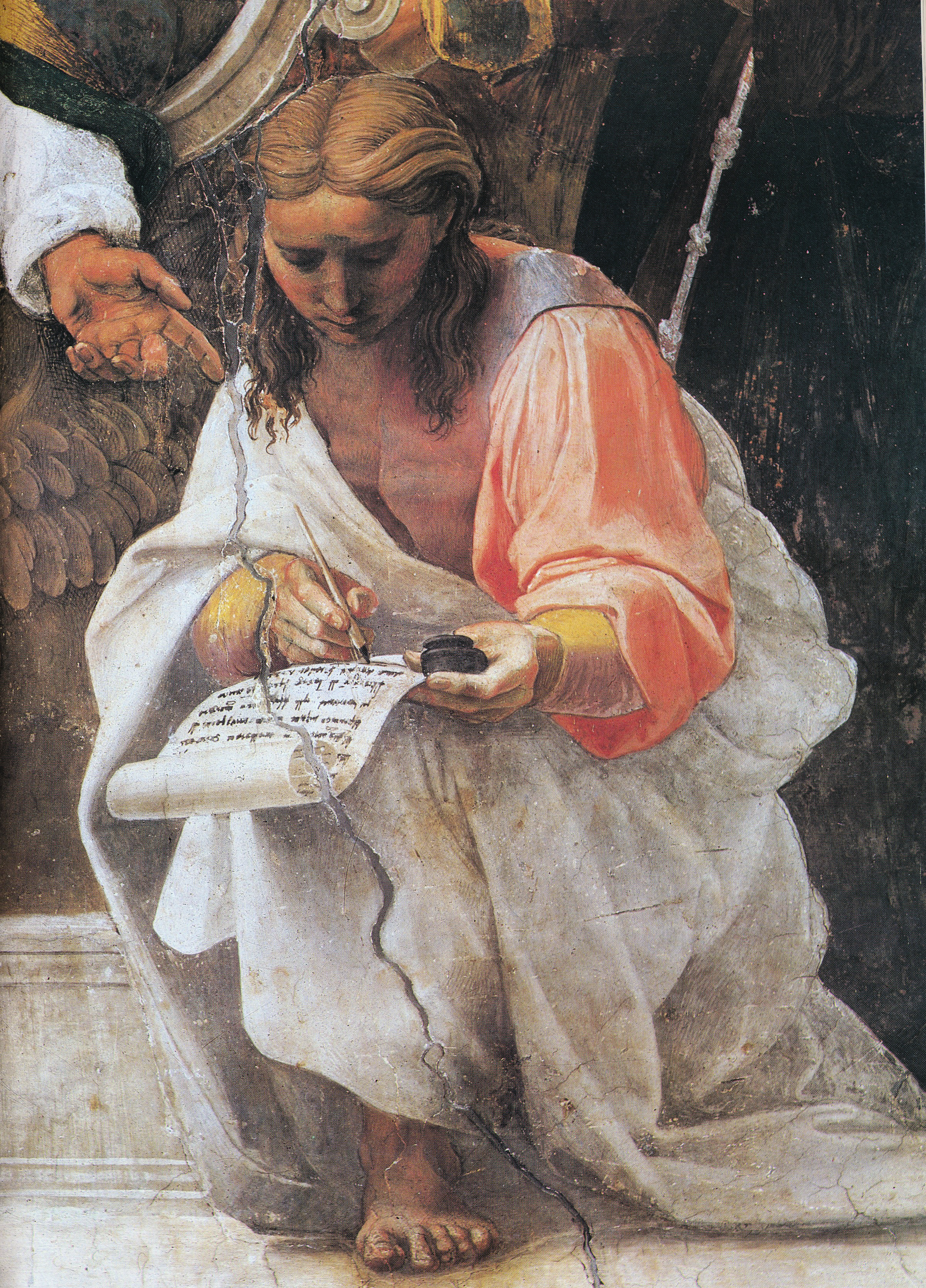
About painting Moore taught his students to think long about it but execute with quickness and determination. This technique aided in transforming oil painting into the manner of Graeco-Roman fresco in that Moore’s working method allowed for painting only what could be finished in a day.

Japonisme and Color Harmony

Moore’s careful planning, rapid execution, and brush technique also suggested the influence of Japonisme. Asian influences in Azaleas included the carp bowl held in the women’s arm (an actual studio prop) and the geometric pattern in the azalea pot whose symmetry Moore saw as part of both Greek and Japanese art. To integrate and transition the predominantly yellow figure in the predominantly white background Moore used a device taken from Japanese art of painting flitting butterflies around the azalea bush. Moore also painted russet blossoms in the woman’s hair and bowl and on the floor that further unites the monumental composition.

Moore’s observation of Japanese prints also likely influenced the English artist’s color scheme in Azaleas. This is identifiable in its limited schematic of hues. The color placement, however, was also subject to the geometric practices in the whole composition.

Critical Reception

When Azaleas was exhibited at the Royal Academy in 1868 it was consigned to an out of the way place on the wall of its North Room. It was observed that Moore’s canvas looked more like a tapestry than an oil painting. In this way, Moore anticipated James McNeill Whistler’s comment about color in that it should appear “embroidered” on the canvas, in the same way a thread is embroidered on fabric. Whistler attributed this color quality to Japanese art in that those artists looked for repetition in color application and not contrast.

Architecture critics in 1868 noticed and especially admired Moore’s Azaleas. Its systematic repetitions and geometric construction were labeled the only “decorative” painting in the 1868 English exhibition. Art critics were less generous. Straining with opera glasses just to see the work they recognized its beauty and Moore’s talent but called its design and execution eccentric. Others turned up their critical nose to the new decorative work as “curious” and little more than a luxurious indulgence of art for art’s sake. Art critics were unhappy with the paintings’ colors as they found they lacked the requisite black that marked contemporary French art and, instead, opted for a quiet and delicate dreamscape.

English writer William Michael Rossetti (1829-1919) declared Azaleas one of the most important English pictures of 1868 and decried those looking to judge it by way of actual historical pictures from Greek antiquity. With Algernon Swinburne (1837-1909), Rossetti compared Moore’s artwork to another painting in the 1868 exhibition: “The Wife of Pygmalion, A Translation from the Greek” by the older George Frederic Watts (1817-1904). In that work Watts sought to create a painterly equivalent of classical sculpture. William Gladstone (1809-1898) wanted to purchase Watts’ picture after seeing it at the Academy in 1868. In a letter to Gladstone in May 1868 Watts informed Gladstone that it had been “claimed” but invited Gladstone to visit him in his studio to see the cast of the fragmentary Greek original from which the painting was derived.

Swinburne saw the poetry and musicality of Moore’s artwork .While most art critics snubbed the painting (and by extension the painter) for its art for art’s sake qualities, Swinburne praised them. Of Azaleas, Swinburne wrote: “The melody of color, the symphony of form is complete: one more beautiful thing is achieved, one more delight is born into the world; and its meaning is beauty; and its reason for being is to be.”

Sea-gulls (1871)

Albert Joseph Moore (1841-1893), SEA-GULLS, 1870/71, oil on canvas, 27 x 61 inches (68.5 x 154.8 cm), Williamson Art Gallery & Museum, Birkenhead, UK.

The Whistler Controversy

Sea-gulls was accepted for the 1871 Royal Academy exhibition. It was the third painting for Albert Moore to exhibit at the Royal Academy. Moore was absorbed in painting Sea-gulls, a major work, for British shipping magnate Frederic Leyland (1831-1892) and this work occupied him up to the Royal Academy Exhibition that spring.

Its creation by the 36-year-old Moore was not without headaches owing to controversy. Moore’s friend and admirer, American ex-patriate artist, James Abbott McNeill Whistler (1834-1903), had learned of Moore’s preliminary work on the painting through Leyland, a major art collector and the artists’ mutual friend.

Whistler expressed concern that Moore’s work perhaps overlapped adversely with some of Whistler’s own preliminary sketches for a painting. Whistler saw a pair of sketches Moore had sent to Leyland as potential commissions. Whistler felt that Moore’s sketch may have been influenced by seeing one of Whistler’s sketches. Whistler feared that if Moore’s painting was exhibited first, it would reflect badly on Whistler as an imitator when in fact the artwork Whistler was working on ante-dated Moore’s conceptions. This was a mortifying prospect for Whistler who prided himself on originality.
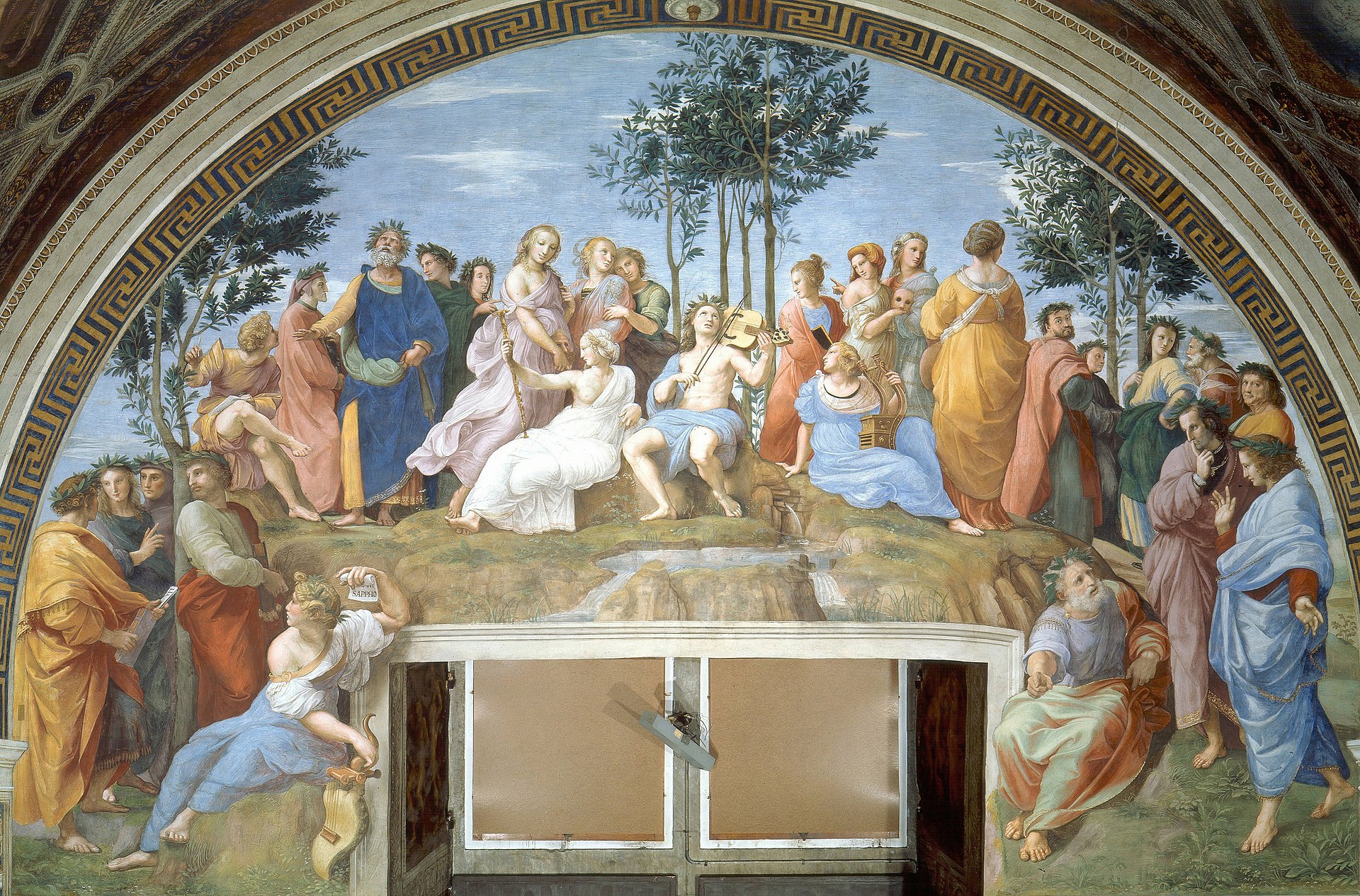
Whistler’s anxiety may have also stemmed from the fact that with Sea-gulls, Moore would fulfill his second commission for Leyland, while Whistler who introduced them had yet to complete a picture for Leyland that had been commissioned in 1867.

To ease Whistler’s fears, the American artist proposed that Moore accompany another mutual friend, architect William Nesfield (1835-1888), to Whistler’s studio in Chelsea to inspect his older original sketch that Moore had seen.

Nesfield, acting as mediator, concluded in September 1870 that the recent work of the two artists shared themes, but each maintained their own artistic originality. The crisis was averted and led to Moore exhibiting Sea-gulls.

Completion and Artistic Development

During this crisis and shortly thereafter, Moore did not finish to his satisfaction his painting when it was time for its exhibition in April 1871. A major effort required to complete Sea-gulls had deeply undermined Moore’s health. After the exhibition the painting was returned to the artist, but he could not yet immediately set to work on it to completion. Months later it was finished and sold to Leyland.

Nature, Movement, and Surface Effects

In Sea-gulls Moore introduced obvious analogies between the liquid patterns of the sea and the rippling and splashing motion of the figure’s hair and drapery. Moore’s intention was to discern patterns inherent in nature. The drawings also suggest that he exaggerated the effect of air currents by employing the revolving fans that were simultaneously in use for Sea-gulls and another painting titled Shells.

Much of Moore’s work to complete the painting after the exhibition revolved around redressing the picture surface. Moore had been experimenting for some time with the surface quality of his paintings. In the early 1870s, Moore’s technique had developed to combine transparent and opaque fabrics that created unusual layering effects. Following the 1871 exhibition, Moore seemed to apply this technique in Sea-gulls that involved unusually thick paint layers.

Grosvenor Gallery and Lasting Friendship with Whistler

Much later, during the winter of 1880, Sir Coutts Lindsay (1824-1913) – the British artist and watercolorist founded Grosvenor Gallery on Bond Street as an alternative exhibition space to the Royal Academy which became a venue for avant-garde artists, particularly those associated with art for art’s sake – mounted a show on the subject of artists’ working sketches. Moore contributed the preparatory studies for Sea-gulls to the show that included his sketches of hands, heads, drapery, plants and flowers, as well as the painting’s cartoon.

Although biographers of Whistler and Moore have attached no importance to their friendship, particularly after the September 1870 controversy over Sea-gulls which they claim ended it, the artists in fact remained on intimate terms unbroken until Moore’s death in 1893. In the later 1870s they again were thrust together in a contentious situation but this time on the same side of sorts. When Whistler became involved in libel proceedings against Ruskin in later 1878 Albert Moore was the only artist who the American ex-patriate artist could rely on to both publicly attend the proceedings and actually give evidence on Whistler’s behalf. 

Albert Joseph Moore was highly admired by James McNeill Whistler, who regarded him as his favorite contemporary British artist.

Reading Aloud (1884)

Albert Joseph Moore (1841-1893), READING ALOUD, 1884, oil on canvas, 42.24 x 81 in., Glasgow Art Gallery & Museum.

Conception and Working Method

Reading Aloud was one of three large-format paintings Albert Moore completed in the 1880s. Completed in 1884, Moore had been working on Reading Aloud for years – at least since 1881. Moore had drawn a chalk sketch of the geometrically designed composition over which the artist would lay a piece of translucent glass. By painting directly on the glass, he could experiment with colors without redrawing the picture. He then could transfer the trial color experiment on glass (as well as a final drawing) onto tracing paper by which the final artwork was then made by pinning the tracing paper to the canvas. The artist then painted the composition directly to the canvas, section by section, working as he painted to unify color scheme and, as figural poses and other details are different in the final artwork than surviving preparatory materials, drawing. It was meticulous organizing and harmonizing creative work that helps to explain why Moore labored for years on the almost 7×4 foot oil on canvas.

Works such as Reading Aloud demonstrate his pursuit of beauty through carefully controlled arrangements of figures, fabrics, colors, and space.

Composition and Symbolism

While these three reclining figures are static their contrasting drapery folds whether they are swirls, zigzags or sweeping diagonals – with the sofa’s swags to unite them – enliven the picture. As classicism revivalists are noted for their mere realism and moralistic anecdote, Moore’s evocation of classicism, though containing allegorical qualities, belies a modernity by way of its abstract combination of line and form in the depiction of languid female figures in a neutral setting. The black-and-white owl vase that Moore included in the lower right corner of the painting had been absent from previous studies (originally it was a seated cat) and provides a narrative sign. It connotes the quality of wisdom as well as perhaps the goddess Athena with which the owl is associated so to apply it to the various states of the readers though the overall picture with its fascination with repose is more subtly mysterious than anecdotal. Yet the classicism/modernity enigma continues as the honey bee which Moore paints on the face of the owl vase was the symbol used by the picture’s purchaser, pig iron industrialist William Connal (1819-1898), for himself.

Moore, Albert Joseph; William Connal; York Museums Trust; http://www.artuk.org/artworks/william-connal-8009

William Connal and the Painting’s Patronage

After his wife of 25 years Emelia Jessie (Campbell) Connal died in 1877, 56-year-old industrialist William Connal faced life alone at Solsgirth, his Scottish country manor. Connal turned his attention to the arts and, in addition to Moore, became an avid collector of contemporary art by such painters as Edward Burne Jones (1833-1898), Edward Poynter (1836-1919), Frederick Sandys (1829-1904), Roddam Spencer Stanhope (1829-1908), Fernand Knopff (1858-1921) and Adolphe Monticelli (1824-1886) along with the Old Masters. Connal owned Symphony in Silver and Grey by American artist James McNeill Whistler (1834-1903) who greatly admired Moore. In 1883, Connal invited Moore to stay at Solsgirth House in Perthshire for a month allowing the artist to recuperate after a serious illness. It was during this stay that Connal commissioned Moore to paint his portrait that shows him wearing a honeybee brooch, the emblem that Connal used on his personal items (Connal’s portrait today is in York Art Gallery).

Geometry, Abstraction, and Critical Response

Moore’s pictorial methodology which he continued to develop over his artistic career is in evidence in Reading Aloud. Moore works out and unifies various and moving parts depicting a scene’s animating personality based in psychology with its physical forms that are mathematically contrived by way of lines and curves and, ultimately, color and texture, and whose impact on the viewer of the completed artwork is allowed to be emotional rather than cerebral. In Reading Aloud Moore constructed the image based on two pairs of diagonals that intersect into a pattern. Though the geometric system is visually subdued, it is evident in the figure on the right whose arms coincide with a set of diagonals. It is obvious also in the picture’s overall use of contrasting bold colors – the fabrics’ pinks and creams are integrated to, though angularly distinct from, the charcoal greys of the covered limbs and book cover. The edges of the book cover also coincide with some of the complex design of diagonal lines whose subliminal quality is an intrinsic expression of the psychic nature of the artwork. This angularity based on diagonals was a deliberate strategy for Moore when he painted the final artwork. There is also the horizontal lines component in the painting manifested in the outstretched arms of the crouching figure at left and the table and vase. Moore’s design strategies were innovative in 1884 startling contemporary viewers approaching to what Cubism would accomplish 25 years later. Critics when viewing Reading Aloud, being neither particularly understanding nor sympathetic to Moore’s methods or intentions, praised the picture’s overall gracefulness but impugned his drawing skills and identified the painting as mostly static decoration. Yet the static figures form part of a complex array of abstract and naturalistic patterns that fill every inch of canvas. Reading Aloud is a testament to the artist’s ability to translate such natural phenomena into a stylized form. Most prominent among them is a fabric effect found in other of Moore’s paintings of the period, in which white lace is layered over cloth of a darker color. Reading aloud was exhibited at the Royal Academy where, starting in 1883, Moore chose to exhibit annually.

The Loves of the Winds and the Summer (1893)

Albert Joseph Moore (1841-1893), The Loves of the Winds and the Seasons, 1893, oil on canvas, Blackburn Museum and Art Gallery, Blackburn, UK.

Moore’s Final Masterpiece

The Loves of the Winds and the Summer was English artist Albert Moore’s final and largest artwork of his career. It is 6 feet tall and 7 feet wide and is the jewel in the crown of the Blackburn Museum and Art Gallery near Manchester, England. It is the result of Moore’s study of the psychology of his subject matter, that of love. Love begins to manifest formally for Moore by the expression of soft bodily postures, changing and harmonious curves, and piercing gazes expressed in deep coral colors. The male figure of the Wind is flanked by the spurned female figure of Summer to the left and the embraced female figure of Autumn to the right. Moore was so enveloped in his amorous themes that while working on this picture he was writing poetry about what the human face was like when in love – and it is found in his picture. The Love of the Winds and the Seasons is Moore’s fullest expression of animating personality united to depicted physical forms that are first lines, curves and color, with the result being an emotional impact on the viewer who encounters the artwork.

Moore drew inspiration from ancient Greek sculpture and classical forms but was not attempting archaeological reconstruction.

Art in the Face of Terminal Illness

This exquisite artistic sensitivity by Moore is made more remarkable since the artist was dying in 1893. In the company of his young and attractive live models in his new capacious art studio, Moore worked day after day on this work. Moore had cancer (a tumor on his thigh) and had submitted to three operations to keep ahead of it. When his doctors told him they could operate no more, and that the cancer continued to spread throughout his body, Moore was resigned to his situation. He is reported to have said: “Well, there’s an end of it.” In the limited time left to him Moore intended to finish his painting of love, The Loves of the Winds and the Seasons. The artist did not want to lose any time. His legs had swollen to twice their size and had to be drained. In acute pain he worked around the clock for the next six months. His friends thought the intense work as well as the cancer was killing Moore but as the painting progressed to completion, they observed that the artist’s personal tranquility and happiness became apparent.
Geometry, Design, and Creative Process

The project was monumental – numerous preparatory studies, drapery studies, full scale and life-sized cartoons (i.e., 4’ 9” tall by 1’4” wide for Autumn) , nude studies – all technically meticulous and versatile- and that underwent the artist’s elaborate and idiosyncratic geometric platting system that he began in the late 1870s. Moore was the consummate auteur that slightly older American ex-patriate painter James Abbott McNeill Whistler (1834-1904) most admired in England. Moore conceived his paintings from start to finish – and The Loves of the Winds and the Seasons was at once its pinnacle and completion. Moore, as Whistler aspired to be, was sole master of his work. In 1893 Moore now expanded this mathematical process to amalgamate his diagonals with horizontals so that his creative process could not suffer the critique that Ruskin hurled at Whistler of “ask(ing) 200 guineas for flinging a pot of paint in the public’s face.” The painting was a commission for the Australian mine-owner George McCulloch (1848-1907). Moore’s calculations included various adjustments of the models’ natural poses to submit to the mathematical formulas on the canvas. This formal submission of subjects to linear construction extended to each detail in the entire composition, such as the flowers for which also study drawings were made. Within these design rigidities, the preparatory drawings of the live models and subjects were transferred to the artwork with little idealization though slight but important adjustments were made, such as to Summer’s hairstyle. Knowing his own time was short, Moore made his cartoons in color so that his transfer to the canvas was as efficient as possible as he painted the final artwork. Critics have observed that despite the intense planning and preparation, the final artwork is executed unevenly – parts are meticulous and vigorous, mostly in the foreground, while others in the background are loose and crude. To what degree this is the artist’s intention or the result of his declining health, is a matter for speculation. During the artistic process the terminally ill artist isolated himself mostly. His handful of visitors remarked that the artist was cheerful, cracked jokes, told funny stories, and smoked his pipe. These select parties knew, however, that their social calls were in the context of final good-byes. In those last days and months of Moore’s life, the artist’s mind, by evidence of the art from his past that he referenced in 1893, stretched back to an earlier career which shared long-held important aspects with The Loves of the Winds and the Summer.
Poetry and Meaning

For his last artwork. Albert Moore glossed the picture’s narrative in verses he wrote to accompany it:

Lo! fickle Zephyr chaseth wayward Spring,
It is a merry race;
Flowers laugh to birds that sing,
Yet frequent tears shall cloud her comely face.
The South Wind shall with blushing Autumn mate,
Contented with her lot;
Summer sigheth – such her fate
She and her burning kisses are forgot.
Two lovers rough for shudd’ring Winter strive,
Beneath a shroud of snow;
Heaven haply shall contrive
Their violence she may not further know.

Legacy and Death

Through its figural and intellectual prism of ancient classical mythology, Moore worked in his career to update the complex equation of the natural world’s varying and transitory seasons to human life’s copious physical, emotional, and spiritual expressions and contradictions. With their immersion in Moore’s modern art, the painter achieved a graciously-contrived visual dramatic interplay of nature and humanity, ancient and present-day, whose quest is eternal in time and space.

Albert Joseph Moore passed away in the middle of the night on September 25, 1893. He died 9 days after finishing his last painting, The Loves of the Winds and the Summer. Moore was 52 years old.

Albert Joseph Moore’s art transformed Victorian classicism into a sophisticated decorative vision that influenced later developments in modern art and design.

SOURCES: ALBERT MOORE, Robyn Asleson, Phaidon, 2000, pgs. 70, 97-100, 104, 108. 164, 166-168, 177, 179, 185, 199-202; https://houseandheritage.org/2017/05/19/solsgirth-house/ – retrieved September 5, 2023.

The 12th Century West Front/Royal Portal of Chartres: A Medieval Vision of Heaven at the Dawn of the Gothic Age.

FEATURE image: The North Porch was constructed at the start of the 13th century. The North Porch, like the North Rose Window (below) crafted in the same time, depicts the glories of the Virgin Mary along with Old Testament figures. PHOTO: “Chartres, North Porch, Central Portal, LeftJamb” by profzucker is licensed under CC BY-NC-SA 2.0.

The Royal Portal of Chartres Cathedral represents one of the defining achievements of early Gothic art, where architecture, sculpture, and theology were fused into a monumental visual statement of Christian belief. Created in the mid-twelfth century and remarkably preserved, its sculpted kings, queens, prophets, and Christ figures reveal the moment when medieval Europe began transforming stone into a sophisticated language of faith, learning, and artistic innovation.

The Royal Portal (Portail Royal) on the west façade of Chartres Cathedral, carved between 1145 and 1155, is one of the finest surviving ensembles of Early Gothic sculpture. Its three richly coordinated doorways present a sweeping vision of Christ’s role in salvation history. Above the left portal, a semicircular tympanum depicts Christ’s Ascension; the central portal illustrates the Apocalypse and the Second Coming of Christ; while the right portal focuses on Christ’s nativity and entrance into human history while crowning the composition is the Sedes Sapientiae (Throne of Wisdom), where the Virgin Mary sits enthroned with the Christ Child in her lap, flanked by two incensing angels. The portals are further enriched by sculpted lintels and archivolts populated with biblical figures and symbolic imagery. Lining the doorways below are the celebrated jamb statues attached to the columns, their elongated, otherworldly forms depicting the kings and queens of the Old Testament. Together, these sculptures create a monumental stone theology that welcomed medieval pilgrims while proclaiming the spiritual and royal lineage of Christ. PHOTO: “Chartres” by Photo:Nina Aldin Thune User:Nina-no is licensed under CC BY 2.5.

The Royal Portal of Chartres is more than a cathedral entrance; it is one of the earliest and most influential masterpieces of Gothic art, transforming carved stone into a timeless expression of faith, knowledge, and medieval imagination.

Jamb statues from the Royal Portal (west façade) of Chartres Cathedral. These columns stand on the right-hand side of the Central Portal. These statues were carved between 1145 and 1155. They represent a critical turning point in Western art history, standing as the definitive bridge between the rigid, blocky Romanesque style and the lifelike naturalism of the Early Gothic period. While individual identities are debated, the overarching program represents the Kings and Queens of the Old Testament. PHOTO: “Cenral tympanum Chartres” by Cancre is licensed under CC BY-SA 2.5.

First Visit and Returning to Chartres Across the Years

I first visited Chartres Cathedral in 1985, returning in 1989, 2002, and 2005. That first visit included a Malcolm Miller tour—my introduction to a guide who, since 1958, had devoted his life to interpreting one building. As I backpacked through Europe, his example showed me how a single enduring monumental work can anchor a lifetime of study.

The Great Glass of Chartres

Chartres is celebrated above all for its 12th‑ and early‑13th‑century stained glass, a nearly intact ensemble unmatched anywhere in Europe. The windows shimmer with deep blues, ruby reds, and jewel‑like greens—colors that have survived more than 800 years. Their narratives unfold left to right, beginning at the base and rising upward, guiding viewers through biblical cycles, guild stories, and royal symbolism.

Layers of Cathedrals on a Roman Site

The cathedral stands on what was once a Roman site, and several earlier churches rose and fell here. Structures were destroyed during the Merovingian era, again in Viking raids, and once more in the fires of the 12th century. Each catastrophe cleared the ground for a new architectural vision, culminating in the High Gothic monument seen today.

Detail of jamb statue located on the on the Central Doorway of the North Portal (Portail Nord) of Chartres Cathedral. The prominently featured statue is identified as Saint Anne, the mother of the Virgin Mary. While the Royal West Portal y dates to the mid-12th century (1145–1155), the North Portal was constructed later, between 1204 and 1220. This timing difference explains why Saint Anne’s face features a much more advanced, deeply expressive, and three-dimensional High Gothic naturalism compared to the highly stylized, strictly column-like figures of the west façade. PHOTO: “France, Detail ‘Cathédrale Notre-Dame de Chartres’” by Vincent_AF is licensed under CC BY-SA 2.0.

The Cult of the Virgin Mary

A powerful cult of the Virgin Mary developed at Chartres, strengthened by the arrival of the cathedral’s most famous relic in the 9th century: the Sancta Camisa, believed to be the Virgin’s veil. When devotion to Mary surged across Europe in the 12th century, Chartres—already dedicated to Mary’s Assumption—was perfectly positioned to become a major pilgrimage center, drawing travelers from across Christendom.

Arrival in Chartres

On my first visit to Chartres Cathedral in 1985, I left Paris after breakfast, walked to Gare Montparnasse, and boarded a direct train to Chartres. That day’s tour with Malcolm Miller centered on the great windows of the north side: the North Rose Window (c. 1231), the Blue Virgin Window (c. 1194), and portions of the Noah Window (c. 1210). The Noah Window includes a portrait of St. Lubin, the 6th‑century bishop of Chartres and patron of wine merchants—one of the guilds that financed the glass.

The Blue Virgin Window (Notre-Dame de la Belle-Verrière) is located completely away from the transept roses, tucked into the south aisle of the choir ambulatory (Bay 30). it was one of the incredibly rare pieces of glass that miraculously survived the great cathedral fire of 1194. The central figures of the Virgin Mary and Child date to approximately 1180. When the cathedral was rebuilt in the early 13th century, the master glasiers saved this sacred 12th-century panel and carefully framed it with new 13th-century outer border panels (circa 1215–1220), blending Romanesque and High Gothic glass art seamlessly. PHOTO: “Chartres, Notre-Dame de la Belle-Verrière (detail of Virgin)” by profzucker is licensed under CC BY-NC-SA 2.0.

The portal celebrates Christ’s majesty while emphasizing the relationship between the Old and New Testaments. Its sculptural program unites architecture and theology, turning the cathedral entrance into a visual lesson in Christian belief.

Sculpture of the West Front

Miller also took us outside to study the 12th‑century statuary of the Royal Portal on the west front—figures I photographed again in 1989. These sculptures belong to the cathedral’s Romanesque‑Gothic transitional phase and survived multiple disasters that reshaped the building.

Early Fires and Romanesque Foundations

A major fire in 1120 destroyed the earlier church, prompting construction of a large Romanesque structure contemporary with Vézelay Abbey. Another fire in 1134 damaged the building and led to the construction of the north tower, completed in 1150. The south tower followed roughly a decade later. The Royal Portal itself was built between 1145 and 1155, forming the nucleus of the west front that still stands today.

The 1194 Fire and Gothic Rebuilding

The defining catastrophe came in July 1194, when a devastating fire destroyed nearly the entire church and much of the city. Remarkably, the mid‑12th‑century west front, its royal doors, and the two contrasting towers survived. Everything else—the soaring nave, the sculptural program, and nearly all the stained glass—was rebuilt between 1195 and 1220, creating the unified High Gothic masterpiece seen today.

The survival of the Royal Portal through fires, wars, and centuries of change makes it an extraordinary witness to medieval civilization.

The North Rose window in Chartres Cathedral displays the Virgin Mary and Child in the center surrounded by small circles of doves, angels and thrones. In the outer circles are depicted the 12 kings of Judah (who were Jesus and Mary’s ancestors) and the 12 minor prophets. “Chartres – cathédrale – rosace nord” by Eusebius@Commons is licensed under CC BY 2.0.

Royal Patronage of the North Rose:

In the rebuilding of Chartres, The North Rose Window (created c. 1230-1235) was donated by Blanche de Castile, mother and regent, who ensured the design honored both her lineage and her teenage son, King Louis IX, whose royal patronage helped define the Gothic cathedral’s luminous 13th‑century glass program both here and soon in Paris.

Political Strategy Behind the Glass

The window is not only a devotional masterpiece; it is a calculated piece of 13th‑century political messaging crafted at a moment when Blanche of Castile faced rebellions from French barons who resented both her gender and her foreign birth to rule France. By shaping the iconography, Blanche used the cathedral’s most prominent glass to assert her divinely sanctioned authority.

Heraldry as a Statement of Power

Blanche inserted unmistakable symbols of legitimacy:

  • the arms of France — golden fleurs‑de‑lis on blue
  • the arms of Castile — golden castles on red

Placed together, they proclaimed the union of dynasties and the rightful lineage of her son, Louis IX, whose minority she was defending.

The Lancet as a Warning to the Barons

Directly beneath the great rose, Blanche added a lancet window pairing righteous biblical kings standing triumphantly over fallen, corrupt rulers. It was a visual admonition to rebellious nobles: oppose the rightful sovereign, and you align yourself with the defeated enemies of God.

Saint Anne and Blanche of Castile

At the center of the vertical lancets stands Saint Anne, holding the infant Virgin Mary. This was a deliberate, intimate parallel. Blanche positioned herself as a holy mother‑protector, raising the sacred child — Louis IX — to rule France. The imagery reinforced her maternal authority and the sanctity of her regency.

Revolutionary Upheaval and Restoration

During the French Revolution, Chartres Cathedral was desecrated and repurposed as a Temple of Reason, part of the radical de‑Christianization campaign. It was not returned to the Church or reconsecrated until 1855, beginning the long modern era of preservation and study that continues today.

The survival of the Royal Portal through fires, wars, and centuries of change makes it an extraordinary witness to medieval civilization. Chartres became a model for later Gothic cathedrals throughout France and Europe.

The West Front is from the 12th, 13th and 16th centuries. The photograph’s column statues below are on the right side of the West Portal’s central door. Though likely originally intended in the 12th century to be enclosed in a narthex, that structure was not built and these sculptures remained outdoors. “Chartres 2014 – 2” by evocateur is licensed under CC BY-SA 2.0.

The Rise of Cathedral Learning

By the 11th century, Europe experienced a renewed intellectual energy, especially in Northern Europe, where monastic and later cathedral schools became centers of study. One of the pivotal figures in this revival was Gerbert of Aurillac (c. 946–1003), later Pope Sylvester II, who had studied in Spain and led the cathedral school at Reims in the 970s. His most influential pupil, St. Fulbert of Chartres, carried this legacy forward.

Fulbert and the Great School of Chartres

As bishop, St. Fulbert founded the Chartres Cathedral School, which became the most illustrious center of learning in the 12th century. It marked a turning point in Western intellectual life. Scholars there debated emerging philosophical questions about God, humanity, reason, and creation—the very issues that defined the 12th‑century renaissance of thought.

Completion and Consecration of the Gothic Cathedral

Although the present Gothic cathedral was roofed and essentially finished around 1220, it was formally reconsecrated in October 1260. By then, Chartres had already become a magnet for major religious figures. Three popes visited during the 12th century, and in later centuries saints such as Thomas Becket, Bernard of Clairvaux, Francis de Sales, Vincent de Paul, Louis de Montfort, and Benedict Joseph Labre prayed there.

Pilgrimage Through the Centuries

Pilgrimages to Chartres began before the 12th century and remained important through the 16th and 17th centuries, though they declined sharply after the French Revolution. By the late 19th century, pilgrims were returning, but the revival of the traditional Paris‑to‑Chartres route is credited to the French poet Charles Péguy.

Charles Péguy and the Modern Pilgrimage

On June 14, 1912, Péguy set out on the nearly 150‑kilometer walk from Paris to Chartres, completing it in three days. The pilgrimage fulfilled a vow he had made the previous year at the bedside of his ill son. “Chartres is my cathedral,” he later wrote. His life ended two years later: on September 5, 1914, serving as a lieutenant in the 19th Company, 276th Infantry Regiment, he was killed near Villeroy, Seine‑et‑Marne. Péguy was 41.

The Royal Portal is the oldest surviving section of Chartres Cathedral and predates much of the present Gothic structure. Elongated jamb figures of kings and queens bridge Romanesque traditions and the emerging naturalism of Gothic sculpture.

The Royal (West) Portal, 12th century, Cathédrale de Chartres (1145-1220), France. December 1989. Author’s photograph 1.24 mb

Identifying the Figures

While art historians have attempted to identify the portal statuary at Chartres, the conclusions remain speculative. The figures appear to represent Old Testament characters—and in this photograph, the pair may be King Solomon, at right holding a scroll, and the Queen of Sheba beside him. Their identities matter less than the expressive force the sculptor carved into their faces nearly a millennium ago.

Faces Filled With Life

What is striking is the inexpressible joy radiating from these stone faces. The 12th‑century sculptor concentrated the entire vitality of the figures in their expressions—an artistic ambition that still feels modern. Even after 900 years of weather, war, and revolution, the faces retain a startling immediacy.

Statuary at the Height of 12th‑Century Art

Although Chartres is world‑famous for its flying buttresses and stained glass, many art historians argue that the statuary is the cathedral’s most compelling achievement. These portal figures represent 12th‑century sculpture at its zenith, where spiritual intensity, architectural innovation, and human emotion converge in stone.

Cathédrale Notre-Dame de Chartres. May 2005. Author’s photograph,

Taken from Jardin de Sakuraï, this view looks west-southwest along 35 Rue du Faubourg Guillaume toward the historic center of Chartres, France, where the world-famous Cathédrale Notre-Dame de Chartres dominates the skyline. This High Gothic masterpiece is instantly recognizable for its asymmetrical spires, soaring flying buttresses, and expansive green copper roof. From this eastern vantage point, the cathedral’s two towering western spires rise at the far left. Following the roofline to the right, the large projecting cross-shaped section in the middle is the north transept façade. Beyond it, the lower rounded end of the church, encircled by an impressive ring of flying buttresses, forms the apse, the cathedral’s eastern termination. Together, these elements reveal the monumental scale and architectural complexity that have made Chartres one of the most celebrated cathedrals in Europe.

SOURCES: 

Cartwright, Mark. “The Stained Glass Windows of Chartres Cathedral.” World History Encyclopedia, October 16, 2018. https://www.worldhistory.org/article/1277/the-stained-glass-windows-of-chartres-cathedral/.

Houvet, Étienne. Chartres: Guide of the Cathedral. Revised by Malcolm B. Miller. Chartres: Éditions Houvet-la Crypte, n.d.

Leff, Gordon. Medieval Thought. Highland, NJ: Humanities Press, 1958.

“The Great Pilgrimages.” Cathédrale de Chartres. Accessed August 23, 2025. https://www.cathedrale-chartres.org/en/cathedrale/pilgrimages/the-great-pilgrimages/. [1]

“The Voice of Chartres.” America Magazine. Accessed August 23, 2025. https://drupal.americamagazine.org/issue/681/article/voice-chartres.


This explanatory article may be periodically updated.