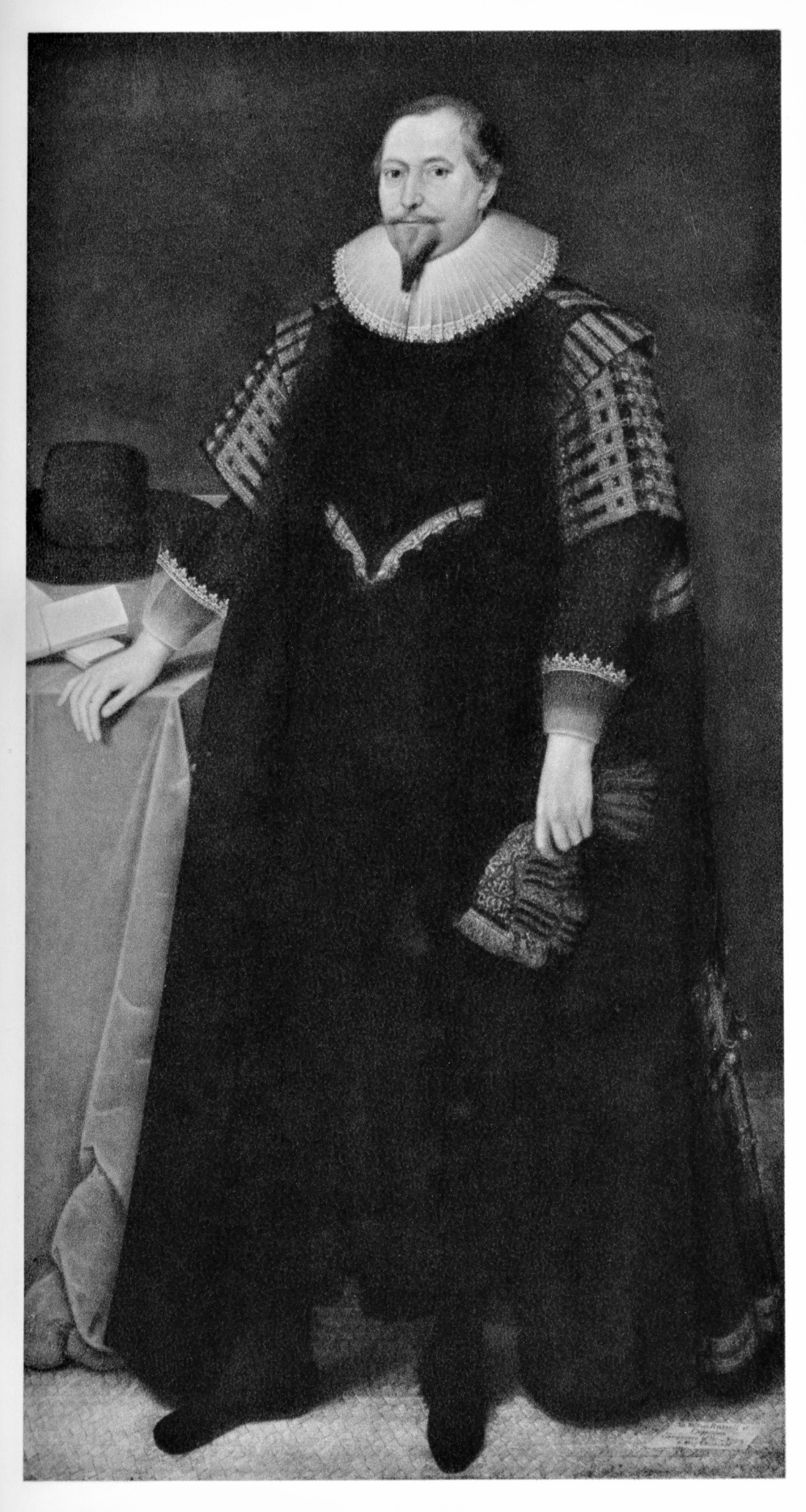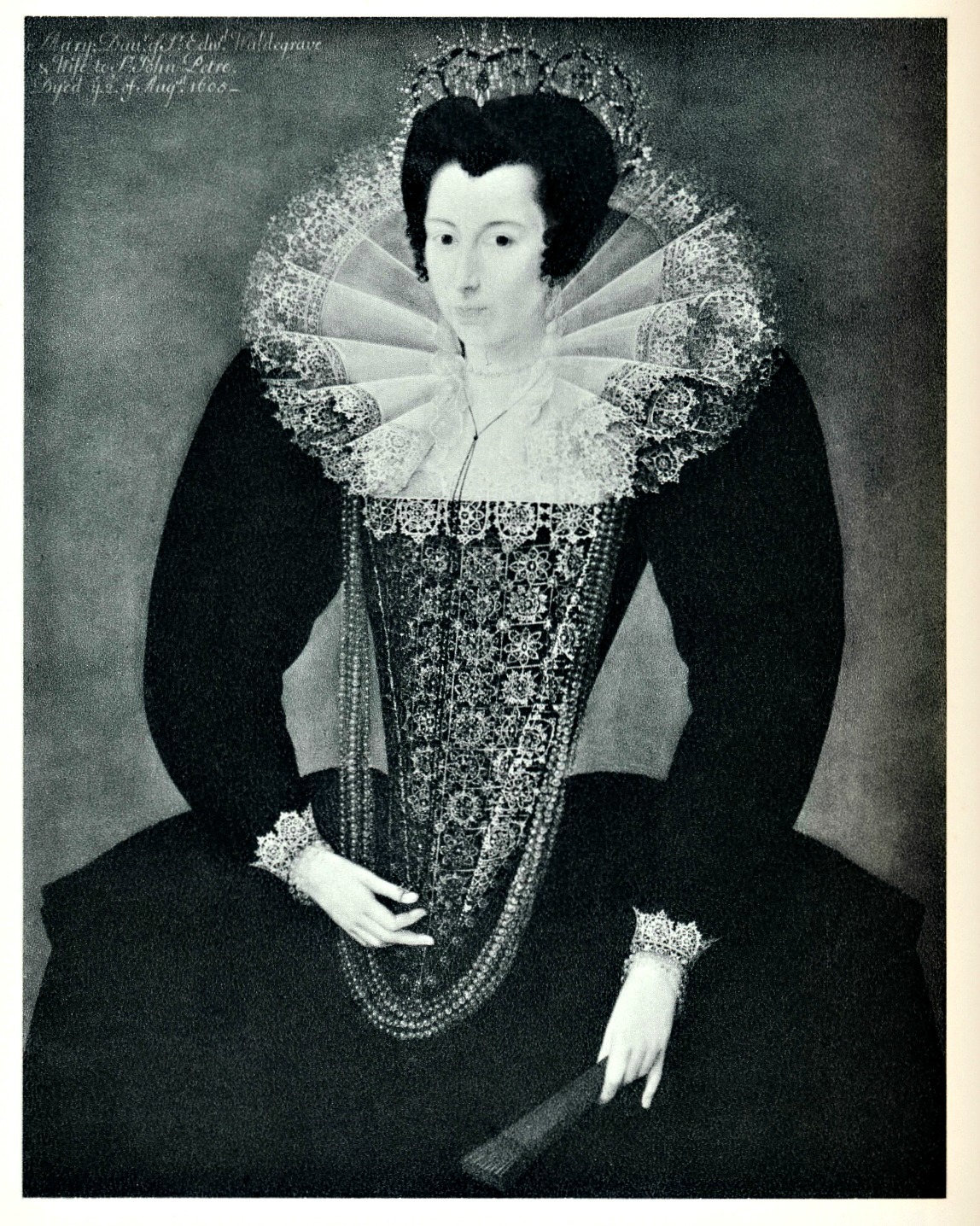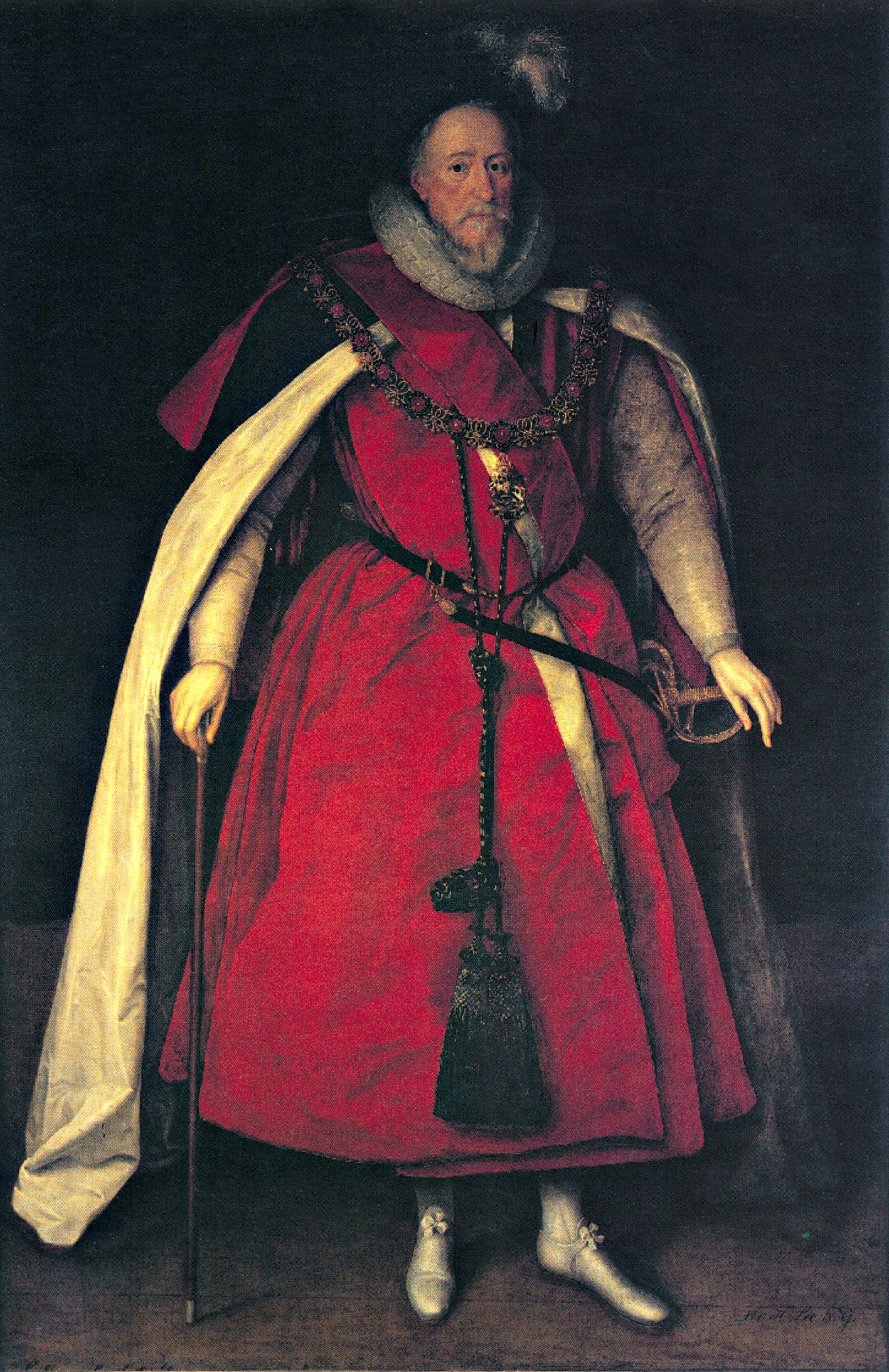
Tag Archives: #ArtHistory

Montmartre in Color: Henri Toulouse-Lautrec’s 31 Posters and the Birth of Modern Mass Culture.

FEATURE image: Henri de Toulouse-Lautrec (1864-1901), La Revue Blanche, 1895, Paris. Lithograph in four colors.

From Montmartre to Mass Culture: Henri Toulouse-Lautrec’s 31 color posters transformed commercial advertising into modern art, using innovative color lithography, bold design, and iconic images of Parisian nightlife to democratize art and shape the visual language of the twentieth century.

By John P. Walsh

The Artist in an Age of Mass Production

The nineteenth century in France brought about a radical transformation of the role of the artist. In place of artwork for aristocratic patrons, artists in all media were increasingly left to their own devices and began creating works of art in their studios and looking to sell them in the open marketplace. Innovative forms, new subjects, and new styles emerged from these changing economic structures brought about by the dawning of the industrial and technological age as well as the growing importance of cities.

In Paris and elsewhere, enterprising artists sought to attract new clients increasingly composed of the urban bourgeoisie. By the mid-to-late nineteenth century the involvement of the public in artistic matters became an irrevocable fact which had been secured by the improved means of mass production. New processes in lithographic and photographic printmaking, for example, made art widely available to a popular audience. The entry of this sort of democracy into artistic production coincided with current aesthetic influences such as a Japonisme movement prevalent in France in the years before 1890. In addition, there was a new understanding of modern beauty that began around 1830 that rejected traditional forms of beauty manifested in classical and later art forms.

Henri Toulouse-Lautrec and the Emergence of Modern Poster Art

By the early 1890’s when Henri Toulouse Lautrec (French, 1864-1901) created his mass-produced posters in Paris a new artistic practice had appeared whose idea of beauty was contemporary, sophisticated and subtly realistic. By 1890, Lautrec’s art could react in several ways to the modern art tradition. Toulouse-Lautrec repudiated the bourgeois modernity of the Impressionists from the 1870’s and 1880’s displayed in the drawing-room paintings of Claude Monet (French, 1840-1926) and Pierre-Auguste Renoir (French, 1841-1919) and, owing to cultural spaces that had shifted by the 1880’s to artistic cabarets and literary cafés, Lautrec could also claim to be a direct heir to an earlier 1830’s romantic bohemian and 1840’s flâneur.

Montmartre, Bohemia, and the Public Sphere

There are several interpretations for this cultural shift and its effects on artists and artistic practice in the 1890’s including Toulouse-Lautrec’s mass-produced commercial posters. Building on a rejection of bourgeois art forms, Mary Gluck at Brown University argues that artists such as Toulouse-Lautrec—who with others was a creature of the cabarets and cafés—desired commercial mass media to be the means by which the public sphere would eclipse individual lives which modern society had fragmented. At the center of their art production, Gluck believes, is a distinct vision of modernity identified with a city’s public space as opposed to the private anonymity of bourgeois culture (see Popular Bohemia: Modernism and Urban Culture in Nineteenth-Century Paris, 2005).

To strive to transform the public sphere by way of the legacy of the café-concert about and for which Toulouse-Lautrec created a significant amount of his mass-produced commercial art could only be an ambitious cultural task. These cabarets and café-concerts, mostly centered on and around Montmartre in Paris, were crowded, loud and often rowdy. Its performances and clientele were often unpolished and popular. Small but well-known art movements such as Les Arts incohérents and their Montmartre cabaret Les Hydropathes begin to describe the level of social parody and frivolity to be expected within these establishments.

While Lionel Richard at the University of Picardy attributes these activities to social rebels (see Cabaret, Cabarets: Origines et décadence, 1991), Jerrold Seigel at New York University views it as a calculated new relationship between the popular classes and the bourgeoisie where the aspiring artist, such as Toulouse-Lautrec, could create art for potential customers (see Bohemian Paris: Culture, Politics, and the Boundaries of Bourgeois Life, 1830-1930, 1986). For T. J. Clark, the cabaret’s diverse audience as a venue for some form of cultural democracy by way of a mixing of classes is illusory (see “The Bar at the Folies-Bergères,” The Wolf and the Lamb: Popular Culture in France, From the Old Régime to the Twentieth Century, 1977). 

Charles Rearick of the University of Massachusetts, Amherst, casts an eye on those frivolous aspects of the Montmartre cabarets, dance halls, and literary cafés. His conclusion is that these activities allowed a Parisian to escape modern society’s social constraints of respectability typically found everywhere else (see Pleasures of the Belle Epoque: Entertainment & Festivity in Turn-Of-The-Century France, 1985). Phillip Dennis Cate at The Jane Voorhees Zimmerli Art Museum at Rutgers University viewed the role of cabarets in the artistic context of these bohemian antics being the genesis of what became twentieth-century avant-garde aesthetics (see The Spirit of Montmartre: Cabarets, Humor, and the Avant-Garde, 1875-1905, 1996). It is the affirmation of the values of spontaneous experience and direct communication as an integral aspect of the modern experience and, for the fin-de-siècle bohemian, parodic performances which helped criticize the official art establishment that carried forward into artistic attitudes in the new century.

The Legacy of Toulouse-Lautrec’s Posters

The fruit of reflection for this late-nineteenth-century artistic period in Paris is numerous and diverse. It leads to the observation—whether of Henri de Toulouse-Lautrec or the variety of subjects in his mass-produced commercial art—that the stereotype of the artist, poet, or performer as bohemian, owing to their psychological nuance and stylistic antisepsis as aesthetic modernity—and possibly its inverse—becomes a source for their estrangement and alienation from modernity—that is, to emerge as an alienated human figure detached from their society and time. With Toulouse-Lautrec’s sixth poster (Divan Japonais, 1893) it is clear that his mass-produced commercial poster art in Paris was making an important impact on modern art in the 1890’s. It was a new art form for its deploying the rapidly developing technique of color printing. It utilized new approaches to composition and subject matter which were created for a mixture of new and popular commercial establishments. Finally, and perhaps most significantly, they became the first regularly displayed art commodity for public mass consumption. Each of these art principles and practices found in Toulouse-Lautrec’s posters of the 1890’s continue to impact contemporary art-making today.

Toulouse-Lautrec’s 31 posters (1891-1900) represent one of the earliest successful unions of fine art and mass-produced advertising.

Toulouse-Lautrec_-_Moulin_Rouge_-_La_Goulue
1. Henri de Toulouse-Lautrec – Moulin Rouge-La Goulue, 1891.

1. Moulin Rouge-La Goulue is a lithograph done in 4 colors: yellow, blue, red, and black. The Moulin Rouge opened in 1889 and, in summer 1891, the poster was commissioned by its owners. It depicts La Goulue (“The Glutton”) who is 21-year-old Louis Weber (1870-1929) and Valentin-le-Désossé (“the Boneless”) (1843-1907). This is Toulouse-Lautrec’s first, largest, and many estimate, most complex and artistically important poster. Printed by Charles Levy, it is made up of two sheets although Toulouse-Lautrec thought the printer had made mistakes and didn’t use him again. When this poster was plastered around Paris, the artist knew that his own silhouetted profile could be found in the background of silhouetted figures. The art of the streets pioneered by Jules Chéret (1836-1932) and immediately recognized for its implications by writers such as the Goncourt brothers and J.K. Huysmans (1848-1907) Lautrec exploited in the 1890’s aided by technological advances in color printing that continued to improve throughout the decade.

le Pendu
2. Henri de Toulouse-Lautrec – Le Pendu, 1892

2. The poster Le Pendu is a lithograph done in 2 colors: black and dark green. It was commissioned by a magazine editor to publicize a new theater play. Based on a true story of a wrongful capital death, the poster depicts the son’s suicide. Created in charcoal in late 1891, it was printed in 1895 in a limited edition for collectors only.

Henri_de_Toulouse-Lautrec_002
3. Henri de Toulouse-Lautrec – Ambassadeurs Aristide Bruant, 1892.

3. The poster Ambassadeurs Aristide Bruant is a lithograph in 5 colors yellow, blue, red, black, and olive green. Aristide Bruant (1851-1923) was a singer and this was a promotional poster for a café concert that opened in June 1892. The poster appeared all over Paris and on stage during the performance. The café owner thought the poster was a “disgusting mess” and refused to hang it until Bruant threatened to cancel his show. The subject wears a heavy dark velvet jacket, red shirt scarf, and wide brimmed hat with a riding crop. His head rises out of a dark mass which is lifted wholesale from a Japanese print by Katsukawa Shunshō (1726-1792).

Lautrec’s posters chronicled the vibrant world of Montmartre’s cabarets, cafés-concerts, dance halls, entertainers, and literary culture.

Toulouse-Lautrec_Eldorado_Aristide_Bruant
4. Henri de Toulouse-Lautrec – Eldorado Aristide Bruant. 1892.

4. The poster Eldorado Aristide Bruant is a lithograph in 5 colors (olive green, yellow, red, blue, and black). It includes the letters “TL” and signed monogram which will appear on other posters. The poster was created for the singer’s event on Boulevard de Strasbourg (north of Boulevard Montmartre at Sebastopol). With the same but reversed design, the customer and artist cut poster costs while increasing brand identity. In modern art the figure of the imposing heroic individual performer was new and Bruant became an overnight celebrity that year in Paris. Toulouse-Lautrec made no money on this project because the café owners were shocked by its content and refused to pay him.

Lautrec helped create a new form of visual culture where art left the museum and entered everyday life through posters pasted on city streets. These works became among the first art objects produced for broad public consumption and were tied directly to the cafés, cabarets, and entertainment venues of Montmartre.

Lautrec_reine_de_joie_poster_1892
5. Henri de Toulouse-Lautrec – Reine de Joie, 1892

5. The poster Reine de Joie is a lithograph in 4 colors (olive green, yellow, red, and black). It includes the emblematic letters “TL” and is signed. The poster was an advertisement for a suggestive new serialized novel by Victor Joze (1861-1933) and depicted the moment in the novel when the heroine kisses a fat banker, the latter being modeled by Georges Lasserre, a Lautrec friend. The poster, also used as the novel’s cover, caused a scandal across Paris and prompted a poster tear-down campaign. Speculation ran rampant as to who might be the real-life personalities on which characters in the novel were based.

The posters are documents of mass entertainment, celebrity culture, advertising, consumer culture, and urban nightlife in Belle Époque Paris.

Henri_de_Toulouse-Lautrec_-_Divan_Japonais
6. Henri de Toulouse-Lautrec – Divan Japonais, 1892-93.

6. The poster Divan Japonais (1892-93) is a lithograph in 4 colors (olive green, yellow, red, and black). The cabaret on rue des Martyrs came under new ownership in 1892 and was totally refurbished in a trendy Japanese style. The poster depicts 24-year-old Jane Avril (1868-1943) with critic Edouard Dujarden (1861-1949) in the cabaret. On stage are shown the long black gloves of new singer Yvette Guilbert (1865-1944). In a stylistic move, the artist cuts off Guilbert’s head and shoulders in the poster much to the consternation of the young singer just getting started in her career. (She later commissioned a poster by another artist to depict her complete figure). When this poster went up all over Paris it created a sensation and was another triumph for Lautrec. In 1894 the Divan Japonais closed to be replaced by another establishment. As with his other posters, there were several preliminary sketches the artist made for Divan Japonais. The posters used the new and improving popular mechanical technique of color printing and applied it to commercial establishments and popular entertainers, subject matter usually reserved for cruder forms of advertisement.    

Divan Japonais is one of Toulouse-Lautrec’s early posters. In his poster career the artist usually used anywhere from 2 to 5 colors. It is signed by Toulouse Lautrec. This Montmartre cabaret was taken over in 1892 by a new owner and totally refurbished in the avant-garde Japanese style which was the inspiration for the cabaret’s name. By February 1893 when this sixth poster was made by Lautrec and put up all around Paris, his 5 previous posters had already made him famous.
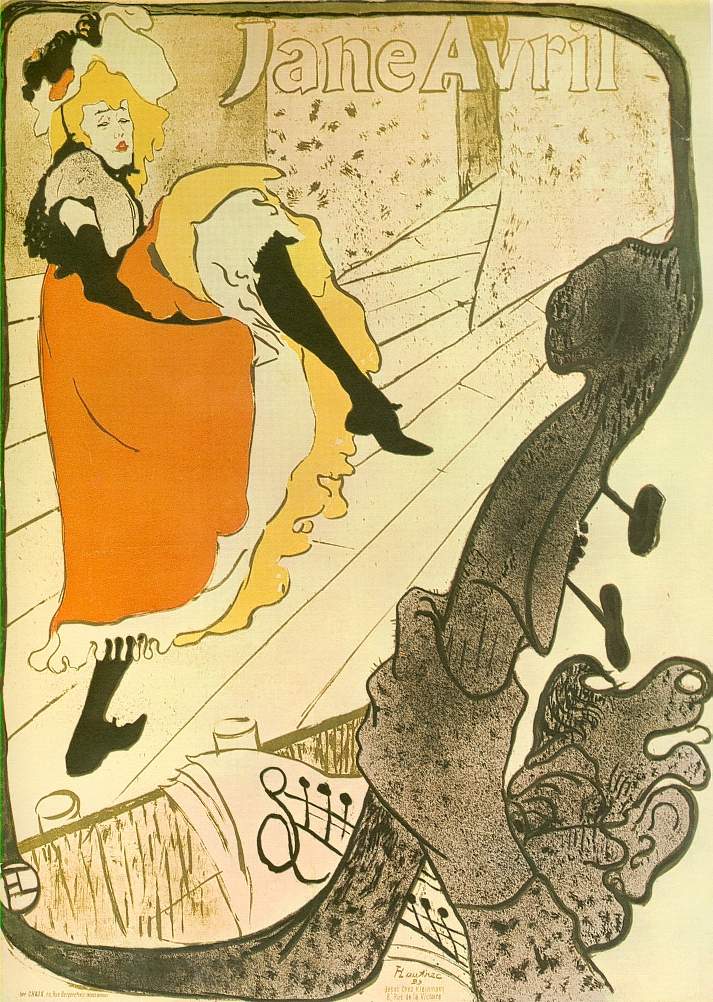
Jane_Avril_by_Toulouse-Lautrec
7. Henri de Toulouse-Lautrec – Jane Avril, 1893.

7. The poster Jane Avril is a lithograph in 5 colors (olive green, yellow, orange, red, and black). The same subject who appeared in Divan Japonais, Jane Avril commissioned this poster for her performance at the Jardin de Paris, a new café-concert. The letters for the name of the establishment were added later by someone other than Lautrec. The artist first produced 20 collector prints and after, with its newly-added letters, the poster went into mass production. Known as La Mélinite—a type of explosive—Jane Avril looked to this poster to reinvigorate her career as a performer in Paris. The poster helped her to take Paris by storm as she went on to perform at the Casino de Paris, the Moulin Rouge and the Folies-Bergères. In terms of composition, the poster is noteworthy for its strong diagonals inspired by Japanese prints and the detail of a large musical instrument—including the meticulously drawn hairs of a musician’s fingers—which rounds out the design and is seen as homage to Degas who used a similar motif in his artwork.

Iconic figures such as Jane Avril, Aristide Bruant, Yvette Guilbert, and La Goulue became cultural celebrities through his poster designs.
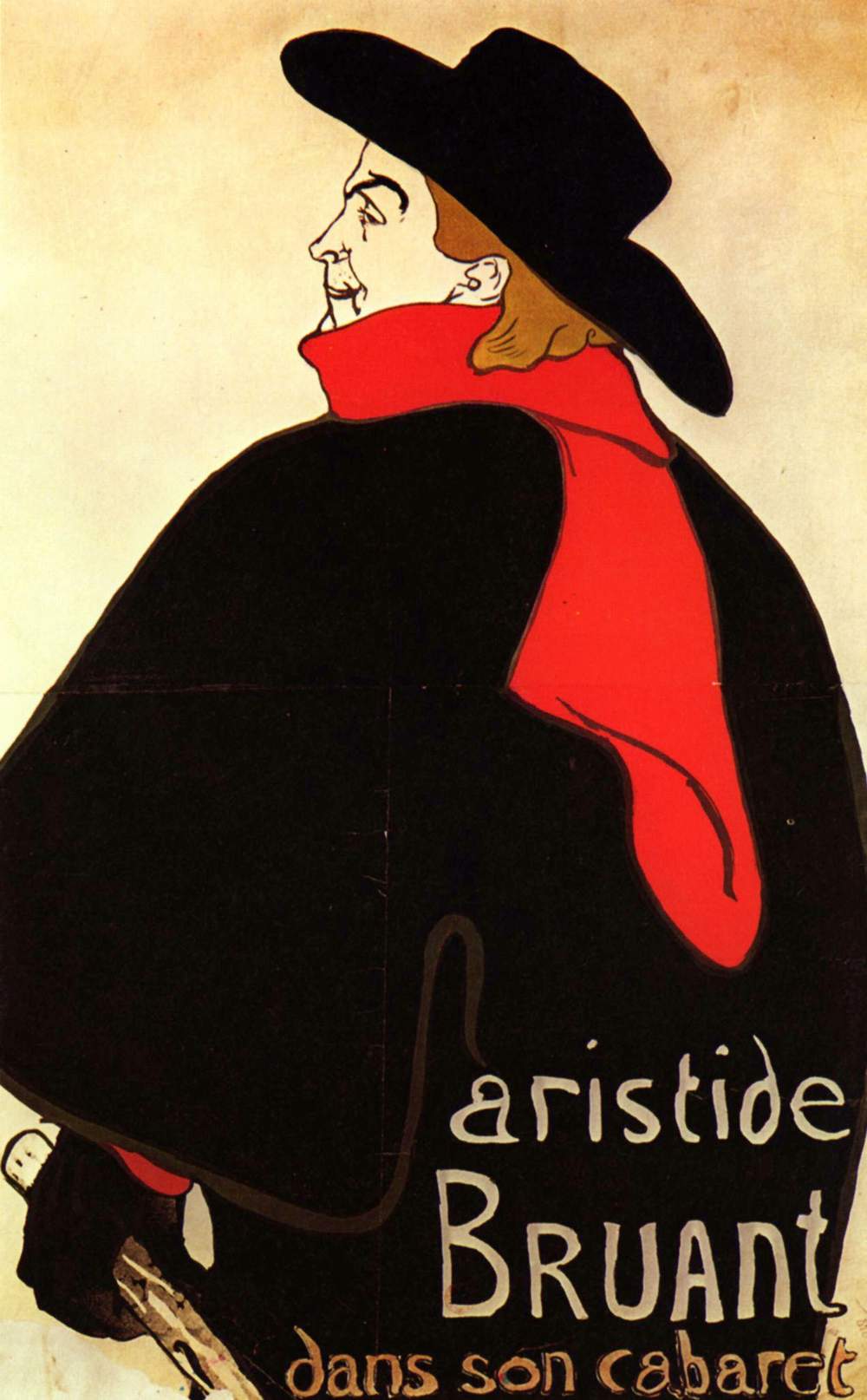
Henri_de_Toulouse-Lautrec_003
8. Henri de Toulouse-Lautrec – Aristide Bruant Dans Son Cabaret, 1893.

8. The poster Aristide Bruant Dans Son Cabaret is a lithograph in 4 colors (olive green, brown, red, and black). Lautrec’s third image of the singer became a Parisian icon. From the poster’s inception the singer used this image to promote his appearances—and for the next twenty years until 1912.

Au Pied De L'Echafaud, 1893
9. Henri de Toulouse-Lautrec – Au Pied De L’Echafaud, 1893.

9. The poster Au Pied De L’Echafaud is a lithograph in 4 colors (grey, red-brown, red, and black). The poster was an advertisement for the memoirs of a prison chaplain published in 1893.

Lautrec_caudieux_poster_1893
10. Henri de Toulouse-Lautrec – Caudieux, 1893.

10. The poster Caudieux is a lithograph in 4 colors (olive green, yellow, red and black). Lautrec depicts Caudieux, who was a popular cabaret comedian, to be striding across the stage. Lautrec used the partial figure in the prompt box in other artwork.

Bruant Au Miriton 1893
11. Henri de Toulouse-Lautrec – Bruant Au Miriton, 1893.
Bruant Au Miriton, 1893.

11. The poster Bruant Au Miriton is a lithograph in 2 colors (olive green or black and red). Represented with his back to the viewer, the popular performer is identified simply by his costume and the way he stands. This artistic device had already been used by Degas based on a theory by an art critic that a person’s economic and social class could be revealed simply by the way he or she comports themselves. The poster was recycled by Bruant as a songbook cover.

Babylone D'Allemagne, 1894
12. Henri de Toulouse-Lautrec – Babylone D’Allemagne, 1894

12. The poster Babylone D’Allemagne is a lithograph in 5 colors (olive green, yellow, red, dark blue and black). This was Lautrec’s second poster for another Victor Joze novel following his Reine de Joie. Lautrec wrote to his mother at this time to relate how busy he was with his art projects. Because of Joze’s anti-German message in the book, the author wanted the poster suppressed but it went up all over Paris nonetheless.

Lautrec_l'artisan_moderne_(poster)_1894
13. Henri de Toulouse-Lautrec – L’Artisan Moderne, 1894.

13. The poster L’Artisan Moderne is a lithograph in 4 colors (dark blue, yellow, green, and brown). The lettering is not done by Lautrec. Because of the impact of the cabaret and book posters, Lautrec began to be commissioned to make posters for the trades. This poster was provided to an interior design firm.

P. Sescau, Photographe, 1894
14. Henri de Toulouse-Lautrec – P. Sescau, Photographe, 1894

14. The poster P. Sescau, Photographe is a lithograph in 4 colors (dark red, yellow, green, and dark blue). The lettering is not done by Lautrec. This poster was provided to Paul Sescau, a professional photographer and personal friend of the artist.

confetti_512
15. Henri de Toulouse-Lautrec – Confetti, 1894.

15. The poster Confetti is a lithograph in 3 colors (dark olive green, red and yellow). This is Lautrec’s poster for the English paper manufacturer Bella & de Malherbe. The model is Jeanne Granier (1852-1939). These paper manufacturers hosted poster exhibitions in 1894 and 1896 to which Lautrec was invited.

Lautrec_may_belfort_poster_1895
16. Henri de Toulouse-Lautrec – May Belfort, 1895.

16. The poster May Belfort is a lithograph in 4 colors (olive black, red and yellow). Following his trades posters Lautrec returned to the subject of the single musical performer. May Egan (whose stage name was May Belfort) was an Irish singer who appeared at the Cabaret des Décadents where Jane Avril performed.

Advances in color lithography allowed his work to reach a broad urban audience, bringing art directly into the streets of Paris.
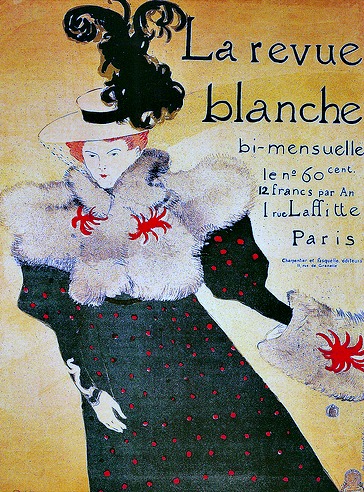
La Revue Blanche, 1895
17. Henri de Toulouse-Lautrec – La Revue Blanche, 1895.

17. The poster La Revue Blanche is a lithograph in 4 colors (blue, red, black, and green). The subject is Misia Natanson (1872-1950) who was married to Thadée Natanson whose brother was editor of La Revue Blanche from 1891 to 1903. Misia was muse to a generation of avant-garde artists, composers, and writers as the publication itself was the remarkable meeting point for the Paris literary and artistic worlds in the 1890’s. Lautrec shows Misia wearing an ostrich feather hat, spotted dress, fur jacket and muff and ice skating which was a popular activity in Paris. Two preparatory drawings for this poster are known.

Lautrec_may_milton_poster_1895
18. Henri de Toulouse-Lautrec – May Milton, 1895.

18. The poster May Milton is a lithograph in 5 colors (blue, red, black, yellow and olive green). This poster was never posted in Paris but produced as an advertisement in a magazine to promote the U.S. tour of May Milton, an English dancer at the Moulin Rouge in Paris. Picasso owned a copy of this poster and used some of its compositional elements in his own artwork. Art dealers would commission limited editions of black-and-white lithographs of performers such as May Milton because they sold quickly.

toulouse_lautrec Napoleon
19. Henri de Toulouse-Lautrec – Napoleon, 1895.

19. The poster Napoleon is a lithograph in 5 colors (blue, reddish brown, black, yellow and olive green). Toulouse-Lautrec produced this poster for a book cover competition that he lost. Failing to sell this artwork, the artist produced a limited edition of 100 copies at the artist’s expense.  The artist’s fee for his poster artwork varied a good deal, although during his career Lautrec clearly made more money from the output of his graphic work than his paintings.

Influenced by Japanese prints (Japonisme), Lautrec employed flattened forms, strong diagonals, silhouettes, and unconventional cropping.

Salon des Cents, 1895
20. Henri de Toulouse-Lautrec – Salon Des Cents, 1895.

20. The poster Salon Des Cents is a lithograph in 6 colors (blue, dark blue, black, yellow, ochre, and red). This poster is Lautrec’s homage to a married woman he met and became infatuated with during a summer cruise in 1895. The young woman sits in a deck chair under an awning facing out to sea. He produced the poster at his rentrée to Paris that fall and used it for international poster exhibitions sponsored by the journal La Plume at the Salon des Cent during winter 1895-96 and later in 1896 at the Libre Esthétique exhibition in Brussels.

800px-Henri_de_Toulouse-Lautrec_-_Rue_Royale_-_The_Chap_Book_-_poster
21. Henri de Toulouse-Lautrec – The Chap Book, 1895.

21. The poster The Chap Book is a lithograph in 5 colors (olive green, blue, yellow, pink and red). The lettering is not done by Lautrec. The artist used the setting of an Irish-American bar near Place Madeleine in Paris to promote The Chap Book, an American magazine.  Along with its identifiable characters, Lautrec includes the image of a bartender preparing a cocktail which was a libation newly introduced to Paris.

La Chatelaine, Ou 'Le Tocsin', 1895
22. Henri de Toulouse-Lautrec – La Chatelaine, Ou ‘Le Tocsin’, 1895

22. The poster La Chatelaine, Ou ‘Le Tocsin’ is a lithograph in 2 colors (blue and blue-green). This poster was commissioned by former Republican politician and Editor-in-chief Arthur Huc (1854-1932) to advertise a novel by Jules de Gastyne (1847-1920) which appeared in his newspaper in popular serial form in 1895. Letters were added by others after copies of the poster were printed for collectors of Lautrec’s increasingly popular artwork.

His work captured the spirit of Belle Époque Paris, documenting its entertainment culture while influencing generations of graphic artists.

troupe
23. Henri de Toulouse-Lautrec – Troupe De Mlle Églantine, 1896.

23. The poster Troupe De Mlle Églantine is a lithograph in 4 colors (green-blue, red, yellow and dark brown). The lettering is not designed by Lautrec. This was commissioned by Jane Avril for her work in London at the Palace Theatre and elsewhere. The formation dance was comprised of four identified dancers including Mlle Églantine and Jane Avril and derived from the famous French can-can.

Lautrec_la_vache_enrage_the_mad_cow_1896
24. Henri de Toulouse-Lautrec – La Vache Enragee, 1896.

24. The poster La Vache Enragée is a lithograph in 5 colors (dark blue, green-blue, red, yellow and black). The lettering is not designed by Lautrec. This was an advertisement for a new monthly magazine founded by Adolphe Willette (1857-1926). Its editor, Adolphe Roedel, organized an annual parade through Montmartre called the Vachalcade to lampoon the artist’s state of life in a major urban center.

Elles, 1896
25. Henri de Toulouse-Lautrec – Elles, 1896.

25. The poster Elles is a lithograph in 4 colors (yellow, dark green, orange and blue). Later lettering is not designed by Lautrec. Degas would visit a Paris brothel to sketch its denizens, but Lautrec moved in for weeks at a time to do his artwork. Elles is a series of lithographs of the lives of prostitutes. Although considered some of the finest of lithographs of the nineteenth century, its portfolio of prints could not find collectors and they had to be sold singly. An exhibition of the complete lithographic series was held at La Plume starting in April 1896 where Lautrec adapted Elles’ title-page lithograph as the poster to advertise the show.

L'Aube, 1896
26. Henri de Toulouse-Lautrec – L’Aube, 1896.

26. The poster L’Aube is a lithograph in 2 colors (dark blue and blue-green). The lettering is not designed by Lautrec. This was another advertisement for a new journal, the leftist L’Aube, first published in 1896. After its printing, the printer and artist had a rafter of remainders of this poster which they tried to sell for next to nothing.
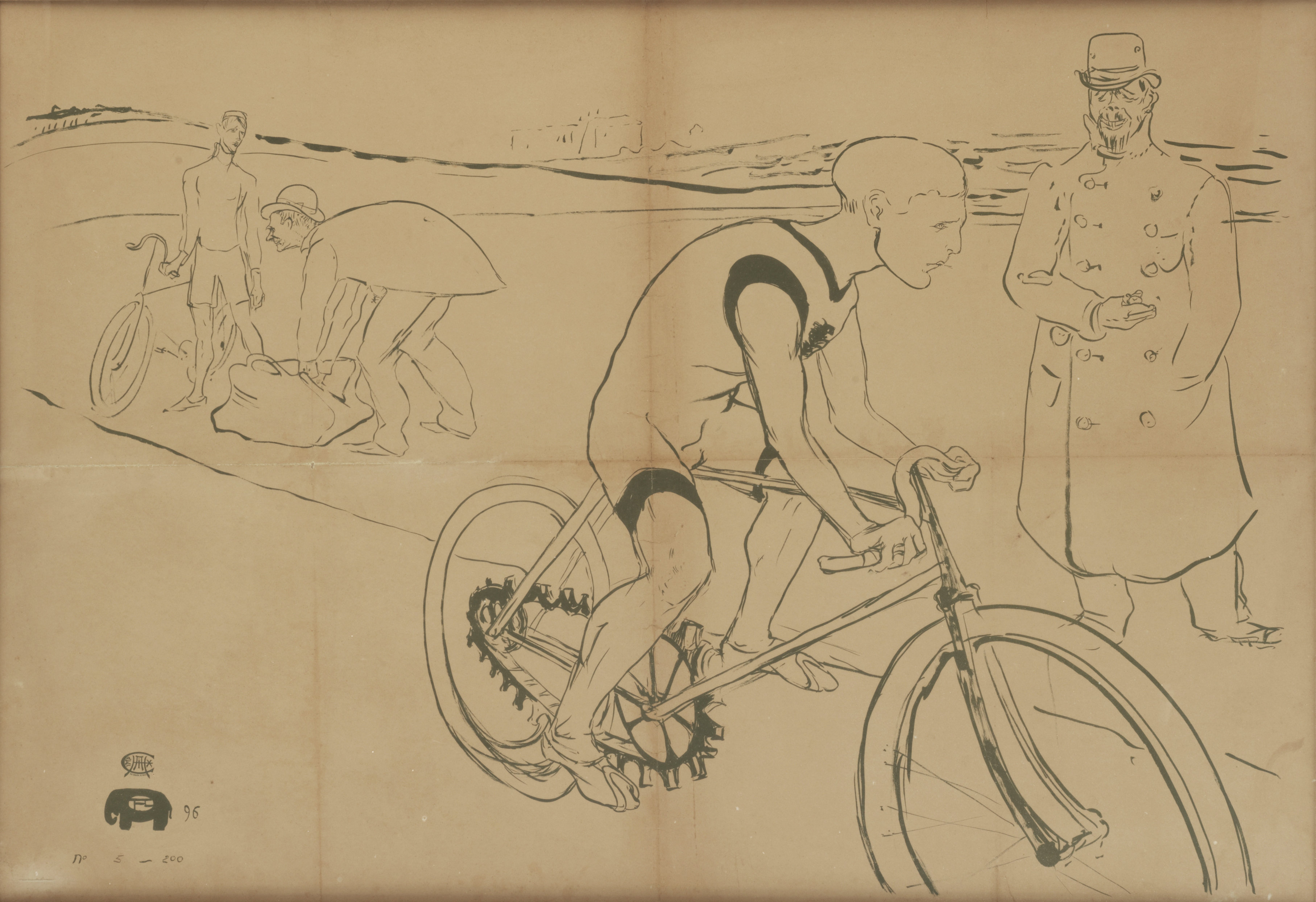
Cycle Michael, 1896.
27. Henri de Toulouse-Lautrec – Cycle Michael, 1896.

27. The poster Cycle Michael is a lithograph in 1 color (olive green). Bicycling had developed into a cult sport in France by the 1890’s. Lautrec’s interest in the new sport led to this poster commission of British cyclist Jimmy Michael with his trainer (left background) and a sports writer with a hand in his coat pocket. The bicycle company rejected Lautrec’s design in part because the depiction of its mechanics was inaccurate which left the artist to print a limited edition for collectors at his own expense.

La Chaine Simpson, 1896
28. Henri de Toulouse-Lautrec – La Chaine Simpson, 1896

28. The poster La Chaîne Simpson is a lithograph in 3 colors (red, yellow and blue). The lettering is not designed by Lautrec. This is Lautrec’s second poster for the new sport of bicycling which had become immensely popular in France in the 1890’s. It depicts popular rider Constant Huret (left) and, in the background wearing hats, two British and French bicycle and chain manufacturers. Lautrec was fascinated with the cycling sport and its imagery appears in other of his artwork.

The Ault & Wiborg Co, 1896
29. Henri de Toulouse-Lautrec – The Ault & Wiborg Co, 1896.

29. The poster The Ault & Wiborg Co is a zincograph in 4 colors (brown, red, yellow and black). The lettering is not designed by Lautrec. The smallest of Lautrec’s posters, it was commissioned by an American ink manufacturer whose sitters are not precisely identified. Before it became a poster advertisement, Lautrec had an edition of it printed which he titled Au Concert.

Posters such as Moulin Rouge: La Goulue, Divan Japonais, and Jane Avril helped establish the visual foundations of Art Nouveau graphic design.

Jane Avril, 1899
30. Henri de Toulouse-Lautrec – Henri de Toulouse-Lautrec – Jane Avril, 1899.

30. The poster Jane Avril is a zincograph in 4 colors (black, red, yellow and blue). After six years of intense poster production, Lautrec temporarily left its practice in 1897 and 1898. When he returned to it in 1899 he found that technology had advanced to make the printing technique for his artwork more efficient. This poster was commissioned by Jane Avril but never publicly displayed. Lautrec looked to capture her dancing style and graceful and wistful figure which the artist admired. The serpentine-themed dress Jane Avril wears was a popular motif in the Art Nouveau.

La Gitane, 1899-1900
31. Henri de Toulouse-Lautrec – La Gitane, 1899-1900.

31. The poster La Gitane is a lithograph in 5 colors (black, grey, red, brown and blue). The lettering is designed by Lautrec. Lautrec’s last poster was produced for a Carmen-like play that opened in January 1900 at the Théâtre Antoine in the tenth arrondissment. The play was unpopular, the poster never published, and Lautrec’s modern art poster career had come to an end.

Lautrec elevated commercial poster art from simple advertising into a respected artistic medium.

Select Bibliography:
Ash, Russell, Toulouse-Lautrec:The Complete Posters, Pavilion Books Limited, London, 1991.
Beauroy, Jacques, Bertrand, Marc, Gargan, Edward T., editors, The Wolf and the Lamb: Popular Culture in France, From the Old Régime to the Twentieth Century, Anma Libri, Saratoga, CA, 1977.
Cate, Phillip Dennis, The Color Revolution: Color Lithography in France, 1890-1900, Peregrine Smith, Inc., Santa Barbara and Salt Lake City, 1978.
Cate, Phillip Dennis and Shaw, Mary, editors, The Spirit of Montmartre: Cabarets, Humor, and the Avant-Garde, 1875-1905, Jane Voorhees Zimmerli Art Museum, Rutgers, New Brunswick, New Jersey, 1996.
Denvir, Bernard, Toulouse-Lautrec, Thames and Hudson, London, 1991.
Gluck, Mary, Popular Bohemia: Modernism and Urban Culture in Nineteenth-Century Paris, Harvard University Press, Cambridge, MA, 2005.
Foxwell, Chelsea, Leonard, Anne, et.al. Awash in Color: French and Japanese Prints, Smart Museum of Art, University of Chicago, 2012.
Oberthur, Mariel, Cafés and Cabarets of Montmartre, Peregrine Smith Books, Salt Lake City, 1984.
Rearick, Charles, Pleasures of the Belle Époque: Entertainment & Festivity in Turn-Of-The-Century France, Yale University Press, New Haven and London, 1985.
Seigel, Jerrold, Bohemian Paris: Culture, Politics, and the Boundaries of Bourgeois Life, 1830-1930, Penguin Books, New York, 1986.
Thory-Frèches, Claire, Roquebert, Anne, Thomson, Richard, Toulouse-Lautrec, South Bank Center, 1991.
Weisberg, Gabriel P., Montmartre and the Making of Mass Culture, Rutgers University Press, News Brunswick, New Jersey and London. 2001.


The Humanists Who Made a Master: Erasmus, More, and Hans Holbein’s First English Success, 1526-1528.

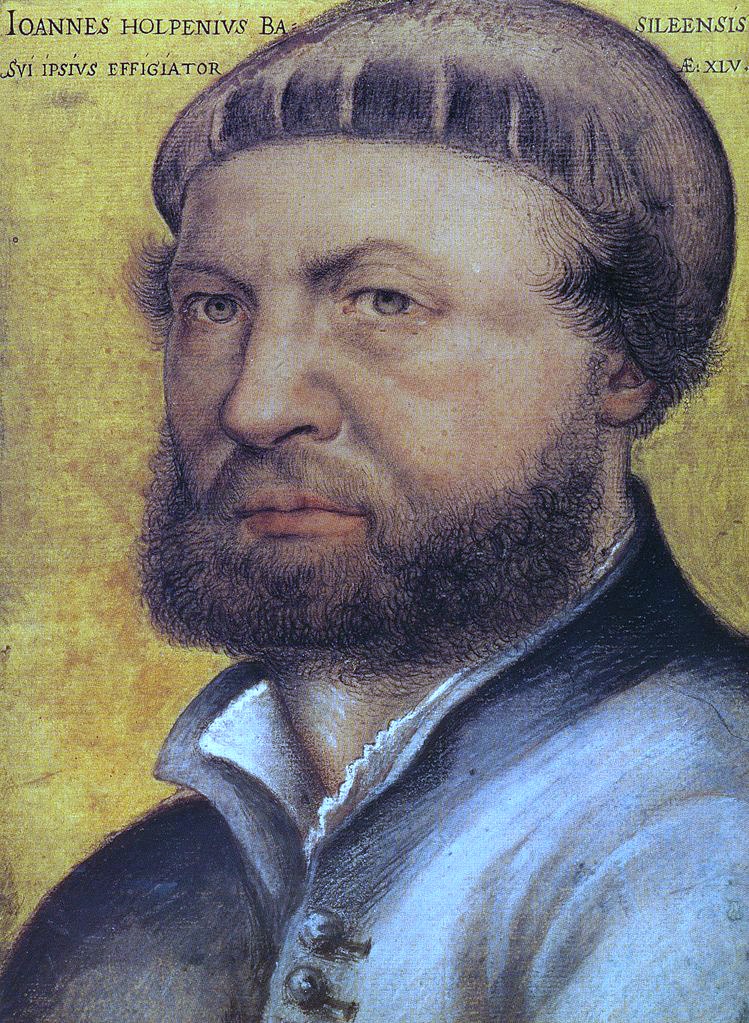
Featured Image: Self-Portrait, Hans Holbein the Younger, 1542/3, black and colored chalks, 23 x 18 cm, Florence, Galleria degli Uffizi. This is the only confirmed self portrait by Holbein.

Hans Holbein the Younger’s first visit to England (1526-1528) was the decisive turning point in his career, as the humanist network centered on Erasmus and Thomas More introduced the young German artist to England’s political and intellectual elite, enabling him to establish himself as a master portraitist and laying the foundation for his later success at the court of Henry VIII.

Self portrait Hans Holbein
Self-portrait Hans Holbein The Younger, Oil on paper, mounted on oak, 16.5 x 14 cm, inscribed on the left and right of the head: H H; on the left above the shoulder: AN [N] O. 1554 / ETATIS SVE/45, Kunstmuseum Basel, donated by Prof. J.J. Bachofen-Burckhardt Foundation in 2015. While Lüdin was probably working from a graphic reproduction, the unknown painter of this picture, if not Holbein’s own drawing, surely had one of the copies made shortly after his death in the narrow workshop environment. This is one more Hans Holbein self-portrait based on the secure Florentine drawing.

Self portrait Holbein
Self-Portrait Hans Holbein, copy by Johannes Lüdin, c. 1647-1667, Oil on canvas, 61.5 x 47.5 cm, Kunstmuseum Basel. In fall 1526 twenty-nine-year-old Hans Holbein crossed the channel from Antwerp to England where the German immigrant’s first concerns were to find work, useful friends, and a place to stay. While Lüdin’s painting was given as a gift to a major art collector in Basel and probably based on a graphic model whose type proliferated after 1600, it is the drawing in the Uffizi (see Featured Image) that remains the only secure self-portrait image according to current Holbein scholarship.

Introduction by John P. Walsh

Holbein’s First English Sojourn, 1526-1528

Hans Holbein the Younger was born in Augsburg, Germany, in 1497. After 1515, he lived and trained in Basel, Switzerland. Over two visits, one starting in 1526 and another in 1532, Holbein spent a total of thirteen years in Henry VIII’s England until the artist’s death in 1543. The focus for this post is Holbein’s first visit to England which lasted two years – specifically, from around September 1526 to mid-August 1528. His second, more permanent, visit to England started in 1532 (Holbein likely arrived in the spring) and lasting to his death, almost certainly from plague, in late 1543. It was during that second, longer visit in England that Holbein became the most important court artist in the time of Henry VIII. His first visit is characterized by the activity of a young immigrant German artist – Holbein was about 29 years in 1526 – getting established in a foreign land and developing a mastery of his craft.

Erasmus, Thomas More, and the Road to England

Holbein arrived in England in late 1526 with a letter of introduction from Dutch humanist Desiderius Erasmus (1466-1536) addressed to Sir Thomas More (1478-1535).

Erasmus’s English Connections and Career Struggles

This was not the first time Erasmus wrote to More asking him to temporarily lodge a friend.1 More would be appointed Lord Chancellor in 1529, but in 1526 Sir Thomas was the Speaker of the House of Commons and Chancellor of the Duchy of Lancaster. By 1526, Erasmus and More had been friends for more than a quarter century. They met during Erasmus’s first high-spirited stay in England in summer 1499. In that year, Erasmus was 33 years old and More twelve years his junior. Other major protagonists in this story – namely, Hans Holbein the Younger and the future King Henry VIII – were just children in 1499.2 While Erasmus began writing seriously on theological topics during his first English stay he also reveled in the gentle and happy personality of More. Part of More’s reception to Holbein in 1526 by way of Erasmus’s request may go back to the two old friends’ first meeting in England in 1499. After Erasmus had been encouraged by More to bring his money into England which More assured the relatively poor scholar would be safe, most of it was confiscated by English customs at Erasmus’ departure. This unpleasant shock not only left Erasmus with keen anger towards England for months afterwards—he never, however, blamed More (and one other English friend) for the misinformation—but left him lacking for money in Paris and elsewhere for several years thereafter.3 Similar to Holbein’s effort in 1526, Erasmus returned to England in 1505 to improve his fortunes by staying with his new friends, including Thomas More, and working to establish a network of influential English contacts. Erasmus emigrated in large part to access various English scholars as well as to counteract friends in the Netherlands who were mostly ignoring his work. It was by way of a new English contact that Erasmus in June 1506 ventured to Italy where he stayed for three years.4 Back in England on his third visit in 1509, Erasmus wrote his Praise of Folly, probably his most enduringly famous work, while living in the house of Thomas More. But writing and lecturing (at Cambridge) brought Erasmus little profit.5 It was only when the Archbishop of Canterbury, another English friend, gave him a stipend in 1512 that Erasmus was relieved of practical destitution. But the favored scholar would remain chronically in need of money and wrote more books to help fill the need. A scholar’s life in cold Britain, however, following three years in Italy’s southern climes, proved tiresome for Erasmus. He found his many months of writing and teaching at Cambridge to be like “a snail’s life, staying at home and plodding.”6 Erasmus was lonely; the plague was frequently about; and, for whatever his labors, he was making literally no money. Further, a state of war between England and France commenced in June 1513 which alarmed and depressed Erasmus, prompting him to publish his first anti-war writings and resolved to leave the island as soon as he could. He sailed for Antwerp in the summer of 1514.7

Humanist Networks and Holbein’s Introduction to More

In 1526 when Erasmus wrote to More asking him to welcome German artist Han Holbein the Younger, both old friends had achieved literary fame in Europe. Thomas More’s Utopia appeared in Latin in 1516, edited by Erasmus and published in Louvain. During the first years of the Reformation, Erasmus remained More’s link to the Continent as they continued their amiable correspondence following Erasmus’ settling in Basel, Switzerland, in 1521. That city would be Erasmus’s dwelling place for the next eight years. Erasmus relied on More’s friendship in the 1520’s as the disputes of the Reformation intensified.8

Holbein’s Artistic Rise in Basel

In 1523 when Hans Holbein the Younger painted two portraits of Erasmus, the young German artist and the older Dutch humanist had been acquainted for some years. Before Holbein joined the workshop of Hans Herbst (c. 1470-1552) in 1516 or had been taken into the Basel painters’ guild in 1519, the teenage Holbein provided a pen and ink drawing for the Basel edition of Erasmus’s Praise of Folly in 1515 which apparently pleased the humanist. From 1519 to 1526 before his first visit to England, Holbein, now in his 20’s, was a whirlwind of artistic activity in Basel. His expressive drawings and paintings were a leading feature, but he demonstrated talent and skill in the many topical arts of his time, including printmaking, metal engraving, frescoes, and altarpieces.9

Erasmus as Holbein’s Most Important Early Patron

By 1523 Holbein desired to focus his talent on portrait painting.10 Basel’s most famous resident of Basel was certainly Erasmus. Before his relocation to the Swiss city, the writer and theologian had been famously embroiled in controversies swirling around German reformer Martin Luther (1482-1546). Erasmus came to Basel from Louvain to escape these difficulties and live in relative tranquility.11 In 1523 in Basel Holbein painted three portraits of Erasmus of Rotterdam. One exists today in Basel (in the Öffentliche Kunstsammlung), in Paris (Louvre) and in London (on loan from the Longford Castle collection to the National Gallery). The Reformation was, for the foreseeable future, taking its toll in terms of the visual and plastic arts. Erasmus described to More the state of the arts on the Continent, citing Basel in particular: “Here the arts freeze.”12

The Erasmus Portrait and Holbein’s English Opportunity

Historian David Starkey has called Holbein’s three-quarter profile portrait of Erasmus which was sent to the Archbishop of Canterbury William Warham (c.1450-1532) as a gift in 1524 as “the most important portrait in England”13 Starkey claims the painting is the beginning of portraiture itself when so-called “realism” was introduced into art.

Thomas More’s Household and Holbein’s Early English Masterpieces

By way of Erasmus’s portrait to Warham, Thomas More learned of Holbein’s artwork up to two years prior to the young artist’s arrival in England. It is probable that like Erasmus before him, Holbein lodged in More’s house during his first English visit. Such accommodation provided practical hospitality to a friend’s friend on many levels including the fact that immigrant artists in England were disallowed from dwelling  within the city gates of London (More’s house was in nearby Chelsea). Further, More, as a rising political figure in England, became Holbein’s first patron and in that way could secure Holbein’s modern art portraiture for himself. Indeed, the major work of Holbein’s first stay in England between 1526 and 1528 is the portrait of the household of Thomas More as well as the famous portrait of Sir Thomas painted around the same time. In this first two-year period in England Holbein also set to work on a variety of artistic projects, but the portraits highlighted the stay.

Returning to Basel and Preparing for a Greater English Career

Like his famed classicist sponsor Erasmus before him, Holbein came to England to improve his fortunes as an artist. Holbein had visited France in 1524 with the hope for a royal commission but was ignored.14 While English guild artists required Holbein’s exclusion from London proper, the time restriction on his stay was owed to the city of Basel. At the cost of losing his citizenship, Holbein was allowed no more than two-year’s absence from the Swiss city.

Conclusion: The Foundations of Holbein’s Success in England

On August 29, 1528, Holbein returned to Basel.15 This marked the end of Holbein’s first visit to England, but not before he had developed many new influential contacts and established his mastery of craft within the orbit of one of Europe’s most dynamic royal courts. Little more than three years later, in spring 1532, with his old friend Thomas More in the last throes of service as Lord Chancellor (More would almost immediately resign that year as dangerous political storms grew), Holbein returned to England. The Continent’s political and religious revolution was creeping across the channel for England’s own idiosyncratic reasons such that the English world Holbein visited in the 1520’s was rapidly declining. A revolutionary zeal was emerging, especially under Thomas Cromwell between 1535 and 1539, which would inspire new challenges for artistic accomplishment which Hans Holbein the Younger met and engaged throughout his second rewarding visit in England from 1532 to 1543.16

Holbein the Younger Erasmus 1523 Louvre
Hans Holbein the Younger: Portrait of Erasmus, 1523, oil on wood, 42 x 32 cm, Louvre, Paris.

Holbein Erasmus Hands 1523 Louvre
One of Holbein’s study drawings of Erasmus’s hands for the profile portraits, silverpoint and chalks, 1523. Louvre.

Holbein erasmus
Hans Holbein the Younger: Portrait of Erasmus, 1523, oil on wood, 73.6 x 51.4 cm, London, National Gallery. Erasmus gifted this portrait to the Archbishop of Canterbury in 1524. The humanist is shown in three-quarter profile wearing a fur collar overcoat seated behind a table with his hands on an inscribed book. Behind the classicist and theologian are painted symbolic elements of the sitter’s profession and achievements: a Renaissance pilaster, green curtain and shelf of books with glass bottle. David Starkey of the National Gallery called this portrait “arguably the most important portrait in England” where “portraiture actually begins.”

Holbein Erasmus 1523 Basel
Hans Holbein the Younger: Portrait of Erasmus, 1523, paper mounted on wood, 36.8 x 30.5 cm, Öffentliche Kunstsammlung, Basel. Closely related to the Louvre portrait, it is lightly smaller but offers the same strict profile of the sitter. The profile derives from an ancient classical pose signifying political or intellectual power. In this painting Erasmus’s writing can be discerned: it is the opening of a commentary on the gospel of St. Mark dedicated to the king of France. (Wolf, p. 39)

Hans Holbein the Younger in England, 1526 to 1528.

Holbein the Younger, Thomas More, 1527
Hans Holbein the Younger: Thomas More (1477-1535), 1527, oil on oak panel, 29.5 in x 23.7 in. (74.9 cm x 60.3 cm), Frick Collection, New York. More became Lord Chancellor in 1529 where thereafter the great humanist scholar, author, and statesman, who resigned in 1532, defied the Act of Supremacy of 1534 that made Henry VIII head of the Church in England and was beheaded on July 6, 1535 for high treason. The “S-S” chain of office More wears in Holbein’s painting is an emblem of service to the King. (Frick, p. 48) More’s execution, coming in quick succession to John Fisher’s two weeks earlier, grieved Erasmus in Basel. Later, Erasmus in a letter lamented More’s involvement in “that dangerous business” which should have been left to “the theologians,” and ignored More’s plea on behalf of his conscience. (Huizinga, p. 183).

Thomas More_Frick_1527_head

Thomas More, 1526/27
Hans Holbein the Younger: Thomas More, 1526/1527, black and colored chalks, 9.8 x 29.9 cm sheet of paper, outlines pricked for transfer. The inscription is a later addition (18th century). Royal Collection Windsor.

Thomas More 1526/27
Hans Holbein the Younger: Thomas More, black and colored chalks, and brown wash on paper, 37.6 x 25.5 cm. Royal Collection Windsor. More’s career included study at Oxford and becoming a lawyer. He became a MP in 1504, King’s Councillor in 1518, was knighted in 1521, and became Speaker of the House of Commons in 1523. More became Lord Chancellor of England in 1529, but practical politics proved outside More’s forte. He resigned the office in 1532 and was beheaded for high treason in 1535. Thomas More was Holbein’s first patron in England, the German artist to enjoy a happier fate as the preeminent painter in the court of Henry VIII starting in the 1530’s. (Ganz, pp. 231-232)

The Living Room of the Frick Collection. Thomas More against Olver Cromwell with El Greco's Saint Jerome in the middle.
Frick Collection, New York City. Holbein the Younger’s Thomas More (1527) and Thomas Cromwell (1533) with El Greco’s Saint Jerome (1610) above the fireplace.

Anne Lovell, 1528
Hans Holbein the Younger: Portrait of a Lady with a Squirrel and a Starling (Anne Lovell), 1528, oil on oak, 56 x 38.8 cm, National Gallery, London. Recent scholarship has produced interesting speculations as to the identity of this unknown woman who, in any case, was in Thomas More’s circle (Foister, p. 30; Ganz, p. 232).

Lady Alice More, 1527.
Hans Holbein the Younger: Alice Middleton, Lady More, 1527, Corsham Court (private collection) near Bath, England, oil and tempera on oak, 14 1/2 x 10 5/8 in. This is a color study for the large family picture. The color chalk study is missing. Alice was Thomas More’s second wife.

Preparatory drawing More Family 1526/27
Hans Holbein the Younger: Portrait of Thomas More with his family, 1527, pen and black ink on paper,  Öffentliche Kunstsammlung, Basel. This is the preparatory drawing for a group portrait of the family of Sir Thomas More that was the major work of Holbein’s first period in England. The finished painting, whether on canvas or wood or a mural, is missing and was probably destroyed. It is the first nondevotional or ceremonial group portrait made north of the Alps (Ganz, p. 276). This is the household into which Holbein had taken up residence during his first visit to England. Thomas More lived outside London in a country house with his second wife Alice, his father John, his son John and bride to be Anne, three married daughters, eleven grandchildren and a live-in relative (Margaret Giggs). From left is Elizabeth Dauncy, More’s second daughter; Margaret Giggs; More’s father; Thomas More’s future daughter-in-law, Anne Cresacre; Sir Thomas More; More’s son; court entertainer Henry Patenson; More’s youngest daughter, Cecily Heron; eldest daughter, Margaret Roper; and More’s second wife, Alice. The Latin inscriptions in brown ink of the sitters’ names and ages were added by astronomer-in-residence Nikolaus Kratzer (whose portrait was painted by Holbein).

Elizabeth Dauncey 1526/27
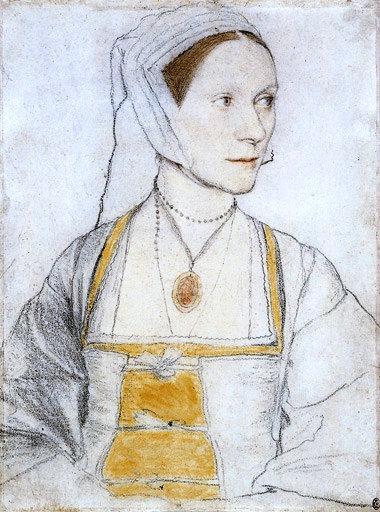
Holbein’s preparatory drawing of Elizabeth Dauncey, middle daughter of Thomas More. In 1525 she married Sir William Dauncey who served Henry VIII and was a member of parliament. This drawing’s later inscription (not by Nikolaus Kratzer) is inaccurate in its identification. (see – https://www.royalcollection.org.uk/collection/400046/sir-henry-guildford-1489-1532)

Margaret Giggs Clement was Thomas More’s foster daughter. In 1526 she married John Clement, a court physician. Margaret eventually had eleven children and died in exile in the Netherlands in 1570. While the extant More family group drawing by Holbein shows Margaret leaning towards John More, this drawing may actually have served as the now-lost or destroyed painting’s final study. The exact meaning of the inscription “Mother Iak” is unknown. Royal Collection, Windsor.

Anne Cresacre , 1526/27.
Hans Holbein the Younger: Anne Cresacre (c.1511-1577), for the More family portrait. Royal Collection, Windsor.

Cecily Heron 1526/27
Hans Holbein the Younger: Cecily Heron (b, 1506 or 1507), youngest daughter of Sir Thomas More. She was married to Giles Heron, a Member of Parliament who was hanged for treason in 1540. Royal Collection, Windsor.

john more 1526
Hans Holbein the Younger: Sir John More (c.1451 – 1530), black and colored chalks, 35.1 x 27.3 cm. Thomas More’s father was a respected judge and described by a biographer as “very virtuous” and “merry.” Royal Collection, Windsor.

john more son 1527

Hans Holbein the Younger: John More, black and colored chalks, 38.1 x 28.1 cm. Thomas More’s son. Royal Collection, Windsor.

Sir Henry Guildford, 1527.
Hans Holbein the Younger: Sir Henry Guildford (1478-1532), Controller of the Royal Household, inscribed and dated, 1527, oil and tempera on wood, 32 1/8 x 26 in. (82.6 x 66.4 cm), Royal Collection, Windsor. Wearing the collar of the garter for his military service – which was the occasion for the portrait – Guildford, a physical giant of a man, holds the wand of office as Comptroller of the King’s Household. Sir Henry stands against a deep blue background, decorated with the twisting vine found in several Holbein portraits. Above the sitter’s head is a curtain rail, from which hangs a rich green curtain. This detail has lost context in the separation of the portrait from its companion, that of Guildford’s wife Mary.

Royal Collection, Windsor.

Sir Henry Guildford (1489-1532)
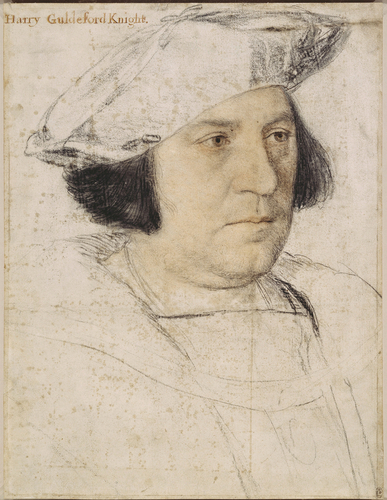
Sir Henry Guildford, Black and colored chalks, and pen and ink on paper, 38.3 x 29.4 cm. The drawing is a study for the painted portrait. Sir Henry was one of Henry VIII’s closest friends and an early patron of Holbein.

Mary,_Lady_Guildford,_drawing_by_Hans_Holbein_the_Younger
Mary Wotton, Lady Guildford, 1527, black and colored chalk on paper, 55.2 x 38.5 cm, Kunstmuseum Basel, Kupferstichkabinett. A study from life for the painted portrait. In the portrait Holbein muted the sitter’s overall playful expression and smile. Mary outlived Sir Henry to marry again.

Mary Wotton, Lady Guildford 1527
Hans Holbein the Younger: Mary Wotton, Lady Guildford, inscribed and dated, 1527, tempera and oil on oak, 34 1/4 x 27 13/16 in.( 87 × 70.6 cm), St. Louis Art Museum. Mary was Sir Henry Guildford’s second wife. They married in 1525. She holds a devotional book.

William Warham, 1527
Hans Holbein the Younger: William Warham (1456-1532), Archbishop of Canterbury (first version), 1527, Oil and tempera on wood, 30 in x 25.75 in., Lambeth Palace, London.

William Warham Archbishop Canterbury drawing by Hans Holbein the Younger
Hans Holbein the Younger: William Warham, Archbishop of Canterbury, 1527.  Colored chalk on paper, 40.1 x 31 cm, The Royal Collection, Windsor.  This is the preparatory drawing for the Louvre portrait. The sitter had been in his position since 1504 and remained there until his death in 1532. The similarities between the Holbein portrait of Erasmus (1523) and that of Warham (1527) are striking for their compositional elements and the conveyance of each sitter’s function by way of iconographical symbols so that these forms are a portrait template.

William Warham, Archbishop of Canterbury, 1527
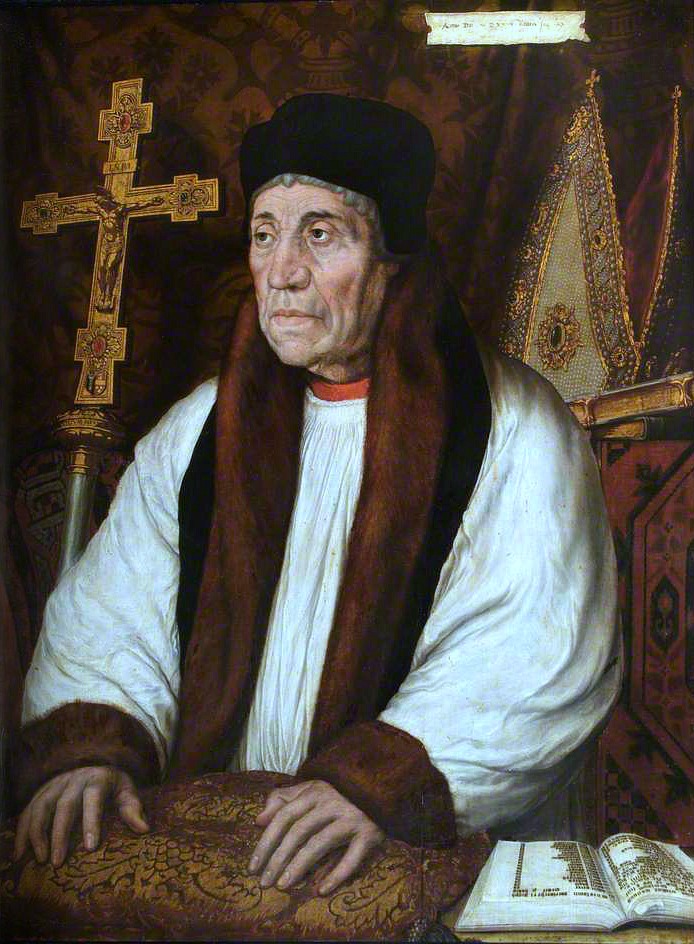
Hans Holbein the Younger: William Warham, Archbishop of Canterbury (second version), 1527, Tempera on wood, 32.3 in x 26.4 in. (82 cm x 67 cm), Musée du Louvre, Paris. Both versions include the episcopal crucifix of gold and jewels with Warham’s coat-of-arms and his motto, prayer books and the Archbishop’s jeweled miter. Warham had this “original replica” painted to reciprocate for a portrait of Erasmus he received. The color is richer in the replica. The brown curtain is replaced with a green one. A later copy of this painting resides in the National Portrait Gallery in London.

Holbein erasmus
  
William Warham, Archbishop of Canterbury, 1527Nikolaus Kratzer, 1528
Hans Holbein the Younger, Portrait of Nikolaus Kratzer (1487-1550), 1528, Tempera on oak, 83 x 67 cm, Musée du Louvre, Paris. The sitter was born in Munich and studied in Cologne and Wittenberg. Appointed professor to Corpus Christi College in Oxford, Kratzer relocated to England. A humanist, he became friends with Thomas More and his family and, starting in 1519, served as astronomer to Henry VIII’s court. The painting, created during Holbein’s first stay in England, continues to exemplify Holbein’s lively style of illustrating a sitter’s career. Kratzer was a maker of mathematical and geometrical instruments and is shown in practical involvement with these tools. Compared with the Guildford portraits of the year before, Holbein expresses a new subtlety of lighting and refined range of tones.

Sir Thomas Godsalve and His Son
Hans Holbein the Younger: Double Portrait of Sir Thomas Godsalve and His Son John, 1528, Resin tempera on oak, 35 x 36 cm, Gemäldegalerie, Dresden. Thomas Godsalve (1481-1542) was a notary from Norfolk.  Holbein cleverly shows him writing his name and age on a sheet of paper. By 1528, the Godsalves were among London’s most wealthy and politically influential men. (Wolf, p. 51) His son John (1510-1556) later had a double portrait of himself and his wife painted by Holbein.

Sir Henry Wyatt, c, 1528
Hans Holbein the Younger: Sir Henry Wyatt of Allington Castle, c. 1528?, oil on oak, 15.4 × 12.2 in. (39 × 31 cm), Musée du Louvre, Paris. Sir Henry Wyatt served in the court of Henry VII and Henry VIII and a member of the latter’s Privy Council. Sir Henry was part of the circle of Thomas More. N.B. This portrait, once thought to have been painted during Holbein’s first visit to England from 1526 to 1528, is today believed to have been painted towards the end of Sir Henry’s life.

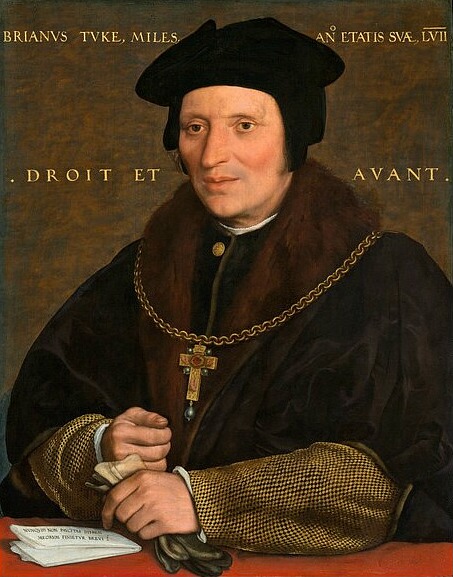
Sir Brian Tuke c. 1527/1528 or c. 1532/1534
Hans Holbein the Younger: Sir Bryan Tuke, c. 1527/1528 or c. 1532/1534, oil on wood, 49 x 39 cm, National Gallery of Art, Washington, D.C. The sitter is about 57 years old. The date of the painting is unknown and its conjecture is based on its style although that leads to at least two possibilities. The physical mass of the body and the sitter’s expression suggest Holbein’s last year in England (mid 1528) although the painting’s other features (notably its horizontal lines of text) suggest the painting was made after Holbein’s return to London in 1532.  There are further later additions after that. The subject, Bryan Tuke (1470-1545), was, starting in 1509, Clerk of the Signet and then Cardinal Wolsey’s secretary. By 1528 Sir Bryan was Treasurer of the Royal Household and secretary to the king for French affairs, a post he held until his death in 1545. There exist several versions of this portrait.

St. Thomas 1527
Hans Holbein the Younger: St. Thomas, 1527, Pen and black ink, brush and gray wash, heightened with white gouache, 8 1/16 x 4 1/8 in. (20.4 x 10.5 cm). Metropolitan Museum of Art, New York.  Holbein produced a diversity of art in England, including design and decorative works (at Greenwich), book illuminations, and sacred art.  St. Thomas is part of a series of apostles of which nine are known. The ultimate application of these drawings is not known and even may have reached their final form in these studies. (Foister, p. 128)

noli me tangere
Hans Holbein the Younger: Noli Me Tangere, 1526-1528?, Oil on oak panel, 76.7 x 95.8 cm, Royal Collection Windsor. Holbein paints the gospel narrative of Mary Magdalen meeting Jesus Christ at his resurrection, with angels illuminating the tomb and night breaking for dawn. Between the major figures, a rushing Peter and John in the background are discussing matters.  Royal Collection, Windsor.

Sir Nicholas Carew
Hans Holbein the Younger: Sir Nicholas Carew, 1527, black and colored chalk sheet: 54.8 x 38.5 cm, Kunstmuseum Basel, Kupferstichkabinett, Amerbach-Cabinet. Sir Nicholas was Henry VIII’s Master of the Horse until he was implicated in one of the various popular uprisings against the same king’s religious policies in the mid-1530’s, and summarily executed in 1539. (Foister, p.121)
Portrait of an Unknown Englishman 1527
Hans Holbein the Younger: Portrait of an Unknown Englishman, 1527, black and colored chalk and leadpoint on prepared paper; outlines traced blind, 38.9 x 27.7 cm,  Kunstmuseum Basel, Kupferstichkabinett.

Portrait of an Unknown Englishwoman 1527
Hans Holbein the Younger: Portrait of an Unknown Englishwoman, 1527, black and colored chalk and leadpoint on prepared paper; outlines traced blind, 38.9 x 27.7 cm,  Kunstmuseum Basel, Kupferstichkabinett. These two drawings were prepared for transfer to panels for painting portraits, neither of which survive.

FOOTNOTES (Introduction).

  1. Erasmus and the Age of Reformation, Johan Huizinga, Harper & Brothers, New York, reprint 1957, p. 223.
  2. Huizinga, p. 29.
  3. Huizinga, pp. 35-36.
  4. Huizinga, p. 58.
  5. Huizinga, pp. 79-81.
  6. Huizinga, p. 83.
  7. Huizinga, p. 85.
  8. Huizinga, p. 87.
  9. Hans Holbein The Younger: The German Raphael, Norbert Wolf, Taschen, Cologne, Germany, 2006, p. 28.
  10. Wolf, p. 38.
  11. Huizinga, p. 161.
  12. Wolf, p. 45.
  13. See podcast – https://www.nationalgallery.org.uk/paintings/hans-holbein-the-younger-erasmus.
  14. Wolf, p. 39.
  15. Holbein in England, Susan Foister, Tate Publishing, London, 2006, p. 13.
  16.  An Advanced History of Great Britain: From the Earliest Times To the Death of Edward VII, T.F. Tout, M.A., Longmans, Green, and Co, New York, London, Bombay and Calcutta, 1913, p.342.

SOURCES:
An Advanced History of Great Britain: From the Earliest Times To the Death of Edward VII, T.F. Tout, M.A., Longmans, Green, and Co, New York, London, Bombay and Calcutta, 1913.
Erasmus and the Age of Reformation, Johan Huizinga, Harper & Brothers, New York, reprint 1957.
Five centuries of British painting: from Holbein to Hodgkin, Andrew Wilton, London: Thames & Hudson, 2001.
Holbein in England, Susan Foister, Tate Publishing, London, 2006.
Hans Holbein The Younger: The German Raphael, Norbert Wolf, Taschen, Cologne, Germany, 2006.
The Frick Collection /A Tour, Edgar Munhall, et.al, The Frick Collection, New York, 1999.
The Paintings of Hans Holbein: First Complete Edition, Paul Ganz, Phaidon, London, 1950.

LINKS:
https://www.flickr.com/groups/536163@N24/ – retrieved February 26, 2018

Hans Holbein the Younger: ‘A man very excellent in taking of physionamies’ (sic) – Dr Susan Foister – https://www.youtube.com/watch?v=3UnbWlZnYv4 – retrieved February 26, 2018.

http://sammlungonline.kunstmuseumbasel.ch/eMuseumPlus – retrieved February 26, 2018.

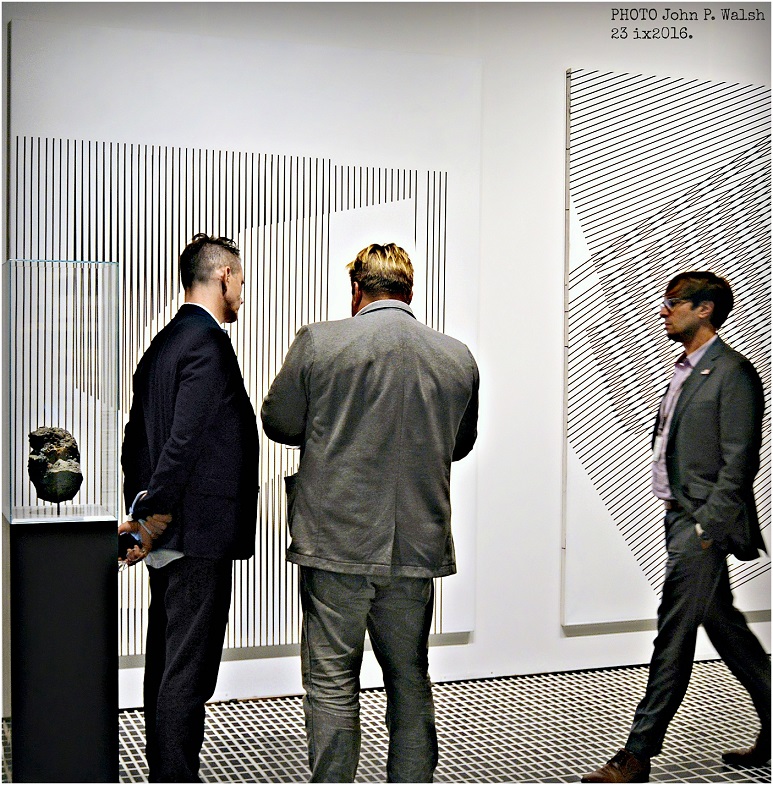
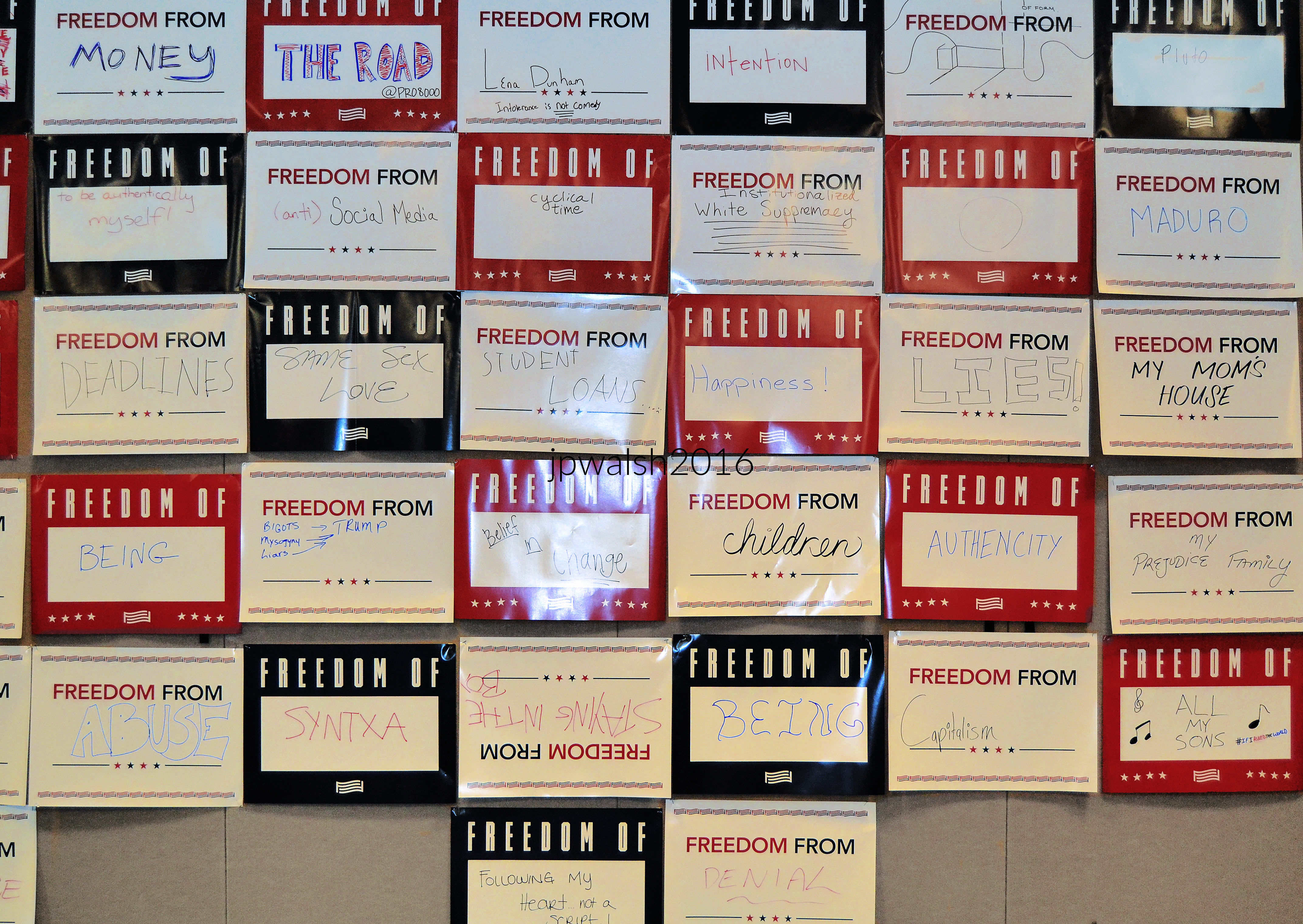
International Perspectives in Contemporary Art: My Photography of EXPO CHICAGO 2016.

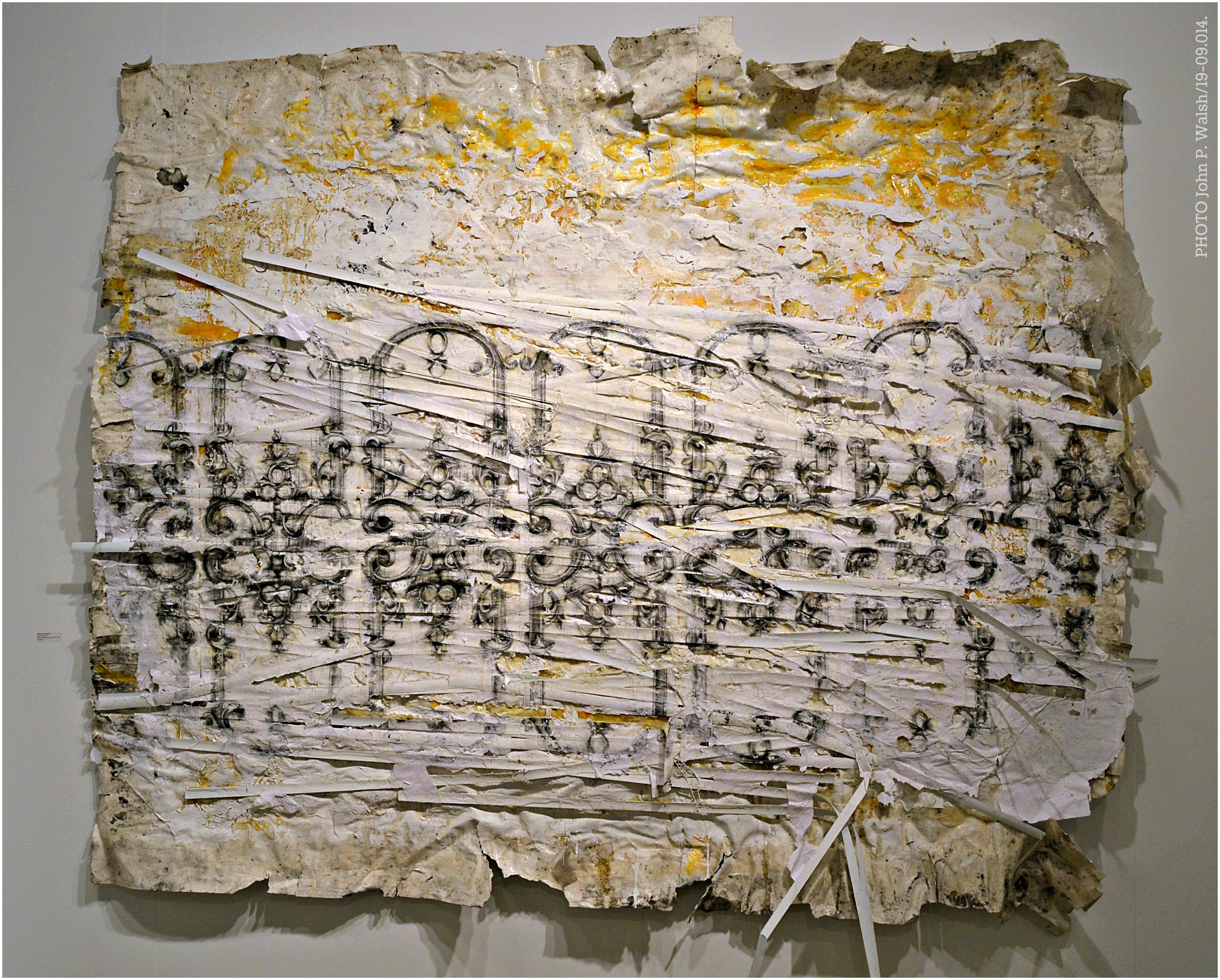
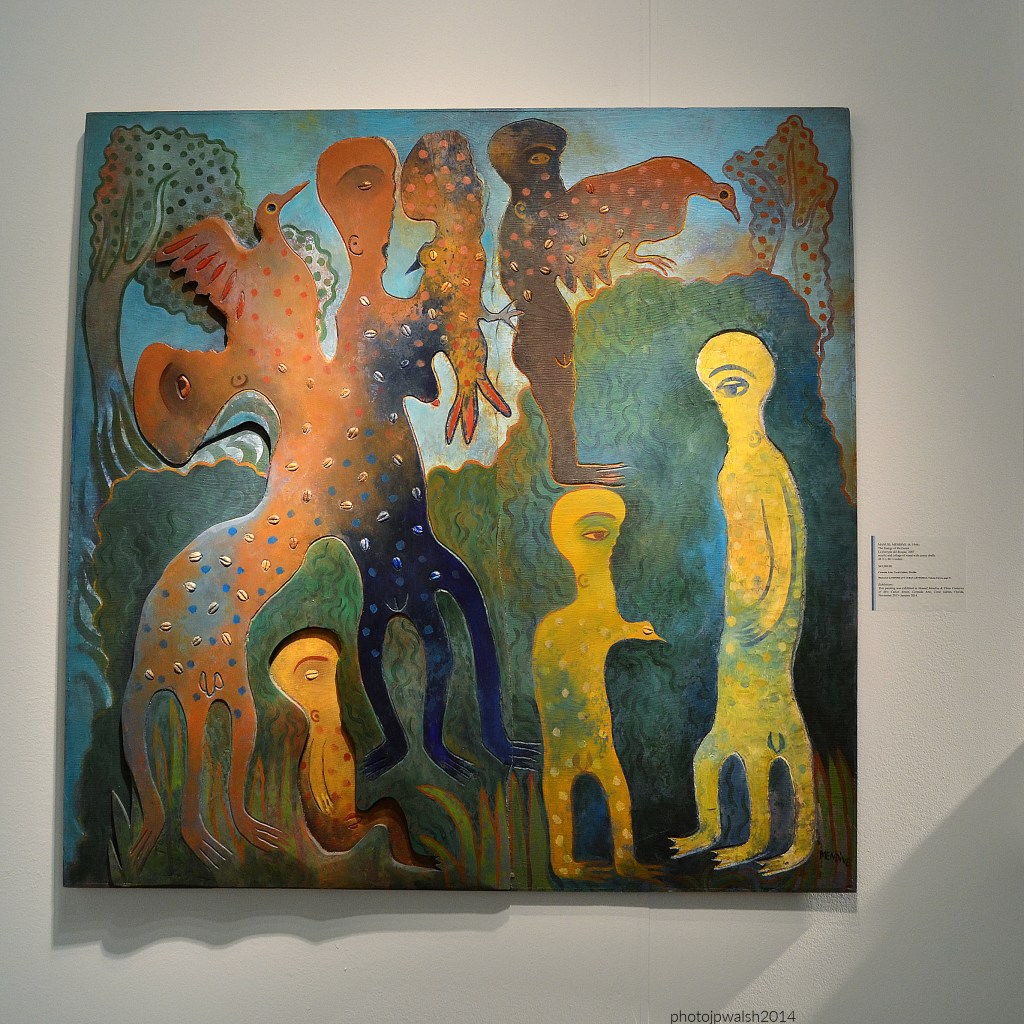
FEATURE IMAGE: Manuel Mendive, Este Lugar Sagrado/This Sacred Place, 2009, acrylic on canvas, Cernuda Arte Coral Gables, FL. Expo Chicago/2016.

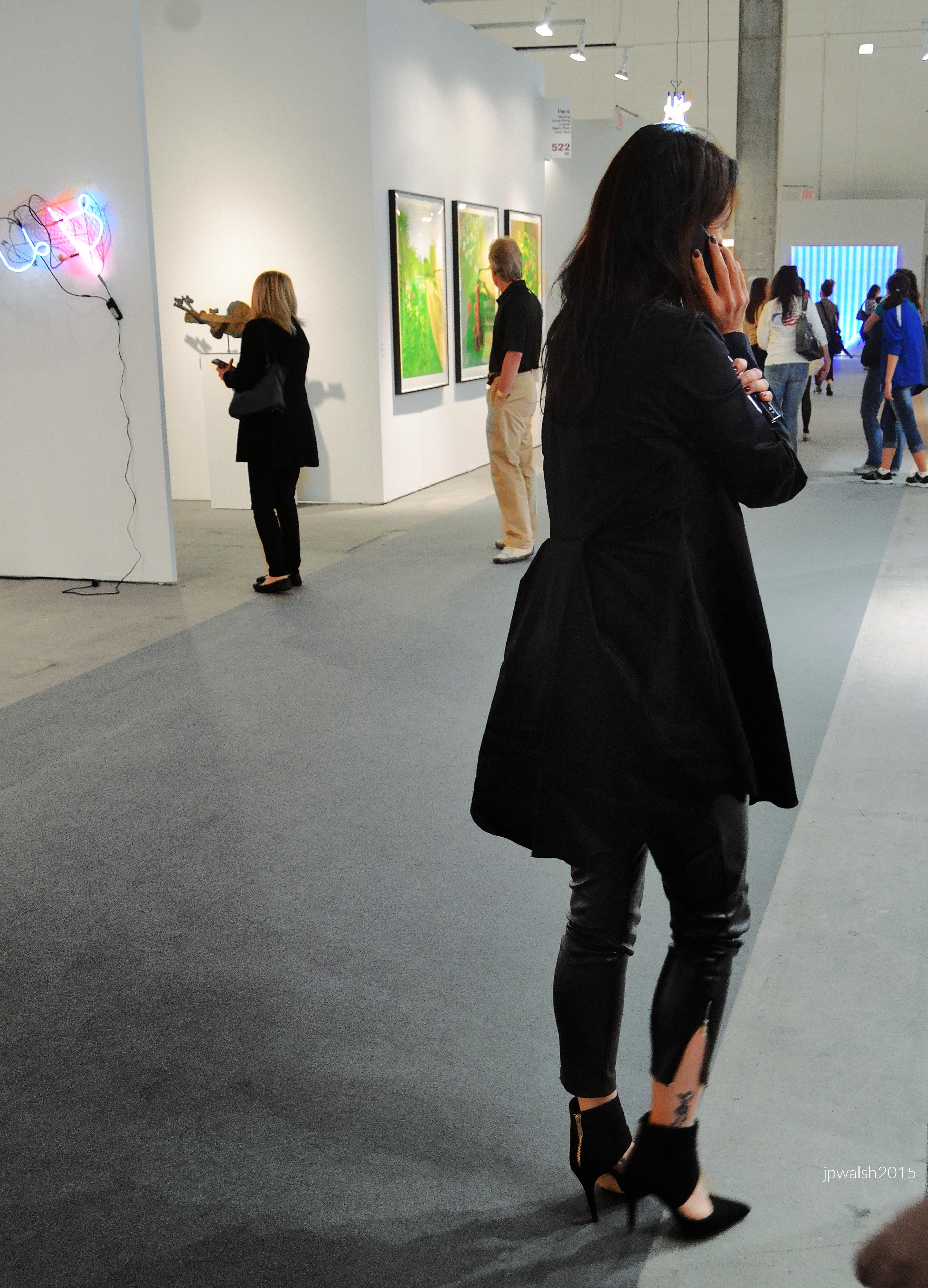
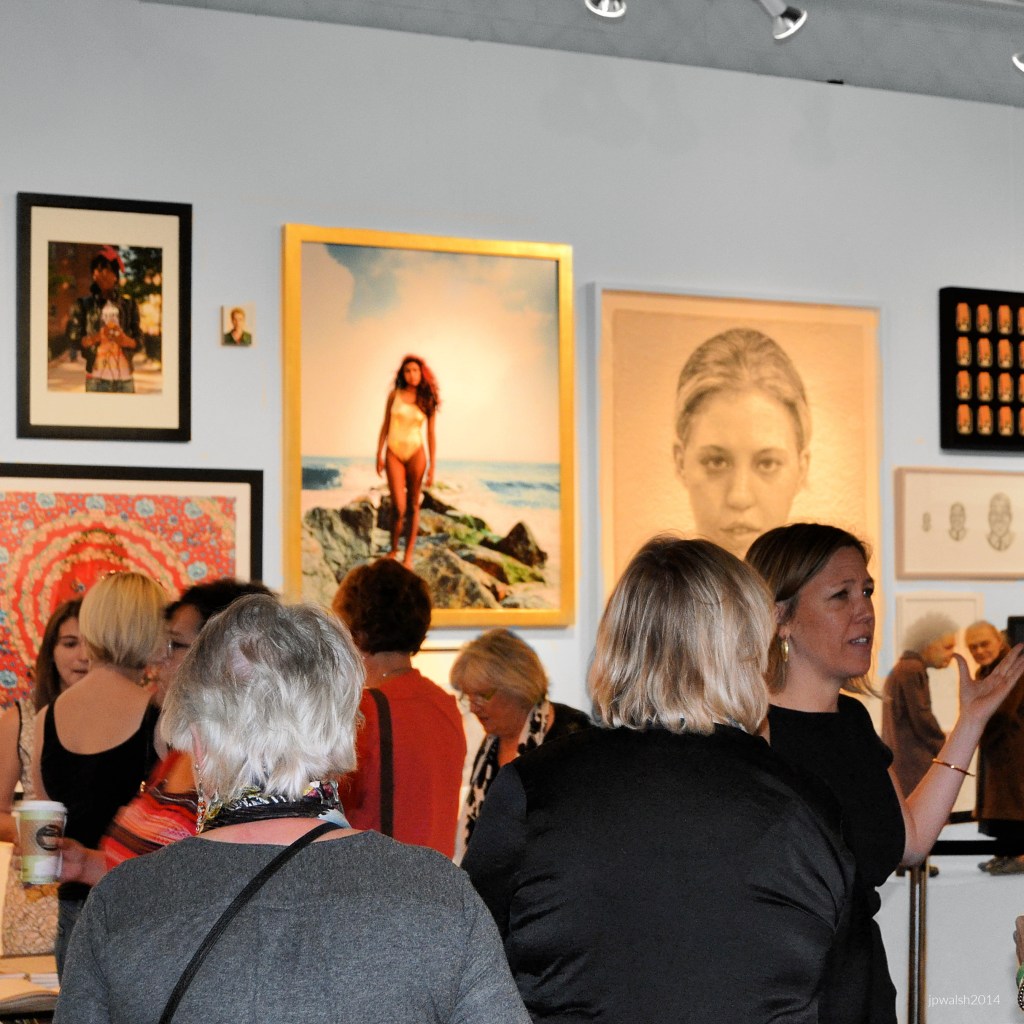
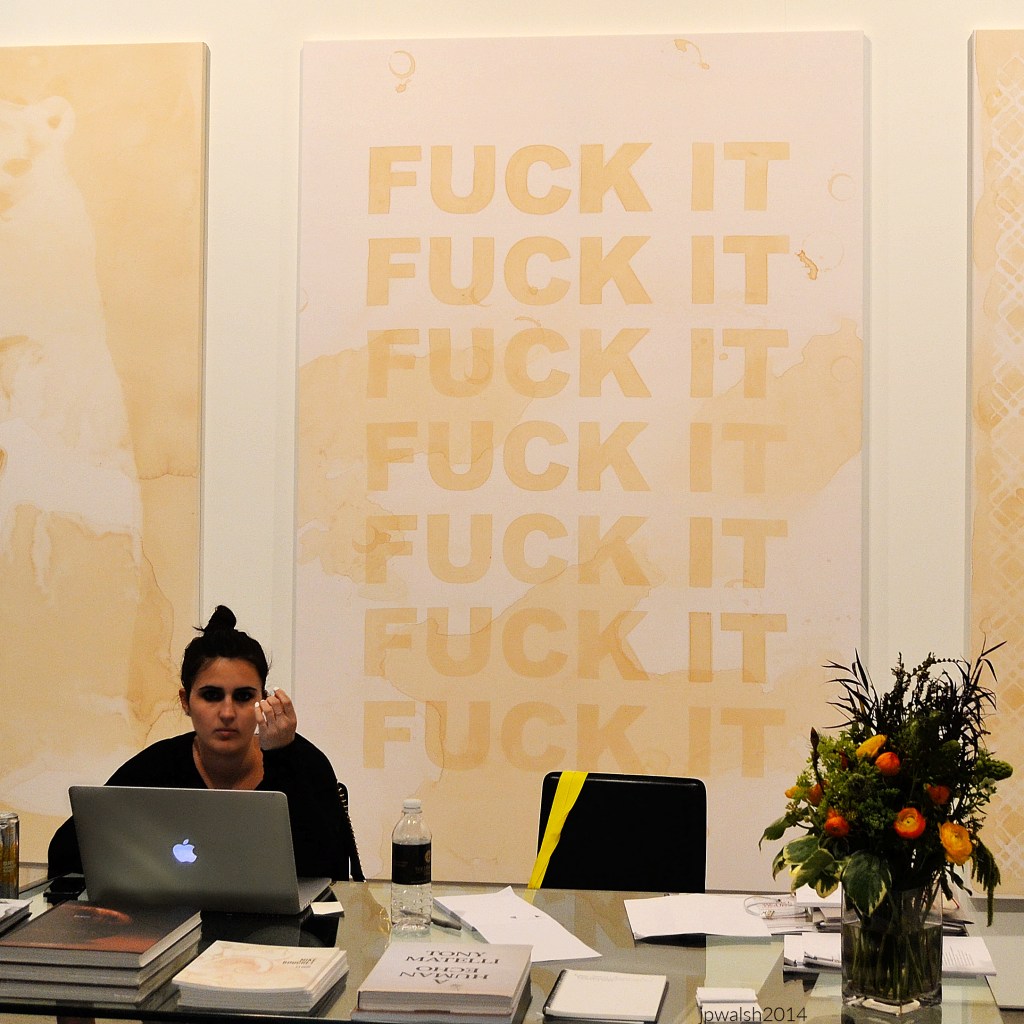
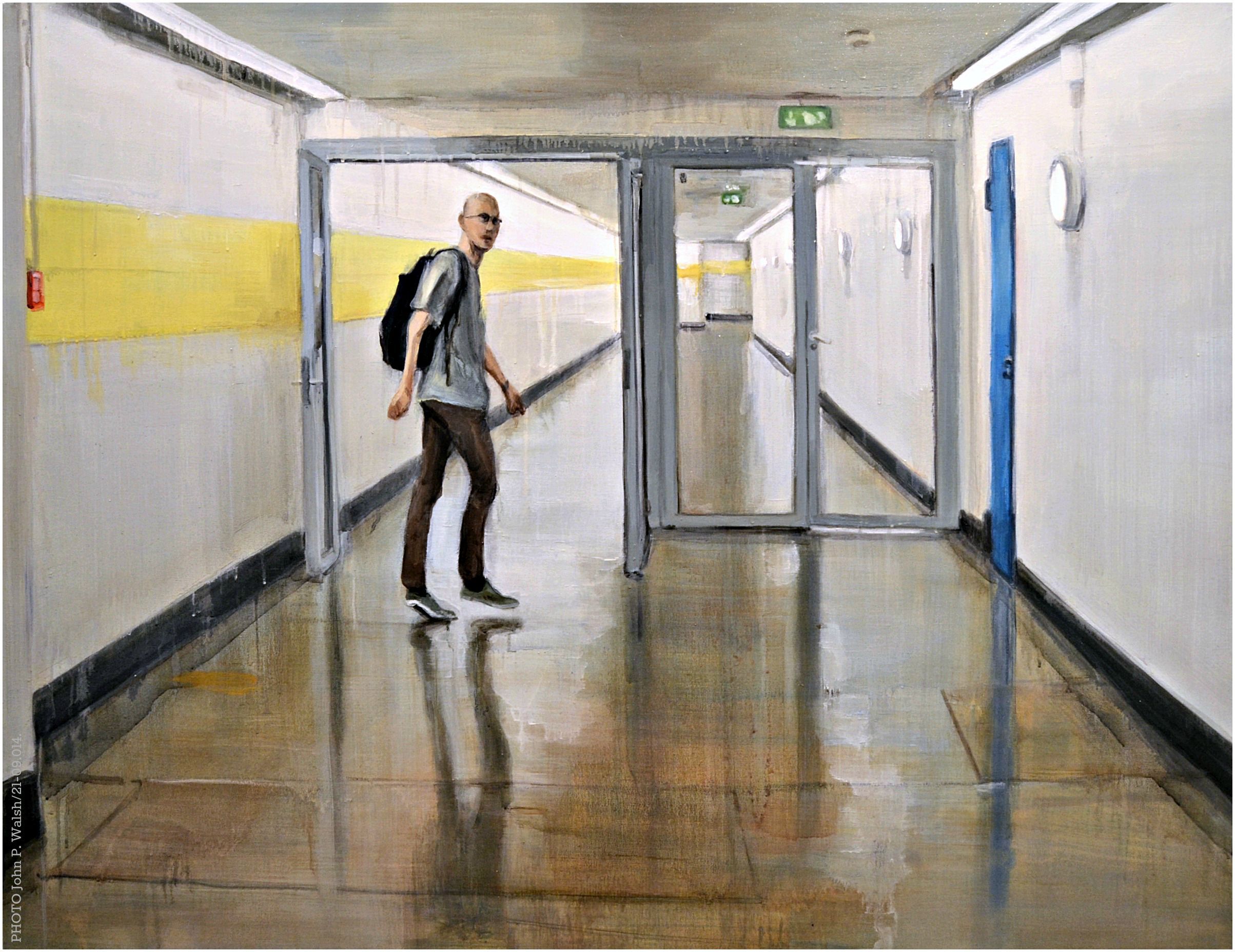
EXPO CHICAGO 2016 demonstrates how Chicago functions as a global crossroads for contemporary and modern art, bringing together international galleries, artists, and audiences while transforming Navy Pier’s Festival Hall into a temporary museum of worldwide creative exchange and experimentation.

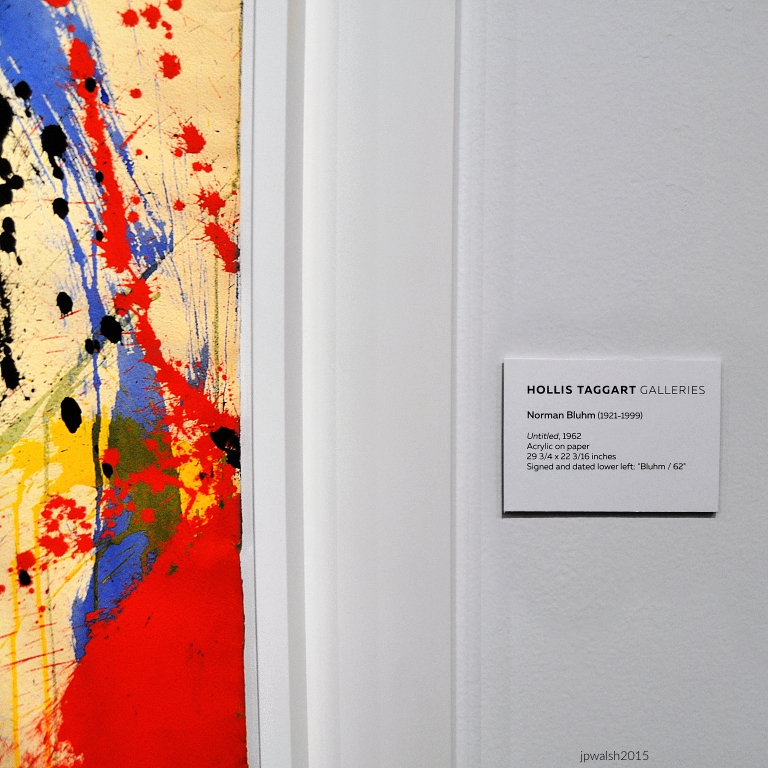
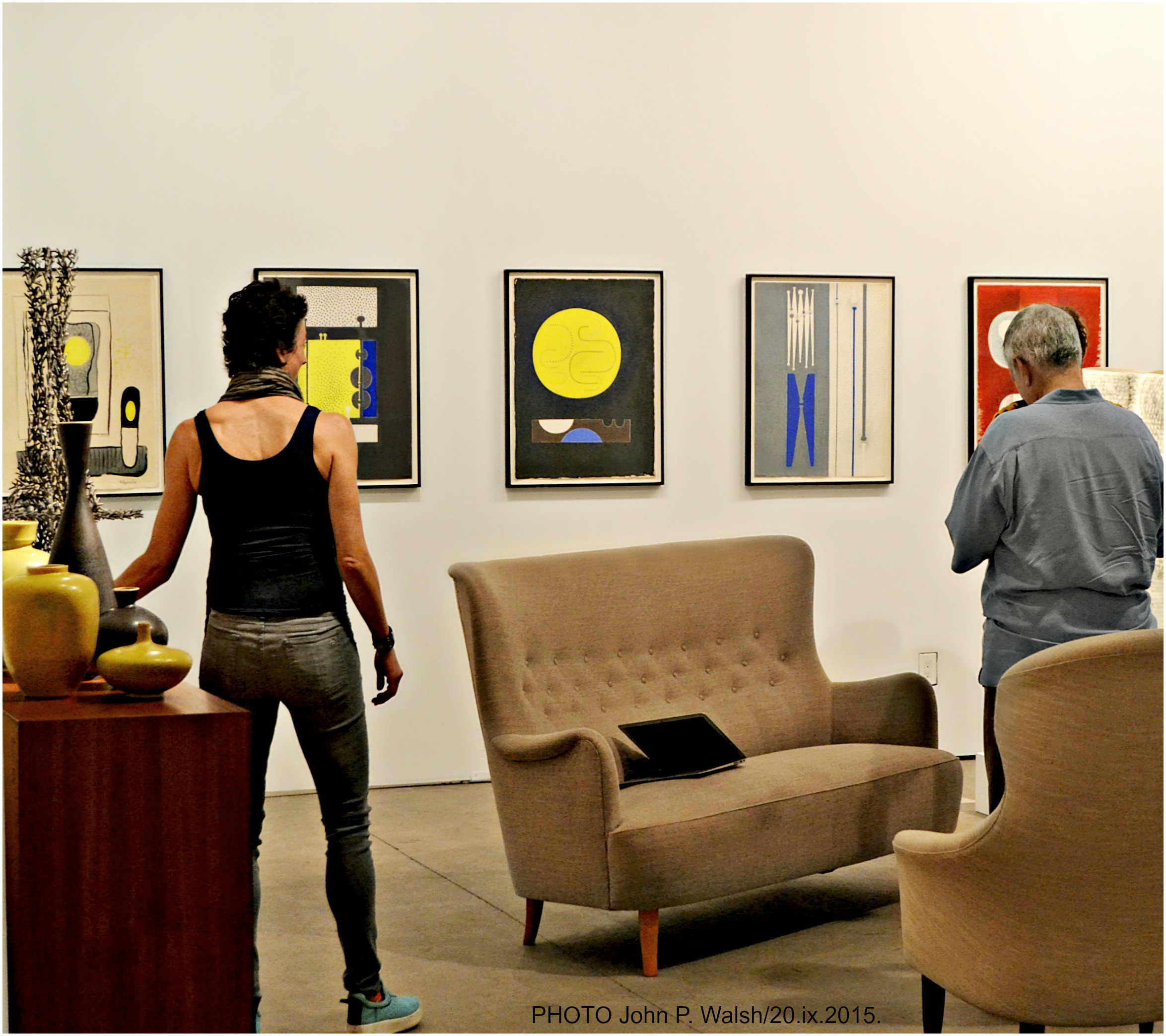
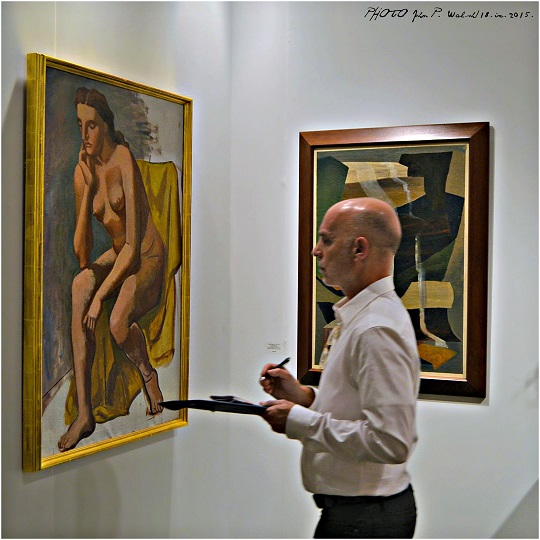
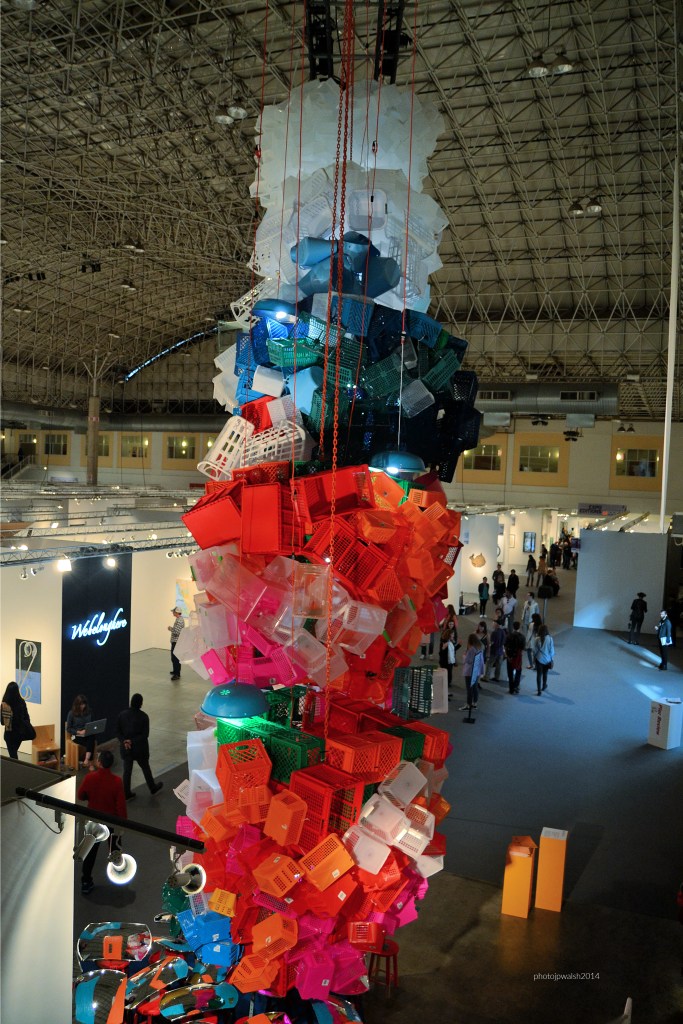
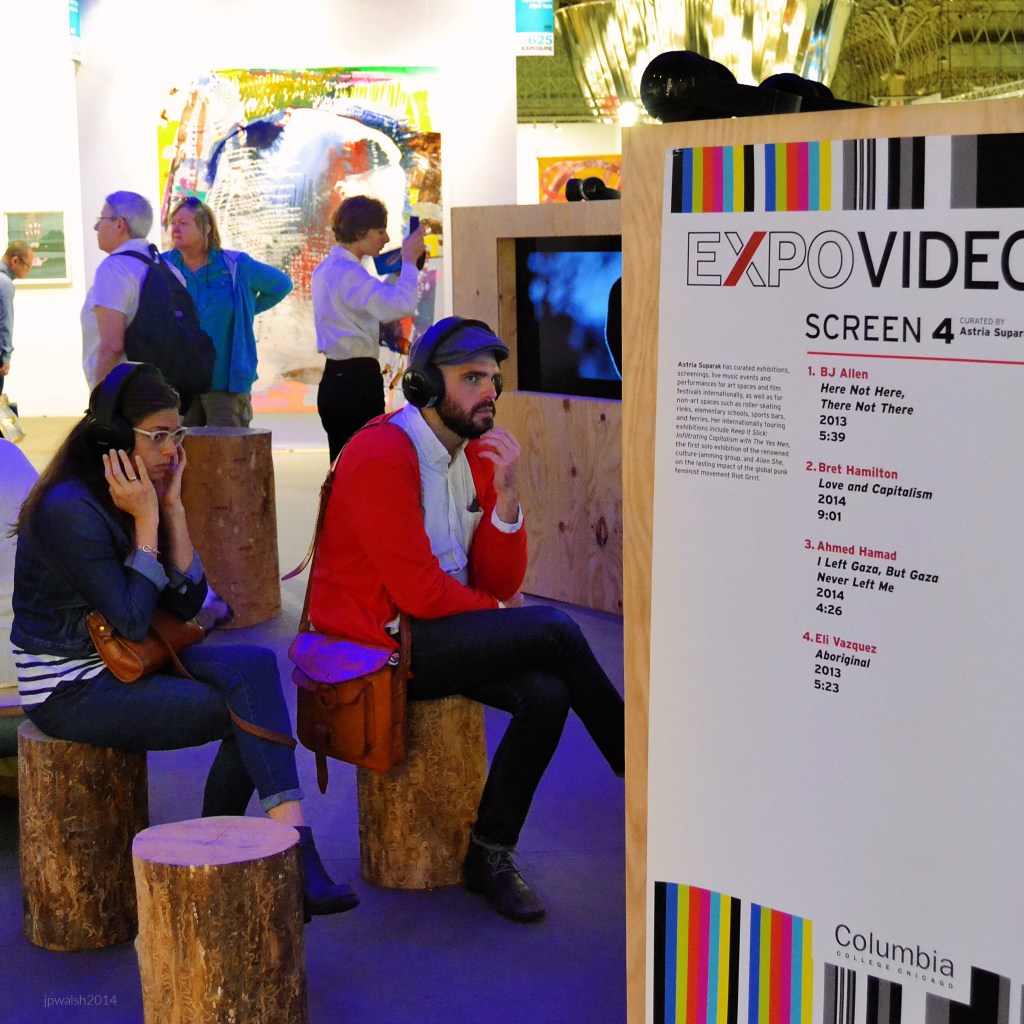
EXPO CHICAGO 2016 is the 5th annual exhibition of international contemporary and modern art held in Chicago at Navy Pier’s Festival Hall. It took place September 22-25, 2016. Expo Chicago/2016 presented 145 galleries and exhibitors representing 22 countries and 53 cities from around the world.

All photographs and text by John P. Walsh.

Jeff Koons' 17th Art Car.

Jeff Koons, BMW M3 GT2, Expo Chicago/2016.

Alfredo Jaar, Be Afraid of the Enormity of the Possible, 2015 neon edition GALERIE THOMAS SCHULTE DSC_0742 (1)

Alfredo Jaar, Be Afraid of the Enormity of the Possible, 2015, neon, edition 3/3 + 3AP, Galerie Thomas Schulte, Berlin, Germany. Expo Chicago/2016.

At Dittrich & Schlechtriem, Berlin (resized).

At Dittrich & Schlechtriem, Berlin, Germany includes artwork by Klaus Jörres and Julian Charrière. Expo Chicago/2016.

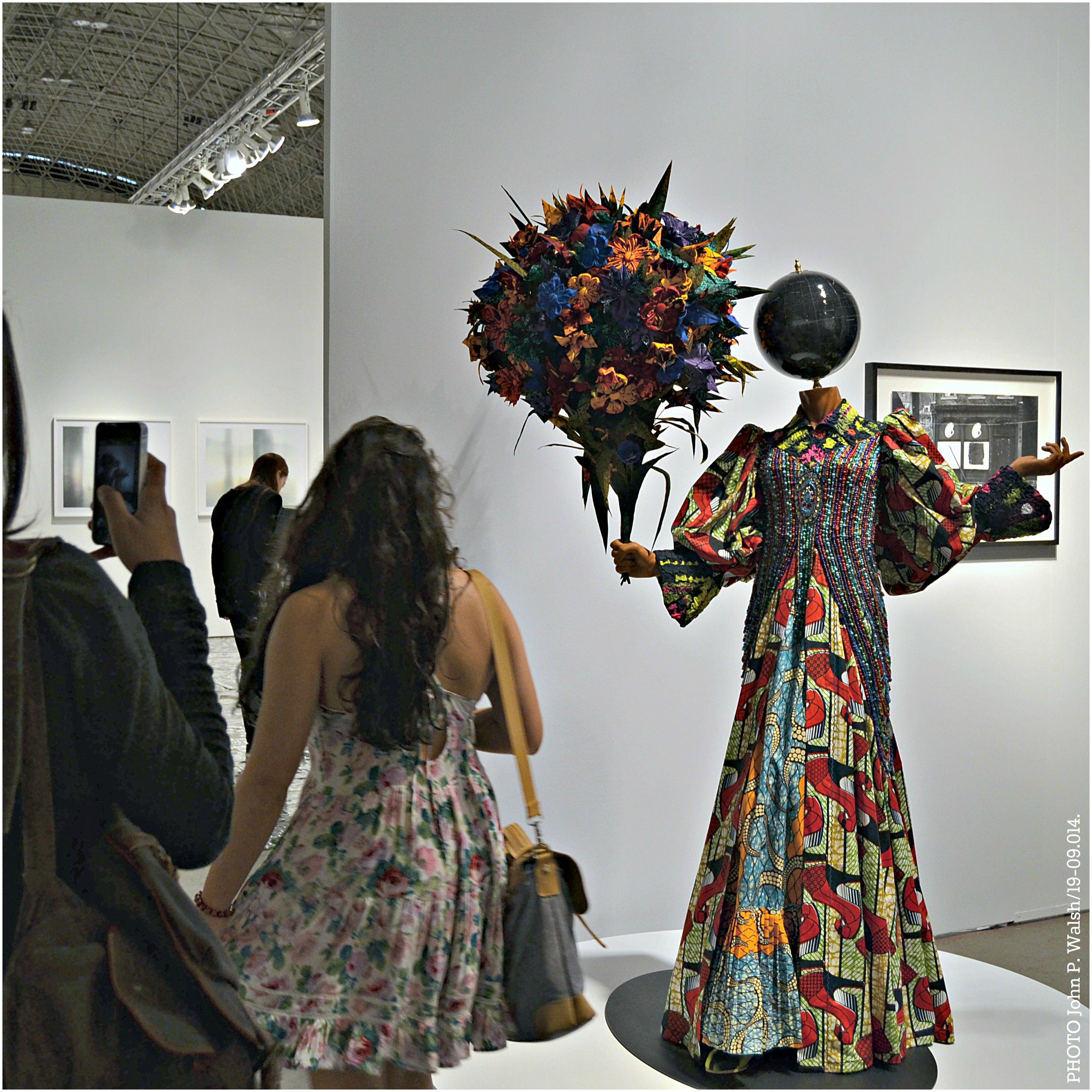
At Cernuda Arte Coral Gables, FL. Manuel Mendive (foreground) Este Lugar Sagrado/This Sacred Place, 2009, acrylic on canvas. Expo Chicago/2016.

Art+Language Made in Zurich 1965-1972, London.

Paintings I, Art+Language, Made in Zurich 1965-1972, London. Expo Chicago/2016.

Michael Baldwin and Mel Ramsden.

The Art + Language group’s Michael Baldwin and Mel Ramsden in Chicago. Founded in the mid1960s in the United Kingdom by Terry Atkinson (b. 1939), David Bainbridge (b. 1941), Michael Baldwin (b. 1945) and Harold Hurrell (b. 1940), artist Mel Ramsden joined in 1970.

Throughout the 1970s, Art + Language dealt with questions about art production and attempted a shift from conventional forms of art, such as painting and sculpture, to theoretically linguistic (text)-based artwork. Art + Language remains active today in several collaborative projects. 

September 2016. 99% 7.21 mb DSC_0630
At Galerie Thomas Schulte (resize).

Jonathan Lasker, The Handicapper’s Faith, 2011, Galerie Thomas Schulte, Berlin, Germany. Expo Chicago/2016.

Gallery MOMO, South Africa (resize).

At Gallery MOMO Cape Town/Johannesburg, South Africa. Artwork by Mary Sibande. Expo Chicago/2016.

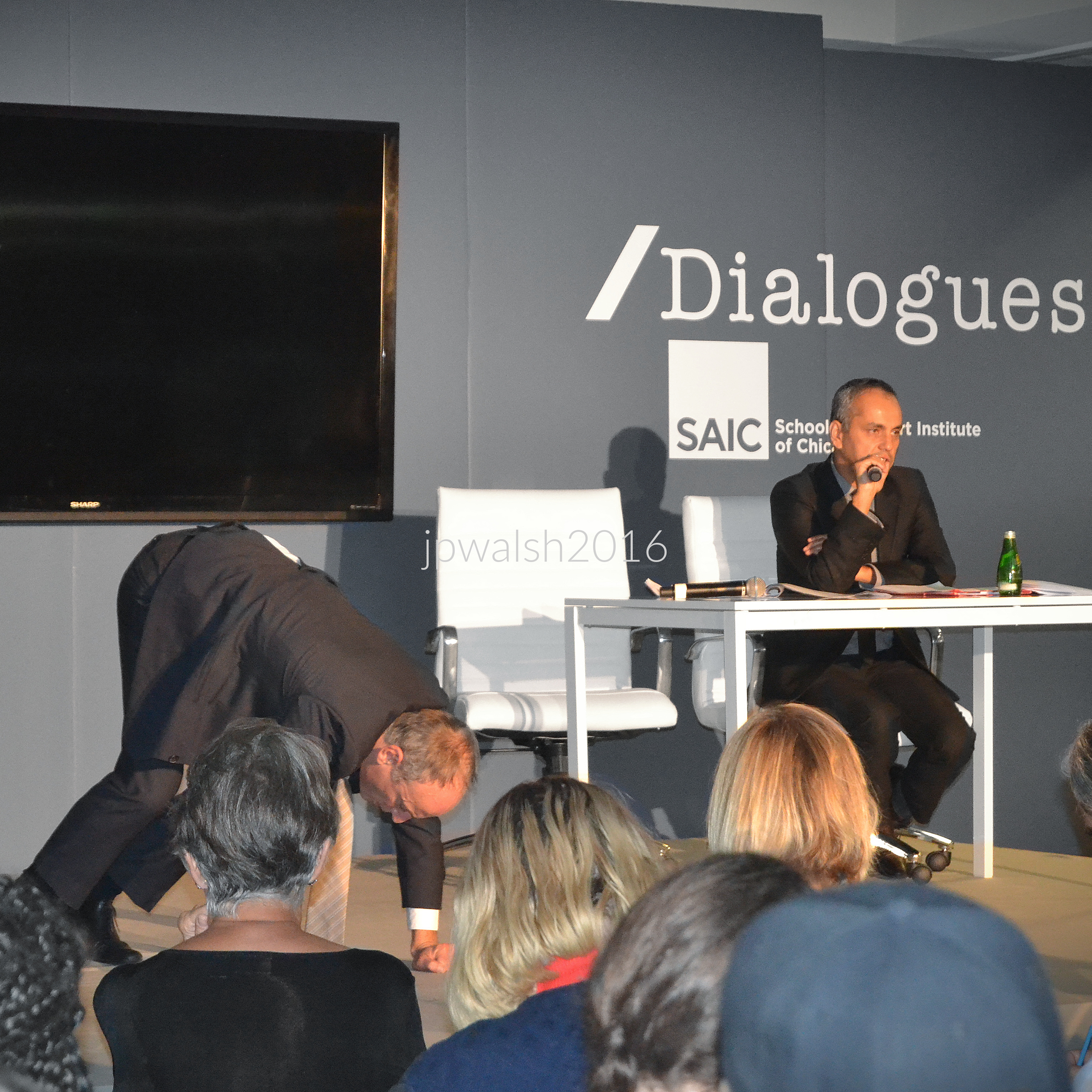
Dialogues.

Expo Chicago/2016.

Andrew Moore, Mirador, Gibara, Cuba, 2008Andrew Moore, Mirador, Gibara, Cuba, 2008, 46 x 58 inch archival pigment print, Yancey Richardson Gallery, New York. 

Margot Bergman, Agnes, 2016.

Margot Bergman, Agnes, acrylic on canvas, 2016, Corbett vs. Dempsey, Chicago. Expo Chicago/2016.

Shannon Finley, Googol, 2015.

Shannon Finley, Googol, 2015, acrylic on linen, 4 panels 95 x 189 in.,Carrie Secrist Gallery, Chicago. Expo Chicago/2016.

#12 FINAL COPY FUB BURST DSC_0867

Euan Uglow, Sue Wearing a Blue Swimming Cap, 1978/80, oil on canvas 19.5 x 27.5 in., Browse & Darby London. Expo Chicago/2016.

Deborah Butterfield, Hala, 2016.

Deborah Butterfield, Hala, 2016, cast bronze with patina, Zolla Lieberman Gallery Inc., Chicago. Expo Chicago/2016.

at Álvaro Alcázar Gallery, Madrid (resize).

Juan Garaizabal, Álvaro Alcázar Gallery, Madrid. Expo Chicago/2016.

April Martin, The Sun had not yet Risen, 2016.

April Martin, The Sun had not yet Risen, 2016, copper, thread, glass, vinegar, The School of the Art Institute of Chicago. Expo Chicago/2016.

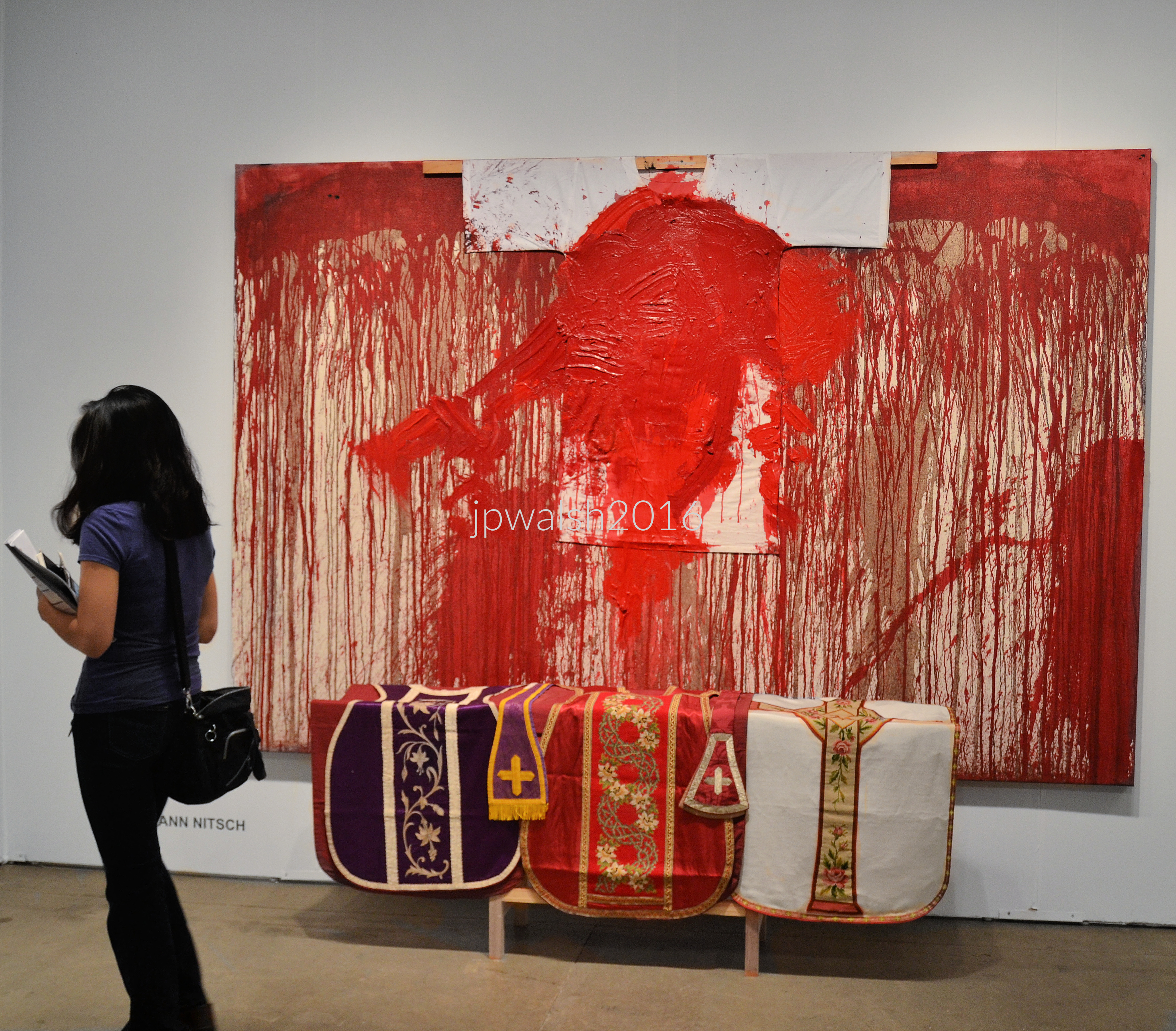
September 2016. Hermann Nitsch, Schüttbild (Shaped Image), 2013, Acrylic on Canvas, Marc Straus Gallery, New York City. 4.29mb DSC_0876 (1)

Dialogue with Miguel Aguilar and Chris Silva.

Dialogue with Miguel Aguilar and Chris Silva, Conversation Pieces. Expo Chicago/2016.

Louise Bourgeois, Girl with hair, 2007, archival dye on silk, edition of 12, Carolina Nitsch, New York City. Expo Chicago/2016.

Pace Gallery, New York City. (resize)

Pace Gallery, New York City. Expo Chicago/2016.

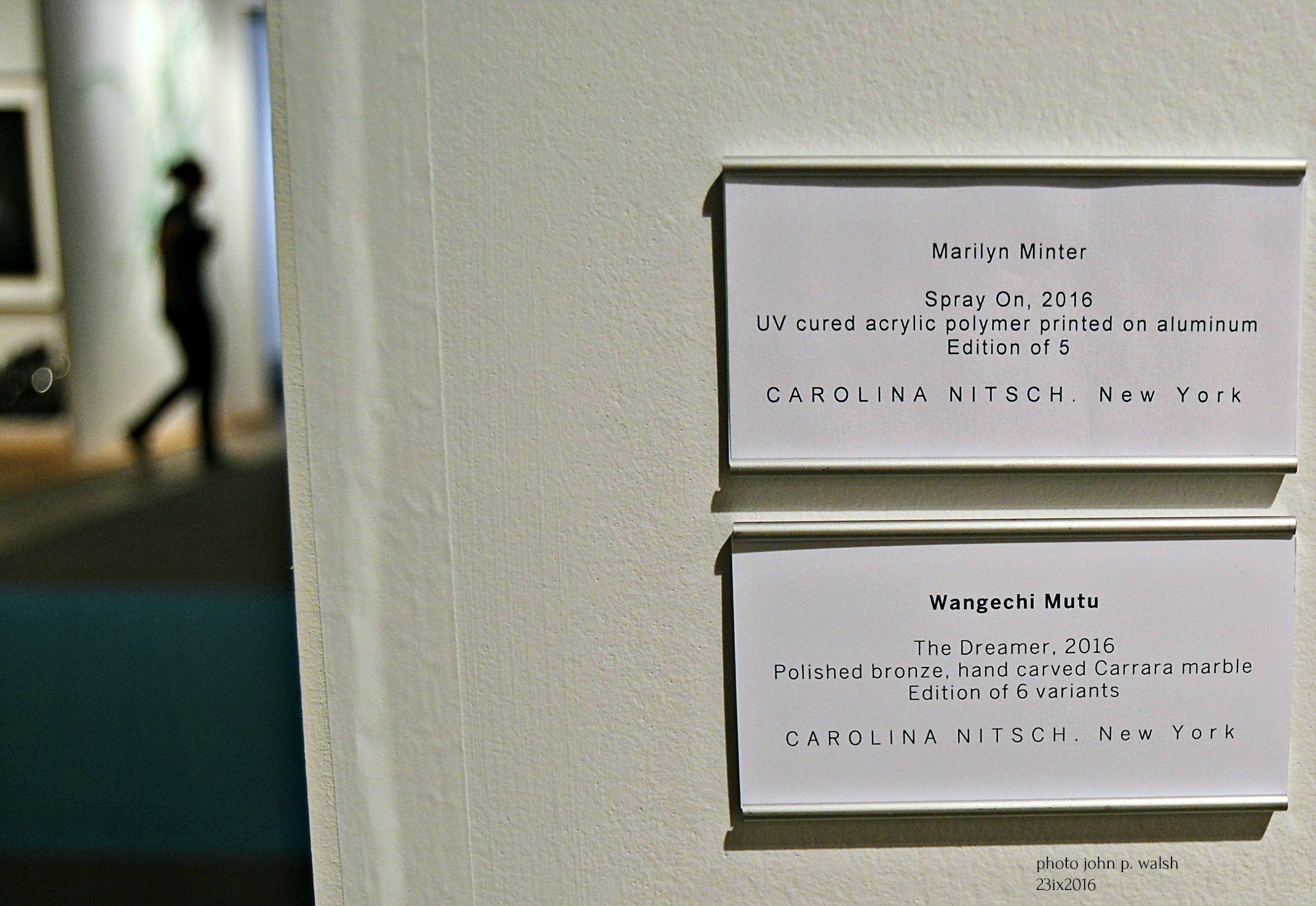
Carolina Nitsch labels.

Expo Chicago 2016.

Genieve Figgis, Half Gallery, NYC (resize)

Genieve Figgis, Half Gallery, New York City. Genieve Figgis is an artist from Ireland who began her artistic career on social media. Expo Chicago/2016.

Buddha's tight ringlet curls by Qi Yu.

Buddha’s tight ringlet curls by Qi Yu. Ceramic cinnabar mineral mounted on canvas. Expo Chicago/2016.

Qi Yu, Beijing, China.

Artist Qi Yu of Redbrick Art Museum, Beijing, China.

North Cafe.

North Cafe. Expo Chicago/2016.

Art Catalogs. (resize).

Expo Chicago/2016.

Amy Sherald, Monique Meloche Gallery.

Listen, you a wonder. you a city of a woman. you got a geography of your own., Amy Sherald, 2016, 54 x 43 in., oil on canvas, Monique Meloche Gallery, Chicago.

The artist’s title quotes American poet Lucille Clifton (1936-2010): “listen, you a wonder. you a city of a woman. you got a geography of your own. listen, somebody need a map to understand you. somebody need directions to move around you. listen, woman, you not a noplace anonymous girl; mister with his hands on you he got his hands on some damn body!”

Sandro Miller, American Bikers 1990-1995.

Sandro Miller, American Bikers 1990-1995, Catherine Edleman Gallery, Chicago. Expo Chicago/2016.

Bettina Pousttchi, Rotunda, 2016.

Bettina Pousttchi, Rotunda, 2016, photographic print on textile, 25′ diameter, Buchmann Galerie, Berlin/Lugano. Expo Chicago/2016.

Raffi Kalenderian, Sekula Benner Street, 2016.

Raffi Kalenderian, Sekula Benner Street, 2016, oil on canvas, Buchmann Galerie Berlin/Lugano. Expo Chicago/2016.

Kate Werble  Ernesto Burgos (resize).

Ernesto Burgos, Kate Werble Gallery, New York City. Expo Chicago/2016.

Sims Reed Gallery London (resize)

Sims Reed Gallery London. Expo Chicago/2016.

Ann Agee, Negishi Heights 1957, 2015, (resize)

Ann Agee, Negishi Heights 1957, 2015, acrylic on Thai Mulberry paper, P.P.O.W. Gallery, New York City. Expo Chicago/2016.

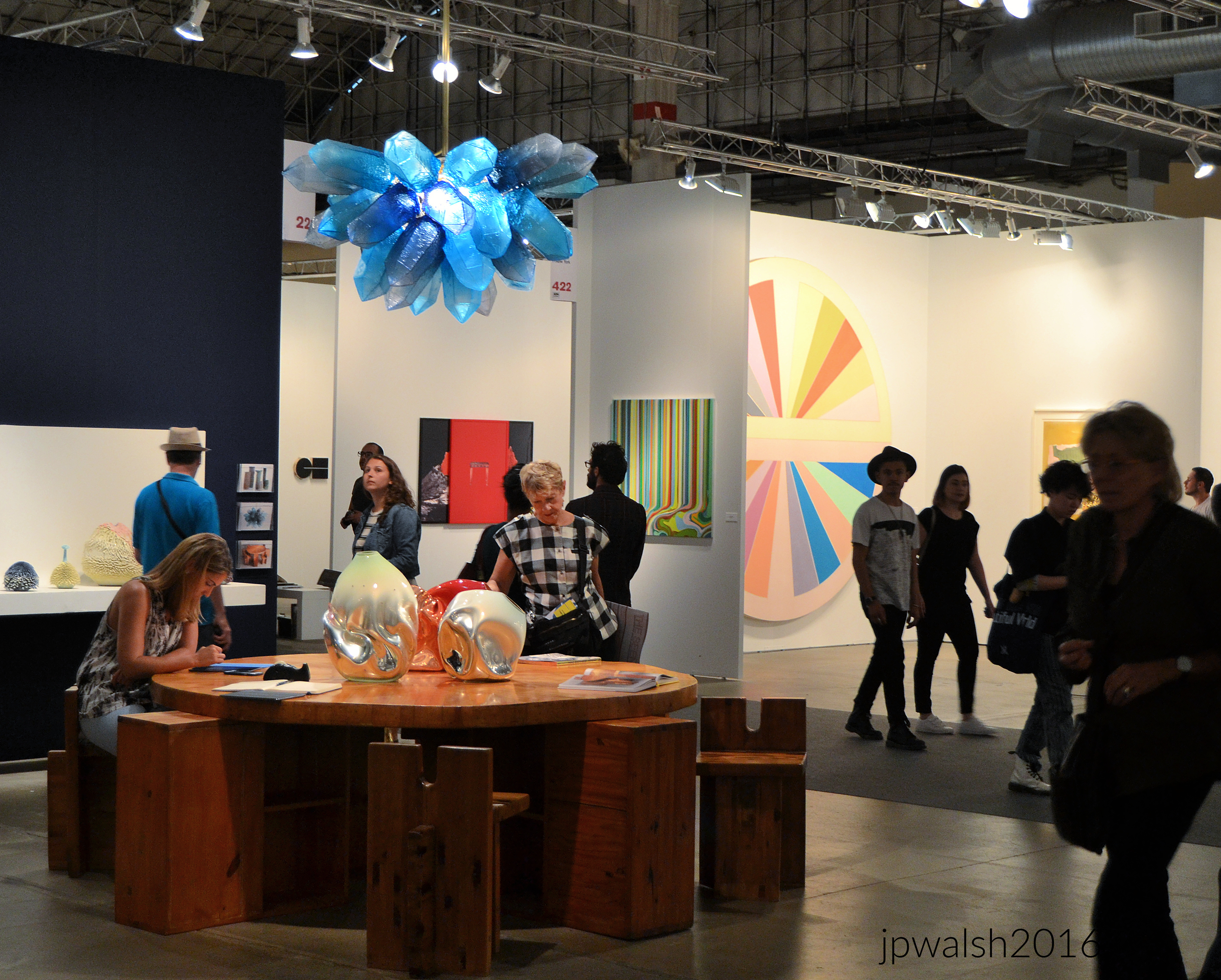
At the Expo.

Expo Chicago/2016.

Artistic performance. (resize)

Performance outside Zwirner Gallery, New York City. Background: Raymond Pettibon, No Title (Manhattan rising, advancing—), 2010, ink and acrylic on paper, 59 x 118 inches. Expo Chicago/2016.

Mel Bochner and Aloyson Shotz.

Mel Bochner, Blah Blah Blah, 2016 and Aloyson Shotz, Flow Fold #3, 2015, Carolina Nitsch Gallery, New York City. Expo Chicago/2016.

Alicja Kwade, Hypotheisches  Gebilde, 2016 (resize)

Alicja Kwade, Hypotheisches Gebilde, 2016, König Galerie Berlin, Germany. Expo Chicago/2016.

Bernar Venet, Indeterminate Line, 2013.

Bernar Venet, Indeterminate Line, 2013, rolled steel, 75 1/2 × 80 × 62 in. Paul Kasmin Gallery, New York City. Expo Chicago/2016.

Richard Norton Gallery (resize)

Richard Norton Gallery. Expos Chicago/2016.

Jannis Varelas, New Flags for a New Country, The Breeder, Athens, Greece. Expo Chicago/2016.

Expo's end.

Expo Chicago/2016.

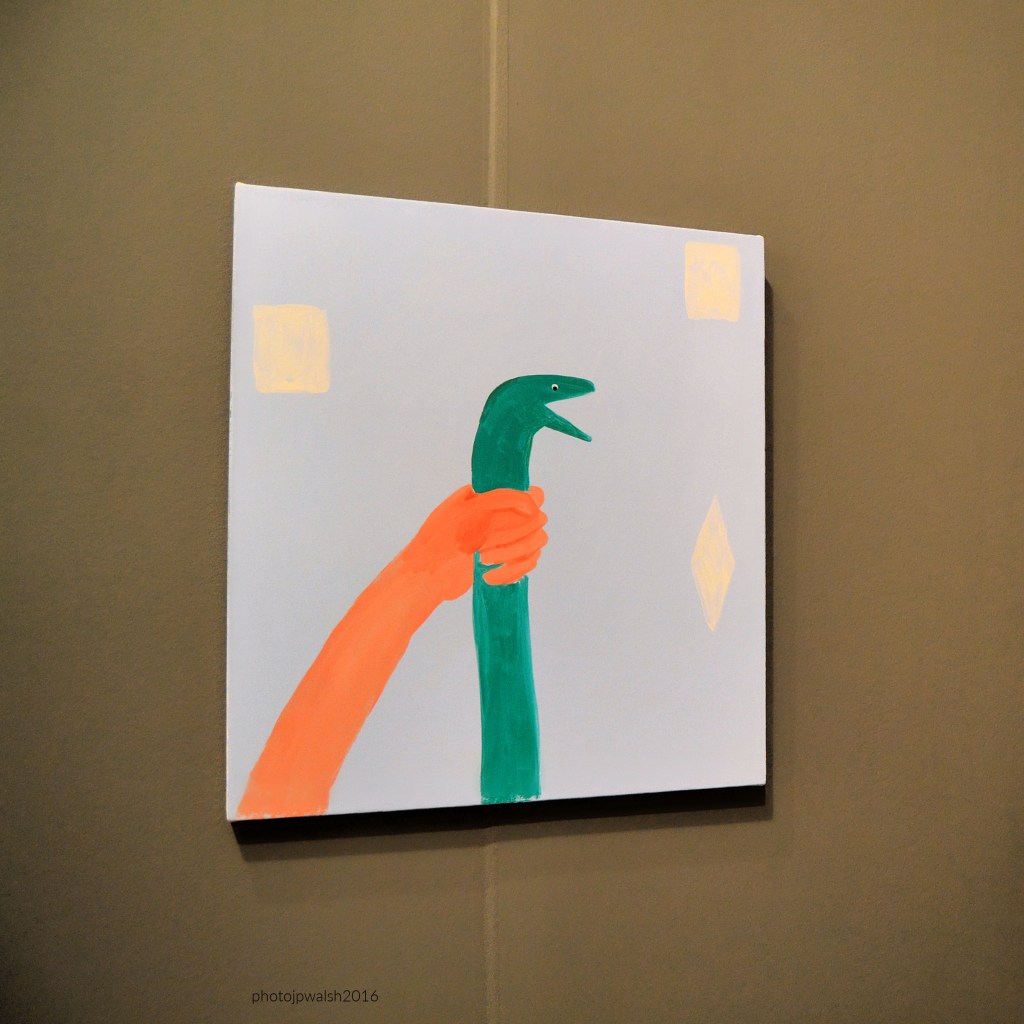
Jenn Smith, Untitled (Snake), oil and acrylic on canvas, 2016, The School of the Art Institute of Chicago. Expo Chicago/2016.

Atelier Van Lieshout, The Beginning of Everything, foam, paint, wood, paverpoll, 2016. Expo Chicago/2016. The molecule represents Glucose (C6H12O6), the primary source of energy for human life.  Without glucose, nothing would function: neither the brain, intelligence, thought, muscles, movement or sports. Without energy, our lives would come to a standstill.

September 2016. 4.96mb DSC_0847 (1)
September 2016. 3.76mb DSC_0719 (2)
September 2016. 4.53mb DSC_0490 (1)

Photographs:

The Painter Who Defined Elizabethan England: Marcus Gheeraerts the Younger (c. 1562-1636) and the Art of Power. Complete signed, dated, documented, inscribed artwork.

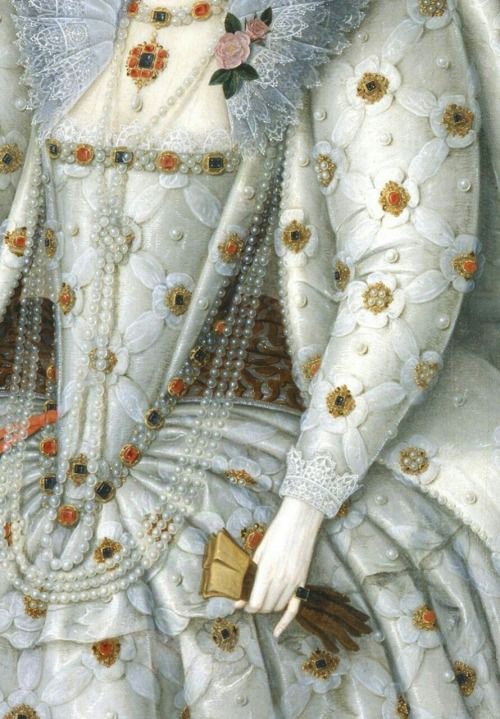
FEATURE image: Detail, Queen Elizabeth I. Ditchley portrait. Marcus Gheeraerts the Younger, 1592.

Marcus Gheeraerts the Younger was one of the most important portrait painters of Elizabethan and early Stuart England, whose innovative artistic style, influential court connections, and penetrating portrayals of political, military, and aristocratic figures helped shape English portraiture during a pivotal era in British history.

Marcus Gheeraerts the Younger, Captain Thomas Lee in Irish Dress, oil on canvas, 1594 (purchased 1980), Tate Britain.

Captain Thomas Lee (c.1551-1601) had his portrait painted by 33-year-old Marcus Gheeraerts the Younger (Bruges, 1561-1636) in London in 1594. Captain Lee was 43 years old and had worked as a military adventurer for English colonization in Ireland since the early 1570’s.

The young artist was the son of Gheeraerts the Elder (c. 1520–c. 1590), a painter and printmaker associated with the Tudor court in the late 1560’s and 1570’s. Fleeing religious persecution in Flanders, Gheeraerts the Elder arrived into England with his 7-year-old son Marcus in 1568. In 1577, Gheeraerts the Elder had likely returned to Flanders.

By 1594, when the portrait of Captain Lee was made, Gheeraerts the Younger was a rising young contemporary artist working in Elizabeth I’s Tudor court.  Sir Roy Strong, the English art historian who served as director of the National Portrait Gallery and the Victoria and Albert Museum in London is unequivocal about Gheeraerts the Younger’s artistic importance to English art history. Strong wrote that Gheeraerts is “the most important artist of quality to work in England in large-scale between (Hans) Eworth (c. 1520 – 1574) and (Anthony) van Dyck (1599-1641).”1 

In addition to a discussion of the early painting of Captain Lee, a complete collection of Marcus Gheeraerts the Younger’s 33 art works– including signed and dated works, documented and dated works, inscribed and dated works, and inscribed and undated works– is included in this post following this introduction.

Social contract: Marriages of court artists in late-16th-century Tudor England

At 22 years old in 1583, Marcus Gheeraerts the Younger’s world in and around London was ideally enclosed by marriage to the sister of talented Tudor court painter John De Critz (c.1555-c.1641). De Critz, like his new brother-in-law Gheeraerts the Younger, was a child expatriate from Flanders to England in 1568.2 

In 1571 Gheeraerts the Elder had married his son’s future wife’s sister, making father and son Gheeraerts also eventually brothers-in law.3 

Over two decades later, in 1602, Gheeraerts the Younger’s sister married the court artist Isaac Oliver (c.1565-1617).4 

This was typical social behavior at the Tudor court where many active artists were connected by ties of marriage, family, and artistic training as well as shared European origin.

In Gheeraerts the Younger’s circle, for instance, John De Critz was apprenticed to the wealthy portrait painter Lucas de Heere (1534-1584) who may also have helped train Gheeraerts the Younger. De Heere – like Gheeraerts the Younger and De Critz – was a religious refugee to England from Flanders.

Isaac Oliver, Gheeraerts the Younger’s other brother-in-law, studied under leading Tudor portrait miniaturist and goldsmith Nicholas Hilliard (c.1547-1619). 5 Roy Strong as Director of the National Portrait Gallery in London links Hilliard to Gheeraerts by way of the supreme artistic quality found in both of these contrasting artists’ masterpieces.6 

One remarkable technical innovation that the young artist applied in his portraits was the use of stretched canvas in place of wood panel that allowed for larger and lighter surface areas on which to paint and more easily transport pictures of the grand gentlemen and ladies of the time.

By way of marriage to an Irish Catholic woman, Captain Thomas Lee became a man of considerable property in Ireland. Captain Lee had separated from his wife by the time of his portrait. The next year -– in 1595 –- Lee married an Englishwoman. Over the decades, Captain Lee’s military reputation became one of an enfant terrible in Ireland which did not mellow over time. Powerful friends looked to explain Thomas’s frequent reckless political and military behavior. It was justified as the occupational hazard of a longtime English soldier in Ireland.

Planning and posing of Captain Lee’s portrait

Lee posed for Gheeraerts when the captain was straight off the battlefield from Ulster chieftain Aodh Mag Uidhir (Hugh Maguire, d. 1600) and in London for delicate negotiations.

To presumably express Thomas’s faithful service to the Crown, the portrait includes a Latin inscription in the tree that refers to Mucius Scaevola (c. 500 BC), an ancient perhaps mythical Roman fighter who remained loyal to Rome even after he was captured by mortal enemies.  

Captain Thomas Lee was related to Sir Henry Lee as paternal half cousins. Sir Henry was Queen Elizabeth I’s Champion for almost 25 years until his retirement in 1590. In that capacity, Henry was the creator of the stunning imagery for her publicly-popular Accession Day festivals that he annually planned. Along with Gheerearts the Younger’s Elizabethan allegorical portrait Lady in Fancy Dress (The Persian Lady) (#30 below) and the Ditchley portrait of Queen Elizabeth I (#31 below) — both painted in the early 1590s — Henry, who remained active and influential in political affairs, may have helped devise the symbolism in Captain Lee’s portrait. The portrait also came from Ditchley, Sir Henry Lee’s timber-framed family house set in the wooded farmsland of north Oxfordshire.

While the painting’s landscape where Captain Lee stands is likely a representation of Ireland’s wild landscape, Henry Lee’s symbolism may provide other subtle and humorous features. 

Troublesome Thomas, for example, stands under an oak, which may refer to Sir Henry’s political protection but also that these trees are prone to dangerous lightning strikes. 

The final seven years of Captain Thomas Lee’s life iterated a legendary standard: at times negotiating with or killing Irish enemies he also served time in prison in Ireland on a charge of treason. Ultimately, Sir Henry could not save his familial junior– in 1601 Thomas faced execution in England for treason against Elizabeth I.

English colonial rule tightens in 17th century Ireland

English power became increasingly absolute in 17th century Ireland.  

In the 1590’s, the Protestant Ascendancy in Ireland believed turning their backs on the mostly Catholic natives was the most effective governing strategy. While an oath of allegiance to the Crown remained law to divest Irish rebels of their property to English rule, it was not vigorously applied until the arrival in 1604 into Ireland of Lord Deputy Arthur Chichester (1563-1625). 

The 1590’s continued to implement England’s new plantation system in Ireland which amounted to confiscating Irish property for English and Scottish settlers. While this provided quick and lucrative rewards for the conquerors, the political situation was not free of ambiguity. English laws were attacked by Irish chiefs seeking protection under older common law.

Protestant settlers had their own uneasy relationship with the English Crown who, in turn, fought a tug of war with an English Parliament.

About half of settlers in Ulster were Presbyterians who were dissenters from the English church which itself was at war with Anglo- and Gaelic Irish Catholics. Moreover, London viewed new Protestant landowners in Ireland –- such as Captain Thomas Lee –- with no less suspicion as despoiled Catholics. The Crown believed that the new Protestant vanguard in Ireland had power to usurp the island’s treasure more readily than pillaged Catholics who could, ironically perhaps, be better disposed to the idea of royal governance.7

While Thomas Lee’s special status is expressed in the painting’s lace embroidery on his rolled-up shirt and inlaid pistol and Northern Italian-made helmet, the Captain is dressed as a common foot-soldier who traveled through Ireland lightly armed. Captain Lee is also, both seriously and humorously, barelegged.

Sir Henry Lee must have been one of Marcus Gheeraerts the Younger’s earliest patrons, as the Ditchley collection had several portraits which can be ascribed to the artist.8

FOOTNOTES:

  1. Strong, Roy, The English Icon: Elizabethan & Jacobean Portraiture, The Paul Mellon Foundation for British Art London Routledge and Kegan Paul Limited New Haven Yale University Press, 1969, p.22.
  2. Ibid. p.259.
  3. Hearn, Karen, Marcus Gheeraerts II: Elizabethan Artist, In Focus (Tate Publishing), 2003, p. 11ff.
  4. Strong, p.269.
  5. Hearn, p.130.
  6. Strong, p.23.
  7. See Roger Chauviré, A Short History of Ireland, New American Library, 1965; T.W. Moody & F.X. Martin, editors, The Course of Irish History, Mercier Press, Cork, 1978; http://www.tate.org.uk/art/artworks/gheeraerts-portrait-of-captain-thomas-lee-t03028 – retrieved May 28, 2017.
  8. The Captain Thomas Lee portrait was first recorded at Ditchley by Vertue in 1725 who noted there a portrait of ‘Lee in Highlanders Habit leggs naked a target & head piece on his left hand his right a spear or pike. Ætatis suae.43.ano.Dni 1594’.

Marcus Gheeraerts the Younger‘s surviving signed, dated, documented, and inscribed works demonstrate both his artistic achievement and his importance as a visual chronicler of Tudor and Jacobean society.

1. SIGNED AND DATED WORKS (8 works):

Louis Frederick, Duke of Württemberg, 1608.

1 – Marcus Gheeraerts The Younger, Louis Frederick, Duke of Württemberg, 1608, oil on canvas, 225.1 x 113.1 cm, St James Palace. Probably painted for James I though first recorded in Charles II’s collection. (Strong 255, The English Icon).

Gheeraerts II painted portraits of several foreign dignitaries on their visits to the English court. Louis Frederick, Duke of Württemberg visited James I in London for three months in the latter part of 1608 and likely the artist produced this work at that time.

Gheeraerts the Younger Wm Camden 1609

2 – Marcus Gheeraerts the Younger, William Camden, 1609, oil of panel,, 76.2.x 58.5 cm, Bodleian Library, Oxford. Given to the Schools by Camden Professor (1622-1647) Degory Whear. (Strong 256).

Gheeraerts the Younger, Lucy Davis. 1623. Private collection.

3 – Marcus Gheeraerts the Younger, Lucy Davis, Countess of Huntingdon, 1623, oil on panel, 76.8 x 62.3 cm, Private Collection. (Strong 257).

Marcus_Gheeraerts_the_Younger_William_Pope,_1st_Earl_of_Downe, 1624

4 – Marcus Gheeraerts the Younger, William Pope, 1st Earl of Downe, 1624, oil on panel, 62.3.x 47.1 cm, Trinity College, University of Oxford. It was presented to Trinity College in 1813 by Henry Kett. (Strong 258).

Gheeraerts the Younger, Elizabeth Cherry, Lady Russell, 1625.

5 – Marcus Gheeraerts the Younger, Elizabeth Cherry, Lady Russell, 1625, oil on canvas, 194.5 x 105.6 cm, The Duke of Bedford. This painting has been at Woburn Abbey since 1625. (Strong 259).

Gheeraerts the Younger Sir William Russell, 1625

6 – Marcus Gheeraerts the Younger, Sir William Russell, 1625, oil on canvas, 195.6 x 111.8 cm, The Duke of Bedford. Always at Woburn Abbey. (Strong 260).

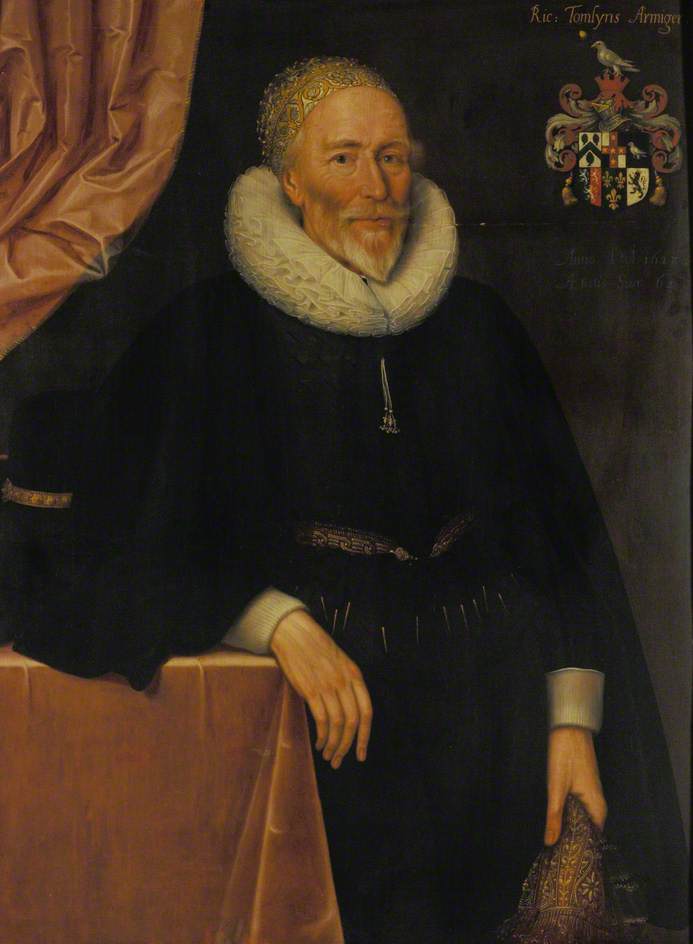
Gheeraerts the Younger, Richard Tomlins, 1628.

7 – Marcus Gheeraerts the Younger, Richard Tomlins, 1628, oil on panel, 111.8 x 83.9 cm. The Bodleian Library, Oxford. It was in the Library in 1759. (Strong 261).

Gheeraerts_Anne_Hale_Mrs_Hoskins

8 – Marcus Gheeraerts the Younger, Anne Hale, Mrs. Hoskins, 1629, oil on panel, 111.8 x 82.7 cm. Jack Hoskins Master, Esq. The painting remains in the family. (Strong 262). 

2. DOCUMENTED AND DATED WORKS (3 works):

Gheeraerts_Barbara_Gamage_with_Six_Children 1596

9 – Marcus Gheeraerts the Younger, Barbara Gamage, Countess of Leicester, and her children, 1596, oil on canvas, 203.2 x 260.3 cm, The Viscount De L’Isle. Always at Penshurst Place near Tonbridge, Kent, 32 miles southeast of London; first recorded 1623. (Strong 263).

Marcus_Gheeraerts_the_Younger_William_2nd_Lord_Petre

10 – Marcus Gheeraerts the Younger, William, 2nd Lord Petre, 1599, oil on panel. 111.8 x 90.2.cm. The Lord Petre; custody of the Essex County Record Office. (Strong 264).

Marcus Gheeraerts the Younger, Katherine Somerset, Lady Petre, 1599.

11 – Marcus Gheeraerts the Younger, Katherine Somerset, Lady Petre, 1599, oil on panel, 111.8 x 90.2 cm. The Lord Petre. Always at Ingatestone Hall, the 16th century manor of the Barons Petre in Essex, England. Queen Elizabeth I spent several nights there in 1561. (Strong 265).

3. INSCRIBED AND DATED WORKS (18 works):

# 12 800px-Marcus_Gheeraerts_II_-_Portrait_of_Mary_Rogers,_Lady_Harington_-_Google_Art_Project

12 – Marcus Gheeraerts the Younger, Unknown Lady (Mary Rogers, Lady Harington), 1593, oil on panel, 114.3 x 94 cm, Tate (purchased 1974). The identity for the sitter is speculative, although her age (23 years old) is inscribed. It is one of the earliest known portraits by Gheeraerts. (Strong 266).

Unknown Lady (Mary Rogers, Lady Harington), 1593

Detail, Unknown Lady (Mary Rogers, Lady Harington), 1593. The sitter is identified in part by the clothes she wears: the distinctive black and white pattern on her dress heralds the Harington coat of arms. The sitter is 23 years old and her portrait may have been painted in connection with a visit to Kelston (The Harington homestead) in 1592 by Queen Elizabeth. The Latin inscription in the painting reads, “I may neither make nor break” a dramatic phrase whose meaning is no longer clear.

Marcus Gheeraerts the Younger, Captain Thomas Lee in Irish Dress, 1594.

13 – Marcus Gheeraerts the Younger, Captain Thomas Lee in Irish Dress, oil on canvas, 1594 (purchased 1980), Tate Britain. (Strong 267). With detail.

Captain Thomas Lee in Irish Dress, 1594.
si francis drake 001 FIXED

14 – Marcus Gheeraerts the Younger, Sir Francis Drake, oil on canvas, 1594. Versions at National Maritime Museum, Greenwich and Lt.- Col. Sir geirge Tapps-Gervis-Meyrick.

Marcus Gheeraerts the Younger, Unknown Man, 1599.

15 – Marcus Gheeraerts the Younger, Unknown Man (Called the Earl of Southampton), 1599, location unknown. (Strong 269).

Marcus Gheeraerts the Younger, Unknown Lady, 1600.

16 – Marcus Gheeraerts the Younger, Unknown Lady, 1600, oil on panel, The Lord Talbot de Malhide. (Strong 270).

Sir Henry Lee by Marcus Gheeraerts Tate Britain, 1600

17 – Marcus Gheeraerts the Younger, Sir Henry Lee, oil on canvas, 1600, private collection on loan since 2008 to Tate Britain.

Sir Henry Lee (1533–1611), a Tudor Court favorite under Elizabeth I, was appointed as Queen’s Champion and Master of the Armoury. In that capacity, Sir Henry organised the annual public Accession Day festivals in honor of the queen. He commissioned the famous Ditchley portrait of Elizabeth I by Gheeraerts for his house at Ditchley in Oxfordshire. In 1597 he was made a Knight of the Garter and in Gheeraerts’s portrait wears that order’s gold chain and bejeweled medal of St George slaying the dragon. (Strong 271).

Sir Henry Lee in Garter Robes, 1602.

One of Gheeraerts II’s finest portraits, Sir Henry Lee is a former man of action, whose old head is remarkably shrewd.

Sir Henry Lee in Garter Robes, 1602 (detail).

18 – Marcus Gheeraerts the Younger, Sir Henry Lee in Garter Robes, 1602, oil on canvas, 216.2 x 137.2 cm. Always at Ditchley until 1933. Today at The Armourers & Brasiers’ Company of the City of London. Founded in 1322, the livery company was awarded its first Royal Charter in 1453 from King Henry VI. In 1708 the Armourers joined with the Brasiers and received its current charter from Queen Anne. (Strong 272).

Marcus Gheeraerts the Younger, Christophe de Harlay, Comte de Beaumont, 1605.

19 – Marcus Gheeraerts the Younger, Christophe de Harlay, Comte de Beaumont, 1605, oil on canvas, The Marquess of Salibury.

The Comte de Beaumont was the French ambassador to England at a time when the Kings of England and France were looking in their own ways for a diplomatic solution to the religious controversies in Europe. The painting was made for Robert Cecil, 1st Earl of Salisbury, a politician who had won James I’s trust. (Strong 273).

Marcus Gheeraerts the Younger, Alexander Seton 1st Earl of Dunfermline, 1606.

20 – Marcus Gheeraerts the Younger, Alexander Seton 1st Earl of Dunfermline, 1606.

Alexander Seton, 1st Earl of Dunfermline (1555–1622), a Scot, was regarded as one of the finest legal minds of his time. Seton served as Lord President of the Court of Session (top judge) from 1593 to 1604, Lord Chancellor of Scotland (top presiding officer of state) from 1604 to 1622 and Lord High Commissioner to the Scottish Parliament. (Strong 274).

Marcus Gheeraerts the Younger, Anne of Denmark, 1614

21 – Marcus Gheeraerts the Younger, Anne of Denmark, 1614, oil on panel, 109.4 x 87.3 cm, Windsor Castle.

At 15 years old, Anne married the future James I of England in 1589. The Queen consort bore James three children who survived infancy, including the future Charles I (reigned 1625-1649). Once fascinated with his bride, observers regularly noted incidents of marital discord between the dour and ambitious James and his independent and self-indulgent wife. Before she died in 1619 the royal couple led mainly separate lives. (Strong 275).

Gheeraerts the Younger, Ulrik, Duke of Schleswig-Holstein, 1614.

22 – Marcus Gheeraerts the Younger, Ulrik, Duke of Schleswig-Holstein, 1614, oil on canvas, 211.2 x 114.3 cm, The Duke of Bedford.

Prince Ulrik of Denmark, (1578–1624) was the second son of King Frederick II of Denmark and his consort, Sophie of Mecklenburg-Güstrow. As second-born Ulrick bore the merely titular rank of Duke of Holstein and Schleswig although he later became Administrator of Schwerin. After his sister Anne became Queen of England, Ulrik was godfather to Princess Mary. (Strong 276).

Gheeraerts the Younger, Sir John Kennedy, 1614.

23 – Marcus Gheeraerts the Younger, Sir John Kennedy, oil on canvas, 1614, The Duke of Bedford.

Upon James I’s accession, Elizabeth Brydges — Maid of Honour of Queen Elizabeth I — married Sir John Kennedy, one of the king’s Scotch attendants. This occurred at Sudeley Manor in Gloucestershire. Chandos appears to have opposed the match, and it was rumored in early 1604 that Sir John Kennedy had a wife living in Scotland. James I wrote to Chandos (February 19, 1603, or 1604) entreating him to overlook Sir John’s errors because of his own love for his attendant. Elizabeth Brydges apparently left her husband and desired to have the matter legally examined. As late as 1609 the legality of the marriage had yet to be decided. Lord Chandos declined to aid his cousin, and Sir John Kennedy’s wife died deserted and in poverty in 1617. (Strong 277).

Gheeraerts the Younger, Catherine Killigrew Lady Jermyn, 1614.

24 – Marcus Gheeraerts the Younger, Catherine Killigrew, Lady Jermyn, 1614, oil on panel, 73.7 x 57.2 cm, Yale Center for British Art. (Strong 278). 

Catherine Killigrew was 35 years old when she sat for this portrait. The wife of an MP as well as the mother of three children, Catherine was the daughter of Sir William Killigrew (d. 1622) who was a courtier to Queen Elizabeth I and to King James I. Her father, Sir William, served as Groom of the Privy Chamber. (Strong 278).

Gheeraerts the Younger, Probably Mary (née Throckmorton), Lady Scudamore, oil on panel, 1615.

25 – Marcus Gheeraerts the Younger, probably Mary (née Throckmorton), Lady Scudamore, oil on panel, 1615, 45 in. x 32 1/2 in. (1143 mm x 826 mm), National Portrait Gallery, London, purchased 1859.

The sitter, once wrongly identified as the Countess of Pembroke, is likely Lady Scudamore though about whom little is known. The portrait is likely for the occasion of her son’s marriage (John, later Viscount Scudamore) to Elizabeth Porter of Dauntsey, Wiltshire. The wreath of flower and inscribed motto ‘No Spring Till now,’ suggest the hope that this marriage must have represented within the family. (Strong 279).

Gheeraerts the Younger, Sir Henry Savile, 1621.

26 – Marcus Gheeraerts the Younger, Sir Henry Savile, 1621, 216.2 x 127 cm, Bodleian Library, Oxford. Gift from the sitter’s widow, 1622.

Sir Henry Savile (1549-1622) was an enterprising Bible scholar. When his qualifications did not meet the standards for the role of Provost of Eton, he had Queen Elizabeth I waive the college’s rules for him. As Warden of Merton — a post secured with the help of influential friends — he was unpopular with faculty and students though the college itself flourished. Sir Henry’s brother was a powerful lawyer who helped guide his brother’s career which included knighthood in 1604. (Strong 280).

Gheeraerts the Younger, Sir Henry Savile, 1621.

27 – Marcus Gheeraerts the Younger, Sir Henry Savile, 1621, oil on canvas, 1621, 203.7 x 122 cm, Eton College. A second smaller copy of the Bible scholar and college administrator. (Strong 281).

Gheeraerts the Younger, William Herbert, Earl of Pembroke, 1628.

28 – Marcus Gheeraerts the Younger, William Herbert, Earl of Pembroke, 1628, oil on panel, 68.5 x 48.2 cm, Philip Yorke.

Under King James I, William Herbert, 3rd Earl of Pembroke (1580 –1630), founded Pembroke College, Oxford, in 1624. In 1623 the First Folio of Shakespeare’s plays was dedicated to him and to Philip Herbert, Earl of Montgomery (the later 4th Earl of Pembroke), his brother. A bookish man, the 3rd Earl of Pembroke was engaged to be married three times. The first engagement was to Elizabeth Carey in 1595. Elizabeth was the granddaughter of the Lord Chamberlain who ran Shakespeare’s company. William simply refused to marry her. In 1597 William was engaged a second time. This time it was to Bridget de Vere. As William found her dowry arrangements to be unsatisfactory, negotiations dragged out to a tiresome point where the match became unacceptable. In 1600 William impregnated a mistress at court whom he  refused to marry. The child was born and died soon after. Following this episode, William and the mistress (Mary Fitton) were barred from court. In 1604 William married Mary Talbot. Their children both died in infancy. At the same time, William was having an extra-marital affair with his cousin, Lady Mary Wroth, which produced two illegitimate children. A lively patron of the arts, William Herbert, 3rd Earl of Pembroke died suddenly in 1630 at 50 years old. He is buried in Salisbury Cathedral in the family vault at the foot of the altar. (Strong 282).

Gheeraerts the Younger, Charles Hoskins, 1629.

29 – Marcus Gheeraerts the Younger, Charles Hoskins, 1629, oil on panel, 66.1 x 52.7 cm, Jack Hoskins Master. Esq. (Strong 283).

Gheeraerts the Younger, Lady in Fancy dress (the Persian Lady), 1590.

30 – Marcus Gheeraerts the Younger, Lady in Fancy Dress (The Persian Lady), 1590s, oil on panel, 216.5 x 135.3 cm, Hampton Court.

First recorded in the collection of Queen Anne but believed to be part of the Royal Collection before that time, in the cartouche the sonnet reads: “The restless swallow fits my restless minde, Instill revivinge still renewinge wronges; her Just complaintes of cruelty unkinde, are all the Musique, that my life prolonges. With pensive thoughtes my weeping Stagg I crowne whose Melancholy teares my cares Expresse; hes Teares in sylence, and my sighes unknowne are all the physicke that my harmes redresse. My only hope was in this goodly tree, which I did plant in love bringe up in care: but all in vaine, for now to late I see the shales be mine, the kernels others are. My Musique may be plaintes, my physique teares If this be all the fruite my love tree beares.” Lady in Fancy Dress is a good example of Elizabethan allegorical portraiture. Importantly, the painting may be related to the Ditchley portrait of Elizabeth I (Strong 285) as well as the portrait of Captain Thomas Lee (Strong 267 ). These three portraits may be connected in some way to the entertainment given by Sir Henry Lee, the Queen’s Master of the Armouries and Champion of the Tilt, when the Queen visited Ditchley in 1592. (Strong 284).

NPG 2561; Queen Elizabeth I ('The Ditchley portrait') by Marcus Gheeraerts the Younger

31 – Marcus Gheeraerts the Younger, Queen Elizabeth I (“The Ditchley Portrait”), oil on canvas, 1592, 95 in. x 60 in. (2413 mm x 1524 mm). National Portrait Gallery, London. Bequeathed by Harold Lee-Dillon, 17th Viscount Dillon, 1932. Queen Elizabeth was nearly 60 years old when this portrait was made. It is traditionally understood to have been painted on the Queen’s visit to Ditchley, the timber-framed family house in north Oxfordshire of Sir Henry Lee (1533-1611). Like John II Walshe (d.1546/7) of Little Sodbury, Gloucestershire, who was the King’s Champion to Elizabeth’s father Henry VIII, Henry Lee served at that standard for Queen Elizabeth from 1570 until his retirement about two years before this painting was made.  Ditchley once provided lodging and access to the royal hunting ground of Wychwood Forest.  (Strong 285). 

ditchley a-elizdetail-1g

Queen Elizabeth I is standing on a map of England. Detail from The Ditchley Portrait of Elizabeth I by Marcus Gheeraerts the Younger in 1592.

ditchley detail fan

Detail of a bejeweled fan in Queen Elizabeth I’s right hand from The Ditchley Portrait of 1592 by Marcus Gheeraerts the Younger. In the decade before The Ditchley Portrait Gheeraerts the Elder, Marcus II’s father, had painted a full- length oil on panel portrait of Elizabeth I. In the ensuing handful of years, practical technical innovation in art is in evidence in the Elizabethan court — the the son’s oil portrait of the same royal personage was able to be produced on canvas on a much larger scale.   

ditchley.detail
ditchley

Detail of the beautiful garment and accessories.

ditchley 800px-queen_elizabeth_i_the_ditchley_portrait_by_marcus_gheeraerts_the_younger

Detail, Queen Elizabeth I. Ditchley portrait. Three fragmentary Latin inscriptions in the painting have been interpreted as: “She gives and does not expect”; “She can, but does not take revenge”; and, “In giving back, she increases.” An inscribed sonnet, whose author is not known, takes the sun as its subject. At some later date the canvas was cut more than 7 centimeters fragmenting the final words of the each line. 

The King’s Champion and the Outlaw: How Sir John Walshe’s Little Sodbury Manor Shielded the English Bible

Sir John II Walshe (d. 1546/7) was a prominent English landowner, courtier, and high-ranking local official based at Little Sodbury Manor in Gloucestershire. He is most famous historically for his close connection to King Henry VIII and his early patronage of the famous Bible translator and Catholic priest, William Tyndale. Sir John was a major favorite of the young King Henry VIII and was chosen to serve as the King’s Champion at Henry’s coronation in 1509. Because of his standing, Henry VIII and Queen Anne Boleyn stayed with Walshe at Little Sodbury Manor for two nights during the King’s Second Royal Progress on August 21, 1535. Walshe was a dominant political figure in the county, serving multiple terms as the High Sheriff of Gloucestershire (in 1526, 1530, 1535, and 1540).

Around 1521–22, Sir John Walshe hired a young William Tyndale to serve as the private tutor for his children and as the manor’s chaplain. Walshe frequently hosted local abbots, deacons, and wealthy clergymen at his dining table. Tyndale famously used these dinners to debate the local Catholic elite using scripture, which frequently troubled Walshe and his wife, Lady Anne. Since the Constitutions of Oxford in 1408, the Catholic Church had strictly banned translation of the Bible into the vernacular, fearing it would undermine theology and their authority, breeding social chaos. By translating directly from the original Greek and Hebrew (rather than the Church’s official Latin Vulgate), Tyndale was committing a capital crime. Historical tradition holds that Tyndale began his monumental work translating the Bible from Greek into English right in his bedroom at Walshe’s manor before church hostility forced him to flee to London in 1523.

Words matter, and Tyndale’s choices stirred controversy—as they actively dismantled institutional power structures. Catholic officials—most notably Sir Thomas More—charged that Tyndale used language that fueled already rampant anti-clericalism in England. For example, Tyndale translated Church as “Congregation,” shifting power from the Vatican hierarchy to local people. He also translated Do Penance to “Repentance,” cutting out the need for the Catholic sacramental system of confession. It was during his time living under Walshe’s roof that Tyndale had his historic argument with a local priest and declared: “If God spare my life, ere many years I will cause a boy that driveth the plow shall know more of the scripture than thou dost.” Sir John died around 1546 or 1547, passing the manor down to his son and heir, Maurice Walshe.

unknown artist; William Tyndale (c.1492-1536), Translator of the New Testament and the Pentateuch; Hertford College, University of Oxford; http://www.artuk.org/artworks/william-tyndale-c-14921536-translator-of-the-new-testament-and-the-pentateuch-222112 also: NPG 1592; Called William Tyndale – Portrait – National Portrait Gallery

Tyndale’s fate was far more complex. In 1528, he published The Obedience of a Christian Man, arguing that a king should answer directly to God rather than the Pope. King Henry VIII famously loved the book because it gave him a legal rationale to break away from Rome. However, in 1530, Tyndale published The Practice of Prelates, where he fiercely opposed Henry VIII’s attempt to annul his marriage to Catherine of Aragon. This instantly turned Tyndale into an enemy of the English Crown; Henry VIII declared him a traitor, banned his books, and actively hunted him down. Tyndale spent years in exile, smuggling thousands of English New Testaments into the hands of ordinary folk in England. In 1535, he was betrayed in Antwerp and spent over a year in a Brussels dungeon at Vilvoorde Castle for his religious activities.

Meanwhile, John Walshe’s role was that of a benevolent, high-status buffer. Rather than throwing Tyndale to the wolves, Walshe acted as a protective patron. He and Tyndale mutually agreed that Tyndale must leave Little Sodbury. Walshe gave Tyndale his blessing, provided him with travel funds, and wrote him letters of introduction to influential contacts in London. Even after Tyndale fled England, became an outlaw, and infuriated the King, Walshe’s loyalty did not vanish. Records indicate that both Sir John and Lady Anne Walshe were personally deeply moved by Tyndale’s theology—though made uncomfortable around powerfully connected Catholic guests—so that when Tyndale was in a dungeon near Brussels, they sent funds to support him and made behind-the-scenes diplomatic efforts to secure his release.

Ultimately, Tyndale was executed by Catholic forces in Brussels a little over a year after Thomas More and John Fisher were beheaded in London by Henry VIII. Tyndale’s execution was particularly brutal. First, since he was found guilty of heresy, he was excommunicated. Because he was an ordained priest, he was dressed in his formal vestments and mocked as the executors of 16th-century justice ripped them away, subsequently scraping the holy oil off his hands and fingers to connote that he could no longer say Mass. Tyndale was then tied to a stake and strangled to death by the hangman, who then burned his body. While Sir John Walshe’s status as King’s Champion had bought Tyndale a safe, early window of time to conceptualize his English translation, and gave him the launchpad to take his prohibited, dangerous work to the global stage, Tyndale’s famous last words were a prayer aimed directly at the monarchy: “Lord, open the King of England’s eyes.” Ironically—as is typical when it comes to Henry VIII and power mongers generally—within just three years of his execution, Henry VIII officially authorized the Great Bible to be printed in English and placed in every parish, using Tyndale’s exact work as its foundational core.

Although no painting preserves Walshe’s face, his legacy is preserved through the architecture of Little Sodbury Manor. The grand 15th-century manor house, its Great Hall where the dinner debates took place, and the room traditionally identified as Tyndale’s library still stand intact in Gloucestershire today.


Marcus Gheeraerts the Younger, Sir Henry Lee, 1590s.

32 – Marcus Gheeraerts the Younger, Sir Henry Lee, 1590s, oil on canvas, 117 x 86.4 cm, The Ditchley Foundation. Always at Ditchley.

The painting and inscribed verses memoralize an incident where Bevis – Lee’s dog – saved his master’s life. “More faithfull then favoured…” (Strong 286).

Michael Dormer, mid 1590s.

33 – Marcus Gheeraerts the Younger, Michael Dormer, mid 1590s, oil on canvas, 122 x 91.5 cm, J.C. H. Dunlop, Esq. There are Latin inscriptions which surround and are written across the globe and shield. (Strong 287).

The social and cultural world of Sir Henry Lee once again influences the young artist’s portrait of Michael Dormer, who was an Oxfordshire neighbor to Sir Henry. In Dormer’s three-quarter-length portrait, the right hand is posed similarly to Thomas Lee’s portrait. As Captain lee’s portrait is the centerpiece of this post’s explorations,it may be said with Michael Dormer’s this post has traveled full circle around Marcus Gheeraerts II’s verifiable portraiture in Elizabethan and Jacobean England.

Conclusion


Here then concludes the complete collection of Marcus Gheeraerts the Younger’s signed and dated works (Strong 255-262); inscribed and dated works (Strong 266-283); and, inscribed and undated works (Strong 284-287). Not included here are works dated and attributed to the artist (Strong 288-294) and attributed and undated (Strong 295-313). The last group includes several well-known portraits including William Cecil, Lord Burghley, c. 1595, in the National Portrait Gallery (Strong 295) and Robert Devereux, 2nd Earl of Essex, c. 1596, in collection of the Duke of Bedford. (Strong 300).

CAPTION NOTES:

Strong 255 – Hearn, Karen, Marcus Gheeraerts II, Elizabethan Artist (In Focus series), Tate Publishing, 2002, p. 29.

Strong 264 and 265 – http://www.ingatestonehall.com/

Strong 266- http://www.tate.org.uk/art/artworks/gheeraerts-portrait-of-mary-rogers-lady-harington-t01872

Strong 271- http://www.tate.org.uk/art/artworks/gheeraerts-sir-henry-lee-l02883

Strong 272- http://www.armourershall.co.uk/armourers-hall

Strong 277 – http://www.tudorplace.com.ar/BRYDGES.htm#Catherine BRYDGES (C. Bedford)

Strong 278- http://collections.britishart.yale.edu/vufind/Record/1669266

Strong 279 – http://www.npg.org.uk/collections/search/portrait/mw05683/Probably-Mary-ne-Throckmorton-Lady-Scudamore#sitter

Strong 280 – https://artuk.org/discover/artworks/sir-henry-savile-15491622-228559/search/actor:gheeraerts-the-younger-marcus-1561156216351636/view_as/list/page/2;  White, Henry Julian (1906). Merton College, Oxford. pp. 93–94; http://www.historyofparliamentonline.org/volume/1558-1603/member/savile-henry-ii-1549-1622; https://www.oxforduniversityimages.com/results.asp?image=BOD000038-01; https://en.wikipedia.org/wiki/Henry_Savile_(Bible_translator)

Strong 282 – https://en.wikipedia.org/wiki/William_Herbert,_3rd_Earl_of_Pembroke

Strong 284 – https://www.royalcollection.org.uk/collection/406024/portrait-of-an-unknown-woman; https://en.wikipedia.org/wiki/Artists_of_the_Tudor_court; http://www.tate.org.uk/art/artworks/gheeraerts-portrait-of-captain-thomas-lee-t03028; https://en.wikipedia.org/wiki/Thomas_Lee_(army_captain); https://commons.wikimedia.org/wiki/User:PKM/icon4

STRONG 285 – John II Walshe (d.1546/7) of Little Sodbury, Gloucestershire, was King’s Champion at the coronation of Henry VIII in 1509 and was a great favorite of the young king’s. Transactions of the Bristol & Gloucestershire Archaeological Society, Vol.13, 188/9, pp. 1–5, Little Sodbury”. Bgas.org.uk. Archived from the original on March 16, 2012. Retrieved 2012-03-19; Sir H Lee – Butler, Katherine (2015). Music in Elizabethan Court Politics. Woodbridge: Boydell and Brewer. pp. 129–42. ISBN 9781843839811.; Ditchley once provided lodging and access to the royal hunting ground of Wychwood Forest. – timber-framed family house in classic north Oxfordshire wooded farmland, – https://web.archive.org/web/20070404233018/http://www.ditchley.co.uk/page/37/ditchley-park.htm; Inscriptions – http://www.npg.org.uk/collections/search/portrait/mw02079/Queen-Elizabeth-I-The-Ditchley-portrait#description; http://npg.si.edu/exhibit/britons/briton1.htm; Hearn, Karen, Marcus Gheeraerts II, Elizabethan Artist (In Focus series), Tate Publishing, 2002, p. 31.

STRONG 287 – Hearn, Karen, Marcus Gheeraerts II, Elizabethan Artist (In Focus series), Tate Publishing, 2002, p. 24.

The Gilded Brush: John Singer Sargent’s Early Portraits of the 1870s & 1880s.

FEATURE image: Margaret Stuyvesant Rutherfurd White (Mrs. Henry White), 1883, oil on canvas, 225.1 × 143.8 cm (88 5/8 × 56 5/8 in.), National Gallery of Art, Washington, D.C. from Corcoran Collection, 2014.

The formative years and professional evolution of American expatriate painter John Singer Sargent during the 1870s and 1880s, tracing how his work progressed from intimate studies of family and friends into high-society commissions that defined Gilded Age portraiture. The post captures the crucial creative window where Sargent’s expanding elite social network catalyzed his rise to prominence, culminating in some of his most legendary and controversial masterpieces.


By John P. Walsh

The art works by John Singer Sargent (1856-1925) in this post are ones in oil, watercolor, and pastel. They begin to present Sargent’s professional output during his formative years in France, England and his trips to the United States.

While Sargent’s early portrait subjects range from famous people such as writer Robert Louis Stevenson (1850-1894) and actress Ellen Terry (1847-1928) in her role as Lady Macbeth, Sargent’s first portraits were mostly of family and friends. These included artists, writers, musicians, and some of the artist’s romantic interests.

Sargent’s artistic practice developed within a swiftly expanding social circle of prominent American expatriates and Europeans which included portrait commissions from business, military, legal and medical practitioners. His portrait work extended to their wives and children. It was during this creative period that Sargent painted his well-known group portrait The Daughters of Edward D. Boit (1882) and the portrait of an exotic and controversial Madame X  (Mme. Virginie Amélie Avegno Gautreau).  

Each of the following art works are identified and described with a brief caption. These include the art work’s title (usually a sitter’s name), date created, and dimensions, markings and location, when known. Further, it often discusses how the sitter knew Sargent and the historical context of the art work including some of its particular provenance and exhibition history.

The survey covers Sargent’s diverse early outputs in oil, watercolor, and pastel during his foundational years traveling between France, England, and the United States.

1fixed

Violet Sargent, c. 1875, oil on panel, 27.7 x 23.5 cm (10 ½ x 9 ¼ in.), private collection. Originally inscribed across the top “Violet” but removed in a later cleaning. The sitter was the artist’s youngest sister (1870-1955).

2fixed

Resting, c. 1875, oil on canvas, 8½ x 10 9/16 in. (21.6 x 26.8 cm), inscribed upper right: John S. Sargent, Sterling and Francine Clark Art Institute, Williamstown, Massachusetts. Informal pose and setting, bold treatment of light, this is one of the artist’s early outdoor works. The identity of the sitter is unknown.

3-john_singer_sargent_emily_sargent_pleasantsfixed

Mrs. Emily Sargent Pleasants, c. 1876, oil on canvas, 55.8 x 40.6 cm (22 x 16 inches), private collection. The artist’s aunt (his father’s sister). Dr. Pleasants (Emily’s husband) visited the artist’s family in France in 1875, but it is not known if she came along. The next year the 20-year-old American artist, born in Florence, Italy,  visited the United States for the first time and went to the Pleasants home in Radnor, Pennsylvania. The high-backed rocking chair in the painting points to this portrait being done there.

The O’Meara Love Triangle: Sargent painted a portrait of his classmate Frank O’Meara specifically so O’Meara could give it to a girl during a summer romance; the girl eventually returned home and married someone else.

5fixed

Frank O’Meara, c. 1876, oil on canvas, 44.5 x 39.5 cm (17½ x 15½ inches), inscribed upper left: John S. Sargent. Inscribed upper right:1875. Typewritten label on reverse signed by Austin Strong, 14/5/1931, The Century Association, New York. O’Meara was an “impecunious and dreamy” Irish art student with Sargent in Carolus-Duran’s atelier. Sargent painted it for O’Meara to give to an American girl during a summer romance. Then Isobel Osbourne (1858-1953) returned home and married somebody else.

The Posthumous Commission: For the portrait of Mrs. Charles Deering, Sargent agreed to a tragic request by a grieving widower to paint a posthumous image of his wife after she died in childbirth.

7fixed

Mrs. Charles Deering, c.1877, oil on canvas, 55.8 x 43.2 cm (22 x 17 in.), Rhode Island School of Design. The family of Annie Rogers Case (1848-1876) met the Sargents in Florence in the 1860s. Her father (“the Admiral”) owned a Sargent Salon picture and dined with them on Christmas Day 1874. In 1876 JSS visited with the Deerings at Newport, Rhode Island,  but did not paint Annie’s portrait. Mrs. Deering died the next year in childbirth. In the Sargent-Deering letters preserved at Chicago the artist agreed to the widower’s request to paint a posthumous work of his wife.

8-fixed-dsc_0533

Violet Sargent, 1877, oil on canvas, 34.9 x 25.4 cm (13 3/4 x 10 in), inscribed upper right: Violet 17th May 1877/7 years old. Location unknown. Sargent’s younger sister, the later Mrs. Frances Ormond. It had been owned by French Academic painter Auguste-Alexandre Hirsch (1833 -1911).

9-dsc_0534

Harriet Louise Warren, 1877, oil on panel, 26.7 x 21 cm (10 1/2 x 8 1/4 in), inscribed lower right: JSS/Jan 18 1877. Private collection. Harriet Louise Warren (1854-1919) and Sargent were early friends. Later, in 1890, the artist painted her daughter, Beatrice.

Inseparable Siblings: His sister Emily, a naturally cheerful watercolorist born just a year after him, traveled roamed Europe and America constantly by his side.

11

Emily Sargent, c.1877, oil on canvas, 31.1 x 22.9 cm (12 ¼ x 9 in.), private collection. Six siblings comprised the FitzWilliam and Mary Newbold Singer Sargent family. John was the second oldest and only boy. Of his five sisters only two lived to adulthood. This is JSS’s sister Emily (1857-1936) born one year after him. About 20 years old in this painting, the two were inseparable at home and roamed Europe and America together. Emily was a watercolorist and naturally cheerful.

12-eugene-juillerat

Eugène Juillerat, c. 1877-78, oil on canvas, 40.6 x 31.1 (16 x 12 ¼ in.), inscribed upper right: à mon ami Juillerat/J.S. Sargent. Inscribed on label on back by sitter on April 19, 1927. Private collection. Juillerat and Sargent were the same age and both studied under Carolus-Duran in Paris. Juillerat was an award-winning lithographer and sculptor receiving medals at the Salons of 1895 and 1899 and at the Exposition Universelle in 1900.

13-head-of-an-italian-girl

Head of an Italian Girl, 1878, oil on canvas, 45.7 x 38.1 (18 x 15 in.), Inscribed upper center: To my cousin Kitty Austin/ John S. Sargent; upper left: 1878. The Sargents had roots in New England yet resettled in Philadelphia where JSS’s father was a surgeon and married JSS’s mother. With the death of their firstborn, the Sargents left for Europe and stayed. JSS was born in Italy in 1856. He first visited the U.S.A. at 20 years old. This painting’s whereabouts and sitter’s identity are unknown.

14-mary-turner-austin

Mary Turner Austin, oil on canvas, 45.7 x 38.1 (18 x 15 in.), Inscribed upper left: to my friend, Mary, John S. Sargent. The Christopher Whittle Collection. The Austins, like the Sargents, were American expats in Europe. Dr. Sargent mentions the Austins in correspondence and writes that the girls are “quite attractive.” Mary was an art student. Chicago artist J.C. Beckwith at dinner with the Sargents hoped to see “the pretty Miss Austin.” French artist Auguste Hirsch owned this portrait.

15-head-of-an-italian-womanfixed

Head of an Italian Woman, c. 1878-1881, oil on canvas, 45.7 x 38.1 (18 x 15 in.), Inscribed upper right: J. S. Sargent. The Arkell Museum, Canajoharie, New York. Gift of Bartlett Arkell. Hair piled at the nape of the neck is a typical mid1870s woman’s hairstyle, though the dress is less fashionable. The model may be a Sargent cousin – a later Mrs. Wurts – who owned this picture in 1926.

15-1958-21-fixed

Portrait Sketch c. 1910, graphite on thin, slightly textured off-white laid paper (tissue) 10 x 9.1 cm (3 15/16 x 3 9/16 in.). Gift of Mrs. Francis Henry Taylor, The Worcester Art Museum, Worcester, Massachusetts. Dated c.1910, this drawing had been only recently identified as the same model as “Head of an Italian Woman” painted by Sargent sometime between 1878 and 1881 and today in the Arkell Museum.

16-john_singer_sargent_-_carmela_bertagna_c-_1880

Carmela Bertagna, c.1879, oil on canvas, 59.7 x 49.5 (23.5 x 19.5 in.), inscribed upper L: à mon ami Poirson; upper R: John S. Sargent; lower L: Carmela Bertagna/rue du/16 Maine. Bequest F.W. Schumacher. The picture’s history is muddled by the sitter’s questioned identity (a professional model, possibly Carmela B.), its stylistic clues (no later than 1880), diverse inscriptions (to later friends) and exactly from whom it was acquired before it was given to the Columbus Museum of Fine Arts.

Unhappy Clients: Sargent’s studio and speed sometimes caused friction. Boston lawyer Henry St. John Smith visited the studio and openly disliked it, requiring mutual friends to intervene. Meanwhile, Mme. François Buloz openly complained that her portrait was painted in such a haste that it made her look ten years older than she actually was.

17-madame-francois-buloz-1879fixed

Mme. François Buloz, 1879, oil on canvas, 54 x 46.2 cm (21.25 x 18.25 in.), Inscribed lower L: à mon amie Me Buloz/John S. Sargent/Ronjoux 1879, Los Angeles County Museum of Art. Mme. Buloz was from a family of writers and musicians. In summer 1879, Sargent was in the Savoy to paint her daughter Marie’s full length portrait for her marriage. Madame complained that this portrait, painted in haste, made her look ten years older than she was.

18-fix

Marie-Louise Pailleron, 1879, 38.7 x 45.1 cm (15.25 x 17.75 in.), Inscribed, upper R: à ma petite amie Marie-Louise/John S. Sargent 1880, private collection. Daughter of Marie (Buloz) and Edward Pailleron, Sargent’s first important patrons. Two years after this portrait, Marie-Louise (1870-1950) was the subject of an important double portrait with her brother Edouard.

19-fixed-dsc_0879

Marie-Louise Pailleron, 1879, watercolor on paper? Dimensions? Untraced. Sargent did other wash drawings of Marie-Louise that are better documented. The head on the left has a halo or other decorative design. This image is taken from a photograph the sitter made available in 1948 when the sketch was in her house at Ronjoux.

The Interrupted Romance of Fanny Watts: Described by his father as his “first serious work,” this Salon painting was an attempt to reminisce about their romance, which had been explicitly “nixed” by Sargent’s mother.

20-frances_sherborne_fanny_ridley_watts-largefixed

Fanny Watts, 1877, oil on canvas, 105.7 x 83.5 cm (41.5/8 x 32.7/8 in.), inscribed upper R: John S. Sargent. Philadelphia Museum of Art. Following money reverses in the U.S., Fanny’s New York family traveled to Nice and Florence in the 1860s and met the Sargents. The young Sargent and Fanny began a romance in 1876 that was nixed by Mrs. Sargent. The portrait is the artist’s attempt to reminisce about their time together. Dr. Sargent thought this portrait was his son’s “first serious work” and had it shown at the Salon. Fanny and the artist stayed lifelong friends.

21fixed

Carolus-Duran, 1879, oil on canvas, 116.8 x 95.9 cm (46 x 37 3/4 in.), inscribed upper R: à mon cher maître M. Carolus Duran, sur élève affectioné/John S. Sargent 1879. Clark Art Institute, Massachusetts. Teacher and portrait painter Carolus-Duran (1838-1917) had a profound influence on JSS’s artistic practice in the mid to late 1870s. The sitter wears a red ribbon of the Légion d’honneur in his buttonhole. It was Sargent’s second portrait exhibited at the Salon and this painting received critical praise in Europe and America.

The First Major Patron: Famed poet and playwright Edouard Pailleron was Sargent’s very first major patron, though how the unknown 23-year-old met him remains a mystery.

24

Edouard Pailleron, 1879, oil on canvas, 127 x 94 cm (50 x 37 in.), Inscribed lower L: John S. Sargent. Musée d’Orsay. Edouard Pailleron (1834-99) was JSS’s first major patron. How the 45-year-old famed poet and playwright met the unknown 23-year-old painter is a mystery. One impetus may be the favored portrait of Carolus-Duran at the Salon of 1879. This casually posed portrait of studied bohemianism was painted in Paris in  summer 1879 and soon paired with one of Mme. Pailleron.

Fashion Controversies: Critics at the 1880 Salon heavily mocked his first full-length portrait (Madame Edouard Pailleron), remarking that her black satin dress looked completely bizarre and out of place in an outdoor garden setting.

25-madame-edouard-pailleron-1879fixed

Madame Edouard Pailleron, 1879, oil on canvas, 208.3 x 100.3 cm (82 x 39.5 in.), Inscribed lower R: John S. Sargent/Ronjoux 1879. National Gallery of Art, Washington D.C. Sargent’s first full length portrait depicts Mme. Pailleron (1840-1913). It was painted at her parents’ house at Chambéry in the Savoy. She posed at the entrance to the allée des Tilleuls with house and garden behind. At the Salon of 1880 critics remarked that the black satin dress was out of place in an outdoor setting.

Madame Edouard Pailleron, 1879, study. The painting was Sargent’s first full length portrait.

The Watershed Salon of 1879: This exhibition was the ultimate turning point for Sargent’s career, directly yielding six distinct portrait commissions in Paris right as he was described by some as “practically starving”.

26-john_singer_sargent_-_robert_de_cevrieuxfixed

Robert de Cévrieux, 1879, oil on canvas, 84.5 x 48 cm (33.25 x 18.875 in.), inscribed lower L: John S. Sargent, 1879. Museum of Fine Arts, Boston. The Salon of 1879 was a watershed for JSS’s artistic career. Out of it came six portrait commissions in Paris including presumably this 6-year-old and his terrier. Carolus-Duran, by now JSS’s former teacher, painted children holding pets which were exhibited in mid1870s Salons. The child wears a velvet suit with no pant legs and matching jacket.

27-portrait-of-jeanne-kieffer-1879fixed

Jeanne Kieffer, 1879, oil on canvas, 43.2 x 35.6 cm (17 x 14 in.), inscribed upper right: John S. Sargent 1879. Private collection. By his early 20s some saw Sargent as an artist of “great talent and a real future.” He was also described as “practically starving.” This portrait of a 7-year-old sitter is quirky for the direct frontal pose and that the pink dress was an afterthought. The artist had originally painted her in a black velvet dress.

The Going Rate: For standard portraits of connected professionals (like well-connected soldier Le Vicomte de Saint-Périer and Boston lawyer Henry St. John Smith), Sargent commanded 1,500 francs, which was equivalent to a typical French worker’s entire annual wage.

29-john_singer_sargent_vicomte_saint_perierfixed

Le Vicomte de Saint-Périer, 1879, oil on canvas, 61 x 50.5 cm (24 x 19.875 in.), inscribed upper L: John S. Sargent. Musée d’Orsay. Sargent was paid 1,500 francs – a typical French worker’s annual wages – for this portrait of a well-connected professional soldier. The expressive realism of the head recalls his recent portraits of Edouard Pailleron and Carolus-Duran.

30-john_singer_sargent_henry_john_smith-2new-clean-fixed

Henry St. John Smith, 1880, oil on canvas, 62.2 x 49.5 cm (24.5 x 19.5 in.), inscribed upper R: John S. Sargent 1880. Portland Museum of Art, Maine. Boston lawyer Henry St. John Smith (1852-1896) graduated from Harvard in 1872 and went to Europe virtually annually. In 1880 he was an eligible bachelor. Smith saw Sargent’s studio in Paris and didn’t like it. Friends Augustus Jay and Boston artist Francis Brooks Chadwick intervened and the result is this head-and-shoulders portrait that earned Sargent a commission of 1,500 francs.

32fixed

Peter Augustus Jay, 1880, oil on canvas, 45.8 x 37.5 cm (18 x 14.75 in.), inscribed upper L: John S. Sargent 1880. Private collection. The future U.S. Ambassador to Argentina is painted when he was a 3-year-old with golden shoulder-length hair and dressed in a bibbed white blouse. It was when Henry St. John Smith was with the boy’s father Augustus “Gussie” Jay at Sargent’s Paris studio when St. John Smith was having his portrait painted that the commission for the child’s portrait probably originated.

33fixed-john_singer_sargent_eleanor_jay_chapmandraft-2clean

Eleanor Jay Chapman, c.1881, oil on canvas, 43.8 x 53.3 cm (17.25 x 21 in.), inscribed upper L: John S. Sargent. Private collection. In 1881, Eleanor Jay Chapman was the 16-year-old daughter of a stockbroker. Through her mother, she was a descendant of John Jay, first Chief Justice of the U.S. Eleanor and her younger sister Beatrix had their portraits painted by Sargent in Paris (Beatrix’s was later destroyed). There is no evidence for how the Chapmans met Sargent, but it happened before her father’s financial collapse in 1882.

34-dsc_0876-3draftcleanfixed

Edward Burckhardt, 1880, oil on canvas, 55.2.x 46.4 cm (21.75 x 18.25 in.), inscribed lower L: To my friend Valerie/John S. Sargent Paris June 1880. Private collection. Sargent was an intimate friend of Swiss businessman Edward Burckhardt (1815-1903) and his American wife and their family. The portrait, painted in Paris in May 1880, has inspired little positive critical commentary.

Destroyed by Fire: Companion portraits of Boston’s James Lawrence and his new wife Caroline Estelle Mudge were completely lost to history when they were destroyed in a house fire in Hingham, Massachusetts, in 1939.

36-john_singer_sargent_mrs_james_lawrence-new-fixed

Mrs. James Lawrence, oil on canvas, 61 x 45.7 cm (24 x 18 in.), inscribed upper R: John S. Sargent 1881. Sargent painted companion portraits of Boston’s James Lawrence (1853-1914) and his new wife Caroline Estelle Mudge (1850-1920). Neither portrait has survived. Both were destroyed by fire in Hingham, Massachusetts, in 1939. In 1888 it was noted that the sitter wore a black dress in front of a red background.

The Torturous 83 Sittings: For The Pailleron Children double portrait, the 10-year-old Marie-Louise was so uncooperative and exasperated by Sargent making her wear her hair “up” that his teacher, Carolus-Duran, had to step in to calm her down across 83 separate sittings.

37-edouard-and-marie-louise-pailleron-1881-fixed

The Pailleron Children, 1881, oil on canvas, 152.4 x 175.3 cm (60 x 69 in.), upper right: John S. Sargent. Des Moines Art Center. Édouard (b.1865) and Marie-Louise (b.1870) are children of Sargent’s first patron. Seated on a bench, the boy is dressed in a suit with an Eton collar and silk bow tie and the girl, hair up, is wearing a satin dress with lace trim. Carolus-Duran had to calm Marie-Louise to cooperate for a double portrait that required 83 sittings done in Sargent’s studio. It was exhibited at the Salon of 1881.

38-fixed-john_singer_sargent_marie_louise_pailleron

Marie-Louise Pailleron, c.1881, watercolor, 27 x 20 cm (10.625 x 7.875 in.). Private collection. Aside from a couple of dabs of blue, the portrait is executed nearly in one color, that is, en grisaille. Marie-Louise wears her hair “down” unlike in the formal portrait with her older brother done at the same time where the 10-year-old was exasperated by the artist’s insistence that she wear her hair “up.”

39-a-john_singer_sargent_marie_louise_pailleronfixed

Marie-Louise Pailleron, c.1881, pen, ink and wash on paper, 23.2 x 18.1 cm (9.125 x 7.125 in.), Metropolitan Museum of Art, New York. A second monochrome facial study of 10-year-old Marie-Louise by JSS. The work has a playful aspect in that the paper’s back side (or verso) has a child’s drawing of a house.

His portrait practice grew within a expanding network of prominent American expatriates and Europeans. This network brought in commissions from professionals in business, the military, law, and medicine, as well as their wives and children.

40-dr_pozzi_at_homefixed

Dr. Pozzi (or Dr. Pozzi at Home), 1881. Oil on canvas, 204.5 x 111.4 cm (80 ½ x 43 7/8 in.). Inscribed upper right: John S. Sargent 1881. UCLA at the Armand Hammer Museum of Art and Cultural Center, Los Angeles.

Below: Detail of left hand, Dr. Pozzi, 1881.

40-bfixed

42-dsc_0533-3

Madame Ramón Subercaseaux, c. 1881, sepia wash, 22.2 x 32.4 cm (12 ¾ x 8 ¾ in.), inscribed, lower right: John S. Sargent. Private collection. This is not a study for the painting below but a derivation from it. The artist made it for the painting’s reproduction in the Salon catalog.

41-madame-ramon-subercaseaux

Madame Ramón Subercaseaux, c. 1880-81, oil on canvas, 165.1 x 109.9 cm (65 x 43 ¼ in.). Inscribed, lower right: John S. Sargent. Private collection.

43-portrait-of-mrs-john-joseph-townsend-catherine-rebecca-bronson-1881

Mrs. John Joseph Townsend, 1881, oil on canvas, 124.5 x 83.8 cm (49 x 33 in.). Inscribed, upper right: John S. Sargent Paris 1881. Location unknown. Catherine Rebecca Bronson (1833-1926) was from a family of U.S. politicians and married a New York businessman. The Bronsons were part of the American expatriate community in Florence and Venice with the Sargents. This is Sargent’s first portrait of the old family friend. She sits on a low couch, right elbow on pillows and holds a swan’s-down fan.

44-dsc_0535fixed

Mrs. John Joseph Townsend, c. 1882, oil on canvas, 69.9 x 56.5 cm (27½ x 22¼ in.). Inscribed, upper left: to my dear friend Mrs Townsend/John S. Sargent. Location unknown.

45-dsc_0536fixed

John Joseph Townsend, 1882, oil on canvas, 128.9 x 86.4 cm (50 ¾ x 34 in.). Incribed, upper right: John S. Sargent/Paris 1882. Private collection. Mr. Townsend (1825-1889) was a New York lawyer who served in the State Assembly. A Columbia University trustee and Union Club president, he married Catherine Bronson, a Sargent family friend, in 1854.

The Tragedy of Beatrice Townsend: Painted as a vibrant teenager holding a dog, Beatrice tragically died just two years later from peritonitis.

46-john_singer_sargent_-_miss_beatrice_townsend

Beatrice Townsend, c. 1882, oil on canvas, 81.9 x 58.4 cm (32 ¼ x 23 in.). Inscribed, upper center: to my friend/Mrs. Townsend/John S. Sargent. National Gallery of Art, Washington, D.C. (Mellon Collection). (Eleanor) Beatrice Townsend (1870-1884), born in New York, was the sixth of seven children of Mr. and Mrs. Townsend. The teenager died tragically of peritonitis, an abdominal disease in 1884.

47-mr-and-mrs-john-w-field-1882

Mr. and Mrs. John Field, 1882, oil on canvas, 111.8 x 82.5 cm (44 x 32½ in.). Inscribed, upper right: John S. Sargent, Paris 1882. Pennsylvania Academy of Fine Arts, Philadelphia. Gilbert Stuart painted the father of Mrs. Field (Eliza Willing Spring Peters, 1820-1897) and she was painted by Thomas Sully in 1841– and now by Sargent. European travel led Mr. Field (1815-1887), a trader, into art collecting. In a June 1882 letter, British writer Vernon Lee noted that it was the Fields (or possibly the Townsends) who were nonstop talkers.

48-isabel-valle-1882

Isabel Vallé, 1882, oil on canvas, 132.1 x 81.3 cm (52 x 32 in.). Inscribed, upper left: John Singer Sargent; upper right: Paris 1882. Private collection. Likely exhibited at the third exhibition of the Cercle des arts libéraux in 1882 on rue Vivienne in Paris, Isabel Vallé (1864-1947) became Mrs. Austin but later divorced. The three-quarter-length portrait of the 18-year-old possesses a “soft, liquid beauty.”

49-dsc_0534-2fixed

Mrs. Jules Félix Vallé, 1882, 50.8 x 40.6 cm (20 x 16 in.), Inscribed, upper right: John S. Sargent/1882. Lost. Mrs. Vallé was Isabel Vallé’s mother.

50c-fixed

Mrs. Daniel Sargent Curtis, 1882, oil on canvas, 71.1 x 53.3 cm (28 x 21 in.). Inscribed, upper left: Venice 1882; upper right: John S. Sargent/to his kind friend Mrs Curtis. Spencer Museum of Art, Lawrence, Kansas. Ariana Randolph Wormeley (1833-1922) came from a family of writers and linguists. At 20 years old she married Dr. Sargent’s cousin and moved from Boston to a palazzo in Venice where she established a fashionable salon. Sargent called her the “Dogaressa” and was a frequent guest in later years.

51-mademoiselle-boussenet-duclos-fixed

Mademoiselle Boussenet-Duclos, 1882, oil on canvas, 55.6 x 46 cm (21 7/8 x 18 7/8 in.). Inscribed, upper left: John S. Sargent; upper right: 1882. Verso: Mr. John Sargent/ 8….. Private collection. The whereabouts of this portrait of a young woman dressed in a black outdoor coat with fur edging was unknown until it reappeared in public in 1988.

52-fixed-john_singer_sargent_madame_allouard_jouanfixed

Madame Allouard-Jouan, c. 1882, oil on canvas, 74.9 x 55.9 cm (29½ x 22 in.). Inscribed, upper left: à Mme Allouard Jouan/témoignage d’amitié; upper right: John S. Sargent. Musée du Petit Palais, Paris. In 1882 the portrait was exhibited at French art dealer Georges Petit’s gallery. The portrait was described as being painted “with verve, by the hand of a master.”

53-fixed-madame-paul-escudier-louise-lefevre-1882

Madame Paul Escudier, 1882, oil on canvas, 128.3 x 90.2 cm (50½ x 35½ in.). Inscribed, lower right: John S. Sargent 1882. Private collection. Louise Lefevre (1861-1950) married Paul Escudier (1858-1931), a sometime French entertainment lawyer. This informal portrait with a beautiful subject and setting in delightful light, the sitter’s identity is not certain. Sometimes compared to Belgian artist Alfred Stevens, the work’s reflection in the mirror seems to evoke Jan Van Eyck.

54-fixed-john_singer_sargent_madame_paul_escudier

Madame Paul Escudier, c. 1882, oil on canvas, 73.2 x 59.5 cm (18 ¾ x 23 ½ in.). Inscribed, upper left: à Madame Escudier/John S. Sargent. Clark Art Institute, Massachusetts. The sitter is dressed in a black coat and diamond pin, ready for a possible soirée. She is wearing a fashionable white-ribboned black hat for a finish.

55-louise-burckhardt-also-known-as-lady-with-a-rose-1882

Louise Burckhardt (or, Lady With a Rose), 1882, oil on canvas, 213.4 x 113.7 cm (84 x 44¾ in.). The Metropolitan Museum of Art, New York.

Below: detail, Louise Burckhardt (or, Lady With a Rose), 1882.

55-lady_with_the_rose_d

This specific era of Sargent’s career produced his famous group portrait, The Daughters of Edward D. Boit (1882), and his controversial portrait of Madame X.

56-the_daughters_of_edward_darley_boit_john_singer_sargent_1882_unfree_frame_crop

Daughters of Edward D. Boit, 1882, oil on canvas, 221.9 x 221.6 cm (87 3/8 x 87 5/8 in.). Museum of Fine Arts, Boston, 1882. The group portrait depicts the four daughters of Sargent’s friend and fellow American painter, Edward Boit and his wife, Mary Louisa. In Europe the Boits lived in Rome and Paris where this painting, directly influenced by Velázquez, was painted in the family flat on Avenue de Friedland. Exhibited at Georges Petit and the Salon. The Japanese vases remain in the family today.

John Singer Sargent, Judith Gautier, 1883-85

Judith Gautier, c. 1883-1885. Detroit Institute of Arts, oil on panel. 39 x 24 1/2 in., (99.1 x 62.2 cm)

JSS, Judith Gautier or Gust of Wind, c, 1883-1885, private collection, oil on canvas, 24 1/8 x 15 in. (61.3 x 38.1 cm).

Judith Gautier or Gust of Wind, c, 1883-1885, private collection, oil on canvas, 24 1/8 x 15 in. (61.3 x 38.1 cm).

While his earliest portraits focused tightly on his personal inner circle—including family, fellow artists, writers, musicians, and romantic interests—he quickly expanded to paint prominent cultural figures like author Robert Louis Stevenson and actress Ellen Terry.

John Singer Sargent, Mrs. Henry White, 1883

Margaret Stuyvesant Rutherfurd White (Mrs. Henry White), 1883, oil on canvas, 225.1 × 143.8 cm (88 5/8 × 56 5/8 in.), National Gallery of Art, Washington, D.C. from Corcoran Collection, 2014.

REFERENCE: John Singer Sargent, Complete Paintings, Volume 1: The Early Portraits by Richard Ormond and Elaine Kilmurray, Yale University Press/Paul Mellon Centre, 1998.

Royal Patronage and Popular Life: Francisco de Goya’s First Tapestry Cartoons for the Princes of Asturias, 1775-1778.

FEATURED image: Francisco de Goya (1746-1828), The Kite (detail), 1777/78. Oil on canvas, 269 x 285 cm.

Francisco de Goya’s first tapestry cartoons for the Princes of Asturias (1775-1778) reveal the young artist at the beginning of his royal career, transforming scenes of everyday Spanish life into sophisticated works of design that celebrated national identity, courtly leisure, and Enlightenment-era ideals, while foreshadowing the artistic genius that would later redefine Spanish painting.

These are a selection of the first two suites of decorative tapestry cartoons (or designs) completed for El Escorial in 1775 and El Palacio Real del Pardo between 1776 and 1778 by Spanish artist Francisco de Goya (1746-1828) .

Both of these palaces were the residences of the future Carlos IV (reigned, 1788-1808) and his wife, Queen consort of Spain, María Luisa de Parma—they are the Prince and Princess of Asturias for whom the artist did these works.

1. DINING ROOM OF THE PRINCES OF ASTURIAS IN SAN LORENZO DE EL ESCORIAL, 1775.

Goya’s first major royal commission was to produce tapestry cartoons for the dining room of the Princes of Asturias, the future Charles IV and Maria Luisa. The series depicts popular Spanish customs, hunting scenes, rural festivities, games, and leisure activities.

1. Decoy Hunting 1775. Oil on canvas, 112 x 179 cm.

The cartoon called Decoy Hunting is part of the first commission that Goya received for the Royal Tapestry Factory of Santa Bárbara in 1774-1775.

It was part of a series of fourteen tapestries—of which Goya rendered nine of them. They depicted hunting subjects, a keen passion for the Spanish nobility, to hang as decoration in the dining room at El Escorial of the Prince and Princess of Asturias.

Newly arrived to Madrid in January 1775 , Goya completed and submitted his cartoons for this commission between May and October 1775.

untitled6fixed
untitled10fixed

The cartoon called Decoy Hunting is part of the first commission that Goya received for the Royal Tapestry Factory of Santa Bárbara in 1774-1775.

It was part of a series of fourteen tapestries—of which Goya rendered nine of them. They depicted hunting subjects, a keen passion for the Spanish nobility, to hang as decoration in the dining room at El Escorial of the Prince and Princess of Asturias.

Newly arrived to Madrid in January 1775 , Goya completed and submitted his cartoons for this commission between May and October 1775.

2. Dogs on a leash 1775. Oil on canvas, 112 x 174 cm.

This is Goya’s tapestry cartoon of two hunting dogs chained together—one of which sits up and holds a fixed gaze on the viewer—with hunters’ tools on the ground. It is part of a series of decorative tapestries depicting hunting subjects for the new Bourbon rooms installed in 1773 by the architect Juan de Villanueva (1739-1811) at El Escorial.

Goya, newly arrived to Madrid from Zaragoza in 1775, was brought into the project because one of its originators, Ramón Bayeu y Subías (1746-1793), after having completed five of the intended fourteen cartoons by March 1775, was appointed to assist painter Anton Raphael Mengs (1728–1779) at El Palacio Real de Madrid in the execution of several frescoes there. 

Goya rendered the remaining nine cartoons, six of which are included in this blog post.

untitled16fixed2

3. Hunting Party 1775. Oil on canvas, 290 x 226 cm.

Hunting Party is one of the nine cartoons Goya provided for the royal dining room at El Escorial. This cartoon scene displays different types of hunting.

While Goya worked closely with the designs of Ramón and elder brother Francisco Bayeu y Subías (1734-1795), the originators of this project, the young artist placed his own stamp upon the commissioned work.

For instance, in the background, Goya’s sprinting greyhound provides an original and engaging study of how to represent rapid animal movement in a painting.

untitled4fixed

4. Hunter with his Hounds 1775. Oil on canvas, 268 x 67.5 cm.

The two cartoons below called Hunter with his hounds and Hunter Loading his Rifle are paired for a tapestry in El Escorial to hang by a window or door.

The cartoon is notable in part for Goya’s successful rendering of a hunter depicted from the back with a rifle on his shoulder and two leashed dogs — a “modern figure in a landscape.” Goya’s late 18th-century artistic accomplishment became a leading challenge for later 19th century French Impressionists such as Claude Monet (1840-1926) and Pierre-Auguste Renoir (1841-1919) to attempt the same sort of figural art work.

untitled8fixed

5. Hunter loading his Rifle 1775. Oil on canvas, 292 x 50 cm.

Goya’s cartoon is called Hunter loading his rifle. It is paired with Hunter with his hounds. the cartoon depicts a face-forward hunter with a sitting dog who stares at the viewer. In the background are others in the hunting party.

The design is for a dining room tapestry at El Escorial for the future Carlos IV (1748-1819) and his wife, María Luisa de Parma (1751-1819).

untitled9fixed

6. The Angler 1775. Oil on canvas, 289 x 110 cm.

Two activities are represented in this cartoon scene—fishing and hunting. A transition between them is marked by the sports’ different tools that overlap in the middle of the canvas. 

The Angler completed the commission begun in 1774 by Francisco and Ramón Bayeu to prepare a set of fourteen tapestry cartoons for the decoration of the dining room of the future Carlos IV and María Luisa de Parma at El Escorial, of which Goya produced nine of them. 

The theme of hunting was specifically selected to merge with the monarchs’ use of El Escorial in the autumn as a hunting grounds.

Two activities are represented in this cartoon scene—fishing and hunting—with a transition between them marked in the sports’ different tools overlapping in the middle of the canvas. 

The Angler completed the commission begun in 1774 by Francisco and Ramón Bayeu to prepare a set of fourteen tapestry cartoons for the decoration of the dining room of the future Carlos IV and María Luisa de Parma at El Escorial, of which Goya produced nine of them. The theme of hunting was specifically selected to merge with the monarchs’ use of El Escorial in the autumn as a hunting grounds.

2. DINING ROOM OF THE PRINCES OF ASTURIAS IN THE PALACE OF EL PARDO, 1776-1778.

7. The Picnic 1776. Oil on canvas, 271 x 295 cm.

The Picnic is part of Goya’s 10-tapestry decorative cartoon series depicting leisure in the countryside for a dining room tapestry at El Pardo for the Prince and Princess of Asturias.

Notable for its foreground still life, this scene depicts young revelers sitting on the banks of the Manzanares River at Madrid’s periphery.

The Picnic is joined in Goya’s second cartoon series by Dance on the Banks of the Manzanares, A Fight at the Venta Nueva, An Avenue in Andalusia (or The Maja and the cloaked Men), The Drinker, The Parasol, The Kite, The Card Players, Children blowing up a Bladder, and Boys picking Fruit. 

untitled13fixed
untitled12fixed

8. A Fight at the Cock Inn 1777. Oil on canvas, 41.9 x 67.3 cm.

An early draft called El Mesón del Gallo by Goya for his preparatory sketch for the cartoon of A Fight at the New Inn.

Goya’s artistic models for the cartoon range from typical seventeenth century Flemish and Dutch genre scenes to elements of Italian classicism.

The 32-year-old Goya displays a creative edginess in a tapestry that is to hang in the royal house. The artist presents a brutal and ironically humorous scene showing country folk from diverse regions of Spain and of varying social roles using several weapon types to violently contest a card game involving money.

Although created for royal interiors, the series focuses on common people rather than aristocratic subjects. The works represent a transitional moment between Rococo elegance and the more realistic, psychologically complex vision that would characterize Goya’s mature career.

untitled15fixed

9. Dance on the Banks of the Manzanares 1776 – 1777. Oil on canvas, 272 x 295 cm.

The resulting tapestry was to be hung on a wall of the dining room at the Palacio de El Pardo in Madrid for the princes of Asturias. Progressing from his hunting cartoon suite done on behalf of the brothers Bayeu the year or so before, this 10-part series of country life scenes was completely Goya’s own invention.

Goya’s cartoon called Dance on the Banks of the Manzanares depicts a scene of majos and majas (country folk) dancing the seguidillas, a dance that was popular in Madrid and throughout Spain’s Castile region.

The view of the river banks and the figure of the man clapping his hands are composition elements preserved in Goya’s drawing notebook suggesting they were taken from life.

untitled17fixed-2

10. Children blowing up a Bladder 1777 – 1778. Oil on canvas, 116 x 124 cm.

The tapestry resulting from this cartoon hung in the dining room of the future Carlos IV and Queen consort María Luisa de Parma in El Palacio de El Pardo in Madrid.

With his cartoon Goya started his childhood scenes in this series of ten tapestries of “country” subjects for the royal house.

In a playful yet dramatic scene, a boy of about 7 years old inflates an animal bladder as his companion awaits the outcome raising one hand to her heart.

Two women seated in the background are perhaps the children’s mothers. One of the women displays a melancholic disposition as she holds a hand to the head while the other looks straight at the viewer.

Bright colors, lively figures, and naturalistic settings distinguish the cartoons from the more formal court art of the period.

untitled18fixed

11. An Avenue in Andalusia or The Maja and the cloaked Men 1777. Oil on canvas, 275 x 190 cm.

This tapestry cartoon presents an ostensible love scene of a well-dressed young woman with her companion. in the tapestry factory invoice Goya identified both figures as gitanos, or gypsy people.

The scene is populated with other stealthily dressed figures, perhaps with their own sinister intent, suggesting an undercurrent of jealous spying on the gitano pair.

For a Madrid royal palace’s dining room (El Pardo), Goya considered this scene a fanciful contemporary walk in far-off Andalucia in southern Spain.

untitled21fixed

The tapestry cartoons demonstrate Goya’s ability to blend decorative function with artistic innovation.

untitled20fixed
untitled19fixed

12. The Parasol 1777. Oil on canvas, 104 x 152 cm.

A bottom-to-top perspective view joined to its format indicates that this tapestry cartoon for the El Pardo dining room was intended to decorate an over-arch.

A cortejo holds a green-color parasol to shade an elegant young woman from the Iberian sunshine.

Goya’s cartoon could have possibly been modeled on the work of Jean Ranc (1674–1735), a French portrait painter or on a lunette entitled Vertumnus and Pomano by Italian painter Pontormo (1494-1557).

If it is the Pontormo that inspired Goya then, in this instance, the artist creatively transformed what was an ancient mythological subject into a scene of modern Spanish life.

untitled22fixed-closer

The paintings reflect Enlightenment interest in ordinary life and national culture as these works helped establish Goya’s reputation within the Spanish court.

13. The Kite 1777 – 1778. Oil on canvas, 269 x 285 cm.

In this mid-to-late eighteenth century contemporary scene, possibly drawn from life, Goya describes it as young people who “have gone out to the field to fly a kite.”

A majo is smoking, body splayed upon the ground, sending smoke into the air. In the cartoon’s center three majos fly the popular kite with a sun face on it. One figure holds the spindle, another guides its string, and a third in heroic stance, launches and maintains the kite aloft.

In the background, couples chat and watch the kite’s flight, while a dog sits and looks towards the viewer.

The building in the cartoon’s upper right part has been interpreted as an astronomical observatory, a scientific project popularly spoken of in the days of Carlos III (1716-1788).

untitled23fixed
untitled24fixed
untitled25fixed
untitled26fixed

14. The Drinker 1777. Oil on canvas, 107 x 151 cm.

A cartoon for a tapestry in the dining room in the Palace of El Pardo in Madrid, one of a series of ten made by Goya between 1776 and 1778.

The scene has been interpreted as has been seen as Goya’s allegory of gluttony. A young man drinks from a boot and a boy eats a raw turnip snatched out of a collection of meager vegetables with a round loaf of bread that constitutes the cartoon’s still life.  

These images would be based on characters from a 1554 Spanish novella entitled The Life of Lazarillo de Tormes and of His Fortunes and Adversities. The novella tells the story of a boy named Lazarillo who learns the world’s wiles from a blind beggar with whom he is apprenticed.

The format and bottom-to-top perspective view indicates the modern tapestry cartoon was for an over-window decoration.

untitled28fixed
untitled29fixed

15. Boys picking Fruit 1778. Oil on canvas, 119 x 122 cm.

Boys picking Fruit is another of Goya’s childhood scenes. It is one of four scenes of a set with Children blowing up a Bladder, The Parasol, and The Drinker which hung as overhead decorations in the dining room at El Pardo. 

The joyful and playful cartoon depicts four boys gathered at a tree to shake down its fruit.  It is part of a series of ten tapestry cartoons of “country” subjects—all conserved in the Prado Museum in Madrid—that Goya composed and produced.

untitled30fixed
untitled31fixed

16. The Card Players 1777 – 1778. Oil on canvas, 270 x 167 cm.

To give this scene an appearance of realism, Goya carefully crafted each individual face and unique expression for each figure. These creative details enriches the depiction of country folk cheating and being cheated at cards.

Goya’s accurate study of the contrast of light and shadow enhances his varied colors which works to heighten the scene’s realism.

A group of majos situate themselves in a field as three of them play card. They gather under a man’s cloak placed on a tree branch which shadows them from the sun at siesta.

With gold coins tossed into a hat on the ground by one of the players, the two other majos study their hands, each with an expression of concern.

Darkly humorous, the cartoon revealed to its viewer the accomplices standing behind two players and who are sending signals to a third player about the unsuspecting victims’ cards.

The Card Players concludes Goya’s 10-part cartoon series of scenes of country life for the tapestries in the dining room of El Pardo for the princes of Asturias.

untitled32fixed

CONCLUSION.

Between 1775 and 1792, Goya painted more than 60 cartoons for the Royal Tapestry Factory located in Madrid since 1720. (It moved to its present site by the main train station in the nineteenth century). Like Les Gobelins, an older counterpart in Paris, the Royal Tapestry Factory supplied the Spanish royal court with tapestries which were among the most prestigious objects owned by them.

By the late eighteenth century, large tapestries were hung in palaces mainly for decoration. Goya’s contemporary scenes from that period illuminated newly-built Bourbon rooms at El Escorial and the dining room at El Pardo.

In 1775, that the Prince and Princess of Asturias were hanging tapestry scenes about the hunt—an activity that would become the future Carlos IV’s passion —or about peasant life had been the fashionable choice for the ruling class for around two hundred years already.

For Goya’s designs to display the artist’s playfully sensuous inventions joined with a dark and ironically humorous wit—along with the candid appreciation of the modern scene based on first-hand observation (especially the costumes) as well as using stock social characters doing things that can intelligently impress and amuse a royal audience and their guests—makes these disposable cartoons the more remarkable.

Further, the fact that they were retrieved largely intact from the basement of a Madrid royal palace almost a century after Goya’s death and are now housed in the Prado makes their firsthand study in the 21st century altogether amazing.

SOURCES:

On Goya’s cartoons:

https://www.goyaenelprado.es/obras/lista/?tx_gbgonline_pi1%5Bgocollectionids%5D=5-56;

Goya, Robert Hughes, Knopf, New York, 2003.

On tapestries:

http://www.artic.edu/aic/collections/exhibitions/divineart/usefunctap;

http://www.millefleurstapestries.com/en/history-of-tapestries.

International Perspectives in Contemporary Art: My Photography of EXPO CHICAGO 2015.

FEATURE image: Ewerdt Hilgemann, Habakuk (Homage to Max Ernst), 2014, stainless steel, Borzo Gallery and The Mayor Gallery. In/Situ Outside 2015.

EXPO CHICAGO 2015 demonstrates how Chicago functions as a global crossroads for contemporary and modern art, bringing together international galleries, artists, and audiences while transforming Navy Pier’s Festival Hall into a temporary museum of worldwide creative exchange and experimentation.

EXPO CHICAGO 2015 is the 4th annual exhibition of international contemporary and modern art held in Chicago at Navy Pier’s Festival Hall. It took place September 17 – 20, 2015. Expo Chicago/2015 presented 140 galleries and exhibitors representing 16 countries and nearly 50 cities from around the world.

All photographs and text by John P. Walsh.

expo-chicago-2015-32
In/Situ, Sung Jang, Mobi, 2015, injection molded plastic, Volume Gallery, Chicago.
In/Situ, Daniel Buren, From three windows, 5 colours for 252 places, 2006. Lisson Gallery, London. The artist creates a template for a sequence of 18 rectangular panels with each one suspemded from the ceiling. Each panel is subdivided into 12 transparent Perspex squares, both clear and in color.
Carlos Rolón/Dzine. MCA Chicago.
expo-chicago-2015-3
Hung Liu (Chinese-born American, b. 1948), Untitled (Dandelion), 2015, mixed media, 60 x 60 in., Nancy Hoffman Gallery, New York. Hung Liu’s paintings are steeped in Chinese culture.
Expo Chicago 2015.
expo-chicago-2015
A. George Miller (American, 1905-1984), Untitled (City Nocturne), ca. 1950s, 16 x 24 in. Richard Norton Gallery, Chicago. A. George Miller attended The School of the Art Institute of Chicago starting in 1923. and was one of three official photographers for the 1933-34 Century of Progress Exhibition in Chicago.
Sergio Carmargo (Brazil, 1930-1990), Untitled #504, 1970 and Anish Kapoor (India, b. 1954), Untitled, 2014, Fiberglass and paint (“Yellow Void”), 160 x 160 x 56 cm. Lisson Gallery London Milan New York.
expo-chicago-2016-7
Hunter Reynolds, Survival AIDS-ACT UP Chicago – A Revolution, 2015. Photo weaving, 8′ x 30′ Courtesy of artist & P.P.O.W. NY and Iceberg Projects Chicago.
Hunter Reynolds in collaboration with Elijah Burgher and Steve Reinke in Survival AIDS Mummification Performance presented in partnership with PPOW and ICEBERG Projects for Survival AIDS Chicago Act Up a Revolution.
expo-chicago-2015-13
Expo Chicago/2015.
Gregor Hildebrandt.
expo-chicago-2015-2
Kate Werble Gallery, NY.
expo-chicago-2015-1
Chantal Joffe (UK, b. 1969), Green Strapless Dress, 2013, oil on board, 72.5 x 48.5 in., Galerie Forsblom, Finland. In a 2009 interview, Joffe said, “I really love painting women. Their bodies, their clothes – it all interests me.”
Expo Chicago 2015.
Expo Chicago 2015.
expo-chicago-2015-5
Vik Muniz (Brazil, b. 1961), Album: Over There, 2014. digital c-print, edition of 6, 71 x 105 in., Rena Bransten Projects, San Francisco.
expo-chicago-2015-39
David Allan Peters, Untitled #24, 2015, acrylic on wood panel, Ameringer McEnery Yohe, New York.
Roberto Fabelo, Sueño de navegante, bronze, 2015. Cernuda Arte, Coral Gables, Florida.
Suzanne Martyl (American, 1917-2013), Asclepias, oil on masonite, 14 x 11 in., Richard Norton Gallery, Chicago. Suzanne Martyl or Martyl Langsdorf – or Martyl. The artist said that she “always found it fascinating to look and look and look, and spend all kinds of time until something would just ring a bell, and I would know how to rearrange nature to make a good composition.”
Books include British photographer Darren Almond; Chicago Social Practice installation artist Theaster Gates; English artist Damien Hirst; and German photographer Andreas Gursky.
expo-chicago-2015-11
VMU Gallery 101 / Art Fund curated by Rimas Čiurlionis, and coordinated by photographer Alex Zakletsky, presents a video installation of artists from the conflict zone in Ukraine including the work of Bella Logachova, Andriy Yermolenko and Ivan Semesyuk.
expo-chicago-2016-12
Rimas Čiurlionis, special exhibitions.
expo-chicago-2015-9
Victoria Gitman (b. 1972, Buenos Aires; lives in Hallandale, FL), Untitled, 2015. Garth Greenan Gallery, New York. Sensuous and conceptually sophisticated oil paintings that are look natural.
Paul Wackers, Look At What I Did Now, 2015, acrylic and spray paint on canvas, 48 x 40 in., Morgan Lehman Gallery, New York. Expo Chicago 2015.
expo-chicago-2015-27
Andy Warhol, Love in the Spring, c.1955, watercolor and pencil on paper, 18×23 inches, McCormick Gallery, Chicago and Vincent Vallarino Fine Art, New York.
Central Academy of Fine Arts School of Design, Beijing, China. Author at right.
CENTRAL ACADEMY OF FINE ARTS SCHOOL OF DESIGN BEIJING
expo-chicago-2015-23
Marc Sijan ( American, b. 1946), Kneeling, resin and oil paint, Gerald Peters Gallery, Santa Fe, New Mexico (detail).
expo-chicago-2015-22
Marc Sijan ( American, b. 1946), Kneeling, resin and oil paint, Gerald Peters Gallery, Santa Fe, New Mexico. Sijan’s super-realistic sculptures are, by the artist’s own words, “homages to humanity’s fascination with its own forms — a fascination which has compelled artists throughout the millennia to mirror life in virtually every medium.”
expo-chicago-2015-17
Elizabeth Catlett (American, 1915-2012), Reclining Woman, bronze, 37 x 19 x 9inches, 1959. Behind, left to right: Charles Howard (American, 1899–1978), Friedel Dzubas (German-born American, 1915-1944) and Michael Goldberg (American, 1907-2007). McCormick Gallery, Chicago & Vincent Vallarino Fine Art, New York City. Black and white ensemble of abstract and figurative Modernist painting and sculpture.
expo-chicago-2015-19
Chilean artist Carlos Costa with one of his “Wind Studies,” 2015, a conceptual project based on structuring basic natural elements. Local Arte Contempoeáneo, Santiago.
FORUM GALLERY ADAA Gaston Lachaise Woman walkAt Forum Gallery New York: Gaston Lachaise, Woman Walking, 1919, cast in 1968, polished bronze, 19 1/2 x 10 x 7 1/2 inches, Edition 6/6.ing 1919 (cast 1968) polished bronze 19 x 107.5 in.
Teresita Fernandez, Ghost Vines (Yellow Gold), 2015, brass. Anthony Meier Fine Arts, San Francisco,
(above and below) Josh Garber, Ourselves, 2015, welded bronze, 30 x 15 x 14 in., Zolla/Lieberman Gallery, Chicago.
expo-chicago-2015-21
Josh Garber, Ourselves, 2015, welded bronze, detail, complete artwork: 30 x 15 x 14 in., Zolla/Lieberman Gallery, Chicago.
Luis de Jesus, Los Angeles, California.
Expo Chicago 2015.
expo-chicago-2015-31
Dealers, Expo Chicago/2015.
Galerie Ernst Hilger, Vienna.
Pace Prints, New York City.
expo-chicago-2015-24
Cernuda Arte, Coral Gables, Florida.
expo-chicago-2015-37
Hollis Taggart Galleries, New York.
Expo Chicago 2015.
(Above and below) In/Situ Antony Gormley, Freefall, 2007, 2mm square section stainless steel bar, 290 x 185 x 180 cm. White Cube, London.
Freefall reveals the space where the body was rather than represent the body itself. They are intended to be “drawings in space.”
Marc Chagall (1887-1985), Self Portrait, 1947, oil on canvas, 35 3/4 x 28 1/2 in.. Richard Gray Gallery, Chicago.
Expo Chicago 2014.
Gregory Scott, Van Gogh’s Bedroom, 2015, pigment print, oil on panel, pigment print, oil on panel, HD video, ed. of 8. Catherine Edelman Gallery, Chicago.
expo-chicago-2015-28
Augustus John, Portrait of a Young Woman, 1923, charcoal on paper, 14×10 inches, Browse & Darby, London.
Browse & Darby London.
expo-chicago-2015-4
Lucian Freud (German-born British painter, 1922-2011), Head & Shoulders of a Girl, 1990 etching, edition of 50, Browse & Darby, London.
expo-chicago-2015-30
Berthe Morisot (detail), Femme et enfant au bois, pencil on paper laid on card stamped ‘B.M’ and numbered, 21 x 15 15/16 inches. Browse & Darby London.
In/Situ. jessica Stockholder, Celestial Season, 2015. Plastic baskets, wire tires, chain, lights, driveway mirrors and paint. 96x70x70 inches. Kavi Gupta, Chicago. a luminous “cloud,” the piece floats just above the boundaries, bouyant and playful at once warm and cool akin to a breeze on a summer’s day.
Michiko Itatani (b. 1948), Untitled, from Virtual Pair #2, 2007, oil on canvas.
expo-chicago-2015-20
Camilo Restrepo (1975, Medellín, Colombia). Bowling for Medillin I, 2014, ink water soluble wax pastel, tape, newspaper clippings, glue, stickers, saliva on paper, 72×240 inches. Morgan Lehman Gallery, New York. Since 1999 the artist lives and works in Paris, France.
Fiona Rae, The Very Once-In-A-Lifetime Moment, 2010, oil and acrylic on canvas, Buchmann Galerie, Berlin and Lugano.
expo-chicago-2015-18
Jan Matulka (American, 1890-1972), Seated Nude with Eyes Closed, oil on canvas, c. 1922, 48 x 34 1/2 in., Richard Norton Gallery, Chicago.
expo-chicago-2015-33
Dayron Gonzalez, Momento de Gloria (Moment of Glory), 2015, oil on canvas, 80×60 inches, Cernuda Arte, Coral Gables, Florida.
expo-chicago-2015-29
Susanne Vielmetter Los Angeles Projects, a contemporary art gallery in Culver City, California.
Forum Gallery, New York City.
Isaac Lazarus Israëls (1865-1934), Young Woman on per at Scheveningen Holland c. 1920. The Conservation Center, Chicago.
Human Rights Watch.
Iván Navarro (b. 1972), Come to Daddy (Black and White), 2015, neon, drum, one-way mirror, mirror and el-energy, Galerie Daniel Templon, Paris and Brussels.
Eight feet high, Dan Flavin’s Untitled (Fondly, to “Phip”), 1976, is red, green, and pink fluoresent light. David Zwirner, New York.
expo-chicago-2015-40
Foreground: Matthias Bitzer, Revolving Future, 2014, Metal. Background: Pier Paolo Catzolari, Untitles (Elevation Myself), 1982. Marianne Boesky Gallery, New York.
Expo Chicago 2015.
Expo Chicago 2015.
Susan Hefuna, Afaz, 2014, palm wood, Rhona Hoffman Gallery, Chicago. With a sense of monumentality of a fragile object, the crates are based on those made by craftspeople near Cairo in Egypt.
expo-chicago-2015-26
Hollis Taggart Galleries, New York.
Chicago skyline from Navy Pier after attending Expo Chicago 2015. (25% of original image).

In/Situ Outside 2015.

fsb sharper DSC_0034
Part of the Expo Chicago/2015 experience is temporary public art installations on the Chicago lakefront and throughout the city. Starting with Expo Chicago/2014, “In/Situ” works showcase large-scale installation art and site-specific works. Giuseppe Penone’s Idee di Pietra-Olmo (“Idea of Stone-Elm), 2008, Marian Goodman Gallery is a 30-foot tall bronze tree incorporating a boulder conveying the effects of human interaction in the natural world.
final copy RESIZE  DSC_0054
In/Situ Outside. Ewerdt Hilgemann’s “Habakuk (Homage to Max Ernst), 2014, stainless steel, Borzo Gallery and The Mayor Gallery.

Photographs:

Seeing Triple: The Art Institute of Chicago Brings Van Gogh’s Bedrooms Together, February 14-May 10, 2016.

FEATURE image: The Bedroom (1889) by Vincent Van Gogh. Original from the Art Institute of Chicago. “The Bedroom (1889) by Vincent Van Gogh. Original from the Art Institute of Chicago. Digitally enhanced by rawpixel.” by Free Public Domain Illustrations by rawpixel is licensed under CC BY 2.0.

OK draft DSCN2466

During its historic run from February 14 to May 10, 2016, the Art Institute of Chicago hosted a monumental blockbuster exhibition that brought together all three versions of Vincent van Gogh’s “The Bedroom” in North America for the first time in art history. Captured here in the author’s photograph, the exhibition’s penultimate gallery offered a rare side-by-side view of these masterworks, spanning from the 1888 original from the Van Gogh Museum in Amsterdam to the two subsequent 1889 versions from Chicago’s own collection and the Musée d’Orsay in Paris. This review explores the profound impact of this unprecedented artistic reunion, examining how seeing these three distinct iterations in one room shifts our understanding of Van Gogh’s psychological obsession with home and sanctuary.


By John P. Walsh. May 6, 2016.

A Blockbuster Exhibition and Its Crowds

I saw the Van Gogh’s Bedrooms exhibition at The Art Institute of Chicago (February 14-May 10, 2016) on the last Friday afternoon before the show closed. The museum that day was drawing a large crowd and it was challenging to navigate through the multi-room art show in a mass of frequently immobile art lovers. Exactly for what cause some stationary patrons might be transfixed could only be speculated upon but often no art was present. No one I think comes to art shows to be caught in a logjam of people yet that recurrent phenomenon in Van Gogh’s Bedrooms soon became one of its unpleasant features. The expansive exhibition space—striking for its illogical reasoning to display three relatively small masterpieces—proved impractical, or at least a two-edged sword, in terms of containing its throngs.

Those three featured paintings are this show’s raison d’être and prove a marvelous highlight after reaching them by way of a dozen or so high-ceiling galleries. Once arrived to the show’s penultimate room, my eyes settled on the Van Gogh Museum, Amsterdam’s version as the most intriguing of the three superficially identical works. The other two versions are from the collections of The Art Institute of Chicago and the Musée d’Orsay in Paris.

Van Gogh in Arles and the Origins of The Bedroom

When 35-year-old Van Gogh painted his The Bedroom series starting in October 1888, the Dutchman had been an artist only a short while: about 7 years. This had followed a variety of other occupations, although Van Gogh began his professional life as an art dealer.  By late 1888—less than two years before his death by self-inflicted gunshot in Auvers-sur-Oise in July 1890—Van Gogh had traveled long and far from his beginnings in North Brabant. He arrived into Paris in 1885 to paint and join his brother Theo who was an avant-garde art dealer in the Rue Montmartre. Looking to sell more of his artwork, he began painting in the bright Impressionist style for which Van Gogh is probably most famous today.  By February 1888 Van Gogh relocated to Arles in the South of France on account of his health and to possibly start an art colony.  Still quite poor and alone, this roughly 15-month period in Arles proved to be prolific for the artist’s production when Van Gogh completed 200 paintings, and over 100 drawings and watercolors. Many of Van Gogh’s most famous works were created in this fecund period—for example, his portraits of Eugène Boch (Musée d’Orsay), Postman Joseph Roulin and Augustine Roulin (both Museum of Fine Arts, Boston)  and Madame Ginoux (Metropolitan Museum of Art, New York) among several others; sunflowers and irises such as Still Life: Vase with Fourteen Sunflowers (National Gallery, London), Still Life: Vase with Fourteen Sunflowers (Neue Pinakothek, Munich) and Irises (Getty Museum, Los Angeles); 15 canvases of cypresses; and his iconic Self-Portrait Dedicated to Paul Gauguin in the Harvard Art Museums.

Context, Interpretation, and Curatorial Excess

None of these contextual artworks were in the Chicago show but demonstrate the range and depth of Van Gogh’s artistic vision in the same time period that The Bedrooms—which shared his body of work’s intoxication with color and decorative strategies—were painted. Despite its title—Van Gogh’s Bedrooms—this show is not content to let their presence in Chicago suffice. Instead, much of the other parts of this massive show were from the Art Institute’s permanent collection of mostly Barbizon and Impressionist artwork.  Perhaps if they had been left on whatever museum walls from which they had come, these fine artworks might have maintained an even greater impact for themselves and this show’s ultimate purpose than crowding them onto walls into this special exhibition space.  That said, the condensed interpretive curatorial exercise of parts of the permanent collection in this show could prove interesting for visitors who are not willing or able to visit other parts of the museum. In a show that took on the formula of a typical Regenstein Hall blockbuster, its propensity for Impressionist rehash (“delve” was the museum’s word) had a boring art textbook’s sensibility. That the show dipped into the museum storehouse to retrieve the life-size maquette of the Yellow House from AIC’s vastly superior exhibition Van Gogh and Gauguin: The Studio of the South in 2001, produced a dispiriting effect on at least one viewer who recognized it. But so far I am quibbling: this AIC exhibition brings together the powerful canon of all three versions of Van Gogh’s The Bedroom for the first time in North America which is very special and undoubtedly sufficient to any museum goer’s time and interest. I don’t believe, however, that their full artistic power was best served by being able to see these objects intensely advertised in the media markets and then only hung at the show’s virtual end following a cacophony of mostly extraneous art historical resources however severely earnestly presented. Instead, a surfeit of front-loaded artistic riches labors to obscure these significant Van Goghs that finally appear in the second to last gallery, all of which are jam-packed with art, people, various filmic explorations, somewhat bloviating wall texts, whole house reconstructions, etc.

By reuniting all three versions of The Bedroom for the first time in North America, the Art Institute of Chicago revealed how Van Gogh transformed an ordinary room into a powerful meditation on home, identity, and emotional refuge, even as the exhibition’s blockbuster presentation sometimes competed with the intimate force of the paintings themselves.

AMSR+TERDAM FINAL exh_vangogh-bedroom-Amsterdam_main_480

Van Gogh Museum Amsterdam,  October 1888. 72.4 x 91.3 cm.

CHGO Vincent van Gogh. The Bedroom, 1889. The Art Institute of Chicago, Helen Birch Bartlett Memorial Collection.exh_vangogh_bedroom_main_480

Chicago, 1889. 72.4 x 91.3 cm. Version Van Gogh painted in the asylum at St. Rémy.

PARIS FINAL exh_vangogh-bedroom_Paris_main_480

Paris, 1889. 57.5 x 74 cm. Destitute bachelor artist Van Gogh gave this version to his mother and sister to assure them that he was working.

Letting the Paintings Speak for Themselves

It is certainly obvious that Van Gogh’s Bedrooms possibly could have benefited by not pulling out all the stops (AIC: “in-depth study”) but to focus on the three colorful masterpieces uniquely gathered in their essential power. If one wants to read blow by blow explanations of virtually every curatorial application in the show, one might turn to other reviews cited in “Further Reading” below. The equitably in-depth appreciation of this trio of Van Gogh works—and minus the Disney World trappings—might be advanced using timed tickets (as done for Van Gogh and Gauguin: The Studio of the South) and within a pared down and simpler exhibition scope. The way things are constructed by the show’s curator Gloria Groom, Chair of European Painting and Sculpture at The Art Institute of Chicago, the exhibition transmits encyclopedic knowledge while largely missing a tangible evocation of bachelor Van Gogh’s humble petit boulevard persona who produced in Arles in 1888 and in Saint-Rémy in 1889 these bold canvases of his simple bedroom and even gifting one of the versions (the one now in Paris) to his aged mother and sister to reassure them in his destitution. For Van Gogh the motif of his private and hard-featured bedroom in Arles continued his bold self-expression in a tightly woven and complex painting composed in broad outlines using a many-hued post-impressionistic palette in thick impasto. Despite Van Gogh’s reputation as mad—he mutilated his ear in this bedroom in December 1888—he soon carried on painting two more versions of The Bedroom (the last one slightly reduced) with the apparent added intention to express to his family and friends that the artist was as stable and restful as his artistic subject.

The Challenge of Presentation

What should an exhibition advertised as Van Gogh’s Three Bedrooms wish to have its spectators looking for and come away with? By the time a visitor reaches Van Gogh’s three paintings after plowing through the aforesaid gauntlet of people and well-known Chicago art resources, the exhibition almost runs the danger of displaying these highly-prized artworks not as denouement but incidental. These Van Gogh paintings are hardly allowed to speak freely for themselves. Of course they have a fascinating history but to what degree should these particular artworks’ written history be simultaneous to their exhibition? Thinking of the viewer, does the display of three paintings of an artist’s bedroom (albeit Vincent Van Gogh’s) that when placed side by side measures the whole of about ten feet across merit thousands of cubic feet of mostly academic groundwork before a viewer can even see them? To what degree are artistic exhibition and their intellectual exposition necessarily complementary since many museum art shows follow this tactic?

Final Reflections

The final gallery after the display of the three bedrooms continued Van Gogh’s Bedrooms’ devotion to comprehensive information and theatricality—although a side-by-side blow-up of the bedrooms’ diverging painterly details was perhaps the most useful techie display so to appreciate the artist’s handling of the individual paintings. Yet it begged a question: could this orientation to detail, to seeing the painting, somehow serve as the exhibition’s primary or sole introduction, such as in a film theater? This last gallery then led directly to the ubiquitous and depressing gift shop hosting the galleries’ multitude disporting themselves basically as they did in and among the art. Hearing its timbre I wondered if a unique opportunity to view together these three Van Gogh bedroom paintings—“the first time in North America”—had under- or overplayed its hand? As its elemental objective, had the exhibition Van Gogh’s Bedrooms rightly oriented and imparted to its viewers an intimate and perhaps personally revealing look into these three sensitive treasures of Van Gogh’s oeuvre? Or had the artist Van Gogh merely omitted to paint into his own scene the proverbial kitchen sink?

FURTHER READING:

Artnews. “Domestic Dreams: ‘Van Gogh’s Bedrooms’ at the Art Institute of Chicago Offers a Rich Look at Three Masterworks.” March 14, 2016. http://www.artnews.com/2016/03/14/domestic-dreams-van-goghs-bedrooms-at-the-art-institute-of-chicago-offers-a-rich-look-at-three-masterworks.

ChirontoLife. “Review of a View: Van Gogh’s Bedrooms.” 2016. http://chirontolife.com/2016/review-of-a-view-van-goghs-bedrooms.

The Economist, “Blockbuster Art Shows: Three Versions of Van Gogh’s ‘Bedroom.’” March 1, 2016. http://www.economist.com/blogs/prospero/2016/03/blockbuster-art-shows.

Johnson, Steve. “‘Van Gogh’s Bedrooms’ at Art Institute Show Artist’s Quest for Home.” Chicago Tribune, February 10, 2016. http://www.chicagotribune.com/entertainment/museums/ct-ent-0204-van-gogh-bedrooms-art-institute-20160210-story.html.

The Wall Street Journal. “‘Van Gogh’s Bedrooms’ Review.” February 17, 2016. http://www.wsj.com/articles/van-goghs-bedrooms-review-1455750210.

Weiss, Hedy. “Art Institute Explores Van Gogh’s Bedroom and a Sense of Home.” Chicago Sun-Times, 2016. http://chicago.suntimes.com/entertainment/art-institute-explores-van-goghs-bedroom-and-a-sense-of-home.

Portraits of the Formative Years: Mapping Joshua Reynold’s Earliest Commissions of the 1730s & 1740s.

FEATURE image: Reginald Pole, 1743-44, 76 x 86.5 cm, Trustees of the Carew Pole Family Trusts, Antony House, Cornwall. See no. 2 below for the painting’s story.

The earliest phase of Sir Joshua Reynolds’s portrait practice, showcasing how his foundational career was built on personal networks, regional connections, and early patrons. By cataloging his earliest documented works, the post highlights how the budding artist transitioned from a precocious child painter into a structurally guided apprentice under local influences and early professional portrait assignments.


Notes by John P. Walsh

Before dominating the London art scene as the first president of the Royal Academy in 1768, Sir Joshua Reynolds laid the groundwork for his legendary career within the tight-knit networks of his native Devon and Cornwall. The 1730s and 1740s represent a vital formative window for the young artist, mapping his transformation from an eleven-year-old prodigy—reputedly painting the local vicar with makeshift materials provided by the Earl of Mount Edgcumbe—into a trained professional artist. His career-launching relationship with Devon attorney Charles Cutcliffe directly secured his pivotal London apprenticeship under master portraitist Thomas Hudson. Through localized family connections like the Kendalls, regional politicians, and naval midshipmen, a young Reynolds sharpened his technical precision and began experimenting with classical postures and profiles. These early regional commissions, authenticated by his father’s intimate 1743 correspondence, capture the raw genesis of a master adapting Old Master compositions, such as those of Anthony van Dyck, to secure his future prominence.

The Alleged First Painting (Reverend Mr. Thomas Smart): Painted in 1735 when Reynolds was only 11 years old, this portrait used art supplies provided by the 1st Earl of Mount Edgcumbe. It was completed the same year the sitter, the Vicar of Maker, died.

#1 NEWEST  The Revd Mr Thomas Smart Engravings from the Works of Sir Joshua Reynolds, 1822
1- REVEREND MR. THOMAS SMART, portrait after Reynolds (1735, private collection), 1822, mezzotint with scratching, 22.6 x 16.3 cm, British Museum, London.

Reverend Mr. Thomas Smart was Vicar of Maker when, in 1735, 11-year-old Joshua Reynolds painted his portrait. It was the same year the sitter died. This print is a much later derivation of the oil on canvas in a private collection. With art materials provided by George, 1st Earl of Mount Edgcumbe (1720-1795), it is traditionally believed to be Reynolds’s first painting.

Network-Driven Sitters (Reginald Pole): Reynolds’s early 1740s commissions relied closely on localized family connections; for instance, the 26-year-old Reginald Pole (depicted in a blue velvet coat) was married to a woman whose brother was also painted by Reynolds.

2 – Reginald Pole, 1743-44, 76 x 86.5 cm, Trustees of the Carew Pole Family Trusts, Antony House, Cornwall.

Reginald Pole (1717-1769), son of a Devon clergyman and his wife, married a woman whose brother was painted by Reynolds. The 26-year-old sitter wears a blue velvet coat.

The Career-Launching Patron (Charles Cutcliffe): Reynolds’s oval portrait of north Devon attorney Charles Cutcliffe captures a vital professional relationship. Cutcliffe actively helped Reynolds secure his pivotal art apprenticeship under the prominent English portrait painter Thomas Hudson.

3 – Charles Cutcliffe, c. 1743, City Art Gallery, Plymouth, 28 x 22 cm (oval).

The sitter was an attorney in north Devon at Bideford who helped Reynolds secure an apprenticeship to English portrait painter Thomas Hudson (1701-1779). This picture is identified as a young Reynolds’s work based on an August 1743 letter from his father to Cutcliffe.

4- Richard Eliot (1733-1746), 1743-44, 48.2 x 43 cm, Private Collection.

The attentive young subject is a midshipman in the British navy.

5 – Richard Edgcumbe, 1st Baron of Mount Edgcumbe (1680-1758), 1740, 127 x 101 cm. Destroyed.

Richard Edgcumbe, son of Sir Richard Edgcumbe, became at 22 years old MP from Plympton where he served for 32 years. He was a reliable ally to long-serving British prime minister Sir Robert Walpole (1676-1745). Edgcumbe married in 1715 but six years later was a widower. Reynolds’ painting was destroyed by bombing in World War II.

Authenticity Grounded in Correspondence: The historical identification of these early works as a young Reynolds’s hand relies directly on historical provenance documentation, such as an August 1743 letter written by Reynolds’s father.

Mrs. Elizabeth Field, 1744, 76 x 63 cm, Private Collection.

Reynolds’ blood uncle’s wife’s sister. Though called “Mrs.,” the sitter never married.

7 – Mrs. Mary Kendall, 1744, 76.3 x 63.5 cm, Private Collection.

An early example of the artist’s use of the profile. Mary Fletcher married Walter Kendall of Cornwall in 1740.

8- known as Miss Mary Kendall, 1744, location unknown.

The identity of the sitter in a blue dress is uncertain. She may be an in-law of Walter Kendall.

9- Master Nicholas Kendall, 1744, 75 x 62.2 cm, Private Collection.

Part of a collection of 6 or 7 Kendall family portraits painted in 1744 when Reynolds was 21 years old.

10 – Walter Kendall (born 1689), 1744, 72.5 x 59.7 cm, Fraunces Tavern Museum, NY.

Walter Kendall was Plymouth Dock’s town clerk.

11-Mrs. Kerley, 1744.

Elizabeth Murray married John Kerley, a town official of Plymouth. Their son became a captain in the Royal Navy.

12-Edward Eliot, 1st Lord (1727-1804), 1744-45, 76 x 63 cm, Trustees of the St Germans Estate, Port Eliot, Cornwall.

Edward Eliot was MP for Cornwall and a life-long friend of Reynolds. Described as lively, very clever and most agreeable, 50 years later he was a pall-bearer at Reynolds’ funeral.

13- Mrs. Foote, 1744-45, 76 x 63.3 cm, private collection.

Wife to Rev. Josiah Foote, Rector of Antony and Kingsteignton in South Devon, the sitter is also the mother of Captain John Foote.

14-Richard Parsons, 2nd Earl of Rosse (c.1718-1764), 1744-46, 127 x 102 cm, private collection.

Rosse was an Irish peer whose portrait was painted in London likely. He married Olivia Edwards in 1754. The composition is derived from a portrait of James Stuart, Duke of Richmond and Lennox, c. 1634–35 by Anthony van Dyck (Flemish, 1599–1641). The van Dyck hangs today in The Metropolitan Museum of Art in New York.

15- Clotworth Skeffington, later 1st Earl of Massereene (1714-1757), 1744-46, 121.3 x 96.5 cm, Private Collection.

Clotworth Skeffington’s portrait was painted in London perhaps. It was Reynolds’ most ambitious painting to date.

16-Sir William Morice, 3rd Bt (c.1707-1750) 1745, 123 x 99 cm, St. Michael’s Mount, Cornwall.

Sir William had his portrait painted other artists. In Italy in 1729 and 1730 he collected Canalettos. In 1731 he married Lady Lucy Wharton. They divorced in 1738.  In 1741 he married Anna Bury. In 1745 Reynolds painted Sir William wearing a brownish silk tunic and grey cloak with a red velvet hat lined in fur.

17 – “Amelia Watts,” 1745, 155 x 102 cm, Private Collection.

Family tradition identifies this as a young girl who married in 1769 and died in childbirth soon after.

Ultimately, these early portrait commissions are far more than regional artworks; they represent the structural progression that formed Sir Joshua Reynolds. By blending local patronage with the classical compositions that would soon define his signature “Grand Style,” these foundational years permanently reshaped the trajectory of 18th-century British art.

International Perspectives in Contemporary Art: My Photography of EXPO CHICAGO 2014.

FEATURE image: EXPO CHICAGO 2014, Festival Hall, Navy Pier.

EXPO CHICAGO 2014 demonstrates how Chicago functions as a global crossroads for contemporary and modern art, bringing together international galleries, artists, and audiences while transforming Navy Pier’s Festival Hall into a temporary museum of worldwide creative exchange and experimentation.

EXPO CHICAGO 2014 is the 3rd annual exhibition of international contemporary and modern art held in Chicago at Navy Pier’s Festival Hall. It took place September 18 – 21, 2014.

All photographs and text by John P. Walsh.

Mylar Cone designed by Studio Gang.
Rosalyn Drexler, Marilyn Pursued By Death, 1963, Fredericks & Freiser and Garth Greenan Gallery, New York City. This is based on a historical photograph of Marilyn as she was escaping the press.  
Christopher Le Brun (British, b. 1951), Friedman Benda, New York.
Cernude Arte, Coral Gables, Florida.
Michiko Itatani, Cosmic Kaleidoscope From the Pattern-Recognition 12 D 9, 2013, oil on canvas, 42 x 34 inches. Linda Warren Projects Chicago.
Matthew Woodward, Polk Street, 2014, mixed media on paper, 101 x 96 in., Linda Warren Projects Chicago.
Ramiro Gomez (American, b. 1986), American Gardeners, 2014, acrylic on canvas, 84 x 120 in., Charlie James Gallery, Los Angeles.
Jessica Stockholder (American, b. 1959), Once Upon A Time, 2014, plastic, paint, mirrors, stools, carpet, chain, cables, staircase, resin, cords, light, bowls, lamp shade. Kavi Gupta Gallery Chicago/Berlin.
Marieke McClendon, Clay Heads, ink on bristol board, ceramic, ShopColumbia Chicago.
Works by Gideon Rubin (b. Israel,1973, works in London). Oil on canvas/linen/wood, 2009-14, and gouache on cardboard, 2012-14, Galerie Karsten Greve AG St Moritz.
Expo Chicago 2014.
Nicholas Krushenick (1929-1999), Grill, 1977, Garth Greenan Gallery New York and Fredericks & Freiser New York.
Expo video/2014.
Gregory Scott, Van Gogh’s Bedroom, 2015, pigment print, oil on panel, HD video, Catherine Edelman Gallery, Chicago.
Antonio Murado, Gardens, 2014, oil on canvas. Galeria Àlvaro Alcázar, Madrid.
Three Walls Chicago.
Elijah Burgher, Untitled, 2012-2014, paintings on unstretched canvas, Western Exhibitions, Chicago and Zieher Smith & Horton, New York.
Anne Lindberg, Parallel 42, 2014, Graphite and colored pencil on mat board, 59 x 34 in., Carrie Secrist Gallery Chicago.
Rene Portocarrero (1912-1985), Ornamental Figure in Brown Background, 1968, mixed media on paper laid down on board, 28 3/8 x 20 in., Cernuda Arte, Coral Gables, Florida.
Alan Reid (American, b. 1976), Lisa Cooley Gallery New York.
Henri Matisse, Marlborough Gallery New York Madrid Monaco Barcelona.
Yinka Shonibare (British-Nigerian, b. 1962), Ms. Utopia, 2013, mannequin, dutch wax cotton textile, fiberglass, wire, globe, and steel baseplate. BlainSouthern, London, Berlin..
Lynn Chadwick (1914-2003), Rad Lad IV, 1962, ed. 2 of 8; Beast XX, 1956, ed. 6 of 9; Boy and Girl III, 1959, ed. 2 of 9. Bronze. BlainSouthern.
Wesley 2014
John Wesley (American, b. 1928), Untitled, 2012 and Nicholas Krushenick (American,1929-1999), Wire Mill Road, 1972. Garth Greenan Gallery New York and Fredericks & Freiser New York.
Alex Katz, Ena and Roberto, 1988, oil on linen, 41 x 62 in., Richard Gray Gallery, Chicago.
Philip Pearlstein, Two Models with Four Geese Decoys, 1993, Watercolor on paper, Hill Gallery, Birmingham, Michigan.
Tony Oursler (American, b. 1957), Galerie Forsblom, Helsinki.
Aimé Mpane (b Kinshasa, 1968), Nude, wood and glue, 2008, Haines Gallery, San Francisco.
Peter Halley, Reign, 2013, acrylic, day-glo acrylic, roll-a-tex on canvas, 53 x 62 in., Galerie Forsblom, Helsinki.
Expo Chicago 2014.
Sandro Miller (b. 1958), Andy Warhol/Green Marilyn (1962), 2014, 29 x 29 in., Edelman Gallery, Chicago.
Leonardo Drew (American, b. 1961), Number 34S, 2014, 31 x 41 x 11 inches, wood, Anthony Meier Fine Arts, San Francisco.
Dayron González, Cernuda Arte, Coral Gables, Florida.
Michelangelo Pistoletto (b. 1933), Golden Buddha and Mirror, 2008, Hollis Taggart Galleries, New York.
Fernand Léger, Paysage Animé, 1937, oil on canvas, 35 7/8 x 23 1/4 in., Marlborough New York.
Jina Park, A Genius, 2000, acrylic on linen, One And J. Gallery, Seoul.
Tristian Koenig, Installation, Melbourne.
Expo Chicago 2014.
Minako Abe, Scene 29, 2011, oil on canvas, 35.8 x 92 in., Base Gallery, Tokyo.
Expo Chicago 2014.
David Hockney, Montcalm Pool, LA, 1980, oil on canvas, 12 x 16 in., Richard Gray Gallery Chicago.
The Flag Art Foundation, New York, curated by Shaquille O’Neal.
Mel Bochner, Money/Nothing, 2006, McCormick Gallery Chicago/Vallarino Fine Art New York.
Sanford Biggers, David Castillo Gallery, Miami, Florida.
Simon Edmondson, The Reader, oil on paper, 48 x 59.9 inches.
Expo Chicago 2014.
Manolo Valdés (Spanish, b. 1942, works New York City), Hojas II, 2014, Marlborough.
Manolo Valdés, Yvette, 2014, oil on burlap, Marlborough.
Mike Bouchet, Fuck It, 2013, Marlborough Chelsea, New York.

Jina Park, Automatic Door Follow Me, 2014

Jina Park, Automatic Door Follow Me, 2014, oil on canvas, 100 x 130 cm, One and J. Gallery, Seoul.

Manuel Mendive, La Energia del Bosque (The Energy of the Forest), acrylic and collage of wood with cowry shells, 2007. Cernuda Arte, Coral Gables, Florida.
Alfred Leslie, Afternoon Soaps, 1983, oil on canvas. Hill Gallery, Birmingham, MI.

Photographs: